2027 Hybrid vs Fully Online Astronomy & Space Studies Bachelor's Degree Programs

Co-Founder and Chief Data Scientist
If you want to study astronomy and space science without putting work, family, or location commitments on hold, the biggest decision is not only which school to choose. It is whether a hybrid or fully online bachelor’s format will give you the right mix of flexibility, academic support, hands-on learning, and career preparation.
Astronomy & space studies programs can include demanding coursework in physics, mathematics, observational astronomy, planetary science, data analysis, and space systems. The delivery format affects how you complete labs, interact with faculty, manage deadlines, build a network, and prove practical skills to employers or graduate schools.
About 45% of students in astronomy & space studies programs report preferring formats offering some real-time, practical components to boost career readiness. That preference reflects a real trade-off: fully online study can remove commuting and relocation barriers, while hybrid study may offer stronger access to observatories, labs, and in-person mentoring. This guide explains how both formats work, where they differ, and how to decide which one fits your schedule, learning style, budget, and long-term goals.
Key Benefits of Hybrid vs Fully Online Astronomy & Space Studies Bachelor's Degree Programs
- Hybrid programs offer greater in-person interaction, enhancing hands-on learning and networking opportunities crucial for complex Astronomy & Space Studies concepts and research collaboration.
- Fully online formats provide maximum scheduling flexibility, ideal for students balancing work, family, and study without geographic constraints.
- Students in hybrid programs may find a structured routine supports time management better, while fully online learners require strong self-discipline to juggle personal and professional responsibilities effectively.
What is a hybrid vs. a fully online astronomy & space studies bachelor's degree?
A hybrid astronomy & space studies bachelor’s degree combines online coursework with required in-person learning. A fully online degree delivers the program remotely, usually through a learning platform with recorded lectures, digital assignments, virtual discussions, simulations, and remote assessments. Recent data from the National Center for Education Statistics shows that around 35% of college students engage in some form of online learning, which helps explain why both formats are now common options for students who need more flexibility than a traditional campus schedule allows.
Hybrid Programs
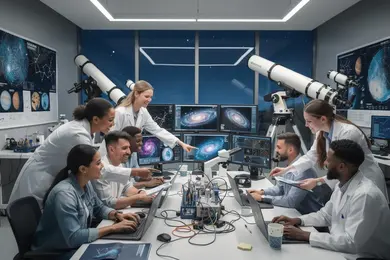
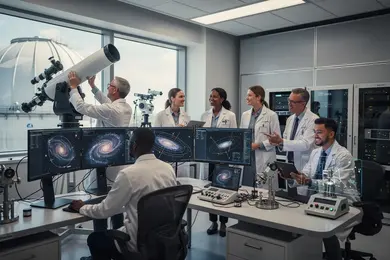
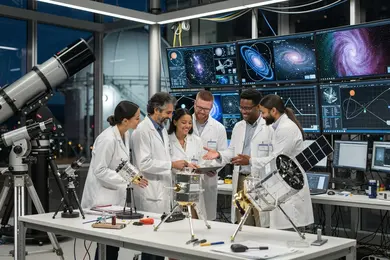
Hybrid programs are best understood as blended degrees. Students complete part of the program online, but they also attend scheduled campus sessions, labs, seminars, observation nights, or intensive residencies.
- Delivery format: Online lessons are paired with required face-to-face meetings.
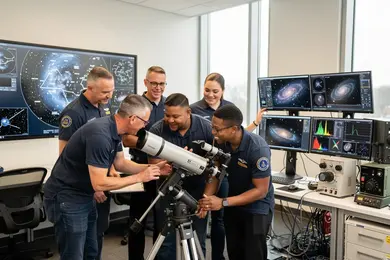
- Hands-on access: Students may use telescopes, observatories, lab equipment, or campus computing resources during required sessions.
- Schedule: The calendar is more structured because students must be available for in-person components.
- Interaction: Faculty and peer contact is often stronger because students meet in person as well as online.
- Best fit: This format works well for students who live within commuting distance and want some flexibility without giving up campus-based science experiences.
Fully Online Programs
Fully online programs remove the campus attendance requirement. Students complete lectures, discussions, projects, exams, and many lab-style activities remotely, often through simulations, remote data sets, and digital collaboration tools.
- Delivery format: Coursework is completed online through recorded lectures, readings, quizzes, discussion boards, and virtual labs.
- Schedule: Many courses are asynchronous, allowing students to study before work, after caregiving duties, or on weekends.
- Independence: Students need strong self-management because there are fewer built-in reminders from in-person classes.
- Access: The format is especially useful for students who cannot relocate or commute regularly.
- Related options: Students comparing flexible undergraduate paths may also review quick online degrees that pay well in adjacent or complementary fields.
The key difference is not academic seriousness. A well-designed program in either format can be rigorous. The real difference is how much structure, physical access, and direct interaction you want in exchange for flexibility.
How does a hybrid vs. a fully online astronomy & space studies bachelor's degree program work?
Both hybrid and fully online astronomy & space studies bachelor’s programs usually cover core scientific and technical topics such as astronomy, physics, mathematics, planetary science, space systems, research methods, and data interpretation. The difference is how students move through the curriculum and how much of the experience happens in person. According to the National Center for Education Statistics, enrollment in distance education courses has surged by more than 75% in the last decade, so students now have more delivery models to compare than in the past.
How Hybrid Programs Work
Hybrid programs divide learning between online study and required in-person participation. The online portion may include lectures, readings, quizzes, discussion boards, and written assignments. The campus portion may include labs, group projects, observation activities, faculty meetings, or exams.
- Course delivery: Students complete online modules and attend scheduled campus sessions for selected parts of the program.
- Lab and observation work: Hands-on activities may take place in physical labs, observatories, or designated field settings.
- Communication: Students use learning management systems and email, but they also benefit from face-to-face discussion.
- Group work: Collaboration can happen both in person and online, which may make team projects easier to organize.
- Attendance expectations: Missing an in-person session can be harder to make up, especially if it involves specialized equipment or a scheduled observation window.
How Fully Online Programs Work
Fully online programs organize the degree around remote access. Students log in to complete lessons, submit assignments, join discussions, and participate in virtual lab activities. Some courses may include live webinars, but many are designed for asynchronous participation.
- Course delivery: Students access recorded lectures, readings, assignments, quizzes, and exams through digital platforms.
- Labs: Programs may use simulations, public astronomical data sets, remote lab tools, or analysis-based projects.
- Communication: Most contact happens through email, discussion boards, messaging tools, virtual office hours, and video meetings.
- Assessment: Exams and major assignments may be completed through timed online tests, remote proctoring, research papers, projects, or presentations.
- Student responsibility: Learners must create their own weekly structure because fewer activities happen at fixed locations and times.
Students who are comparing online learning across fields may find it helpful to examine how flexible programs are structured in other disciplines, such as an online college business degree, before deciding how much independence they want in a science-focused program.
Are admission requirements different for hybrid and fully online astronomy & space studies bachelor's degrees?
Admission requirements are usually similar because both formats lead to the same level of degree. Applicants commonly need to meet the institution’s undergraduate admissions standards, provide academic records, and show readiness for college-level math and science. The differences tend to appear in location, technology expectations, orientation, and evidence that the student can succeed in the chosen format.
- Residency and location: Hybrid programs may be less practical for students who live far from campus because attendance is required for certain sessions. Fully online programs are often more accessible to out-of-area students, though applicants should still check state authorization and institutional policies.
- Technology readiness: Fully online students may need reliable internet, a capable computer, webcam access, and software that can support video, simulations, data tools, and remote testing. Hybrid students also need digital access, but they may be able to use campus resources for some technical requirements.
- Math and science preparation: Both formats may expect applicants to be ready for quantitative coursework. A weak background in algebra, trigonometry, calculus, physics, or general science can make the first year harder, regardless of format.
- Lab expectations: Hybrid programs may place more emphasis on attending physical labs or observation sessions. Fully online programs may ask students to confirm they can complete virtual labs, remote projects, or software-based assignments.
- Application materials: Some programs may use essays, interviews, or advising conversations to assess whether students understand the demands of online or blended learning.
- Orientation: Hybrid students may attend in-person orientation or lab safety briefings, while online students may complete virtual readiness modules before classes begin.
A student enrolled in a fully online astronomy & space studies bachelor’s degree described the admissions process as clear but demanding. “The biggest challenge was demonstrating my ability to manage self-directed learning since everything relies on motivation without in-person reminders,” she said.
She also had to prepare her home setup for interactive coursework. “The school made sure I understood expectations before classes started, which helped me feel confident about going fully online.” Her experience shows why applicants should not treat online admission as easier. The format may be more flexible, but programs still expect academic readiness, technical preparation, and consistent follow-through.
Is the learning experience better in hybrid vs online astronomy & space studies bachelor's degrees?
Neither format is automatically better. A hybrid program may provide a richer hands-on experience, while a fully online program may provide better access and schedule control. The stronger choice depends on how you learn, how close you are to campus, and whether your goals require direct experience with equipment, faculty, and peer teams.
Where Hybrid Learning Can Be Stronger
Hybrid astronomy & space studies programs often create a more guided learning environment. Students can ask questions in person, work beside classmates, and receive immediate feedback during labs or observation sessions. For difficult subjects such as physics, orbital mechanics, astronomical imaging, or data interpretation, that direct contact can reduce confusion and build confidence.
- Hands-on work: Students may gain direct practice with telescopes, lab tools, observation planning, and collaborative experiments.
- Faculty access: In-person meetings can make it easier to build mentoring relationships.
- Peer support: Scheduled campus time can help students form study groups and project teams.
- Structure: Required attendance can help students stay on pace.
The trade-off is convenience. Hybrid students must plan around commute time, campus dates, lab availability, and possible schedule conflicts with work or family responsibilities.
Where Fully Online Learning Can Be Stronger
Fully online programs are often better for students who need control over when and where they study. Recorded lectures can be paused and replayed, assignments can often be completed around work shifts, and students outside commuting range can still access degree programs.
- Flexibility: Students can build study time around employment, caregiving, military service, or location constraints.
- Repeatable content: Recorded lectures and digital materials can be reviewed multiple times.
- Remote tools: Simulations, data analysis projects, and virtual discussions can support meaningful learning when well designed.
- Access: Students who cannot relocate may still pursue astronomy & space studies coursework.
The challenge is isolation and self-direction. Fully online students must be proactive about asking questions, attending virtual office hours, joining discussion forums, and keeping a weekly schedule. If a program offers weak advising or limited lab substitutes, the online experience may feel less connected and less practical.
Which is more flexible: a hybrid or a fully online astronomy & space studies bachelor's degree?
A fully online astronomy & space studies bachelor’s degree is generally more flexible because it does not require regular campus attendance. Students can often complete lectures, readings, discussions, and assignments from any location with reliable internet. According to a 2022 survey by the Online Learning Consortium, 85% of remote learners value this flexible approach.
Hybrid programs still offer more flexibility than fully campus-based study, but the in-person requirements limit how freely students can plan their weeks. A hybrid student may complete most readings and assignments online yet still need to attend a lab, observation session, seminar, or weekend residency at a specific time.
When Hybrid Flexibility Is Enough
- You live close to campus and can commute without major disruption.
- Your work schedule is predictable enough to accommodate required sessions.
- You want some online convenience but value in-person labs and faculty contact.
- You learn better with fixed deadlines and face-to-face accountability.
When Fully Online Flexibility Matters More
- You work irregular shifts or have caregiving responsibilities.
- You live far from programs offering astronomy & space studies coursework.
- You cannot relocate or commute for labs and lectures.
- You prefer asynchronous study and can manage your own schedule.
The practical question is not simply, “Which format is flexible?” It is, “How much schedule control do I need to stay enrolled through graduation?” If a single required campus weekend could disrupt your job or family responsibilities, a fully online program may be safer. If you can manage occasional campus visits and want physical lab access, hybrid may offer a useful compromise.
Students comparing flexible graduate or technical fields can also review how online structure works in programs such as the best data science masters options online.
What is the workload for hybrid vs. fully online astronomy & space studies bachelor's degrees?
The workload is usually comparable in academic rigor, but the time pressure feels different. Hybrid students have fixed attendance blocks plus online assignments. Fully online students may have fewer scheduled meetings, but they must create their own structure. Research from the Online Learning Consortium indicates that about 40% of online learners spend more hours weekly on coursework than they initially expected, which is important for students who assume online study will be lighter.
Hybrid Workload
In a hybrid program, the calendar provides built-in structure. Students know when they must attend class, labs, observation sessions, or discussions. This can make planning easier, especially for learners who benefit from routine.
- Scheduled time: Campus sessions create fixed weekly or term-based commitments.
- Online assignments: Readings, videos, quizzes, papers, and projects are still completed outside class.
- Lab preparation: Students may need to review procedures before attending in-person labs to make limited equipment time productive.
- Travel time: Commuting, parking, and campus logistics add hours that do not appear in the course catalog.
- Group coordination: Team projects may be easier in person but still require planning outside scheduled meetings.
Fully Online Workload
In a fully online program, the academic work may be just as demanding, but the structure is less visible. Students must schedule time for lectures, problem sets, virtual labs, discussion posts, data projects, exams, and instructor communication.
- Self-paced does not mean deadline-free: Assignments still have due dates, and science courses often build week by week.
- Independent study load: Students may spend more time reading instructions, troubleshooting technology, and clarifying expectations.
- Virtual labs: Simulations and data analysis assignments can be time-intensive, especially for students new to the software.
- Communication time: Questions may require emails, discussion posts, or scheduled video meetings rather than quick after-class conversations.
- Risk of procrastination: Without scheduled class meetings, small delays can become major workload spikes.
A realistic plan is to block study time before the term starts. Students who wait to “fit school in” around other obligations often underestimate the reading, math practice, and project work required in a science-focused bachelor’s program.
How does tuition compare for hybrid vs online astronomy & space studies bachelor's degrees?
Tuition depends on the institution, credit requirements, residency rules, fees, transfer credits, and whether students study full time or part time. In general, fully online programs may have lower direct costs, while hybrid programs may carry additional campus-related expenses. A recent study highlighted that online undergraduate tuition in STEM fields, including astronomy & space studies, can be 10-15% less than hybrid programs.
- Per-credit tuition: Hybrid programs may charge more when in-person instruction, labs, facilities, and specialized resources are built into the cost.
- Technology fees: Fully online students may pay e-learning, platform, or digital support fees. These can reduce the apparent savings if students compare tuition only.
- Campus and facility fees: Hybrid students may pay for campus services, lab access, observatory use, student facilities, or other in-person resources.
- Residency rules: Hybrid tuition may vary more by in-state or out-of-state status. Some fully online programs use more uniform pricing, but students should verify the policy before applying.
- Travel and time costs: Hybrid students should budget for commuting, parking, meals, lodging for intensives, or time away from work.
- Equipment and software: Fully online students may need a stronger home computer setup, webcam, reliable broadband, or software access for simulations and data work.
- Financial aid: Students should confirm that the institution is properly accredited and that the program’s format is eligible for the aid they plan to use.
A graduate of a hybrid astronomy & space studies bachelor’s degree said the hardest part was budgeting for changing campus fees. “Sometimes I budgeted assuming one fee structure, only to find that lab access or observatory hours increased costs unexpectedly,” he said.
He valued the in-person instruction but had to plan carefully around tuition, fees, work hours, and commuting. His experience highlights an important point: the less expensive option is not always obvious from tuition alone. Students should compare total cost of attendance, not just the advertised per-credit rate.
Do employers prefer hybrid or fully online astronomy & space studies bachelor's degrees?
Employers generally care more about the institution, accreditation, skills, projects, research experience, internships, and technical competence than whether every course was completed online or partly in person. According to a survey by the National Association of Colleges and Employers, 82% of employers now regard online degrees as comparable in credibility to traditional programs, especially when accreditation and practical learning are assured.
That said, astronomy & space studies is a field where hands-on and analytical experience matters. A hybrid program may make it easier to show direct lab, observation, or equipment-based experience. A fully online student can still compete, but they should be intentional about building a portfolio of projects, data analysis work, research participation, internships, or technical certifications where relevant.
- Accreditation and school reputation: Employers are more likely to trust a degree from a recognized, properly accredited institution.
- Evidence of practical skill: Projects involving astronomical data, coding, imaging, research methods, or technical writing can help graduates demonstrate readiness.
- Hands-on experience: Hybrid programs may have an advantage when roles require familiarity with physical instruments, lab environments, or team-based technical work.
- Online credibility: Fully online programs are increasingly accepted when they have strong faculty, rigorous assessments, and meaningful lab or simulation components.
- Career target: Students aiming for technical support, science communication, education, aerospace-related roles, or graduate study should choose the format that best helps them build relevant evidence of ability.
The degree format should not be the only deciding factor. Before enrolling, ask each program how students complete labs, whether undergraduate research is available, what career services support online and hybrid learners, and how graduates present their skills to employers or graduate schools.
Students exploring how employers evaluate online and hybrid credentials in other fields may also find it useful to compare education-to-career pathways such as careers in forensic psychology.
Who should choose a hybrid vs. a fully online astronomy & space studies bachelor's degree?
The best format depends on your constraints and goals. Choose hybrid if you can attend campus and want more direct scientific practice. Choose fully online if flexibility, location independence, and schedule control are essential to completing the degree.
Choose a Hybrid Program If You:
- Learn best in person: You benefit from direct explanations, live discussion, and immediate feedback.
- Want hands-on access: You value telescope use, observatory sessions, labs, or campus-based research activities.
- Live near campus: Commuting is realistic and will not regularly interfere with work or family responsibilities.
- Need structure: Scheduled sessions help you stay accountable and avoid falling behind.
- Want stronger campus connection: You plan to use faculty office hours, study groups, advising, and student organizations.
Choose a Fully Online Program If You:
- Need maximum flexibility: Your work, caregiving, military, health, or location constraints make campus attendance difficult.
- Are self-motivated: You can keep a study calendar, meet deadlines, and ask for help without in-person reminders.
- Cannot relocate: You want access to astronomy & space studies coursework without moving near a campus.
- Prefer independent learning: You are comfortable with recorded lectures, online discussions, simulations, and remote projects.
- Have reliable technology: You can maintain the internet access and equipment needed for online science coursework.
Students who are not ready to commit to a four-year program may also consider online associate degree programs as a lower-commitment starting point before transferring into a bachelor’s pathway. The important step is to confirm how credits transfer and whether the early coursework supports future astronomy, physics, math, or space studies requirements.
How can I succeed in a hybrid vs. a fully online astronomy & space studies bachelor's degree program?
Success in either format requires more than interest in space. Astronomy & space studies coursework can be quantitative, technical, and project-based. Students need consistent study habits, comfort with digital tools, and a plan for getting help before problems become unmanageable.
Success Strategies for Hybrid Students
- Protect campus time: Treat in-person labs, observation sessions, and seminars as non-negotiable commitments.
- Prepare before labs: Read instructions, review formulas, and understand the objective before arriving so you can use limited hands-on time well.
- Use faculty access: Ask questions during class, visit office hours, and seek feedback on projects early.
- Plan for commuting: Build travel, parking, meals, and possible weather delays into your weekly schedule.
- Form study groups: Use in-person sessions to connect with classmates, then continue collaboration online between meetings.
Success Strategies for Fully Online Students
- Create a weekly school schedule: Block time for lectures, reading, math practice, discussion posts, labs, and review.
- Set up a reliable workspace: A quiet area, dependable internet, and appropriate hardware reduce avoidable stress.
- Ask for help quickly: Use virtual office hours, email, tutoring, and discussion boards before confusion compounds.
- Stay visible: Participate in forums and live sessions when available so instructors and peers know you are engaged.
- Back up your work: Save projects, data files, papers, and lab reports in more than one secure location.
Strategies That Help in Both Formats
- Strengthen math foundations: Review algebra, trigonometry, calculus, and physics concepts as needed.
- Learn the software early: Astronomy simulations, data tools, spreadsheets, and research databases can take time to master.
- Build a portfolio: Save strong projects, research posters, data analyses, technical reports, or presentations that show what you can do.
- Use advising: Confirm course sequencing, transfer credit, graduation requirements, and career or graduate school preparation.
- Monitor workload honestly: If you fall behind, adjust your study schedule or course load before the next term.
What Graduates Say About Hybrid vs Fully Online Astronomy & Space Studies Bachelor's Degree Programs
- : "Choosing a fully online astronomy & space studies bachelor's program allowed me to balance my job and family commitments without sacrificing my educational goals. The flexibility of the coursework helped me stay engaged, while virtual labs and simulations made the complex topics accessible and exciting. This degree opened doors for me in aerospace research, proving that online education can be just as rigorous and rewarding as traditional formats. — Dante"
- : "Enrolling in a hybrid astronomy & space studies program was a deliberate choice to gain practical, hands-on experience alongside theoretical knowledge. Navigating both in-person labs and online lectures challenged me to develop strong self-discipline and time management skills. Today, I credit this blend of learning environments for preparing me to collaborate effectively in professional space science teams worldwide. — Collin"
- : "Pursuing my bachelor's in astronomy & space studies fully online gave me access to top-tier faculty and research resources without relocating. Although it required adapting to a virtual classroom, the immersive forums and interactive coursework fostered meaningful connections with professors and peers. This degree has been instrumental in advancing my career as an astrophysicist, highlighting how remote learning can elevate professional opportunities. — Dylan"
Other Things You Should Know About Astronomy & Space Studies Degrees
In 2027, hybrid astronomy & space studies programs often offer in-person workshops and networking events, enhancing career services. Fully online programs typically rely on virtual career platforms and online mentoring sessions, providing flexible access but potentially less face-to-face interaction.
Students need a reliable internet connection, a modern computer with updated software, and access to video conferencing tools for both hybrid and fully online programs in 2027. Some courses may also require specific software for astronomical simulations or data analysis.
In 2027, hybrid astronomy and space studies programs may require in-person fieldwork, such as telescope observations or lab work, while fully online programs typically substitute virtual labs or simulations to meet fieldwork requirements. Confirm specific requirements with individual programs.
References
- BSc (Hons) in Physics with Astronomy & Space Science at the University College Dublin https://www.therightu.com/course/university-college-dublin-physics-with-astronomy-space-science-bsc-hons-dn200-mpg3
- This website is not available in your country https://www.space-careers.com/article/963/how-to-achieve-a-career-in-space-studies
- Tips for someone wanting to go into the field of astronomy. https://forum.nasaspaceflight.com/index.php
- Compare 4 Astrophysics education, training and courses – Springest https://www.springest.co.uk/sciences/astrophysics
- UniScout https://www.uniscout.app/course/physics-and-astrophysics-international-study
- VU Bendro prisijungimo sistema https://2023.emokymai.vu.lt/course/view.php
- Hybrid class vs. online: Choosing the best for your student https://www.asuprepdigital.org/blog/hybrid-class-vs-online/
- 2025 Astronomy Tuition - Online https://www.collegetuitioncompare.com/majors/40.0201/astronomy/