2027 Online Astronomy & Space Studies Bachelor's Degree Programs With No Application Fee

Co-Founder and Chief Data Scientist
Many professionals with backgrounds unrelated to astronomy face high barriers when seeking to enter the space industry, often deterred by costly application fees and complex admission processes for online astronomy & space studies bachelor's programs. These hurdles can discourage career changers despite a growing demand in the space sector. According to recent data, 35% of students entering online astronomy & space studies programs are career switchers, highlighting a significant trend toward flexible, accessible education options. This article explores accredited bachelor's degree programs that waive application fees, providing clear guidance for those aiming to transition smoothly into astronomy & space studies careers.
Key Benefits of Online Astronomy & Space Studies Bachelor's Degree Programs With No Application Fee
- Compare online astronomy & space studies programs by verifying accreditation, curriculum depth, and transfer credit policies to ensure alignment with your academic goals and avoid hidden costs beyond the waived application fee.
- Analyze tuition rates and available financial aid options carefully, as programs with no application fee may have varying expenses impacting your total degree cost and budget planning.
- Evaluate career outcomes and state-specific program offerings to confirm the degree supports your long-term aspirations, considering industry trends where astronomy jobs are expected to grow 8% through 2032.
What Does 'No Application Fee' Really Mean for an Online Astronomy & Space Studies Bachelor's Program?
Programs advertising no application fee for online astronomy & space studies bachelor's degrees may offer either permanent waivers or temporary fee waivers linked to specific enrollment periods or promotional codes. Data from the National Center for Education Statistics (NCES) reveals that approximately 40% of accredited institutions offering these degrees charge no application fee or provide recurring waivers, while the rest impose fees ranging from $25 to $75. Offerings vary widely across schools, so cost-conscious adult learners and first-generation students should verify the fee structure before applying.
- Western State University: Online applicants pay no application fee year-round, enhancing accessibility for students balancing work and family.
- Midwest Virtual College: Maintains a permanent no-application-fee policy specifically for space studies applicants, lowering financial barriers.
- New Horizons Online: Provides fee waivers only during designated enrollment windows, emphasizing the importance of timing your application.
The benefit of zero application fee in astronomy & space studies online degrees can improve accessibility, but applicants should also explore tuition, financial aid, and transfer credit policies. For those seeking efficient career pathways, considering affordable options alongside reputable programs is essential; resources like online certification courses may complement degree plans for maximizing employment opportunities.
Which Nationally and Regionally Accredited Schools Offer Online Astronomy & Space Studies Bachelor's Degrees With No Application Fee?
Prospective students seeking an online astronomy & space studies bachelor's degree program with no application fee have several options among nationally and regionally accredited institutions. Accreditation is key for ensuring program quality, ease of credit transfer, and employer recognition. Regionally accredited schools-recognized by one of the seven regional accrediting bodies in the U.S.-are generally preferred for smoother credit transfers and higher acceptance by employers and graduate programs. National accreditation, typically granted to career-focused institutions through agencies like the Distance Education Accrediting Commission (DEAC), may offer flexibility but can present challenges in transferring credits to regionally accredited schools and may be viewed differently by employers.
Students exploring regionally accredited online astronomy & space studies bachelor's degrees without application charges should verify current policies directly with the schools, as fees can change between admissions cycles. Below is a representative sample of online programs with no application fees and estimated total tuition:
- Southern New Hampshire University: Regionally accredited by the New England Commission of Higher Education (NECHE). Offers an online Bachelor of Science in Astronomy & Space Studies with estimated total tuition of about $36,000.
- Granite State College: Also NECHE-accredited. Provides a bachelor's degree in a STEM-related field that includes astronomy coursework, with tuition near $30,000.
- American Public University System: Nationally accredited by DEAC. Features online space studies programs with total tuition around $25,000.
- Liberty University: Regionally accredited by the Southern Association of Colleges and Schools Commission on Colleges (SACSCOC). Delivers an online Bachelor of Science in Astronomy & Space Studies with tuition approximately $40,000.
When budgeting for a degree, consider that application fee waivers are one piece of managing costs, but verifying tuition, financial aid options, and transfer credit policies is critical. Adult learners and career changers may also find it helpful to explore strategies for affordable degree completion, including evaluating support for transfer credits and career outcomes. For those interested in related fields, exploring the cheapest online master's degree in psychology could provide complementary career pathways and further educational opportunities.
2026 Update: Matching Course Focus to Space Career Goals
For 2026, this guide adds a closer look at how students can compare no-application-fee online astronomy and space studies bachelor’s programs based on curriculum fit, not just cost or access.
- Check whether the program emphasizes astronomy, space science, space operations, or interdisciplinary space studies.
- Review how much math, physics, and data analysis is required before enrolling.
- Look for courses using real observational data, simulation tools, or remote astronomy resources.
- Compare electives in areas such as planetary science, astrobiology, space policy, or aerospace fundamentals.
- Ask whether the degree includes a capstone, research project, or portfolio-building assignment.
- Confirm that academic advising can help connect course choices to career or graduate school goals.
This helps students choose a no-fee program that is not only easier to apply to, but also better aligned with the kind of space-related path they want to pursue.
How Much Money Can Students Save by Choosing an Online Astronomy & Space Studies Bachelor's Program With No Application Fee?
Applying to multiple online astronomy & space studies bachelor's programs without an application fee can lead to substantial savings. Based on College Board data, application fees typically range between $25 and $75 per school. When a student submits applications to eight or ten programs, these fees add up quickly, potentially costing $200 to $750 upfront. Considering that the overall cost of a bachelor's degree generally falls between $40,000 and $50,000 according to the Georgetown Center on Education and the Workforce, waiving application fees represents an important, though often overlooked, financial relief.
The elimination of these fees is particularly impactful for low-income students and first-generation college applicants. For these groups, the initial expense of applying can serve as a significant barrier, discouraging them from casting a wider net when researching programs. No-application-fee options provide an opportunity to apply to a broader range of schools, which can improve chances of matching with a program that fits their academic and financial needs.
Still, application fees are just one element of affordability. Prospective students should also evaluate per-credit tuition costs, financial aid packages, transfer credit policies, and overall program duration. Taking a holistic view ensures a more accurate understanding of the true cost of earning an online astronomy & space studies degree.
- Upfront Savings: Students can avoid spending $200 to $750 on multiple application fees, reducing initial financial stress.
- Improved Access: Removing fees helps low-income and first-generation students explore more options without hesitation.
- Part of a Bigger Picture: Tuition rates, aid availability, and total costs must also be factored to assess affordability accurately.
- Encourages Broader Search: Cost-free applications make it easier to consider more selective or varied programs for better fit.
A professional who recently pursued an online astronomy & space studies bachelor's degree with no application fee shared that the waived costs made him more confident in applying broadly despite juggling work and family responsibilities. He mentioned feeling less anxious about upfront costs, which allowed him to focus on comparing program curriculums and financial aid options rather than narrowing choices due to expense. This approach ultimately gave him greater peace of mind throughout the application process and helped him identify a school that suited both his career goals and budget.
Are Online Astronomy & Space Studies Bachelor's Programs That Charge No Application Fee Accredited and Legitimate?
Many reputable institutions offering accredited online astronomy and space studies bachelor's programs with no application fee do so to increase accessibility, not because of lower quality. Accreditation from recognized bodies remains the best indicator of legitimacy. Regional accreditors acknowledged by the Council for Higher Education Accreditation (CHEA) and the U.S. Department of Education ensure that academic standards and faculty credentials meet rigorous requirements. Specialized accreditations, such as ABET for engineering-related aspects or CAEP for education tracks, further validate program quality.
To confirm legitimacy, prospective students should follow this checklist:
- Search CHEA Database: Use CHEA's directory to verify if the institution and program hold recognized accreditation.
- Use Department of Education Lookup: Enter the school's name in the U.S. Department of Education's online tool to confirm current accreditation status.
- Identify Relevant Accreditors: Look for respected regional bodies like Middle States or WASC, along with any applicable program-specific accreditations.
- Avoid Degree Mills: Be cautious of no-fee applications from institutions lacking credible accreditation, which may use waived fees as a marketing tactic rather than reflecting true quality.
Choosing legitimate and affordable programs is possible; students seeking legitimate astronomy and space studies bachelor's degrees online without application charges should prioritize accreditation checks while exploring financial aid options. For additional guidance on cost-effective degree paths, exploring an online LMFT program can offer insights into streamlined educational routes.
What Are the Admission Requirements for Online Astronomy & Space Studies Bachelor's Programs That Waive the Application Fee?
Most online astronomy & space studies bachelor's programs requiring no application fee still maintain standard admission criteria. A high school diploma or GED equivalent is almost always necessary, ensuring applicants meet foundational academic thresholds. GPA minimums typically range from 2.5 to 3.0 on a 4.0 scale, though some institutions allow conditional acceptance below this range with additional support.
Submission of SAT or ACT scores has become less common as many programs adopt test-optional policies. Yet, more competitive online astronomy & space studies degrees might still request these scores to assess applicants' analytical and quantitative skills. Applicants should review each program's specifics, as requirements vary.
- GPA Minimums: Most programs expect a GPA between 2.5 and 3.0, reflecting adequate academic preparation.
- High School Diploma/GED: Mandatory proof of secondary education completion for eligibility.
- SAT/ACT Policies: Increasingly optional but occasionally required by selective programs.
- Discipline Prerequisites: Basic coursework in mathematics and science, especially algebra and physics, is commonly recommended or required.
- Admissions Selectivity: Waived application fees appear in both open admission and selective programs; fee waivers do not indicate lowered standards.
- Acceptance Rates: Vary significantly, with some no-fee programs admitting over 70% of applicants while others remain highly competitive below 30%.
- Rolling Admissions & Start Dates: Flexible enrollment and multiple annual start points help applicants manage their timing alongside fee waivers.
A professional who completed an online astronomy & space studies bachelor's program without paying an application fee shared that navigating admissions felt straightforward but thorough. "The process was clear, and I never felt the lack of an application fee reflected lower expectations," she noted. Overcoming the challenge of proving readiness with my GPA and prerequisite courses was crucial, yet the flexibility of multiple start dates allowed me to align my studies with personal commitments. This balance helped me focus on advancing my career confidently after graduation."
How Does Per-Credit-Hour Tuition at Online Astronomy & Space Studies Bachelor's Programs Compare When the Application Fee Is Already Waived?
Online astronomy & space studies bachelor's programs that waive application fees charge per-credit tuition rates ranging roughly from $180 to $530, depending on factors like public versus private status and residency rules. National data from IPEDS and College Scorecard reveal the average per-credit tuition for all online bachelor's degrees is about $300, placing many astronomy & space studies programs either below or above this national benchmark.
- University of Florida: $212 per credit, 120 credits, totaling about $25,440, with no application fee.
- Arizona State University: $530 per credit, 120 credits, $63,600 total, with waived application fees for select applicants.
- California State University-Chico: Flat rate of $250 per credit, 120 credits, $30,000 total, no application fee charged.
- University of Central Florida: $226 per credit, 120 credits, $27,120 total, no application fee.
- University of Massachusetts-Lowell: $370 per credit, 120 credits, $44,400 total, application fee waived for online students.
Some institutions, like California State University-Chico, offer flat-rate tuition policies for online learners, charging a fixed per-credit fee regardless of residency. This approach simplifies budgeting and can be more affordable for out-of-state students in astronomy & space studies. However, waiving application fees does not guarantee lower overall tuition, since schools with no fees may still have higher per-credit costs.
Key Points:
- Tuition Range: The cost per credit hour varies markedly, influenced by university type and residency, generally falling between $180 and $530 for astronomy & space studies programs with no application fee.
- Flat-Rate Tuition: Flat-rate policies help online students manage expenses better by applying a consistent per-credit cost irrespective of state residency.
- Application Fee Impact: Eliminating application fees reduces upfront costs but should not be mistaken for overall affordability, as tuition rates may remain high.
- National Average Comparison: The $300 average per credit across all online bachelor's degrees serves as a useful benchmark for evaluating astronomy & space studies programs.
- Tuition Transparency: Disclosing detailed per-credit rates and total tuition estimates equips prospective students to budget wisely.
As of 2023, about 35% of online degree programs have removed application fees, yet this practice has not consistently lowered total tuition expenses, highlighting the importance of a full financial evaluation.
What Financial Aid and Scholarships Are Available for Online Astronomy & Space Studies Bachelor's Students at No-Fee Programs?
FAFSA eligibility and access to key federal financial resources are available to students enrolled in any accredited online astronomy & space studies bachelor's degree program, regardless of application fee policies. According to Federal Student Aid resources, this includes Pell Grants and subsidized or unsubsidized federal student loans, which form the backbone of financial support for many students.
- Federal Aid Eligibility: Accreditation ensures qualification for federal grants and loans through FAFSA, independent of whether programs charge application fees. These aid sources are essential for students financing their astronomy & space studies degree online.
- Discipline-Specific Scholarships: Various scholarships target astronomy & space studies majors, including awards from entities like the Astronomical Society of the Pacific and institution-specific funds. Utilizing STEM-focused scholarship databases helps uncover additional opportunities tailored to this field.
- Institutional Grants: Many no-application-fee programs offer internal scholarships and grants. Prospective students should proactively contact financial aid offices to identify these awards, which can significantly reduce tuition costs when combined with federal aid.
- Employer Tuition Assistance: Working adults can leverage employer tuition reimbursement programs. When layered with institutional grants, these benefits reduce out-of-pocket expenses effectively for online astronomy & space studies students.
- Early FAFSA Submission: Timely FAFSA completion is critical, as funds are often disbursed on a first-come, first-served basis. Early submission improves chances of securing the maximum available aid.
Recent data from the National Center for Education Statistics indicates about 70% of undergraduates receive some financial aid, underlining its importance for accessibility in higher education, including online astronomy & space studies programs.
How Long Does It Take to Complete an Online Astronomy & Space Studies Bachelor's Degree at a No-Application-Fee School?
Students aiming to complete an online astronomy & space studies bachelor's degree at no-application-fee schools generally plan for about 120 credit hours. Most full-time learners finish within four years, aligning with traditional on-campus pacing. However, the average time to finish an astronomy & space studies bachelor's degree online with no application fee can vary due to flexible program designs and personal commitments.
- Standard Pace: A typical full course load of 15 credits per semester over two semesters per year usually results in four years to completion. This schedule balances coursework with other responsibilities but requires continuous enrollment without significant breaks.
- Accelerated Options: Some programs provide year-round enrollment with trimesters or eight-week modules alongside asynchronous delivery, enabling motivated students to reduce their time to graduation. Competency-based education models also allow learners to progress by demonstrating mastery rather than time spent in class.
- Part-Time Study: Balancing work or family demands often necessitates a reduced credit load each term, extending degree completion to five or more years. This approach offers flexibility but demands careful planning to sustain steady progress.
- Credit Transfer & Prior Learning: Transferring credits from previous college, military training, or passing exams such as CLEP can lower total credit requirements and shorten completion time.
- Personal Timeline Factors: Assessing available study hours, work schedules, and term lengths is crucial to building a realistic timeframe and avoiding burnout.
Prospective students should also research accreditation and financial aid options within astronomy & space studies programs. For career insights related to the field, one may consider exploring how much do forensic psychologists make as an example of related professional outcomes.
Can Transfer Students Apply for Online Astronomy & Space Studies Bachelor's Degrees With No Application Fee?
Yes, most online Astronomy & Space Studies bachelor's degree programs that waive the application fee also accept transfer students. According to data from NCES and NC-SARA, the majority of these institutions actively evaluate prior academic credits to facilitate degree completion and affordability for transfer applicants. This aligns with transfer policies for online astronomy & space studies bachelor's degrees designed to reduce barriers and upfront costs for students.
- Transfer Credit Evaluation: Institutions rigorously assess transcripts from previous schools, reviewing course descriptions, syllabi, and accreditation to determine credit applicability within astronomy & space studies curricula. This ensures that relevant coursework counts toward the degree.
- Accepted Credit Types: Community college courses, especially general education and foundational sciences, typically transfer well. Credits from prior bachelor's degrees and military training are also commonly accepted, subject to their relevance and the institution's discretion.
- Non-Transferrable Credits: Specialized or outdated courses that do not meet current astronomy program requirements or fall outside the scientific scope often cannot be transferred, limiting their use in degree progression.
- Articulation Agreements: Some online astronomy & space studies programs maintain formal partnerships with community colleges. These agreements guarantee acceptance of specified courses, streamlining the transfer process and enhancing credit reliability.
- Early Evaluation Recommended: Prospective transfer students should request a transfer credit evaluation early in the application phase. This clarifies the amount of remaining coursework and helps estimate total costs, supporting effective planning.
For students considering career paths after earning a degree in this field, exploring options such as environmental science can be valuable. More information on what can you do with an environmental studies degree helps connect academic choices with employment outlooks and further educational opportunities.
Are Online Astronomy & Space Studies Bachelor's Degrees With No Application Fee Recognized by Employers?
Employers increasingly value online astronomy & space studies bachelor's degrees from regionally accredited institutions as equally credible to traditional on-campus degrees. Recent SHRM data underscores that the delivery mode-online versus face-to-face-is becoming less relevant when the school maintains a strong academic reputation. However, degrees from unaccredited or lesser-known schools often raise doubts, regardless of any free application perks.
In this field, specialized accreditation or ties to major professional groups such as the American Astronomical Society (AAS) hold particular significance. These affiliations signal that the curriculum aligns with industry standards, which is more important than where or how the degree was obtained. For applicants, emphasizing accreditation status and relevant skills on resumes and during interviews can boost credibility and employment prospects.
- Accreditation Importance: Regional accreditation confirms rigorous academic quality, assuring employers of the degree's legitimacy and the graduate's preparedness.
- Online Credibility: Accredited online astronomy & space studies programs are gaining parity with on-campus options, especially when led by qualified faculty.
- Industry Connections: Membership or endorsement from professional bodies like the AAS enhances job market competitiveness by demonstrating curriculum relevance.
- Resume Strategy: Clearly stating accreditation and focusing on applicable skills helps candidates present their online degree confidently during job applications.
What Technology Requirements and Online Learning Tools Are Used in No-Fee Online Astronomy & Space Studies Bachelor's Programs?
Reliable broadband internet is crucial to smoothly stream lectures and join live discussions in an online astronomy & space studies bachelor's program. Students need a modern laptop or desktop computer with enough processing power to run web browsers and specialized applications effectively. A webcam and microphone are necessary for participating in real-time sessions and virtual office hours.
- Learning Management Systems: Platforms like Canvas, Blackboard, and D2L offer intuitive interfaces that allow easy access to course materials, assignment submissions, and communication with instructors. Features typically include discussion boards, grade tracking, and course calendars to keep students organized throughout their studies.
- Specialized Software: Many astronomy & space studies programs require software for telescope simulations, data analysis, or planetarium visualization. Some institutions provide cloud-based licenses included in tuition, although students should be prepared for potential additional fees if specific tools require separate purchases or subscriptions.
- Hardware Needs: Aside from a capable computer, external storage options such as USB drives or cloud backup services are recommended to manage large datasets and project files common in astronomy coursework.
- Technical Support: Programs often offer dedicated tech support to assist with software installation and troubleshooting, as well as resources to accommodate diverse learning needs and ensure smooth navigation of learning platforms.
What Graduates Say About Their Online Astronomy & Space Studies Bachelor's Degree Programs With No Application Fee
- Dante: "I chose the online astronomy & space studies bachelor's degree program with no application fee because it removed the financial barrier right at the start. The affordable tuition made it feasible for me to pursue a career change without accumulating heavy debt. Since completing the program, I've landed a position in aerospace research, and the flexibility of the online format allowed me to balance work and study effectively."
- Collin: "Reflecting on my decision to enroll in the online astronomy & space studies bachelor's degree program, the no application fee was a significant factor-it motivated me to explore a field I had long been passionate about without upfront costs. The program's cost-effectiveness made advanced education accessible, helping me transition smoothly from a non-technical background to a career in data analysis within space sciences. I appreciate how this degree opened new professional doors while fitting my busy lifestyle."
- Dylan: "From a professional standpoint, pursuing an online astronomy & space studies bachelor's degree with no application fee was a smart move that minimized my initial investment risk. The program's reasonable cost allowed me to reinvest in additional certifications later on, elevating my expertise. Since graduating, I've experienced notable growth in my career, moving from education into a specialized role in space mission planning."
Other Things You Should Know About Astronomy & Space Studies Degrees
Yes, many programs in 2027 accept transfer credits, usually requiring official transcripts for evaluation. Policies vary by institution, often with a cap on the number of transferable credits. It’s crucial to check each program’s specific requirements and transfer agreements.
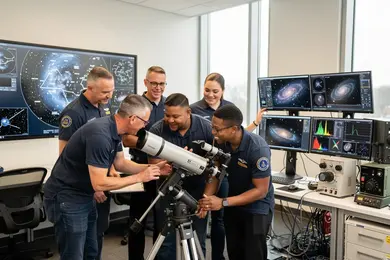
Most online astronomy and space studies bachelor’s programs do not require students to own a telescope or visit an observatory. Required labs are usually completed through simulations, virtual software, or remote data analysis. Some courses may ask for a webcam, stable internet, and a modern laptop.
References
- BSc (Hons) in Physics with Astronomy and Space Science University College Dublin https://www.hotcoursesabroad.com/india/course/ireland/bsc-hons-physics-astronomy-and-space-science/52601482/program.html
- World's Largest platform as University Common Application https://www.planstudyabroad.uniagents.com/course-details.php
- BSc (Hons) in Physics with Astronomy & Space Science at the University College Dublin https://www.therightu.com/course/university-college-dublin-physics-with-astronomy-space-science-bsc-hons-dn200-mpg3
- Physics and Astronomy | Fastweb https://scholarshipsfordreamers.org/scholarships-for-physics-and-astronomy-majors.html
- Courses – Starmaster Space Education https://www.starmaster.edu.au/courses/
- Cost of Online Education vs. Traditional Education [2025]: Comparison https://educationdata.org/cost-of-online-education-vs-traditional-education