2027 CPA Average Salaries & Wages by State: Career Paths

Co-Founder and Chief Data Scientist
CPA salary questions are rarely answered by one national average. Pay changes by state, industry, firm size, credentials, years of experience, and whether the role is in public accounting, corporate finance, government, consulting, tax, audit, or advisory. That is why comparing CPA average salary by state is useful, but it is only one part of deciding whether the CPA path is worth the time, exam preparation, and licensing requirements.
The decision matters more now because the profession is facing a talent gap. A staggering 72% of the Association of International Certified Professional Accountants (AICPA) members became eligible for retirement in 2024, while the CPA pipeline is at its lowest point in more than 11 years. At the same time, industry observers note that many accounting graduates are no longer convinced the CPA credential is worth the workload and exam commitment.
This guide explains what CPAs earn, why salaries vary, which states and industries pay more, how experience affects compensation, and which credentials can increase career mobility. It also discusses the state of the profession, alternative education routes, advanced degrees, salary negotiation, and the trends changing CPA work.
Quick Answer: What Is a Typical CPA Salary?
CPA pay depends heavily on role, market, and employer. Accountants and auditors in the United States have an average wage of about $77,250 annually, and CPAs often earn more than non-CPAs because the license signals advanced accounting knowledge, exam completion, and eligibility for higher-responsibility roles. Recent salary surveys conducted in 2024 indicate that CPAs can earn roughly 12% to 18% more on average than non-CPAs.
Entry-level and early-career salaries can vary widely. Large accounting firms may offer entry-level salaries as high as $72,000 for billing coordinator roles and $92,000 for staff accountant roles. More experienced CPAs, especially those in audit management, tax leadership, corporate finance, valuation, forensic accounting, or advisory services, can move into six-figure compensation ranges.
CPA Salary and Career Guide: Table of Contents
- CPA salary overview
- Best places and industries for CPA jobs
- CPA career outlook
- Common misconceptions about CPA careers Career outlook details
- Accelerated accounting programs and CPA preparation
- Specialized certifications for CPAs
- Advanced degrees and CPA career growth
- Professional networking for CPA advancement Advanced degree considerations
- Alternative education pathways into accounting
- Affordable online accounting associate degree options
- Additional accounting certifications
- Tax law expertise for CPAs
- Affordable advanced degrees for CPA progression
- Future trends in the CPA profession
- CPA salary negotiation strategies Future trends Affordable advanced degrees Alternative pathways Advanced degrees Accelerated programs Additional CPA planning topics
How Much Does a CPA Make?
Becoming a CPA can lead to stronger compensation than many entry-level accounting paths, but salary estimates should be read in context. The CPA average wage, commonly grouped with accountants and auditors, is around $77,250 annually in the United States. That figure is close to the average forensic accounting salary of $71,00 according to Payscale, and it is generally higher than the earnings associated with those who become a bookkeeper.
The most important point: there is no single CPA salary that applies to every professional. A newly licensed CPA in a smaller local firm may earn far less than a tax manager in a large metropolitan market or an advisory specialist at a major firm. Salary is shaped by geography, firm size, credentials, experience, specialization, and industry.
Experience is one of the clearest salary drivers. Entry-level senior tax accountants can expect to earn an average of $72,500 per year, while professionals with five to 10 years of experience can earn an average of $88,000 to $115,000 per year.
Industry also matters. CPAs in finance and insurance tend to report the highest annual salaries at $91,470 as of 2024. Those in accounting, tax preparation, bookkeeping, and payroll services earn $85,600 on average.
Location can make a large difference. According to the Bureau of Labor Statistics (BLS), the highest-paying states for CPAs in the U.S. are the District of Columbia, New York, New Jersey, Virginia, and California, with average salaries ranging from $89,000 to $105,000 per year.
Employer size is another major factor. Deloitte, Ernst & Young (EY), PricewaterhouseCoopers (PwC), and Klynveld Peat Marwick Goerdeler (KPMG) are widely known for competitive compensation. Based on 2024 Glassdoor data, average annual pay at these big four accounting firms is approximately $94,367, or $45.36 per hour.
CPA Pay by Education Level
In the United States, CPA licensure generally requires at least a bachelor’s degree in accounting or a closely related field, along with passing the CPA exam and satisfying state-specific rules. Some employers prefer candidates who also hold a graduate degree in accounting, business administration, finance, or another related area.
Academic preparation can influence both eligibility and salary progression. If you are still comparing academic options, it helps to understand what a major is and how a focused accounting, finance, or business major may support CPA exam preparation. In general, the closer your coursework aligns with accounting and financial reporting, the easier it may be to meet employer expectations and licensing prerequisites.
According to the BLS, the median annual wage for accountants and auditors, including CPAs, with a bachelor’s degree was $89,760 as of May 2024. CPAs with a master’s degree in accounting or a related field, such as financial analysts, can expect higher salaries at $97,540 annually. CPAs with a Ph.D. in accounting or a related field may pursue higher-level roles in academia, research, or consulting. PayScale data places the average salary for a CPA with a Ph.D. at around $112,000 per year.
CPA Salary by Years of Experience
Experience usually affects compensation because more senior CPAs can manage client relationships, supervise staff, interpret complex rules, lead audits, advise executives, and take responsibility for higher-risk decisions. According to BLS data, CPAs with 0-2 years of experience earn around $60,000 to $70,000 annually. Mid-level CPAs with three to five years of experience earn an average annual salary of $75,000 to $90,000. CPAs with more than six years of experience earn around $90,000 to $120,000 or more, depending on location, industry, and specialization.
| Role | 0-2 years of experience | 3-5 years of experience | 6+ years of experience |
| Accountant | $61,902 | $70,156 | $77,378 |
| Tax Accountant | $60,870 | $66,029 | $82,279 |
| Senior Tax Accountant | $69,124 | $85,526 | $111,523 |
| Audit Manager | $94,916 | $107,185 | $133,425 |
| Accounts Receivable Manager | $82,536 | $103,170 | $128,963 |
CPA Salary by State
State-level salary comparisons are useful, but they should not be interpreted as guaranteed earnings. A high average wage may reflect a stronger local economy, concentration of corporate headquarters, financial services activity, public accounting demand, or a higher cost of living.
According to BLS data, the five highest-paying states for CPAs in the U.S. are the District of Columbia, New York, New Jersey, Virginia, and California.
- Demand for accounting services: Large business markets create more need for audit, tax, compliance, advisory, and corporate accounting work.
- Cost of living: Higher salaries in major markets often reflect higher housing, transportation, tax, and general living expenses.
- Industry concentration: Finance, entertainment, technology, healthcare, real estate, and government contracting can increase demand for specialized accounting talent.
- Competition for experienced professionals: Firms in talent-constrained markets may pay more to recruit and retain accountants. Accountants remain part of hiring plans for many companies across industries.
Some high-paying states may also have demanding CPA licensing rules, additional education expectations, or competitive employer standards. Before choosing a location based on salary alone, compare pay against licensing requirements, cost of living, commute time, and long-term career opportunities.
| State | Annual mean wage | Total employment |
| District of Columbia | $103,930 | 10,660 |
| New York | $98,650 | 112,030 |
| New Jersey | $91,960 | 39,820 |
| Virginia | $85,720 | 42,200 |
| California | $83,910 | 148,500 |
Does Firm Size Affect CPA Pay?
Firm size can influence salary, benefits, training, promotion timelines, workload, and client exposure. Larger accounting firms often have broader service lines, formal career ladders, national or global clients, and more structured compensation bands. Smaller firms may pay less in some markets, but they can offer earlier client contact, flexible work arrangements, and broader responsibility.
According to an AICPA survey, CPAs working in firms with one to 10 employees had an average salary of $73,700 per year. Those in firms with 11-50 employees averaged $88,400 per year, while CPAs in firms with more than 200 employees averaged $110,700 annually.
For job seekers, the practical question is not simply “Which firm pays the most?” It is “Which firm offers the best combination of salary, workload, training, promotion potential, benefits, flexibility, and specialization?”
| Career stage | Average salary | Top 25 CPA firms | Top 300 CPA firms |
| Entry-level graduate | $57,500 | $65,000 - $72,000 | $57,500 - $62,500 |
| First-year associate | $65,000 | $70,000 - $80,000 | $65,000 - $75,000 |
| Senior | $82,500 | $85,000 - $100,000 | $80,000 - $90,000 |
| Supervisor | $105,000 | $100,000 - $115,000 | $95,000 - $105,000 |
| Manager | $130,000 | $125,000 - $145,000 | $115,000 - $130,000 |
| Senior manager | $175,000 | $150,000 - $180,000 | $145,000 - $165,000 |
| Managing director/principal | $185,000 | $175,000 - $230,000 | $160,000 - $190,000 |
Where Should CPAs Work for Strong Career Opportunities?
The best place to work as a CPA depends on whether you want public accounting, corporate finance, government work, tax specialization, audit leadership, consulting, forensic accounting, or entrepreneurship. A high-paying market may not be the best choice if the cost of living is high or if your preferred specialty is stronger elsewhere.
Best Metropolitan Areas for CPA Employment
Based on BLS data, leading metropolitan areas for CPAs include New York City, Chicago, Los Angeles, Washington D.C., and Dallas. These markets have large employer bases, public accounting firms, corporate headquarters, government agencies, financial institutions, and specialized industries that require accounting expertise.
New York City has a major concentration of financial institutions, multinational companies, law firms, and large accounting employers, including the “Big Four” firms Deloitte, PwC, Ernst & Young, and KPMG. Chicago’s economy includes large corporations, mid-sized companies, and smaller businesses that need audit, tax, and advisory support. Los Angeles provides opportunities tied to entertainment, technology, real estate, and corporate accounting.
Washington, D.C. has a distinctive market because of federal agencies, contractors, consulting firms, nonprofits, and policy-related organizations. Dallas offers a broad business environment with corporate, public accounting, and regional firm opportunities.
| Metropolitan area | Total employment | Annual mean wage |
| New York-Newark-Jersey City, NY-NJ-PA | 120,490 | $102,090 |
| Los Angeles-Long Beach-Anaheim, CA | 60,610 | $81,310 |
| Chicago-Naperville-Elgin, IL-IN-WI | 43,820 | $79,370 |
| Washington-Arlington-Alexandria, DC-VA-MD-WV | 41,370 | $95,570 |
| Dallas-Fort Worth-Arlington, TX | 40,620 | $82,480 |
Best Industries for CPAs
According to the BLS, 1.45 million accountants and auditors were employed in the U.S. as of May 2024. The largest share works in accounting, tax preparation, bookkeeping, and payroll services, which includes public accounting firms. The federal government also employs many accounting professionals, with 71,230 accountants and auditors working for the government as of May 2024. State agencies, local governments, and nonprofit organizations also employ CPAs.
The industries below show how employment volume and pay can differ. Some industries employ many accountants but may not have the highest average pay. Others employ fewer professionals but offer specialized compensation opportunities.
| Industry | Employment total | Annual mean wage |
| Accounting, Tax Preparation, Bookkeeping, and Payroll Services | 326,810 | $83,460 |
| Management of Companies and Enterprises | 98,100 | $80,620 |
| Oil and Gas Extraction | 8,400 | $88,050 |
| Other Investment Pools and Funds | 520 | $83,070 |
| Insurance and Employee Benefit Funds | 270 | $81,480 |
What Is the Career Outlook for CPAs?
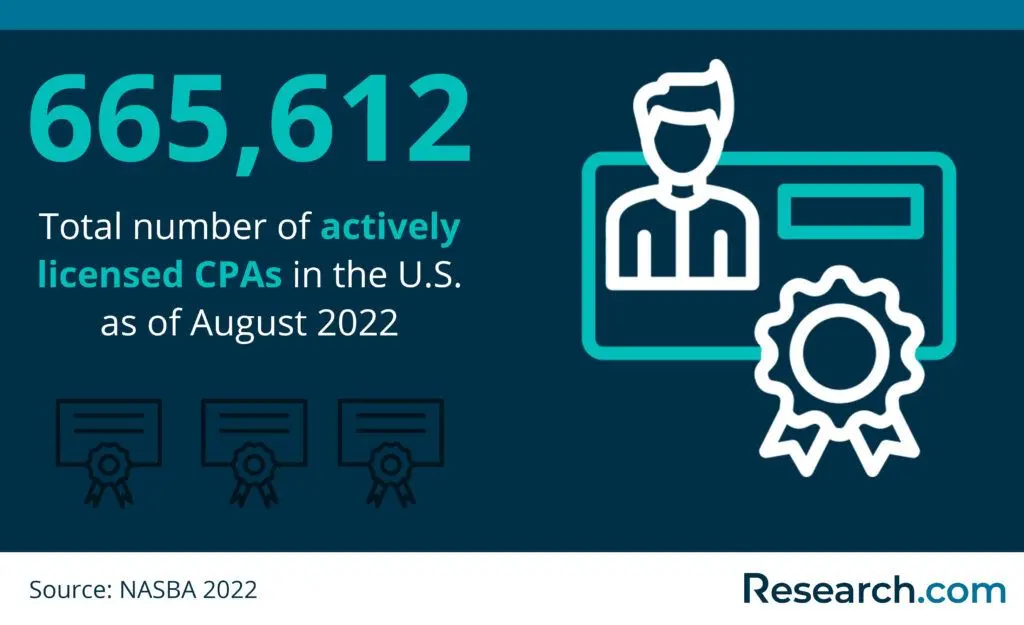
The CPA career outlook remains favorable for candidates who combine accounting fundamentals with technology, communication, analytical thinking, and industry-specific expertise. As of 2024, there are approximately 760,000 actively licensed CPAs.
Demand is supported by tax complexity, financial reporting rules, business globalization, internal controls, risk management, mergers and acquisitions, and the ongoing need for credible financial information. As businesses continue adapting after the COVID-19 pandemic, CPAs may also be needed to help organizations manage budgeting, cash flow, compliance, and financial decision-making.
CPA prospects can be especially strong for professionals with skills in tax preparation, forensic accounting, audit, information technology, analytics, and advisory services. Building business and technology skills through an online business program may help accounting professionals prepare for broader management responsibilities.
Data analytics is becoming more important in accounting education and practice. The study “A Framework and Resources to Create a Data Analytics-Infused Accounting Curriculum” by Dow, Watson, and Jacknis argues that accounting graduates increasingly need analytics capabilities that support data-driven decisions. Demand has surged by 40% over the past year according to recent reports from the International Federation of Accountants. Students comparing technology-focused options may also review data analytics online programs.
The authors write that “a fully-integrated curriculum helps create graduates with strong Data Analytics skills that complement accounting knowledge. These technically savvy, accounting graduates can propel their future organizations into the future of Big Data and Data Analytics. However, accounting instructors should keep in mind that the techniques, tools, and terms used in Data Analytics are continually evolving. As a consequence, the accounting curriculum will also have to continually evolve to stay relevant in this technology-driven world.”
Misconceptions About Becoming a CPA
Some students avoid the CPA path because they associate the credential only with tax season, audit busy periods, or long exam preparation. Those concerns are real for some roles, but they do not describe the full profession.
- Misconception: CPAs only work in audit or tax. Many CPAs do work in audit and tax, but the credential is also useful in forensic accounting, financial planning, consulting, risk management, corporate finance, government accounting, and executive leadership.
- Misconception: The CPA exam is impossible. The exam is demanding, but many candidates pass with structured preparation, consistent study, and a realistic timeline.
- Misconception: Every CPA works extreme hours all year. Public accounting can involve busy seasons, but corporate, government, nonprofit, and internal accounting roles may offer more predictable schedules.
- Misconception: The CPA license only matters at large firms. Small firms, private companies, government agencies, consulting practices, and independent clients also value CPA expertise.
CPA Certifications for Career Advancement
Among those planning to become CPAs, 97% identified career advancement as the main reason for pursuing certification, and 82% rated the CPA credential as very valuable. Students who need flexible academic options can compare online accounting degree programs and related degrees as part of their preparation strategy.
Once licensed, CPAs may add specialized credentials to signal expertise in management accounting, internal audit, fraud examination, government finance, valuation, or global management accounting. Some professionals begin with programs from the most affordable online schools to control education costs while building credentials.
| Certification | Best fit | Reported senior-level salary range |
| Certified Management Accountant (CMA) | Corporate finance, planning, analysis, and management accounting | $105,000 to $170,000 per year |
| Certified Internal Auditor (CIA) | Internal audit, controls, risk, and compliance | $102,000 to $146,000 per year |
| Certified Fraud Examiner (CFE) | Fraud prevention, detection, forensic accounting, and investigations | $102,000 and $172,000 per year |
| Certified Government Financial Manager (CGFM) | Government accounting and public-sector financial management | $98,000 and $142,000 per year |
| Chartered Global Management Accountant (CGMA) | Management accounting, strategy, and global business finance | $105,000 and $165,000 per year |
| Certified Valuation Analyst (CVA) | Business valuation, litigation support, mergers and acquisitions, and financial analysis | $125,000 and $200,000 per year |
Certified Management Accountant
The Certified Management Accountant (CMA) credential is offered by the Institute of Management Accountants (IMA). It is designed for professionals who focus on financial planning, analysis, controls, decision support, and ethics within organizations. The certification is recognized globally and can help CPAs move toward corporate finance, budgeting, performance management, and leadership roles.
The average salary for a senior-level management accountant with a CMA certification is between $105,000 to $170,000 per year.
Certified Internal Auditor
The Certified Internal Auditor (CIA) credential is offered by the Institute of Internal Auditors (IIA). It validates knowledge of internal auditing standards, procedures, risk assessment, controls, and audit practices. For CPAs interested in governance, compliance, enterprise risk, and internal control systems, the CIA can be a strong complement to CPA licensure.
According to the 2024 Salary Guide by Robert Half, the average salary for a senior-level internal auditor with a CIA certification is between $102,000 to $146,000 per year.
Certified Fraud Examiner
The Certified Fraud Examiner (CFE) credential is offered by the Association of Certified Fraud Examiners (ACFE). It is intended for professionals who investigate, detect, and prevent fraud. CPAs with this credential may work in accounting firms, corporations, law enforcement, consulting, compliance, or litigation support.
The average salary for a senior-level forensic accountant with a CFE certification is between $102,000 and $172,000 per year.
Certified Government Financial Manager
The Certified Government Financial Manager (CGFM) credential is offered by the Association of Government Accountants (AGA). It is built for professionals working in public-sector financial management and demonstrates knowledge of government accounting, reporting, budgeting, and financial controls.
According to the 2024 Salary Guide by Robert Half, the average salary for a senior-level government accountant with a CGFM certification is between $98,000 and $142,000 per year.
Chartered Global Management Accountant
The Chartered Global Management Accountant (CGMA) designation is awarded through the Chartered Institute of Management Accountants (CIMA) program and is jointly offered by the American Institute of Certified Public Accountants (AICPA) and CIMA. It emphasizes management accounting, business strategy, finance leadership, and ethical decision-making.
The average salary for a senior-level management accountant with a CGMA certification is between $105,000 and $165,000 per year.
Certified Valuation Analyst
The Certified Valuation Analyst (CVA) credential is offered by the National Association of Certified Valuators and Analysts (NACVA). It is designed for professionals who provide business valuation and financial analysis services for mergers and acquisitions, litigation support, taxation, financial reporting, and business planning.
According to the 2024 Salary Guide by Robert Half, the average salary for a senior-level business valuation analyst with a CPA and CVA certification is between $125,000 and $200,000 per year.
Can Accelerated Accounting Programs Help You Reach CPA Eligibility Faster?
Accelerated accounting programs can make sense for students who already know they want to move quickly into accounting roles or complete required coursework for CPA eligibility. These programs are typically more intensive than traditional timelines, so they require strong time management and a clear understanding of state CPA requirements.
An accelerated accounting degree may be especially useful for career changers, working adults, or students who want a faster route to foundational accounting, auditing, financial reporting, and tax coursework. Online formats can also help students balance school with work or family obligations.
Before enrolling, confirm whether the program’s credits, accounting coursework, and institution accreditation align with the CPA rules in the state where you plan to become licensed. Speed is only valuable if the program helps you meet the right requirements.
What Specialized Certifications Can Strengthen a CPA Career?
Specialized credentials can help CPAs stand out when they align with a specific career goal. For example, a masters in forensic accounting may be useful for CPAs who want to investigate financial crimes, support litigation, or help organizations reduce fraud risk. Credentials such as CMA, CIA, CFE, CGFM, CGMA, and CVA can also support advancement into specialized roles.
The best certification is not necessarily the one with the highest salary range. Choose based on the work you want to do, the employers you want to target, the experience you already have, and the continuing education requirements you are willing to maintain.
How Advanced Degrees Can Affect CPA Career Growth
An advanced degree is not automatically required for every CPA career path, but it can be valuable for professionals aiming for leadership, specialized advisory work, academia, consulting, or executive finance roles. A Master of Accounting can deepen technical accounting knowledge, while an MBA can strengthen management, strategy, and leadership skills.
A master’s degree in accounting may help CPAs build expertise in complex reporting rules, international accounting standards, tax planning, financial analysis, audit methodology, or data-driven decision-making. It can also support promotion into corporate finance, controllership, and senior accounting leadership roles.
An MBA with a finance or management focus may be more useful for CPAs who want broader business leadership roles such as Financial Director or Chief Financial Officer (CFO). This path can be particularly relevant for professionals who already have strong accounting experience and want to influence strategy, operations, and capital decisions.
Before enrolling, compare total cost, time commitment, employer tuition support, delivery format, curriculum relevance, accreditation, and opportunity cost. If you are asking whether getting a masters in accounting is worth it, the answer depends on whether the degree clearly supports the roles you want next.
How Important Is Professional Networking for CPA Career Success?
Networking can influence CPA career growth because many accounting opportunities are shaped by referrals, professional reputation, client relationships, mentors, and industry visibility. Joining professional associations, attending events, participating in local accounting groups, and taking targeted courses can help CPAs stay current and discover roles that are not always widely advertised.
Professional development can also happen through flexible learning. An accounting course online may help professionals refresh technical knowledge, prepare for a specialization, or build skills while maintaining full-time employment.
Why the CPA Pipeline Matters for Students and Employers
The CPA credential is often associated with accounting, auditing, and tax preparation. It is also associated with strong earning potential, professional credibility, and demanding work. Public accounting firms, universities, and professional organizations are working to strengthen the CPA pipeline because employers continue to report a shortage across industries.
The modern CPA role is broader than transaction processing. CPAs increasingly help organizations interpret financial data, assess risks, improve controls, plan taxes, advise leadership, evaluate investments, and support business strategy. Automation can reduce repetitive work, but judgment, ethics, professional skepticism, and communication remain central to accounting practice.
Like technical disciplines that require practice and formal preparation, such as programs in engineering online degrees, accounting skill develops through education, supervised experience, and problem-solving. Students who need flexibility should compare online degree vs traditional degrees before choosing a program format.
Alternative Education Pathways Into Accounting
Not every future CPA begins with a four-year accounting program. Some students start with easy associate degrees or community college coursework before transferring into a bachelor’s program. This approach can reduce upfront costs and help students test their interest in accounting before committing to a longer program.
However, students should be careful: CPA certification requires at least a bachelor’s degree and state-specific education rules. An associate degree can be a starting point, not a complete CPA qualification. The best pathway is one that allows credits to transfer cleanly into a bachelor’s program and eventually helps satisfy CPA exam and licensure requirements.
Can an Affordable Online Accounting Associate Degree Start a CPA Path?
An affordable online accounting associate degree can be a practical first step for students who want lower-cost entry into accounting. These programs can introduce bookkeeping, accounting principles, financial statements, payroll, and business fundamentals. Students interested in this route can compare cheap online accounting associate degree programs to identify flexible and budget-conscious options.
Before enrolling, ask whether credits transfer to a bachelor’s degree, whether courses are offered by an accredited institution, and whether the curriculum aligns with long-term CPA coursework needs.
What Additional Certifications Can Diversify an Accounting Skill Set?
Additional certifications can help accounting professionals signal focused expertise before or after CPA licensure. For example, a bookkeepers certification can demonstrate competence in maintaining accurate financial records, which may be useful for early-career accounting roles, small business support, or professionals building practical accounting experience.
The key is to avoid collecting credentials without a plan. Choose certifications that match the work you want, such as audit, fraud, tax, government finance, valuation, bookkeeping, management accounting, or advisory services.
How Can CPAs Benefit From Tax Law Expertise?
Tax knowledge can expand a CPA’s advisory value because many business decisions have tax consequences. CPAs who understand tax legislation, compliance risk, entity structures, deductions, credits, and planning strategies may be better positioned to advise individuals, businesses, and executives.
Some professionals may also explore the intersection of accounting and law. Reviewing tax attorney careers can help CPAs understand how legal training and accounting expertise can overlap in tax controversy, estate planning, corporate transactions, and compliance work.
Can Affordable Advanced Degrees Speed Up CPA Career Progression?
Affordable advanced degrees can support CPA career progression when they provide relevant skills without creating excessive debt. The strongest programs connect coursework to leadership, analytics, finance strategy, compliance, research, or specialized accounting practice.
Some CPAs considering senior leadership, consulting, or academic-adjacent roles may review DBA programs online. As with any advanced degree, the decision should be based on career fit, accreditation, cost, time commitment, employer recognition, and expected professional benefit.
Future Trends Reshaping the CPA Profession
CPA work is changing as accounting software, artificial intelligence, cloud systems, automation, and data analytics alter routine tasks. This does not remove the need for CPAs, but it changes the skills employers value. Professionals who can interpret data, explain risks, use accounting technology, and advise decision-makers may be better positioned than those who rely only on manual processing.
Regulatory change, sustainability reporting, cybersecurity concerns, fraud risk, tax complexity, and global business structures also increase demand for adaptable accounting professionals. Students who want early exposure to the field can explore an accounting associate career path before committing to a longer CPA-focused route.
How Can CPAs Negotiate Competitive Salaries?
Salary negotiation works best when CPAs combine market data with evidence of their own value. Before negotiating, review current compensation benchmarks, including resources that explain how much accountants make, and compare figures by location, industry, firm size, title, and experience level.
- Use current salary benchmarks: Bring market data for your role, state, and industry instead of relying on a general national average.
- Document measurable impact: Show examples such as audit efficiency, tax savings, improved controls, client retention, process improvements, or revenue contributions.
- Highlight scarce skills: Certifications, analytics ability, ERP experience, tax specialization, forensic accounting, and leadership responsibilities can strengthen your case.
- Negotiate at the right moment: Performance reviews, promotions, new responsibilities, completed credentials, and competing offers can provide leverage.
- Look beyond base pay: Bonus eligibility, remote work, continuing education support, CPA exam reimbursement, retirement benefits, paid time off, and promotion timeline can affect total compensation.
Common Mistakes to Avoid When Planning a CPA Career
| Mistake | Why it can hurt you | Better approach |
| Choosing a program without checking CPA requirements | Credits may not meet state licensing rules. | Confirm education requirements with the state board where you plan to become licensed. |
| Comparing salaries without cost of living | A higher salary may not translate into better take-home value. | Compare salary, housing, taxes, commute, and career mobility together. |
| Assuming every accounting job requires the same lifestyle | Public accounting, corporate, government, and nonprofit roles can have different workloads. | Research busy seasons, travel, overtime, and flexibility by employer type. |
| Pursuing credentials without a career target | Extra certifications cost time and money if they do not support your goals. | Select credentials based on the role, industry, and specialization you want. |
| Focusing only on starting salary | Training, promotion speed, mentorship, and client exposure can matter more long term. | Evaluate total career value, not just first-year compensation. |
Questions to Ask Before Choosing the CPA Path
- Do I want public accounting, corporate accounting, government, forensic accounting, tax, audit, advisory, or finance leadership?
- Which state do I want to be licensed in, and what are its CPA education and experience requirements?
- Will my degree program provide the accounting credits I need for CPA eligibility?
- Can I realistically commit time to CPA exam preparation while working or studying?
- Which industries hire CPAs in my preferred location?
- How important are salary, work-life balance, remote work, firm prestige, and promotion speed to me?
- Would a master’s degree or specialized certification create a clear advantage for my target role?
Key Insights
- CPA salaries vary by more than title. State, industry, firm size, specialization, education, and experience all affect compensation.
- The CPA credential can improve earning power. Recent salary surveys conducted in 2024 indicate that CPAs can earn roughly 12% to 18% more on average than non-CPAs.
- Location matters, but context matters more. The District of Columbia, New York, New Jersey, Virginia, and California report some of the highest CPA wages, but cost of living and job fit should be part of the decision.
- Experience creates major salary separation. Mid-level CPAs earn $75,000 to $90,000 annually, while those with more than six years of experience can earn $90,000 to $120,000 or more.
- Specialization can accelerate advancement. CMA, CIA, CFE, CGFM, CGMA, and CVA credentials can help CPAs move into management accounting, audit, fraud, government finance, global strategy, or valuation roles.
- The profession is changing, not disappearing. AI, automation, analytics, and cloud accounting are shifting CPAs toward interpretation, advisory work, controls, risk management, and strategic decision-making.
- The best CPA path is planned backward from the target role. Start with the job you want, then choose the degree, state license strategy, certifications, employer type, and location that best support that outcome.
References:
- Bureau of Labor Statistics (2024). Occupational Outlook Handbook: Accountants and Auditors.
- Dow, N., Watson, K., and Jacknis, M. (2024). A Framework and Resources to Create a Data Analytics-Infused Accounting Curriculum. https://www.aasb.org/research/data-analytics-accounting-curriculum-2024 Study DOI
- LHH Recruitment Solutions (2024). Career Guide for Accounting and Finance Professionals.
- National Association of State Boards of Accountancy (2024). How Many CPAs Are There?
- Robert Half (2024). Finance and Accounting 2024 Salary Guide.
- ZipRecruiter (2024). Big Four Accounting Salary.
Other Things You Should Know About CPA Average Salaries & Wages by State
Most states require 150 semester hours of college credit, a bachelor’s degree, and passing all four sections of the Uniform CPA Examination: Auditing and Attestation, Financial Accounting and Reporting, Regulation, and Business Analysis and Reporting. Candidates must also meet state board experience rules.
In 2027, CPAs can boost their salaries by earning additional certifications like the Certified Management Accountant (CMA) or Chartered Financial Analyst (CFA) designations. These certifications can lead to higher-paying roles by showcasing specialized expertise and enhancing career advancement opportunities.
The highest-paying industries for CPAs include finance and insurance, management of companies and enterprises, oil and gas extraction, and other investment pools and funds. CPAs in these industries can expect to earn annual mean wages ranging from $81,480 to $88,050.
In 2027, CPAs in the highest-paying states like New York and California can earn over $100,000 annually, while those in lower-paying states such as Mississippi and Arkansas may earn approximately $70,000. Salaries vary significantly based on cost of living and demand for accounting professionals.
In 2027, firm size continues to significantly influence CPA salaries. Larger firms generally offer higher salaries due to their ability to take on bigger clients and provide greater advancement opportunities, whereas smaller firms might offer competitive starting salaries but could provide less overall growth potential.
Location has a significant impact on CPA salaries. CPAs in states with high demand for accounting services and a higher cost of living, such as the District of Columbia, New York, New Jersey, Virginia, and California, tend to earn higher salaries. The concentration of industries such as finance, entertainment, and technology in these states also contributes to higher pay.