2027 How to Become a CPA: Guide to Career Paths & Certification Requirements

Co-Founder and Chief Data Scientist
Becoming a Certified Public Accountant is not just a credential upgrade for accounting majors. It is a licensing path that affects what services you can provide, which employers will consider you for higher-responsibility roles, and how far you can move into audit, tax, advisory, forensic accounting, controllership, and finance leadership. The decision matters because CPA licensure requires planning: most candidates need 150 semester hours of education, passing CPA Exam scores, verified work experience, possible ethics requirements, and ongoing continuing education after licensure.
This 2027 guide explains how to become a CPA from start to finish. It is written for accounting students, career changers, working accountants, and anyone comparing CPA licensure with other accounting career paths. You will learn how education requirements work, what the CPA Exam includes, how work experience is verified, how much to budget for exams and applications, how online programs can fit into the process, and how to decide whether the CPA path is worth the time and cost. If you are still exploring what you can do more with an accounting degree, this guide will help you understand where CPA licensure fits into your long-term career plan.
Demand for accounting talent remains steady. The Bureau of Labor Statistics reports an estimated 124,200 job openings for CPAs each year through 2034 for accountants and auditors, a category that includes many CPA-track roles. Licensure does not guarantee a specific job or salary, but it can strengthen your eligibility for roles that require or prefer a CPA designation.
Quick Answer: How Do You Become a CPA?
To become a CPA, you generally need to complete a bachelor’s degree and enough additional coursework to reach 150 semester hours, pass the Uniform CPA Exam, meet your state board’s work experience rules, pass any required ethics exam, and submit a license application with supporting documents. Requirements vary by state or jurisdiction, so your first practical step should be checking the rules of the state board where you plan to become licensed.
| CPA licensure step | What it usually involves | Decision point for candidates |
| Education | Bachelor’s degree plus enough credits to meet the 150-semester-hour requirement in most jurisdictions | Decide whether to use a master’s program, post-baccalaureate accounting courses, a five-year CPA track, or transfer credits |
| CPA Exam | Three core sections and one discipline section, each taken separately | Choose when to sit for the exam and whether to use a structured review course |
| Work experience | Relevant accounting work, often supervised by a licensed CPA | Confirm whether public accounting, industry, government, or nonprofit experience counts in your state |
| Ethics requirement | An AICPA ethics exam, a state-specific course, or no ethics exam, depending on the jurisdiction | Check timing rules so your ethics requirement does not delay licensure |
| License application | Submission of transcripts, experience verification, fees, and other state-required documentation | Prepare documents early and verify every requirement with your state board |
| License maintenance | Continuing Professional Education, typically renewed every one or two years | Choose CPE that supports your practice area and future career goals |
How to Become a CPA Table of Contents
- CPA Education Requirements
- CPA Work Experience Requirements and Verification
- Uniform CPA Exam
- CPA Ethics Exam
- How to Choose the Right CPA Exam Review Course
- CPA License Application
- Effective Strategies for Managing CPA Exam Costs
- Continuing Education Requirements for CPAs
- Should I Pursue an Advanced Degree in Finance After Becoming a CPA?
- How Can Emerging Technologies Empower CPAs?
- What Future Trends Are Shaping the CPA Profession?
- Is an Affordable Online Associate Degree a Viable Stepping Stone for Aspiring CPAs?
- Career Benefits of Becoming a CPA
- Exploring Online Pathways to CPA Licensure
- What Are the Compensation and Benefits of Being a CPA?
- Which Industries and Regions Offer the Highest CPA Compensation?
- What Additional Certifications Can Enhance My CPA Career?
- How Can Accelerated Online Programs Fast-Track My CPA Journey?
CPA Education Requirements
The CPA path builds on, but goes beyond, the basic steps involved in how to become an accountant. A staff accountant may enter the field with a bachelor’s degree, but CPA licensure usually requires additional academic credits, specific accounting and business coursework, and approval from a state board of accountancy. Most jurisdictions follow requirements shaped by the National Association of State Boards of Accountancy and the American Institute of Certified Public Accountants, but the details are not identical everywhere.
The most important rule to understand is this: CPA licensure is state-based. You do not earn a single national CPA license. Instead, you apply through a state or jurisdiction, and that board decides whether your education, exam scores, experience, ethics requirement, and documentation satisfy its rules.
Degree Requirements
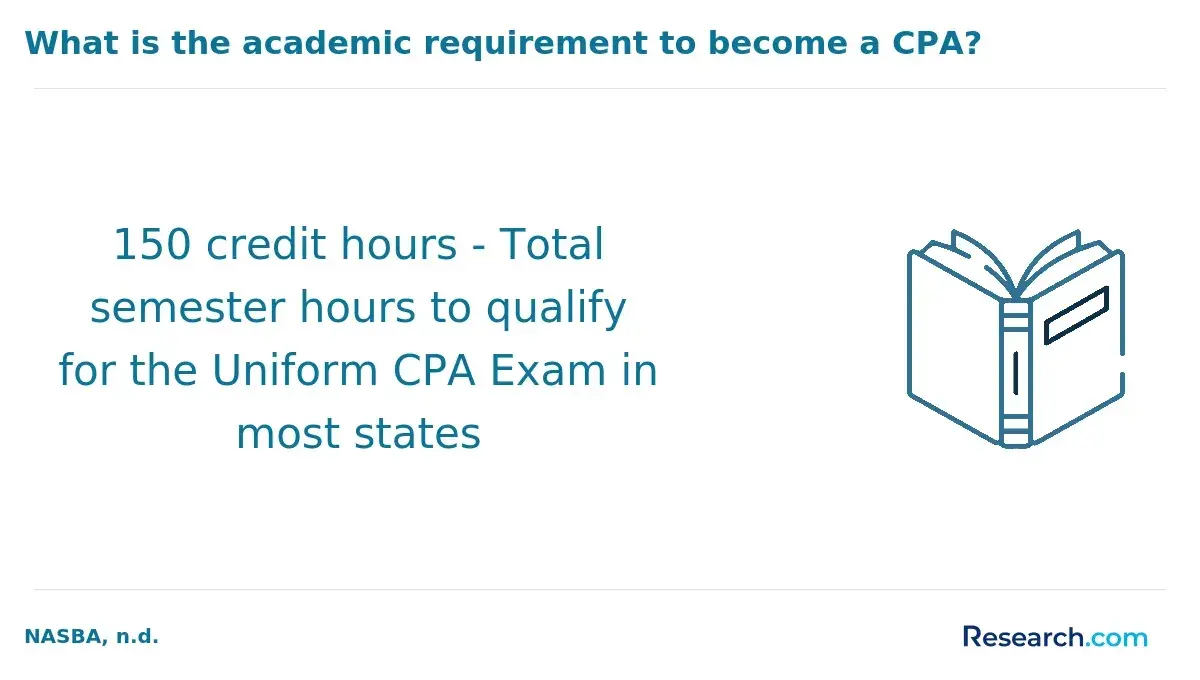
Most CPA candidates need a bachelor’s degree from a properly accredited institution and a total of 150 semester hours of college credit. That is why accreditation matters when comparing a campus program with an accredited accounting degree online. A standard bachelor’s degree is commonly built around approximately 120 semester hours, so many candidates need about 30 additional credits before they can be licensed.
An associate degree can help you begin college-level accounting study, but it does not qualify you for CPA licensure by itself. Even the best online associate degree would still need to be followed by a bachelor’s degree and additional qualifying credits. Accounting is the most direct major for CPA preparation, but finance or business degrees may also work if they include the required accounting and business coursework set by the state board. Some candidates complete the remaining credits through a master’s in accounting, a graduate certificate, additional undergraduate accounting courses, or selected cheap online business courses that meet board rules.
State timing rules can differ. In New York, for example, you can sit for a CPA Exam with only 120 semester hours, but you must complete the 150-hour academic credit requirement before you receive the license. This distinction matters because “eligible to test” and “eligible to be licensed” are not always the same thing.
Some universities offer five-year accounting programs designed specifically for CPA candidates. These programs can simplify planning because the curriculum is built around the 150-semester-hour requirement. Other students prefer post-baccalaureate accounting certificates or selected courses through some of the best online accounting degree programs, especially when they already hold a bachelor’s degree and only need targeted accounting credits. Certificates may be faster and less expensive than a full master’s degree, but they are not available everywhere and must be checked against state board requirements.
| Education option | Best for | Main advantage | Watch out for |
| Bachelor’s degree in accounting | Students starting college with CPA licensure as a goal | Direct exposure to core accounting, audit, tax, and business concepts | May not reach 150 semester hours without extra coursework |
| Five-year CPA-track accounting program | Students who want a structured path from first year to licensure eligibility | Designed around the credit-hour expectation for CPA candidates | Can require a longer upfront college commitment |
| Master’s in accounting | Graduates who need advanced accounting study and additional credits | Can deepen technical preparation while helping reach 150 semester hours | Total cost should be compared against expected career benefit |
| Post-baccalaureate accounting certificate | Career changers or graduates missing accounting prerequisites | Focused coursework without committing to a full graduate degree | Availability and CPA eligibility vary by school and state |
| Additional approved business or accounting courses | Candidates short by a limited number of credits | Can be flexible and cost-conscious | Courses must satisfy the state board’s subject-area rules |
Required Courses
CPA education rules usually require both accounting coursework and broader business coursework. Exact subject requirements vary by jurisdiction, but candidates commonly need exposure to the following areas:
- General accounting. This area introduces the accounting cycle, transaction recording, financial statements, and the way organizations report financial activity.
- Taxation. Tax coursework covers individual and business tax rules, federal and state tax concepts, compliance obligations, and planning considerations.
- Auditing. Audit courses focus on audit evidence, internal controls, financial statement audits, professional standards, and reporting responsibilities.
- Business statistics. Statistics helps future CPAs understand sampling, probability, regression, data interpretation, and evidence-based business decisions.
- Business communications. CPAs must be able to explain findings clearly to clients, executives, regulators, and coworkers, so written and oral communication training is useful.
- Financial management. This coursework addresses capital budgeting, financial planning, analysis, risk, and the financial decisions organizations make.
- Risk analysis. Risk-focused study helps candidates recognize operational, strategic, compliance, and financial risks and understand how organizations manage them.
- International finance. International finance introduces foreign exchange, global markets, international investment, and financial issues affecting multinational organizations.
- Business ethics. Ethics courses examine professional judgment, corporate responsibility, conflicts of interest, ethical leadership, and decision-making frameworks.
Before enrolling in extra coursework, ask the school and your state board whether each course will count toward CPA education requirements. A course may appear relevant but still fail to meet a specific accounting-credit category.
CPA Work Experience Requirements and Verification
Most states and jurisdictions require at least two years of public accounting experience before licensure, according to AICPA guidance. Some boards also accept experience in industry, government, or other non-public accounting settings, but they may require more time or impose different documentation rules. The work usually must involve accounting-related duties such as auditing, tax preparation, financial reporting, accounting analysis, or related professional services, and it often must be supervised or verified by a licensed CPA.
The key question is not simply whether you worked in accounting. It is whether your work matches the experience definition used by the jurisdiction where you want to be licensed. For example, bookkeeping, accounts payable, financial analysis, internal audit, tax preparation, and corporate accounting may be treated differently depending on the board.
| Experience setting | How it may support CPA licensure | What to verify early |
| Public accounting firm | Often aligns well with audit, tax, and client-service experience requirements | Whether your supervisor is licensed and can sign the experience form |
| Corporate accounting or finance department | May count in some jurisdictions if duties are sufficiently accounting-related | Whether non-public accounting experience is accepted and for how long |
| Government accounting or auditing | Can provide relevant reporting, audit, compliance, or budget experience | Whether the state board accepts the role and supervisor verification |
| Nonprofit accounting | May build experience in reporting, controls, grants, tax filings, and compliance | Whether the work meets the board’s definition of professional accounting experience |
Candidates can use NASBA’s work experience verification service in select states and jurisdictions. The process generally involves an online form from the applicant and review by a supervisor or employer. The service is available to individuals who have passed the CPA Exam or are working toward that step. If your jurisdiction is not covered, you may need to work directly with your state board or explore whether transferring exam scores to a participating jurisdiction is an option.
Uniform CPA Exam
The Uniform CPA Exam is the central testing requirement for CPA licensure in the United States. It is used by all states and territories and evaluates whether candidates have the technical knowledge and professional judgment expected of entry-level CPAs. The exam includes multiple-choice questions and task-based simulations, and candidates complete the sections separately.
The current structure includes three core sections:
- Auditing and Attestation (AUD). AUD focuses on audit procedures, generally accepted auditing standards, ethics, independence, evidence, internal controls, and professional responsibilities.
- Financial Accounting and Reporting (FAR). FAR covers financial accounting, generally accepted accounting principles, reporting requirements, and preparation of financial statements.
- Taxation and Regulation (REG). REG addresses federal taxation, business law, tax practice ethics, and professional responsibilities connected to tax work.
Each CPA Exam section has a four-hour time limit. Candidates also choose one four-hour discipline section from Business Analysis and Reporting (BAR), Information Systems and Control (ISC), and Tax Compliance and Planning (TCP). Your discipline choice should reflect your strengths and career goals, not just what appears easiest. For example, a tax-focused candidate may prefer TCP, while someone interested in systems, controls, or technology risk may consider ISC.
| CPA Exam section | Primary focus | Who may find it especially relevant |
| AUD | Audit procedures, attestation, standards, ethics, and reporting | Candidates pursuing audit, assurance, internal audit, or compliance roles |
| FAR | Financial reporting, accounting standards, and statement preparation | Candidates aiming for financial reporting, controllership, or public accounting roles |
| REG | Taxation, business law, and professional responsibilities | Candidates planning to work in tax, advisory, or small business services |
| BAR | Business analysis and reporting | Candidates interested in reporting, analysis, and advisory work |
| ISC | Information systems and control | Candidates drawn to systems, controls, IT audit, and technology risk |
| TCP | Tax compliance and planning | Candidates focused on tax compliance, tax planning, and tax advisory roles |
CPA Exam Fees and Age Requirements
CPA Exam fees are set at the jurisdiction level and commonly include an application fee plus fees for exam sections. The application fee is paid to the state board and ranges from $40 to $200. The examination fee costs between $390 for each section. Overall, candidates should prepare around $900 to $1,900, before considering study materials, transcript fees, travel, or retake costs.
Age rules also differ. Some jurisdictions require candidates to be at least 18. New York and Missouri require candidates to be at least 21 years old to receive a CPA license. In most states and territories, there is no age requirement to sit for the CPA Exam, but exam eligibility and license eligibility should be checked separately.
CPA Exam Scoring
The CPA Exam is scored from 0 to 99, and 75 is the minimum passing score. Scores are equated to account for differences in exam difficulty across versions. The AICPA releases scores on a rolling schedule, and candidates can schedule a retake 24 hours after receiving their initial scores, according to Becker (2025).
Historically, CPA Exam pass rates have been around 50%. Pass rates have varied by section and timing, with past patterns showing higher rates in the first and fourth quarters and lower rates in the second and third quarters. Earlier exam structures included the Business Environment and Concepts section, so older pass-rate comparisons should be interpreted in context.
Research also suggests that preparation background matters. In “Factors Affecting CPA Examination Success,” Pierre L. Titard and Kietii A. Russell identified advanced degrees, collegiate GPA, public accounting experience, and formal supplementary study as factors that may relate to CPA Exam outcomes. The study, published in Semantic Scholar, noted that individuals with advanced degrees were more successful on the exam than those without such degrees, while also recognizing that other factors, such as GPA, may contribute to the difference.
CPA Ethics Exam
Many jurisdictions require a CPA ethics exam before licensure. The purpose is to confirm that candidates understand professional conduct rules, independence expectations, confidentiality, conflicts of interest, and the ethical responsibilities that come with serving clients, employers, investors, and the public. In many cases, candidates complete the ethics requirement within one or two years after passing the CPA Exam.
The requirement is not uniform. Some states use the AICPA ethics exam, some require a state-specific ethics course or exam, and some do not require an ethics exam for licensure. Virginia, for instance, requires an annual state-specific ethics course. Ohio requires a board-approved professional standards and responsibilities course that emphasizes Ohio accountancy law and board rules. Texas and Wisconsin have state codes of professional conduct. Pennsylvania, Kentucky, Georgia, and Michigan do not include an ethics exam as part of CPA license requirements, according to Becker.
The AICPA ethics exam is a self-study, open-book exam with 40 multiple-choice questions. Candidates must earn at least 90 to pass and have three attempts. The AICPA ethics course includes 11 hours of study material covering topics such as legal and regulatory issues, independence from clients or employers, and the AICPA code of conduct.
How to Choose the Right CPA Exam Review Course
A CPA review course can be helpful, but the best option depends on your schedule, learning style, budget, and exam timeline. A highly structured live course may work well if you need accountability. A self-paced course may be better if you work full time or have an unpredictable schedule. The goal is not to buy the most expensive package; it is to choose a preparation system you will actually complete.
| Review-course factor | What to look for | Why it matters |
| Learning format | Live classes, recorded lectures, self-study modules, or hybrid options | Your format should match how you retain information and manage time |
| Practice tools | Multiple-choice questions, task-based simulations, mock exams, and progress tracking | The exam requires application, not just memorization |
| Instructor support | Access to explanations, office hours, forums, or tutoring | Support can help when you struggle with technical topics |
| Coverage | Materials for AUD, FAR, REG, and your chosen discipline section | Incomplete materials can force you to buy extra modules later |
| Cost and retake policy | Transparent pricing, discounts, updates, and access length | CPA prep is a major expense, and short access windows can be risky |
| Student feedback | Reviews from candidates with similar schedules and backgrounds | Pass claims are less useful than specific feedback about usability and depth |
If you are still completing your degree, an accounting degree online fast option may help you build the academic foundation needed for CPA preparation. Just confirm that credits from any accelerated program satisfy the education rules of your target jurisdiction.
CPA License Application
After you meet the education, exam, experience, and ethics requirements for your jurisdiction, you can apply for licensure. Many candidates begin through the NASBA CPA Licensing Online Application System, but requirements still depend on the state board. Read the instructions carefully because missing documents can delay approval even after you have passed the exam.
Common application materials may include:
- Official transcripts
- Work experience verification
- Character references
- Proof of citizenship
- Proof of residency
- Social security documentation
- Proof of participation in international programs, if applicable
Before submitting, compare your documents against the state board checklist. Names should match across transcripts, exam records, identification documents, and application forms. If you changed your name or studied at multiple institutions, gather supporting records early.
CPA License Application Fees
License application fees vary by jurisdiction. In California, the initial CPA license application can cost $250. In Washington, DC, candidates can apply for their CPA license for $175. These fees are separate from exam fees, review materials, transcript orders, and any education costs needed to meet the 150-semester-hour rule.
Effective Strategies for Managing CPA Exam Costs
The CPA path can become expensive because candidates may pay for additional college credits, exam applications, section fees, review courses, transcript orders, ethics courses, and license applications. The most effective way to control cost is to plan the entire pathway before you start paying for individual pieces.
- Ask employers about reimbursement. Many accounting firms and some corporate accounting departments support CPA-track employees by paying for exam fees, review courses, or bonus incentives after passing.
- Compare review courses by total value, not sticker price. A cheaper course may cost more if it lacks simulations, updated materials, or adequate access time. A more expensive package may be worthwhile if it prevents retakes.
- Look for accounting scholarships. Programs such as AICPA Legacy Scholarships can help eligible accounting students offset education or exam-related expenses.
- Avoid buying credits that do not count. Before enrolling in extra courses, confirm that the state board will accept them toward accounting, business, or total-hour requirements.
- Schedule sections strategically. Retakes add cost and stress. Build a realistic study schedule rather than rushing to sit before you are ready.
- Evaluate graduate school ROI carefully. A master’s degree can help with exam preparation and the 150-hour requirement, but candidates should compare tuition with alternatives and review the broader cost of masters in accounting.
| Cost category | How to reduce waste | Question to ask first |
| Extra college credits | Use only courses that satisfy your state board’s rules | Will this course count toward my CPA education requirement? |
| CPA review course | Choose a course with complete materials and enough access time | Does this package cover my chosen discipline section? |
| Exam fees | Register when you have a realistic study plan | Am I prepared enough to avoid an avoidable retake? |
| License application | Submit a complete and accurate application the first time | Do I have every required document and signature? |
| CPE after licensure | Select courses that also support career advancement | Will this CPE improve my practice area or future opportunities? |
Continuing Education Requirements for CPAs
CPA licensure is not finished after the license is issued. Licensed CPAs must complete Continuing Professional Education to renew their licenses and stay current with changes in accounting standards, tax rules, auditing practices, technology, ethics, and regulatory expectations. CPE protects the public and helps CPAs maintain professional competence.
Jurisdictions set their own CPE rules. Requirements commonly fall between 40 to 120 hours per reporting period, and the reporting period is typically every one or two years. Some boards also specify ethics hours, subject-area minimums, or limits on self-study credits.
CPAs can earn CPE through several formats:
- In-person seminars. Classroom-style sessions can provide direct interaction, structured learning, and professional networking.
- Webinars. Online sessions make it easier to complete CPE without travel and can fit into a busy work schedule.
- Self-study courses. Independent courses allow flexible pacing through textbooks, online modules, assessments, or recorded materials.
- Conferences. Professional conferences combine technical sessions, updates from experts, and networking with peers.
- On-the-job training. Some job-related training activities may qualify for CPE credit if they meet board rules.
Good CPE planning should support your career direction. A tax CPA may prioritize tax law updates. An audit professional may focus on standards, controls, and risk. A CPA moving toward analytics may explore graduate study through the best data science masters programs. CPAs interested in information security, systems controls, and risk may review programs from the best cybersecurity schools.
Advanced academic credentials can also support long-term mobility. A master’s or PhD in accounting online or on campus may be useful for CPAs interested in research, teaching, senior technical roles, or executive-level specialization.
Should I Pursue an Advanced Degree in Finance After Becoming a CPA?
An advanced finance degree can be valuable for CPAs who want to move beyond compliance-focused work and into financial strategy, corporate finance, investment analysis, risk management, or executive decision support. It may be especially useful for CPAs targeting controller, finance director, CFO-track, valuation, or advisory roles.
However, graduate school should solve a specific career problem. If your goal is tax specialization, an advanced tax program or targeted certification may be more relevant. If your goal is analytics, data coursework may be a better fit. If finance leadership is the target, compare curriculum, cost, flexibility, and employer recognition. Reviewing options such as the cheapest online masters in finance can help you weigh additional education against your career timeline and budget.
How Can Emerging Technologies Empower CPAs?
Technology is changing what employers expect from CPAs. Cloud accounting platforms, automation, artificial intelligence, data visualization, and analytics tools can reduce manual processing and shift more CPA work toward interpretation, controls, advisory services, and risk management. CPAs who understand both accounting rules and digital systems can add value by explaining what the numbers mean, identifying unusual patterns, improving reporting processes, and advising organizations on stronger controls.
Technology does not remove the need for professional judgment. It increases the need for CPAs who can validate data quality, interpret automated outputs, explain assumptions, protect sensitive information, and apply ethics to new tools. Candidates who need flexible academic preparation may consider an accounting degree online, but they should look for programs that include current accounting systems, analytics exposure, and strong fundamentals.
What Future Trends Are Shaping the CPA Profession?
Several trends are reshaping CPA work. Automation is reducing some repetitive tasks, while data analytics is increasing demand for professionals who can turn financial information into decision-ready insight. Regulatory complexity continues to affect tax, audit, and reporting work. Cybersecurity and information systems risk are increasingly relevant because financial data is stored, transferred, and analyzed through digital platforms.
These changes do not mean every CPA must become a programmer. They do mean that future CPAs should be comfortable working with systems, asking better data questions, understanding controls, and communicating risk to non-accountants. Candidates comparing paths can explore what is the best career in accounting to see how audit, tax, advisory, forensic accounting, government accounting, and corporate finance roles differ.
Networking Opportunities for CPAs
Networking helps CPA candidates and licensed CPAs find mentors, job leads, technical guidance, and career options that are not always visible in job postings. It is especially important for students and career changers who need to understand how public accounting, industry, government, and nonprofit accounting roles differ in practice.
- Professional associations. Groups such as the AICPA and state CPA societies can provide local chapters, technical events, mentoring programs, volunteer opportunities, and updates on regulatory changes.
- Industry conferences. Events such as AICPA Engage and the Accounting & Finance Show can expose CPAs to emerging issues, practice-area trends, and employers across the field.
- Online platforms. LinkedIn and accounting-focused communities can help candidates follow firms, connect with alumni, learn about exam experiences, and participate in professional discussions.
- CPE events. Continuing education sessions can also function as networking opportunities because participants often share similar technical interests or career goals.
Networking should be intentional. Ask professionals how they entered their specialty, what skills mattered most, whether their state board accepted their work experience, and what they would do differently if starting again.
Is an Affordable Online Associate Degree a Viable Stepping Stone for Aspiring CPAs?
An online associate degree can be a practical first step if you want a lower-cost entry into accounting before committing to a bachelor’s degree. It can introduce financial accounting, managerial accounting, business law, spreadsheet skills, and basic tax concepts. It may also help you test your interest in accounting before investing in a longer program.
The limitation is clear: an associate degree alone does not meet CPA licensure requirements. To use it effectively, choose a program with strong transfer pathways, articulation agreements, and courses that can apply toward a bachelor’s degree. Students comparing lower-cost starting points can review the most affordable accounting associate degree online programs and then confirm transfer policies with the receiving four-year institution.
Career Benefits of Becoming a CPA
CPA licensure can improve your professional credibility and expand the roles for which you are competitive. The value is strongest when the credential aligns with your target work: audit, tax, financial reporting, advisory, forensic accounting, government accounting, controllership, or finance leadership.
- Broader career options. CPAs work in public accounting firms, corporations, government agencies, nonprofit organizations, consulting firms, and specialized advisory practices.
- Stronger professional credibility. The CPA designation signals that you met formal education, exam, experience, ethics, and continuing education standards.
- Potential for higher compensation. The Bureau of Labor Statistics reports a median annual salary of $81,680 for accountants and auditors. CPAs may earn more than non-certified peers depending on role, employer, location, and experience.
- Access to specialized work. CPAs can build careers in taxation, auditing, forensic accounting, risk, financial reporting, internal controls, and advisory services.
- Leadership mobility. CPA experience can support movement into controller, finance manager, CFO-track, partner-track, or executive roles, although advancement depends on performance and opportunities.
The employment of accountants and auditors, including many CPA-related roles, is projected to increase by 4.6% through 2034, which is similar to the average growth rate across occupations. More than 124,200 job opportunities for accountants and auditors are expected each year on average over the decade. Many openings are expected to come from replacement needs as workers transfer to other occupations or leave the labor force, including retirement.
Exploring Online Pathways to CPA Licensure
Online accounting programs can be a good fit for CPA candidates who are working, caregiving, changing careers, or living far from a campus. The main advantage is flexibility, but flexibility should not be confused with automatic CPA eligibility. Online students still need accredited coursework, the right accounting and business credits, and a plan to reach the 150-semester-hour threshold.
Advantages of Online Programs
- Flexible scheduling. Online courses can make it easier to continue working while completing degree or credit-hour requirements.
- Potential cost savings. Some online programs reduce commuting, relocation, and housing costs compared with campus study.
- Access to accredited options. Many online accounting programs are offered by accredited institutions and can support CPA preparation when their courses align with state requirements.
Students beginning from the undergraduate level may consider a bachelor of accounting online. This can provide core preparation in financial accounting, auditing, taxation, business law, and accounting systems while allowing students to plan additional credits for licensure.
| Online CPA-path question | Why it matters |
| Is the institution properly accredited? | State boards may reject credits from schools that do not meet accreditation standards. |
| Does the program include enough upper-level accounting coursework? | Total credits alone may not satisfy subject-specific accounting requirements. |
| Can credits transfer into a bachelor’s or master’s program? | Transfer policies affect total cost and time to the 150-semester-hour target. |
| Does the curriculum support CPA Exam preparation? | Strong coursework in audit, tax, reporting, and business law can reduce exam-prep gaps. |
| Will the program meet requirements in my licensing state? | A program suitable in one jurisdiction may not satisfy another board’s rules. |
What Are the Compensation and Benefits of Being a CPA?
CPA compensation depends on location, employer type, industry, specialization, experience, and whether the role is in public accounting, corporate accounting, government, consulting, or advisory services. Licensure can improve access to higher-responsibility roles, but pay is not automatic. Candidates should compare salary data by state and role rather than relying on a national average alone.
For state-level salary information, review CPA starting salary data. This can help you compare regional compensation, cost of living, and career opportunities before choosing where to work or where to become licensed. Beyond pay, CPAs may benefit from professional credibility, stronger career mobility, specialized practice opportunities, and eligibility for roles that require or prefer the credential.
Which Industries and Regions Offer the Highest CPA Compensation?
CPA pay can vary significantly by industry and region. Financial services, consulting, and technology-related roles may pay more when they require specialized technical knowledge, strong controls experience, tax expertise, or advisory skills. Large urban markets and regions with many multinational firms may offer higher compensation, though cost of living can also be higher.
Specialized skills can also affect earning potential. Employers may value CPAs with experience in cybersecurity, data analytics, forensic accounting, information systems controls, or complex tax planning. To compare career paths and compensation possibilities, review current information on accounting salary across roles and specializations.
What Additional Certifications Can Enhance My CPA Career?
The CPA license is powerful, but additional credentials can help you signal a narrower specialty. The right certification depends on the work you want to do. A CPA focused on fraud investigations may pursue forensic accounting credentials. A CPA aiming for corporate finance leadership may pursue management accounting or finance-related credentials. A CPA working with small businesses may benefit from deeper bookkeeping, payroll, or advisory knowledge.
A bookkeeping certification can be useful for professionals who want stronger practical record-keeping skills or who support small business clients, but it is not a substitute for CPA licensure. Treat supplemental certifications as career tools, not as a checklist to collect credentials without a clear purpose.
How Can Accelerated Online Programs Fast-Track My CPA Journey?
Accelerated online programs can shorten the time needed to complete foundational coursework or add credits, especially for students who are organized and able to handle a heavier pace. They may help candidates move faster toward bachelor’s completion, transfer into a four-year program, or prepare for advanced accounting study.
The trade-off is intensity. Fast programs require disciplined scheduling, strong time management, and careful transfer planning. If you choose a quick-start option, confirm that credits are transferable and relevant to your CPA pathway. Students comparing early-stage options may explore a 6 month associate degree online, but should remember that any associate-level study must eventually connect to a bachelor’s degree and the 150-semester-hour requirement.
Common Mistakes to Avoid on the CPA Path
| Mistake | Why it can hurt you | Better approach |
| Choosing a school without checking accreditation | Your credits may not be accepted by the state board | Confirm accreditation and state board acceptance before enrolling |
| Assuming 150 total credits are enough | Boards may require specific accounting and business subjects | Map your courses to the board’s subject-area rules |
| Taking online courses without checking licensure fit | Convenient courses may fail to satisfy CPA requirements | Ask the board or school to confirm how each course applies |
| Focusing only on tuition | Fees, review courses, retakes, and application costs can add up | Create a full CPA budget, not just a tuition estimate |
| Waiting too long to document work experience | Supervisors may leave, or details may become hard to verify | Track duties, dates, supervisors, and CPA license information as you work |
| Buying a review course that does not match your learning style | You may not use the materials consistently | Compare format, support, practice tools, and access length before buying |
| Assuming salaries are guaranteed | Pay depends on role, location, industry, and experience | Use salary data as a planning tool, not a promise |
Questions to Ask Before Starting the CPA Path
- Which state or jurisdiction do I plan to be licensed in? Requirements vary, so choose a target board before planning coursework.
- Do I already have the right accounting and business credits? A transcript review can reveal gaps before they become expensive.
- How will I reach 150 semester hours? Compare a master’s degree, certificate, extra undergraduate courses, or a five-year program.
- Will my work experience qualify? Confirm whether your role, supervisor, and employer type meet board expectations.
- Which CPA Exam discipline aligns with my career goal? Choose BAR, ISC, or TCP based on your strengths and intended specialty.
- Can my employer help with exam costs? Reimbursement and study support can substantially affect affordability.
- What is my backup plan if I do not pass a section on the first attempt? Retake planning should include time, cost, and study adjustments.
- How will I maintain the license after earning it? CPE requirements should fit your schedule and professional development plan.
The Challenges and Rewards of Becoming a CPA
The CPA path is demanding because it combines education, testing, supervised experience, ethics, documentation, and ongoing professional education. It requires more planning than many accounting jobs, and it can be costly if candidates choose programs or courses without confirming state board approval. For the right person, however, the credential can provide long-term professional flexibility and credibility.
CPAs are not limited to traditional audit or tax roles. Some move into teaching even without a traditional or online degree in teaching, although academic roles may require additional graduate education. Others use accounting, investigation, and litigation-support skills in forensic accounting careers. The best path depends on your interests, risk tolerance, budget, and willingness to keep learning throughout your career.
Key Insights
- CPA licensure is state-based. Always check the rules of the jurisdiction where you plan to become licensed before choosing courses, work experience, or an exam timeline.
- The 150-semester-hour requirement drives education planning. Most candidates need more than a standard bachelor’s degree, so compare a master’s degree, certificate, five-year track, or additional approved coursework.
- The CPA Exam is a major commitment. Candidates take AUD, FAR, REG, and one discipline section from BAR, ISC, or TCP, with each section carrying a four-hour time limit.
- Experience rules can be just as important as education. Most states require at least two years of relevant work experience under a licensed CPA, but accepted settings vary.
- Ethics requirements are not identical everywhere. Some states use the AICPA ethics exam, some require state-specific courses, and some do not require an ethics exam.
- Costs extend beyond exam fees. Budget for additional credits, review materials, applications, transcripts, retakes, ethics coursework, and future CPE.
- Online and accelerated programs can work if they are properly vetted. Accreditation, transferability, and state board acceptance matter more than speed alone.
- Technology is changing CPA work. Data analytics, automation, artificial intelligence, cloud platforms, and cybersecurity concerns are pushing CPAs toward advisory, controls, and interpretation-focused roles.
- The CPA credential can improve career mobility, but outcomes vary. Salary and advancement depend on specialization, location, employer, experience, and performance.
References:
- AICPA. (2025). AICPA 2025 Trends Report. AICPA.
- AICPA. (2026, January 16). Learn more about CPA exam scoring and pass rates. AICPA.org. Retrieved January 2026.
- Becker. (n.d.). CPA exam requirements by state. Becker.com. Retrieved January 2026.
- Brown, A. (2025, September 2). I failed the CPA Exam. Now what? Becker.
- National Association of State Boards of Accountancy. (n.d.). CPA Exam. NASBA. Retrieved January 2026.
- National Association of State Boards of Accountancy. (n.d.). Maintaining a License. NASBA. Retrieved January 2026.
- National Association of State Boards of Accountancy. (n.d.). How to get licensed. NASBA. Retrieved January 2026.
- National Association of State Boards of Accountancy. (2025). How many CPAs are there? NASBA. Retrieved January 2026.
- National Association of State Boards of Accountancy. (2025). Explore the Numbers Behind CPA Exam Success: 2024 NASBA Report Now Available. NASBA.
- Sadovi, M. (2026, January 20). Accounting student enrollment rises 7.3%, outpacing rate across majors. CFO Dive.
- Titard, P.L., & Russell, K.A. (2005). Factors Affecting CPA Examination Success. Semantic Scholar. Retrieved January 2026.
- U.S. BLS. (2025, August 28). Occupational projections and worker characteristics. Employment Projections. BLS.
Other Things You Should Know About How to Become a CPA
In 2027, CPAs generally need to complete 40 hours of continuing professional education (CPE) annually. These hours must include ethics training and updates on various accounting standards. Specific requirements can vary by state, so it’s important to check your state board’s guidelines to maintain an active license.
The Uniform CPA Exam is administered by NASBA and consists of four sections: Auditing and Attestation (AUD), Business Environment and Concepts (BEC), Financial Accounting and Reporting (FAR), and Regulation (REG). Each section tests different knowledge areas relevant to accounting and auditing.
Each state board of accountancy sets CPA licensure rules, including education, experience, ethics, and mobility requirements. The National Association of State Boards of Accountancy (NASBA) helps administer the Uniform CPA Exam, but it does not issue licenses. Candidates must follow the board in the state where they plan to apply.
Becoming a CPA in 2027 typically requires one to two years of supervised accounting work. This must be verified by a licensed CPA and meet specific state requirements outlined by the respective state's Board of Accountancy, such as the completion of certain accounting tasks or projects.
In 2027, candidates must complete a minimum of 150 semester credit hours to sit for the CPA Exam, which typically includes a bachelor's degree and additional coursework in accounting. Specific educational requirements may vary by state, so check local board guidelines.
Once you have met the educational and work experience requirements, you can apply for a CPA license through your state board of accountancy. The application process may include submitting transcripts, work experience verification, character references, and passing exam scores.