
2027 Master’s in Accounting vs. MBA: Explaining the Difference

Co-Founder and Chief Data Scientist
Choosing between a master’s in accounting and an MBA is not just a question of which graduate business degree is “better.” The better choice depends on the work you want to do, how specialized you want your training to be, whether you plan to pursue credentials such as the CPA or CMA, how much flexibility you need, and how quickly you want to move into management.
Both degrees are popular for a reason. Recent studies show that business management and administration represents the largest share of graduate business degrees at 28%, while accounting ranks third at 17%. That demand reflects two different career goals: some students want deep accounting expertise, while others want broader leadership preparation across business functions.
This guide compares a master’s in accounting and an MBA by curriculum, completion time, online availability, cost, financial aid, career outcomes, employer perception, long-term return on investment, accreditation, and job market trends. It is designed for students, working professionals, career changers, and early-career business graduates who want a practical way to decide which degree fits their goals.
Quick Answer: Master’s in Accounting vs. MBA
A master’s in accounting is usually the stronger choice if you want a specialized accounting, audit, tax, controller, or CPA-oriented career path. An MBA is usually the better fit if you want broader business mobility, leadership roles, consulting, operations, marketing, finance, entrepreneurship, or senior management opportunities outside a strictly accounting-focused track.
| Decision Factor | Master’s in Accounting | MBA |
| Best fit | Students who want advanced accounting knowledge and a more technical career path | Professionals who want broad business leadership training and career flexibility |
| Typical full-time length | 12–24 months | 18–24 months |
| Curriculum focus | Financial reporting, auditing, tax, cost accounting, compliance, and accounting systems | Management, finance, marketing, operations, leadership, strategy, and analytics |
| Career direction | Accounting, audit, tax, controllership, financial reporting, compliance | Management, consulting, strategy, operations, marketing, finance, entrepreneurship |
| Online availability | Widely available, but generally fewer options than MBAs | More online options overall, supported by strong demand for flexible MBA formats |
| Credential connection | Often useful for CPA or CMA preparation, depending on state and program requirements | May support leadership credentials or specialized business concentrations, but is less directly tied to accounting licensure |
Key Things to Know Before You Choose
- A master’s in accounting gives students concentrated technical training in accounting, while an MBA covers multiple business disciplines such as management, marketing, finance, operations, and leadership.
- Full-time master’s in accounting programs commonly take 12–24 months, while traditional full-time MBA programs typically take 18–24 months. Both degrees may also offer accelerated, part-time, online, and hybrid formats.
- Online options exist for both degrees, but online MBA programs are generally more numerous. A 64% surge in online MBA applications shows how much candidates value flexible and accessible graduate business education.
- The right choice depends less on degree prestige and more on career alignment. If you want accounting depth, choose accounting. If you want cross-functional leadership mobility, consider the MBA.
- What are the fundamental differences between a master's in accounting and an MBA?
- How long does it take to complete a master’s in accounting versus an MBA?
- How does the curriculum of a master's in accounting differ from the core MBA curriculum?
- Are there significant differences in the availability of online programs for master’s in accounting and MBA?
- How much does a master’s in accounting cost compared to an MBA?
- What financial aid options are available for master’s in accounting students vs. MBA students?
- What jobs can you get with a master’s in accounting vs. an MBA?
- What is the long-term return on investment for these degrees?
- What accreditation and certification factors impact career outcomes?
- What strategies can accelerate career success after graduation?
- How do regional factors influence salary expectations and career growth?
- How do employers perceive the leadership potential of master’s in accounting and MBA graduates?
- Do MBA graduates typically reach senior management roles faster than those with a master's in accounting?
- What are the job market trends for master’s in accounting and MBA graduates?
What are the fundamental differences between a master's in accounting and an MBA?
The core difference is specialization versus breadth. A master’s in accounting is built for students who want advanced preparation in accounting rules, reporting, auditing, taxation, cost analysis, and compliance. It is a technical degree that usually leads to roles where accuracy, regulation, financial documentation, and accounting judgment matter every day.
An MBA is a generalist business degree. Instead of going deeply into one accounting discipline, it teaches students how organizations operate across finance, marketing, strategy, operations, leadership, human resources, and data-informed decision-making. MBA graduates are often preparing for management, consulting, executive, entrepreneurial, or cross-functional business roles.
Neither degree automatically outranks the other. The value depends on the destination. A future auditor, tax specialist, controller, or CPA candidate may get more direct value from a master’s in accounting. A professional aiming for product leadership, consulting, operations management, corporate strategy, or general management may benefit more from an MBA.
| Question to Ask | Choose a Master’s in Accounting If... | Choose an MBA If... |
| Do you want specialized or broad training? | You want advanced accounting knowledge and a technical professional identity. | You want business-wide leadership skills that apply across departments. |
| Do you plan to pursue accounting credentials? | You want coursework that may support CPA or CMA preparation. | You are more interested in leadership, strategy, or management credentials than accounting licensure. |
| Do you want career flexibility across industries? | You want flexibility mainly within accounting, audit, tax, finance, and compliance. | You want to move among consulting, finance, marketing, operations, technology, healthcare, or entrepreneurship. |
| Do you prefer technical analysis or people-and-strategy work? | You enjoy financial reporting, rules, controls, and quantitative accuracy. | You want to manage teams, shape strategy, lead projects, and solve broad business problems. |
Students comparing graduate business pathways may also want to review how an MS in organizational leadership compares with an MBA. That degree emphasizes team leadership, organizational influence, and change management rather than accounting depth or broad MBA-style business administration.
How long does it take to complete a master’s in accounting versus an MBA?
Program length depends on enrollment status, course load, prior coursework, school calendar, and whether the student chooses an accelerated, traditional, part-time, online, hybrid, or executive format. In general, both degrees can be completed in about one to two years full time, while part-time students often need longer.
Master’s in Accounting Timeline
- Most full-time master’s in accounting programs require 12–24 months.
- Some accelerated programs can be completed in as little as 10–12 months.
- Part-time students may need 2–5 years, depending on how many courses they take each term.
- Online and hybrid formats may allow students to adjust their pace around work, family, or CPA exam preparation.
MBA Timeline
- A standard full-time MBA generally takes 18–24 months.
- Accelerated MBA programs may allow students to finish in as little as one year.
- Part-time and executive MBA formats commonly take 3–5 years because they are designed for working professionals who attend classes during evenings, weekends, or flexible online sessions.
| Format | Master’s in Accounting | MBA | Best For |
| Accelerated | As little as 10–12 months | As little as one year | Students who can manage an intensive schedule and want to enter the job market quickly |
| Traditional full time | 12–24 months | 18–24 months | Students who can prioritize school and internships, recruiting, or exam preparation |
| Part time | 2–5 years | 3–5 years | Working professionals who need a slower pace |
| Online or hybrid | Varies by program design | Varies by program design | Students who need geographic flexibility or want to keep working while enrolled |
How does the curriculum of a master's in accounting differ from the core MBA curriculum?
The curriculum difference is one of the clearest ways to decide between the two degrees. A master’s in accounting narrows in on technical accounting capability. An MBA uses a wider lens and trains students to understand how business functions connect.
What You Study in a Master’s in Accounting
A master’s in accounting usually includes advanced coursework in accounting topics that prepare students for financial reporting, audit, tax, compliance, and accounting leadership roles. Common course areas include:
- Financial reporting: Students learn how organizations communicate financial performance through documents such as the balance sheet, income statement, and cash flow statement.
- Managerial and cost accounting: Coursework focuses on how internal financial and nonfinancial information supports planning, budgeting, pricing, cost control, and operational decisions.
- Auditing and assurance services: Students examine how financial records, controls, and operational processes are evaluated for accuracy, compliance, risk, error, and possible fraud.
- Federal income tax: Tax courses cover rules and principles that affect individuals, businesses, reporting obligations, deductions, and compliance in the United States.
What You Study in an MBA
An MBA curriculum is broader and is designed to help students make decisions across departments, markets, and organizational levels. Core course areas often include:
- Managerial finance: Students study how managers evaluate financial choices, allocate resources, measure risk, and make investment or budgeting decisions.
- Marketing management: Courses examine how companies identify customer needs, position products or services, build campaigns, analyze markets, and create value.
- Leadership and teamwork: Students learn how to manage groups, communicate effectively, influence stakeholders, resolve conflict, and guide organizational change.
- Data analytics and modeling: MBA students often learn to interpret business data, use analytical tools, build models, and communicate insights. These skills also connect to roles covered in Research.com’s guide on how to become a data analytics manager.
| Curriculum Area | Master’s in Accounting Emphasis | MBA Emphasis |
| Accounting | Advanced and central to the degree | Usually covered as part of a broader business foundation |
| Finance | Often connected to reporting, controls, tax, and compliance | Often connected to managerial decisions, investment, strategy, and corporate performance |
| Leadership | Usually tied to accounting teams, controllership, audit management, or compliance functions | Core part of the degree, with emphasis on managing people and organizations |
| Marketing and operations | Typically limited or elective-based | Commonly included in the core curriculum |
| Career preparation | Accounting roles, CPA-oriented tracks, audit, tax, reporting, financial controls | Management, consulting, corporate leadership, entrepreneurship, operations, marketing, strategy |
Are there significant differences in the availability of online programs for master’s in accounting and MBA?
Yes. Both degrees are available online, but online MBA programs are generally more common. The MBA serves a wide audience, including professionals in finance, marketing, healthcare, technology, operations, consulting, human resources, and entrepreneurship. That broad audience has encouraged many schools to build flexible MBA formats, making the search for the best online MBA programs larger and more varied.
Demand for flexibility is also visible in application trends. A 64% surge in online MBA applications points to strong interest in accessible formats, technology-supported learning, and programs designed for working adults. In addition, more than half of U.S. online MBA programs reported application growth for the second consecutive year, reversing earlier periods of decline.
Online master’s in accounting programs are also expanding, especially as students seek flexible ways to build accounting expertise or meet professional education requirements. However, the number of options is generally smaller than in the online MBA market. Students comparing online accounting programs should look carefully at accounting accreditation, CPA exam alignment, course sequencing, faculty expertise, and whether the program meets requirements in the state where they plan to work.
| Online Program Factor | Master’s in Accounting | MBA |
| Program availability | Growing, but usually fewer choices than MBAs | Broad availability across many schools and concentrations |
| Typical student profile | Accounting graduates, CPA candidates, auditors, tax professionals, finance staff, career changers with prerequisites | Working professionals, managers, analysts, entrepreneurs, consultants, and career changers across industries |
| Key issue to verify | CPA or accounting credential alignment, prerequisites, and state requirements | Accreditation, concentration options, career services, networking, and employer recognition |
| Flexibility value | Useful for students balancing work, CPA preparation, and technical coursework | Especially important for professionals seeking management advancement while employed |
How much does a master’s in accounting cost compared to an MBA?
A master’s in accounting is often less expensive than an MBA, but costs vary widely by school type, residency status, delivery format, program length, fees, and whether the institution is public or private. Students should compare total program cost rather than relying only on per-credit tuition.
Master’s in Accounting Costs
- Public universities: The average full-program cost is around $12,600.
- Private institutions: The average full-degree cost is about $28,000.
- Lower-cost online options: Some affordable online programs begin at $7,000–$15,000 for the complete degree.
MBA Costs
- Lowest-cost online MBA options: Some selected public institutions charge about $3,855 to $14,490 for the full program.
- Average online MBA tuition: The average is about $4,964 per year, with many programs totaling $10,000–$36,000 by completion.
- National average across MBA programs: The average MBA cost is $61,800, while prestigious programs can exceed $100,000.
| Cost Item | Why It Matters | Question to Ask the School |
| Tuition | Tuition is usually the largest direct expense, but it does not always include fees. | What is the total tuition for the entire degree, not just one term or one credit? |
| Fees | Online, technology, graduation, student service, and course fees can raise the real cost. | Which mandatory fees are charged each term? |
| Books and materials | Accounting and MBA courses may require software, cases, simulations, exam tools, or textbooks. | What should students budget for materials and required platforms? |
| Lost income | Full-time enrollment can reduce working hours or delay earnings. | Can the program be completed part time while working? |
| Credential costs | Accounting students may also budget for CPA or CMA preparation, exam, or licensing-related expenses. | Does the program include exam preparation resources or advising? |
Students who want graduate leadership training but need a lower-cost alternative can also compare programs such as the most affordable online master’s in organizational leadership programs. Looking across related degrees can clarify whether the extra cost of an MBA or accounting master’s is justified by your career goal.
What financial aid options are available for master’s in accounting students vs. MBA students?
Both accounting master’s students and MBA students may qualify for scholarships, fellowships, employer support, assistantships, grants, and loans. The main difference is that accounting students may find more discipline-specific awards tied to the accounting profession, while MBA students may find more school-based business scholarships, employer sponsorship opportunities, and fellowships tied to leadership goals or career interests.
Financial Aid for Master’s in Accounting Students
- Scholarships: Schools and external organizations may offer awards based on merit, financial need, academic record, professional goals, or representation in the accounting field.
- Graduate assistantships: Some campus-based programs provide tuition reductions or stipends in exchange for teaching, research, tutoring, or departmental work.
- Fellowships: Certain institutions offer competitive fellowships, including awards intended to broaden participation in the accounting profession.
- Grants: Need-based grant support may be available through the school or outside organizations.
- Loans: Eligible graduate students can explore federal and private loan options, commonly beginning by completing the FAFSA.
- External accounting scholarships: Organizations such as the American Institute of Certified Public Accountants (AICPA), the Public Company Accounting Oversight Board (PCAOB), and private foundations offer competitive funding for graduate accounting students.
Financial Aid for MBA Students
- School-funded scholarships and fellowships: MBA programs may award merit-based or need-based aid, and some automatically review applicants for available awards.
- Federal and private loans: MBA students often use federal loans through FAFSA and may also compare federal versus private student loans.
- Employer sponsorship: Some employers cover part or all of an MBA when the degree supports the employee’s current role or future leadership track.
- Specialized fellowships: MBA fellowships may support students pursuing entrepreneurship, social enterprise, industry-specific leadership, or other defined career goals.
- Graduate assistantships: These are less common in MBA programs than in some accounting programs, but selected schools may offer assistantships, apprenticeships, or work-linked tuition benefits.
- External scholarships: Business associations, foundations, and professional groups may provide funding, although awards are often less narrowly targeted than accounting scholarships.
| Aid Type | Accounting Master’s Students | MBA Students |
| Professional scholarships | Often available through accounting organizations and foundations | Available through business groups, schools, and foundations |
| Employer tuition assistance | Possible, especially for employees in accounting, audit, tax, or finance roles | Commonly considered by working professionals seeking advancement |
| Assistantships | More likely in some campus-based programs | Less common, though some programs offer related opportunities |
| Loans | Federal and private options may be available to eligible students | Federal and private options may be available to eligible students |
| Best cost-control step | Ask whether the program supports CPA-related goals without requiring extra credits elsewhere | Ask whether employer sponsorship, scholarships, or part-time study can reduce debt risk |
What jobs can you get with a master’s in accounting vs. an MBA?
A master’s in accounting and an MBA can both lead to business and finance careers, but the job targets differ. Accounting graduates usually pursue roles tied to reporting, audit, tax, compliance, and financial controls. MBA graduates often pursue broader positions in management, consulting, marketing, operations, finance, and strategy.
Common Jobs With a Master’s in Accounting
| Role | Typical Responsibilities | Average Annual Salary |
| Staff Accountant | Prepares financial reports, updates ledgers, handles accounts payable and receivable, and supports compliance with accounting standards. | $66,994 |
| Accounting Manager | Leads accounting operations, supervises staff, manages month-end close, and reviews financial reporting accuracy. | $95,659 |
| Project Accountant | Tracks project revenue and expenses, manages project-related records, monitors assets, and supports regulatory compliance. | $71,914 |
| Controller | Oversees the accounting function, manages internal controls, guides financial reporting, and supports planning and analysis. | $119,497 |
Common Jobs With an MBA
| Role | Typical Responsibilities | Average Annual Salary |
| Management Consultant | Helps organizations improve performance, solve business problems, redesign processes, and implement growth strategies. | $63,292 |
| Marketing Manager | Plans campaigns, builds marketing strategies, studies market trends, and supports product or service positioning. | $83,488 |
| Operations Manager | Coordinates daily business activity, improves workflows, manages teams, and keeps organizational processes running efficiently. | $63,456 |
| Financial Analyst | Reviews financial data, prepares reports, evaluates budgets or investments, and supports business decision-making. | $88,111 |
Students who are drawn specifically to finance should also compare these degrees with finance-focused graduate options. Research.com’s guide on what you can do with a master’s in finance explains roles such as investment banking, risk management, and financial planning, which may be a better fit for students who want finance depth rather than accounting specialization or general management training.
The chart below shows how education level can affect accountant salaries.
What is the long-term return on investment for these degrees?
Long-term ROI depends on more than tuition. Students should weigh total program cost, time out of the workforce, salary growth, credential value, employer sponsorship, geographic market, and whether the degree directly supports the role they want.
A master’s in accounting can offer a more direct ROI path when it helps a student qualify for accounting roles, strengthen technical expertise, or prepare for CPA or CMA-related goals. Because the curriculum is specialized, the value is strongest when the student plans to work in accounting, audit, tax, compliance, financial reporting, or controllership.
An MBA may produce stronger long-term value for professionals who use it to move into leadership, consulting, strategy, operations, entrepreneurship, or senior management. However, MBA ROI can vary widely because tuition ranges from low-cost online programs to prestigious programs that can exceed $100,000. Career services, network strength, employer recognition, and concentration choice can significantly affect the payoff.
| ROI Factor | Master’s in Accounting | MBA |
| Most direct payoff | Accounting advancement, CPA-oriented roles, audit, tax, reporting, controllership | Management advancement, consulting, strategy, operations, leadership, entrepreneurship |
| Main risk | Choosing the degree without confirming CPA requirements or accounting career interest | Paying high tuition without a clear career goal, strong network, or employer-recognized program |
| Cost-control strategy | Compare public, online, and employer-supported options | Compare online, part-time, accelerated, and employer-sponsored options |
| Best ROI question | Will this program help me qualify for the accounting roles or credentials I want? | Will this program improve my access to leadership, career switching, or higher-responsibility roles? |
Students trying to limit debt while building accounting skills can compare affordable online accounting programs as part of a broader ROI review.
What accreditation and certification factors impact career outcomes?
Accreditation and certification alignment can affect employer trust, transferability, financial aid eligibility, and preparation for professional credentials. MBA programs often highlight AACSB or ACBSP accreditation because these signals show that the business school meets recognized standards for management education. Accounting master’s programs may emphasize business accreditation, accounting-specific quality, and coursework that supports CPA or CMA preparation.
For accounting students, the most important question is whether the program helps meet the education requirements in the state where they plan to become licensed. CPA rules are not identical everywhere, so students should not assume that any online or out-of-state accounting master’s automatically satisfies their target state’s requirements.
MBA students should evaluate accreditation differently. Since an MBA is usually not tied to licensure, the key issues are employer recognition, faculty quality, career services, alumni network strength, concentration relevance, and whether the format supports professional networking.
| Credential or Quality Factor | Why It Matters | What to Verify |
| AACSB or ACBSP accreditation | Signals that the business program follows recognized academic and professional standards. | Whether the business school or program lists current accreditation clearly. |
| CPA alignment | Important for students pursuing public accounting or licensed accounting roles. | Whether the degree helps meet state-specific CPA education requirements. |
| CMA preparation | Useful for students interested in management accounting, corporate finance, and internal decision support. | Whether courses cover relevant management accounting and financial analysis topics. |
| Employer recognition | Can influence recruiting, promotions, and credibility. | Whether graduates work in roles, firms, or industries similar to your goals. |
Students who need a lower-cost foundation before graduate study may also compare the cheapest online accounting associate degree programs, especially if they are still building prerequisite knowledge.
What strategies can accelerate career success after graduation?
The degree alone is not the whole career strategy. Graduates usually see stronger outcomes when they combine the credential with relevant experience, professional networking, targeted certifications, and a clear job-search plan.
For Master’s in Accounting Graduates
- Confirm CPA or CMA requirements early and map remaining education, exam, and experience steps.
- Use internships, audit rotations, tax season experience, or accounting assistant roles to build applied experience before or during graduate study.
- Develop strong Excel, accounting systems, data analysis, compliance, and financial reporting skills.
- Target firms, government agencies, corporations, nonprofits, or advisory practices that match your accounting specialization.
- Use faculty, alumni, and professional accounting associations to identify entry points and mentorship opportunities.
For MBA Graduates
- Choose a concentration or elective pattern that matches a specific career move, such as consulting, operations, finance, marketing, or human resources.
- Build a portfolio of leadership examples through work projects, case competitions, internships, consulting projects, or entrepreneurial activity.
- Use the MBA network deliberately; alumni relationships, cohort projects, and employer events can be as valuable as coursework.
- Practice interview storytelling around leadership, influence, decision-making, and measurable business results.
- Track market shifts in technology, analytics, regulation, and industry hiring so your skills remain current.
Accounting professionals who combine technical expertise with strategic business insight may be able to compete for some of the highest paid types of accountants. MBA graduates can use the degree’s wider business training to pursue competitive leadership tracks, but outcomes depend on experience, program reputation, networking, and job market conditions.
How do regional factors influence salary expectations and career growth?
Location can affect salary, hiring demand, promotion speed, and the types of employers available. Accounting graduates may find different opportunities depending on the concentration of public accounting firms, corporate headquarters, government agencies, nonprofit employers, and regulated industries in their region. MBA graduates should consider whether their target city has strong hiring in consulting, finance, healthcare, technology, manufacturing, logistics, entrepreneurship, or corporate management.
Cost of living also matters. A higher salary in an expensive metropolitan area may not produce better financial outcomes than a lower salary in a lower-cost region. Students should compare salary expectations, job openings, commuting costs, relocation needs, and professional licensing requirements before choosing a program or career market.
Accounting students pursuing CPA licensure should pay close attention to state-level rules and compensation patterns. Research.com’s guide to CPA salaries by state can help students compare regional earning expectations and plan accordingly.
How do employers perceive the leadership potential of master’s in accounting and MBA graduates?
Employers often view MBA graduates as more directly prepared for broad leadership roles because MBA programs emphasize strategy, communication, team management, decision-making, and cross-functional business thinking. These skills are relevant to management tracks where professionals must lead people, coordinate departments, and make decisions under uncertainty.
Master’s in accounting graduates are typically valued first for technical accuracy, accounting judgment, regulatory awareness, and financial reporting expertise. That does not mean accounting graduates lack leadership potential. Many move into accounting manager, controller, finance leadership, audit leadership, or CFO-track roles. The difference is that their leadership path is often rooted in technical credibility before expanding into broader management.
Employers also pay close attention to soft skills. Communication, teamwork, adaptability, professionalism, and decision-making can influence advancement regardless of degree type. MBA graduates, including students in an online MBA in human resources, may receive more structured leadership training, but accounting graduates can close that gap through mentoring, project leadership, client interaction, and management experience.
Do MBA graduates typically reach senior management roles faster than those with a master's in accounting?
MBA graduates may reach broad senior management roles faster when their program, experience, network, and career goals are aligned. The MBA is intentionally designed for leadership, strategy, and organizational decision-making, so it can help professionals move beyond one technical function into management tracks.
Why MBA Graduates May Move Faster Into Senior Management
- Strategic training: MBA coursework emphasizes leadership, innovation, decision-making, and business strategy, which are relevant to roles such as Chief Executive Officer (CEO), Chief Financial Officer (CFO), or Vice President.
- Cross-functional mobility: MBA graduates study finance, marketing, operations, strategy, and management, which can make it easier to move across industries such as consulting, technology, healthcare, and entrepreneurship.
- Network access: MBA programs often provide alumni networks, employer connections, cohort relationships, and recruiting events that may open leadership opportunities more quickly.
However, faster advancement is not guaranteed. A master’s in accounting can also lead to senior roles, especially in accounting, finance, audit, controllership, risk, compliance, and CFO-track positions. The path may be more technical at first, but it can become highly strategic as the professional gains responsibility for financial controls, reporting quality, risk management, and organizational performance.
Professionals who want deeper academic preparation in leadership after an MBA or related master’s may explore options such as a PhD in organizational leadership. Timing also matters: understanding what is a good age for an MBA can help professionals decide whether to enroll before, during, or after a major career transition.
What are the job market trends for master’s in accounting and MBA graduates?
The job market for accounting master’s graduates and MBA graduates is changing in different ways. Accounting remains tied to steady organizational needs for accurate records, compliance, reporting, audits, and financial controls. MBA hiring is broader and more sensitive to changes in consulting, technology, finance, and corporate hiring cycles.
Master’s in Accounting Job Market Trends
- Steady demand: The accounting profession is projected to grow 6% from 2024 to 2034, faster than the average for all occupations, with about 130,800 job openings annually for accountants and auditors.
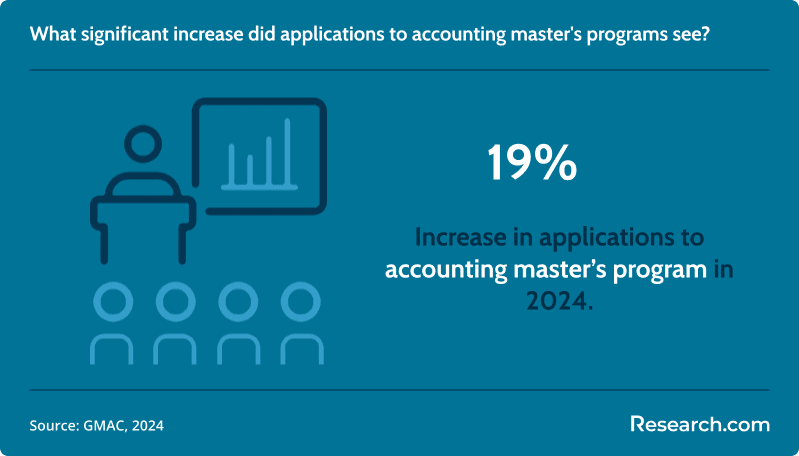
- Rising program interest: Applications to accounting master’s programs increased by 19% in 2024, and about 72% of U.S. master’s in accounting programs reported application growth.
- Workforce composition: 61.8% of accountants are women, and 38.2% of accountants are men.
MBA Job Market Trends
- Changing hiring patterns: The global market for MBA graduates is evolving as hiring cycles shift in traditional sectors such as technology and consulting. Job searches have extended to an average of 6–9 months, making planning, networking, and market targeting more important.
- Admissions selectivity: An average of 18.4% of applicants are accepted into MBA programs, although acceptance rates vary by school prestige, public or private status, and online or in-person format.
- Salary gaps: On average, male MBA graduates earn 20% more annually than female MBA graduates. The average salary is $180,000 for men and $150,000 for women with an MBA, and the gap remains across experience levels.
AI, Automation, and Technology Impact
Technology is changing both pathways. Accounting professionals increasingly need comfort with automation, analytics, audit technology, financial systems, and data quality. Routine bookkeeping tasks may become more automated, but demand remains for professionals who can interpret standards, evaluate controls, communicate findings, and apply judgment.
MBA graduates also face rising expectations in analytics, artificial intelligence, digital transformation, and technology-enabled strategy. Employers increasingly expect managers to understand data, lead change, evaluate technology investments, and communicate across technical and nontechnical teams.
| Trend | Impact on Accounting Master’s Graduates | Impact on MBA Graduates |
| Automation | Raises the value of analytical judgment, audit oversight, controls, and interpretation beyond routine transactions | Increases demand for leaders who can manage digital transformation and process improvement |
| Data analytics | Strengthens roles in reporting, risk, compliance, forecasting, and audit support | Supports decision-making in strategy, marketing, operations, finance, and leadership |
| Regulation and compliance | Supports demand for professionals who understand reporting rules, tax issues, and controls | Creates need for managers who can align business strategy with governance and risk expectations |
| Flexible education | Expands access to online accounting master’s programs | Drives strong demand for online MBA formats and broader program choice |
Common Mistakes When Choosing Between a Master’s in Accounting and an MBA
| Mistake | Why It Can Hurt You | Better Approach |
| Choosing based only on salary averages | Salary depends on role, experience, location, employer, industry, credentials, and performance. | Compare the specific jobs you want, not just degree-level salary claims. |
| Ignoring accreditation | Poor accreditation can affect employer trust, financial aid eligibility, and credential preparation. | Verify business accreditation and, for accounting, CPA or CMA alignment. |
| Assuming every online accounting program meets CPA requirements | CPA education rules vary by state, and out-of-state online programs may not meet your target state’s requirements. | Check your state board requirements before enrolling. |
| Looking only at tuition | Fees, books, software, travel, lost income, and exam costs can change the real price. | Calculate total cost of attendance and expected debt. |
| Picking an MBA without a career plan | A broad degree can become expensive if you do not know how you will use it. | Choose a concentration, target employers, and define the career move before enrolling. |
| Choosing accounting without liking technical work | Accounting careers require precision, standards, documentation, and detail-oriented analysis. | Review course descriptions and job tasks before committing. |
| Relying only on rankings | A highly ranked program may not be the best fit for your budget, location, schedule, or career target. | Compare outcomes, cost, format, accreditation, faculty, career services, and employer connections. |
Questions to Ask Before You Enroll
- What job title do I want within three to five years after graduation?
- Do I want to become a CPA, CMA, manager, consultant, entrepreneur, analyst, controller, or executive?
- Does the program meet licensing or credential requirements in the state where I plan to work?
- What is the total cost of the degree, including fees, materials, and lost income?
- What scholarships, assistantships, employer tuition benefits, or loan options are realistic for me?
- Are graduates working in the roles and industries I am targeting?
- Does the online or part-time format include networking, advising, and career support?
- Will the curriculum build the technical, analytical, leadership, and communication skills employers expect?
- How strong is the alumni network in my region or target industry?
- What is my backup plan if hiring conditions change while I am enrolled?
Graduate Perspectives on Master’s in Accounting vs. MBA
-
: "
My accounting master’s gave me the technical confidence to work with complex reporting issues early in my career. Some classmates in MBA programs moved into broader management conversations sooner, but my specialized training helped me add value on detailed financial projects right away. - Raymond
"
-
: "
The MBA helped me think beyond one function. I had to build more technical knowledge for certain finance-adjacent roles, but the leadership training, strategic coursework, and professional network became important as I moved toward management. - Isabelle
"
-
: "
I chose the master’s in accounting because I wanted a clear route into a field that rewards precision and expertise. The focused coursework prepared me for financial reporting work and supported my CPA exam goals in a way a broader MBA would not have. - Kenji
"
Key Insights
- A master’s in accounting is best for students who want technical accounting depth, CPA- or CMA-related preparation, and careers in audit, tax, reporting, compliance, or controllership.
- An MBA is better suited for professionals who want broad management training, career flexibility, leadership development, and access to roles in consulting, operations, marketing, finance, strategy, or entrepreneurship.
- Full-time master’s in accounting programs usually take 12–24 months, while traditional full-time MBA programs typically take 18–24 months; part-time options for both can take several years.
- Cost can differ significantly. Public master’s in accounting programs average around $12,600 for the full program, while the average MBA cost is $61,800, with prestigious programs exceeding $100,000.
- Online MBA options are generally more widely available, and a 64% surge in online MBA applications shows strong demand for flexible graduate business education.
- Accounting employment has a stable outlook, with the profession projected to grow 6% from 2024 to 2034 and about 130,800 job openings annually for accountants and auditors.
- Applications to accounting master’s programs rose 19% in 2024, and about 72% of U.S. master’s in accounting programs reported application growth.
- MBA outcomes can vary widely by program reputation, network, specialization, prior experience, and hiring market conditions. Job searches have extended to an average of 6–9 months in the evolving MBA labor market.
- Do not choose either degree based on prestige alone. Verify accreditation, total cost, career services, employer outcomes, credential alignment, and whether the curriculum matches your target role.
- The simplest decision rule: choose accounting for specialized financial expertise; choose the MBA for broader business leadership and career mobility.
References:
- Bureau of Labor Statistics. (2024). Field of degree: Business. U.S. Department of Labor. Retrieved from https://www.bls.gov/ooh/field-of-degree/business/business-field-of-degree.htm
- Flynn, J. (2023, March 28). 25 Educational MBA Statistics [2023]: Average Age, Cost, And Salary For MBA Graduates. Zippia. Retrieved from https://www.zippia.com/advice/mba-statistics
- Graduate Management Admission Council. (2024). Application Trends Survey 2024 Report. Retrieved from https://www.gmac.com/-/media/files/gmac/research/admissions-and-application-trends/2024_ats.pdf?rev=7fdd40dc7f914d97a29ed5c0f42834c2
- U.S. Bureau of Labor Statistics. (2025, May 14). Accountants and Auditors. Retrieved from https://www.bls.gov/ooh/business-and-financial/accountants-and-auditors.htm
- U.S. Department of Labor. (n.d.). Soft Skills: The Competitive Edge. Retrieved May 17, 2025, from https://www.dol.gov/agencies/odep/publications/fact-sheets/soft-skills-the-competitive-edge
- ZipRecruiter. (2025). Accounting Manager Salary. Retrieved May 17, 2025, from https://www.ziprecruiter.com/Salaries/Accounting-Manager-Salary
- ZipRecruiter. (2025). Controller Salary. Retrieved May 17, 2025, from https://www.ziprecruiter.com/Salaries/Controller-Salary
- ZipRecruiter. (2025). Financial Analyst Salary. Retrieved May 17, 2025, from https://www.ziprecruiter.com/Salaries/Financial-Analyst-Salary
- ZipRecruiter. (2025). Management Consultant Salary. Retrieved May 17, 2025, from https://www.ziprecruiter.com/Salaries/Management-Consultant-Salary
- ZipRecruiter. (2025). Marketing Manager Salary. Retrieved May 17, 2025, from https://www.ziprecruiter.com/Salaries/Marketing-Manager-Salary
- ZipRecruiter. (2025). Operations Manager Salary. Retrieved May 17, 2025, from https://www.ziprecruiter.com/Salaries/Operations-Manager-Salary
- ZipRecruiter. (2025). Project Accountant Salary. Retrieved May 17, 2025, from https://www.ziprecruiter.com/Salaries/Project-Accountant-Salary
Other Things You Should Know About Master’s in Accounting vs. MBA
An MBA is generally better if you seek broad business leadership roles or want flexibility across industries. At the same time, a master’s in accounting is ideal if you aim to become a specialized accounting professional or pursue a CPA license. The MBA offers a wider skill set and networking opportunities, making it suitable for management or entrepreneurial paths. In contrast, the master’s in accounting provides deep expertise for auditing, taxation, or corporate accounting careers. Your choice depends on your career goals and interests.
A Master's in Accounting focuses deeply on accounting principles, preparing students for CPA exams, while an MBA offers a broader business education with courses in finance, marketing, and management. In 2027, choosing between the two depends on whether you want specialized accounting knowledge or a wide-ranging business skill set.


