
2027 Doctorate in Accounting Programs Guide

Co-Founder and Chief Data Scientist
Choosing a doctorate in accounting is not the same as choosing another accounting credential. This degree is usually for people who want to produce research, teach at the college level, lead complex finance functions, or advise organizations on high-stakes accounting decisions. It can be valuable, but it is also expensive, time-intensive, and unnecessary for many accounting careers.
This guide explains what a Doctorate in Accounting involves, how PhD and DBA options differ, what programs cost, how long they take, which careers they may support, and what questions to ask before applying. It is designed for accounting professionals, CPA-track candidates, finance leaders, consultants, and prospective faculty members who want a practical way to decide whether doctoral study fits their goals.
Quick answer: Is a Doctorate in Accounting worth it?
A Doctorate in Accounting can be worth it if your goal is college teaching, academic research, senior finance leadership, specialized consulting, or executive-level accounting strategy. It is usually not required if your main goal is to become an accountant, auditor, bookkeeper, tax preparer, or CPA. For those roles, a bachelor’s degree, master’s degree, accounting credits, and professional certification are usually more direct routes.
What are the benefits of getting a Doctorate in Accounting?
- Graduates may qualify for advanced roles in research, consulting, finance leadership, executive management, and postsecondary teaching.
- The average annual base salary for someone with a doctorate accounting degree is $98,000 and can reach up to $100,000 or more.
- Doctoral study allows students to concentrate on a narrow accounting topic, such as auditing, taxation, forensic accounting, financial reporting, or accounting analytics.
What can I expect from a Doctorate in Accounting?
A doctorate in accounting is an advanced graduate program focused on research, theory, high-level analysis, and professional application. Students learn how to investigate accounting problems, evaluate financial information, interpret data, publish or present research, and apply evidence-based thinking to organizations, markets, and classrooms.
The two most common options are a Doctor of Philosophy (PhD) in Accounting and a Doctor of Business Administration (DBA) with an accounting concentration. A PhD is usually the better fit for students who want research-intensive academic careers. A DBA is generally more practice-oriented and is often chosen by experienced professionals who want to apply research to executive, consulting, or organizational leadership problems.
| Decision point | PhD in Accounting | DBA in Accounting |
| Best fit | Future researchers, tenure-track faculty, and academic scholars | Experienced professionals, executives, consultants, and applied business leaders |
| Main focus | Original academic research and theory development | Applied research used to solve business and accounting problems |
| Typical final project | Dissertation | Dissertation, doctoral study, or capstone depending on the school |
| Common delivery formats | On campus, hybrid, or limited online options | Online, hybrid, executive, or campus-based options |
| Career alignment | University faculty, research centers, policy research, academic publishing | Corporate leadership, consulting, entrepreneurship, applied research, teaching in some settings |
Both online and campus-based programs exist. Some online programs still include residencies, weekend intensives, live seminars, or dissertation workshops. Prospective students should review residency requirements carefully because “online” does not always mean fully remote.
Students can typically expect doctoral work to include:
- Training in advanced quantitative, qualitative, analytical, archival, or experimental research methods.
- Small seminar-style courses with close faculty interaction.
- Research collaboration with faculty members and doctoral peers.
- Substantial independent reading, writing, data analysis, and dissertation preparation.
- Use of online research databases, virtual meeting tools, statistical software, and collaborative platforms.
- Opportunities to specialize in a defined area of accounting rather than study general accounting broadly.
Where can I work with a Doctorate in Accounting?
A doctorate in accounting can support careers in academic, corporate, government, nonprofit, and consulting environments. The degree is most useful when the role requires advanced research ability, deep accounting expertise, strategic decision-making, or credibility as a subject-matter expert.
- Consulting firms
- Government agencies
- Non-profit organizations
- Corporations or enterprises
- Investment, securities, and credit companies
- Academia, including universities, colleges, and research facilities
According to the U.S. Bureau of Labor Statistics (2024), the largest employers of accountants and auditors in May 2023 were accounting, tax preparation, bookkeeping, and payroll services (23%). Doctoral graduates may also work in technology/financial technology, forensic accounting, law-adjacent financial analysis, policy research, and executive finance. Among those who move into postsecondary teaching, 28% work in private higher education institutions, while 39% hold roles in state universities (BLS, 2024).
How much can I make with a Doctorate in Accounting?
Earnings vary widely because doctoral graduates do not all enter the same occupation. A PhD graduate teaching accounting at a university may have a different salary profile from a DBA graduate working as a financial executive or consultant. Location, employer type, tenure status, research productivity, leadership responsibility, and prior experience all affect compensation.
For postsecondary educators who teach business, BLS data show the following wage figures:
- Mean annual wage: $108,060
- 10% percentile: $48,100
- 50% percentile: $88,790
- 90% percentile: $206,630
For graduates who move into high-level corporate roles such as financial manager, BLS figures include:
- Mean annual wage: $166,050
- 10% percentile: $79,050
- 50% percentile: $139,790
- 90% percentile: $239,200
Salary data should be treated as planning information, not a guarantee. A doctorate may improve access to certain roles, but income depends on the job you obtain, your work history, your geographic market, and how well the program aligns with your career strategy.
- Best Doctorate in Accounting Programs for 2027
- How long does it take to complete a Doctorate in Accounting program?
- Online vs. on-campus Doctorate in Accounting programs
- Average cost of a Doctorate in Accounting program
- Financial aid options for Doctorate in Accounting students
- Admission requirements for Doctorate in Accounting programs
- Common courses in a Doctorate in Accounting program
- Doctorate in Accounting specializations
- How to choose the right Doctorate in Accounting program
- Career paths after a Doctorate in Accounting
- Combining a doctorate with another graduate degree
- Job market outlook for Doctorate in Accounting graduates
- Return on investment of a Doctorate in Accounting
- Additional certifications to consider with a Doctorate in AccountingROI considerations
- Doctoral accounting study and actuarial career goals
- How professional certifications can support career growth
- Accreditation standards to check before enrolling
- Emerging research trends in accounting doctoral programs
- Using a Doctorate in Accounting for consulting or entrepreneurship
- When an education leadership doctorate may be a better fit
- Mentorship and professional networks in doctoral study
- Technology and automation in accounting doctoral programsEducation leadership comparisonAdditional program questionsConsulting pathJob market outlookKey insights
List of the Best Doctorate in Accounting Programs for 2027
How do we rank schools?
A doctoral program can affect your finances, career path, research network, and professional identity for years. Research.com uses a structured methodology to evaluate programs and present information that helps prospective students compare options more carefully.
Program information is informed by sources such as the Integrated Postsecondary Education Data System (IPEDS), Peterson’s database, including its Distance Learning Licensed Data Set, College Scorecard, and the National Center for Education Statistics (NCES). Rankings should be used as a starting point, not as the only reason to choose a school.
How to use this program list
Before comparing schools, decide whether you need a research-oriented PhD, a practice-based DBA, a fully online format, a hybrid executive model, or a campus-based doctoral experience. Then compare accreditation, funding, faculty fit, dissertation support, research expectations, completion time, and residency requirements.
| School | Degree option | Program length | Cost information | Accreditation |
| University of Texas at Austin | PhD in Accounting | Five years | Full-time quotation $8,684$10,848 (residents), $17,312$19,786 (non-residents) | AACSB |
| University of Illinois at Urbana-Champaign | PhD in Accountancy | Five years | $652 | AACSB |
| Stanford University | PhD in Accounting | Four years | Full tuition quote $48,960/year | AACSB |
| Walden University | DBA Accounting Specialization | Four to eight years | $1,025 | ACBSP |
| National University | DBA in Advanced Accounting | Three to four years | $442 per quarter unit | ACBSP |
| Capella University | PhD in Business Management Accounting | Three to four years | $985 | ACBSP |
| Liberty University | DBA in Accounting | Three years | $595 (total cost est. $35,700) | ACBSP |
| Florida Atlantic University | Executive PhD in Business Administration focusing on Accounting | Three years | $1,000 | AACSB |
| West Virginia University | DBA with a concentration on Accounting | Three to four years | $1,200 (total cost est. $63,600) | AACSB |
| Trident University | PhD in Business Administration with accounting and finance focus | Three to four years | $990 | ACBSP |
1. University of Texas at Austin
The University of Texas at Austin offers a PhD in Accounting through the McCombs School of Business. The program has been offered since 1934 and includes a one-term teaching requirement for doctoral students. Students may use analytical, archival, and experimental approaches in accounting research, while also building knowledge in statistics and foundational work in psychology or economics. McCombs doctoral students participate in small seminars, lab meetings, and one-on-one mentoring. CPA certification is not required for admission.
- Program Length: Five years
- Tracks/Concentrations: Auditing, Financial Accounting, Managerial Accounting, Taxation
- Cost per Credit: Full-time quotation $8,684$10,848 (residents), $17,312$19,786 (non-residents)
- Required Credits to Graduate: 30 semester hours min. in advanced coursework, including dissertation hours
- Accreditation: Association to Advance Collegiate Schools of Business (AACSB)
2. University of Illinois at Urbana-Champaign
The University of Illinois at Urbana-Champaign offers a PhD in Accountancy through Gies College of Business. The program is built for students preparing for research and teaching careers and emphasizes close collaboration with faculty scholars. Doctoral students study theories from finance, economics, and behavioral science while developing institutional knowledge and analytical and empirical research skills. Research development begins early in the program.
- Program Length: Five years
- Tracks/Concentrations: PhD in Accountancy
- Cost per Credit: $652
- Required Credits to Graduate: 96
- Accreditation: AACSB
3. Stanford University
Stanford University offers a PhD in Accounting through its Graduate School of Business. The program focuses on analytical and empirical research related to corporate governance, financial reporting, managerial accounting, and taxation. Stanford states that the program prepares scholars for research and teaching careers at leading academic institutions worldwide. Accepted PhD students can receive a full fellowship for doctoral study.
- Program Length: Four years
- Tracks/Concentrations: PhD in Accounting
- Cost per Credit: Full tuition quote $48,960/year
- Required Credits to Graduate: 135 (for residency)
- Accreditation: AACSB
4. Walden University
Walden University offers an online DBA with a specialization in accounting. The professional doctorate is designed for experienced academics and business professionals who want to influence organizations and the accounting field. Coursework applies theory and research to real business and management challenges. Students typically complete foundational courses, core courses, specialization courses, research methods courses, two residencies, and a doctoral capstone.
- Program Length: Four to eight years
- Tracks/Concentrations: DBA Accounting Specialization
- Cost per Credit: $1,025
- Required Credits to Graduate: 60 (minimum)
- Accreditation: Accreditation Council for Business Schools and Programs (ACBSP)
5. National University
National University (NU), formerly Northcentral University, offers a DBA in Advanced Accounting that may be completed online or onsite. The program does not require group work or residency and emphasizes applied research for organizational problem-solving. It is designed for senior roles such as vice president of accounting and chief accountant. NU does not require the GRE or GMAT and uses rolling enrollment with eight-week courses.
- Program Length: Three to four years
- Tracks/Concentrations: DBA in Advanced Accounting
- Cost per Credit: $442 per quarter unit
- Required Credits to Graduate: 48 (minimum)
- Accreditation: ACBSP
6. Capella University
Capella University offers an online PhD in Business Management Accounting in a guided learning format. Students usually take one to two courses during each 10-week quarter. Coursework includes weekly deadlines, but students can access materials flexibly and consult academic coaches. The competency-based curriculum covers business principles and practices, qualitative or quantitative research methods, and accounting specialization topics. Students complete an exam and dissertation.
- Program Length: Three to four years
- Tracks/Concentrations: Advanced Research in Accounting, Financial Reporting, Accounting in the Global Era, Forensic Accounting
- Cost per Credit: $985
- Required Credits to Graduate: 90
- Accreditation: ACBSP
7. Liberty University
Liberty University offers a DBA in Accounting in an online format. Students study topics such as supply chain management, marketing, human resources, strategy formation, and accounting for decision-making. The program concludes with a doctoral research project. Courses use an eight-week format, and students access lessons and assignments through an online learning platform. Student support services are available throughout the program.
- Program Length: Three years
- Tracks/Concentrations: Tax Research and Jurisprudence, Advanced Auditing, Advanced Financial Accounting Theory, Accounting Ethics
- Cost per Credit: $595 (total cost est. $35,700)
- Required Credits to Graduate: 60
- Accreditation: ACBSP
8. Florida Atlantic University
Florida Atlantic University offers a hybrid Executive PhD in Business Administration with an accounting focus. The curriculum includes research methods, econometrics, contemporary issues, and advanced management theory. Students attend live online sessions and must participate in two residency weekends on campus during the fall and spring semesters. They also attend campus once each summer session, resulting in five residency weekends per academic year.
- Program Length: Three years
- Tracks/Concentrations: Accounting, Economics, Finance, Information Technology, Management or Marketing
- Cost per Credit: $1,000
- Required Credits to Graduate: 80
- Accreditation: AACSB
9. West Virginia University
West Virginia University offers a DBA with a concentration on Accounting for experienced professionals. The program uses a cohort model with asynchronous coursework. Optional campus residencies are available for students who want networking and campus engagement. The curriculum emphasizes research seminars, research methodology, and dissertation work. Small class sizes support individualized learning and faculty or peer mentorship.
- Program Length: Three to four years
- Tracks/Concentrations: Accounting, Economics, Management, Marketing
- Cost per Credit: $1,200 (total cost est. $63,600)
- Required Credits to Graduate: 53
- Accreditation: AACSB
10. Trident University
Trident University offers an online PhD in Business Administration with an accounting and finance focus. The research-oriented program includes coursework in data analysis, advanced data management, corporate finance, and financial accounting. Students complete 12 sessions for dissertation work and are encouraged to publish in peer-reviewed journals or present research at academic conferences. Learners also receive technical support and personalized faculty assistance.
- Program Length: Three to four years
- Tracks/Concentrations: Accounting/Finance, Information Systems/Information Technology Management, Leadership, Management and Organizations, Marketing
- Cost per Credit: $990
- Required Credits to Graduate: 56
- Accreditation: ACBSP
Key findings about Doctorate in Accounting programs
- 3% of CPAs in the US work in the education sector.
- The average cost of a doctoral program ranges from $93,670 to $129,395 or more.
- Leadership roles may be available to graduates with doctorates in accounting, and chief-level professionals can earn as much as $246,440 each year.
- Between 2024 and 2034, the job outlook for postsecondary business educators is projected to increase by 6%, creating roughly 8,100 openings annually.
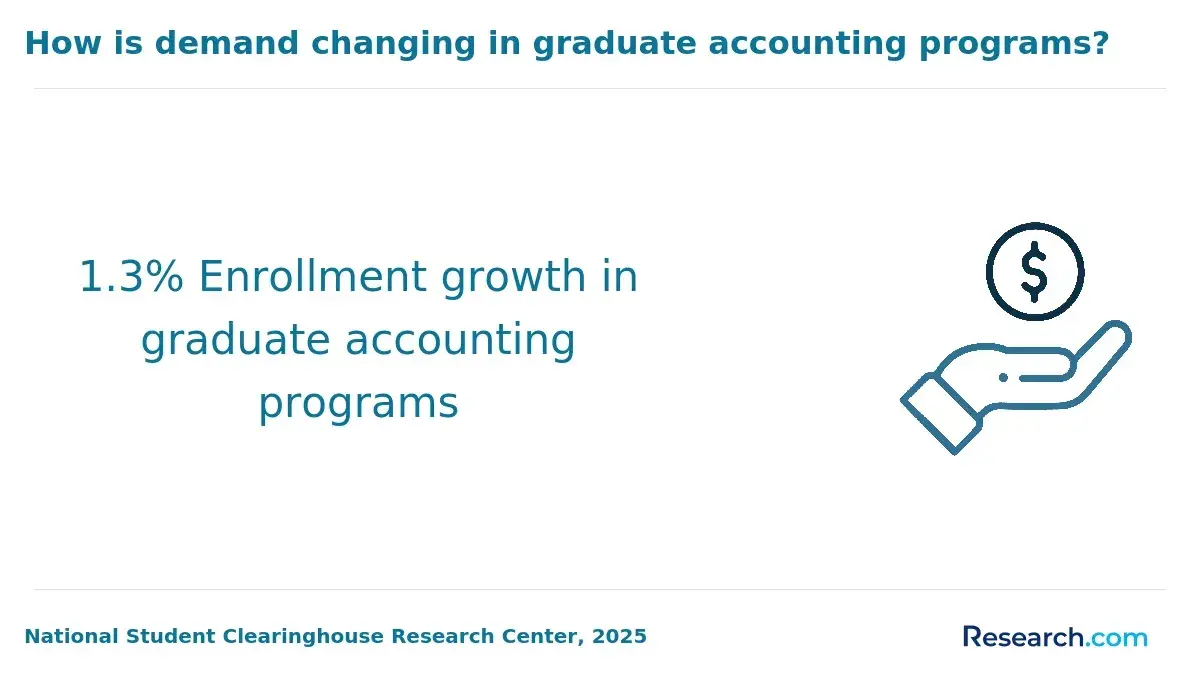
- Enrollment for graduate-level business majors has recently rebounded, driven largely by specialized master's programs. In the 2023–24 academic year, 363,968 students were enrolled in master's programs at AACSB-accredited schools, representing a 13% increase over the previous six years (AACSB, 2024).
How long does it take to complete a Doctorate in Accounting program?
A PhD in Accounting can take three to eight years to complete. Students often spend the first three years on coursework, research training, seminars, and exams, then shift more heavily into dissertation research beginning in the fourth year. Some students also complete teaching assistantships or research assistantships as part of their doctoral funding or training. Many DBA programs are completed within three to four years.
| Program type | Typical timeline | Common time commitments | Best for |
| PhD in Accounting | Three to eight years | Coursework, research seminars, teaching or research assistantships, dissertation | Students pursuing academic research or faculty careers |
| DBA in Accounting | Three to four years | Applied coursework, research methods, residencies in some programs, doctoral capstone or dissertation | Working professionals seeking executive, consulting, or applied leadership roles |
| Executive or hybrid doctorate | Often structured around working professionals | Online coursework plus required campus weekends or residencies | Professionals who want doctoral study without leaving the workforce |
Enrollment in business doctoral and graduate programs has shifted since the pandemic. A 2024 report shows a 13% increase in enrollment for graduate-level business majors since 2018 (AACSB, 2024). The students enrolled in business graduate degrees (453,960) in 2024 rose to 468,540 in 2025 (Education Data Initiative, 2025). Accounting organizations and educators continue to focus on updating training as technology, analytics, and changing licensure expectations reshape the profession.
A doctorate is not required to enter accounting. Students who want the fastest route into entry-level accounting roles may be better served by accelerated bachelor degrees online, certificate programs, CPA-aligned coursework, or master’s degrees. Doctoral programs are most appropriate when your goals require research depth, teaching preparation, or senior-level expertise.
The chart below uses data gathered from the National Student Clearinghouse to show enrollment trends among business graduate degrees.
How does an online Doctorate in Accounting compare to an on-campus program?
An accredited online doctorate in accounting can be academically rigorous, but delivery format matters. As with an accredited online master’s degree in accounting vs a traditional degree, quality depends on accreditation, faculty strength, research support, curriculum design, and student outcomes—not simply whether classes meet online or in person.
| Factor | Online doctorate | On-campus doctorate |
| Flexibility | Better for working professionals, especially if asynchronous courses are available | Less flexible, but often more immersive |
| Networking | Depends on live sessions, residencies, cohort structure, and faculty availability | More frequent in-person access to faculty, peers, seminars, and campus events |
| Research support | Can be strong, but students should confirm database access, dissertation advising, and methods support | Often easier to access research workshops, faculty offices, and campus resources |
| Residency requirements | May include campus weekends, summer sessions, or dissertation intensives | Built into the program because students are already on campus |
| Best fit | Professionals balancing doctoral study with employment or family commitments | Students seeking full immersion in academic research culture |
Online doctoral programs commonly use live discussions, virtual research meetings, learning management systems, digital libraries, collaborative writing tools, and online assessment platforms. Some are highly structured, while others require more self-direction.
Campus programs provide face-to-face access to professors, research workshops, teaching opportunities, and peer communities. Hybrid programs attempt to combine both models by offering online coursework with scheduled campus residencies.
What is the average cost of a Doctorate in Accounting program?
Doctoral costs vary significantly by school type, residency status, funding, delivery format, and program length. Based on estimates from sources including the NCES (n.d.), College Tuition Compare (n.d.), and Education Data Initiative (Hanson, 2023), prospective students should plan around the following figures:
- Full-time graduate, public postsecondary (2024-2025): $13,790
- Graduate accounting program, in-state (2025): $11,365
- Graduate accounting program, out-of-state (2025): $21,890
- Doctorate, public: $93,670
- Doctorate private: $129,395
These figures are broad estimates rather than exact program prices. Some affordable doctoral programs may cost, more or less, the same as a bookkeeping associates degree, but students should calculate the full cost of attendance rather than compare tuition alone.
| Cost factor | Why it matters | Question to ask |
| Tuition structure | Programs may charge per credit, per quarter unit, per semester, or by full-time enrollment | Is the quoted price per credit, per term, per year, or total program cost? |
| Residency status | Public universities may charge different rates for residents and non-residents | Do online students pay in-state, out-of-state, or separate online tuition? |
| Residencies | Travel, lodging, meals, and time away from work can add cost | How many campus visits are required before graduation? |
| Dissertation extension fees | Students who take longer may continue paying tuition or fees | What happens financially if dissertation work extends beyond the standard timeline? |
| Lost income or reduced workload | Full-time doctoral study may limit employment | Can I realistically keep working while completing this program? |
What are the financial aid options for students enrolling in a Doctorate in Accounting program?
Financial aid differs sharply between PhD and DBA programs. Research-focused PhD programs may offer assistantships, stipends, fellowships, or tuition support, especially for full-time students preparing for academic careers. DBA students, particularly in professional and online programs, may be less likely to receive full tuition waivers and stipends, but they can still explore loans, scholarships, employer tuition assistance, and professional association funding.
The American Institute of Certified Public Accountants (AICPA) identifies several funding options for doctoral accounting students, including the Accounting Doctoral Scholars Program (ADS) for accounting faculty members, the AICPA Fellowship for Minority Doctoral Students, and the William (Bill) Ezzell Scholarship for CPAs pursuing their PhDs. Some employers may also help pay for doctoral study when the degree supports leadership, consulting, or organizational goals.
College Board statistics state that an average of $30,100 in financial aid was allotted to full-time graduate students for S.Y. 2024-2025. Of that amount, $10,500 was in grants, and $18,200 was in federal loans. The average loan debt for someone with a doctorate is $135,000, while 23.5% of PhD students say they offset their education costs with teaching assistantships.
| Aid option | Usually best for | Important caution |
| Teaching assistantship | PhD students preparing for faculty careers | May require campus presence and teaching duties |
| Research assistantship | Students working closely with faculty on research | Availability depends on faculty funding and department priorities |
| Employer tuition assistance | DBA students and working professionals | May require continued employment after graduation |
| Scholarships and fellowships | Students with strong academic, professional, or diversity-related eligibility | Deadlines and eligibility rules vary |
| Federal loans | Students who need borrowing support | Debt should be weighed against realistic career outcomes |
What are the prerequisites for enrolling in a Doctorate in Accounting program?
Admission requirements vary by institution, but most doctoral accounting programs expect applicants to show academic readiness, research potential, quantitative ability, and a clear reason for pursuing doctoral study.
- Master’s degree in accounting or related field
- Official transcripts
- Proof of coursework in accounting or related subjects for non-accounting majors
- GPA of at least 3.0
- Three to five years of work experience
- Resume or CV
- Letters of recommendation
- Statement of purpose
Some programs require GRE or GMAT scores, while more competitive schools may expect a minimum GPA of 3.5. Applicants may also need interviews, writing samples, research statements, proof of professional licensure or certification, or stronger work experience. International applicants may be required to submit English proficiency documentation.
Completing PhD requirements takes planning because doctoral study is less course-based than many earlier degrees. Admissions committees often look for applicants who understand research expectations, can work independently, and have a focused academic or professional purpose.
According to the National Center for Education Statistics (2025), health professions and related programs had 87,800 doctoral degrees conferred—the highest number of doctoral degrees earned by the field of research in A.Y. 2022-2023 in the United States. This was followed by legal professions and studies at 36,500, education at 13,100, engineering at 11,400, and biological and biomedical sciences at 7,650. Business, where accounting belongs, ranked 10th on the list, with 3,950 degrees conferred (NCES, 2025).
The chart below presents Statista data on the share of students who earned doctoral degrees.
What courses are typically in a Doctorate in Accounting program?
Doctoral accounting programs vary by school, but most combine advanced accounting theory, research design, statistics or econometrics, data analysis, doctoral seminars, and dissertation preparation. Students who are still building foundational accounting knowledge may want to compare options such as reputable online colleges or the best online accounting schools before applying to doctoral programs.
| Course area | What students study | Why it matters |
| Advanced Financial Accounting | Complex reporting topics such as consolidations, partnerships, and international accounting standards | Builds expertise in sophisticated financial reporting issues |
| Quantitative Research Methods | Research questions, hypotheses, study design, statistical interpretation, and evidence evaluation | Prepares students to conduct defensible doctoral research |
| Tax Research and Planning | Advanced tax concepts, planning strategies, and research methods | Supports work in complex tax environments and specialized research |
| Leadership in Accounting Education | Teaching methods, curriculum design, and academic leadership | Helps students preparing for faculty or instructional roles |
| Applied Data Analytics in Accounting | Use of data tools for financial analysis, auditing, and decision-making | Reflects employer demand for technology-aware accounting professionals |
| Dissertation Research Seminar | Development, refinement, and defense of a doctoral research project | Guides students through the central requirement of many doctoral programs |
Strong candidates usually have or are willing to develop the following abilities:
- Foundational accounting knowledge
- Researching and writing skills
- Information management ability
- Interpersonal and leadership skills
- Basic knowledge of digital accounting tools
Technology is changing what accountants need to know. In a discussion of accounting roles in the AI era, Jac (2024) emphasized that future accountants need technological understanding, collaboration skills, and the ability to communicate with different stakeholders across business contexts. Doctoral students should expect programs to place increasing weight on analytics, digital systems, and research methods that address technology-driven accounting questions.
What types of specializations are available in Doctorate in Accounting programs?
Specialization matters because doctoral work is deep rather than broad. The right concentration should connect your research interests, faculty expertise, and career target.
- Forensic Accounting. This area builds on topics also found in a forensic accounting masters degree, with a stronger emphasis on fraud research, financial irregularities, litigation support, and investigative methods.
- Advanced Taxation. Students examine corporate, international, and estate taxation, as well as tax optimization, policy analysis, and ethical issues in tax practice.
- Advanced Auditing. This specialization covers risk assessment, internal control evaluation, auditing standards, data analytics, and technology’s effect on audit processes.
- Corporate Finance. Doctoral study may address mergers and acquisitions, corporate governance, restructuring, capital decisions, and finance-related accounting questions.
- Financial Reporting. Students focus on financial statement preparation and analysis, revenue recognition, accounting for financial instruments, disclosure rules, strategic decisions, and investment-related reporting.
How to choose the best Doctorate in Accounting program?
The best doctoral program is not always the highest-ranked or most recognizable school. It is the program that matches your research interests, career goal, budget, schedule, and required level of faculty support. This is true whether you are comparing doctoral programs or earlier options such as the best forensic accounting master’s programs.
- Accreditation. Confirm institutional accreditation and business or accounting accreditation. AACSB, ACBSP, or IACBE accreditation can indicate that the program meets recognized business education standards.
- Faculty expertise. Review faculty publications, research areas, professional experience, and dissertation supervision history.
- Student support. Look for academic mentoring, research methods help, writing support, mental health resources, online library access, career services, and dissertation coaching.
- Curriculum fit. Compare required courses, electives, research methods training, dissertation milestones, and specialization options.
- Alumni outcomes. Ask where graduates work, whether they publish, how many finish, and what roles they obtain after graduation.
Many doctoral accounting students are preparing for academia or research-heavy work. Doctoral programs are not usually designed to help students study accounting for licensure exams. If CPA eligibility is your primary goal, check state board requirements before assuming a doctorate is the most efficient path.
Doctorate holders are not always required to hold accounting certifications for teaching or research jobs, but credentials can strengthen professional credibility in consulting, executive, forensic, tax, or audit-focused work.
| Question to ask | Why it matters |
| Does the program’s faculty publish in my area of interest? | Your dissertation success often depends on faculty fit. |
| Is the degree a PhD, DBA, or executive doctorate? | The degree type affects research expectations and career positioning. |
| Are residencies required? | Travel requirements can affect cost, schedule, and feasibility. |
| What is the dissertation support model? | Poor advising can delay completion and increase cost. |
| Are assistantships, stipends, or tuition waivers available? | Funding can change the ROI calculation dramatically. |
| What careers do recent graduates actually enter? | Published outcomes are more useful than broad marketing claims. |
What career paths are available for graduates of Doctorate in Accounting programs?
A doctorate can expand options beyond traditional accounting roles, but it does not automatically qualify graduates for every senior position. Employers still weigh experience, leadership record, technical skills, certifications, and industry knowledge. Students exploring broader employment options for someone with an accounting degree should compare doctoral outcomes with bachelor’s, master’s, and certification-based pathways.
| Career path | Annual earning potential | How a doctorate may help |
| Forensic Accountant | $76,457 | Supports specialized research, fraud analysis, and expert-level credibility |
| Accountant | $86,740 | Usually does not require a doctorate, though advanced expertise may help in specialized roles |
| Budget Analyst | $87,680 | Research and analytical skills can support complex public or organizational budgeting work |
| Financial and Investment Analyst | $108,790 | Advanced quantitative and reporting knowledge may strengthen analysis roles |
| Financial Risk Analyst | $116,140 | Doctoral methods training can support risk modeling, controls research, and advisory work |
| Personal Financial Advisor | $137,740 | May add credibility, though licensure and client-building skills are also important |
| Research Scientist | $155,880 | Aligns closely with doctoral research training |
| Chief Financial Officer | $246,440 | Can support strategic credibility, but executive experience is essential |
Different college degrees lead to different career options and earning potential. In general, more education can support higher-paying roles, but salary is also shaped by employer, location, experience, performance, certifications, and market demand.
Can Combining a Doctorate with Other Graduate Degrees Enhance Your Career Prospects?
Combining a doctorate with another graduate degree can make sense when each credential serves a distinct purpose. For example, a doctorate may build research authority, while another graduate degree may add applied management, analytics, finance, or policy knowledge. Students comparing advanced credentials can review examples of high paying master's degrees to understand how different graduate paths align with compensation and career mobility.
This approach is most useful for professionals targeting interdisciplinary roles, such as accounting analytics leader, financial policy researcher, executive consultant, or business school faculty member with industry specialization. It is less useful if the second degree duplicates material you already know or adds debt without improving your target role.
What is the job market for graduates with a Doctorate in Accounting?
Many careers in financial accounting are projected to grow from 2024 to 2034. Based on BLS data, employment is expected to increase for financial managers (17%), personal financial advisors (17%), and financial analysts/risk specialists (9%). Opportunities for accountants (6%) and top executives (5%) are also projected to grow, which is just as fast as the average for all occupations. (U.S. Bureau of Labor Statistics, 2025)
For postsecondary educators teaching business, employment growth is listed as 9% from 2024 to 2034, while overall growth for postsecondary teachers is 10%. (U.S. Bureau of Labor Statistics, 2025) The projected number of openings for postsecondary educators teaching business during this period is 106,900 positions (BLS, 2023b).
Demand for accounting educators is also connected to changes in the profession. The CPA Evolution initiative, developed by the American Institute of Certified Public Accountants (AICPA) and the National Association of State Board Accountancy (NASBA), aims to promote an improved CPA licensure model that reflects changing skills and competencies in accounting practice. As accounting education changes, faculty with current research and technology knowledge may be important to curriculum development.
What is the return on investment of a doctorate in accounting?
The ROI of a doctorate in accounting depends on what you do with it. A fully funded PhD that leads to a faculty role has a very different financial profile from a self-funded DBA pursued for executive credibility. Before applying, compare total cost, lost income, likely completion time, expected career change, and whether the degree is truly necessary for your target role.
| Doctorate may have strong ROI if... | Doctorate may have weak ROI if... |
| You want a research or faculty career that requires doctoral training | You only need CPA eligibility or entry-level accounting employment |
| You receive significant funding, assistantship support, or employer sponsorship | You must borrow heavily without a clear salary or career-change plan |
| Your specialization matches market demand or a defined consulting niche | You choose a topic with little connection to your intended job market |
| You already have strong accounting or leadership experience | You expect the degree alone to replace professional experience |
| You can use the credential for teaching, research, consulting, or executive advancement | You choose a program mainly for prestige without checking outcomes |
Students comparing compensation potential should review role-specific information, including guidance on financial accountant salary, rather than assume all accounting doctorate graduates earn the same amount.
Should I pursue additional certifications alongside my doctorate in accounting?
Additional certifications can be useful when they support the exact work you want to do. A doctorate signals advanced research and subject-matter expertise, while professional certifications can demonstrate applied competence, regulatory knowledge, or technical specialization.
For example, a professional planning to consult with small businesses may benefit from practical credentials such as a bookkeeper certification. A future accounting professor may not need that credential, but a consultant serving entrepreneurs might find it useful for client trust and hands-on service delivery.
| Credential strategy | When it makes sense | When to avoid it |
| Doctorate only | Your target role values research, teaching, or scholarly expertise | The role requires a specific license or practice credential |
| Doctorate plus CPA | You want credibility in public accounting, audit, tax, consulting, or accounting education | You do not meet state requirements or do not plan to use CPA practice authority |
| Doctorate plus niche certification | You want forensic, risk, tax, analytics, or advisory specialization | The certification does not align with your market or clients |
| Multiple graduate degrees plus certifications | You have a defined interdisciplinary leadership path | You are collecting credentials without a career plan |
Can a Doctorate in Accounting Enhance Actuarial Career Prospects?
A doctorate in accounting may support actuarial-adjacent work when the role involves financial reporting, risk analysis, quantitative modeling, insurance finance, or investment-related research. However, it is not a substitute for actuarial exams or the formal pathway described in the requirements to be an actuary.
This path is most realistic for professionals who already have actuarial, finance, analytics, or risk experience and want to add advanced accounting research expertise. It is less direct for students whose main goal is to become an actuary as quickly as possible.
How can additional professional certifications enhance career growth?
Professional certifications can help doctoral graduates translate research expertise into practice. For example, a graduate who wants to teach auditing, consult on compliance, or advise firms on financial controls may benefit from becoming licensed or certified in a relevant area. Students who plan to become CPA should review state-specific education, exam, and experience requirements before assuming a doctoral program will satisfy all criteria.
Certifications may improve credibility, but they also require time, fees, exams, continuing education, and maintenance. Choose them only when they support your specific teaching, consulting, leadership, or practice goals.
Which accreditation standards are crucial when choosing a Doctorate in Accounting program?
Accreditation is one of the most important checks before enrolling. At the institutional level, accreditation affects credit transfer, employer recognition, and access to federal financial aid. At the business school or accounting level, programmatic accreditation can indicate that the curriculum, faculty qualifications, and assessment practices meet recognized standards.
Prospective students should review accreditation from organizations such as AACSB, ACBSP, IACBE, or regional education authorities. They should also confirm whether the program’s accreditation aligns with their goals in academia, consulting, corporate leadership, or professional accounting practice.
Do not compare accounting doctoral quality using unrelated affordability lists, such as cheapest online finance master's degree programs, unless you are only studying general cost patterns across graduate business education. Accreditation and faculty fit matter more than a low advertised price.
What emerging research trends are shaping accounting doctorate programs?
Accounting doctoral research is increasingly influenced by technology, regulation, data availability, and demands for more transparent reporting. Students may encounter research topics involving blockchain applications, data analytics for real-time financial insights, sustainability reporting frameworks, environmental, social, and governance (ESG) criteria, audit quality, tax policy, cybersecurity, and AI-supported accounting systems.
Interdisciplinary work can be valuable, but it should remain tied to accounting questions. A student interested in sports finance, for instance, should not choose a doctoral accounting topic simply because general undergraduate pages such as cheapest online bachelor degree programs in sports management are available. The better approach is to define a research problem that connects accounting theory, financial reporting, governance, analytics, or compliance to the industry being studied.
How can a doctorate in accounting support entrepreneurial ventures and consulting roles?
A doctorate can support consulting or entrepreneurship when the graduate uses advanced accounting knowledge to solve complex problems for organizations. The degree may be especially useful for professionals who advise on financial reporting, risk controls, fraud prevention, tax strategy, valuation, analytics, or accounting systems.
- Advanced financial judgment: Doctoral graduates may bring deeper knowledge of taxation, auditing, financial reporting, and accounting theory to business planning and advisory work.
- Risk-focused thinking: Research training can help consultants evaluate controls, compliance gaps, uncertainty, and financial exposure.
- Evidence-based analysis: Doctoral study develops the ability to examine data, question assumptions, and support recommendations with credible evidence.
- Professional credibility: A doctorate can help establish authority with clients, especially when paired with relevant experience and certifications.
What skills are essential for success in a doctorate in accounting program?
Doctoral study requires more than accounting knowledge. Students must be able to manage ambiguity, work independently, write extensively, accept critique, and stay focused through a long research process.
- Advanced research and analytical skills: Students need to design studies, evaluate data, interpret results, and contribute meaningful findings to accounting scholarship or practice.
- Technical accounting knowledge: A strong foundation in standards, reporting, auditing, taxation, and accounting systems helps students engage with doctoral-level material.
- Critical thinking and problem-solving: Doctoral work often involves open-ended questions rather than routine accounting tasks.
- Communication and teaching ability: Graduates often explain complex accounting ideas to students, executives, clients, regulators, or research audiences.
- Time management and self-discipline: Dissertation work requires steady progress with limited day-to-day supervision.
- Networking and collaboration: Faculty relationships, peer communities, conferences, and professional groups can shape research opportunities and career outcomes.
Students who are not yet ready for doctoral study may want to start with affordable online accounting degree programs and build toward graduate-level accounting work over time.
How do doctoral programs in education prepare you for leadership roles?
If your primary goal is education administration rather than accounting research or finance leadership, an education doctorate may fit better. Programs such as a PhD in Educational Leadership online are built for school administrators, district leaders, policy professionals, higher education leaders, and education-focused researchers.
- Strategic decision-making: Education leadership doctorates focus on decisions affecting students, staff, institutions, and communities.
- Organizational management and policy: Students study leadership structures, education policy, change management, and institutional operations.
- Ethical leadership: These programs often emphasize equity, inclusion, public responsibility, and ethical decision-making.
- Research for educational improvement: Doctoral candidates use research to evaluate learning systems, leadership practices, and institutional outcomes.
Choose an accounting doctorate if your central questions are about accounting, auditing, taxation, financial reporting, governance, or accounting education. Choose an education leadership doctorate if your main goal is to lead schools, districts, education systems, or academic administration.
What role do professional networks and mentorship play in a doctorate in accounting program?
Mentorship can strongly affect doctoral success. Faculty advisors help students narrow research questions, select methods, publish work, prepare for teaching, and navigate the academic or professional job market. Peer networks also matter because doctoral study is demanding and often isolating.
When comparing programs, ask how students are matched with advisors, how often doctoral students meet with faculty, whether research workshops are available, and whether students receive support for conferences or publications. Students who are not ready for a doctorate but want advanced accounting education can also compare the cheapest online masters in accounting options before committing to doctoral study.
What is the role of technology and automation in accounting doctorate programs?
Technology now shapes accounting research, audit practice, financial reporting, fraud detection, risk management, and advisory work. Doctoral programs increasingly expect students to understand how automation, artificial intelligence, data analytics, and digital systems affect accounting decisions.
- Data analytics and AI: Students may study how advanced analytics and artificial intelligence affect financial reporting, auditing, forecasting, and risk assessment.
- Blockchain in financial reporting: Research may explore how distributed ledgers affect verification, transparency, fraud prevention, and recordkeeping.
- Cybersecurity and accounting systems: As financial information moves through digital platforms, accountants need to understand how data can be protected and governed.
- Automation and the future of work: Routine accounting tasks are increasingly automated, so doctoral programs emphasize judgment, research, strategy, controls, and interpretation.
- Emerging technology research: Doctoral students may study audit quality, AI-supported modeling, automated controls, or digital transformation in accounting organizations.
Students considering the broader field can review accounting careers to see how accounting roles differ and where technology may create new expectations.
Common mistakes to avoid when choosing a Doctorate in Accounting
| Mistake | Why it can hurt you | Better approach |
| Choosing a program without checking accreditation | It may affect recognition, transferability, financial aid, and employer confidence | Verify institutional and business school accreditation before applying |
| Focusing only on tuition | Residencies, fees, travel, dissertation delays, and lost income can raise total cost | Calculate total cost of attendance and time-to-completion risk |
| Assuming every online program is fully remote | Some programs require campus residencies or weekend sessions | Ask for a complete residency schedule before enrolling |
| Selecting a school without faculty fit | Weak advisor alignment can make dissertation progress difficult | Review faculty research and ask about advisor matching |
| Using rankings as the only decision tool | A highly ranked program may not match your research topic, budget, or schedule | Use rankings alongside accreditation, outcomes, cost, and faculty expertise |
| Assuming a doctorate guarantees a high salary | Compensation depends on role, industry, location, experience, and performance | Compare salary data for the specific career you want |
| Ignoring CPA or licensure requirements | A doctorate may not satisfy state-specific CPA rules | Check state board requirements if licensure is part of your plan |
Questions to ask before applying
- Am I pursuing a doctorate for research, teaching, consulting, executive advancement, or personal growth?
- Would a master’s degree, CPA, certificate, or specialized credential get me to my goal faster?
- Does the program offer faculty expertise in my intended research area?
- What percentage of students complete the program, and how long do they take?
- What funding, assistantships, fellowships, or employer benefits can reduce my cost?
- Does the program require residencies, teaching, exams, or publication expectations?
- What roles have recent graduates obtained?
- How much debt can I responsibly take on based on realistic career outcomes?
- Will I be able to balance doctoral study with work, family, and professional obligations?
- What support is available if my dissertation timeline extends?
References:
- AICPA (2024). 2024 Trends: A Report on Accounting Education and Public Accounting Hiring.
- Jac (2024). Redefining Accounting Roles in the AI Era: Lessons from Industry Leaders. Monash University. https://www.monash.edu/indonesia/news/redefining-accounting-roles-in-the-ai-era-lessons-from-industry-leaders
- U.S. Bureau of Labor Statistics (2024). Occupational Outlook Handbook: Business and Financial Occupations. https://www.bls.gov/ooh/management/financial-managers.htm
- U.S. Bureau of Labor Statistics (2025). Employment Projections: 2024-2034 Summary. https://www.bls.gov/news.release/ecopro.t01.htm
- U.S. Bureau of Labor Statistics (2025). Occupational Outlook Handbook: Postsecondary Teachers. https://www.bls.gov/ooh/education-training-and-library/postsecondary-teachers.htm
Key Insights
- A Doctorate in Accounting is best suited for research, faculty, executive, consulting, and specialized leadership goals—not for basic entry into accounting.
- Choose a PhD if you want academic research and a DBA if you want applied business leadership, consulting, or practice-focused doctoral work.
- Program fit matters more than name recognition. Faculty expertise, dissertation support, accreditation, funding, and format should drive your decision.
- Costs can be substantial, with doctoral program averages ranging from $93,670 to $129,395 or more, so ROI should be calculated before enrollment.
- Online programs can be rigorous, but students must check residency requirements, research support, and whether the format fits their schedule.
- Technology, analytics, AI, blockchain, cybersecurity, and ESG reporting are increasingly important in doctoral accounting research.
- A doctorate can strengthen credibility, but it does not replace CPA eligibility, professional experience, or role-specific certifications when those are required.
- The smartest next step is to define your target role first, then work backward to the degree, accreditation, funding, and specialization that support that outcome.
Other things You Should Know About Doctorate in Accounting Programs
In a 2027 Doctorate in Accounting program, students have access to diverse research opportunities. They can explore areas like auditing, tax law, financial reporting, and managerial accounting. Collaboration with faculty on projects, publishing in academic journals, and presenting at conferences are common avenues for research engagement.
In 2027, earning a doctorate in accounting typically involves completing around 4-5 years of coursework, comprehensive exams, and a dissertation. Admission prerequisites include a master's degree in accounting or a related field, GMAT or GRE scores, academic transcripts, and recommendations. Some programs may also require work experience or specific research interests.
Online students of doctorates in accounting must be proactive to overcome potential challenges. Establishing a dedicated study space, maintaining a structured schedule, and actively participating in virtual discussions enhance engagement. Regular communication with instructors and seeking peer support mitigate the feelings of isolation. Staying tech-savvy, embracing flexibility, and prioritizing self-discipline are also essential for success. Additionally, accessing online resources, participating in webinars, and fostering a sense of community through virtual forums contribute to a rich and supportive online learning experience.
A doctorate in accounting enhances professional opportunities by deepening expertise and credibility. Graduates can pursue high-level roles like CFO or auditor, leveraging advanced knowledge in financial reporting, taxation, and auditing. They also contribute to academia through teaching and research, shaping future accountants. Doctoral programs often offer networking opportunities with industry leaders and scholars, opening doors to collaborations and consulting roles. The rigorous research and critical thinking skills honed during the program prepare graduates for complex problem-solving, strategic decision-making, and leadership positions, making them valuable assets in accounting firms, corporations, academia, and regulatory bodies.





