
2027 How to Become a Substance Abuse Counselor in Utah

Co-Founder and Chief Data Scientist
Choosing substance abuse counseling in Utah means preparing for a regulated helping profession where education, supervised practice, ethics, and state licensing all matter. The path can be confusing because Utah has multiple credential levels, different degree expectations, and documentation requirements that affect when you can work independently or move into higher-level roles. This guide explains how to become a substance abuse counselor in Utah, what the work involves, how licensure works, what you may earn, and how to evaluate whether this career fits your goals. It is written for prospective students, career changers, behavioral health workers, and anyone comparing counseling pathways in Utah.
Quick answer: how do you become a substance abuse counselor in Utah?
To become a substance abuse counselor in Utah, you generally need a relevant education, substance use disorder training, supervised field experience, a passing score on an approved counseling exam, a background check, and approval from the Utah Division of Professional Licensing. Entry-level roles may be available with less education, but advancement usually requires at least a bachelor’s degree, supervised experience, and state-recognized credentials. Because requirements vary by credential level, applicants should verify the current rules directly with DOPL before enrolling in a program or submitting an application.
Key facts about becoming a substance abuse counselor in Utah
| Decision factor | What to know before you start |
| Workforce demand | The U.S. Bureau of Labor Statistics estimated a 23% increase in employment opportunities from 2020 to 2030, reflecting stronger need for substance use and mental health services. |
| Salary expectations | As of 2023, the average salary for substance abuse counselors in Utah is approximately $51,000 per year, with some specialized or leadership roles reaching upwards of $70,000 annually. |
| Geographic need | Utah has a shortage of substance abuse counselors, especially in rural communities, according to the Utah Department of Workforce Services. |
| Affordability context | Utah’s cost of living index was 104.5 as of 2023, so salary decisions should be weighed against housing, transportation, and local job availability. |
| Education cost | Degree costs in Utah can range from $20,000 to $60,000 depending on the institution and program, making accreditation, transfer credit, and financial aid important comparison points. |
| Public health relevance | With over 20% of Utah residents reporting substance use issues, trained counselors play a direct role in treatment access and community health. |
- How can you become a substance abuse counselor in Utah?
- What education do you need to become a substance abuse counselor in Utah?
- What does a substance abuse counselor do?
- How does Utah certification and licensing work?
- What legal and ethical rules apply in Utah?
- How much can substance abuse counselors earn in Utah?
- How can digital tools support counseling practice?
- How can an advanced counseling degree change your options?
- How does substance abuse counseling compare with related fields?
- How can interdisciplinary training expand your counseling skills?
- What is the Utah job market like?
- What advancement paths are available?
- How does family involvement affect treatment?
- What continuing education is required?
- How can self-care improve your work as a counselor?
- How can school psychology collaboration help?
- How can behavior analysis strengthen counseling?
- What challenges should you expect?
- How can interdisciplinary insights help substance abuse counseling?
- How can regulation and insurance changes affect your practice?
How can you become a substance abuse counselor in Utah?
The practical route to this career is to match your target credential with the right education, training hours, supervised experience, exam, and application documents. Utah’s credentialing structure can vary by title, so the best first step is deciding whether you want an entry-level support role, a certified counselor role, or a licensed role with more responsibility.
| Step | What you need to do | Why it matters |
| 1. Choose your intended credential level | Review whether you are aiming for an entry-level position, Certified Substance Use Disorder Counselor status, Substance Use Disorder Counselor licensure, or an advanced role. | Your credential goal determines the degree, supervised hours, and exam pathway you should follow. |
| 2. Complete the required education | A high school diploma or GED may qualify you for some entry-level roles, while a bachelor’s degree in addiction counseling, psychology, social work, substance use disorder counseling, or a related field is commonly needed for advancement. | Choosing the wrong degree can delay licensing or require extra coursework later. |
| 3. Finish substance use disorder training | Aspiring counselors must complete at least 200 hours of training focused on substance use disorders, including practical preparation in assessment, treatment planning, and counseling. | This training builds the core clinical knowledge needed for addiction-focused work. |
| 4. Complete supervised practice | Training may include a practicum of at least 200 hours, and SUDC licensure may require an additional 2,000 hours of supervised experience in the field. | Supervised work connects classroom learning with real client care while helping you meet state expectations. |
| 5. Pass an approved exam | Candidates may need to pass a recognized exam such as the NAADAC National Certification Exam or the IC&RC Alcohol and Drug Counselor examination. | The exam verifies that you understand addiction treatment principles, ethics, and professional practice. |
| 6. Submit the state application | Applicants provide transcripts, supervised experience documentation, background check materials, and required agreements or attestations. | Incomplete records are one of the most common reasons applications are slowed down. |
| 7. Prepare for employment | Build a resume around practicum work, supervised experience, training, crisis response skills, documentation ability, and any population-specific experience. | Employers want evidence that you can work ethically, document care accurately, and collaborate with treatment teams. |
Utah institutions such as the University of Utah and other accredited colleges offer programs or training options connected to substance use disorder counseling. If you are still comparing counseling careers more broadly, Research.com’s guide to counseling, therapy, and psychology careers can help you understand adjacent paths before committing to one specialty.
Questions to ask before choosing a Utah counseling program
- Does the program clearly state which Utah credential it is designed to support?
- Are the required practicum, internship, and supervised experience hours built into the curriculum or arranged separately?
- Is the institution accredited by a recognized accreditor, and does the program meet DOPL expectations?
- Will credits transfer if you later pursue a bachelor’s, master’s, or related counseling degree?
- What are the total costs after tuition, fees, books, exam fees, background checks, and travel to field sites?
- Does the school have placement relationships with treatment centers, community agencies, hospitals, or rural providers?
What is the minimum educational requirement to become a substance abuse counselor in Utah?
The minimum education depends on the role you want. Some entry-level behavioral health or support positions may accept a high school diploma, GED, or associate-level preparation, but counselor credentials and long-term advancement usually require more formal education. A common starting point is an associate’s degree requiring 60 semester hours from an accredited institution. For broader clinical responsibility and stronger mobility, a bachelor’s degree in substance use disorder counseling or a related field is typically the more useful option.
A bachelor’s degree generally takes four years and may include psychology, human development, addiction treatment methods, counseling skills, ethics, case documentation, and assessment. Students who want clinical leadership, teaching, research, or a wider counseling scope may continue into a master’s or doctoral program, which usually adds another two to three years of study.
| Education level | Typical use in the field | Best fit |
| High school diploma or GED | May support limited entry-level work or a first step into behavioral health settings. | Students testing the field before committing to a degree. |
| Associate’s degree | Often includes 60 semester hours and can prepare students for support roles or continued study. | Cost-conscious students who want a staged pathway into counseling. |
| Bachelor’s degree | Commonly needed for higher substance use disorder counseling credentials and more direct counseling responsibility. | Students seeking stronger employability and future licensure options. |
| Master’s or doctoral degree | Can expand opportunities in clinical practice, supervision, teaching, or administration. | Counselors aiming for advanced roles or broader behavioral health practice. |
Coursework matters because addiction counseling requires more than general helping skills. Students should expect to study addiction dynamics, counseling methods, neurobiology of addiction, assessment, treatment planning, relapse prevention, and professional ethics. In Utah, students are expected to complete a minimum of 250 hours of supervised internship as part of their training.
Costs vary widely. Bachelor’s degree programs typically range from $20,000 to $50,000, while graduate programs may exceed $30,000 annually depending on the school and residency status. Accreditation should be a nonnegotiable part of your search; prospective students should look for institutions accredited by recognized bodies, including the Council for Accreditation of Counseling and Related Educational Programs (CACREP) where applicable. Salt Lake Community College is one Utah institution offering structured preparation related to substance use disorder counseling.
If you are comparing licensure rules across states or counseling fields, Research.com’s guide to licensed counselor requirements and job growth in Kansas shows how education and licensing pathways can differ by location.
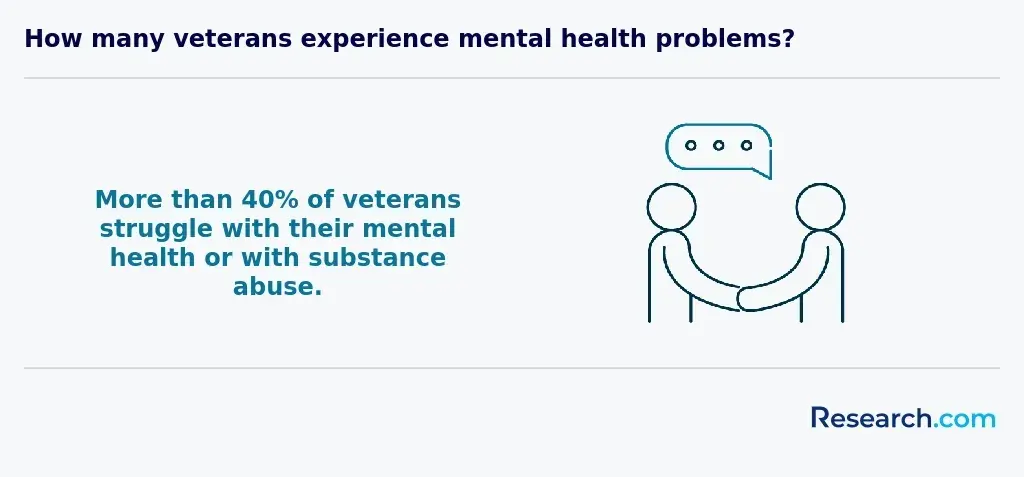
Veterans are one population counselors may encounter in substance use and mental health settings. Surveys indicate that roughly 40% of veterans struggle with mental health problems or with substance abuse, as shown below.
What does a substance abuse counselor do?
Substance abuse counselors help clients understand substance use patterns, build recovery skills, address relapse risks, and connect with treatment resources. Their work is both clinical and practical: they may conduct assessments in the morning, lead a group session at midday, update case notes in the afternoon, and coordinate care with a physician, social worker, probation officer, or family member before the day ends.
| Responsibility | What it looks like in practice |
| Assessment | Gathering information about substance use, mental health symptoms, family history, risk factors, and treatment needs. |
| Treatment planning | Developing measurable goals, recovery supports, intervention strategies, and referral plans. |
| Individual counseling | Helping clients examine triggers, coping skills, motivation, trauma history, and recovery barriers. |
| Group counseling | Facilitating peer support, relapse prevention discussions, skill-building activities, and accountability. |
| Family education | Explaining addiction, boundaries, communication patterns, and support strategies to families when appropriate. |
| Care coordination | Working with healthcare, mental health, legal, housing, and social service professionals to support recovery. |
| Documentation | Maintaining timely notes, treatment updates, progress records, and compliance documentation. |
Effective counselors combine empathy with structure. Important skills include active listening, clear communication, crisis awareness, cultural responsiveness, documentation accuracy, ethical judgment, and the ability to stay calm when clients are ambivalent, angry, ashamed, or at risk of relapse.
-
: "
“Graduating from the University of Utah’s program equipped me with the tools I needed to make a real difference. Every day, I witness the transformative power of support and understanding in my clients’ lives.”
"
Students who want a broader counseling scope may also compare substance abuse counseling with licensed professional counselor careers in Utah, which can involve wider mental health assessment and treatment responsibilities depending on credential and setting.
What is the certification and licensing process for a substance abuse counselor in Utah?
Utah’s certification and licensing process is administered through the Utah Division of Professional Licensing. Applicants must document education, substance use disorder coursework, supervised training, supervised experience, exam completion, and background clearance. Because requirements can differ by credential category, applicants should use DOPL instructions as the controlling source rather than relying only on school summaries or job postings.
Candidates may need to show completion of a substance abuse education program with at least 200 hours of related coursework and a supervised practicum. They may also need to document supervised experience totaling a minimum of 500 hours, with verification from supervisors. A passing score on an accepted exam, such as the NAADAC - NCE Level II, MAC, or AADC – IC&RC, is required for licensure.
Fingerprinting and a background check are part of the application process. The licensure application fee is typically around $40, although candidates should also budget for exam fees, background check costs, transcripts, and possible program-specific fees.
Timing matters. For example, the application for the Substance Use Disorder Counselor program opens annually in April and August, with deadlines in June and October, respectively. Missing a transcript, submitting incomplete supervisor verification, or misunderstanding course prerequisites can delay approval.
| Application item | Common mistake | Better approach |
| Transcripts | Uploading unofficial or incomplete records. | Request official transcripts early and confirm they show all required coursework. |
| Supervised hours | Tracking hours casually or after the fact. | Use a consistent log signed by approved supervisors throughout training. |
| Exam requirement | Registering for the wrong exam level. | Confirm which exam DOPL accepts for your target credential before paying. |
| Background check | Waiting until the end to address possible issues. | Review application disclosures and seek guidance if you have concerns. |
| Ethics agreement | Treating ethics paperwork as a formality. | Study confidentiality, boundaries, reporting duties, and informed consent before practice. |
If you want to understand how professional counseling licensure differs in other states, Research.com also covers licensed counselor careers in New Hampshire.
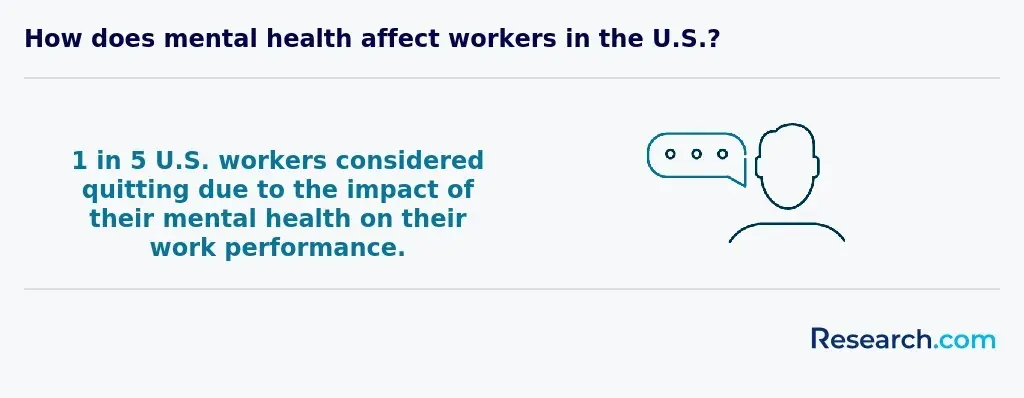
Mental health concerns also affect the broader workforce. About one in five U.S. workers considered quitting because of the effect of mental health on work performance, as shown below.
What legal and ethical considerations must a substance abuse counselor consider in Utah?
Substance abuse counselors handle sensitive information, high-risk situations, and vulnerable client populations. Utah counselors must practice within their credential, protect client privacy, understand mandatory reporting duties, and follow professional ethical standards. These responsibilities are not optional; they protect clients, employers, communities, and counselors themselves.
Licensure and scope of practice
Counselors must hold the proper credential from the Utah Division of Occupational and Professional Licensing and must not provide services beyond their training or legal authority. Practicing outside your scope can create legal risk and harm clients who need a higher level of care.
Mandatory reporting
Utah counselors are required to report suspected child abuse or neglect and threats of harm to self or others under applicable law, including Utah Code § 62A-4a-403. Counselors should know their employer’s reporting protocol before a crisis occurs.
Confidentiality and privacy
Client information must be protected unless disclosure is legally required or the client has provided valid consent. Counselors also need familiarity with HIPAA, which establishes national protections for health information.
Common ethical risks
- Dual relationships: Personal, business, or social connections with clients can distort professional judgment and weaken trust.
- Informed consent: Clients should understand services, risks, limits of confidentiality, fees, records, and their rights before treatment begins.
- Documentation shortcuts: Poor notes can undermine continuity of care, compliance, and legal protection.
- Bias: Counselors must monitor assumptions related to culture, religion, income, race, gender, criminal history, or relapse history.
Federal and state compliance
Counselors may work within regulations and standards connected to the Substance Abuse and Mental Health Services Administration and Utah’s Substance Abuse Treatment Standards. In practice, this means using appropriate treatment methods, maintaining records, protecting privacy, and escalating care when client risk exceeds the program’s capacity.
How much can you earn as a substance abuse counselor in Utah?
Substance abuse counselor pay in Utah depends on credential level, employer type, experience, supervision duties, population served, and location. The average salary is approximately $50,000 per year, while the median salary is around $48,000. Nationally, the average salary is approximately $47,000 and the median salary is $45,000, so Utah compensation is competitive within the figures cited here.
| Role or location | Approximate annual pay | What may influence earnings |
| Typical Utah substance abuse counselor | Approximately $50,000 average; around $48,000 median | Credential, caseload, employer, and years of experience. |
| Clinical director | Upwards of $70,000 | Program oversight, staff supervision, compliance, and leadership responsibility. |
| Substance abuse program manager | Around $65,000 | Program operations, reporting, team coordination, and quality improvement. |
| LCSW specializing in substance abuse | Approximately $60,000 | Advanced clinical training and broader behavioral health scope. |
| Salt Lake City | Average of $55,000 | Urban employer concentration, higher demand, and higher living costs. |
| Provo | Around $52,000 | Education and healthcare presence. |
| Ogden | Approximately $50,000 | Healthcare sector growth and regional demand. |
Salary should not be evaluated in isolation. Compare the full package: health benefits, supervision support, continuing education reimbursement, workload, on-call expectations, commute, and advancement potential. A lower-paying role with excellent supervision can sometimes be a better early-career choice than a higher-paying job with poor support and high burnout risk.
In 2018, many adults viewed substance use as a serious local concern. Prescription pain medications such as Oxycontin, Percocet, and Vicodin were considered major problems by 43% of adults, while 42% identified other drugs such as cocaine and methamphetamines as major concerns. Heroin use was viewed as a serious issue by 37%, alcohol use by 34%, and marijuana use by 26%, as shown below.
How can digital tools enhance substance abuse counseling in Utah?
Digital tools can make treatment more accessible and organized when they are used carefully. Telehealth platforms can help counselors reach clients in rural or underserved communities, while secure scheduling, documentation, and case management systems can reduce administrative friction. Mobile apps may also support between-session tracking, reminders, and recovery planning when they are evidence-informed and used within privacy rules.
The main caution is that technology does not replace clinical judgment. Counselors must confirm that telehealth delivery, electronic records, and app-based tools meet confidentiality expectations and employer policies. For readers considering a broader behavioral health pathway that also uses telehealth and digital care models, see Research.com’s guide on how to become a mental health counselor in Utah.
How does obtaining an advanced counseling degree affect your career opportunities?
An advanced counseling degree can expand your options, especially if you want to supervise staff, manage programs, provide more complex clinical services, teach, conduct research, or move into leadership. Graduate study can deepen your understanding of diagnosis, trauma, co-occurring disorders, ethics, assessment, and evidence-based interventions.
The trade-off is cost and time. Graduate programs can be expensive, and the return depends on whether the credential leads to roles you actually want. Before enrolling, compare licensing outcomes, supervised hour requirements, field placement quality, and employer preferences. If you are deciding between social work and clinical licensure routes, Research.com’s overview of MSW and LCSW differences can clarify how education and licensure connect.
How do educational pathways in substance abuse counseling compare with related counseling fields?
Substance abuse counseling programs focus heavily on addiction, relapse prevention, motivational work, treatment planning, case management, and substance use disorder assessment. Related counseling fields may emphasize different systems. Marriage and family therapy often centers on relationships and family dynamics, while professional counseling may cover broader mental health treatment.
| Pathway | Main focus | When it may be a better fit |
| Substance abuse counseling | Addiction treatment, recovery planning, relapse prevention, and substance use assessment. | You want to work in treatment centers, recovery programs, community agencies, or integrated behavioral health settings. |
| Marriage and family therapy | Family systems, relationships, communication patterns, and relational treatment. | You want to work with couples, families, and relational dynamics connected to mental health or substance use. |
| Professional counseling | Broader mental health counseling, assessment, treatment planning, and client development. | You want a wider counseling scope beyond addiction-focused services. |
If you are comparing family-focused credentials, Research.com’s guide to marriage counselor education requirements in Utah can help you understand how that pathway differs from substance use disorder counseling.
How can interdisciplinary training broaden your counseling expertise in Utah?
Substance use rarely exists in isolation. Clients may be dealing with trauma, family conflict, housing instability, legal involvement, chronic pain, depression, anxiety, or school problems. Interdisciplinary training helps counselors communicate better with other professionals and understand the systems affecting recovery.
For example, family therapy concepts can help counselors address enabling patterns, conflict, and support systems. Behavioral health training can strengthen assessment and intervention design. Legal or forensic awareness may help when clients are court-involved. Counselors who want to add family-systems knowledge may find value in reviewing affordable online marriage and family therapy degree programs as part of a longer-term education plan.
What is the job market like for a substance abuse counselor in Utah?
Utah’s job market for substance abuse counselors is strong but not effortless. The Utah Department of Workforce Services projects employment growth of approximately 20% over the next decade, outpacing the national average. Demand is connected to increased recognition of mental health needs and the continuing impact of the opioid crisis.
- Compensation: The average annual salary is around $50,000, with entry-level positions starting at approximately $40,000. Experienced counselors may earn upwards of $70,000, especially in metropolitan areas such as Salt Lake City.
- Competition: More applicants are completing relevant degrees and certifications, so field experience, specialty training, and strong documentation skills can help you stand out.
- Common employers: Counselors may work in rehabilitation facilities, hospitals, community mental health agencies, outpatient treatment centers, residential programs, correctional settings, and private practices.
- Location differences: Rural areas may have strong need but fewer employers, while urban areas may offer more roles but higher living costs.
- Culture and community: Utah’s community-oriented environment can support recovery work, but counselors should be prepared to serve clients with diverse beliefs, family structures, and treatment expectations.
-
: "
“The demand is high, but I had to think carefully about Salt Lake City’s cost of living compared with the salary. The growth opportunities have still made the path worthwhile because the community is increasingly committed to mental health.”
"
What career and advancement opportunities are available for a substance abuse counselor in Utah?
Substance abuse counseling can begin with direct-service work and grow into supervision, program management, clinical leadership, education, or related behavioral health roles. Advancement usually depends on education, licensure level, documented experience, leadership ability, and comfort with compliance and team coordination.
| Career stage | Possible roles | Typical advancement strategy |
| Entry level | Behavioral health technician, substance abuse counselor, recovery support role. | Gain supervised experience, learn documentation systems, and build skills in assessment and group facilitation. |
| Mid level | Clinical supervisor, program coordinator, senior counselor. | Complete higher education or additional certifications, develop supervisory skills, and understand state compliance requirements. |
| Senior level | Director of substance abuse services, executive director of treatment facilities. | Build expertise in budgeting, policy, quality improvement, staffing, program design, and community partnerships. |
| Related pathways | Mental health counselor, social worker, educator, trainer, prevention specialist. | Add credentials or graduate training that broaden your scope beyond addiction treatment. |
The projected job growth of 18.8% for substance abuse counselors in the state over the next decade suggests continued opportunity, but advancement is not automatic. Counselors who want leadership roles should seek supervision experience, learn billing and compliance systems, and track outcomes in ways employers can verify.
Substance use patterns continue to shape public health needs. Marijuana dominates substance use in the U.S., with nearly one in five people using it in the past year. Opioids and prescription pain medications remain major concerns, and the use of prescription stimulants, sedatives, LSD, cocaine, methamphetamines, and heroin also creates treatment demand, as shown below.
What role does family involvement play in optimizing treatment outcomes in Utah?
Family involvement can strengthen treatment when it is appropriate, ethical, and clinically planned. Addiction affects communication, trust, money, safety, parenting, and household routines. A counselor who understands family systems can help relatives support recovery without enabling harmful patterns.
Family work may include education about addiction, boundary-setting, relapse warning signs, communication skills, and coordinated support after treatment. However, family participation should never override client consent, confidentiality, or safety concerns. Counselors interested in formal family-systems credentials can review Research.com’s guide on how to become an MFT in Utah.
What professional development and continuing education opportunities are available for substance abuse counselors in Utah?
Continuing education is part of maintaining competence and licensure. Substance abuse counselors in Utah must complete 40 hours of continuing education every two years to keep their licensure active. The goal is not only compliance; it is also staying current with ethics, trauma-informed care, evidence-based treatment, cultural responsiveness, co-occurring disorders, and changes in practice standards.
- DOPL provides information on approved continuing education providers and licensure expectations.
- The Utah Association of Addiction Professionals and the National Association of Alcoholism and Drug Abuse Counselors offer workshops, conferences, and training opportunities.
- SAMHSA and the National Institute on Drug Abuse provide online resources and training modules that can strengthen knowledge of substance use treatment.
- Universities such as the University of Utah and Utah State University may offer continuing education and workshops for practicing professionals.
- Professional organizations can help counselors find mentors, peer consultation, job leads, and updates on standards of care.
- Specialized credentials such as the Certified Alcohol and Drug Counselor credential can support deeper expertise when aligned with your career goals.
How to choose continuing education wisely
- Prioritize training that directly improves your current caseload needs.
- Keep certificates and completion records organized before renewal season.
- Balance required ethics training with practical skills such as suicide risk assessment, motivational interviewing, trauma-informed care, and co-occurring disorder treatment.
- Avoid paying for courses before confirming they count toward your license renewal.
How can self-care practices boost your effectiveness as a substance abuse counselor in Utah?
Substance abuse counseling can involve grief, relapse, trauma histories, family conflict, and crisis work. Counselors who ignore their own resilience may experience burnout, compassion fatigue, or poor decision-making. Self-care is therefore a professional responsibility, not a personal luxury.
Useful practices include regular supervision, peer consultation, clear work boundaries, manageable caseload planning, mindfulness or reflection routines, and time away from crisis-heavy work. Counselors who are drawn to complex behavioral and legal issues may also find it useful to explore related fields such as criminal psychology careers in Utah, where resilience and ethical judgment are also central.
How can collaborating with school psychologists benefit your practice in Utah?
Collaboration with school psychologists can improve early intervention for adolescents and families affected by substance use. School-based professionals may identify behavioral changes, academic decline, peer issues, anxiety, depression, or family stress before a crisis escalates. When communication is appropriate and consent rules are followed, coordinated care can help young clients receive more consistent support.
Substance abuse counselors who want to understand youth assessment, school systems, and student mental health services can learn more from Research.com’s guide to school psychologist certification requirements in Utah.
How can behavior analysis techniques enhance substance abuse counseling in Utah?
Behavior analysis can add structure to addiction treatment by helping counselors identify triggers, reinforcement patterns, avoidance behaviors, and measurable behavior changes. This approach can complement counseling by making progress easier to observe and document.
Examples include tracking high-risk situations, identifying replacement behaviors, reinforcing treatment attendance, and measuring progress toward recovery goals. Counselors who want formal training in behavior analysis can review Research.com’s guide on how to become a behavior analyst in Utah.
What challenges should you consider as a substance abuse counselor in Utah?
This career is meaningful, but it is not easy. Counselors must be prepared for emotional intensity, relapse, documentation demands, limited resources, and ethical pressure. Understanding these challenges before entering the field can help you choose better training and avoid unrealistic expectations.
| Challenge | Why it matters | How to prepare |
| Client resistance | Some clients are ambivalent, court-mandated, ashamed, or not ready to stop using substances. | Build skills in motivational interviewing, rapport-building, and nonjudgmental communication. |
| Relapse | Statistics indicate that over 85% of individuals may relapse within a year following treatment. | Treat relapse risk as part of treatment planning rather than as a personal failure by the client or counselor. |
| Bias and stigma | Judgment can damage trust and discourage clients from continuing care. | Use supervision, cultural humility, and reflective practice to identify assumptions. |
| Resource constraints | Shortages of counselors, high caseloads, and limited funding can reduce service capacity. | Learn referral networks, crisis procedures, and realistic workload management. |
| Ethical complexity | Confidentiality, mandated reporting, family involvement, and dual relationships can create difficult decisions. | Study ethics early and consult supervisors before problems escalate. |
Students comparing graduate counseling options may also want to review MS vs MA in counseling education to understand how degree type can affect training emphasis and career direction.
How can substance abuse counseling benefit from interdisciplinary insights in Utah?
Interdisciplinary knowledge can improve case understanding when clients have legal involvement, medical complications, family stress, or co-occurring mental health symptoms. For example, forensic knowledge may help counselors understand drug-related legal cases, documentation needs, and coordination with justice-system professionals.
This does not mean substance abuse counselors should practice outside their scope. Instead, they should know when to collaborate, refer, or seek consultation. If you are interested in the legal and investigative side of substance-related cases, Research.com explains how to become a forensic scientist in Utah.
How will regulatory changes and insurance updates affect your practice in Utah?
Regulatory and insurance changes can affect how substance abuse counselors document services, bill for care, obtain authorizations, and maintain compliance. Counselors in agencies and private practice should pay attention to reimbursement rules, service definitions, supervision requirements, and funding changes.
Practical ways to stay prepared include attending employer compliance trainings, following DOPL updates, participating in professional associations, and learning basic billing and documentation expectations. If speed of entry is one of your main concerns, Research.com’s guide to the quickest way to become a counselor in Utah can help you compare faster and longer training routes.
What do substance abuse counselors say about their careers in Utah?
-
: "
“This work has been deeply meaningful because I get to see people rebuild their lives piece by piece. Utah’s recovery community can be very supportive, and it is powerful to watch clients discover strengths they did not believe they had.” Joanna
"
-
: "
“There is real need for substance abuse counselors here. The clients I meet come from many backgrounds, and each case teaches me something new. I also value the collaboration among professionals because it keeps me learning.” Austin
"
-
: "
“I entered this field because I wanted to help people reclaim their choices and stability. In Utah, community resources, support groups, and education programs can make recovery more reachable, and being part of that process is incredibly fulfilling.” Sue
"
Related Articles for Nearby States
- 2027 How to Become a Substance Abuse Counselor in Nevada
- 2027 How to Become a Substance Abuse Counselor in Arizona
- 2027 How to Become a Substance Abuse Counselor in Idaho
- 2027 How to Become a Substance Abuse Counselor in Wyoming
- 2027 How to Become a Substance Abuse Counselor in Colorado
- 2027 How to Become a Substance Abuse Counselor in New Mexico
- 2027 How to Become a Substance Abuse Counselor in California
- 2027 How to Become a Substance Abuse Counselor in Montana
- 2027 How to Become a Substance Abuse Counselor in Oregon
- 2027 How to Become a Substance Abuse Counselor in Washington
References:
- Addiction-Counselors.com. (2020, November 13). Substance Use Disorder Counselor Requirements in Utah. Addiction-Counselors.com.
- Careers of Substance. (n.d.). Counselor / Clinician. Careers of Substance.
- DOPL. (2022, November 4). Licensed Advanced Substance Use Disorder Counselor. Utah Department of Commerce. DOPL.
- DOPL. (2022, November 7). Certified Advanced Substance Use Disorder Counselor. Utah Department of Commerce. DOPL.
- HumanServicesEdu.org. (n.d.). Substance Abuse Counseling Certification in Utah. HumanServicesEdu.org.
- Bradley University. (2024, January 16). Substance Abuse Counselor Salary and Potential Careers. Bradley University.
- Online Utah. (n.d.). Substance Use Disorder Counselor Treatment Training Program (SUDTTC) Request Information. Online Utah.
- Salt Lake Community College. (n.d.). Substance Use Disorder Counselor. Salt Lake Community College.
- Social Work Utah. (n.d.). Substance Use Disorder Treatment Training. Social Work Utah.
- UVU. (n.d.). Substance Use Disorder Counseling. UVU.
Key Insights
- Utah substance abuse counseling is a credentialed career path, so your first decision should be the exact role or license level you want.
- Entry-level work may require less education, but long-term mobility usually depends on a relevant degree, supervised experience, and an approved exam.
- Do not choose a program based on tuition alone. Confirm accreditation, Utah credential alignment, field placement support, total cost, and transfer options.
- Salary can be competitive, but location, supervision duties, leadership responsibility, and employer type make a major difference.
- Rural Utah needs counselors, but job seekers should weigh access to supervision, workload, pay, and support resources.
- Ethics, confidentiality, documentation, and mandatory reporting are central to safe practice and should be treated as core skills from the beginning.
- Technology, family involvement, behavior analysis, and interdisciplinary collaboration can strengthen care when used within legal and ethical limits.
- The best candidates prepare for both the rewards and the stress of the work by building supervision networks, self-care habits, and continuing education plans early.
Other Things You Should Know About Becoming a Substance Abuse Counselor in Utah
The Utah Division of Professional Licensing (DOPL) issues and regulates substance use disorder counselor licenses in 2027. Applicants must follow DOPL rules, submit the required application and fees, and meet education, supervision, and exam requirements before a license is granted.
In 2027, to become a substance abuse counselor in Utah, you need a minimum of a bachelor's degree in a related field. Additionally, completing specific coursework in substance abuse counseling and gaining supervised clinical experience is required for licensure.
To become a licensed substance abuse counselor in Utah in 2027, candidates must pass the National Counselor Examination (NCE) and any additional state-specific exams. These examinations are administered by the Utah Division of Occupational and Professional Licensing (DOPL).





