2027 How to Become an Elementary School Teacher in West Virginia: Requirements & Certification

Co-Founder and Chief Data Scientist
Becoming an elementary school teacher in West Virginia is a practical career path for people who want to work with young learners, build foundational literacy and math skills, and serve communities where schools often play a central role. The decision, however, is not just “Should I teach?” You also need to know which degree route fits your background, whether an online program will qualify for licensure, how much the process may cost, and what the job market looks like after graduation.
This guide explains the education, testing, licensing, program-selection, cost, and career-planning steps for aspiring elementary school teachers in West Virginia. It is designed for first-time college students, career changers, paraeducators, substitute teachers, and current educators considering a new endorsement or advancement path.
Quick answer: How do you become an elementary school teacher in West Virginia?
To become an elementary school teacher in West Virginia, you generally need to complete a bachelor’s degree and a state-approved teacher preparation program, pass the required Praxis exams, complete a background check, and apply for licensure through the West Virginia Department of Education. Candidates using a traditional route usually complete student teaching as part of their degree. Career changers may qualify for alternative certification if they already hold a bachelor’s degree and meet state requirements.
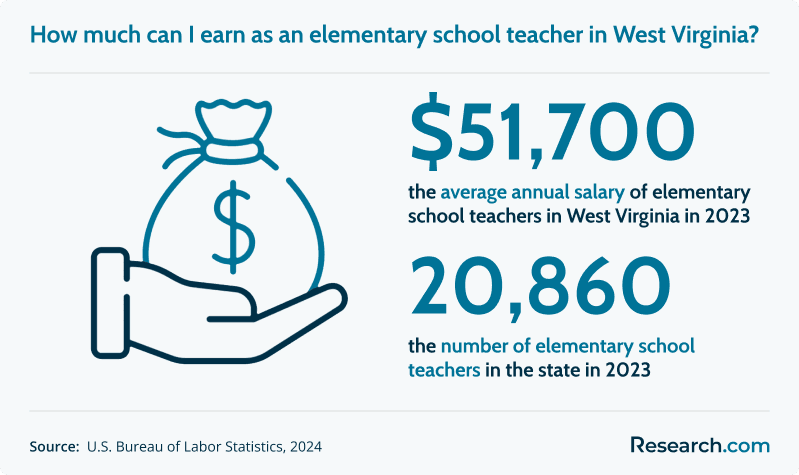
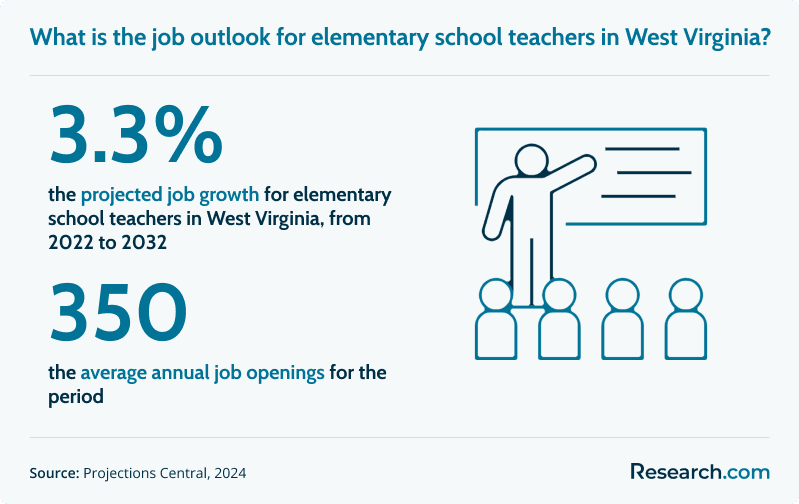
Elementary school teaching in West Virginia is projected to grow by 3.3% from 2022 to 2032, compared with 4.0% projected growth for all occupations in the state. Elementary school teachers in West Virginia earn an average annual salary of $51,700, and the state is expected to have about 350 job openings each year during the forecast period. In 2023, there were around 20,860 elementary school teachers in the state.
Key Things You Should Know About Becoming an Elementary School Teacher in West Virginia
- Typical licensure timeline: The average time to complete the licensure process is approximately 1 to 2 years after meeting degree requirements, depending on prior education, exam readiness, and program format.
- Initial license activity: In the 2022-2023 academic year, West Virginia issued over 1,200 initial teaching licenses for elementary education.
- Application and testing costs: The teaching license application fee is $100, the renewal fee is $50, and required exams may cost $50 to $150 per test.
- Renewal requirement: Teachers must complete 18 hours of professional development every five years to maintain licensure.
- Required exams: West Virginia requires Praxis exams that assess general teaching knowledge and elementary subject knowledge. Many candidates spend several months preparing.
- Education requirements for elementary teachers in West Virginia
- Licensure application and renewal process
- Traditional vs. alternative teacher certification
- How long the process usually takes
- Whether online programs qualify for licensure
- Online vs. campus elementary education programs
- Average cost of elementary education programs
- How to choose the right elementary education program
- Elementary education specializations
- Career paths for elementary teachers
- Challenges elementary teachers face in West Virginia
- Other teaching careers in West Virginia
- Moving into special education
- Using an interdisciplinary degree to strengthen teaching
- Additional certifications that can expand your options
- Advancement opportunities for elementary teachers
- West Virginia elementary teacher job market
- Using preschool education to strengthen an elementary career
- Accessible ways to earn a teaching degree
- Resources that may speed up certification
- Benefits of an online PhD in education
- Factors that affect the licensing timeline
- Speech therapy as a complementary path
- Private school vs. public school teaching
- Transitioning from elementary to high school teaching
- Current teacher certification guidance
What are the educational requirements for elementary school teachers in West Virginia?
West Virginia requires elementary teacher candidates to show that they are academically prepared, trained in classroom practice, and eligible to work with children. The standard pathway starts with a bachelor’s degree and includes supervised teaching experience through an approved educator preparation program.
- Bachelor’s degree: Candidates typically complete a bachelor’s degree in elementary education or a closely related field. A strong program should include child development, reading instruction, mathematics methods, assessment, classroom management, and inclusive teaching practices.
- State-approved teacher preparation program: The program must prepare candidates for licensure and include field experiences, usually culminating in student teaching. This is where candidates learn how to plan lessons, manage classrooms, assess student progress, and adjust instruction for different learners.
- Praxis exams: After or near the end of preparation, candidates must pass the required Praxis assessments for professional teaching knowledge and elementary content knowledge. Passing scores are determined by the state and may change, so candidates should verify current requirements before registering.
- Background check: A criminal background check is required before licensure. Candidates should complete this step early enough to avoid delays in application processing.
In 2023, there were around 20,860 elementary school teachers in West Virginia, earning $51,700 per year on average. That employment base suggests a stable profession, though openings depend heavily on district staffing needs, retirements, funding, and location.
| Requirement | What it means for candidates | Decision point |
| Bachelor’s degree | You need a degree that supports elementary licensure. | Choose a program designed for West Virginia certification, not just a general education major. |
| Teacher preparation | You complete education coursework and supervised classroom experience. | Confirm the program is state-approved before enrolling. |
| Praxis exams | You must demonstrate teaching and content knowledge. | Budget both study time and exam fees before your final semester. |
| Background check | The state reviews your eligibility to work in schools. | Ask your program when to begin the process so licensing is not delayed. |
What is the licensure application and renewal process for elementary school teachers in West Virginia?
The licensure process begins before you submit the final application. Your degree program, exams, student teaching, and institutional recommendation all feed into the state’s review. The most efficient candidates track requirements semester by semester instead of waiting until graduation.
Initial licensure steps
- Complete an approved preparation program: Finish the required coursework, field experience, and student teaching.
- Pass required exams: Register for the Praxis exams required for elementary education and submit official scores as directed.
- Complete the background check: Follow the state’s current fingerprinting and background review procedures.
- Secure institutional recommendation: Most candidates need their college or university to verify program completion.
- Submit the license application: The application fee for a West Virginia teaching license is $100.
Renewal expectations
Maintaining a license requires active credential management. West Virginia teachers must complete 18 hours of professional development every five years, and the renewal fee is $50. Teachers should keep documentation of completed professional development because district and state requirements may require proof.
Professional development is not only a compliance task. It can also help teachers strengthen reading intervention, math instruction, classroom technology use, special education support, and behavior management. Educators comparing flexible graduate options may want to review inexpensive online teaching degrees if a master’s degree fits their long-term plan.
What is the difference between traditional and alternative teacher certification programs in West Virginia?
West Virginia offers more than one route into elementary teaching. The right path depends on whether you are starting college, already hold a bachelor’s degree, or are changing careers from another field.
Traditional teacher certification programs
A traditional program is usually the best fit for students who are beginning their undergraduate education or who already know they want to become licensed teachers. These programs are commonly housed in colleges of education and include the full sequence of education coursework and student teaching.
- Degree requirement: Candidates usually earn a bachelor’s degree in elementary education or a related approved field.
- Coursework: Programs cover pedagogy, child development, literacy, math methods, assessment, classroom management, and inclusive instruction.
- Clinical practice: Candidates complete field placements and student teaching before licensure.
- Exams: Candidates must pass West Virginia’s required Praxis assessments.
- Examples: West Virginia University and Marshall University offer accredited traditional teacher preparation programs.
Alternative teacher certification programs
Alternative certification is designed for people who already have a bachelor’s degree outside education or who are entering teaching after work in another field. It may allow candidates to work while completing certification requirements, but it is not automatically easier. Candidates still need to meet state standards, pass exams, and develop classroom skills quickly.
- Best for: Career changers, bachelor’s degree holders in non-education fields, and candidates willing to complete certification while working.
- Timeline: Many alternative programs can be completed within one to two years.
- Support: Programs often include mentoring, supervision, and structured professional learning.
- Example: The West Virginia Department of Education offers an Alternative Certification for Career Changers program for qualified candidates.
| Pathway | Best fit | Main advantage | Main trade-off |
| Traditional certification | First-time college students or students planning ahead for licensure | Clear sequence of coursework, fieldwork, and student teaching | Usually takes longer if you are starting from the beginning of college |
| Alternative certification | Career changers with a bachelor’s degree | May allow a faster transition into teaching | Requires balancing teaching, coursework, testing, and mentorship |
| Clinical teacher of record or residency-style pathway | Candidates ready for intensive supervised practice | Builds classroom experience while completing final preparation | Can be demanding because responsibilities increase quickly |
Experts predict that from 2022 to 2032, the job growth of K12 teachers hover around 3.3%, except for preschool teacher positions which have a negative growth trend at -4.6%. See the chart below for more details.
How long does it take to become an elementary school teacher in West Virginia?
The total timeline depends on where you are starting. A first-time college student may spend several years completing a bachelor’s degree and teacher preparation. A career changer who already has a bachelor’s degree may move faster through an alternative pathway, but still needs time for testing, clinical practice, and state application processing.
- Bachelor’s degree: A bachelor’s degree generally takes about four years. Students who transfer credits or attend year-round may shorten the timeline, while part-time students may need longer.
- Teacher preparation program: Candidates who already have a bachelor’s degree may need an additional one to two years, depending on whether they pursue a post-baccalaureate, graduate, or alternative route.
- Licensure exams: Preparing for Praxis exams can take several months. Candidates should schedule exams early enough to allow retakes if needed.
- Application processing: After program completion, candidates must submit documentation, complete a background check, and wait for state review. This may take a few weeks to a couple of months.
From the start of a bachelor’s degree through licensure, many aspiring elementary teachers should plan for approximately five to seven years. Candidates who already hold a degree may complete the professional preparation and licensure process more quickly, especially through approved alternative routes.
If you are still comparing education-related careers, reviewing childhood development careers can help you decide whether classroom teaching, early childhood services, child advocacy, or another child-focused role fits your goals.
Are online education programs accepted for teacher licensure in West Virginia?
Yes, online education programs may be accepted for teacher licensure in West Virginia if they meet state approval and accreditation expectations. The key issue is not whether the courses are online; it is whether the program leads to the correct licensure pathway and includes required fieldwork or student teaching.
- Accreditation matters: Candidates should verify whether the program is accredited by a recognized educator preparation accreditor such as the Council for the Accreditation of Educator Preparation (CAEP) or the National Council for Accreditation of Teacher Education (NCATE), where applicable.
- State approval matters even more: A degree can be accredited but still not meet West Virginia licensure requirements. Always ask the program directly whether it prepares candidates for West Virginia elementary teacher certification.
- Field placements are still required: Online programs usually require local classroom observations, practicum hours, or student teaching. Confirm whether the school helps arrange placements in West Virginia schools.
- Testing remains the same: Online students still need to pass required Praxis exams and complete the same application and background check steps.
Before enrolling in any online program, ask for written confirmation that the program meets West Virginia licensure requirements. This is especially important for out-of-state online programs, because teacher certification rules vary by state.
How does an online elementary education program in West Virginia compare to an on-campus program?
Online and on-campus elementary education programs can both lead to licensure if they meet state requirements. The better option depends on your schedule, learning style, access to schools for fieldwork, and need for in-person support.
| Factor | Online program | On-campus program |
| Schedule flexibility | Often better for working adults, parents, and students far from campus | More structured, with set class times and campus expectations |
| Classroom interaction | Uses video, discussion boards, and virtual collaboration | Provides face-to-face interaction with professors and peers |
| Field experience | May be arranged near the student, but support varies by program | Often tied to established local school partnerships |
| Costs | May reduce commuting or housing costs, but may include technology fees | May include campus fees, transportation, and room and board |
| Best fit | Self-directed students who need flexibility | Students who want regular in-person support and campus resources |
Questions to ask before choosing online or campus study
- Does the program explicitly prepare students for West Virginia elementary teacher licensure?
- Who arranges student teaching placements?
- Are Praxis preparation resources included?
- Can transfer credits reduce the total time and cost?
- What happens if I move to another state before licensure?
What is the average cost of elementary education programs in West Virginia?
The cost of an elementary education program in West Virginia depends on the institution, whether you attend full time or part time, whether you live on campus, and how many credits you transfer. Tuition is only one part of the total cost, so candidates should build a full budget before enrolling.
- Tuition costs: For the 2022-2023 academic year, community colleges such as Eastern West Virginia Community and Technical College offer competitive rates. Students may pay approximately $4,000 to $6,000 per year for a full-time course load of 12 credit hours per semester.
- Room and board: Students living on or near campus may spend between $8,000 and $12,000 annually, depending on housing choice and location.
- Books and supplies: Textbooks and academic materials may cost around $1,000 to $1,500 per year.
- Credentialing fees: Certification exams and application processes may total around $300 to $500.
- License fees: The initial West Virginia teaching license application fee is $100, and the renewal fee is $50.
Students who eventually want leadership, research, or district-level roles may later consider graduate study. If that is part of your long-term plan, reviewing possible doctorate in education roles can help you decide whether advanced study is worth the investment.
How to choose the best elementary education program in West Virginia?
The best elementary education program is the one that leads to licensure, fits your budget, provides strong clinical experience, and prepares you for the types of classrooms where you want to teach. Rankings can be useful, but they should not replace verification of licensure alignment and field placement quality.
- Confirm state approval: Make sure the program is recognized for West Virginia teacher preparation.
- Check accreditation: Look for recognized educator preparation accreditation and institutional accreditation.
- Review field placement support: Ask how early students enter classrooms and whether student teaching placements are arranged by the school.
- Compare Praxis support: Strong programs offer test preparation, practice exams, advising, and retake planning.
- Ask about transfer credits: Transfer-friendly programs can reduce both time and cost.
- Evaluate faculty experience: Faculty with classroom, curriculum, special education, or literacy expertise can provide practical preparation.
- Review job placement support: Ask whether the program has relationships with West Virginia districts and how graduates find teaching positions.
| Program question | Why it matters |
| Will this program qualify me for West Virginia elementary licensure? | A degree that does not meet licensure requirements can delay or block your teaching career. |
| How are student teaching placements assigned? | Strong placements help you build classroom confidence and local district connections. |
| What is the total program cost after fees, books, and living expenses? | Low tuition does not always mean the lowest total cost. |
| Can I complete requirements while working? | Flexibility matters for paraeducators, substitutes, parents, and career changers. |
| What support is available if I do not pass Praxis on the first attempt? | Retakes can add cost and time, so preparation support is important. |
As of 2021, West Virginia had approximately 1,800 elementary school teachers. Because teacher workforce counts can vary by source, role definition, and reporting year, students should compare program claims against current state and federal data before making enrollment decisions.
What types of specializations are available within elementary education in West Virginia?
Specializations can make an elementary teacher more versatile and may help match a teacher’s skills to district needs. They can also support future moves into intervention, coaching, special education, curriculum, or leadership.
- Special education: Prepares teachers to support students with disabilities, collaborate on individualized education plans, and use differentiated instruction.
- STEM education: Focuses on science, technology, engineering, and mathematics strategies for young learners.
- Early childhood education: Emphasizes developmentally appropriate teaching for children from birth to age eight.
- Bilingual education: Helps educators support English language learners and culturally responsive instruction.
- Technology integration: Builds skill in using digital tools to support instruction, assessment, and student engagement.
- Social-emotional learning: Helps teachers support student behavior, emotional regulation, classroom relationships, and resilience.
According to the National Center for Education Statistics, approximately 50% of teachers in the U.S. hold a master's degree. This does not mean every elementary teacher needs a master’s degree, but it does show that advanced education is common in the profession.
Education majors can also consider grade-level or subject-area shifts. High school teachers earn $55,590 on average, middle school teachers earn $49,650, and grade school teachers earn $51,700 on average. See the chart below for a visual comparison.
What career paths are available for elementary school teachers in West Virginia?
An elementary education license can lead to more than one career direction. Many graduates begin in a general elementary classroom, but experience and additional credentials can open specialized, leadership, or support roles.
- Public elementary classroom teacher: The most direct route, focused on teaching core subjects, managing classroom routines, assessing learning, and communicating with families.
- Alternative certification teacher: Career changers may enter through approved alternative routes while completing certification requirements.
- Clinical teacher of record: Candidates in residency-style programs may gain supervised teaching responsibility during the final stage of preparation.
- Special education teacher: Additional training or endorsement can prepare teachers to support students with disabilities.
- Instructional coach or curriculum specialist: Experienced teachers may move into roles that support other educators, analyze curriculum, and improve instructional practice.
- School leader: With advanced credentials and leadership preparation, teachers may pursue assistant principal, principal, or district-level positions.
If you are comparing flexible undergraduate options, Research.com’s guide to the best value online elementary education programs can help you evaluate online routes by affordability and fit.
What are the challenges faced by elementary school teachers in West Virginia?
Elementary teaching in West Virginia can be meaningful work, but it is also demanding. Candidates should understand the realities of the job before committing to a program.
- Resource gaps: Some schools, particularly in rural areas, may have limited supplies, older materials, or uneven access to instructional technology.
- Workload pressure: Teachers balance lesson planning, instruction, assessment, family communication, documentation, meetings, and professional development.
- Student needs beyond academics: Elementary teachers often support children facing social, emotional, economic, or family-related challenges.
- Administrative requirements: Reporting, compliance, and assessment documentation can reduce time available for planning and direct instruction.
- Salary considerations: The average annual salary of $51,700 should be evaluated alongside student debt, cost of living, benefits, and long-term advancement opportunities.
- Professional development access: Teachers in rural areas may need flexible online or district-supported options to meet training requirements.
Understanding the broader path to licensure can help candidates plan realistically. For a state-specific overview, see Research.com’s guide on how to become a teacher in West Virginia.
What other teaching careers are available in West Virginia?
If elementary education is not the right long-term fit, West Virginia offers other teaching paths. Some educators prefer working with older students, specializing in one subject, or moving into high-need areas. For example, candidates interested in math and early adolescence can review how to become a middle school math teacher in West Virginia to compare requirements and classroom expectations.
How can I transition to special education roles in West Virginia?
Elementary teachers who want to work more directly with students with disabilities may pursue special education coursework, endorsements, or a dedicated certification pathway. This route is a strong fit for teachers who are patient, highly organized, collaborative, and comfortable adapting instruction to individual learning plans. For step-by-step details, see how to become a special education teacher in West Virginia.
How can an interdisciplinary degree enhance your teaching career in West Virginia?
Interdisciplinary study can help teachers understand the nonacademic factors that affect learning, including family systems, community resources, behavior, and child development. For educators who want deeper preparation in student support and community engagement, an option such as the cheapest online social work degree may provide useful context, though it should not be assumed to replace teacher licensure requirements.
What additional certifications can broaden your teaching expertise?
Additional certifications or endorsements can help elementary teachers expand their instructional range. Reading, special education, early childhood, STEM, technology, and arts-related credentials may all strengthen classroom practice. Some career guides are state-specific while others are broader; for example, Research.com’s guide on how to become an art teacher in Washington can help readers understand how subject-specific teaching careers are structured, even though West Virginia candidates must verify their own state requirements.
What are the advancement opportunities for elementary school teachers in West Virginia?
Elementary teachers can advance by deepening classroom expertise, earning additional endorsements, pursuing graduate education, or moving into leadership roles. Advancement does not always require leaving the classroom; some of the strongest career growth comes from becoming a mentor teacher, intervention specialist, lead teacher, or instructional coach.
- Instructional leadership: Experienced teachers may support curriculum planning, data analysis, and professional learning for colleagues.
- Specialized teaching: Endorsements in special education, literacy, early childhood, or STEM can open more focused roles.
- School administration: Teachers interested in principal or district roles typically need advanced leadership preparation.
- Graduate study: Educators considering leadership may compare options such as the cheapest online doctorate in educational leadership to determine whether the investment fits their goals.
What is the job market for elementary school teachers in West Virginia?
The West Virginia job market for elementary school teachers is stable rather than fast-growing. The state projects 3.3% growth for elementary school teaching from 2022 to 2032, below the state’s overall occupational growth rate of 4.0%. Even with modest growth, replacement needs create ongoing openings as teachers retire, relocate, or move into other roles.
- Projected openings: West Virginia is expected to have around 350 annual job openings for elementary school teachers between 2022 and 2032.
- National comparison: National employment for elementary school teachers is projected to rise from 1.425 million in 2022 to 1.435 million by 2032, a 1% increase.
- Salary: Elementary school teachers in West Virginia earned $51,700 per year on average in 2023.
- Where opportunities may vary: District needs differ by region, school size, funding, retirements, and hard-to-staff subject or support areas.
Candidates interested in leadership or broader school-system work may also want to explore early childhood education jobs and related education leadership pathways.
How Can I Leverage Preschool Education to Enhance My Teaching Career in West Virginia?
Preschool education can strengthen an elementary teaching career by helping educators understand early development, school readiness, foundational language, and early math skills. Teachers who understand the preschool-to-elementary transition may be better prepared to support kindergarten and early-grade learners. To compare this route with elementary certification, see how to become a preschool teacher in West Virginia.
What are some of the easiest way to obtain a teaching degree in West Virginia?
The “easiest” route depends on your starting point. A first-time student may find a traditional bachelor’s program easiest because it provides a clear sequence. A working adult may find an online or alternative route easier because it offers more flexibility. The goal should be to choose the most efficient approved path, not the least rigorous one.
- Choose an online teaching program if flexibility is essential: Online coursework can help students balance work, family, and school. If comparing accessible routes, review programs described in Research.com’s guide to the easiest teaching degree.
- Use alternative certification if you already have a bachelor’s degree: This can reduce duplication of coursework and may shorten the transition into teaching.
- Start at a community college: Completing lower-division credits affordably before transferring can reduce total cost.
- Maximize transfer credits: Send transcripts early and ask for a formal transfer-credit evaluation.
- Plan Praxis exams early: Waiting until the end of the program can delay licensure if you need a retake.
What Resources Can Expedite My Teacher Certification Process in West Virginia?
The best way to speed up certification is to remove preventable delays: choose an approved program, verify testing requirements early, submit transcripts promptly, complete the background check on schedule, and follow application instructions exactly. Candidates looking for lower-cost or more direct options can review the cheapest way to get a teaching credential in West Virginia for additional planning guidance.
What should aspiring elementary teachers ask before enrolling?
- Is this program approved for West Virginia elementary teacher licensure?
- Will I need additional coursework if I already have a bachelor’s degree?
- What Praxis exams are required, and what support is available?
- How much will the full program cost, including fees, books, testing, and student teaching expenses?
- Can I complete fieldwork near where I live?
- What percentage of graduates receive a teaching license?
- Does the program have district partnerships in the area where I want to work?
Common mistakes to avoid
- Choosing a program before checking licensure alignment: Not every education degree qualifies you for West Virginia teacher certification.
- Looking only at tuition: Fees, books, housing, travel, testing, and lost work time can change the real cost.
- Assuming online means fully remote: Student teaching and fieldwork generally require in-person school placements.
- Waiting too long to take Praxis exams: Failed or delayed exams can postpone licensure and hiring.
- Relying on unrelated state data: Figures such as 300 annual job openings for elementary school teachers in Rhode Island or 3,910 elementary school teachers employed in Rhode Island in 2023 do not describe the West Virginia market.
- Assuming salary outcomes are guaranteed: Pay can vary by district, experience, credentials, contract terms, and location.
What are the benefits of pursuing an online PhD in education as an elementary school teacher in West Virginia?
An advanced education degree can support teachers who want to move into research, curriculum leadership, higher education, district administration, or specialized instructional roles. An online PhD in education may be useful for educators who need flexible study while continuing to teach, but it is usually not necessary for entry-level elementary classroom positions. Before enrolling, compare tuition, dissertation expectations, time commitment, and whether the degree aligns with your career goal.
What Factors Can Influence the Teacher Licensing Timeline in West Virginia?
The licensing timeline can be shorter or longer depending on prior credits, program format, exam readiness, background check timing, transcript processing, and whether the candidate uses a traditional or alternative route. Career changers should pay particular attention to prerequisite coursework and testing deadlines. For a broader timeline comparison, review how long does it take to become a teacher in West Virginia.
Can transitioning to speech therapy complement an elementary teaching career in West Virginia?
Speech-language support can complement elementary teaching for educators interested in communication development, language delays, reading foundations, and student intervention. This path usually requires specialized graduate training and separate credentialing, so it should be treated as a distinct professional route rather than a simple endorsement. To compare requirements, see how to be a speech therapist in West Virginia.
What distinguishes private school teaching from public school roles in West Virginia?
Private school teaching may offer smaller classes, mission-specific curriculum, and more flexibility in instructional approach. Public school teaching generally follows state licensure, accountability, and district contract structures more closely. Requirements can differ by employer, so candidates should verify hiring standards with each school. For more detail, read how to become a private school teacher in West Virginia.
How Can I Transition from Elementary to High School Teaching in West Virginia?
Moving from elementary to high school teaching usually requires subject-specific preparation and the appropriate secondary endorsement or certification. The transition is most realistic for teachers with strong academic preparation in a subject such as mathematics, science, English, or social studies. If math is your target subject, review high school math teacher qualifications in West Virginia to understand the additional expectations.
What are the latest guidelines for teacher certification in West Virginia?
Teacher certification rules can change, so candidates should use the West Virginia Department of Education as the final authority for requirements, approved programs, testing, renewals, and endorsements. Research.com’s overview of teaching certificate requirements in West Virginia can help you understand common certificate types before verifying details with the state.
Key Insights
- The standard route is degree plus preparation plus testing: Most candidates need a bachelor’s degree, an approved teacher preparation program, Praxis exams, student teaching, a background check, and state licensure approval.
- Online programs can work, but only if they meet licensure requirements: Always confirm state approval, accreditation, and field placement support before enrolling.
- The job market is stable, not explosive: West Virginia projects 3.3% growth for elementary teachers from 2022 to 2032, with around 350 annual openings.
- Costs go beyond tuition: Candidates should budget for room and board, books, testing, credentialing, and the $100 initial license application fee.
- Alternative certification can help career changers: Candidates who already hold a bachelor’s degree may be able to enter teaching through a faster approved pathway.
- Specializations can improve long-term flexibility: Special education, early childhood, STEM, literacy, technology, and social-emotional learning can help teachers match district needs and career goals.
- Verification is essential: Before committing time or money, confirm requirements with the program and the West Virginia Department of Education.
Related Articles for Nearby States
- 2027 How to Become an Elementary School Teacher in Virginia: Requirements & Certification
- 2027 How to Become an Elementary School Teacher in Ohio: Requirements & Certification
- 2027 How to Become an Elementary School Teacher in Kentucky: Requirements & Certification
- 2027 How to Become an Elementary School Teacher in Pennsylvania: Requirements & Certification
- 2027 How to Become an Elementary School Teacher in Maryland: Requirements & Certification
- 2027 How to Become an Elementary School Teacher in North Carolina: Requirements & Certification
- 2027 How to Become an Elementary School Teacher in Tennessee: Requirements & Certification
- 2027 How to Become an Elementary School Teacher in Indiana: Requirements & Certification
- 2027 How to Become an Elementary School Teacher in South Carolina: Requirements & Certification
- 2027 How to Become an Elementary School Teacher in Georgia: Requirements & Certification
References:
- wvde.us (20 Feb 2020). State-approved programs. wvde.us
- bestcolleges.com (03 Nov 2023). How to become a teacher in West Virginia. bestcolleges.com
- easternwv.edu (22 Jun 2021). Community and technical college system of West Virginia. easternwv.edu
- onetonline.org (06 Aug 2024). West Virginia employment trends 25-2021.00 - Elementary school teachers, except special education. onetonline.org
Other Things You Should Know About Becoming an Elementary School Teacher in West Virginia
West Virginia elementary teacher candidates must complete coursework in reading, language arts, math, science, social studies, classroom management, and methods of teaching young children. Programs also require supervised student teaching, and candidates must graduate from a state-approved educator preparation program before applying for licensure through the West Virginia Department of Education.
In 2027, transferring a teaching license to West Virginia involves applying for reciprocity. Applicants must provide proof of teaching experience, a valid teaching license from their home state, and transcripts. Additional exams or coursework may be necessary, depending on West Virginia's specific requirements.
To teach elementary school in West Virginia in 2027, candidates must pass the Praxis Core Academic Skills for Educators exams and the Praxis II tests specific to elementary education. These exams assess a teacher's knowledge and skills in teaching practices and subject-specific content.