
2027 How to Become an Art Teacher in Oklahoma: Requirements & Certification

Co-Founder and Chief Data Scientist
If you want to teach visual art in Oklahoma, the central question is not simply whether you can make a living as an art educator. You need to know which degree leads to certification, what exams and background checks are required, how student teaching works, where jobs are likely to be available, and how to build a classroom practice that meets Oklahoma’s visual arts standards. This guide is for future teachers, career changers, college students comparing education programs, and certified educators considering an art endorsement or specialization. It explains the Oklahoma pathway step by step, highlights costs and licensing issues to verify, and helps you decide whether art teaching is the right career move for your goals.
Quick Answer: How Do You Become an Art Teacher in Oklahoma?
To become an art teacher in Oklahoma, you generally need a bachelor’s degree in art education or a related approved teacher preparation program, supervised student teaching, passing scores on required certification assessments such as the Oklahoma Subject Area Test for Art and the Praxis Performance Assessment for Teachers, a fingerprint-based background check, and a teaching license issued through the Oklahoma State Department of Education. After licensure, teachers must meet renewal and professional development requirements to keep their certification active.
Key Things You Should Know About Becoming an Art Teacher in Oklahoma
- Oklahoma is currently experiencing a shortage of art teachers, particularly in rural areas. That can create openings for qualified candidates who are willing to work outside major metro districts.
- The average salary for art teachers in Oklahoma is approximately $48,000 per year, though pay can differ by district, years of experience, school type, and location.
- The employment outlook for art teachers in Oklahoma is described as promising, with a projected growth rate of about 5% over the next decade. Retirements and renewed attention to arts education are among the factors contributing to available positions.
- The cost of living in Oklahoma is relatively low, with an index of 86.1 compared to the national average of 100. For many teachers, this can make compensation stretch further than it would in higher-cost states.
- Steps to becoming an art teacher in Oklahoma
- Education requirements for Oklahoma art teachers
- Certification and licensing process
- Student teaching, internships, and classroom experience
- Oklahoma visual arts standards and curriculum expectations
- Job market and salary expectations
- Professional development and continuing education
- Classroom management and effective art teaching methods
- Additional career planning considerations
- State policy factors affecting art teachers
- Career advancement and specializations
- Maintaining and renewing certification
- Resources for new Oklahoma art teachers
- Inclusive teaching strategies
- Art teaching compared with music teaching
- Mentorship and peer networks
- Interdisciplinary learning for art teachers
- Technology in art instruction
- Using history to strengthen art education
- Early childhood strategies for art instruction
- Private school opportunities for Oklahoma art teachers
How can you become an art teacher in Oklahoma?
The most direct route is to complete an approved art education program, meet testing and background check requirements, and apply for state certification. Career changers may have alternative options, but they still need to verify eligibility with the Oklahoma State Department of Education before assuming a nontraditional route will lead to licensure.
| Step | What to Do | Why It Matters |
| 1. Choose the right degree pathway | Earn a bachelor’s degree in art education or a related field that includes approved teacher preparation. | Oklahoma certification usually depends on completing both art content coursework and educator preparation requirements. |
| 2. Complete required coursework | Take studio art, art history, aesthetics, curriculum, assessment, classroom management, and teaching methods courses. | These courses prepare you to teach visual art across grade levels and meet certification expectations. |
| 3. Finish student teaching | Complete supervised classroom practice through your teacher preparation program. | Student teaching provides evidence that you can plan lessons, manage materials, assess work, and teach real students. |
| 4. Pass required assessments | Prepare for and pass the Oklahoma Subject Area Test for Art and the Praxis Performance Assessment for Teachers when required. | Testing verifies subject knowledge and teaching readiness. |
| 5. Complete the background check | Submit fingerprints and required documentation through the state process. | Schools require clearance before placing teachers in classrooms. |
| 6. Apply for certification | Submit transcripts, test scores, fees, and all required forms to the Oklahoma State Department of Education. | The state-issued license is what authorizes you to teach in Oklahoma public schools. |
| 7. Build your hiring materials | Create a teaching resume, sample lesson plans, a portfolio, and a clear teaching philosophy. | Art teacher hiring often depends on both instructional readiness and evidence of artistic practice. |
Several Oklahoma institutions offer art education pathways, including the University of Central Oklahoma, Northeastern State University, East Central University, and the University of Science and Arts of Oklahoma. Before enrolling, confirm that the program is designed for Oklahoma teacher certification and ask whether it includes student teaching placements in the grade levels you want to teach.
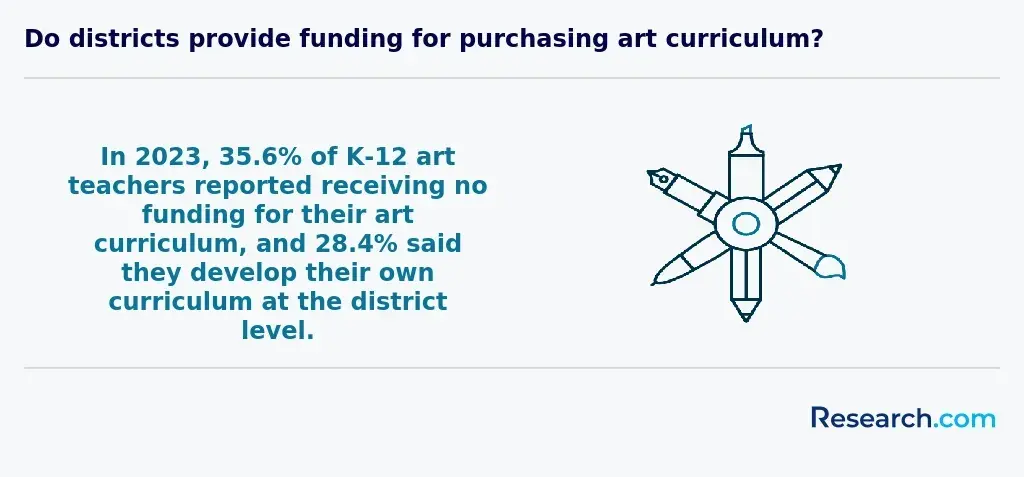
Do districts provide funding for art curriculum purchases? In 2023, 35.6% received no funding for their art curriculum and 28% said they develop their own curriculum at the district level, as shown in the graphic below.
What are the educational requirements for becoming an art teacher in Oklahoma?
Oklahoma art teachers need preparation in both visual art and teaching. A strong program should help you develop your own artistic skill while also training you to teach students with different ability levels, backgrounds, and learning needs.
- Bachelor’s degree: The standard entry point is a bachelor’s degree in art education or a related field that leads to teacher certification.
- Art coursework: Expect study in drawing, painting, design, ceramics, sculpture, digital art, art history, aesthetics, and studio practices, depending on the program.
- Education coursework: Teacher preparation typically includes lesson planning, assessment, child and adolescent development, classroom management, educational psychology, and teaching methods.
- Minimum academic performance: Some programs require a cumulative GPA of at least 2.5 in specified coursework. Requirements can vary by institution, so verify the exact threshold before applying.
- Field experience: Observation hours and student teaching help candidates apply classroom theory before becoming the teacher of record.
- Accreditation: Choose a recognized institution and confirm that the educator preparation program meets Oklahoma certification standards. If you are comparing online options, use resources such as Research.com’s guide to nationally accredited online colleges as a starting point, but always confirm teacher licensure alignment directly with the school and the state.
| Program Feature | What to Ask Before Enrolling |
| Licensure alignment | Does this program lead to Oklahoma art teacher certification? |
| Student teaching | How are placements arranged, and can I complete them near where I live? |
| Art studio access | Will I have access to facilities, materials, digital tools, and exhibition opportunities? |
| Online coursework | If classes are online, which requirements must still be completed in person? |
| Transfer credits | Which previous art or education credits will apply to the degree? |
| Career support | Does the department help students prepare portfolios, resumes, and teacher interviews? |
Some students considering art education also explore adjacent graduate or instructional roles, such as an affordable online library science master's. That can be useful for long-term planning, but it is not a substitute for Oklahoma art teacher certification if your goal is to teach visual art in public schools.
What is the certification and licensing process for an art teacher in Oklahoma?
Certification is the state’s formal approval for you to teach. The exact process can change, so applicants should verify current forms, fees, testing requirements, and deadlines with the Oklahoma State Department of Education.
- Complete an approved teacher preparation program: Most candidates finish a bachelor’s program that combines art education coursework, professional education courses, and supervised student teaching. Programs often require a minimum of 120 credit hours.
- Pass the OSAT for Art: The Oklahoma Subject Area Test for Art measures visual art content knowledge and teaching-related competencies.
- Complete the Praxis Performance Assessment for Teachers: The PPAT evaluates teaching practice, instructional planning, assessment, and reflection.
- Submit official transcripts: Your degree-granting institution must provide documentation showing that you completed the required program.
- Complete a fingerprint-based background check: Candidates submit fingerprints for review. Fingerprinting services typically range from $50 to $75.
- Pay application and testing fees: The teaching license application fee is approximately $50, and additional fees may apply for certification exams.
- Apply for the Oklahoma teaching license: After meeting education, testing, and background requirements, submit your application to the state.
- Plan for renewal: Oklahoma requires professional development for license renewal every five years.
Traditional vs. Alternative Certification
| Pathway | Best For | Important Caution |
| Traditional art education degree | Students who know early that they want to teach art in public schools. | Confirm the program is approved for Oklahoma certification before enrolling. |
| Post-baccalaureate or alternative route | Career changers who already hold a bachelor’s degree in another field. | Alternative routes may still require coursework, exams, mentoring, and state approval. |
| Private school route | Teachers interested in independent or faith-based schools. | Private schools may set different hiring requirements, but certification can still improve employability. |
How important is teaching experience and what are the internship opportunities for art teachers in Oklahoma?
Teaching experience is essential because art classrooms require more than subject knowledge. You must manage supplies, teach safety procedures, support students with different skill levels, assess creative work fairly, and keep students engaged during hands-on projects. Oklahoma candidates typically complete a student teaching placement, often for one semester, before full certification.
- Student teaching: Candidates commonly complete at least 12 weeks of student teaching through an accredited teacher preparation program.
- School-based fieldwork: Earlier observation and practicum hours let you see different grade levels before taking on full teaching responsibilities.
- Community art programs: Volunteering in museums, arts centers, after-school programs, and youth workshops can strengthen your resume.
- Substitute teaching: Subbing can help career changers build classroom confidence while completing certification steps.
- Mentored placements: Universities and school districts may connect candidates with experienced art teachers who can provide feedback on lesson design and classroom management.
How to Get More Value From Student Teaching
- Ask your mentor teacher for specific feedback on pacing, demonstrations, transitions, and assessment rubrics.
- Keep a record of successful lesson plans, sample student prompts, and photos of classroom displays when allowed by school policy.
- Practice teaching different media, including drawing, painting, mixed media, sculpture, and digital tools if available.
- Observe how experienced teachers manage cleanup, shared materials, kiln or tool safety, and students who finish early.
- Use the experience to decide whether you prefer elementary, middle school, high school, or mixed-grade teaching.
Candidates who want to compare broader roles in schools can also review alternative education careers to see how art teaching fits into the wider education field.
What are the standards and curriculum requirements for teaching art in Oklahoma?
Oklahoma’s visual arts standards organize learning around four artistic processes: Creating, Presenting, Responding, and Connecting. These categories help teachers design lessons that go beyond making objects. Students learn to generate ideas, develop technical skill, interpret works of art, present their work, and connect art to culture, history, personal identity, and other subjects.
- Creating: Students develop ideas, explore materials, solve visual problems, and produce original work.
- Presenting: Students learn how to select, prepare, display, and discuss artwork.
- Responding: Students interpret, analyze, critique, and evaluate art using evidence and vocabulary.
- Connecting: Students relate art to personal experience, cultural contexts, history, and other academic areas.
The Oklahoma Fine Arts Framework can help teachers translate standards into lessons, assessments, instructional tasks, and grade-level expectations. Teachers may also integrate aesthetics, criticism, and art history, especially when designing units that connect visual art to social studies, literature, technology, or local culture. Advanced study in other creative fields, such as online MFA creative writing options, may enrich an educator’s broader creative practice, but K-12 public school teaching still depends on meeting state certification requirements.
| Curriculum Question | Why It Matters |
| Which Oklahoma standard does this lesson address? | Standards alignment keeps art instruction connected to statewide learning expectations. |
| How will students show evidence of learning? | Art assessment should evaluate process, decision-making, technique, reflection, and final work. |
| How will I support beginners and advanced students? | Differentiation keeps the same project accessible without lowering expectations. |
| What materials and safety procedures are required? | Planning prevents waste, confusion, and unsafe studio practices. |
| How does the project connect to culture or history? | Context helps students understand art as communication, not just decoration. |
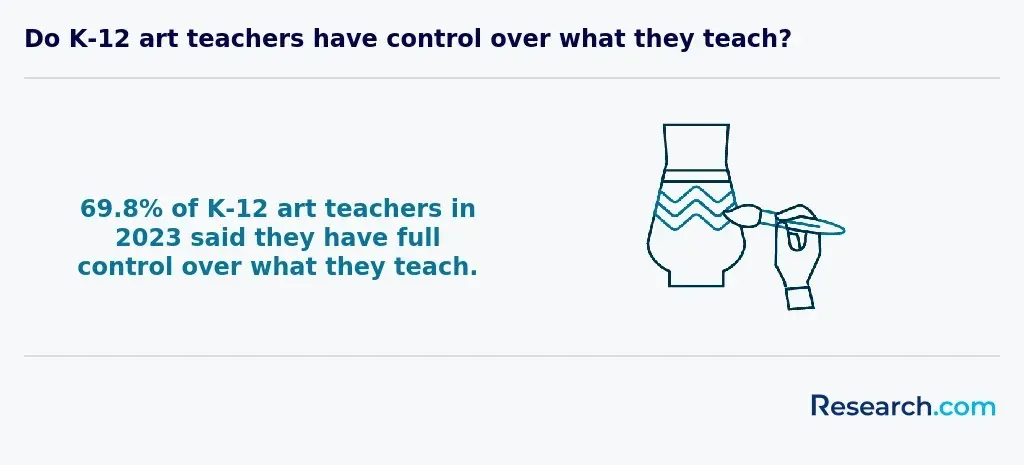
Do K-12 art teachers have control over what they teach? The majority of K-12 art teachers at 69.8% state that they have full control over what they teach, as shown in the graphic below.
What is the job market like and what are the salary expectations for art teachers in Oklahoma?
The Oklahoma art teacher job market can vary sharply by district. Large districts may offer more specialized arts positions, while rural schools may have a harder time finding certified candidates and may need teachers who can serve multiple grade levels or support extracurricular art activities.
- The average salary for art teachers in Oklahoma is described as approximately $48,000 per year, while another commonly cited estimate places the average around $45,000 per year.
- In urban areas such as Oklahoma City and Tulsa, salaries may exceed $50,000 because of district size, cost of living, and demand for specialized teachers.
- In rural districts, starting salaries may be closer to $40,000, though these schools may offer strong community ties and opportunities to build visible arts programs.
- Benefits often include health insurance, retirement plans, paid time off, and professional development opportunities.
| Setting | Potential Advantages | Potential Trade-Offs |
| Urban public schools | More arts staff, larger departments, higher possible salaries, more specialized electives. | Greater competition, larger class sizes, and more complex student needs may occur. |
| Rural public schools | High need for teachers, close community relationships, chance to shape a program. | Lower salary ranges and limited supplies or facilities may be challenges. |
| Private schools | Potential curriculum flexibility and smaller school communities. | Pay, benefits, certification expectations, and resources vary by school. |
| Community arts education | Creative programming, flexible audiences, museum or nonprofit partnerships. | May not offer the same stability or benefits as public school teaching. |
One Oklahoma teacher described the trade-off clearly: “I graduated from the University of Oklahoma, and while the starting salary was lower than I hoped, the benefits made a difference. I considered the stability of the job market and the chance to inspire students, which outweighed the initial salary concerns.” For teachers in smaller communities, local support for arts education can be an important part of job satisfaction.
As reported by the Bureau of Labor Statistics (BLS, 2024), special effects artists and animators lead arts and design professions with a median salary of $106,500 annually. Fashion designers follow closely at $99,060, while industrial designers earn $79,290. Interior designers make $76,250, and set and exhibit designers earn $62,510. Graphic designers have the lowest median salary at $58,910. However, graphic design degree online programs continue to be popular among artists. These are shown in the graph below. In summary, technical and specialized roles in the arts tend to offer the highest earning potential within the field.
What professional development and continuing education opportunities are available for art teachers in Oklahoma?
Professional development helps art teachers keep lessons current, meet renewal requirements, improve classroom practice, and build connections with other educators. It is especially valuable for teachers working in small schools where they may be the only visual arts specialist on campus.
- Oklahoma Arts Council: Offers programs, resources, and arts education support that can help teachers connect classrooms with community arts opportunities.
- Annual Oklahoma Arts Conference: Provides workshops and discussions related to arts education, community development, and arts leadership.
- Oklahoma Contemporary: Offers teacher-focused programs, hands-on workshops, classroom activities, and Studio School opportunities.
- Local museums: Institutions such as the Oklahoma City Museum of Art may provide teacher workshops, curriculum resources, and school visit support.
- Oklahoma Art Education Association: Supports art educators through professional learning, standards resources, conferences, and peer connections.
- Online resources: Museum lesson plans, digital collections, recorded workshops, and virtual activities can support teachers in districts with limited travel budgets.
- Emerging arts leadership programs: Oklahoma's New and Emerging Arts Leaders (ONEAL) can help younger professionals or newer arts administrators build networks and leadership skills.
- District professional development: School systems may offer required training in classroom management, student support, assessment, technology, and instructional practices.
| Professional Development Goal | Good Options to Consider |
| Improve standards-based lesson planning | Oklahoma Fine Arts Framework training, OAEA sessions, district curriculum workshops. |
| Learn new studio methods | Museum workshops, Oklahoma Contemporary Studio School, artist-led sessions. |
| Strengthen classroom management | District PD, mentor observations, peer learning communities. |
| Integrate technology | Digital portfolio workshops, design software training, media arts sessions. |
| Build leadership skills | Conference presentations, curriculum committees, ONEAL, department chair opportunities. |
What are effective classroom management strategies and teaching methods for art teachers in Oklahoma?
Art classrooms can be highly engaging, but they also involve movement, materials, tools, water, cleanup, collaboration, and open-ended projects. Effective teaching depends on routines that protect creativity without allowing disorder to take over.
- Teach routines explicitly: Show students how to get supplies, use materials, clean workspaces, store unfinished projects, and transition between activities.
- Set behavior expectations early: Explain what respectful critique, safe tool use, and productive studio time look like before problems occur.
- Use clear demonstrations: Short, focused demonstrations work better than long lectures, especially when students are eager to start creating.
- Differentiate project choices: Offer options such as drawing, collage, mixed media, or digital design when the same learning objective can be met in multiple ways.
- Plan for early finishers: Keep extension prompts, sketchbook challenges, reflection questions, or peer feedback tasks ready.
- Use formative assessment: Check progress during the process rather than waiting until the final artwork is complete.
- Build critique skills gradually: Teach students to use art vocabulary, ask questions, and give evidence-based feedback.
- Make the room flexible: Organize areas for wet media, dry media, group work, display, storage, and cleanup.
- Connect lessons to students’ lives: Projects are often stronger when students can use personal experience, community themes, or cultural references responsibly.
Common Classroom Mistakes New Art Teachers Should Avoid
| Mistake | Better Approach |
| Starting a messy project before teaching cleanup routines. | Practice material procedures before using paint, clay, printmaking tools, or shared supplies. |
| Grading only the final product. | Assess planning, process, craftsmanship, reflection, and growth. |
| Giving every student the same narrow project. | Use common objectives but allow age-appropriate creative choices. |
| Assuming students know how to critique. | Model respectful feedback and provide sentence frames or critique protocols. |
| Overplanning expensive lessons. | Design strong projects that can work with realistic district funding and available materials. |
What else should I consider when planning my career as an art teacher in Oklahoma?
Art teaching is both a creative career and a regulated education profession. Before committing to a program, compare degree costs, licensure alignment, student teaching requirements, commute or relocation needs, expected salary, and the type of school environment you want. If you are still exploring the broader teaching pathway, Research.com’s guide on how to become a teacher in Oklahoma can help you understand the state’s general certification process beyond art education.
How are current state policies impacting art teacher careers in Oklahoma?
State education policies influence teacher certification, professional development, academic standards, district budgets, and the availability of classroom materials. Art teachers should monitor Oklahoma State Department of Education updates, district board decisions, and funding changes that may affect staffing, curriculum, and supplies. Educators who want a broader view of how state requirements shape different subject areas can compare this pathway with how to become an english teacher in Oklahoma.
What are the career advancement opportunities and specializations for art teachers in Oklahoma?
Art teachers can grow into specialized instructional roles, leadership positions, curriculum work, and arts administration. Advancement usually depends on classroom results, professional development, additional credentials, and the ability to lead programs beyond a single classroom.
- Digital media specialization: Teachers with design, animation, photography, or digital portfolio experience may help schools expand contemporary visual arts offerings.
- Art history or museum education: Educators interested in interpretation, exhibitions, and cultural learning can build partnerships with museums and community organizations.
- Special education or gifted education endorsements: Additional preparation can help teachers serve students with more specialized learning needs.
- Department leadership: Experienced teachers may become art department chairs, fine arts coordinators, or curriculum leads.
- School administration: Some teachers pursue administrative certification, such as principal preparation, to move into broader leadership roles.
- Curriculum and policy work: Teachers may contribute to district curriculum committees, standards implementation, or arts advocacy efforts.
In Oklahoma, the demand for qualified art educators continues to grow, with the Oklahoma State Department of Education reporting a need for innovative teaching methods that incorporate technology and contemporary art practices.
Looking at some stats, the median annual wages for craft fine artists in the top industries in the United States in 2024 were as follows, according to the Bureau of Labor Statistics (BLS): Federal government, excluding postal service, earned $105,640; motion picture and sound recording industries earned $95,590; personal care services earned $49,170; and independent artists, writers, and performers earned $45,970. These figures highlight the significant wage disparities among different industries within the field of craft fine arts. The federal government offers the highest median wage, followed by the motion picture and sound recording industries. In contrast, independent artists, writers, and performers earn significantly lower wages, as shown in the graph below.
One Oklahoma educator described a practical advancement path this way: “After graduating from the University of Oklahoma, I started as a high school art teacher in Norman. I pursued a digital media specialization, which opened doors for me to become the art department chair within five years. Now, I’m involved in curriculum development, shaping how art is taught across the district.”
How Do You Maintain and Renew Your Art Teaching Certification in Oklahoma?
Oklahoma art teachers must keep certification current by meeting state renewal requirements, which may include continuing education, approved professional development, and documentation of ongoing professional growth. Because renewal rules can change, teachers should track deadlines, keep certificates from workshops, and verify requirements through the Oklahoma State Department of Education well before the expiration date. For a broader explanation of credential categories, review Research.com’s guide to types of teaching certifications and requirements.
What resources and support are available for new art teachers in Oklahoma?
New art teachers need more than a license. They need lesson resources, mentors, professional networks, and funding strategies. These supports can make the first years more manageable, especially when budgets are tight or when a teacher is responsible for multiple grade levels.
- Oklahoma State Department of Education: Provides standards, curriculum frameworks, certification information, and state education updates.
- Oklahoma Art Education Association: Offers professional networking, standards support, workshops, conferences, and connections with experienced art educators.
- Oklahoma Arts Council: Provides arts programming information and grant-related resources that may support classroom or community projects.
- Local school district mentors: Many districts pair new teachers with experienced educators who can help with classroom management, grading, and school procedures.
- Museums and arts centers: Oklahoma museums and cultural organizations may offer lesson plans, tours, educator workshops, and object-based learning resources.
- Online teaching platforms: Sites such as Teachers Pay Teachers and Artsonia can provide project ideas, display tools, and classroom inspiration, though teachers should adapt materials to Oklahoma standards.
- Social media groups and forums: Oklahoma art teacher groups can be useful for sharing supply sources, grant ideas, lesson adjustments, and district-specific advice.
- Teacher recognition programs: Programs such as Oklahoma Teacher of the Year can expose newer teachers to effective practices from highly regarded educators.
How can inclusive teaching strategies enhance art education in Oklahoma?
Inclusive art teaching helps more students participate meaningfully in creative work. Teachers can use differentiated instruction, universal design for learning, culturally responsive examples, adaptive tools, flexible media choices, and clear visual instructions. Collaboration with special education teachers, English learner specialists, counselors, and families can help ensure that projects are accessible without reducing creative expectations. Educators who want to understand specialized instructional supports can review the pathway for special education teacher certification in Oklahoma.
How do art and music teaching careers compare in Oklahoma?
Art and music teachers both work within Oklahoma’s teacher certification structure, but their classrooms operate differently. Art teachers focus on visual communication, studio habits, critique, design, and material processes. Music teachers often emphasize performance, ensemble skills, auditory development, music theory, and rehearsal management. Both fields require planning, assessment, classroom leadership, and advocacy for arts education. If you are comparing arts pathways, Research.com’s guide on how to become a music teacher in Oklahoma can help clarify the differences.
What mentorship opportunities and peer networks are available for art teachers in Oklahoma?
Mentorship can shorten the learning curve for new art teachers. A mentor can help you handle supply ordering, grading creative work, documenting student progress, managing messy projects, preparing for art shows, and aligning lessons with state standards.
- Oklahoma Art Education Association: Membership can connect teachers with workshops, conferences, standards discussions, and experienced peers.
- District professional learning communities: Some districts organize PLCs where art teachers share lesson plans, assessments, and solutions to common classroom problems.
- University alumni networks: Graduates from Oklahoma art education programs may find support through faculty, classmates, and cooperating teachers.
- Cross-district collaboration: Teachers in smaller schools may benefit from regional networks because they may be the only art specialist in their building.
- Museum educator networks: Partnerships with local museums can provide curriculum ideas, exhibition opportunities, and object-based teaching strategies.
Teachers who are considering broader certification or grade-level flexibility may also benefit from learning how to become an elementary school teacher in Oklahoma, especially if they are interested in younger learners or interdisciplinary instruction.
What do graduates have to say about becoming an art teacher in Oklahoma?
- Teaching art in Oklahoma has been one of the most rewarding experiences of my life. The support from the community and the emphasis on creativity in our schools make it a unique place to inspire young minds. I’ve seen students flourish in ways I never imagined, and it’s fulfilling to be part of their journey. Mae
- As an art teacher in Oklahoma, I appreciate the diverse cultural influences that enrich our curriculum. The state’s commitment to arts education is evident, and I feel empowered to explore various artistic styles with my students. It’s a privilege to help them express themselves creatively and develop their own voices. Jason
- The collaborative spirit among educators in Oklahoma is remarkable. We often share resources and ideas, which enhances our teaching methods. The state also offers numerous grants and funding opportunities for art programs, allowing us to provide our students with high-quality materials and experiences. Sallie
How can interdisciplinary studies enhance art teaching practices in Oklahoma?
Interdisciplinary learning can make art classes more rigorous and relevant. Art teachers can connect visual projects to literature, cultural studies, science, history, ethics, technology, and community issues. For example, studying symbolism, belief systems, and cultural narratives through a theology degree pathway may broaden a teacher’s understanding of how images communicate meaning across traditions. The goal is not to replace art instruction, but to help students understand art as part of a wider human story.
How can technology transform art teaching in Oklahoma?
Technology is changing what students create and how teachers assess learning. Digital portfolios can show growth over time, design software can introduce students to creative industries, and virtual galleries can make student work visible beyond the classroom. Teachers can also use tablets, animation tools, digital photography, video editing, and online critique platforms when resources allow. Cross-disciplinary technology strategies, such as those discussed in How to be a middle school math teacher in Oklahoma?, may help teachers think about data, adaptive learning, and digital tools in new ways.
Could integrating history instruction enrich art education in Oklahoma?
History gives art lessons stronger context. When students study artistic movements, cultural change, political imagery, architecture, Indigenous art, regional traditions, and global visual culture, they learn that art reflects time, place, power, identity, and belief. Teachers who are interested in deeper historical instruction may compare requirements to become a history teacher in Oklahoma, especially if they want to build interdisciplinary courses or collaborate with social studies departments.
How can early childhood education strategies enrich art instruction in Oklahoma?
Early childhood strategies are useful for art teachers because many foundational art skills begin with sensory exploration, play, movement, storytelling, and fine motor development. Even teachers of older students can learn from early education approaches: break tasks into visible steps, use tactile materials, encourage experimentation, and value process as well as product. Art educators who work with younger grades may find helpful comparisons in Research.com’s guide on how to become a kindergarten teacher in Oklahoma.
What unique benefits do private schools offer to art teachers in Oklahoma?
Private schools in Oklahoma may give art teachers more flexibility in curriculum design, project themes, scheduling, and community events. Some private schools also have smaller classes or distinctive missions that shape arts instruction. However, pay, benefits, resources, and certification expectations vary widely, so candidates should ask direct questions before accepting a position. To compare this route with public school teaching, review how to become a private school teacher in Oklahoma.
Common Mistakes to Avoid When Becoming an Art Teacher in Oklahoma
| Mistake | Why It Can Hurt You | What to Do Instead |
| Choosing a degree without checking certification alignment. | You may graduate without meeting Oklahoma teacher licensure requirements. | Ask the program and the Oklahoma State Department of Education whether the pathway leads to art teacher certification. |
| Looking only at tuition. | Art education programs may involve supplies, studio fees, testing fees, commuting, and student teaching costs. | Estimate the full cost of attendance and certification before enrolling. |
| Assuming every online program works for Oklahoma licensure. | Some online degrees may not include approved student teaching or state-specific requirements. | Confirm licensure eligibility in writing before committing. |
| Waiting too long to prepare for certification exams. | Delayed testing can delay job applications or certification approval. | Build test preparation into your final year of coursework. |
| Neglecting your portfolio. | Art teacher interviews often require evidence of both artistic skill and teaching ability. | Prepare a portfolio with your artwork, lesson plans, student teaching materials, and teaching philosophy. |
| Assuming salary outcomes are guaranteed. | Pay varies by district, experience, location, and school type. | Review district salary schedules and ask about benefits before accepting an offer. |
Key Insights
- Oklahoma public school art teachers usually need a bachelor’s degree in art education or an approved related pathway, student teaching, certification exams, a background check, and state licensure.
- The Oklahoma State Department of Education reports that as of 2023, there are approximately 1,200 art teachers employed in public schools across the state, indicating continuing demand for qualified educators.
- A bachelor’s degree pathway typically requires around 120 credit hours and includes both visual art and professional education coursework.
- The median annual wage for art teachers in Oklahoma was approximately $48,000 in 2023, according to the U.S. Bureau of Labor Statistics, but district salary schedules and benefits should be reviewed carefully.
- Art teacher pay varies by location: urban districts such as Oklahoma City and Tulsa may offer salaries exceeding $50,000, while rural districts may start closer to $40,000.
- Special effects artists and animators lead arts and design professions with a median salary of $106,500 annually. Fashion designers follow at $99,060, while industrial designers earn $79,290.
- Interior designers make $76,250, set and exhibit designers earn $62,510, and graphic designers have the lowest median salary at $58,910 among the listed arts and design roles.
- The median annual wages for craft fine artists in the top industries in the United States in 2024 were: federal government, excluding postal service, $105,640; motion picture and sound recording industries, $95,590; personal care services, $49,170; and independent artists, writers, and performers, $45,970.
- The majority of K-12 art teachers at 69.8% state that they have full control over what they teach, but funding remains a practical challenge because 35.6% received no funding for their art curriculum in 2023 and 28% said they develop their own curriculum at the district level.
- The Oklahoma Subject Area Test for Art is a critical certification step because it assesses knowledge across artistic disciplines and teaching methodologies.
- Oklahoma offers alternative certification routes for individuals with a bachelor’s degree in a non-education field, but candidates must still complete required training and assessments before entering the profession.
- The strongest candidates combine certification readiness with a polished teaching portfolio, practical classroom experience, standards-based lesson planning, and flexibility about district location.
Related Articles for Nearby States
- 2027 How to Become an Art Teacher in Texas: Requirements & Certification
- 2027 How to Become an Art Teacher in Kansas: Requirements & Certification
- 2027 How to Become an Art Teacher in Arkansas: Requirements & Certification
- 2027 How to Become an Art Teacher in Missouri: Requirements & Certification
- 2027 How to Become an Art Teacher in Colorado: Requirements & Certification
- 2027 How to Become an Art Teacher in New Mexico: Requirements & Certification
- 2027 How to Become an Art Teacher in Nebraska: Requirements & Certification
- 2027 How to Become an Art Teacher in Louisiana: Requirements & Certification
- 2027 How to Become an Art Teacher in Iowa: Requirements & Certification
- 2027 How to Become an Art Teacher in Mississippi: Requirements & Certification
References:
- Art Teacher Education. (2014, September 18). Oklahoma art teacher certification and job requirements. Art Teacher Education.
- East Central University. (2018, June 28). Art – teacher certification. East Central University.
- Northeastern State University. (2024). Bachelor of art education. Northeastern State University.
- Oklahoma Arts Council. (2024). Our programs. Oklahoma Arts Council.
- Oklahoma Art Education Association. (2016, December 22). OAEA & NAEA visual arts standards. Oklahoma Art Education Association.
- Oklahoma Contemporary Arts Center. (2024, September 17). School and teacher programs. Oklahoma Contemporary Arts Center.
- Oklahoma State Department of Education. (2024). Oklahoma academic standards for fine arts visual art (VA). Oklahoma State Department of Education.
- Oklahoma State Department of Education. (2024, June 26). Oklahoma Fine Arts Framework. Oklahoma State Department of Education.
- University of Central Oklahoma. (2024). Art education, B.A.Ed. University of Central Oklahoma.
- University of Science and Arts of Oklahoma. (2023, October 6). Bachelor of arts in art/teacher certification. University of Science and Arts of Oklahoma.
Other Things You Should Know About Becoming an Art Teacher in Oklahoma
Oklahoma requires fingerprint-based state and FBI background checks through the Oklahoma State Department of Education before licensure. Applicants must also complete a review for any disqualifying criminal history, and schools can request additional clearance before employment.
To obtain an art teaching certification in Oklahoma, you must complete at least 124 credit hours. This typically includes general education, art-specific courses, and pedagogical training. Documentation of these hours is required when applying for certification.
Oklahoma requires art teachers to hold a valid teaching certificate issued by the Oklahoma State Department of Education.
- Qualifications: This includes completing a bachelor’s degree in education or a related field, along with a teacher preparation program.
- Teacher Code of Ethics: Art teachers must adhere to the Oklahoma Teacher Code of Ethics, which emphasizes professionalism, integrity, and respect for students. Violations can lead to disciplinary actions, including revocation of teaching licenses.
- Mandatory Reporting: Reporting requirements are critical. Oklahoma law mandates that teachers report any suspected child abuse or neglect to the appropriate authorities. Failure to report can result in legal consequences, including fines or imprisonment.
- Safe & Inclusive Classroom: Teachers must create a safe and inclusive classroom environment. This includes being aware of and accommodating students with disabilities, as outlined in the Individuals with Disabilities Education Act (IDEA) and Section 504 of the Rehabilitation Act.
- Curriculum Standards: Art teachers should be familiar with the Oklahoma Academic Standards for Visual Arts, which guide curriculum development and ensure that students receive a comprehensive education in the arts.
- Maintain Boundaries: Ethical considerations also include maintaining appropriate boundaries with students. This means avoiding favoritism, ensuring equitable treatment, and refraining from any form of harassment or discrimination.
- Respectful & Inclusive Environment: Teachers are encouraged to foster a culture of respect and creativity while being mindful of the diverse backgrounds of their students. This includes being sensitive to cultural appropriation in art projects and discussions. Classroom Management:
- Classroom management strategies must align with Oklahoma’s laws regarding student discipline. Teachers should implement fair and consistent disciplinary measures, ensuring that all students understand the rules and consequences.
- Stay Informed: Finally, art teachers should stay informed about changes in educational laws and ethical guidelines through professional development opportunities and resources provided by the Oklahoma State Department of Education.


