2027 How to Become a Middle School Math Teacher in Missouri: Requirements & Certification

Co-Founder and Chief Data Scientist
If you want to teach middle school mathematics in Missouri, the core decision is not simply “Which degree should I earn?” It is which certification route fits your background, budget, timeline, and long-term teaching goals. Missouri candidates usually need a bachelor’s degree, approved educator preparation, required assessments, student teaching or supervised classroom experience, background checks, and certification through the Missouri Department of Elementary and Secondary Education (DESE). This guide explains the main routes, education requirements, exams, classroom experience, financial aid options, career outlook, and practical questions to ask before committing to a program.
Quick facts about becoming a middle school math teacher in Missouri
- Missouri has reported a meaningful need for middle school math teachers, with shortages affecting many districts and creating opportunities for well-prepared candidates.
- As of 2023, the average salary for middle school math teachers in Missouri is approximately $52,000 per year, though pay varies by district, experience, education level, and local salary schedules.
- The projected employment growth rate for middle school math teachers in Missouri is about 5% over the next decade, supported in part by the continued emphasis on STEM education.
- Missouri’s relatively low cost of living can make teaching more financially manageable than in higher-cost states, especially in areas where housing remains less expensive than many large metropolitan markets.
- Some educators may qualify for student loan forgiveness, district benefits, mentorship programs, or other supports, but eligibility depends on the employer, school type, loan program, and service requirements.
- Education requirements for Missouri middle school math teachers
- Certification and licensing process in Missouri
- Student teaching, internships, and classroom experience
- Missouri math standards and curriculum expectations
- Scholarships and financial aid for future Missouri math teachers
- Job market and salary expectations
- Professional development and continuing education
- Classroom management and effective math teaching methods
- Career advancement and specialization options
- Common challenges and how to manage them
- Other math-related teaching careers in Missouri
- Inclusive education strategies for middle school math
- Trends shaping the future of Missouri math teaching
- Alternative routes to middle school math certification
- Legal and ethical responsibilities for Missouri teachers
- Resources and support for new teachers
- Complementary subject certifications
- Cost-effective certification pathways
- Dual certification and broader teaching options
- Additional certifications that strengthen a teaching portfolio
- Graduate perspectives on entering Missouri classrooms
- Mentorship and networking for career growth
- Online teacher certification and career flexibility
- How to stay on track with Missouri certificate requirements
Quick answer: How do you become a middle school math teacher in Missouri?
To become a middle school math teacher in Missouri, you generally need to earn a bachelor’s degree, complete a DESE-approved teacher preparation program, satisfy mathematics coursework requirements, complete supervised teaching experience, pass required assessments such as the Missouri Content Assessment for Mathematics and the Missouri General Education Assessment (MoGEA) when applicable, clear fingerprinting and background checks, and apply for certification through DESE. Candidates who already hold a bachelor’s degree may be able to use an alternative certification route instead of starting over with a traditional undergraduate education degree.
| Step | What it means | Why it matters |
| Earn the right degree | Complete at least a bachelor’s degree in education, mathematics, or a related field. | Missouri certification depends on meeting academic and subject-area preparation requirements. |
| Complete educator preparation | Finish a state-approved teacher preparation program or approved alternative route. | This connects subject knowledge with teaching methods, classroom management, and supervised practice. |
| Pass required assessments | Complete required general education and math content exams as directed by your route. | Assessments verify that you are prepared to teach middle school math content. |
| Gain classroom experience | Complete practicum work, student teaching, residency, or mentored teaching depending on the pathway. | Middle school teaching requires real classroom practice, not only math knowledge. |
| Apply through DESE | Submit transcripts, assessment results, background check documentation, and the certification application. | Certification is required before you can serve as a properly credentialed Missouri public school teacher. |
The best route depends on where you are starting. A first-time college student usually chooses a traditional teacher preparation degree. A career changer with a math-related bachelor’s degree may compare alternative certification, Temporary Authorization, online programs, and district-supported pathways. Candidates comparing education routes in other states can review examples such as Nevada teacher education courses, but Missouri candidates should always verify current requirements with DESE before enrolling.
What are the educational requirements for becoming a middle school math teacher in Missouri?
Missouri middle school math teachers need both content preparation and teaching preparation. Strong math skills alone are not enough; employers and certification officials also look for evidence that a candidate can plan lessons, assess learning, manage a classroom, support adolescents, and align instruction with state standards.
- Bachelor’s degree: The minimum academic credential is a bachelor’s degree. Many candidates major in education with a mathematics concentration, while others major in mathematics and complete an approved teacher preparation route.
- Mathematics coursework: Future middle school math teachers should expect coursework across core areas such as algebra, geometry, and statistics. The article’s source material identifies at least 21 semester hours in mathematics as an important benchmark for preparation.
- Pedagogical training: Courses in instructional design, adolescent development, assessment, classroom management, and educational psychology help candidates translate math knowledge into effective teaching.
- State-approved teacher preparation: A DESE-approved preparation program is the standard route for candidates seeking initial certification through a college or university.
- Subject-area competency: Candidates must demonstrate mathematics knowledge through required assessments, such as the Missouri Content Assessment for Mathematics or other designated exams connected to the certification route.
- Supervised teaching: Practicum and student teaching experiences provide the real-world practice needed to work with middle school learners.
| Candidate profile | Typical education path | Best-fit consideration |
| First-time college student | Bachelor’s degree in education with middle school math preparation | Best for students who know early that they want to teach. |
| Math major who wants to teach | Mathematics degree plus approved educator preparation | Useful for candidates with strong content knowledge who need teaching credentials. |
| Career changer with a bachelor’s degree | Alternative certification or Temporary Authorization route | Can reduce duplicate coursework if prior academic preparation fits Missouri requirements. |
| Current educator seeking another area | Additional endorsement or certification pathway | Helpful for teachers who want to add middle school math to an existing credential. |
Before choosing a school, ask whether the program is approved for the exact Missouri certification area you want. Also confirm field placement support, exam preparation, transfer credit rules, and whether online coursework satisfies any in-person clinical or student teaching requirements.
What is the certification and licensing process for a middle school math teacher in Missouri?
Missouri offers several ways to reach teacher certification. The right option depends on your prior degree, teaching experience, subject-area background, and how quickly you need to enter the classroom.
| Certification route | Who it may fit | Key requirement to verify |
| Traditional route | Students completing a four-year education degree with student teaching | Program approval, required assessments, and field placement structure |
| Alternative route | Bachelor’s degree holders transitioning into teaching | Approximately 30 semester hours of coursework may be required depending on the program and prior preparation |
| Temporary Authorization | Candidates with a relevant content-area degree, such as mathematics | Allows teaching for two years while completing self-directed coursework and district mentorship requirements |
| Out-of-State Certified route | Teachers already licensed in another state | Verification of a valid out-of-state certificate and Missouri-specific requirements |
| American Board of Certification for Teacher Excellence (ABCTE) | Bachelor’s degree holders pursuing middle or high school mathematics certification | Eligibility, testing, mentoring, and DESE recognition for the target area |
- Complete the academic route: Finish the approved preparation program or alternative coursework required for your pathway.
- Pass exams: Submit the required assessment results for general education and math content as applicable.
- Clear background checks: Missouri teacher candidates must complete fingerprinting and background checks before certification.
- Submit the application: Use the Certification Account Portal to provide transcripts, assessment results, and other required documentation.
- Plan for fees: Certification, testing, fingerprinting, and transcript costs can vary, so candidates should budget before applying.
Candidates who already hold a bachelor’s degree and are comparing lower-cost ways to enter teaching may want to review affordable online bachelor’s degree in education options, but it is important to confirm that any program leads to Missouri certification rather than a generic education degree.
Education level can affect earning potential across public elementary and secondary school teaching roles. In the 2020–2021 academic year, teachers with a Bachelor's degree had an average salary of $52,540. Teachers with a Master's degree earned an average salary of $66,960. Educators with an Education Specialist degree averaged $70,480, while those with a Doctorate degree averaged $71,280, as shown below.
These figures show that advanced education is associated with higher average wages in the teaching workforce. However, a graduate degree should still be evaluated against tuition, district salary schedules, time commitment, and whether the credential improves your certification, leadership, or specialization options.
How important is teaching experience and what are the internship opportunities for middle school math teachers in Missouri?
Teaching experience is one of the strongest preparation tools for middle school math teachers because it reveals what coursework alone cannot: how students respond to explanations, where misconceptions appear, how classroom routines affect learning, and how to adjust instruction in real time.
- Student teaching: Missouri candidates commonly complete a full-semester student teaching experience. The source material also identifies a minimum of 12 weeks of student teaching as a key certification component.
- Practicum placements: Earlier field experiences give candidates a chance to observe instruction, assist with small groups, and test lesson-planning skills before taking on full teaching responsibility.
- District partnerships: Many universities coordinate placements with local school districts, which can help candidates build hiring connections before graduation.
- Alternative classroom experience: Tutoring, substitute teaching, paraprofessional work, after-school math support, and volunteer roles can help candidates strengthen classroom confidence.
- Mentorship: Mentor teachers provide feedback on pacing, questioning, assessment, student behavior, and family communication.
| Experience type | What you learn | How to make it more valuable |
| Student teaching | Full-class instruction, lesson planning, grading, and classroom routines | Ask for specific feedback after every observed lesson. |
| Tutoring | Student misconceptions and individualized explanation strategies | Track which explanations help students move from confusion to independence. |
| Paraprofessional work | Behavior support, special education collaboration, and daily school operations | Observe how different teachers manage transitions and small-group instruction. |
| Residency or district internship | Longer exposure to school culture and student needs | Build relationships with administrators and department chairs. |
When comparing programs, ask who arranges placements, how far you may need to travel, whether evening or online coursework conflicts with student teaching, and whether the program has partnerships with districts where you hope to work.
What are the Missouri standards and curriculum requirements for teaching middle school math?
Missouri middle school math teachers must plan instruction around the Missouri Learning Standards and district curriculum expectations. These standards identify what students should know and be able to do at each grade level, while local districts select materials, pacing guides, assessments, and instructional priorities.
- Show-Me Standards: Missouri’s broader standards framework establishes expectations for student learning and graduation readiness.
- Missouri Learning Standards: Middle school math instruction should build conceptual understanding, procedural fluency, problem-solving ability, and readiness for more advanced coursework.
- Local curriculum alignment: Districts may use different textbooks, digital platforms, intervention models, and benchmark assessments, so teachers must learn both state and district expectations.
- Real-world application: Effective math teaching connects ratios, algebraic reasoning, geometry, statistics, and number sense to practical problems students can understand.
- Professional collaboration: Math departments, instructional coaches, and professional learning communities help teachers interpret standards and calibrate expectations.
Teachers who want to expand beyond classroom teaching can use standards knowledge in curriculum design, assessment writing, instructional coaching, and other professional opportunities with a teaching degree.
| Curriculum element | What teachers should focus on | Practical classroom move |
| Conceptual understanding | Helping students explain why a method works | Ask students to compare two solution strategies. |
| Procedural fluency | Building accuracy and efficiency | Use short, spaced practice instead of one-time review. |
| Problem solving | Applying math to unfamiliar situations | Use multi-step tasks with discussion before calculation. |
| Assessment | Finding gaps before they become long-term barriers | Use quick exit tickets and reteach groups. |
What scholarships and financial aid options are available for aspiring middle school math teachers in Missouri?
Teacher preparation can be expensive, so aspiring Missouri math teachers should compare net cost rather than tuition alone. Net cost includes tuition, fees, books, testing charges, fingerprinting, transportation to field placements, lost work hours during student teaching, and any financial aid or loan forgiveness that may apply.
Missouri Teacher Education Scholarship
The Missouri Teacher Education Scholarship supports students pursuing education degrees at participating institutions. The source material identifies an award amount of up to $3,000 annually for eligible students who demonstrate academic strength and a commitment to teaching in Missouri.
TEACH Grant
The federal Teacher Education Assistance for College and Higher Education Grant may provide up to $4,000 per year for eligible students preparing for high-need teaching fields such as mathematics. Recipients must understand the service obligation carefully, including the requirement to teach in a qualifying low-income school for at least four years after graduation.
Public Service Loan Forgiveness Program
Public Service Loan Forgiveness can help qualifying public school teachers with federal student loans if they meet the program’s employment and payment requirements. The source material describes a ten-year qualifying public service period with on-time loan payments before remaining eligible balances may be forgiven.
Institutional scholarships
Missouri colleges and universities often offer financial aid for education majors, including merit-based and need-based awards. Students considering institutions such as the University of Missouri or Missouri State University should contact the financial aid office and education department early, because some awards have separate deadlines.
| Financial aid option | Potential benefit | Important caution |
| FAFSA | Access to federal grants, loans, and work-study | Submit early and renew each year. |
| Access Missouri Financial Assistance Program | Need-based state aid for eligible in-state students | Eligibility can depend on enrollment, finances, and state rules. |
| TEACH Grant | Up to $4,000 per year for eligible candidates | If service obligations are not met, the grant can become a loan. |
| Institutional scholarships | Can reduce direct tuition costs | May require a separate application or minimum GPA. |
| Loan forgiveness | May reduce federal loan burden after qualifying service | Rules are specific; keep documentation from the beginning. |
Students who need flexibility may compare an affordable online bachelor of education degree with campus-based options, but online students should confirm that the program can arrange Missouri-approved field experiences and certification support.
What is the job market like and what are the salary expectations for middle school math teachers in Missouri?
The Missouri job market for middle school math teachers is shaped by district staffing needs, retirement patterns, local budgets, rural and urban hiring conditions, and the continued priority placed on STEM preparation. Reported shortages in many districts can make math a stronger certification area than some less difficult-to-staff subjects, but hiring is still local and not guaranteed.
The employment outlook for postsecondary teachers is positive, with a 4% growth rate from 2022 to 2032. Annual wages are listed at around $76,920, and 9,400 new jobs are forecast for the decade due to increasing demand for teachers, as shown below.
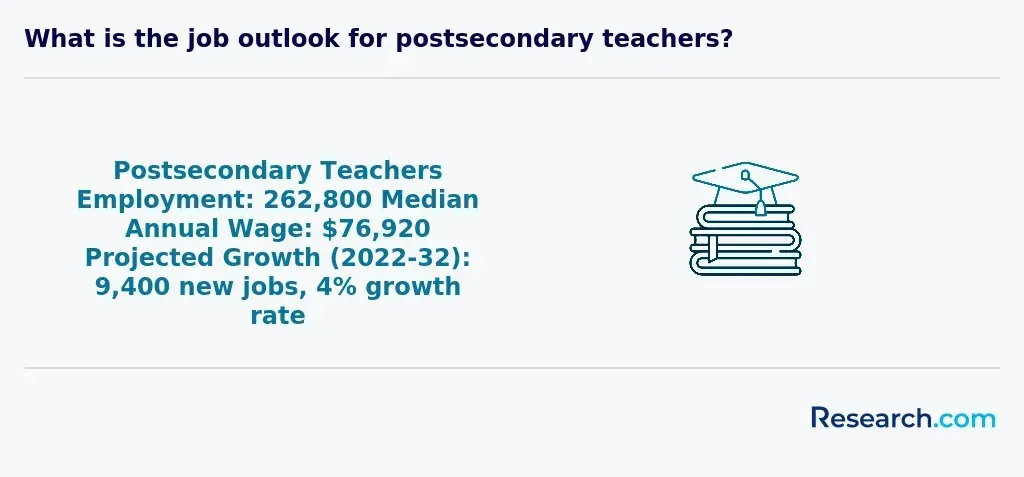
Although postsecondary teaching data is not the same as middle school math teaching, it can be useful for educators considering long-term advancement into community college, teacher education, or instructional leadership roles. Educators interested in advanced leadership preparation can compare online EdD options, including affordable online doctoral programs.
For Missouri middle school math teachers, salary expectations should be checked at the district level. Public school pay is often determined by a salary schedule that accounts for years of experience, graduate credits, degree level, and sometimes additional duties such as coaching, department leadership, or extracurricular supervision.
| Factor | How it can affect pay or hiring | What to check |
| District location | Urban, suburban, and rural districts may have different salary schedules and vacancy patterns. | Review district salary schedules before accepting an offer. |
| Degree level | Higher degrees are often associated with higher salary lanes. | Ask whether graduate credits or master’s degrees increase pay. |
| Math certification | Math can be a high-need area in many schools. | Look for shortage-area postings and district hiring incentives. |
| Experience | Prior teaching years may determine placement on the salary schedule. | Confirm how the district credits out-of-district or out-of-state experience. |
What professional development and continuing education opportunities are available for middle school math teachers in Missouri?
Professional development is not optional for teachers who want to stay effective. Missouri educators must maintain certification requirements, adapt to curriculum changes, learn new technology tools, and respond to changing student needs.
- Required professional development: Missouri requires teachers to complete professional development activities to keep skills current and maintain certification status.
- Math-specific workshops: These sessions may focus on problem-based learning, algebra readiness, data analysis, assessment design, intervention strategies, and technology integration.
- District training: Many districts provide professional learning on local curriculum, student behavior systems, special education procedures, and assessment platforms.
- Online courses and webinars: Flexible professional learning can help teachers earn continuing education credit while balancing classroom responsibilities.
- Professional conferences: Math education conferences allow teachers to exchange strategies with colleagues and learn from instructional specialists.
Teachers who decide they prefer younger learners may compare online elementary education degree programs, but changing grade levels may require different certification or endorsement planning.
| Professional development goal | Useful activity | Career benefit |
| Improve daily instruction | Math pedagogy workshops and coaching cycles | Better lesson design and student understanding |
| Support struggling learners | Intervention training and special education collaboration | Stronger differentiation and progress monitoring |
| Move into leadership | Graduate coursework or instructional leadership training | Preparation for department chair, coach, or administrator roles |
| Use technology well | Training on adaptive software and digital assessment tools | More efficient feedback and individualized practice |
What are effective classroom management strategies and teaching methods for middle school math teachers in Missouri?
Middle school math classrooms require a balance of structure, warmth, academic challenge, and flexibility. Students at this age are developing independence but still need clear routines, predictable expectations, and frequent feedback.
- Set expectations early: Teach routines for entering class, using materials, asking for help, working in groups, and transitioning between activities.
- Use consistent procedures: Predictable systems reduce wasted time and help students focus on mathematical thinking.
- Build relationships: Students are more willing to take risks in math when they trust the teacher and believe mistakes are part of learning.
- Make math visible: Use diagrams, manipulatives, number lines, graphs, and student explanations to move beyond memorized steps.
- Connect math to real problems: Budgeting, statistics, sports data, measurement, and design challenges can make abstract concepts easier to understand.
- Differentiate instruction: Provide extension tasks for advanced learners and scaffolded supports for students who need more practice.
- Check understanding frequently: Exit tickets, whiteboards, quick quizzes, and small-group conferences help teachers adjust before misconceptions grow.
| Common classroom issue | Less effective response | Better alternative |
| Students say they are “bad at math” | Move on quickly to avoid discomfort | Normalize mistakes and use growth-oriented feedback tied to specific strategies. |
| Group work becomes off-task | Assign groups without roles | Use roles, time limits, shared products, and accountability checks. |
| Wide range of skill levels | Teach only to the middle | Use flexible groups, targeted practice, and enrichment problems. |
| Students memorize without understanding | Give more procedural worksheets | Ask students to explain, model, compare, and justify solution methods. |
What are the career advancement opportunities and specializations for middle school math teachers in Missouri?
Middle school math teaching can lead to several career paths beyond the classroom. Some teachers remain classroom specialists and increase their impact through mentoring or curriculum work, while others move into leadership, administration, or advanced instructional roles.
- Instructional coordinator: Experienced teachers may help design curriculum, support teachers, analyze assessment results, and align instruction with state standards.
- Department chair or math lead: Teachers can guide grade-level planning, coordinate interventions, and mentor new educators.
- School administration: Some teachers pursue assistant principal or principal roles after completing leadership requirements.
- Specializations: Additional preparation in special education, gifted education, STEM education, educational technology, or assessment can broaden a teacher’s value.
- Graduate education: A master’s degree or specialist credential may support higher salary placement or eligibility for leadership positions.
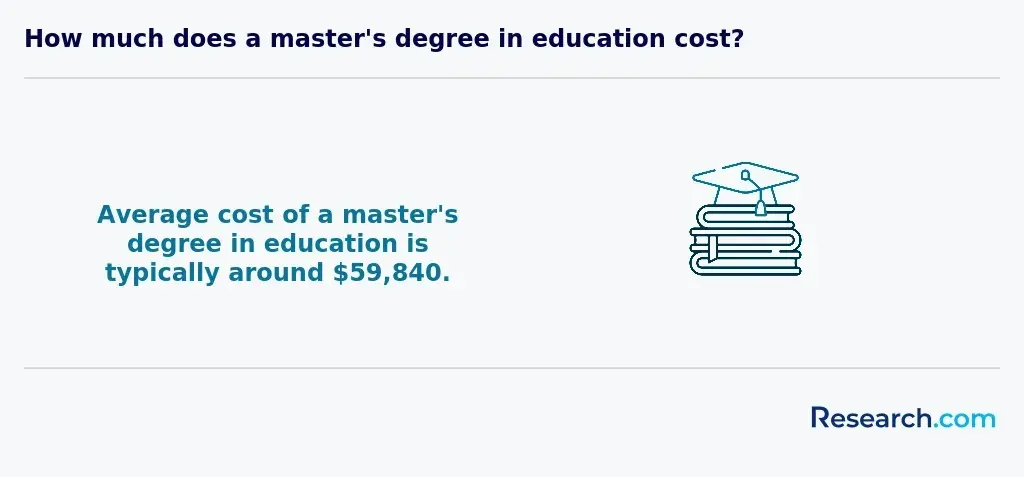
Overall, a Master's degree in Education costs around $59,840, on average, as shown below.
- : "A Missouri educator described the move from classroom teaching into curriculum work as demanding but worthwhile: balancing graduate study with teaching responsibilities was difficult, yet seeing new instructional ideas used with students made the effort meaningful."
Before pursuing an advanced degree, compare the expected cost with your district’s salary schedule. A graduate program may be more worthwhile if it qualifies you for a higher pay lane, leadership credential, or a specialization that matches district needs.
What challenges do middle school math teachers in Missouri face and how can they overcome them?
Middle school math teachers face challenges that are academic, developmental, and systemic. The strongest teachers plan for these challenges rather than reacting only after problems appear.
| Challenge | Why it happens | Practical response |
| Math anxiety | Students may have repeated frustration or believe math ability is fixed. | Use low-stakes practice, multiple solution methods, and visible progress tracking. |
| Behavior and motivation | Middle school students are navigating social and emotional changes. | Use clear routines, respectful correction, meaningful tasks, and relationship-building. |
| Skill gaps | Students may enter class missing prerequisite knowledge. | Use diagnostic checks, small-group reteaching, and targeted intervention blocks. |
| Limited resources | Some rural or underserved schools may lack updated materials or technology. | Collaborate with colleagues, seek grants, share resources, and prioritize high-impact materials. |
| Testing pressure | Teachers must balance state standards, local benchmarks, and authentic learning. | Align practice with standards while still using rich problem-solving tasks. |
Teachers should also build systems for workload management. Common supports include planning templates, shared department resources, professional learning communities, and mentorship. Similar themes of resourcefulness and continuous improvement appear in other state teaching guides, such as elementary school teacher requirements in New Jersey, but Missouri educators should rely on Missouri-specific rules for certification decisions.
What other teaching careers are available to those interested in math education in Missouri?
Not every math-oriented educator belongs in a middle school classroom. Some candidates prefer younger children, advanced secondary math, special education settings, instructional support, or curriculum roles. If you enjoy early numeracy and foundational learning, reviewing how to become a preschool teacher in Missouri can clarify early childhood requirements. If you prefer algebra, geometry, statistics, or college-readiness instruction, high school math teaching may be a better fit. Candidates should choose the age group and content level that match their communication style, patience, and subject strengths.
How can inclusive education strategies enhance middle school math teaching in Missouri?
Inclusive math instruction helps students with different learning needs access rigorous content without lowering expectations. This requires planning lessons with multiple entry points, using accessible representations, collaborating with special education professionals, and adjusting assessments when students have documented accommodations.
- Use visual models, manipulatives, vocabulary supports, and worked examples to reduce unnecessary barriers.
- Offer multiple ways for students to show understanding, including written explanations, oral reasoning, diagrams, and digital tools.
- Coordinate with special education teachers to align IEP supports with math learning goals.
- Use flexible grouping so students receive targeted support without being permanently labeled by ability.
Teachers who want deeper expertise in accessibility and individualized instruction can review how to become a special education teacher in Missouri.
How will emerging educational trends shape the future of Missouri middle school math teaching?
Missouri math teachers are working in a changing instructional environment. Digital learning platforms, adaptive practice tools, data dashboards, and STEAM-oriented projects are increasingly common. These tools can support learning, but they do not replace strong teaching judgment. Teachers still need to identify misconceptions, build mathematical discussion, and decide when technology helps or distracts.
- AI and adaptive software: These tools may help personalize practice, but teachers must monitor accuracy, equity, and student overreliance.
- STEAM learning: Cross-disciplinary projects can make math more relevant through science, technology, engineering, arts, and design problems.
- Data-informed instruction: Teachers are expected to use assessment data to identify gaps and plan interventions.
- Communication skills: Explaining math clearly to students and families is increasingly important. Candidates who want to strengthen broader communication skills may explore options such as the cheapest online English degree, though additional degrees should be pursued only when they support clear professional goals.
What are the alternative routes to becoming a middle school math teacher in Missouri?
Alternative routes can help career changers, military veterans, paraprofessionals, and degree holders in mathematics-related fields enter teaching without repeating an entire traditional undergraduate pathway. These routes still require certification, content verification, and supervised teaching support.
- Alternative certification programs: Candidates with a bachelor’s degree in mathematics or a related field may complete an approved program while moving toward full certification.
- Temporary Authorization route: Candidates with relevant subject-area preparation may teach for two years while completing required self-directed coursework, mentorship, and exit requirements.
- Online and accelerated options: Some candidates compare accelerated online degree programs to shorten the timeline, but speed should not come at the expense of certification alignment or field placement quality.
- Teacher residency programs: District-based residency models may pair candidates with experienced teachers while they complete certification requirements and develop practical classroom skills.
- ABCTE pathway: The American Board of Certification for Teacher Excellence can be an option for certain bachelor’s degree holders pursuing middle or high school mathematics certification.
| Question to ask before choosing an alternative route | Why it matters |
| Does this pathway lead to Missouri middle school math certification? | Not every online or alternative program is approved for every state or subject area. |
| Can I work while completing requirements? | Some routes are designed for employed teachers; others require unpaid student teaching. |
| Who provides mentoring? | New teachers need coaching on classroom management, planning, and assessment. |
| What are the total costs? | Testing, coursework, fees, and lost wages can change the real price of the pathway. |
What legal and ethical considerations must Missouri middle school math teachers follow?
Teaching in Missouri involves legal duties and professional ethics, not only instructional responsibilities. Teachers work with minors, confidential records, family communication, assessments, and mandated reporting requirements.
- Valid certification: Public school teachers must hold the appropriate Missouri teaching certificate for their assignment.
- Mandated reporting: Teachers are required to report suspected child abuse or neglect through the proper channels.
- Student privacy: Grades, disability status, behavior records, and family information must be handled confidentially.
- Equitable treatment: Teachers must provide fair access to instruction and follow special education and accommodation requirements.
- Professional boundaries: Communication with students, families, and colleagues should remain appropriate, documented when necessary, and aligned with district policy.
- Assessment integrity: Teachers must administer tests honestly, protect secure materials, and avoid practices that misrepresent student learning.
According to the latest data in the source material, median annual wages vary by teaching role. Kindergarten and elementary school teachers earn $63,670, middle school teachers earn $64,290, secondary and high school teachers earn $65,220, and postsecondary teachers earn $84,380. Career and technical education teachers earn $63,580, special education teachers earn $65,910, and adult basic and secondary education and ESL teachers earn $60,560. These comparisons are shown below.
What resources and support are available for new middle school math teachers in Missouri?
New teachers should not try to solve every classroom problem alone. Missouri educators can draw on district mentors, department teams, professional organizations, state resources, and online communities to improve faster and reduce burnout.
- District mentorship: Many Missouri districts pair beginning teachers with experienced educators who can help with planning, grading, classroom management, and parent communication.
- Professional organizations: The Missouri Council of Teachers of Mathematics can connect math teachers with professional development, conferences, and peer networks.
- DESE resources: DESE provides guidance related to certification, standards, professional development, and educator quality.
- Professional learning communities: Grade-level or subject teams help teachers compare student work, plan interventions, and align assessments.
- Conferences and workshops: Math-focused events can offer practical strategies for teaching difficult concepts and supporting diverse learners.
- Loan forgiveness information: Teachers working in qualifying public service settings or shortage areas may be able to explore forgiveness options, depending on program rules and eligibility.
The most valuable support systems are practical and ongoing. A one-time workshop can help, but regular coaching, collaborative planning, and feedback from trusted colleagues usually have a stronger impact on daily teaching.
Can complementary subject certifications broaden your teaching expertise?
Complementary certifications can make sense when they support a teacher’s actual instructional goals or district staffing needs. For example, a math teacher interested in interdisciplinary projects might study the music teacher education requirements in Missouri to understand how arts-based learning and pattern recognition can connect with mathematics. However, additional certifications require time, money, and exam preparation, so candidates should avoid adding credentials simply to collect them.
What is the most cost-effective pathway to teacher certification in Missouri?
The cheapest pathway is not always the best pathway. A low-tuition program can become expensive if credits do not transfer, certification is not approved, student teaching is hard to arrange, or exam preparation is weak. Candidates should compare total program cost, certification alignment, field placement support, completion time, pass-rate support, and employment connections.
| Cost factor | Why candidates overlook it | How to evaluate it |
| Tuition | Advertised rates may exclude fees. | Ask for a full cost estimate through completion. |
| Testing and background checks | These are often paid separately from tuition. | Include exam, fingerprinting, transcript, and application fees. |
| Student teaching | It may reduce your ability to work full time. | Plan for transportation, scheduling, and lost income. |
| Transfer credits | Policies differ by institution. | Get a written transfer evaluation before enrolling. |
| Certification fit | Some programs are not designed for Missouri licensure. | Confirm approval for the exact Missouri certificate area. |
For a focused cost comparison, review the cheapest way to get a teaching credential in Missouri and use it alongside DESE requirements and your district employment goals.
How can dual certification expand your teaching opportunities in Missouri?
Dual certification can make a teacher more flexible, especially in districts that need educators across grade levels or subject areas. A middle school math teacher who also qualifies for high school math may have access to a broader range of openings, advanced math courses, and department leadership opportunities. Candidates interested in that path can compare requirements in the guide on how to become a high school math teacher in Missouri.
Dual certification is most useful when it aligns with your strengths. If you enjoy abstract algebra, proof-based reasoning, or college-preparatory content, high school math may be a natural extension. If your passion is adolescent development and foundational math confidence, middle school may remain the better primary focus.
How can complementary certifications enhance your teaching portfolio in Missouri?
Additional certifications can strengthen a teaching portfolio when they help you serve students better or qualify for roles your district needs. For example, English preparation may support literacy across the curriculum, academic vocabulary instruction, written explanations in math, and interdisciplinary projects. Candidates considering language arts credentials can review the Missouri English teacher certification requirements.
The main risk is overextension. Adding another certification before mastering first-year teaching can increase stress. New teachers should usually stabilize classroom practice first, then pursue endorsements that match a clear professional plan.
What do graduates say about their transition to teaching in Missouri?
New Missouri teachers often describe the move from preparation program to full-time teaching as intense, practical, and formative. Classroom experience, mentor feedback, and repeated lesson revision tend to matter more than theory alone. Graduates commonly learn that middle school students need clear explanations, emotional consistency, humor, structure, and patience.
Those still comparing grade levels can review how to become an elementary teacher in Missouri to understand how elementary certification differs from middle school math teaching. Elementary education usually requires broader subject preparation, while middle school math requires deeper focus on adolescent learners and mathematical progression.
How can mentorship and networking enhance career success for middle school math teachers in Missouri?
Mentorship helps new math teachers shorten the learning curve. A strong mentor can review lesson plans, observe instruction, suggest behavior strategies, explain district expectations, and help a beginning teacher interpret student work. Networking adds another layer by connecting teachers with job leads, shared resources, conference opportunities, and colleagues who teach similar courses.
- Ask your mentor to observe specific routines, not just full lessons.
- Join math-focused professional groups rather than relying only on general education networks.
- Save and organize high-quality lesson materials from colleagues with permission.
- Attend district or regional workshops where hiring administrators and department leaders are present.
- Learn from educators outside math when it improves questioning, discussion, writing, or historical context. For example, strategies used by a high school history teacher in Missouri may help math teachers facilitate argumentation and evidence-based explanations.
How can online teacher certification enhance your career prospects?
Online teacher certification can help career changers, working adults, rural candidates, and paraprofessionals complete coursework with more scheduling flexibility. It can also expose teachers to digital instructional tools that are increasingly common in classrooms. Still, online convenience does not automatically mean certification readiness.
Before enrolling, verify that the online program is approved for Missouri certification, provides field placement support, prepares candidates for required assessments, and explains any in-person student teaching obligations. To compare digital options, review the best online teacher certification programs.
| Online certification advantage | Possible drawback | What to ask |
| Flexible scheduling | Clinical practice still requires in-person classroom time. | How are Missouri placements arranged? |
| Access from rural areas | Support can feel distant if advising is weak. | Who is my certification advisor? |
| Potentially lower total cost | Hidden fees may apply. | What is the full program cost through certification? |
| Technology skill development | Digital coursework may not model strong in-person classroom management. | How does the program prepare candidates for live teaching? |
How can you effectively navigate the teaching certificate requirements in Missouri?
The safest way to avoid certification delays is to create a requirement checklist before choosing a program. Start with the official DESE process, then confirm each requirement with your college advisor or alternative certification provider. For a broader overview, use Research.com’s guide to teaching certificate requirements in Missouri.
- Identify the exact certificate area you want before enrolling.
- Confirm that your program is approved for Missouri certification.
- Ask which assessments are required and when you should take them.
- Keep copies of transcripts, test scores, background check records, and field placement documentation.
- Budget for all fees, not just tuition.
- Check whether your desired district has additional hiring preferences or shortage-area incentives.
- Review DESE updates regularly, because certification policies can change.
What do graduates have to say about becoming a middle school math teacher in Missouri?
- : "“Teaching middle school math in Missouri is rewarding because students are old enough to reason deeply but still developing confidence. The strongest support came from colleagues who shared lesson ideas and helped me adjust when a plan did not work.” — Selina"
- : "“Technology can make math more interactive, but it works best when it supports good questions and student discussion. The most satisfying moments happen when a student who used to avoid math starts explaining a solution to someone else.” — Joe"
- : "“The diversity of student needs keeps the job challenging. Professional development helped me learn new ways to reach students who needed more support and students who were ready for extension.” — Ernie"
Key Insights
- Missouri middle school math certification usually requires a bachelor’s degree, approved teacher preparation, math content competency, supervised classroom experience, required exams, background checks, and DESE application approval.
- Career changers do not always need to start over with a traditional four-year education degree. Alternative certification, Temporary Authorization, ABCTE, and residency-style routes may fit candidates who already have a relevant bachelor’s degree.
- As of 2023, the source material reports significant demand for Missouri middle school math teachers, an average salary of approximately $52,000 per year, and a projected job growth rate of about 5% over the next decade.
- Education level can affect pay. In 2020–2021, public elementary and secondary school teachers averaged $52,540 with a bachelor’s degree, $66,960 with a master’s degree, $70,480 with an education specialist degree, and $71,280 with a doctorate degree.
- The employment outlook for postsecondary teachers is listed at a 4% growth rate, with 9,400 new jobs expected from 2022 to 2032 and average annual wages around $76,920.
- Certification applications should be planned early. The source material notes that, as of 2023, the average processing time for certification applications is approximately 4-6 weeks.
- Test preparation matters. The source material reports that the 2023 pass rate for first-time Missouri Content Assessment for Mathematics test takers was around 75%.
- About 80% of new teachers in Missouri have completed their degrees from accredited institutions, according to the source material, making accreditation and program approval essential checks before enrollment.
- Mentorship can improve retention. The source material states that teachers who participate in mentorship programs are 30% more likely to remain in the profession after their first three years.
- A Master's degree in Education costs around $59,840 on average, so teachers should compare graduate tuition with district salary increases and leadership opportunities before enrolling.
- The most common mistakes are choosing a program without verifying Missouri approval, focusing only on tuition, underestimating student teaching logistics, delaying exams, and assuming salary or loan forgiveness outcomes are guaranteed.
The strongest path is the one that aligns with Missouri certification rules, your existing education, your budget, and the type of classroom where you can teach effectively. Verify requirements early, choose an approved preparation route, build real classroom experience, and use mentorship to develop into a confident middle school math educator.
Related Articles for Nearby States
- 2027 How to Become a Middle School Math Teacher in Kansas: Requirements & Certification
- 2027 How to Become a Middle School Math Teacher in Iowa: Requirements & Certification
- 2027 How to Become a Middle School Math Teacher in Nebraska: Requirements & Certification
- 2027 How to Become a Middle School Math Teacher in Arkansas: Requirements & Certification
- 2027 How to Become a Middle School Math Teacher in Oklahoma: Requirements & Certification
- 2027 How to Become a Middle School Math Teacher in Illinois: Requirements & Certification
- 2027 How to Become a Middle School Math Teacher in Kentucky: Requirements & Certification
- 2027 How to Become a Middle School Math Teacher in Tennessee: Requirements & Certification
- 2027 How to Become a Middle School Math Teacher in Indiana: Requirements & Certification
- 2027 How to Become a Middle School Math Teacher in South Dakota: Requirements & Certification
References:
- Bureau of Labor Statistics. (2023). Occupational employment and wages, May 2023: Secondary school teachers, except special and career/technical education. Bureau of Labor Statistics.
- DataUSA. (2024). Teacher education. DataUSA.
- Math Teacher Education. (2023). How to become a math teacher in Missouri: Requirements for math teacher jobs in MO. Math Teacher Education.
- Missouri Department of Elementary and Secondary Education. (2023). Professional development. Missouri Department of Elementary and Secondary Education.
Other Things You Should Know About Becoming a Middle School Math Teacher in Missouri
To become a middle school math teacher in Missouri, you must obtain a teaching certificate issued by the Missouri Department of Elementary and Secondary Education (DESE). This typically involves completing a bachelor's degree in education with a focus on mathematics, passing the required state exams, and completing a student teaching internship. Additionally, you may need to complete ongoing professional development to maintain your certification.
To become a middle school math teacher in Missouri in 2027, you need a bachelor's degree in education with a math focus. Complete an approved teacher preparation program, pass the Missouri Educator Gateway Assessments (MEGA), and apply for certification with the Missouri Department of Elementary and Secondary Education.
In Missouri, aspiring middle school math teachers in 2027 must pass the Missouri Content Assessment for Middle School Mathematics. Additionally, the Missouri Educator Gateway Assessments (MEGA) exam series, including the Missouri General Education Assessment, is required to ensure comprehensive teacher preparedness.
To become a certified middle school math teacher in Missouri in 2027, you must earn a bachelor's degree in education or a related field, complete a state-approved teacher preparation program, and pass the Missouri Educator Gateway Assessments (MEGA). You must then apply for certification through the Missouri Department of Elementary and Secondary Education.