2027 Best Accredited Online Ultrasound Technology Degree Programs: Compare Tuition, Admissions, and Career Outcomes

Co-Founder and Chief Data Scientist
Choosing an online ultrasound technology program is tricky because "online" rarely means fully online: diagnostic medical sonography requires supervised clinical scanning. The decision matters because the U. S. Bureau of Labor Statistics reported a May 2024 median pay of $89,340 for diagnostic medical sonographers, while employers commonly look for graduates eligible for professional certification. This guide is for first-time students, working adults, transfer students, and allied health professionals comparing accredited options. You'll learn how to weigh tuition, admissions, accreditation, flexibility, clinical placement, and career outcomes before applying.
Key Things You Should Know
- The best value is usually a CAAHEP-accredited hybrid program that combines online coursework with verified local or assigned clinical rotations, because this pathway is most likely to support ARDMS exam eligibility.
- Use published tuition benchmarks carefully: College Board reported average 2024-25 tuition and fees of $4,050 at public two-year in-district colleges and $11,610 at public four-year in-state colleges, before sonography-specific fees.
- The career outlook is favorable but not automatic; BLS projections for diagnostic medical sonographers and related cardiovascular technologists show much faster-than-average growth for 2024-2034, but hiring still depends on certification, clinical competence, location, and specialty.
Which Accredited Online Ultrasound Technology Degree Programs Offer the Best Overall Value?
The strongest accredited online ultrasound technology degree programs are not always the cheapest or the most selective. The best overall value comes from a program that is properly accredited, places students into enough supervised scan time, prepares graduates for certification, and keeps total borrowing reasonable.
Because ultrasound is a hands-on imaging field, many reputable options are hybrid rather than fully online. If you want a school-by-school starting point, compare ultrasound tech programs online and then verify each program's current accreditation, clinical placement model, tuition, and certification outcomes directly with the school.
The table below summarizes the value profiles students usually compare. It is more useful than a simple ranking because the right choice depends on your prior college credit, work schedule, location, and certification goal.
| Program value profile | Typical credential | Best fit | Why it can offer strong value | Main risk to check |
| Public community college hybrid program | Associate degree | First-time students seeking the lowest credential cost | Often lower tuition and strong local hospital relationships | May have limited seats, daytime clinical hours, and strict prerequisites |
| Public university online or hybrid bachelor's pathway | Bachelor's degree or degree completion | Transfer students or registered imaging professionals seeking advancement | Can improve long-term mobility into leadership, education, or advanced specialties | May require prior imaging credentials or transfer credits |
| Private nonprofit allied health program | Associate or bachelor's degree | Students who need structured advising and multiple start dates | May provide intensive support, cohort scheduling, and established clinical coordination | Higher tuition can reduce ROI if outcomes are not strong |
| Post-primary certificate program | Certificate | Radiologic technologists or other health professionals adding sonography | Shorter path for students who already meet healthcare prerequisites | Not appropriate for students without the required prior credential or patient-care background |
For most students, the best-value choice is the least expensive accredited program that still provides strong clinical placement support and clear certification eligibility. Paying more can make sense if the program has better access to clinical sites, stronger student support, or a schedule that lets you keep working, but a higher price alone is not evidence of better outcomes.
What Accreditation Should Students Look for in an Online Ultrasound Technology Degree Program?
Accreditation is one of the most important filters when comparing online ultrasound technology programs. It affects financial aid access, transferability, certification eligibility, employer confidence, and your ability to continue into higher degrees.
Students should look for two layers of quality review. Institutional accreditation applies to the college or university as a whole, while programmatic accreditation evaluates the sonography program itself. In diagnostic medical sonography, the most recognized programmatic accreditation is through CAAHEP, based on review by the Joint Review Committee on Education in Diagnostic Medical Sonography.
Use the following accreditation checklist before you submit an application or deposit. This step is especially important for online and hybrid programs because clinical training may happen away from the main campus.
- Confirm institutional accreditation through a U.S. Department of Education-recognized accreditor, not only through the school's marketing page.
- Verify whether the diagnostic medical sonography program itself is CAAHEP-accredited, and check the exact specialty tracks covered, such as abdomen, OB/GYN, vascular, or cardiac sonography.
- Ask whether graduates meet eligibility requirements for ARDMS or other relevant certification exams, and request this information in writing.
- Confirm who secures clinical placements: the school, the student, or both, because a delayed clinical site can delay graduation.
- Check whether accreditation applies to your campus, online pathway, degree level, and specialty track rather than a different program at the same institution.
A common mistake is assuming that institutional accreditation alone is enough. It may qualify a school for federal financial aid, but it does not always mean the sonography curriculum has been reviewed for clinical competencies expected by certification bodies and employers.

How Do Tuition Costs Compare Across Accredited Online Ultrasound Technology Degree Programs?
Tuition for accredited online ultrasound technology degree programs varies widely because students may be comparing associate degrees, bachelor's completion programs, private college programs, and certificate pathways. The sticker price also rarely shows the full cost because sonography students often pay for uniforms, background checks, health screenings, liability insurance, simulation or lab fees, textbooks, travel to clinical sites, and certification exam preparation.
The table below uses national tuition benchmarks to help you interpret program prices. These figures are not sonography-specific, but they provide a useful baseline when you compare a school's published tuition against the broader U.S. market.
| Institution type | 2024-25 average published tuition and fees | How to use this benchmark |
| Public two-year college, in-district | $4,050 | Useful comparison point for associate-level sonography programs at community colleges |
| Public four-year college, in-state | $11,610 | Useful comparison point for bachelor's or degree-completion pathways at public universities |
| Private nonprofit four-year college | $43,350 | Useful comparison point when evaluating whether a private program's support and outcomes justify the higher price |
When comparing costs, focus on total program cost rather than cost per credit. A lower per-credit price can become less attractive if the program requires more credits, offers limited transfer credit, charges high lab fees, or forces students to travel long distances for clinical rotations.
Before choosing a program, ask the financial aid or bursar's office for a complete cost estimate. The most useful estimate should separate tuition, mandatory fees, books and equipment, clinical compliance expenses, commuting or relocation costs, exam fees, and expected annual increases.
How Competitive Is Admission to Accredited Online Ultrasound Technology Degree Programs?
Admission to accredited online ultrasound technology degree programs can be competitive because clinical seats are limited. Even when online coursework expands access, schools still need qualified clinical sites and instructors to supervise students' scanning practice.
The table below compares common admission expectations by pathway. Requirements vary by school, but this framework helps you identify whether you are academically ready now or need to complete prerequisites first.
| Pathway | Common admissions requirements | Typical competitiveness | Best applicant profile |
| Entry-level associate degree | High school diploma or GED, prerequisite science courses, minimum GPA, placement tests, background check, immunizations | Often competitive because of limited clinical seats | Students with strong grades in anatomy, physiology, physics, algebra, and communication |
| Entry-level bachelor's degree | General education courses, science prerequisites, GPA review, interview or essay, clinical eligibility requirements | Moderate to high depending on the school and local clinical capacity | Students who want a broader degree and may pursue leadership or specialty roles later |
| Degree-completion program | Prior college credit, current imaging credential, professional experience, active certification or licensure when required | Usually selective for professional readiness rather than first-year academics | Working imaging professionals who want a bachelor's credential |
| Post-primary certificate | Prior allied health credential, patient-care experience, prerequisite coursework, clinical access approval | Selective because it assumes previous healthcare training | Radiologic technologists or other qualified clinicians adding sonography skills |
Students can improve their chances by treating admissions as a readiness process, not a one-time application. Strong applicants usually document prerequisite completion early, confirm that their science courses are recent enough, prepare for interviews, and understand the physical and communication demands of patient-facing imaging work.
One red flag is a program that advertises extremely easy admission without explaining clinical placement, competency assessment, or certification preparation. Admissions flexibility is not automatically bad, but sonography programs should still be clear about how students become clinically competent.
Which Learning Formats Offer the Greatest Flexibility in Online Ultrasound Technology Degree Programs?
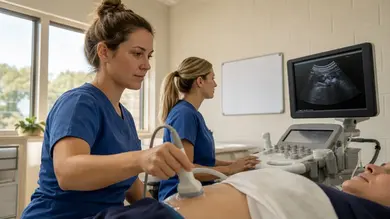
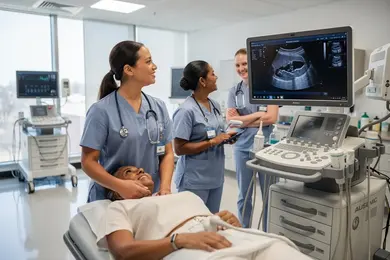
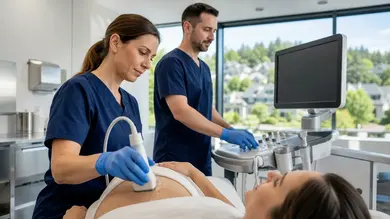
The most flexible accredited online ultrasound technology degree programs usually combine asynchronous online lectures with scheduled labs, simulations, and in-person clinical rotations. A fully online format is uncommon for entry-level sonography because students must learn probe handling, patient positioning, image optimization, safety protocols, and real-time clinical judgment.
The table below compares learning formats based on flexibility and practical trade-offs. Use it to match the program structure to your work schedule, commute, and learning style.
| Format | Flexibility level | What happens online | What happens in person | Best fit |
| Hybrid cohort program | Moderate | Lectures, quizzes, assignments, case reviews | Labs, scanning practice, clinical rotations | Students who want structure and faculty interaction |
| Mostly online with local clinical placement | High if a clinical site is nearby | Didactic coursework and some simulation-based learning | Clinical scanning at an approved site | Working adults who can complete clinical hours locally |
| Online degree completion | High | Upper-division imaging, management, research, or healthcare courses | May be limited or not required if the student is already credentialed | Registered imaging professionals seeking advancement |
| Campus-based program with online general education | Low to moderate | Some nonclinical courses | Most sonography labs and clinical training | Students who prefer hands-on instruction and local campus access |
Flexibility should never come at the expense of clinical quality. Before enrolling, ask whether clinical hours are guaranteed, how far students may need to travel, whether evening or weekend rotations are available, and what happens if a clinical site becomes unavailable.
A current trend affecting online sonography education is the use of simulation and digital case libraries. These tools can strengthen image-recognition skills and help students practice decision-making, but they do not replace supervised patient scanning required for entry-level competence.

What Student Support Services Improve Success in Online Ultrasound Technology Degree Programs?
Student support services matter because sonography programs are academically demanding and clinically intensive. Students must manage science-heavy coursework, hands-on skill development, patient communication, documentation, and certification preparation at the same time.
The table below highlights support services that can directly affect persistence and graduation. These are worth comparing because two programs with similar tuition can feel very different once classes and clinical rotations begin.
| Support service | Why it matters | Question to ask before enrolling |
| Clinical placement coordination | Delays in placement can delay graduation and certification eligibility | Who is responsible for finding and approving clinical sites? |
| Faculty access and scan feedback | Students need timely correction to improve image quality and patient technique | How quickly do instructors review cases and respond to students? |
| Certification exam preparation | Many employers prefer or require professional certification | Are registry-style practice exams, review courses, or tutoring included? |
| Academic tutoring | Physics, anatomy, and pathology can be challenging for new students | Is tutoring available online and outside business hours? |
| Career services | Students need help translating clinical experience into job applications | Does the program offer resume help, interview prep, and employer connections? |
| Disability and wellness support | Sonography can involve repetitive motion, standing, and patient mobility tasks | How does the school support accommodations and student well-being? |
One common mistake is choosing the least expensive program without checking whether support is available during evenings or weekends. For working adults, support hours can be just as important as online course access.
Which Financial Aid Options Are Available for Accredited Online Ultrasound Technology Degree Students?
Students in accredited online ultrasound technology degree programs may qualify for several types of financial aid, but eligibility depends on the school, credential level, enrollment status, and program approval. The Free Application for Federal Student Aid is usually the starting point for federal grants, loans, and work-study consideration.
For the 2025-26 award year, the maximum Federal Pell Grant is $7,395 for eligible students. That amount can meaningfully reduce net cost at a public two-year program, but it may cover a smaller share at higher-priced private institutions, so students should compare net price rather than tuition alone.
Students comparing healthcare education routes may also look at non-imaging options, such as a nutritionist degree, to understand how tuition, clinical requirements, and credentialing differ across allied health fields.
Use this financial aid checklist after you receive admission offers. It will help you compare what you will actually pay and how much you may need to borrow.
- Complete the FAFSA and confirm that the institution and program are eligible for federal student aid.
- Ask each school for a net price estimate that includes grants, scholarships, loans, fees, and clinical expenses.
- Compare scholarship renewal rules, including GPA minimums and full-time enrollment requirements.
- Check whether local hospitals, imaging centers, or employers offer tuition assistance in exchange for work commitments.
- Ask whether certification exam fees, uniforms, health screenings, and background checks are included in the aid budget.
- Avoid borrowing based only on the first term's bill; estimate total debt across the full program length.
The best financial aid package is not always the one with the largest total award. A package heavy in loans may be less affordable than a smaller package with more grants, lower tuition, and fewer out-of-pocket clinical costs.
Which Career Outcomes Are Associated With Accredited Online Ultrasound Technology Degree Programs?
Accredited online ultrasound technology degree programs can prepare students for roles in diagnostic medical sonography, depending on the program's specialty tracks and the student's certification pathway. Sonographers use imaging equipment to capture internal body structures, support physicians' diagnoses, explain procedures to patients, document findings, and maintain image quality and safety standards.
The main career outcome to evaluate is not simply whether graduates get "healthcare jobs." Look for whether the program prepares students for sonography-specific employment and certification in areas such as abdominal, obstetric and gynecologic, vascular, cardiac, breast, or pediatric sonography.
BLS reported a May 2024 median annual wage of $89,340 for diagnostic medical sonographers. This is a national median, not a starting salary guarantee; actual pay varies by state, employer, specialty, shift, experience, certification, and whether the role is in a hospital, outpatient center, physician office, or mobile imaging setting.
If your long-term goal is broader patient management, prescribing authority, or advanced clinical decision-making, you may want to compare sonography with nursing pathways such as nurse practitioner school. Sonography can be a strong fit for students who want technology-driven diagnostic patient care, while advanced nursing fits students seeking a provider role after completing the required nursing education and licensure steps.
When evaluating career outcomes, ask schools for recent, program-specific information rather than broad college-wide outcomes. Useful indicators include graduation rate, certification exam pass rate, job placement rate, employer partners, specialty placement, and the share of students who complete clinical requirements on time.
How Do Online and Campus-Based Ultrasound Technology Degree Programs Compare?
Online and campus-based ultrasound technology degree programs can lead to similar goals, but they differ in how students experience coursework, labs, clinical rotations, scheduling, and support. The key is not whether a program is online or on campus; it is whether the format gives you enough access to faculty, equipment, patients, and clinical feedback.
The table below compares online or hybrid programs with campus-based programs across the factors that most affect student fit. Use it to decide which format is realistic for your schedule and learning needs.
| Comparison factor | Online or hybrid ultrasound program | Campus-based ultrasound program |
| Coursework | Many lectures, assignments, and exams may be completed online | Most instruction happens on campus, though some general education courses may be online |
| Hands-on scanning | Completed through required labs, intensives, or approved clinical sites | Often integrated into campus labs and local clinical affiliates |
| Schedule flexibility | Higher for didactic courses but limited by clinical rotation schedules | Lower overall, but more predictable for students near campus |
| Best fit | Working adults, transfer students, and students far from campus-based options | Students who want frequent in-person faculty access and structured lab time |
| Main challenge | Securing and completing clinical requirements without delays | Commuting, fixed class times, and less geographic flexibility |
Unlike advanced online healthcare programs such as a 1 year DNP program online, entry-level ultrasound education cannot be compressed into online coursework alone. Students must demonstrate hands-on scanning competence, so any program promising a completely online path with no clinical requirements should be treated as a serious red flag.
Campus-based programs may be a better choice if you live near a strong sonography school, learn best through repeated in-person practice, or need immediate access to faculty and lab equipment. Online or hybrid programs may be better if you already have healthcare experience, need to remain employed, or can complete clinical training near home.
How Should Students Choose the Best Accredited Online Ultrasound Technology Degree Program?
Choosing the best accredited online ultrasound technology degree program requires balancing accreditation, cost, admissions fit, clinical access, flexibility, and career outcomes. A program that looks perfect on one measure may be weak on another, so the best decision comes from comparing evidence rather than relying on rankings alone.
Use the following process to narrow your list. It is designed to help you avoid the most common enrollment mistakes, including comparing only tuition, overlooking clinical placement, or assuming every online program leads to the same certification options.
- Start with accreditation: confirm institutional accreditation and determine whether the sonography program has CAAHEP accreditation for your intended specialty.
- Verify certification alignment: ask which exams graduates are prepared or eligible to take and whether outcomes are reported by specialty.
- Calculate total program cost: include tuition, fees, books, equipment, travel, clinical compliance expenses, and certification preparation.
- Evaluate clinical placement: ask where students train, who secures sites, how far students travel, and what backup options exist if a site falls through.
- Compare admissions fit: review prerequisites, GPA expectations, healthcare experience requirements, interview processes, and application deadlines.
- Match the format to your life: confirm whether online courses are asynchronous, whether labs require travel, and whether clinical shifts fit your work and family schedule.
- Review outcomes carefully: request graduation, certification exam, and job placement data for the specific program rather than the institution as a whole.
- Ask about transfer credit: confirm how many credits will apply before enrolling, especially if you already completed general education or science courses.
- Compare net price: evaluate grants and scholarships separately from loans so you understand true affordability.
- Speak with current students or recent graduates: ask about faculty responsiveness, clinical site quality, workload, and job search support.
Students who are drawn to healthcare but prefer research, teaching, or academic leadership may eventually compare other graduate pathways, including the cheapest PhD nursing programs. For students focused on diagnostic imaging and direct patient interaction, however, an accredited sonography pathway is usually the more relevant investment.
The strongest overall choice is the program that you can afford, complete on schedule, and use for the certification and employment path you actually want. If a school cannot clearly explain accreditation, clinical training, total cost, or outcomes, keep looking.
Other Things You Should Know About Ultrasound Technology
Yes, but you should expect to build those skills before and during the program. Sonography uses anatomy, physiology, physics, algebra, and image interpretation, so students who struggle in these areas may benefit from tutoring or prerequisite refreshers before applying.
It can be. Sonographers often stand for long periods, assist patients with positioning, and perform repetitive scanning motions. Good ergonomics, strength, and injury-prevention habits are important for long-term career sustainability.
Yes. Many sonographers specialize in areas such as abdominal, OB/GYN, vascular, cardiac, breast, or pediatric sonography. Specialty options depend on your program, clinical experience, certification pathway, and employer needs.
Most students need a reliable computer, high-speed internet, webcam, microphone, and access to the school's learning platform. Specialized scanning equipment is normally provided through labs, simulation centers, or clinical sites rather than purchased for home use.
References
- The Sonography Job Market https://www.ultrasoundschoolsinfo.com/the-sonography-job-market/
- Sonographer Program https://iudmed.com/one-year-program/
- Commission on Accreditation of Allied Health Education Programs | Council for Higher Education Accreditation https://www.chea.org/commission-accreditation-allied-health-education-programs
- School of Diagnostic Medical Sonography https://www.aurorahealthcare.org/education/diagnostic-sonography
- Being an Ultrasound Technician | Pros and Cons of Being an Ultrasound Tech https://www.cambridgehealth.edu/ultrasound-technician/being-an-ultrasound-technician/
- Costs and Financial Aid https://www.kumc.edu/school-of-health-professions/academics/departments/respiratory-care-and-diagnostic-science/academics/diagnostic-ultrasound-and-vascular-technology-program/costs-and-financial-aid.html
- Is Sonography a Good Career in Canada? https://pharmamedical.ca/is-sonography-a-good-career/
- Benefits of Certification | ARDMS, APCA, & POCUS Certifications https://www.inteleos.org/benefits-of-certification/
- How Competitive Is Sonography School? Acceptance Rates + Real Tips That Actually Help - Life of a Sono Tech https://lifeofasonotech.com/how-competitive-is-sonography-school/
- Accredited Diagnostic Medical Sonography Programs | CBD College https://www.cbd.edu/programs/diagnostic-medical-sonography/