2027 Best Online Ultrasound Technology Degree Programs at Nonprofit Universities

Co-Founder and Chief Data Scientist
Choosing an online ultrasound technology degree is difficult because clinical training, accreditation, and certification eligibility matter as much as convenience. The U.S. Bureau of Labor Statistics reports that diagnostic medical sonographers had a median annual wage of $89,340 in May 2024, while employment is projected to grow 13% from 2024 to 2034.
This guide helps prospective sonographers compare nonprofit programs, identify legitimate online formats, estimate costs, and select a degree that supports their intended credential and career path.
Key Things You Should Know
- The strongest online options are usually hybrid: didactic coursework may be online, but scanning labs and supervised clinical education must be completed in person.
- For entry-level sonography, programmatic accreditation and eligibility for professional certification can matter more than nonprofit status, tuition, or a general university ranking.
- Diagnostic medical sonographers earned a median annual wage of $89,340 in May 2024, and the occupation is projected to grow 13% from 2024 to 2034, according to the U.S. Bureau of Labor Statistics.
What Makes an Online Ultrasound Technology Degree Program at a Nonprofit University Different?
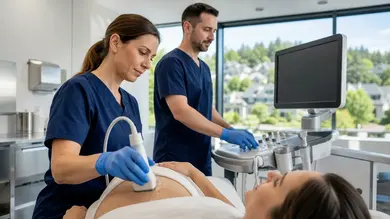
An online ultrasound technology degree at a nonprofit university combines remote academic instruction with required in-person clinical education. Ultrasound technology, also called diagnostic medical sonography, prepares students to operate imaging equipment, obtain diagnostic images, recognize anatomy, document findings, and work with physicians and patients. Because scanning is a hands-on clinical skill, a legitimate entry-level program is rarely 100% online.
Nonprofit universities include public institutions and private nonprofit institutions. Their status may affect governance, mission, and eligibility for certain institutional aid, but it does not by itself prove that a sonography program is affordable, accredited, or suitable for certification. Students should compare the program, not the tax classification alone. A starting point for locating format options is this guide to ultrasound tech programs online.
The degree level should match the student's starting point and goal. This comparison clarifies the common paths.
| Program type | Typical fit | Common delivery pattern | Career purpose |
| Associate degree | New students seeking entry-level clinical preparation | Online theory with local labs and clinical rotations | Diagnostic medical sonographer entry path |
| Bachelor's completion degree | Credentialed sonographers or students with prior college credit | Often largely online | Career advancement, leadership, or broader academic preparation |
| Certificate program | Health professionals adding a specialty, where admission rules permit | Hybrid with clinical requirements | Focused sonography preparation |
| Master's degree | Practicing professionals pursuing education, administration, research, or related roles | Often online or hybrid | Advanced non-entry-level career development |
Public nonprofit schools can be especially attractive to in-state residents because resident tuition may be lower. Private nonprofit universities may offer smaller cohorts, more structured advising, or transfer pathways, but their published tuition can be higher. Either can be a sound choice when the program's clinical placement model, accreditation, total cost, and graduate outcomes fit the student.
How Can Students Verify Accreditation for an Online Ultrasound Technology Degree at a Nonprofit University?
Students should verify two separate forms of accreditation before applying. Institutional accreditation evaluates the university as a whole. Programmatic accreditation evaluates the specific sonography program's curriculum, faculty, equipment, clinical education, and assessment. Institutional accreditation alone does not establish that an ultrasound program meets professional preparation standards.
For entry-level diagnostic medical sonography, accreditation through the Commission on Accreditation of Allied Health Education Programs (CAAHEP), based on a recommendation from the Joint Review Committee on Education in Diagnostic Medical Sonography, is an important benchmark. Certification bodies and employers may have different eligibility routes, so applicants should confirm the requirements that apply to their intended specialty and state.
Use the following process before paying an enrollment deposit.
- Confirm the university's institutional accreditation in the U.S. Department of Education or Council for Higher Education Accreditation directory.
- Search the CAAHEP directory for the exact campus, program name, concentration, and accreditation status.
- Ask whether the online or hybrid track is covered by the programmatic accreditation, rather than assuming all formats are included.
- Request written information about eligibility for professional certification examinations after graduation.
- Check whether required clinical sites are available in your state and whether the program accepts students from your location.
A major red flag is a school that emphasizes "online" delivery but cannot identify its clinical partners, programmatic accreditation status, or certification pathway. Another is a program that uses vague phrases such as "accreditation pending" without explaining how that affects currently enrolled students. Do not assume approval, candidacy, or institutional accreditation is equivalent to full programmatic accreditation.
How Rigorous Are Online Ultrasound Technology Degree Programs at Nonprofit Universities?
Reputable online and hybrid sonography programs are rigorous because they must teach both academic knowledge and safe, repeatable scanning performance. Students commonly complete anatomy and physiology, medical terminology, patient care, abdominal and obstetric imaging, physics and instrumentation, pathology, image evaluation, and professional ethics. Clinical education then requires supervised performance in real patient-care settings.
Online coursework may be asynchronous, synchronous, or mixed. Asynchronous classes can help working students manage reading, lectures, and assignments around their schedules. They do not remove deadlines, competency assessments, live check-offs, lab intensives, or clinical shifts. Students comparing broader health-professions pathways can also review a 1 year DNP program online, but a DNP is a nursing doctorate and is not a substitute for sonography education or certification preparation.
Academic expectations vary by degree level and entry status. The table separates the parts students can often complete remotely from the experiences that generally require physical attendance.
| Learning component | Usually online? | Why it matters |
| Lectures, readings, and discussions | Often | Builds clinical vocabulary, anatomy knowledge, and theoretical understanding |
| Ultrasound physics and image analysis | Often, with proctored assessment requirements | Supports safe equipment use and image-quality decisions |
| Scanning lab and competency check-offs | Usually in person | Evaluates probe handling, protocol use, ergonomics, and image acquisition |
| Clinical rotations | No | Provides supervised patient-care and workplace experience |
| Certification examination preparation | Often | Reinforces specialty knowledge and test readiness |
Students should expect a workload comparable to other clinical allied-health programs. Ask for the number of clinical hours, the usual shift schedule, travel expectations, and whether sites require daytime availability. A program may be academically online yet impractical for someone who cannot complete weekday clinical rotations.
How Much Does an Online Ultrasound Technology Degree Cost at a Nonprofit University?
The advertised per-credit tuition is only one part of the cost. The total price of an online or hybrid ultrasound technology degree can include tuition, institutional fees, textbooks, software, liability insurance, immunizations, background checks, drug screening, uniforms, certification-exam preparation, travel to labs, and transportation to clinical sites. Public nonprofit institutions may charge different resident and nonresident rates, while private nonprofit institutions often charge one published rate but may provide institutional scholarships.
Rather than treating a low tuition figure as the best value, compare every required cost through completion. Students can use an online cost comparison alongside options in adjacent health fields, such as a nurse practitioner school, while recognizing that nurse practitioner education has different degree, licensure, and clinical requirements.
This cost framework shows what to request from each program's financial aid and admissions offices.
| Cost category | What to verify | Potential decision impact |
| Tuition | Total required credits and whether tuition changes by residency or course level | Determines the base educational cost |
| Mandatory fees | Technology, distance-learning, lab, graduation, and clinical fees | Can materially change the final price |
| Clinical travel | Distance, parking, lodging, and unpaid time away from work | May make a lower-tuition program less affordable |
| Equipment and compliance | Uniforms, health screening, insurance, and background checks | Creates upfront expenses before clinical placement |
| Transfer credit | Which general education or prior courses are accepted | May reduce time to completion and tuition |
Request a written net-cost estimate based on your transfer evaluation and expected enrollment pattern. If a school cannot estimate clinical and mandatory expenses, budget conservatively and ask whether costs can change after admission. A lower-cost program is not automatically a better investment if it lacks accessible clinical placements or does not support the certification route you need.
What Financial Aid Is Available for an Online Ultrasound Technology Degree at a Nonprofit University?
Students enrolled in an eligible degree or certificate program at an accredited nonprofit institution may qualify for federal student aid, subject to program, enrollment, and individual eligibility rules. Completing the Free Application for Federal Student Aid is the usual starting point for federal grants, work-study, and Direct Loans. Eligibility is not automatic simply because a program is online or offered by a nonprofit university.
Financial aid packages can combine several sources. Review the aid offer by source and by whether the award must be repaid.
- Federal Pell Grants may help eligible undergraduate students with financial need and generally do not require repayment.
- Federal Direct Loans can help cover education costs but create repayment obligations and interest costs.
- State grants may be available to qualifying residents attending eligible in-state or approved institutions.
- Institutional scholarships from public or private nonprofit universities may depend on need, academic record, enrollment status, or clinical-program eligibility.
- Employer tuition assistance may help students already working for health systems, clinics, or other qualifying employers.
Ask whether clinical semesters affect eligibility for part-time aid, satisfactory academic progress, or disbursement timing. Students should also ask whether scholarship renewal requires a minimum grade point average or continuous enrollment. Borrow only after estimating the realistic cost of attendance and considering income lost during required clinical hours.
How Flexible Are Online Ultrasound Technology Degree Programs at Nonprofit Universities?
Flexibility in an online ultrasound technology program usually applies most strongly to lecture-based coursework. A program may allow students to view recorded lectures during the week, but its labs, simulations, examinations, competency evaluations, and clinical placements can still occur on fixed schedules. "Online" should be understood as a delivery method, not a promise of fully self-paced study.
Working adults should compare flexibility at the course and clinical levels. A part-time plan can reduce the weekly academic load, but it may extend time to graduation and delay entry into clinical sequencing. Accelerated formats can shorten classroom terms, yet they often demand more hours each week and are a poor fit for students without dependable time for study and clinical obligations.
Before enrolling, get clear answers to the scheduling questions that most often affect completion.
- Are lectures asynchronous, live online, or a combination of both?
- Are there required campus visits, weekend labs, or proctored examinations?
- Can clinical rotations be completed near your home, and who secures the placement?
- Do clinical sites require daytime, evening, weekend, or full-time availability?
- Can students pause enrollment without losing clinical placement or financial aid eligibility?
- What is the normal course sequence if a student must repeat a clinical competency?
Students who need maximum schedule control may be better served by an online bachelor's-completion program after gaining an entry-level credential. Those seeking initial sonography preparation should prioritize a realistic clinical placement model over a marketing claim of complete online flexibility.
What Student Support Services Do Nonprofit Universities Provide for Online Ultrasound Technology Degree Students?
Strong student support is especially important in ultrasound technology because learners must coordinate academic work, compliance requirements, clinical education, and career preparation. Services vary more by institution and program than by nonprofit status, so students should verify what is included for online learners rather than relying on a general services page.
The most useful supports are those connected to progression through a clinical program. The following comparison identifies services worth evaluating during admissions conversations.
| Support service | What effective support looks like | Why students should ask |
| Academic advising | Advisers understand prerequisite, clinical, and graduation sequencing | Missed sequencing can delay completion |
| Clinical coordination | Clear site agreements, compliance guidance, and placement communication | Clinical access is essential to hands-on preparation |
| Tutoring | Help with anatomy, physics, study skills, and examination preparation | Technical coursework can be demanding |
| Accessibility services | Documented accommodation process for online and in-person learning | Support needs may extend to labs and clinical settings |
| Career services | Resume feedback, interview preparation, employer connections, and job-search guidance | Helps translate clinical experience into employment applications |
Ask whether support staff are available outside standard business hours and whether online students have the same access as campus-based students. Also ask for the program's policies on remediation, clinical concerns, leave of absence, and appeals. A supportive program explains these processes before a student encounters a problem.
Do Online Ultrasound Technology Degree Programs at Nonprofit Universities Prepare Graduates for In-Demand Careers?
When an online or hybrid program includes quality clinical training and aligns with certification expectations, it can prepare graduates for diagnostic medical sonography roles in hospitals, physician offices, outpatient imaging centers, and medical laboratories. Sonographers commonly perform abdominal, obstetric and gynecologic, vascular, breast, cardiac, or other specialty examinations, depending on their education, credentials, and workplace.
The U.S. Bureau of Labor Statistics projects 13% employment growth for diagnostic medical sonographers from 2024 to 2034, faster than the average for all occupations. This projection indicates a favorable national demand trend, not a guarantee of a job in a specific city, specialty, or health system. Local hiring may depend on population needs, employer credential preferences, clinical experience, and state requirements.
Career preparation should be evaluated through concrete evidence, not promotional language. Students exploring another patient-care path may compare educational expectations at a nutritionist degree, although nutrition and dietetics leads to different clinical responsibilities and credentialing routes.
Before choosing a school, ask the program for its most recent outcomes information, including credentialing-exam performance where applicable, completion outcomes, graduate employment data, and employer partnerships. Also identify whether the curriculum supports the specialty you want. A general sonography program may not offer the clinical exposure needed for every specialty, particularly cardiac or vascular sonography.
Employers increasingly expect more than image acquisition skills. Competitive graduates demonstrate patient communication, attention to safety, documentation accuracy, teamwork, cultural awareness, basic informatics competence, and the ability to adapt to changing imaging technology. Artificial intelligence tools may assist image analysis and workflow in some settings, but they do not replace the sonographer's patient-facing scanning judgment, acquisition skills, and clinical communication.
Can an Online Ultrasound Technology Degree From a Nonprofit University Prepare Students for Graduate School?
Yes, but the best degree depends on the graduate field a student plans to enter. An associate degree can support entry-level sonography preparation, while a bachelor's degree is more commonly expected for graduate admission. Students considering graduate school should choose an institutionally accredited bachelor's program, protect their grade point average, complete required prerequisites, and confirm that online coursework will be accepted by their target graduate programs.
Graduate study after sonography may lead toward healthcare administration, education, public health, imaging leadership, business, or related clinical fields. A master's degree in sonography or medical imaging may emphasize leadership, education, research, or advanced professional practice rather than initial scanning preparation. A doctoral pathway is usually appropriate for experienced professionals seeking senior leadership, academic, policy, or research roles.
Students considering nursing graduate study should understand that sonography coursework does not replace nursing licensure or nursing prerequisites. For example, cheapest PhD nursing programs are designed for nurses and nursing scholars, not for students seeking initial sonographer training.
The table shows how degree choices can affect future academic options.
| Current credential | Potential next step | Best for | Key consideration |
| Associate degree in sonography | Bachelor's completion degree | Credentialed professionals seeking broader academic preparation | Confirm transfer of technical and general education credits |
| Bachelor's degree | Master's degree | Leadership, education, administration, or specialized professional goals | Review prerequisite courses and admissions standards |
| Master's degree | Doctoral degree | Faculty, executive, policy, or research ambitions | Choose a doctorate aligned with the intended discipline |
Students should avoid enrolling in a degree solely because it has "online" in the title. Instead, map the undergraduate program to the admission requirements of two or three realistic graduate programs before committing.
How Should Students Compare the Best Online Ultrasound Technology Degree Programs at Nonprofit Universities?
The best online ultrasound technology program is the one that meets the student's certification, clinical, financial, and scheduling needs at an acceptable total cost. A public nonprofit program with accessible in-state clinical sites may offer better value for one student, while a private nonprofit with stronger transfer policies or a more workable hybrid schedule may fit another.
Build a shortlist of programs only after confirming that each one can serve students in your state. Then use this sequence to make an evidence-based decision.
- Define your target role, such as entry-level general sonographer, credentialed sonographer completing a bachelor's degree, imaging educator, or healthcare administrator.
- Verify institutional accreditation and, for entry-level clinical programs, relevant programmatic accreditation and certification eligibility.
- Confirm every in-person requirement, including labs, clinical hours, site assignment responsibility, travel distance, and expected shifts.
- Request a transfer-credit review and a written estimate of tuition, required fees, clinical costs, and likely time to completion.
- Compare course delivery, including live attendance, examination proctoring, term length, part-time availability, and leave policies.
- Review recent program outcomes and ask how the school supports certification preparation, career planning, and academic remediation.
- Choose the program that clears your nonnegotiables rather than the one with the lowest advertised tuition or broadest online marketing claim.
Common mistakes include confusing institutional accreditation with programmatic accreditation, assuming clinical placement is guaranteed near home, overlooking mandatory daytime rotations, and comparing tuition without travel or compliance expenses. Another frequent error is assuming that nonprofit status automatically produces stronger return on investment. Program quality and value depend on the full combination of accreditation, completion feasibility, debt, credentials, and career alignment.
A final comparison should emphasize the factors most likely to affect your outcome.
| Comparison factor | High-value evidence | Warning sign |
| Accreditation | Verifiable institutional and relevant programmatic status | Unclear language or status that does not cover the actual track |
| Clinical education | Defined partners, supervision, and transparent placement process | No clear answer about where students complete rotations |
| Total cost | Written estimate including fees, travel, and compliance costs | Only a per-credit figure is provided |
| Flexibility | Published schedule for live sessions, labs, and clinical work | "Fully online" claim with undisclosed attendance obligations |
| Career alignment | Curriculum and outcomes relevant to the intended specialty or advancement goal | Broad career claims without credential or specialty details |
Other Things You Should Know About Ultrasound Technology
Usually not for initial clinical preparation. Coursework may be online, but ultrasound scanning labs and supervised clinical experiences generally require in-person attendance because students must demonstrate hands-on competencies with patients and equipment.
The terms are often used interchangeably. Diagnostic medical sonographer is the more formal occupational title used by many employers and the U.S. Bureau of Labor Statistics. Job duties can vary by specialty, employer, and credential.
Time to completion depends on prior coursework, prerequisites, program structure, clinical sequencing, and full-time or part-time enrollment. Associate-level entry programs commonly take longer than a year because they include general education, technical courses, labs, and clinical education.
Requirements vary by state and employer. Professional certification is widely valued by employers, but students should check the rules in the state where they plan to work and confirm that their selected program supports the relevant credentialing route.
References
- Find Accredited Ultrasound Technician Schools in New York https://www.ultrasoundschoolsinfo.com/new-york/
- Top 12 Fully Accredited U.S. Ultrasound Schools https://todopocus.com/top-12-fully-accredited-us-ultrasound-schools/
- Tuition & Fees https://kpsahs.edu/tuition-and-financial-aid/tuition-and-fees
- Sonography (Ultrasound) Program Cost - Kettering College https://kc.edu/academics/sonography-ultrasound/sonography-ultrasound-program-cost/
- Benefits of Certification | ARDMS, APCA, & POCUS Certifications https://www.inteleos.org/benefits-of-certification/
- Academic Requirements https://iudmed.com/academic-requirements-for-enrollment/
- United Medical Institute | Degree Programs in Sonography | CA & AZ https://www.unitedmedicalinstitute.edu/
- Sonography Technician Schools https://www.sonographytechnicianschools.com/online-sonography-schools.html
- Scope of Practice https://www.sdms.org/about/who-we-are/scope-of-practice
- Ultrasound & Sonography Technician Schools & Programs for Technicians Des Plaines IL - The Aquarius Institute https://aquariusinstitute.com/