2027 Online Ultrasound Technology Degree Programs With No Personal Statement or Admissions Essay Required

Co-Founder and Chief Data Scientist
Students interested in ultrasound technology may want a faster application without drafting a personal statement, but simplified admissions do not remove the need for academic and clinical preparation. The U.S. Bureau of Labor Statistics projects 11% employment growth for diagnostic medical sonographers from 2023 to 2033, faster than the average for all occupations.
This guide explains what no-essay admission means, which requirements remain, how online clinical training works, and how to compare programs without choosing convenience over accreditation or career readiness.
Key Things You Should Know
- A true no-essay policy means no personal statement is required for standard admission, but schools may still require transcripts, prerequisite science courses, a minimum GPA, background checks, interviews, or proof of clinical eligibility.
- Diagnostic medical sonographer employment is projected to grow 11% from 2023 to 2033, according to the U.S. Bureau of Labor Statistics, making accredited training and clinical placement more important than a short application.
- Essay-optional and essay-waived policies are not the same as no-essay admission: honors tracks, competitive cohorts, scholarships, and appeals may still require written responses.
What Does No Personal Statement or Admissions Essay Required Mean for Online Ultrasound Technology Degree Programs?
For an online ultrasound technology degree program, "no personal statement or admissions essay required" usually means applicants can submit the standard application without writing a narrative about their goals, experiences, or reasons for entering healthcare. The school instead evaluates objective materials such as prior coursework, grades, identity documents, and eligibility for clinical training.
This policy applies to admission only when the program page clearly says that an essay is not required for the applicant's credential and entry point. It may apply to an online general education phase but not to a later, selective diagnostic medical sonography cohort. Students should distinguish between an institution's admission and admission to the professional sonography program.
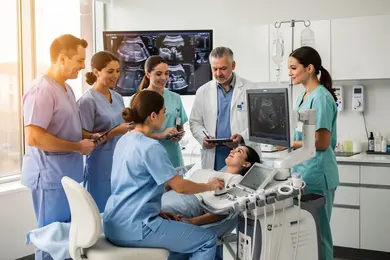
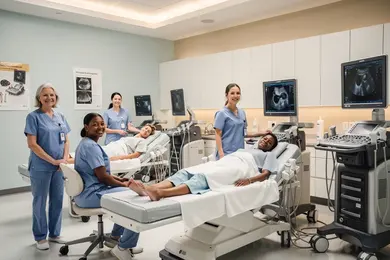
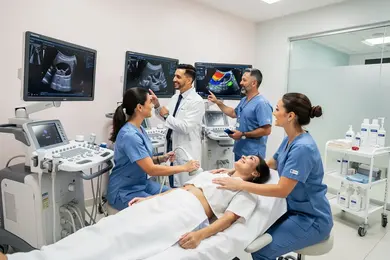
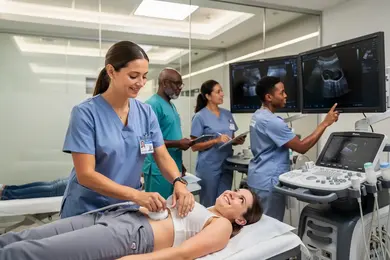
Many programs marketed as online are hybrid. Lectures, assignments, and some simulations may be completed online, while scanning labs and supervised clinical rotations occur in person. Reviewing available ultrasound tech programs online can help applicants identify whether a program is fully distance-based in coursework, requires campus labs, or expects students to arrange local clinical participation.
A no-essay application is useful for applicants who have solid academic records and want a streamlined process. It should not be interpreted as open admission, automatic acceptance, or evidence that a program meets professional certification expectations.
What Admissions Requirements Do Online Ultrasound Technology Degree Programs Use Instead of an Essay?
Programs use other evidence to determine whether an applicant can succeed in science-intensive coursework and patient-facing clinical education. Requirements vary substantially between an associate degree, bachelor's completion degree, certificate, and post-baccalaureate pathway.
The following comparison shows common substitutes for an essay and why they matter during review:
| Requirement | What the school evaluates | Why it matters |
| Official transcripts | Prior college, high school, or allied-health coursework | Confirms academic history and transfer-credit eligibility. |
| Minimum GPA | Overall GPA or GPA in prerequisite courses | May determine eligibility for a selective sonography cohort. |
| Science prerequisites | Anatomy and physiology, algebra, physics, medical terminology, or related courses | Demonstrates readiness for imaging science and clinical coursework. |
| Healthcare credentials | Existing degree, license, certification, or patient-care experience | Often required for completion or advanced-entry programs. |
| Interview or information session | Communication, availability, and understanding of clinical commitments | May replace written self-assessment at selective programs. |
| Compliance screening | Immunizations, drug screening, background check, CPR certification, and health records | Clinical sites commonly require these before placement. |
Standardized test policies are separate from essay policies. A school may be test-optional while still requiring prerequisites, or it may not require an essay but request placement testing for applicants without transferable college-level English or math credit.
Before applying, ask whether requirements apply at initial college admission, professional-program admission, or both stages. That distinction prevents a common mistake: assuming acceptance to an online college automatically reserves a seat in a limited clinical cohort.
Who Is a Good Fit for Online Ultrasound Technology Degree Programs With No Admissions Essay?
No-essay pathways can fit organized applicants who can demonstrate readiness through grades, completed prerequisites, or prior healthcare education. They are especially practical for working adults, military-connected learners, career changers with strong transcripts, and transfer students who prefer not to repeat personal narratives across applications.
A simplified application is not necessarily the right choice for everyone. Applicants with a lower GPA, uneven academic record, limited science preparation, or a major career transition may benefit from an essay-required or essay-optional program if the essay provides a meaningful opportunity to explain context, resilience, and relevant patient-care experience.
Consider these fit signals before prioritizing a no-essay program:
- Likely a good fit: You meet published prerequisite and GPA requirements, can attend required labs and clinical rotations, and do not need a narrative to explain your academic record.
- May need additional support: You have missing science prerequisites, prior coursework that is several years old, or schedule limitations that make clinical placement difficult.
- May prefer essay-optional admission: You have compelling healthcare experience, academic improvement, or circumstances that could strengthen a holistic review.
Students comparing broader clinical career options may also explore a nurse practitioner school pathway, although nurse practitioner preparation is a nursing graduate route and is not interchangeable with diagnostic medical sonography training. The better choice depends on the type of patient care, credential, time commitment, and clinical responsibilities you want.
What Is the Difference Between No-Essay, Essay-Optional, and Essay-Waived Ultrasound Technology Degree Admissions?
Admissions language can be easy to misread. The practical difference is whether writing is excluded from the standard application, available as a voluntary supplement, or removed only under a stated condition.
This table clarifies how applicants should interpret common policy labels before deciding whether to prepare written materials:
| Policy | Meaning for standard admission | Applicant consideration |
| No essay required | The standard application does not request a personal statement or admissions essay. | Confirm whether a separate professional-program application includes short answers. |
| Essay-optional | An essay is not mandatory, but the applicant may submit one. | Consider submitting only if it adds relevant context not visible in transcripts. |
| Essay-waived | An essay requirement is removed for a defined applicant group or term. | Read the waiver conditions, which may depend on transfer credits, GPA, partnership status, or application date. |
| Essay required for special consideration | General admission may be no-essay, while scholarships, honors, or appeals require writing. | Plan extra time if seeking institutional aid or a competitive cohort seat. |
A true no-essay policy is the clearest route for applicants seeking less writing. Essay-optional admission can be better for someone whose transcript alone does not show readiness. Essay-waived admission requires the closest reading because the waiver may not apply to every applicant, program, or enrollment term.
Are Online Ultrasound Technology Degree Programs With No Admissions Essay Easier to Get Into?
Not necessarily. Removing an essay reduces one application task; it does not reduce the academic, clinical, or capacity constraints that often drive sonography admissions decisions. A program can have no essay requirement and still limit enrollment because students need faculty-supervised scanning practice and approved clinical placements.
The U.S. Bureau of Labor Statistics reports that diagnostic medical sonographers had a median annual wage of $89,340 in May 2023. That wage figure describes the occupation nationally, not a guaranteed outcome of any degree, and it helps explain why applicants should evaluate certification eligibility, clinical quality, and local employment conditions rather than applying solely because the form is shorter.
Programs may be more selective at the professional phase than at general college admission. For example, a college might admit students broadly to complete prerequisites online, then rank qualified applicants for a smaller diagnostic medical sonography cohort based on science GPA, completed courses, observation hours, interview performance, or healthcare experience.
Red flags include promises of immediate entry without reviewing clinical readiness, unclear details about in-person training, and vague statements about certification preparation. A school should be able to explain how it selects students, where clinical education occurs, and what happens if a placement is unavailable.
How Can You Verify Accreditation and Quality in No-Essay Online Ultrasound Technology Degree Programs?
Accreditation should be the first comparison point because a no-essay policy says nothing about educational quality or certification pathways. For diagnostic medical sonography, applicants should look for programmatic accreditation appropriate to the specialty and confirm that the program's structure supports eligibility for relevant credentialing examinations.
Start by verifying institutional accreditation and then investigate whether the diagnostic medical sonography program is accredited by the Commission on Accreditation of Allied Health Education Programs, commonly known as CAAHEP, through its relevant review process.
Requirements for certification may also depend on the student's specialty, clinical experience, education pathway, and the credentialing organization's current rules.
Use the following checks to assess quality beyond admission simplicity:
- Confirm the exact credential, specialty track, and programmatic accreditation status directly with the school and accreditor.
- Ask whether online students complete hands-on scanning labs on campus, at partner sites, or through a scheduled intensive format.
- Request a written explanation of how clinical placements are assigned, including geographic limits, travel expectations, and responsibility if a site is delayed.
- Ask for recent credentialing-exam eligibility information, program completion data, and graduate employment information, while recognizing that outcomes can vary by student and labor market.
- Verify that the curriculum meets requirements in the state where you expect to train and work, especially if you plan to relocate.
Quality review should also include faculty credentials, student support during clinical rotations, technology requirements, and total program cost. A reputable program will answer these questions clearly before asking for a deposit or enrollment commitment.
How Does the Application Process Work for Online Ultrasound Technology Degree Programs With No Personal Statement?
No-personal-statement applications are usually document-driven. Applicants complete an online form, authorize transcript delivery, submit any required compliance records, and wait for an admission decision or a separate review for the professional phase.
The sequence below helps applicants avoid confusing institutional admission with clinical-program admission:
- Identify the credential you need: entry-level associate or bachelor's degree, degree-completion program, certificate, or a specialized track for already credentialed professionals.
- Read the current admissions page and catalog for your exact start term, then save the stated essay policy and prerequisite list.
- Order official transcripts early and compare completed courses with prerequisite requirements, including minimum grades and recency rules.
- Submit the standard application and pay any applicable fee, while checking whether an interview, observation documentation, or supplemental clinical application is required.
- Complete background, health, CPR, drug-screening, and immunization requirements only when instructed, because timing and costs vary by school and clinical site.
- Review the admission letter carefully to determine whether it is full admission, conditional admission, or admission only to pre-professional coursework.
Applicants should keep copies of submission confirmations and communicate in writing when asking whether an essay is required. If an admissions representative says no essay is needed, ask whether that answer also covers scholarships, selective sonography cohorts, and transfer evaluation.
Can Transfer and Adult Students Apply to Online Ultrasound Technology Degree Programs Without an Essay?
Yes, transfer and adult students can often use no-essay admissions pathways, but they may face additional transcript evaluation and prerequisite review. Transfer credit is not automatic: a school may accept general education credit while declining to apply older or non-equivalent science courses toward sonography prerequisites.
Adult learners should ask whether prior learning, military training, allied-health credentials, or prior degrees can satisfy specific requirements.
They should also confirm whether the program is designed for beginners or only for registered imaging professionals. Online completion programs frequently assume that students already hold a clinical credential and may not provide the entry-level scanning education needed for a first sonography role.
Transfer applicants weighing nearby allied-health alternatives can compare a nutritionist degree with their interests, but nutrition and dietetics education leads to different training, supervised-practice, and credentialing pathways than ultrasound technology.
Before enrolling, transfer and adult applicants should request a preliminary credit evaluation, verify remaining clinical requirements, and calculate the realistic completion timeline. This is particularly important when work or caregiving commitments limit daytime clinical availability.
Do No-Essay Online Ultrasound Technology Degree Programs Affect Tuition, Financial Aid, or Scholarships?
No-essay admission does not inherently make a program less expensive or change federal financial aid eligibility. Tuition is determined by the institution, residency rules, delivery format, course load, fees, and clinical expenses.
Financial aid depends on factors such as enrollment status, cost of attendance, satisfactory academic progress, and the information submitted through the Free Application for Federal Student Aid.
Cost comparisons should include charges that may not appear in a per-credit tuition figure:
| Cost factor | Why it can change the total cost |
| Tuition and mandatory fees | Online courses may have separate technology, distance-learning, laboratory, or course fees. |
| Clinical expenses | Students may pay for health clearances, CPR training, background checks, drug screening, uniforms, travel, parking, or housing during rotations. |
| Transfer credit | Accepted credits can reduce required coursework, but evaluation policies differ. |
| Enrollment pace | Part-time study may spread tuition over more terms and affect living-cost planning. |
| Scholarships | Institutional or external awards may use essays even when admission does not. |
For context, College Board reported average published tuition and fees of $4,050 for in-district students at public two-year colleges in 2024-25. That national benchmark is not a price quote for a sonography program, especially because clinical and program-specific costs can materially raise the total.
Students considering longer advanced-practice healthcare education should recognize that a 1 year DNP program online is a separate doctoral nursing option, generally intended for students who already meet nursing education and licensure prerequisites. It should not be used as a substitute for entry-level sonography training.
Apply for aid and scholarships on their own timelines. Do not skip a scholarship simply because the degree application has no essay; many awards use short-answer questions or personal statements to allocate limited funds.
How Should You Compare Online Ultrasound Technology Degree Programs With No Admissions Essay?
Compare programs in the order that affects career access, not in the order that makes applying easiest. An accredited program with reliable clinical education may be a stronger choice than a faster application with uncertain placement support.
Use this comparison framework when narrowing your list:
| Comparison priority | What to verify | Decision value |
| Accreditation and credential pathway | Institutional accreditation, programmatic accreditation, specialty focus, and examination eligibility pathway | Helps protect access to certification and employer expectations. |
| Clinical education | Who secures placements, location options, travel expectations, and contingency plans | Determines whether the online format is realistically workable. |
| Admissions structure | Whether no-essay applies to the professional cohort, transfer applicants, and scholarship applicants | Prevents unexpected supplemental requirements. |
| Total cost | Tuition, fees, equipment, compliance costs, and travel | Supports a realistic borrowing and budget decision. |
| Academic support | Tutoring, faculty access, scheduling, clinical advising, and technology support | Matters for science coursework and distance learners. |
| Outcomes transparency | Completion, credentialing, and employment information with definitions and reporting periods | Allows more meaningful program comparisons. |
Ask each school the same questions: Is an essay required at any stage? Is admission conditional? Are clinical sites guaranteed, arranged, or student-sourced? What credential can I pursue after graduation? What will I pay beyond tuition? Written answers make side-by-side comparisons more reliable.
If you are comparing ultrasound training with research-focused nursing education, review cheapest PhD nursing programs separately. A PhD in nursing is typically designed for research, teaching, or leadership rather than diagnostic imaging practice, so admissions criteria and career outcomes differ substantially.
The best no-essay program is one that removes unnecessary application friction while still providing a clear, accredited, clinically feasible route toward your intended ultrasound specialty.
Other Things You Should Know About Ultrasound Technology
Not always. It may apply only to first-time students, transfer students, a particular term, or general college admission. International applicants, applicants seeking conditional admission, and students applying to a selective clinical cohort may have additional requirements.
Yes. A school may request a written explanation for academic probation, a disciplinary disclosure, an appeal, a transfer-credit review, or a competitive cohort application. Ask whether the policy covers both initial admission and the diagnostic medical sonography program.
They may. Scholarship committees commonly use essays or short responses to distinguish among qualified applicants. Review each scholarship's requirements separately and meet its deadline even if the degree application is essay-free.
Usually, the academic portion can be substantially online, but entry-level sonography requires hands-on scanning instruction and supervised clinical experience. Confirm where labs and clinical rotations occur, who arranges them, and whether the locations are accessible before enrolling.
References
- Find Accredited Ultrasound Technician Schools in California in 2025 https://www.ultrasoundschoolsinfo.com/california/
- 33 Colleges Without Supplemental Essays! https://www.collegeadvisor.com/resources/colleges-without-supplemental-essays/
- Sonography Student Scholarships https://www.sdms.org/foundation/programs/scholarships/sonography-student
- College Applications Without Essays: Do They Exist? https://collegewise.com/blog/college-application-without-essay
- Funding Opportunities for Sonography Students https://www.downstate.edu/education-training/school-of-health-professions/programs/diagnostic-medical-imaging/funding_opportunities.html
- 22 Best Sonography Scholarships (2026) - Verified Links, Deadlines, Amounts - ScholarshipsandGrants.us https://scholarshipsandgrants.us/major/sonography/
- Colleges Without Supplemental Essays? Yes, Please. - Top Tier Admissions https://toptieradmissions.com/colleges-without-supplemental-essays-yes-please/
- Admission Essay vs Personal Statement | What's the Difference? https://www.proof-reading.com/resources/admission-essay-vs-personal-statement
- Scholarships | Inteleos Foundation https://inteleosfoundation.org/scholarships