
2027 Best In-Demand Healthcare Business Intelligence Jobs

Co-Founder and Chief Data Scientist
As hospitals, insurance providers, and pharmaceutical companies seek to optimize patient care, reduce costs, and improve operational efficiency, the skills of a healthcare business intelligence (BI) expert are becoming indispensable. The overall healthcare and social assistance sector is projected to add 5.2 million jobs from 2024 to 2034, with BI roles being a key driver of that growth.
In this article, you'll gain an in-depth understanding of the most in-demand healthcare BI jobs. We'll explore various career paths, from entry-level to senior roles, and break down the foundational skills and technical requirements needed to succeed. You can also expect to find practical information on educational pathways and certifications, as well as a detailed look at salary expectations and career progression.
Key things you should know about healthcare business intelligence jobs
- A degree in healthcare business intelligence opens doors to a variety of in-demand roles. Some of the most common titles include Healthcare Data Analyst, Healthcare Business Intelligence Developer, and Clinical Data Analyst.
- The median salary for a Healthcare Business Intelligence Analyst is approximately $99,864 per year. Salaries can vary significantly based on location, experience, and specific job title, with top earners making up to $148,500 annually.
- Pursuing an online degree in healthcare BI offers significant advantages. It provides flexibility to students and professionals who are already working, allowing them to balance their studies with personal and professional commitments.
- Best In-Demand Healthcare Business Intelligence Jobs Best Jobs
- What are the key responsibilities of a healthcare BI professional? Key Responsibilities
- How is a business intelligence analyst different from a data scientist in a healthcare setting? How is a business intelligence analyst different from a data scientist in a healthcare setting?
- Which types of organizations hire healthcare BI experts? Which types of organizations hire healthcare BI experts?
- What are the most crucial technical skills for an aspiring healthcare BI analyst to learn? Technical Skills
- What is the average salary for a healthcare business intelligence analyst? Average Salary
- What is the overall job growth outlook for the healthcare business intelligence field? Job Growth
- What is the work-life balance like in a healthcare business intelligence career? What is the work-life balance like in a healthcare business intelligence career?
- What strategies can healthcare BI professionals employ to advance their careers? What strategies can healthcare BI professionals employ to advance their careers?
- What are the biggest challenges facing the healthcare business intelligence industry today? Challenges
- What emerging technologies should I be learning to stay competitive in the future? What emerging technologies should I be learning to stay competitive in the future?
- How can an advanced degree enhance leadership opportunities in healthcare BI? How can an advanced degree enhance leadership opportunities in healthcare BI?
Healthcare Business Intelligence Jobs in 2026: How to Choose the Right Career Path
Healthcare organizations are under pressure to improve outcomes, reduce waste, manage staffing, protect patient data, and make better financial decisions. Business intelligence, or BI, helps them do that by turning clinical, operational, claims, and financial data into practical information leaders can use.
This guide is for students, career changers, healthcare workers, analysts, and IT professionals who want to understand where healthcare business intelligence jobs fit in the broader health data field. You will learn which roles are most in demand, what skills employers expect, how BI differs from data science, where these professionals work, what salary and growth signals suggest, and how to prepare for advancement.
The goal is not just to describe job titles. It is to help you decide whether healthcare BI matches your strengths, what training path makes sense, and which mistakes to avoid before investing time or money in a degree, certificate, or career transition.
Quick Answer: What Are Healthcare Business Intelligence Jobs?
Healthcare business intelligence jobs focus on collecting, organizing, analyzing, and presenting healthcare data so organizations can make better clinical, operational, and financial decisions. Common roles include healthcare data analyst, health informatics specialist, BI developer, clinical informatics analyst, and population health analyst.
These jobs usually require a mix of data skills, healthcare knowledge, communication ability, and familiarity with tools such as SQL, Tableau, Power BI, databases, data warehouses, and healthcare systems such as electronic health records. The strongest candidates can translate messy data into clear recommendations that clinicians, executives, insurers, and public health leaders can act on.
| Best fit if you enjoy... | Healthcare BI may be a strong option |
| Working with data but also seeing real-world impact | BI work often connects directly to patient flow, quality improvement, cost control, staffing, and care access. |
| Explaining technical findings to nontechnical users | Healthcare BI professionals frequently build dashboards and brief clinical or administrative teams. |
| Solving operational problems | Many BI projects focus on reducing bottlenecks, tracking performance, and improving workflows. |
| Combining healthcare and technology | The field rewards people who understand both data systems and the realities of healthcare delivery. |
Best In-Demand Healthcare Business Intelligence Jobs
Healthcare BI is not a single job. It is a group of roles that sit between analytics, information systems, clinical operations, finance, compliance, and strategy. Some positions are more technical, while others require stronger healthcare workflow knowledge or stakeholder communication.
| Role | Primary focus | Best for candidates with... |
| Healthcare Data Analyst | Analyzing healthcare datasets and preparing reports, dashboards, and recommendations | SQL, Excel, statistics, visualization, and strong business communication skills |
| Health Informatics Specialist | Improving how health information is captured, stored, shared, secured, and used | Healthcare operations knowledge, EHR experience, privacy awareness, and IT collaboration skills |
| Healthcare BI Developer | Building the technical BI environment, including databases, pipelines, models, and dashboards | SQL, Python, R, ETL, data warehousing, Tableau, Power BI, and database design |
| Clinical Informatics Analyst | Using clinical data to improve care quality, safety, treatment workflows, and outcomes | Clinical background, analytics skills, and experience working with care teams |
| Population Health Analyst | Studying health patterns across groups, communities, or covered populations | Public health, epidemiology, claims data, outcomes measurement, or health equity interests |
Healthcare Data Analyst
A healthcare data analyst works with information from sources such as patient records, insurance claims, billing systems, surveys, scheduling tools, and hospital operations platforms. The analyst’s job is to clean the data, find patterns, interpret results, and explain what those patterns mean for decision-makers.
Typical projects may involve tracking readmission trends, measuring appointment wait times, identifying cost drivers, comparing service-line performance, or evaluating whether a new workflow improved patient throughput. The best analysts do more than produce charts. They clarify the business question, test the data carefully, and explain limitations before recommending action.
Health Informatics Specialist
A health informatics specialist focuses on how healthcare information moves through an organization. This role often connects clinicians, IT teams, administrators, compliance officers, and vendors. The work may involve electronic health records, data governance, workflow design, user training, security practices, and system improvement.
Because informatics work affects real clinical workflows, this role requires careful communication. A new template, alert, documentation field, or reporting process can help care teams, but it can also create frustration if it is poorly designed. Successful specialists understand both technology and the day-to-day pressures of healthcare delivery.
Healthcare Business Intelligence Developer
A healthcare BI developer builds and maintains the technical foundation that analysts rely on. This may include databases, data warehouses, ETL processes, semantic layers, automated reports, and interactive dashboards. Developers make sure data is accessible, structured, secure, and usable for reporting and analytics.
This role is typically more technical than a general analyst position. Employers often look for SQL, Python, R, data modeling, database performance knowledge, and experience with platforms such as Tableau and Power BI. In many organizations, BI developers are the reason leaders can trust that dashboard numbers match source systems.
Clinical Informatics Analyst
A clinical informatics analyst applies data analysis to care delivery. Instead of looking only at financial or operational performance, this role may examine treatment patterns, quality measures, readmissions, patient safety events, clinical trial data, or care pathway adherence.
Many clinical informatics analysts have a background in nursing, medicine, allied health, or clinical operations. That experience helps them understand why data may look unusual, where documentation gaps occur, and how recommendations will affect patients and care teams. The role is especially valuable when organizations want to improve quality and safety without disrupting frontline workflows.
Population Health Analyst
A population health analyst studies health trends across groups rather than focusing only on individual encounters. These professionals may work with public health agencies, nonprofit organizations, insurers, accountable care organizations, or large health systems.
Projects can include monitoring disease patterns, evaluating public health programs, identifying high-risk patient groups, studying health disparities, or measuring preventive care outcomes. This path may appeal to people who want to combine data analysis with community health, prevention, policy, or health equity work.
Healthcare BI can also be a practical option for people coming from different academic backgrounds. If you are considering graduate study outside your undergraduate field, this career area often rewards transferable strengths such as statistics, healthcare experience, project management, communication, and technical training. For related guidance, see Research.com’s article on whether you can go to grad school for a different major.
What Are the Key Responsibilities of a Healthcare BI Professional?
Healthcare BI professionals help organizations convert raw data into decisions. Their responsibilities usually include data preparation, analysis, dashboard development, stakeholder communication, performance monitoring, and process improvement. The exact mix depends on whether the role is analyst-focused, developer-focused, clinical, financial, operational, or strategic.
People who want to enter the field quickly often compare analytics programs, bootcamps, certificates, and degree options. A fast track online data analytics degree can be one route, but the right choice depends on your current skills, healthcare experience, budget, and target job title.
Data Analysis and Interpretation
Healthcare BI work begins with data from many systems: electronic health records, billing platforms, claims databases, scheduling systems, medical devices, finance tools, and patient engagement platforms. BI professionals clean, validate, join, and analyze these datasets so leaders can see what is happening across the organization.
The analysis may be descriptive, such as showing how many patients were seen last month; diagnostic, such as identifying why wait times increased; or predictive, such as estimating future resource needs. Accuracy matters because flawed healthcare data can lead to poor staffing decisions, missed compliance issues, or incorrect assumptions about patient care.
Dashboard and Report Development
A major part of healthcare BI is turning complicated data into dashboards and reports that different users can understand. A hospital executive may need high-level financial and quality indicators. A clinic manager may need daily appointment volume and no-show trends. A nurse leader may need staffing and patient acuity information.
BI professionals often use Tableau, Power BI, and similar tools to build visualizations that make trends easier to interpret. Strong dashboards do not just look polished. They define metrics clearly, show the right level of detail, refresh reliably, and help users decide what action to take next.
Collaboration and Communication
Healthcare BI professionals spend a significant amount of time working with people outside the analytics team. They may interview department leaders, clarify metric definitions, gather reporting requirements, explain why numbers changed, or help clinical teams interpret results.
This translation skill is one of the biggest differences between a useful BI professional and someone who only knows tools. The best BI workers can turn a vague request such as “Why are costs rising?” into a measurable question, then explain the answer in language that finance, operations, and clinical teams can all understand.
Process Improvement and Strategic Planning
BI teams often support improvement initiatives. Their analyses may reveal registration bottlenecks, resource overuse, documentation gaps, high denial rates, inconsistent care patterns, or avoidable delays. Leaders then use those insights to redesign workflows, allocate resources, or evaluate whether a change produced the intended result.
In mature organizations, BI is not limited to reporting what happened last quarter. It becomes part of planning, budgeting, compliance monitoring, quality improvement, and long-term strategy.
| Responsibility | What it looks like in practice | Why it matters |
| Data preparation | Cleaning, validating, joining, and standardizing data from multiple systems | Bad inputs can produce misleading reports and poor decisions. |
| Metric definition | Clarifying how measures such as readmissions, length of stay, cost, or utilization are calculated | Teams need shared definitions before they can trust comparisons. |
| Dashboard design | Creating reports that display KPIs for clinical, operational, or financial users | Decision-makers need information that is clear, timely, and actionable. |
| Stakeholder support | Explaining findings, limitations, and recommended next steps | BI creates value only when users understand and apply the insight. |
| Improvement tracking | Monitoring whether a new policy, workflow, or intervention changed results | Organizations need evidence that changes are working. |
How Is a Business Intelligence Analyst Different From a Data Scientist in Healthcare?
In healthcare, a BI analyst usually focuses on helping an organization understand current and historical performance. A data scientist is more likely to build models, test advanced methods, work with larger or less structured datasets, and predict future outcomes.
For example, a BI analyst may build dashboards showing patient throughput, staffing patterns, claims denials, or financial performance. A data scientist may develop a model that estimates readmission risk, identifies patients who may benefit from outreach, or analyzes medical images using artificial intelligence methods.
The two roles overlap, but their goals are different. BI asks, “What happened, why did it happen, and what should we monitor?” Data science often asks, “What is likely to happen next, and can we build a model or algorithm to support a decision?”
| Category | Healthcare BI Analyst | Healthcare Data Scientist |
| Main purpose | Support operational, clinical, and financial decisions through reports and dashboards | Develop predictive, experimental, or algorithmic solutions |
| Typical questions | How are wait times changing? Which departments are over budget? What is the readmission trend? | Which patients are at higher future risk? Can a model detect patterns humans may miss? |
| Common outputs | Dashboards, KPI reports, scorecards, trend analyses, executive summaries | Predictive models, machine learning pipelines, experiments, algorithms, advanced analytics prototypes |
| Data types | Structured data from EHRs, claims, finance, billing, and operations systems | Structured and unstructured data, potentially including text, images, device data, and large-scale datasets |
| Best fit | People who enjoy business questions, reporting, stakeholder interaction, and process improvement | People who enjoy statistics, machine learning, programming, research, and model development |
Some people enter health analytics through adjacent healthcare data fields before moving into BI or informatics. For example, training from the best online medical billing and coding schools may help learners understand claims, coding, and documentation workflows, although most BI roles require additional analytics and database skills.
Which Types of Organizations Hire Healthcare BI Experts?
Healthcare BI professionals work wherever healthcare decisions depend on data. Hospitals are major employers, but the field also includes insurers, public health agencies, pharmaceutical companies, software vendors, device companies, consulting firms, and nonprofit organizations.
- Hospitals and healthcare systems: These employers use BI to monitor patient flow, readmissions, staffing, quality measures, revenue cycle performance, supply use, and compliance. Analysts often work closely with clinical, finance, operations, and executive teams.
- Pharmaceutical and biotechnology companies: BI professionals may analyze clinical trial operations, market trends, sales performance, research pipelines, or product effectiveness data. The work often supports research, commercialization, and strategic planning.
- Health insurance companies: Insurers rely on BI to examine claims patterns, detect fraud and abuse, manage risk, monitor utilization, and design insurance products. These roles often require comfort with claims data and cost analysis.
- Public health and government agencies: BI supports disease monitoring, program evaluation, resource allocation, health policy, and population-level reporting. These jobs may appeal to people interested in prevention, equity, and community health.
- Medical device and health technology firms: Companies that build devices, electronic health record tools, analytics platforms, and healthcare software use BI to study product adoption, user behavior, customer needs, and market demand. These insights can overlap with customer analytics and roles related to customer experience manager salary research, especially when data is used to improve user satisfaction and engagement.
| Employer type | Common BI priorities | What to ask before applying |
| Hospital or health system | Quality, operations, finance, staffing, patient flow | Will I support clinical teams, executives, revenue cycle, or enterprise analytics? |
| Insurance company | Claims, risk, utilization, fraud detection, cost management | How much healthcare claims knowledge is expected on day one? |
| Public health agency | Population trends, program outcomes, resource planning | Will the role require epidemiology, policy, or grant reporting experience? |
| Pharma or biotech company | Clinical trials, market intelligence, product performance | Is the role closer to commercial analytics, research operations, or regulatory support? |
| Health technology vendor | Product analytics, customer reporting, implementation data | Will I be building internal dashboards or client-facing analytics products? |
What Are the Most Important Technical Skills for an Aspiring Healthcare BI Analyst?
Healthcare BI requires a practical technical toolkit. You do not need to master every advanced technology before applying for entry-level roles, but you do need enough skill to access data, verify it, analyze it, and present it clearly.
Healthcare-specific knowledge also matters. A general analytics background is useful, but BI professionals must understand that patient data is sensitive, clinical workflows are complex, and documentation practices affect what the data can and cannot prove. Learners comparing health data programs sometimes also explore options such as online medical transcription courses, but transcription training alone is not a substitute for BI, SQL, database, and analytics preparation.
SQL for Data Querying and Manipulation
SQL is one of the most important technical skills for healthcare BI analysts because much of the relevant data lives in relational databases. Analysts use SQL to pull records, join tables, filter populations, aggregate measures, check data quality, and answer specific business questions.
For healthcare work, SQL skill should include more than basic SELECT statements. Candidates should learn joins, grouping, date logic, window functions, common table expressions, data validation, and performance-aware querying.
BI and Data Visualization Tools
After data is extracted and prepared, BI tools help analysts communicate results. Tableau and Microsoft Power BI are commonly used to create dashboards, charts, filters, drilldowns, and recurring reports.
Strong visualization skill means knowing what not to show. A dashboard with too many metrics can be less useful than a focused report that answers a specific question. Healthcare users need displays that define measures clearly, flag important changes, and support decisions without overwhelming clinical or administrative teams.
Databases and Data Warehousing
BI analysts do not always build databases from scratch, but they should understand how data is stored, modeled, refreshed, and governed. This includes concepts such as fact tables, dimension tables, data warehouses, data marts, ETL, data lineage, and source-system limitations.
This knowledge helps analysts avoid common problems, such as double-counting records, mixing incompatible time periods, using outdated extracts, or assuming two systems define the same metric the same way.
| Skill | Why it matters in healthcare BI | How to practice |
| SQL | Used to retrieve and transform structured healthcare data | Practice joins, aggregations, date filters, validation queries, and reporting datasets. |
| Tableau or Power BI | Used to build dashboards and communicate trends | Create dashboards around patient flow, claims, staffing, or quality metrics using sample data. |
| Excel | Still widely used for analysis, validation, and quick summaries | Learn pivot tables, lookup functions, data cleaning, and basic statistical summaries. |
| Healthcare data concepts | Helps analysts interpret EHR, claims, coding, billing, and quality data correctly | Study common healthcare workflows, terminology, coding systems, and reporting measures. |
| Data governance and privacy | Patient data requires strict handling and controlled access | Learn basic privacy, security, audit, and role-based access principles. |
| Communication | BI work depends on translating results into decisions | Practice writing concise findings, documenting assumptions, and presenting to nontechnical users. |
What Is the Average Salary for a Healthcare Business Intelligence Analyst?
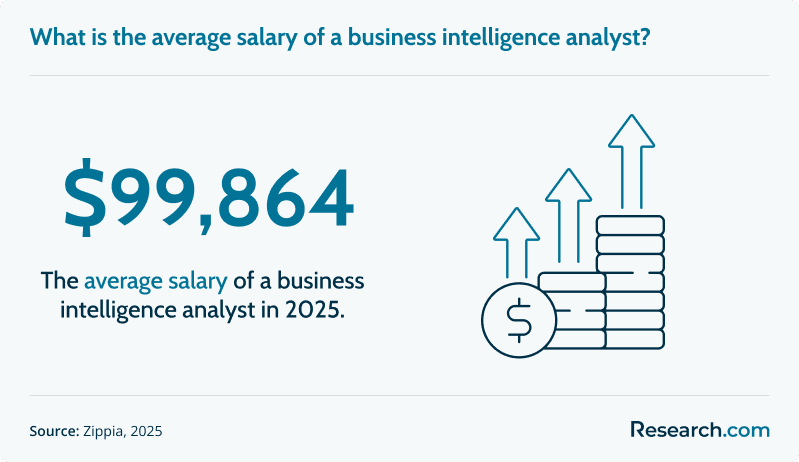
The average salary for a healthcare Business Intelligence analyst in the United States as of 2025 is approximately $99,864 per year, or about $48.01 per hour. Reported salary ranges commonly run from around $76,000 at the 25th percentile to $116,000 at the 75th percentile, with top earners making up to $148,500 annually.
Compensation can vary by employer type, location, experience, technical depth, healthcare domain knowledge, and whether the job is more focused on reporting, engineering, analytics strategy, or leadership. A BI analyst with strong SQL, Tableau, Power BI, and knowledge of healthcare data standards such as HL7 and ICD-10 may be positioned for higher-paying opportunities than someone who only has basic reporting experience.
Compared with many direct patient-care support roles, healthcare BI can offer a higher salary ceiling. For context, Research.com also covers adjacent healthcare paths such as traveling medical assistant salary information for readers comparing clinical and data-oriented careers.
| Salary figure | Amount | How to interpret it |
| Average annual salary | $99,864 per year | A broad benchmark that may differ by region, employer, and role scope. |
| Approximate hourly equivalent | $48.01 per hour | Useful for comparing salaried and contract opportunities. |
| 25th percentile | Around $76,000 | Often closer to early-career, lower-cost-market, or narrower-scope roles. |
| 75th percentile | Around $116,000 | More likely for experienced analysts or roles requiring stronger technical and domain expertise. |
| Top earners | Up to $148,500 annually | May reflect senior, specialized, high-demand, leadership, or high-cost-market positions. |
Salary should not be evaluated in isolation. Consider benefits, remote-work flexibility, promotion paths, workload, training support, and whether the role builds skills that transfer to future analytics, informatics, management, or data science positions.
What Is the Overall Job Growth Outlook for Healthcare Business Intelligence?
The outlook for healthcare BI is strong because healthcare organizations continue to rely on data to manage quality, costs, staffing, compliance, patient access, and performance. BI is especially important as health systems, insurers, public health agencies, and technology vendors work with larger and more complex datasets.
The global healthcare BI market is projected to reach about $11.41 billion by the end of 2025 and is expected to nearly double by 2033, with a compound annual growth rate of around 7.5%. This market growth is tied to rising demand for operational efficiency, patient care improvement, financial management, regulatory compliance, clinical performance monitoring, and AI-powered BI tools.
The U.S. Bureau of Labor Statistics projects faster-than-average growth for data analytics-related jobs through 2033, and BI professionals are becoming more important across healthcare employers. This trend reflects a broader pattern in technical healthcare careers, including fields discussed in Research.com’s biomedical engineer salary guide, where specialized technical skills can influence demand.
| Growth driver | Why it increases BI demand |
| More healthcare data | EHRs, claims systems, devices, portals, and operational platforms generate large volumes of information that must be organized and interpreted. |
| Cost pressure | Hospitals, insurers, and agencies need analytics to identify waste, manage utilization, and support financial decisions. |
| Quality and safety measurement | Healthcare organizations track outcomes, readmissions, patient safety events, and performance indicators. |
| Regulatory and compliance needs | Accurate reporting and auditable data processes are critical in healthcare environments. |
| AI and advanced analytics adoption | Organizations need clean, governed data and BI foundations before advanced analytics can be trusted. |
What Is the Work-Life Balance Like in a Healthcare BI Career?
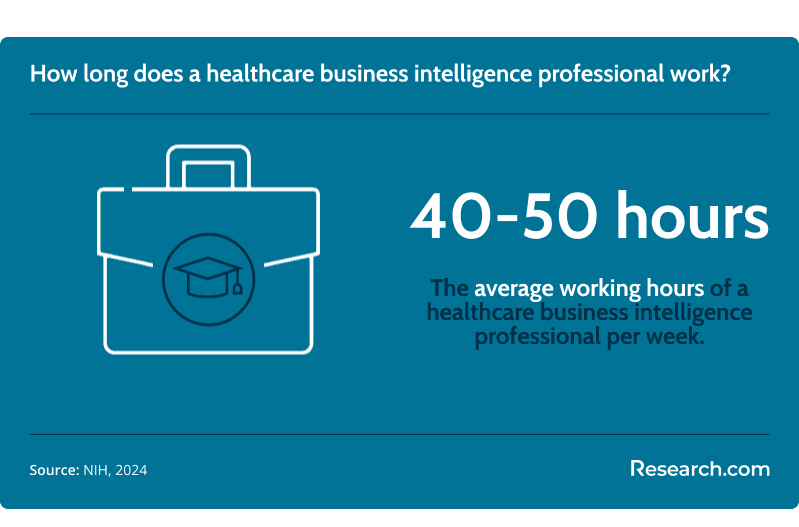
Healthcare BI often offers a more predictable schedule than many direct clinical roles, but the workload depends on the employer, team size, reporting deadlines, and level of responsibility. Many BI professionals work a standard 40 to 50-hour week, especially in analyst roles with stable reporting cycles.
Remote and hybrid work can be available because much of the work involves databases, reporting platforms, meetings, and documentation. That flexibility may reduce commuting time and make the career attractive to people who want to remain in healthcare without working rotating shifts or physically demanding clinical schedules.
However, deadlines can be intense. Regulatory reporting periods, executive requests, system conversions, audits, urgent operational issues, and major dashboard launches may require longer hours. The work can also be mentally demanding because accuracy, privacy, and stakeholder expectations are high.
This is different from credential-focused clinical comparisons such as registered medical assistant vs certified medical assistant, where the main questions often involve certification requirements, clinical scope, and patient-facing duties. In BI, flexibility may be stronger, but accountability for data quality and decision support can be significant.
| Work-life factor | What to expect | Questions to ask employers |
| Schedule | Often predictable, but deadlines can create temporary spikes. | Are there recurring evening, weekend, or on-call expectations? |
| Remote work | Possible in many BI roles, depending on data access and organizational policy. | Is the role remote, hybrid, or fully on site? |
| Stress level | Can rise when reports influence executive, financial, clinical, or compliance decisions. | How are urgent requests prioritized? |
| Team support | Workload is easier to manage when metric definitions, data ownership, and governance are clear. | Is there a formal BI team, or is this a one-person analytics role? |
| Career stage | Senior, managerial, and consulting roles may involve more meetings and longer hours. | What does advancement look like, and how does workload change with promotion? |
What Strategies Can Healthcare BI Professionals Use to Advance Their Careers?
Career growth in healthcare BI usually comes from combining stronger technical ability with broader business, clinical, and leadership judgment. Early-career analysts may begin with dashboards and recurring reports, then move into data modeling, analytics strategy, project leadership, informatics management, or enterprise decision support.
Professionals who want to lead larger initiatives should learn how to manage stakeholders, define project scope, document requirements, prioritize competing requests, and measure whether analytics work produces business value. Training in project management can help, and some professionals explore options such as an accelerated project management online degree when they want to build leadership and implementation skills more quickly.
| Career goal | Skills to strengthen | Practical next step |
| Move from entry-level analyst to senior analyst | Advanced SQL, dashboard design, data validation, metric ownership | Volunteer to own a high-visibility KPI dashboard or recurring executive report. |
| Become a BI developer | ETL, data warehousing, data modeling, database performance, automation | Learn how source data moves into reporting environments and practice building reliable datasets. |
| Move into clinical informatics | EHR workflows, quality measures, clinical operations, change management | Partner with clinicians on a workflow or quality improvement project. |
| Enter analytics leadership | Stakeholder management, roadmap planning, budgeting, governance, team development | Lead a cross-functional reporting initiative and document measurable outcomes. |
| Prepare for data science roles | Statistics, Python, machine learning, model evaluation, responsible AI | Build predictive analytics projects only after mastering data quality and domain assumptions. |
What Are the Biggest Challenges Facing Healthcare Business Intelligence Today?
The healthcare business intelligence industry is expanding, but implementation is not simple. Healthcare data is sensitive, fragmented, heavily regulated, and often shaped by complicated clinical workflows. Even a strong BI tool cannot fix unclear governance, poor data quality, or resistance from users who do not trust the numbers.
- Fragmented and siloed systems: Patient records, billing tools, EHR platforms, device data, scheduling systems, and third-party applications may not connect cleanly. This makes it difficult to create a complete and accurate view of patients, operations, or finances.
- Data quality and standardization problems: Duplicate records, inconsistent formats, missing fields, coding differences, and documentation errors can weaken analysis. BI teams need validation, cleansing, and governance processes before leaders rely on reports.
- Legacy infrastructure: Many healthcare organizations still use older systems that are difficult to integrate with newer BI platforms. This can slow modernization and limit advanced analytics efforts.
- Shortage of hybrid talent: Employers need people who understand both healthcare and data technology. Candidates who have only one side of that skill set may need additional training or experience.
- Privacy, security, and compliance demands: Healthcare organizations must protect sensitive patient information while still enabling meaningful analysis. Regulations such as HIPAA and GDPR require strong controls, auditability, and careful access management.
- High implementation costs: Sophisticated BI and AI-enabled analytics platforms can be expensive to deploy and maintain, especially for smaller providers with limited budgets.
- Cultural and operational resistance: Dashboards do not automatically change behavior. Staff may distrust new metrics, misunderstand the data, or see reporting as extra work unless BI projects are aligned with real workflows.
Solving these problems requires more than technical expertise. Healthcare BI teams often need people who understand organizational behavior, communication, training, and change management. Professionals from nontraditional backgrounds, including those who have studied areas such as psychology dual degree programs, may bring useful insight into how people adopt, resist, and act on data-driven systems.
What Emerging Technologies Should Healthcare BI Professionals Learn?
Healthcare BI is becoming more connected to AI, automation, cloud infrastructure, real-time analytics, and device-generated data. Professionals do not need to master every emerging tool, but they should understand which technologies are reshaping analytics work and which ones align with their career goals.
Artificial intelligence and machine learning are increasingly important because they can support predictive analytics, real-time risk scoring, automated recommendations, and diagnostic assistance. Frameworks and platforms such as TensorFlow, PyTorch, and IBM Watson Health are examples of tools that may matter for professionals moving toward advanced analytics or data science.
Big data technologies such as Apache Spark, Hadoop, and Kafka support large-scale and real-time data processing. These tools can be relevant when organizations work with massive datasets from electronic health records, IoT devices, imaging systems, or streaming operational feeds.
Cloud-based healthcare data platforms are also becoming important. Examples include AWS HealthLake, Microsoft Azure Healthcare, and Google Cloud Healthcare API. These environments can support scalable storage, analytics, integration, and governed access across healthcare datasets.
Data integration and ETL tools such as Talend, Apache NiFi, and Informatica help organizations combine and clean fragmented healthcare data. Data warehouse platforms such as Amazon Redshift and Snowflake can support analysis of large, structured datasets.
The Internet of Medical Things and wearable device analytics create additional opportunities in remote monitoring and personalized care. However, these technologies also raise questions about data quality, consent, privacy, security, and clinical usefulness.
Because the technical landscape is expanding, some professionals pursue graduate-level information systems training. Research.com’s guide to the fastest online master's degree in management information systems may help readers compare options for building advanced technology and management skills.
| Technology area | Why it matters | Best fit for |
| AI and machine learning | Supports prediction, risk scoring, automation, and advanced decision support | BI professionals moving toward data science or analytics strategy |
| Cloud healthcare platforms | Enable scalable data storage, integration, governance, and analytics | Analysts, developers, architects, and informatics leaders |
| Big data processing | Handles high-volume and real-time healthcare data sources | Technical BI developers and data engineers |
| ETL and integration tools | Connect fragmented systems and improve data reliability | BI developers, data engineers, and enterprise analytics teams |
| IoMT and wearable analytics | Adds patient-generated and remote monitoring data to healthcare analytics | Professionals interested in digital health, remote care, and personalized medicine |
How Can an Advanced Degree Enhance Leadership Opportunities in Healthcare BI?
An advanced degree can help healthcare BI professionals move from task-based analytics into roles that influence strategy, budgets, teams, systems, and organizational change. Leadership roles often require more than technical skill. They require financial awareness, planning ability, risk management, communication, and the judgment to align analytics with business and clinical priorities.
Graduate education may be useful for professionals who want to become analytics managers, informatics directors, BI leads, healthcare operations leaders, consultants, or product leaders in health technology. Programs with coursework in management, information systems, healthcare administration, analytics, finance, and project leadership can be especially relevant.
Cost and flexibility matter. Professionals who want to keep working while studying may compare affordable MBA programs online with analytics, health informatics, healthcare administration, or management information systems programs. The best choice depends on whether your goal is executive leadership, technical analytics leadership, clinical informatics, or data science.
Is a Healthcare BI Career Worth It?
A healthcare BI career can be worth it if you want a data-focused role with clear relevance to patient care, operations, finance, public health, or health technology. It is especially attractive for people who like problem-solving, structured analysis, and cross-functional communication.
However, it may not be the right fit if you dislike messy data, frequent stakeholder requests, strict privacy rules, documentation, or ambiguity. Healthcare data can be complex and imperfect. BI professionals must often explain why a number changed, why two reports do not match, or why the available data cannot fully answer a question.
| Choose healthcare BI if... | Consider another path if... |
| You enjoy connecting analytics to real healthcare decisions. | You want a role with little stakeholder interaction. |
| You are comfortable learning healthcare terminology, workflows, and compliance expectations. | You prefer clean, simple datasets with few privacy constraints. |
| You like building dashboards, explaining trends, and improving processes. | You mainly want to build advanced machine learning models with minimal reporting work. |
| You can balance technical accuracy with practical communication. | You dislike revising work based on changing business definitions or user needs. |
| You want a career that can lead toward analytics leadership, informatics, BI development, or data science. | You want direct patient care as your primary daily responsibility. |
How to Prepare for a Healthcare BI Job
A strong preparation plan should build both analytics skill and healthcare context. Many candidates make the mistake of learning a dashboard tool first and assuming that is enough. Employers usually want people who can understand the business question, find the right data, test it, explain it, and recommend a next step.
- Clarify your target role. Decide whether you are aiming for healthcare data analyst, BI developer, informatics specialist, population health analyst, or clinical informatics analyst. Each path emphasizes different skills.
- Build SQL competence. Practice querying, joining, aggregating, and validating data. SQL is often more important than knowing every feature of a visualization tool.
- Learn one major BI platform well. Tableau or Power BI is a practical starting point. Build dashboards that solve specific healthcare-style questions rather than generic charts.
- Study healthcare data basics. Learn how EHRs, claims, billing, coding, quality measures, and patient privacy affect analytics.
- Create a project portfolio. Use sample or public datasets when appropriate and show your process: question, data preparation, assumptions, analysis, visualization, findings, and recommendations.
- Practice stakeholder communication. Write short executive summaries, explain limitations, and avoid overclaiming what the data proves.
- Look for healthcare-adjacent experience. Internships, analyst assistant roles, revenue cycle reporting, quality improvement projects, or informatics support work can help you build domain credibility.
- Keep learning responsibly. AI, cloud, automation, and predictive analytics are valuable, but they should sit on top of strong data quality, governance, and privacy practices.
Common Mistakes to Avoid When Entering Healthcare BI
| Mistake | Why it creates problems | Better approach |
| Learning only visualization tools | Dashboards are only as reliable as the data and logic behind them. | Prioritize SQL, data validation, metric definitions, and healthcare context. |
| Ignoring privacy and compliance | Healthcare data is sensitive and must be handled carefully. | Learn basic HIPAA, GDPR, access control, de-identification, and audit principles. |
| Assuming all healthcare data is clean | Documentation gaps, duplicate records, and system differences are common. | Build validation checks into every analysis and document assumptions. |
| Choosing a program based only on speed | Fast programs may not provide enough depth for your target role. | Compare curriculum, projects, faculty experience, career support, and employer alignment. |
| Relying only on rankings | A highly ranked school may not offer the specific healthcare analytics skills you need. | Review course content, tool coverage, healthcare data exposure, and graduate outcomes. |
| Overpromising insights | Healthcare decisions are high stakes, and data often has limitations. | Explain confidence, missing data, definitions, and what the analysis can and cannot show. |
| Skipping communication practice | Technical findings are not useful if users cannot act on them. | Practice presenting results to clinical, financial, and executive audiences. |
Questions to Ask Before Choosing a Healthcare BI Program or Training Path
- Does the curriculum teach SQL, databases, data visualization, statistics, and healthcare data concepts?
- Will I build projects that resemble real healthcare BI work?
- Does the program discuss privacy, security, compliance, and data governance?
- Are Tableau, Power BI, Python, R, or cloud tools included, and are they taught through practical assignments?
- Does the program offer career support for healthcare analytics, informatics, BI development, or population health roles?
- Can I transfer credits, study part time, or continue working while enrolled?
- Are costs transparent beyond tuition, including fees, software, books, and technology requirements?
- Will the credential help with my specific target role, or would a shorter certificate, portfolio, or work experience be more efficient?
- Do instructors or advisors understand healthcare analytics careers, not just general data analytics?
- How will I demonstrate job readiness to employers after completing the program?
What Graduates Say About Healthcare Business Intelligence Jobs
- : "The most satisfying part of my work is seeing our dashboards help the hospital shorten wait times and plan staffing more effectively. When the metrics improve, patients feel the difference. That makes the work feel meaningful. — Maybelle"
- : "In my pharmaceutical BI role, data helps our teams understand research operations and move important work forward. I get technical problem-solving and a public health mission in the same career, which is exactly what I wanted. — Ian"
- : "I use claims data to identify patterns that may point to fraud or waste. The work is challenging, but it protects resources that should go toward real patient care. It feels like a high-impact way to use analytics. — Aziz"
References and Further Reading
- BARC. Business Intelligence Trends. https://barc.com/business-intelligence-trends/
- EB Pearls. The State of Data Science. https://ebpearls.com.au/blog/the-state-of-data-science
- International Institute of Business Analysis. The global state of business analysis 2023. https://www.iiba.org/career-resources/the-global-state-of-business-analysis/the-global-state-of-business-analysis-2023/
- U.S. Bureau of Labor Statistics. Occupational Outlook Handbook: Management Analyst. https://www.bls.gov/ooh/business-and-financial/management-analysts.htm
- U.S. Department of Labor, Employment and Training Administration. Operations research analysts. https://www.onetonline.org/link/summary/15-2051.01
Key Insights
- Healthcare BI jobs turn clinical, financial, operational, claims, and population health data into decisions that can improve care quality, efficiency, compliance, and cost control.
- The most common roles include healthcare data analyst, health informatics specialist, healthcare BI developer, clinical informatics analyst, and population health analyst. Each role requires a different balance of technical, healthcare, and communication skills.
- BI analysts and data scientists overlap, but they are not the same. BI usually focuses on reporting, dashboards, current performance, and operational decisions, while data science often focuses on prediction, modeling, and advanced analytics.
- As of 2025, the average healthcare BI analyst salary in the United States is approximately $99,864 per year, with reported ranges from around $76,000 at the 25th percentile to $116,000 at the 75th percentile and top earners making up to $148,500 annually.
- SQL, Tableau, Power BI, database knowledge, data warehousing concepts, healthcare data literacy, privacy awareness, and stakeholder communication are core skills for job readiness.
- The field has strong growth signals, supported by healthcare’s increasing reliance on data and a global healthcare BI market projected to reach about $11.41 billion by the end of 2025 and nearly double by 2033.
- Healthcare BI can offer solid work-life balance, especially in remote or hybrid analyst roles, but deadlines, compliance reporting, audits, and urgent executive requests can create periods of high workload.
- The biggest barriers in healthcare BI are fragmented systems, inconsistent data quality, legacy infrastructure, privacy requirements, high implementation costs, and user resistance to data-driven change.
- Before choosing a degree or training program, verify that it teaches practical BI skills, healthcare data concepts, privacy and governance, and portfolio-ready projects aligned with your target role.
- The best long-term career strategy is to build depth in analytics while also learning healthcare operations, communication, project management, and responsible use of emerging technologies such as AI, cloud platforms, and data integration tools.
Other Things You Should Know About the Best In-Demand Healthcare Business Intelligence Jobs
Certifications like Certified Healthcare Data Analyst (CHDA) and Certified Business Intelligence Professional (CBIP) can enhance a career in healthcare business intelligence. They demonstrate expertise in data analysis and BI practices, potentially increasing job prospects and salary opportunities in the industry.
Most healthcare business intelligence employers expect strong SQL for querying claims, EHR, and revenue-cycle data. Candidates should know joins, window functions, CTEs, and performance tuning, plus basic data validation. Many job postings also ask for experience with Microsoft SQL Server, Snowflake, or Oracle databases.


