2027 Best Online Master’s in Healthcare Quality and Patient Safety Programs

Co-Founder and Chief Data Scientist
Choosing an online master’s in healthcare quality and patient safety is not just a school-search decision. It is a career decision about whether you want to help healthcare organizations reduce preventable harm, improve outcomes, meet regulatory expectations, and use data to make care safer. This guide is for nurses, physicians, administrators, quality specialists, risk managers, public health professionals, and career changers comparing online graduate programs in healthcare quality, patient safety, and related healthcare leadership fields.
You will learn what these programs teach, how long they take, what they cost, how online study compares with campus-based learning, which schools offer relevant programs, what careers graduates pursue, and how to judge whether the degree is worth the investment. The goal is to help you narrow your options with practical criteria instead of relying on marketing claims alone.
Quick answer: Is an online master’s in healthcare quality and patient safety worth considering?
An online master’s in healthcare quality and patient safety can be a strong fit if you already work in healthcare or want to move into quality improvement, patient safety, risk management, compliance, healthcare analytics, or healthcare administration. The best programs combine quality improvement methods, patient safety science, data analysis, leadership, regulatory knowledge, and applied projects. Online delivery is especially useful for working professionals who need to keep their jobs while earning a graduate credential.
The degree is not automatically the right choice for everyone. If your goal is direct clinical practice, a licensure-focused nursing, physician assistant, counseling, pharmacy, or public health pathway may be more appropriate. If your goal is broad healthcare operations leadership rather than quality and safety specialization, an MHA, MBA in healthcare management, or healthcare administration degree may offer a better fit.
What are the main benefits of an online master’s in healthcare quality and patient safety?
- Career-focused specialization: The degree builds expertise in patient safety, quality improvement, risk reduction, healthcare data, compliance, and systems leadership.
- Flexibility for working professionals: Online formats allow many students to continue full-time employment while completing coursework from another city or state.
- Practical application: Many programs use case studies, improvement projects, simulations, and capstones that connect directly to healthcare workplace problems.
- Leadership preparation: Graduates may qualify for roles involving quality programs, patient safety initiatives, regulatory readiness, clinical performance improvement, and healthcare operations.
- Potential salary and advancement upside: Earnings vary by title, employer, experience, and location, but leadership roles in healthcare quality and administration can offer strong compensation.
What should you expect from an online master’s in healthcare quality and patient safety?
An online master’s in healthcare quality and patient safety is designed to teach professionals how to identify care gaps, prevent avoidable harm, measure performance, lead improvement initiatives, and create safer healthcare systems. Programs may be titled Master of Science in Healthcare Quality and Safety, Master of Applied Science in Patient Safety and Healthcare Quality, Master of Health Administration with a quality concentration, or a closely related name.
| Program component | What it usually covers | Why it matters |
| Quality improvement | Lean, Six Sigma, PDSA cycles, process mapping, root-cause analysis, and performance measurement | Helps professionals redesign workflows and reduce variation in care delivery |
| Patient safety | Medication safety, infection prevention, adverse event reporting, human factors, safety culture, and harm prevention | Prepares graduates to lead initiatives that protect patients and reduce preventable errors |
| Healthcare analytics | Data collection, quality metrics, dashboards, statistical methods, and interpretation of clinical performance data | Supports evidence-based decisions rather than guesswork |
| Leadership and change management | Team leadership, communication, organizational behavior, stakeholder engagement, and strategic planning | Quality work often requires influencing clinicians, executives, patients, and regulators |
| Regulation, compliance, and ethics | Healthcare law, accreditation standards, risk management, policy, and ethical decision-making | Connects quality improvement to legal, regulatory, and organizational accountability |
| Capstone or applied project | A real-world improvement project, practicum, or research-based final assignment | Gives students evidence of applied skills for employers and advancement conversations |
Where can graduates work with this degree?
Graduates can apply healthcare quality and patient safety training in settings where organizations must measure outcomes, improve care processes, manage risk, and meet regulatory expectations. The degree is especially relevant in healthcare environments that depend on team-based care, electronic health data, patient safety reporting, and continuous improvement.
- Hospitals and health systems: Common roles include quality improvement specialist, patient safety officer, risk manager, clinical quality manager, infection preventionist, and performance improvement manager.
- Clinics and physician practices: Graduates may help standardize care processes, monitor patient experience, support compliance, and improve chronic care workflows.
- Insurance companies and payer organizations: Quality professionals may work on value-based care, utilization trends, provider performance, member outcomes, and quality reporting.
- Government agencies and nonprofits: Roles may involve public health quality, program evaluation, patient safety policy, regulatory oversight, or population health improvement.
- Consulting firms: Experienced professionals may advise healthcare organizations on quality strategy, risk management, accreditation readiness, and data-driven improvement.
- Research and academic settings: Graduates with research interests may contribute to patient safety studies, healthcare delivery research, quality education, or training programs.
How much can graduates earn with an online master’s in healthcare quality and patient safety?
Compensation depends heavily on role, years of experience, clinical background, management responsibility, employer type, and region. The following ranges reflect potential salaries cited for common healthcare quality and patient safety roles:
- Quality Improvement Specialist: $70,000 - $100,000 per year
- Patient Safety Officer: $80,000 - $120,000 per year
- Risk Manager: $90,000 - $140,000 per year
- Director of Quality and Patient Safety: $120,000 - $180,000+ per year
These figures should be used as planning ranges, not guarantees. A graduate moving from an entry-level quality role into a director-level position will typically need relevant experience, leadership ability, measurable project results, and sometimes additional credentials.
- Best online master’s in healthcare quality and patient safety degree programs for 2027
- How long does an online Master of Science in Healthcare Quality and Safety take?
- Online vs. on-campus healthcare quality and safety master’s programs
- Average cost of an online Master of Science in Healthcare Quality and Safety
- Financial aid options for online healthcare quality and safety master’s students
- Common admission requirements and prerequisites
- Typical courses in healthcare quality and safety master’s programs
- Specializations and related focus areas
- Accreditation and industry recognition
- How to choose the right online healthcare quality and safety master’s program
- Career paths after graduation
- Job market and demand for graduates
- Certifications that may complement the master’s degreeJob market details
- Whether a related bachelor’s degree is required for success
- Employer recognition of online degrees
- Emerging trends in healthcare quality and safety
- Return on investment considerations
- Career support and networking in online programs
- How online programs maintain academic quality
- How bioinformatics can strengthen healthcare quality and safety workAcademic qualityOnline supportStudent preparationROITrendsEmployer recognitionEmployment outlook
Best Online Master in Healthcare Quality and Patient Safety Degree Programs for 2027
How Research.com approaches school rankings
Because graduate education is a major financial and professional commitment, Research.com rankings are built to help readers compare programs using transparent criteria rather than advertising language. Our ranking methodology draws on established data sources, including:
- the IPEDS database
- Peterson's database, including distance learning data
- the College Scorecard database,
- and the National Center for Education Statistics.
When comparing healthcare quality programs, avoid relying on unrelated ranking pages, such as lists of the best colleges for forensic science programs, unless you are researching a separate field entirely.
| Rank | School | Program focus | Program length | Tuition | Credits or courses | Accreditation listed |
| 1 | MidAmerica Nazarene University | Administration & Quality Post-Master’s Certificate; Healthcare Administration & Quality | Approximately 12 months | $535 per credit hour, in-state and out-of-state | 21 credit hours | Higher Learning Commission |
| 2 | Johns Hopkins University | Master of Applied Science in Patient Safety and Healthcare Quality | 2 to 4 years | $1,086 per credit hour | 48 credits | Middle States Commission on Higher Education (MSCHE); Council on Education for Public Health (CEPH) |
| 3 | Mary Baldwin University | Online Master of Healthcare Administration with Quality and Systems Safety | Two years | $650 per credit hour | Not specified | Southern Association of Colleges and Schools Commission on Colleges (SACSCOC) |
| 4 | Sam Houston State University | Master of Science in Health Care Quality and Safety | 16-month cohort program beginning each fall semester | $244.00/credit hour | 36 credit hours | Southern Association of Colleges and Schools Commission on Colleges (SACSCOC) |
| 5 | Western Governors University | Master of Healthcare Administration with leadership, regulation, patient care, and quality improvement content | Approximately 12 months | $4,995 per six-month term, same for in-state and out-of-state students | 12 courses; specific credit hours not listed | Northwest Commission on Colleges and Universities (NWCCU) |
| 6 | Maryville University | Master of Health Administration with a Population Management concentration | As few as 2 years | $774 per credit hour, with no distinction between in-state and out-of-state | 36 credit hours | Higher Learning Commission (HLC) |
| 7 | Thomas Jefferson University | Master of Science in Healthcare Quality and Safety | 2 to 4 years, depending on pace | $1,309/credit hour | 10 online courses and a capstone project | Middle States Commission on Higher Education (MSCHE) |
| 8 | George Washington University | Master of Science in Health Sciences in Healthcare Quality | 24 months, part-time | $980 per credit hour | 36 credits | Middle States Commission on Higher Education (MSCHE); Commission on Accreditation of Healthcare Management Education (CAHME) |
| 9 | Northwestern University | Master of Science in Healthcare Quality and Patient Safety | 2 years, part-time | $4,000 per course, totaling $36,000 for the program | 9 courses or units | Higher Learning Commission (HLC); Accreditation Council for Continuing Medical Education (ACCME) |
| 10 | University of Alabama at Birmingham (UAB) | Master of Science in Healthcare Quality and Safety and Graduate Certificate | Typically completed in two years online | $541/credit, both in-state and out-of-state; approximately $25,884 per year, in-state and out-of-state | 36 credit hours | Southern Association of Colleges and Schools Commission on Colleges (SACSCOC); Commission of Accreditation of Healthcare Management Education (CAHME) |
Program notes for each ranked school
- MidAmerica Nazarene University: The online Administration & Quality Post-Master’s Certificate is aimed at MSN-prepared registered nurses and master’s-prepared professionals from other fields who want focused training in Healthcare Administration & Quality. The 21-credit curriculum includes Informatics and Healthcare Quality, Quantum Leadership, Human Resources and Workforce Development, Strategic Planning and Financial Management, Healthcare Safety & Quality Improvement Science, and Healthcare Law.
- Johns Hopkins University: The fully online MAS in Patient Safety and Healthcare Quality is a multidisciplinary program connected to the Bloomberg School of Public Health, the JHU School of Nursing, the JHU School of Medicine, and the Armstrong Institute for Patient Safety and Quality. Students study safer system design, patient-centered care, safety measurement, organizational culture, and methods for identifying risks before they harm patients.
- Mary Baldwin University: The online MHA is designed for working professionals with varied schedules and includes a Quality and Systems Safety focus. Coursework covers healthcare finance, policy, leadership, patient safety, and health system administration.
- Sam Houston State University: The MS in Health Care Quality and Safety uses an online cohort model for professionals preparing for quality and safety leadership roles in hospitals, clinics, nursing homes, and other healthcare organizations. Courses include Health Services Administration, Health Care Quality and Safety, Statistical Design in Health, Health Care Informatics, and Risk Management in Health Care Organizations.
- Western Governors University: The online Master of Healthcare Administration is not a dedicated healthcare quality and safety degree, but it includes relevant leadership, regulation, patient care, quality improvement, community health, enterprise risk management, and analytical methods content.
- Maryville University: The online MHA with a Population Management concentration emphasizes analytics-driven approaches to improving care for communities and groups. Courses include Population Health Management, Healthcare Financial Management, and Managerial Epidemiology.
- Thomas Jefferson University: The MS in Healthcare Quality and Safety through the Jefferson College of Population Health is fully online and includes courses such as Introduction to Healthcare Quality and Safety, Health Informatics, and Leadership Skills in Healthcare Quality and Safety. Students complete a capstone project.
- George Washington University: The MSHS in Healthcare Quality was developed in partnership with the National Committee for Quality Assurance (NCQA). It includes patient safety improvement, healthcare data interpretation, leadership, evidence-based practice, and quality care decision-making. It is described as one of the first programs in North America to receive CAHME accreditation.
- Northwestern University: The MS in Healthcare Quality and Patient Safety is an executive-style program for clinical and non-clinical healthcare professionals. It combines distance learning, immersive sessions, and a capstone practicum focused on real healthcare delivery problems.
- University of Alabama at Birmingham: UAB offers a Master of Science in Healthcare Quality and Safety and a Graduate Certificate for administrators, nurses, physicians, quality managers, and patient safety officers. The program includes a partnership with the National Association for Healthcare Quality (NAHQ), allowing those with the Certified Professional in Healthcare Quality (CPHQ) credential to earn master's credit.
How long does it take to complete an online Master of Science in Healthcare Quality and Safety degree?
Most online master’s programs in healthcare quality and safety take between one and four years, depending on whether the student attends full time, part time, in an accelerated format, or in a cohort sequence.
| Study format | Typical timeline | Best for |
| Full-time online study | Typically takes 1 to 2 years | Students who can manage a heavier course load and want to finish sooner |
| Part-time online study | Can take 2 to 3 years or longer | Working professionals balancing school with employment, family, or clinical schedules |
| Accelerated online programs | May be completed in less than a year | Students with strong time management, relevant background, and the ability to handle compressed coursework |
| Programs accepting transfer credits | May reduce total completion time | Students with eligible graduate coursework, certificates, or approved prior learning |
Before enrolling, ask the school how many courses you can take per term, whether courses are asynchronous or synchronous, whether a capstone is required, and whether transfer credits or professional certifications can reduce the total time to completion.
Healthcare quality and safety work is also shaped by rising costs for patients. Out-of-pocket healthcare spending in the United States increased from $352.7 billion in 2015 to $364.6 billion in 2016, $370 billion in 2017, $385.7 billion in 2018, and $402.3 billion in 2019. Spending declined slightly to $398.3 billion in 2020, then rose to $442.2 billion in 2021 and $471.4 billion in 2022. This pattern highlights why healthcare organizations continue to focus on efficiency, safety, access, and value.
How does an online Master’s of Science in Healthcare Quality and Safety degree compare to an on-campus program?
Online and on-campus programs can lead to similar academic credentials, but the learning experience, schedule, networking style, and total cost structure may differ. The better option depends on your work schedule, location, learning preferences, and need for in-person interaction.
| Factor | Online program | On-campus program |
| Schedule flexibility | Usually better for full-time employees, shift workers, and students outside the school’s region | Often requires attendance at set times and travel to campus |
| Access | Can be completed from any location with reliable internet, depending on program requirements | Best for students who live near campus or want an immersive in-person environment |
| Interaction | Uses discussion boards, video meetings, group projects, online office hours, and virtual networking | Offers more spontaneous face-to-face contact with classmates and faculty |
| Cost considerations | May reduce commuting or relocation costs, though tuition is not always lower | May involve transportation, parking, housing, or reduced work hours |
| Best fit | Self-directed learners who can manage deadlines independently | Students who prefer structured class meetings and frequent in-person engagement |
What is the average cost of an online Master of Science in Healthcare Quality and Safety degree program?
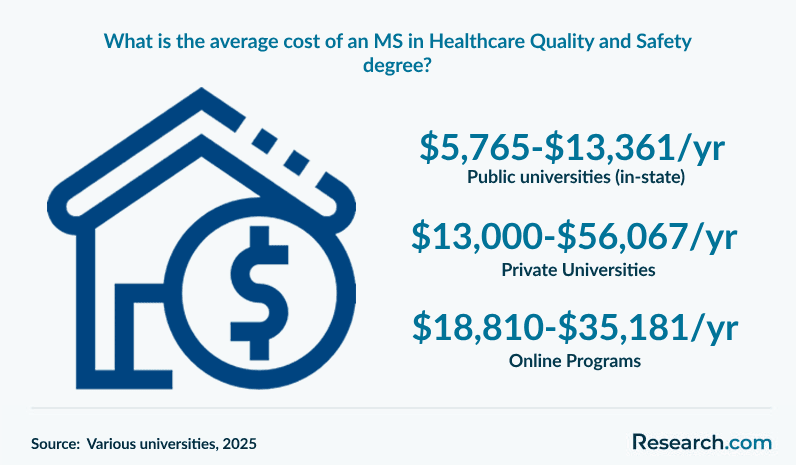
The cost of an online master’s in healthcare quality and safety varies widely by institution type, tuition model, residency policy, fees, and program length. The tuition ranges cited for these programs run from approximately $7,000 to $56,000 per year, with broader tuition examples ranging from under $6,000 to over $56,000 per year.
Tuition ranges to compare
- Public universities, in-state tuition: $5,765 - $13,361 per year
- Private universities: $13,000 - $56,067 per year
- Online programs: $18,810 - $35,181 per year, often similar to on-campus counterparts
Costs beyond tuition
- Program fees: Technology, library, graduation, or online learning fees can change the true cost.
- Books and supplies: Course materials can add several hundred dollars to the overall expense.
- Travel: Some online programs may include residencies, immersions, or practicum-related travel.
- Lost income: A program that requires reduced work hours can be more expensive than tuition alone suggests.
- Living expenses: These matter most for campus-based or hybrid programs requiring relocation or frequent travel.
Important cost notes
- Tuition figures may exclude fees, books, travel, and other required expenses.
- Some schools charge a flat online tuition rate regardless of state residency.
- Shorter programs, certificate-to-master’s pathways, employer tuition assistance, and tuition locks may reduce total cost.
Do not compare programs only by annual tuition. A lower annual price can still cost more overall if the program takes longer, includes more credits, or charges substantial fees.
What are the financial aid options for students enrolling in an online Master of Science in Healthcare Quality and Safety degree program?
Graduate students in online healthcare quality and safety programs may have access to several funding options. Eligibility varies by school, enrollment status, citizenship or residency status, academic progress, and program type.
- Federal student loans: Eligible graduate students may use federal loan programs through the U.S. Department of Education. Options include:
- Direct Subsidized Loans: For undergraduates with financial need; the government pays interest during school, grace period, and deferments.
- Direct Unsubsidized Loans: For undergraduate and graduate students; the borrower is responsible for all interest.
- Direct PLUS Loans: For graduate or professional students and parents of undergraduates.
- Direct Consolidation Loans: Allow eligible federal student loans to be combined into one loan.
- Private student loans: Banks and private lenders may offer education loans, but rates, repayment terms, and borrower protections can differ from federal loans.
- Scholarships: Some scholarships support graduate students in healthcare, nursing, public health, administration, quality improvement, or patient safety.
- Grants: Need-based or institution-based grants may be available, depending on the school and student profile.
- Employer tuition assistance: Hospitals, health systems, insurers, and government agencies may help employees pay for relevant graduate study.
- Professional development funds: Some employers provide separate funds for certifications, conferences, or job-related continuing education that may complement the degree.
Apply early and ask each school for a full cost-of-attendance estimate, not just tuition. Also ask whether online students qualify for the same institutional aid as campus students.
What are the prerequisites for enrolling in an online Master of Science in Healthcare Quality and Safety degree program?
Admission standards differ by university, but most programs expect applicants to show academic readiness and a clear connection to healthcare quality, safety, administration, clinical care, or public health.
- Bachelor's degree: A bachelor’s degree from an accredited institution is typically required.
- Minimum GPA: Many schools set a minimum GPA requirement, often around 3.0.
- Healthcare experience: Some programs prefer or require experience in a healthcare setting, especially for leadership-oriented programs.
- Letters of recommendation: Applicants may need recommendations from supervisors, faculty members, or professional references.
- Statement of purpose: Many programs ask applicants to explain their career goals and interest in healthcare quality and safety.
- Resume or CV: Schools may review clinical, administrative, analytic, public health, or quality improvement experience.
- Standardized tests: Some programs may require the GRE or GMAT, although this requirement is becoming less common.
A related undergraduate major can help, but it is not always mandatory. Applicants from nursing, medicine, public health, health administration, health information management, business, analytics, and allied health backgrounds may all be considered, depending on the program.
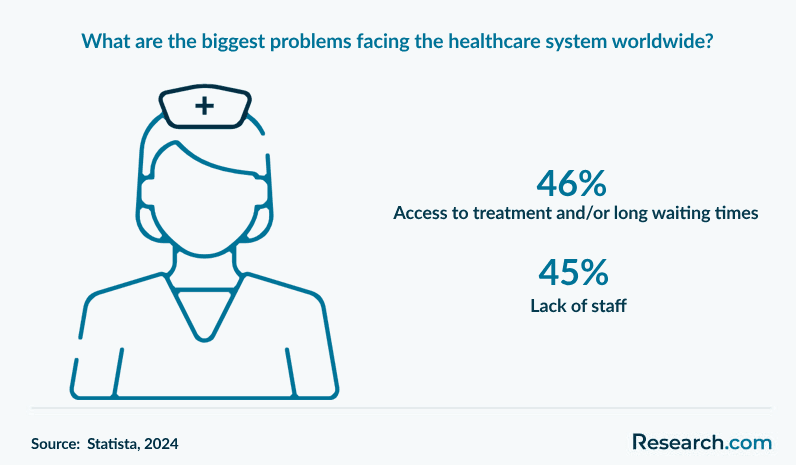
A 2024 global survey found that access to treatment and long waiting times were identified by 46% of adults as the biggest healthcare system problem. Lack of staff followed closely, cited by 45% of respondents. These concerns show why quality and safety professionals need to understand systems thinking, workforce constraints, process improvement, and patient access.
What courses are typically in an online Master of Science in Healthcare Quality and Safety degree program?
Curricula vary, but most programs blend healthcare systems content, quality methods, patient safety science, analytics, leadership, and applied improvement work.
Common core courses
- Fundamentals of Healthcare Quality and Safety: Introduces the major concepts, vocabulary, frameworks, and goals of the field.
- Healthcare Quality Improvement Methods: Covers methods such as Lean, Six Sigma, and PDSA (Plan-Do-Study-Act).
- Patient Safety: Examines safety risks such as medication errors, healthcare-associated infections, falls, and adverse events.
- Healthcare Data Analytics: Teaches students how to gather, evaluate, and interpret data used in quality improvement.
- Healthcare Law and Ethics: Explores legal, regulatory, and ethical issues related to safety, quality, privacy, and accountability.
- Leadership and Communication in Healthcare: Builds skills for leading teams, persuading stakeholders, and sustaining change.
Common specialized courses
- Risk Management in Healthcare: Focuses on identifying, evaluating, reducing, and monitoring organizational risk.
- Healthcare Informatics: Examines how technology and information systems support safer and more effective care.
- Performance Improvement in Healthcare: Teaches students how to design, implement, and evaluate improvement initiatives.
- Population Health Management: Connects data, care coordination, prevention, and outcomes improvement across groups of patients.
- Global Health: Looks at healthcare quality and safety challenges beyond the U.S. system.
Possible electives
- Human Factors in Healthcare: Applies human factors principles to reduce errors and improve system design.
- Healthcare Finance: Helps students understand how payment, budgets, and resource allocation affect quality decisions.
- Public Health: Focuses on quality improvement in public health programs and services.
- Behavioral health quality: Students interested in mental health systems may also compare related options such as affordable online master’s in mental health counseling programs.
What types of specializations are available in an online Master of Science in Healthcare Quality and Safety degree programs?
Not every program offers formal concentrations, but students can often shape their pathway through electives, capstone topics, professional certifications, or related graduate certificates.
| Focus area | What it emphasizes | When it makes sense |
| Pharmaceutical Quality | Quality assurance, medication safety, and regulatory compliance in pharmaceutical settings | Best for students interested in drug safety, pharmacy operations, or regulated product environments |
| Medical Device Quality | Safety, quality systems, and compliance related to medical devices | Useful for professionals working with device manufacturers, hospitals, or regulatory teams |
| Health Information Technology | Electronic health records, informatics, digital tools, and data-supported safety improvement | Strong fit for students who want analytics, informatics, or clinical technology roles |
| Insurance and Payer Quality | Quality metrics, value-based care, member outcomes, and payer-side performance improvement | Relevant for students targeting insurers, managed care, or accountable care organizations |
| Healthcare management | Operations, staffing, finance, strategic planning, and organizational leadership | Good for students comparing healthcare quality programs with broader options such as affordable online MBA healthcare management programs |
| Healthcare Quality Research | Research methods, measurement, evaluation, and evidence generation | Best for students considering research, academia, or doctoral study |
| Healthcare Quality Education | Teaching, training, curriculum development, and workforce education | Useful for professionals who train clinical teams or lead staff development |
| Public Health Quality | Population-level improvement, program evaluation, prevention, and public health systems | Relevant for students also considering affordable accelerated online MPH options |
| Regulatory Affairs | Compliance, standards, reporting, and regulatory strategy | Best for students interested in accreditation, policy, audits, or compliance leadership |
| Epidemiology | Disease patterns, surveillance, outcomes, and population risk | Helpful for students connecting quality improvement with public health analytics |
| Forensic Healthcare Quality | Quality and safety principles applied to forensic healthcare, investigations, and legal contexts | A niche option for students whose work connects healthcare systems with legal or investigative settings |
Salary outcomes can vary substantially by specialization and seniority. Salary.com data cited for this field includes an average salary of $63,671 for a Quality Assurance Analyst in healthcare, $94,811 for a Quality Assurance Coordinator in healthcare, and $98,825 for a Patient Safety Manager. Other cited roles include Healthcare Quality and Compliance Manager at $114,100 and Quality Assurance Manager in healthcare at $114,800.
Leadership positions may pay more. The cited average salary is $129,326 for Director of Quality and Patient Safety, $130,282 for Quality Improvement Director in healthcare, $253,100 for Director of Quality and Patient Safety Officer, and $424,780 for Vice President of Healthcare Quality Management. These figures, cited from Salary.com, 2025, should be interpreted as role-specific estimates rather than guaranteed earnings for degree holders.
Is the program accredited and recognized by industry leaders?
Accreditation is one of the first items to verify before applying. At minimum, the institution should hold recognized institutional accreditation. For healthcare management-oriented programs, CAHME accreditation can also be important because it indicates that the program has been reviewed against healthcare management education standards.
Industry recognition also matters. Look for relationships with healthcare systems, professional associations, quality organizations, advisory boards, and applied project partners. For students comparing broader healthcare administration options, accelerated online MHA programs may also be worth reviewing, especially if the career goal is executive administration rather than a narrower quality and safety role.
How does one choose the best online Master of Science in Healthcare Quality and Safety degree program?
The best program is the one that matches your career goal, schedule, budget, background, and preferred learning style. Use the checklist below before submitting applications.
| Question to ask | Why it matters |
| Is the institution properly accredited? | Accreditation affects academic credibility, financial aid eligibility, employer confidence, and transfer options. Even low-cost accredited online bachelor’s degree programs need recognized accreditation, and graduate programs should be evaluated just as carefully. |
| Does the curriculum match your target role? | A future patient safety officer needs different preparation than someone aiming for payer quality, informatics, or executive healthcare administration. |
| Who teaches the courses? | Faculty with healthcare quality, patient safety, clinical leadership, informatics, or regulatory experience can make coursework more practical. |
| Is the program asynchronous, synchronous, or hybrid? | Your work schedule may determine whether live class meetings are realistic. |
| What is the total program cost? | Compare tuition, fees, books, travel, time to completion, and potential lost income. |
| Does the program include a capstone or applied project? | Applied work can help you demonstrate measurable improvement skills to employers. |
| Are career services available to online students? | Some online programs offer coaching, alumni networking, résumé support, and employer connections; others offer limited support. |
| How strong is the alumni network? | A relevant network can help with mentoring, job leads, and professional credibility. |
Common mistakes to avoid when choosing a program
- Choosing based only on tuition: Total cost, program length, fees, and opportunity cost can change the real price.
- Ignoring accreditation: A cheaper program is not a bargain if employers or other schools do not respect the credential.
- Assuming all online programs are the same: Course format, faculty involvement, cohort design, and project requirements vary widely.
- Overlooking career fit: A general MHA may be better for operations leadership, while a healthcare quality degree may be better for patient safety and improvement roles.
- Relying only on rankings: Rankings can help you build a shortlist, but they should not replace curriculum review and cost analysis.
- Skipping employer input: If you already work in healthcare, ask your supervisor or HR team whether the degree aligns with promotion paths or tuition assistance policies.
What career paths are available for graduates of online Master of Science in Healthcare Quality and Safety degree programs?
Graduates can pursue roles that combine healthcare operations, safety science, analytics, regulatory knowledge, and leadership. Some jobs require clinical credentials, while others are open to non-clinical professionals with relevant experience.
| Career path | Typical responsibilities | Clinical background usually needed? |
| Quality Improvement Specialist | Plans, supports, and evaluates improvement projects across departments or service lines | Sometimes |
| Patient Safety Officer | Develops safety programs, reviews adverse events, supports reporting systems, and promotes safety culture | Often helpful |
| Risk Manager | Identifies organizational risks, reviews incidents, supports mitigation plans, and works with compliance teams | Sometimes |
| Healthcare Data Analyst | Collects, cleans, analyzes, and reports healthcare performance and quality data | No, but healthcare data experience is important |
| Healthcare Consultant | Advises organizations on quality, safety, compliance, accreditation, and operational improvement | Depends on client focus |
| Clinical Quality Manager | Oversees quality programs in a department, clinic, hospital unit, or service line | Often |
| Healthcare Administrator | Manages healthcare operations with attention to quality, safety, staffing, finance, and compliance. Students focused on administration may also compare affordable online healthcare administration degrees. | Not always |
| Clinical Informatics Specialist | Uses health information systems and data to improve care quality, safety, and workflows | Often helpful |
| Health Information Manager | Maintains accurate, secure, and compliant patient information systems | No, but HIM training may be required or preferred |
| Infection Preventionist | Designs and monitors infection prevention and control programs | Often |
| Compliance Officer | Monitors adherence to healthcare regulations, internal policies, and reporting requirements | Not always |
| Performance Improvement Manager | Leads system-level improvement efforts to increase efficiency, safety, and quality | Sometimes |
| Patient Advocate | Represents patient concerns and supports safer, more responsive care experiences | Not always |
| Healthcare Epidemiologist | Studies patterns of disease, injury, outcomes, and safety risks in healthcare settings | Often requires specialized public health or clinical training |
| Research Scientist | Conducts studies that advance healthcare quality, safety, outcomes, and delivery science | Often requires research training beyond the master’s level |
What is the job market for graduates with an online Master of Science in Healthcare Quality and Safety degree?
The job market is supported by the healthcare sector’s emphasis on quality measurement, patient safety, regulation, value-based care, and reducing preventable harm. The graphic below summarizes related employment data.
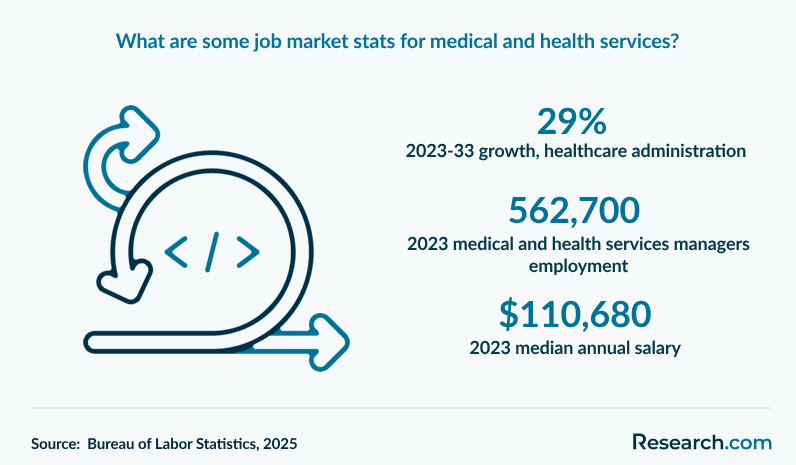
- Related occupational growth: Healthcare administration is projected to grow 29% from 2023 to 2033 according to BLS data cited for medical and health services managers.
- Current employment base: 562,700 medical and health services managers were employed in the US as of May 2023 according to BLS data.
- Openings: 61,400 annual job openings are projected for related roles according to BLS data.
- Median wage benchmark: The median annual wage for medical and health services managers is $110,680 as of May 2023.
- Industry scale: Healthcare is described as the largest US employer, with over 20.5 million professionals as of 2018.
- Degree supply: Specific degree-completion data for healthcare quality and safety is limited, but related fields such as public health show strong volume, with over 20,000 master's degrees annually.
- Examples of well-known universities: Johns Hopkins, Northwestern, and University of Southern Maine are cited among notable institutions connected to the field.
- Demand drivers: Regulation, value-based care, quality reporting, risk management, and patient safety priorities continue to support demand for specialized professionals.
- Related degree comparison: Students focused on broad administrative advancement may also compare affordable online MHA programs.
Specialized training can help graduates stand out, but it does not replace experience. Employers typically look for evidence that candidates can manage projects, interpret data, work across departments, communicate with clinical teams, and document measurable results.
Should I pursue additional certifications to complement my online master’s in healthcare quality and safety?
Certifications can strengthen a master’s degree when they align with your target job. They can also demonstrate current technical competence, especially in fields where employers value measurable skills or recognized professional standards. Examples include healthcare quality, patient safety, risk management, Lean, Six Sigma, project management, informatics, compliance, and clinical specialty credentials.
Choose certifications strategically. A patient safety professional may benefit from a quality or safety credential, while a healthcare data professional may need analytics or informatics training. Someone seeking more clinical exposure might compare options such as a certified medical assistant program online, but that route is more appropriate for hands-on clinical support than for graduate-level quality leadership.
Is a related undergraduate degree essential for success in an online master’s in healthcare quality and safety program?
A related bachelor’s degree can make the transition easier, but it is not always required. Students with backgrounds in nursing, medicine, health administration, public health, business, analytics, allied health, pharmacy, and health information management may all bring useful perspectives to quality and safety work.
Applicants without healthcare coursework should look for bridge support, introductory healthcare systems courses, faculty advising, or programs that welcome non-clinical professionals. Students who want stronger preparation in data governance, records, privacy, and health information systems may consider a bachelor of science in health information management online before or alongside longer-term career planning.
What graduates say about online master’s programs in healthcare quality and patient safety
-
: "
The online format made graduate study possible while I continued working full time. The strongest part of the program was applying quality improvement methods directly to problems in my hospital. I now help lead improvement initiatives and feel better prepared to discuss safety data with clinical and administrative teams. Zoya
"
-
: "
I was unsure whether online learning would feel engaging, but the case discussions, faculty feedback, and applied assignments were more useful than I expected. I used patient safety frameworks from class in my clinical unit almost immediately, and the degree helped me compete for leadership opportunities. Lysander
"
-
: "
As a working parent, I needed a program that did not require me to pause my career. The coursework helped me connect public health, quality improvement, and patient outcomes. I now work on projects aimed at improving care for underserved communities. Gene
"
Do employers recognize the value of an online Master of Science in Healthcare Quality and Safety degree?
Many employers care less about whether a graduate program was online and more about whether the school is accredited, the curriculum is rigorous, the student completed applied work, and the graduate can produce results. Online degrees from respected institutions can be credible when they include strong faculty involvement, healthcare-relevant projects, and clear academic standards.
Employer perception may be strongest when the degree is paired with experience in clinical operations, safety reporting, analytics, accreditation, compliance, or project leadership. Professionals in medication safety or interdisciplinary care may also compare related clinical education routes, including an accredited online pharmacy school, when pharmacy practice rather than quality management is the intended destination.
What are the emerging trends in healthcare quality and safety?
Healthcare quality and patient safety work is becoming more data-driven, interdisciplinary, and technology-enabled. Professionals entering the field should be prepared to work with electronic health records, dashboards, predictive analytics, telehealth workflows, remote monitoring tools, and patient-reported outcomes.
- AI and analytics: Healthcare organizations are using data tools to identify risk patterns, monitor quality metrics, and support earlier interventions. Human oversight remains essential because data quality, bias, workflow design, and clinical judgment affect results.
- Telemedicine and remote care: Virtual care creates new safety questions around documentation, escalation protocols, medication management, patient identity, and continuity of care.
- Value-based care: Payment models that emphasize outcomes and quality measures increase the need for professionals who can connect performance data with care improvement.
- Workforce pressure: Staffing shortages and access challenges make process design, team communication, and workload-aware safety strategies more important.
- Medication safety and integrated care: Collaboration with pharmacy, nursing, medicine, informatics, and population health teams is increasingly important. Students interested in pharmacy-centered clinical pathways may compare online Pharm D programs.
What is the return on investment of an online master’s in healthcare quality and safety degree?
ROI depends on the total program cost, your current income, whether your employer helps pay tuition, the time required to finish, and the type of role you pursue after graduation. A lower-cost program with strong employer recognition and an applied capstone may offer better ROI than a more expensive program with weak career support.
| ROI factor | How to evaluate it |
| Total cost | Add tuition, fees, books, travel, interest, and any income lost from reducing work hours. |
| Career goal | Compare the degree with the requirements for your target job, not just with general salary averages. |
| Employer support | Ask whether your employer offers tuition assistance, promotions tied to graduate study, or internal quality roles. |
| Completion time | A shorter program may reduce opportunity cost, but only if the workload is realistic. |
| Applied portfolio | Capstones and improvement projects can help demonstrate practical value in job interviews. |
| Alternative credentials | For some roles, targeted certificates or technical training may be enough. Students considering revenue cycle or coding roles may compare accredited online medical billing and coding schools. |
Do online programs provide effective career support and networking opportunities?
Some online healthcare quality and safety programs offer strong career support, while others provide only basic advising. Before applying, ask whether online students receive access to career coaching, alumni directories, employer events, mentorship, virtual networking, résumé review, interview preparation, and capstone placement support.
Networking in an online program usually requires more intention than on campus. Join professional associations, participate actively in discussion boards, attend virtual events, connect with faculty, and use applied projects to build relationships inside your workplace. Students seeking short clinical exposure should understand that a 6-week medical assistant program serves a very different purpose from a graduate quality and safety degree.
How do online programs maintain academic excellence and industry relevance?
Strong online programs maintain quality through regular curriculum review, qualified faculty, applied assignments, healthcare case studies, interactive learning, and alignment with current industry practices. Many use advisory boards, practitioner faculty, simulation exercises, project-based learning, and capstones to keep coursework connected to real healthcare problems.
Prospective students should verify faculty credentials, accreditation, student outcomes, course format, assessment methods, and employer partnerships. Students who want a stronger technical foundation in health data may also compare a fast-track online HIM bachelor’s degree as part of a broader career plan.
How can integrating bioinformatics enhance healthcare quality and safety?
Bioinformatics can support healthcare quality and patient safety by improving how professionals analyze complex clinical, genomic, population, and operational data. When used appropriately, advanced analytics can help identify risk patterns, support more targeted interventions, and improve decision-making in areas such as medication safety, population health, and outcomes measurement.
This does not mean every healthcare quality professional needs to become a bioinformatics specialist. However, professionals interested in data-intensive quality roles may benefit from additional study in analytics, informatics, or computational health sciences. Students wanting deeper expertise can explore online master’s programs in bioinformatics.
Key Insights
- The degree is best for healthcare improvement roles: It is most useful for professionals targeting patient safety, quality improvement, risk management, compliance, healthcare analytics, or healthcare administration roles with a quality focus.
- Online study can work well for experienced professionals: Many programs are designed for working students, but success requires strong time management and comfort with self-directed learning.
- Program fit matters more than title alone: Compare curriculum, accreditation, capstone requirements, faculty experience, delivery format, cost, and career support before applying.
- Costs vary widely: Tuition for these programs can range from $5,765 to $56,067 per year depending on university type and format, with online program tuition cited at $18,810 - $35,181 per year.
- Job outlook is supported by related healthcare management growth: BLS data cited for medical and health services managers shows 29% projected growth from 2023 to 2033, 562,700 employed as of May 2023, and 61,400 projected annual openings.
- Salary potential rises with responsibility: The median annual wage for medical and health services managers is $110,680 as of May 2023, while cited Salary.com figures show higher compensation for some director and vice president roles.
- Accreditation is non-negotiable: Verify institutional accreditation and, where relevant, specialized recognition such as CAHME before committing tuition dollars.
- Certifications can strengthen the degree: Credentials in healthcare quality, patient safety, Lean, Six Sigma, informatics, risk, or compliance may improve job alignment when chosen for a specific career goal.
- Rising healthcare costs and access challenges make the field important: U.S. out-of-pocket healthcare spending reached $471.4 billion in 2022, and a 2024 global survey found that 46% of adults cited access to treatment and long waiting times as the biggest healthcare system problem.
References:
- Bureau of Labor Statistics, U.S. Department of Labor. (2023). Medical and Health Services Managers. Occupational Outlook Handbook. Bureau of Labor Statistics.
- Bureau of Labor Statistics. (2023). Occupational Employment and Wage Statistics. Bureau of Labor Statistics.
- Data USA. (n.d.). Public Health. Data USA.
- Johns Hopkins University. (n.d.). Master of Applied Science in Patient Safety and Healthcare Quality. Johns Hopkins University.
- Northwestern University. (n.d.). MS in Healthcare Quality and Patient Safety. Northwestern University.
- Salary.com. (2024). Healthcare Quality and Compliance Manager Salary in the United States. Salary.com.
- Salary.com. (2024). Quality Improvement Director - Healthcare Salary in the United States. Salary.com.
- Salary.com. (2024). Patient Safety Manager Salary in the United States. Salary.com.
- Salary.com. (2025). Director Of Quality And Patient Safety Salary. Salary.com.
- Salary.com. (2025). Quality Assurance Analyst - Healthcare Salary in the United States. Salary.com.
- Salary.com. (2025). Quality Assurance Manager - Healthcare Salary in California. Salary.com.
- Salary.com. (2025). Quality Management Director - Healthcare Salary in the United States. Salary.com.
- Statista. (2025). U.S. total out-of-pocket health care payments since 1960. Statista.
- University of Southern Maine. (n.d.). Certificate and pathway to MPH in Healthcare Quality and Patient Safety. University of Southern Maine.
Other Things You Should Know About Online Master of Science in Healthcare Quality and Safety Degree Programs
Look for 2027 programs offering interactive platforms, real-time collaboration tools, and advanced data analytics coursework. These features enhance learning and keep pace with healthcare advances, ensuring students gain hands-on experience with current technologies and best practices in patient safety and quality management.
Many programs require a supervised practicum or capstone, often 100 to 200 hours, completed in a healthcare setting or quality-improvement project. Some schools waive a practicum for students with substantial professional experience, but they still require a final applied project or portfolio.