
2027 Best APA Accredited Clinical Psychology Programs

Co-Founder and Chief Data Scientist
Choosing an APA-accredited clinical psychology program is a high-stakes decision because it can influence whether you qualify for licensure, access accredited internships, build supervised clinical experience, and earn trust from employers and state boards. For students who want to become licensed clinical psychologists, the program is not simply a graduate school choice. It affects your timeline, debt, specialization options, clinical competence, and ability to practice across states.
This guide is for prospective doctoral students, psychology majors planning ahead, working adults considering a career change, and applicants comparing PhD, PsyD, online, hybrid, and campus-based clinical psychology programs. You will learn what APA accreditation means, how clinical psychology training works, how long the pathway takes, what programs may cost, how salaries vary, and which questions to ask before applying.
Quick answer: Should you choose an APA-accredited clinical psychology program?
For most students pursuing licensure as clinical psychologists, an APA-accredited clinical psychology program is the most reliable option. APA accreditation signals that a doctoral program meets recognized standards for clinical training, assessment, diagnosis, psychotherapy, ethics, research, supervision, and internship preparation.
The drawback is the investment. Becoming a clinical psychologist often requires 8 to 12 years of post-secondary education and supervised experience. Still, graduates may pursue roles in hospitals, outpatient centers, private practice, universities, research organizations, physician offices, and community mental health agencies.
Why pursue a clinical psychology degree?
- More employment settings: Clinical psychology graduates may work in healthcare, academia, research, consulting, hospitals, outpatient care, community mental health, family services, or private practice.
- Licensure-focused preparation: APA-accredited doctoral programs are structured around the coursework, clinical supervision, research training, and internship experiences expected of future licensed psychologists.
- Opportunities to specialize: Many programs let students build expertise in areas such as child and adolescent psychology, neuropsychology, forensic psychology, health psychology, or geropsychology.
- Potential for strong earnings: Reported salary figures vary by source, including a BLS average of $106,600, Zippia’s estimate of $97,659, and ZipRecruiter’s estimate of $109,894.
- Some flexible formats: Online and hybrid options exist in some cases, but students must confirm practicum, residency, internship, and state licensure requirements before enrolling.
What should you expect in a clinical psychology degree program?
A clinical psychology degree trains students to evaluate, diagnose, understand, and treat mental health conditions and behavioral health concerns. Doctoral programs combine psychological science with clinical practice, requiring students to learn research methods, ethical standards, assessment techniques, psychotherapy approaches, diagnosis, and supervised patient care.
APA-accredited programs are built around professional standards for clinical competence. Students commonly study psychopathology, psychological assessment, diagnosis, treatment planning, statistics, research design, multicultural practice, legal responsibilities, and ethical decision-making. Because clinical psychologists work directly with clients and patients, programs also require hands-on experiences such as practica, externships, internships, and supervised clinical placements.
Doctoral students are also expected to complete original scholarly work, often through a dissertation or similar research project. This requirement is especially central in PhD programs, where students are trained to contribute to the evidence base behind psychological assessment and treatment.
| Program component | What students usually complete | Why it matters |
| Core coursework | Psychopathology, ethics, assessment, intervention methods, research methods, and statistics | Creates the academic base needed for sound clinical judgment |
| Practicum training | Supervised clinical experience while enrolled in the program | Allows students to practice skills with real clients or patients under supervision |
| Internship | A formal full-time or equivalent clinical training placement | Often supports graduation requirements and licensure preparation |
| Dissertation or research project | Original research completed with faculty guidance | Builds competence in psychological science and evidence-based practice |
| Licensure preparation | Training connected to exams, supervised experience, and state board expectations | Helps students move from doctoral training into professional practice |
Where do clinical psychology graduates work?
Clinical psychology graduates can work in many environments, but job eligibility depends on licensure, degree type, specialization, supervised experience, and state rules. Doctoral-level clinical psychologists are commonly found in healthcare systems, hospitals, outpatient clinics, physician offices, individual and family services, correctional facilities, universities, research settings, and private practices.
Based on BLS data cited in the source material, the following industries are among the higher-paying settings for clinical psychologists:
| Industry | Average annual wage | What applicants should know |
| Offices of Other Health Practitioners | $114,900 | May include specialty behavioral health practices and multidisciplinary care teams |
| Offices of Physicians | $113,970 | Often involves collaboration with medical providers in integrated care settings |
| Outpatient Care Centers | $107,500 | May include therapy, assessment, treatment planning, and ongoing patient care |
| General Medical and Surgical Hospitals | $101,450 | Can require skills in consultation, acute care, health psychology, or medical settings |
| Individual and Family Services | $91,160 | Frequently centers on community-based, family-focused, and social-service-related care |
State location also affects earnings. Among the top-paying states identified in the source material, California reports an average annual wage of approximately $132,410, New York reports around $113,230, and Illinois reports about $111,300 for clinical psychologists.
If you are weighing psychology against a different field, compare not only salary but also program length, licensing requirements, and barriers to entry. For instance, students researching technology may look for the easiest information technology degree, while clinical psychology applicants must prepare for a longer and more regulated professional pathway.
How much do clinical psychologists earn?
Clinical psychologist salaries vary by employer, state, specialty, experience, licensure status, and job title. The BLS average cited in the source material is $106,600 for clinical psychologists. Other sources report different figures: Zippia lists an average of about $97,659, with a typical annual range of $72,000 to $132,000; Salary.com reports a range of about $86,800 to $114,774; and ZipRecruiter lists an annual average of $109,894.
The source material also includes the following salary figures for psychology-related occupations:
- Industrial-organizational Psychologists: $147,420
- Psychologists, All Other: $117,750
- Clinical and Counseling Psychologists: $96,100
- School Psychologists: $84,940
Use these numbers as reference points, not promises. A newly graduated clinician completing supervised hours will usually earn differently from an experienced licensed psychologist with a specialty practice, hospital role, academic appointment, or established private practice.
- APA-accredited clinical psychology programs for 2027
- Time required to become a clinical psychologist
- Clinical psychology program costs
- Admissions requirements for APA-accredited programs
- Common clinical psychology doctoral courses
- Clinical psychology specialization options
- Online vs. on-campus clinical psychology programs
- Financial aid for clinical psychology students
- High-earning clinical psychology career paths
- How to evaluate APA-accredited programs
- Accelerated pathways for aspiring clinical psychologists
- Clinical psychology and behavior analysis
- PhD vs. PsyD in clinical psychology
- Online psychology PhD programs for clinical practice
- Child psychology specialization and career prospects
- Ways to pay for clinical psychology education
- Trends affecting clinical psychology education
- Online PsyD programs and clinical practice
- Clinical psychologist licensure requirements
- Career options after clinical psychology training
- Job outlook for APA-accredited program graduates
APA-Accredited Clinical Psychology Programs for 2027
How Research.com evaluates schools
Research.com rankings use a documented ranking methodology that considers institutional and program information from credible education data sources. Rankings are meant to simplify comparison, but they should not replace direct confirmation with each university, the APA, or the licensing board in the state where you plan to practice.
Sources include the IPEDS database maintained by the National Center for Education Statistics, Peterson's database, including the Distance Learning Licensed Data Set, and the College Scorecard database, which includes information on higher education costs and outcomes.
Use this list as an initial research tool. Before submitting applications, verify APA accreditation, funding availability, internship placement support, faculty research alignment, practicum opportunities, licensure fit, and the full cost through graduation.
| School | Program | Length | Credits | Tuition or cost detail |
| Columbia University | PhD in Clinical Psychology | About 5 years | 95 credits | $2,274 per credit + fees |
| Boston University | PhD in Clinical Psychology | Not specified | Not specified | $30,568 per year + fees |
| Syracuse University | PhD in Clinical Psychology | Typically completed in 5 years | 90 credit hours | $32,436 per academic year + fees |
| Drexel University | PhD in Clinical Psychology | 4 to 5 years | Not specified | $1,342 per credit hour + fees |
| University of North Texas | PhD in Clinical Psychology | 5 years | Not specified | $5,632 per semester, including fees |
| George Washington University | PhD in Clinical Psychology | Varies based on individual progress | Not specified | $1,885 per credit + fees |
| Fielding Graduate University | PhD in Clinical Psychology | Varies | Not specified | $29,100 per year + fees |
| University of Central Florida | PhD in Clinical Psychology | 5 years | 86 semester hours | $15,346 per year, including fees |
| Pacific University | PhD in Clinical Psychology | Not specified | Not specified | $39,567 per year + fees |
| Alliant International University | PhD in Clinical Psychology | 5 years of full-time study | Not specified | $1,298 per unit + fees |
1. Columbia University — PhD in Clinical Psychology
Columbia University offers a PhD in Clinical Psychology that began in 1947 and has maintained APA accreditation. The program focuses on clinical science, research, service delivery, and close faculty mentorship. Students complete about five years of study and 95 credit hours.
- Program Length: About 5 years
- Required Credits to Graduate: 95 credits
- Cost per Credit: $2,274
- Tuition: $2,274 per credit + fees
2. Boston University — PhD in Clinical Psychology
Boston University has offered an APA-accredited PhD in Clinical Psychology since 1948. Its mentorship-based model connects research and practice, and smaller academic settings support closer interaction with faculty and peers. Graduates often enter medical, academic, and clinical roles.
- Program Length: Not specified
- Required Credits to Graduate: Not specified
- Cost per Credit: Not specified
- Tuition: $30,568 per year + fees
3. Syracuse University — PhD in Clinical Psychology
Syracuse University uses a scientist-practitioner approach that integrates research training with applied clinical work. The program includes attention to diversity and cultural competence, a master's thesis, a dissertation, a one-year internship, and at least 90 credit hours. Scholarships and assistantships may help students manage costs.
- Program Length: Typically completed in 5 years
- Required Credits to Graduate: 90 credit hours
- Cost per Credit: Not specified
- Tuition: $32,436 per academic year + fees
4. Drexel University — PhD in Clinical Psychology
Drexel University offers a PhD in Clinical Psychology with concentration options in Clinical Child Psychology, Clinical Neuropsychology, Forensic Psychology, and Health Psychology. The program has a cognitive-behavioral orientation and blends clinical application with scientific research. Students participate in research labs, complete a master's degree, and finish a dissertation.
- Program Length: 4 to 5 years
- Required Credits to Graduate: Not specified
- Cost per Credit: $1,342
- Tuition: $1,342 per credit hour + fees
5. University of North Texas — PhD in Clinical Psychology
The University of North Texas provides a PhD in Clinical Psychology centered on evidence-based practice, professional competence, clinical skill development, and research preparation. The five-year program aligns with American Psychological Association standards and includes coursework, research, clinical practice, a dissertation, and an internship.
- Program Length: 5 years
- Required Credits to Graduate: Not specified
- Cost per Credit: Not specified
- Tuition: $5,632 per semester, including fees
6. George Washington University — PhD in Clinical Psychology
George Washington University trains students to connect psychological science with clinical service while addressing diversity, community needs, and systemic oppression. The program includes assessment practica, therapy practica, externships, a one-year internship, and mentorship intended to support licensure readiness.
- Program Length: Varies based on individual progress
- Required Credits to Graduate: Not specified
- Cost per Credit: $1,885
- Tuition: $1,885 per credit + fees
7. Fielding Graduate University — PhD in Clinical Psychology
Fielding Graduate University delivers an APA-accredited PhD in Clinical Psychology through a distributed learning model that combines online study with in-person requirements. The program emphasizes social justice, culturally responsive practice, ethical research, diagnosis, psychotherapy, and evidence-based treatment planning.
- Program Length: Varies
- Required Credits to Graduate: Not specified
- Cost per Credit: Not specified
- Tuition: $29,100 per year + fees
8. University of Central Florida — PhD in Clinical Psychology
The University of Central Florida offers broad doctoral preparation in clinical practice and psychological science. Its generalist training model prepares students for clinical or scientific careers, with particular attention to assessment and treatment for adult clients.
- Program Length: 5 years
- Required Credits to Graduate: 86 semester hours
- Cost per Credit: Included in the annual tuition
- Tuition: $15,346 per year, including fees
9. Pacific University — PhD in Clinical Psychology
Pacific University combines clinical training and psychological research in a PhD program designed for scholar-practitioners. The curriculum provides generalist preparation for multiple professional settings, including healthcare. Students complete at least two years of clinical training.
- Program Length: Not specified
- Required Credits to Graduate: Not specified
- Cost per Credit: Not specified
- Tuition: $39,567 per year + fees
10. Alliant International University — PhD in Clinical Psychology
Alliant International University offers a PhD in Clinical Psychology taught by licensed professionals. The program prepares students for teaching, research, and clinical service roles. Students may select from six emphasis areas, including child/family, health psychology, and trauma-focused forensic psychology.
- Program Length: 5 years of full-time study
- Required Credits to Graduate: Not specified
- Cost per Credit: $1,298
- Tuition: $1,298 per unit + fees
How long does it take to become a clinical psychologist?
The path to licensed clinical psychologist status commonly takes 8 to 12 years after high school. Students usually complete a bachelor's degree, graduate coursework, doctoral training, supervised clinical experience, internship requirements, licensure exams, and any postdoctoral hours required by their state.
A bachelor's degree generally takes 4 years. Some students complete a master's degree before applying to doctoral programs, while others enter doctoral study directly when programs allow it. Applicants who want a shorter graduate step sometimes compare 1 year master's in psychology online programs, but a master's degree usually does not replace the doctoral training required for psychologist licensure.
According to the American Psychological Association, institutions awarded 38,033 master's degrees and 7,194 doctoral degrees in clinical psychology in 2023. These figures show both the size of the field and the substantial education required to enter it at the doctoral level.
| Stage | Typical time commitment | Key decision |
| Bachelor's degree | 4 years | Build a foundation in psychology, behavioral science, statistics, or a related field |
| Master's degree | Varies; some online options are designed for 1 year | Decide whether a master's degree improves your application or opens interim career options |
| Doctoral program | Often 4 to 5 years or more, depending on program design | Compare PhD vs. PsyD, funding, APA accreditation, internship outcomes, and faculty fit |
| Internship and supervised experience | Varies by school and state | Confirm that placements satisfy graduation and licensure expectations |
| Licensure exams and application | Varies by jurisdiction | Review EPPP, jurisprudence, ethics, and state board requirements |
How much do clinical psychology programs cost?
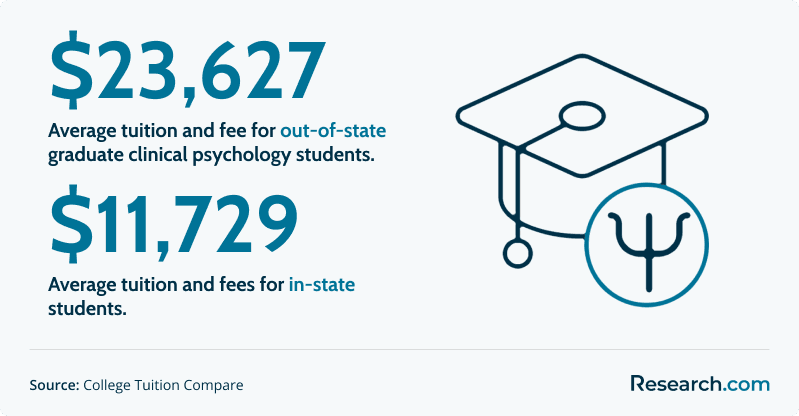
Clinical psychology programs can require a major financial commitment, particularly at the doctoral level. According to College Tuition Compare, the average cost of a doctorate degree in psychology with a clinical focus is $23,627 annually for out-of-state students and $11,729 for in-state students.
Individual programs may cost more than those averages. Columbia University lists $2,274 per credit, which could exceed $216,030 for the full program based on the stated credit requirement. Boston University lists tuition of $30,568 per year, and Syracuse University lists $32,436 per academic year. These examples show why applicants should calculate the total price of attendance instead of comparing only annual tuition or per-credit rates.
At the undergraduate level, the source material reports average clinical psychology program costs of $14,162 for in-state students and $37,330 for out-of-state students.
| Cost factor | Why it changes the real price | Question to ask the program |
| Tuition structure | Schools may bill per credit, per semester, or per academic year | What is the estimated total tuition through completion? |
| Required fees | Technology, student, university, and clinical training fees can increase costs | Which fees are mandatory every term? |
| Funding package | Assistantships, fellowships, stipends, and tuition waivers can reduce net cost | Is funding guaranteed, competitive, or renewed annually? |
| Practicum and internship expenses | Students may face relocation, travel, background check, and unpaid training costs | Where do students usually complete clinical placements? |
| Time to completion | Additional years can add tuition, fees, living expenses, and lost earnings | What is the average time to degree for recent cohorts? |
What are the enrollment requirements for APA-accredited clinical psychology programs?
Admissions standards vary, but APA-accredited clinical psychology programs are typically competitive. Strong applicants usually demonstrate academic readiness, research exposure, professional judgment, clear career goals, and a strong match with faculty expertise.
- Bachelor's Degree: Applicants generally need a bachelor's degree from an accredited college or university. A psychology major may help, but some programs accept applicants from related fields who complete prerequisites.
- GPA: Many programs set a minimum GPA expectation, often around 3.0 or higher on a 4.0 scale.
- GRE Scores: Some programs still require GRE scores, while others have changed or reduced standardized testing requirements.
- Letters of Recommendation: Applicants commonly submit three recommendations from professors, supervisors, or professionals who can assess graduate-level potential.
- Personal Statement: Programs usually ask for a statement describing academic interests, research fit, professional goals, and reasons for pursuing clinical psychology.
- Research Experience: Prior research is especially important for PhD applicants because faculty mentorship and scholarly fit often play a major admissions role.
- Prerequisite Courses: Some schools require prior coursework in psychology, statistics, research methods, or closely related subjects.
Applicants should also think beyond admission and examine what graduates do after finishing the program. Researching clinical psychology career options can help you compare licensure outcomes, internship placements, and alumni roles across clinical, research, academic, and private practice settings.
What courses are typically included in APA-accredited clinical psychology programs?
APA-accredited clinical psychology programs blend research training with applied clinical education. Course titles differ by school, but most programs address psychological assessment, diagnosis, intervention, ethics, statistics, research design, and supervised clinical practice.
- Foundational Courses: Introduction to Clinical Psychology, Psychopathology, and Ethical and Legal Issues in Clinical Practice
- Assessment and Diagnosis: Psychological Assessment, Neuropsychological Testing, and Behavioral Assessment
- Therapeutic Techniques: Cognitive Behavioral Therapy, Psychodynamic Psychotherapy, Group Therapy, and Family Systems Therapy
- Research Methods and Statistics: Quantitative Methods, Research Design, and Advanced Statistics
- Specialized Electives: Child and Adolescent Therapy, Health Psychology, and Forensic Psychology
- Practicum and Internship: Supervised clinical placements and a full-year internship that support licensure preparation
Quality programs help students translate coursework into clinical judgment. Assessment training, for example, should prepare students to administer tools, interpret findings responsibly, communicate results clearly, and recommend appropriate treatment plans.
What specializations are available in APA-accredited clinical psychology programs?
Specializations help students build focused expertise with certain populations, disorders, clinical settings, or assessment methods. Because offerings vary widely, applicants should compare faculty interests, research labs, practicum placements, and internship pathways before choosing a program.
| Specialization | Area of focus | Best fit for students interested in |
| Child and Adolescent Psychology | Development, assessment, intervention, and mental health care for children and teens | Schools, pediatric care, youth services, family agencies, and child-focused practice |
| Health Psychology | The relationship between behavior, mental health, physical illness, and healthcare systems | Hospitals, integrated care, behavioral medicine, and chronic illness support |
| Neuropsychology | Brain-behavior relationships, cognition, functioning, and assessment | Medical settings, assessment-heavy roles, brain injury, and cognitive disorders |
| Forensic Psychology | Psychological knowledge applied to legal, correctional, and court-related questions | Courts, correctional facilities, forensic evaluation, and legal consultation |
| Geropsychology | Mental health, cognition, and psychological functioning in older adults | Aging services, dementia-related care, healthcare, and later-life mental health |
If your goal is to work with children or teens, comparing child and adolescent psychology careers can clarify common roles, practice settings, and salary expectations.
How do online clinical psychology programs compare to on-campus programs?
Online and campus-based clinical psychology programs may differ in delivery, supervision, residency expectations, faculty access, and clinical placement support. Online formats can benefit students with work, caregiving, or geographic constraints, but clinical psychology cannot be completed through coursework alone. Any credible program must include supervised clinical training, assessment preparation, internship planning, and licensure alignment.
| Factor | Online or hybrid programs | On-campus programs |
| Flexibility | Often more suitable for students balancing location limits, employment, or family responsibilities | Usually requires consistent in-person participation and campus involvement |
| Clinical training | May depend on local placements, residencies, or required in-person intensives | Often benefits from established practicum partnerships near campus |
| Faculty interaction | Depends heavily on advising systems, cohort design, and program communication | May offer easier access to faculty offices, labs, peer networks, and campus resources |
| Licensure alignment | Requires careful state-by-state verification | Still requires verification, though some programs have longer licensing outcome histories |
| Best fit | Independent learners who can manage distance coursework and placement logistics | Students seeking immersive mentorship, in-person labs, and local clinical networks |
Students comparing doctoral programs may review the best schools for psychology doctorate degrees, but they should always confirm accreditation and state licensure alignment with each school.
What financial aid options are available for clinical psychology programs?
Because clinical psychology training can involve several years of tuition, fees, clinical placements, and unpaid or lower-paid supervised work, students should create a funding plan before enrolling. A strong package is not only generous in the first year; it remains manageable through graduation.
- Scholarships: Schools may award scholarships based on academic performance, financial need, service interests, or research potential.
- Fellowships: Fellowships may support advanced graduate training, specific research topics, or students from underrepresented groups.
- Assistantships: Teaching and research assistantships may include stipends, tuition support, or both.
- Grants: Federal, institutional, or private grants may reduce direct costs or help support research activities.
- Loans: Federal and private loans can fill funding gaps, but repayment should be evaluated against realistic salary expectations.
Some employers offer tuition assistance for graduate education. While many well-known examples focus on companies that pay for your MBA, employees should also ask whether their workplace supports psychology, counseling, behavioral health, or related graduate study.
Which clinical psychology career paths can be most financially rewarding?
Higher-paying clinical psychology paths often involve specialized training, advanced assessment ability, a strong professional reputation, or experience in complex settings. Neuropsychology, forensic psychology, and health psychology may offer strong earning potential for some clinicians because these areas require specialized knowledge and often involve high-stakes evaluation or treatment. Private practice can also increase income potential, but it brings business risk, insurance administration, marketing demands, and fluctuating client volume.
For a wider view of income across psychology roles, see Research.com's guide to the highest paying careers in psychology.
How should you choose an APA-accredited clinical psychology program?
The best program is not automatically the most famous one. It is the program that matches your licensure goals, research interests, clinical population, budget, learning format, and long-term career plans. APA accreditation should be your first filter, not your final decision factor.
| Selection factor | Why it matters | What to confirm |
| APA accreditation | May affect internship competitiveness, licensure preparation, and employer confidence | Verify current status through official APA resources |
| Faculty fit | Especially important for PhD applicants who need research mentorship | Identify faculty whose research matches your interests and who are accepting students |
| Clinical placements | Supervised practice is essential for competence and licensure readiness | Ask where students complete practica, externships, and internships |
| Funding | Debt can limit post-graduation choices and affect career flexibility | Compare stipends, assistantships, tuition waivers, fellowships, and expected loans |
| Program culture | Mentorship quality, workload, and cohort support can affect completion | Talk with current students and recent graduates when possible |
| Licensure outcomes | A doctorate alone does not guarantee licensure | Request information on exam outcomes, internship placements, and licensure results |
Some students complete an online masters degree psychology program before doctoral study, particularly if they need a flexible or lower-cost way to strengthen academic preparation.
Is an accelerated pathway a good choice for aspiring clinical psychologists?
An accelerated pathway can make sense if it reduces cost or time without weakening clinical preparation. Speed should not replace depth. Clinical psychology requires supervised practice, strong assessment training, faculty mentorship, internship preparation, and licensure alignment.
Accelerated options may suit highly organized students with strong academic preparation who can manage intensive coursework. Before choosing a faster route, confirm that the program still includes the practica, internship support, assessment training, and research mentorship expected in doctoral clinical psychology. Students exploring quicker routes can compare accelerated online psychology degree options as part of long-term planning.
Can a clinical psychology degree strengthen behavior analysis expertise?
Clinical psychology and behavior analysis intersect in assessment, intervention design, behavior change, treatment planning, and evidence-based care. A clinical psychology degree can deepen diagnostic and therapeutic skill, while behavior-analytic training can add expertise in functional assessment and behavioral intervention.
Students who want to combine these areas may explore additional coursework or credential pathways such as a BCBA program. This combination may be useful for autism services, developmental disabilities, school consultation, behavioral health, and complex intervention planning.
What is the difference between a PhD and a PsyD in clinical psychology?
The core difference is training emphasis. A PhD in clinical psychology generally gives more weight to research, scientific inquiry, and scholarship, while a PsyD usually emphasizes applied clinical practice and direct service. Both degree types can support licensure when they are properly accredited and meet state requirements.
| Feature | PhD in Clinical Psychology | PsyD in Clinical Psychology |
| Primary emphasis | Research, science, and clinical practice | Clinical service and applied training |
| Best fit | Students interested in research, academia, hospitals, or scientist-practitioner roles | Students primarily focused on direct patient care and clinical service delivery |
| Research expectations | Often substantial, including a dissertation and lab-based mentorship | Usually includes research, but often with a more applied clinical focus |
| Career direction | Academic, research-intensive, medical, and clinical settings | Therapy, assessment, clinical practice, and service delivery roles |
| Cost consideration | Some research-focused programs may offer funding | Costs vary widely, so applicants should compare total tuition and aid |
Students drawn to practice-focused doctoral training should compare accreditation, internship outcomes, state licensure fit, and total cost. Research.com's guide to the cheapest PsyD options can help begin the affordability review.
Are online psychology PhD programs viable for future clinical psychologists?
Online psychology PhD programs may be viable only when they include rigorous doctoral coursework, qualified supervision, credible clinical placements, and clear alignment with licensure requirements. Flexibility is useful, but an online format does not automatically satisfy clinical psychology licensing expectations in every state.
Students researching online psychology PhD programs should ask whether the program is APA-accredited, how in-person requirements work, where practica take place, whether the school supports internship placement, and how graduates perform in the licensure process.
Can a child psychology specialization improve career prospects?
A child psychology focus can help clinical psychology graduates work with children, adolescents, families, schools, pediatric systems, and community agencies. This specialization requires knowledge of development, family-centered treatment, school systems, age-appropriate assessment, and early mental health intervention.
Students interested in youth-focused practice should look for child-specialized faculty, pediatric or school partnerships, youth practica, and coursework in developmental psychopathology. Research.com's overview of careers in child development psychology can help compare possible roles.
How can you pay for clinical psychology education?
Financing clinical psychology training often requires multiple funding sources. Applicants should compare scholarships, grants, fellowships, assistantships, federal loans, private loans, employer tuition assistance, and part-time employment. The goal is to control debt without sacrificing clinical training quality or licensure readiness.
Students early in the pathway may lower total education costs by starting with an affordable psychology bachelor's degree before entering graduate study. Doctoral applicants should request a written estimate of total program cost, available funding, average debt, and typical time to completion.
What trends are shaping clinical psychology education?
Clinical psychology education is changing as healthcare delivery, technology, and patient needs evolve. Programs increasingly address telehealth, digital mental health tools, culturally responsive care, interdisciplinary practice, simulation-based learning, and behavioral health integration. These topics reflect how psychologists now work in hospitals, schools, clinics, private practices, community systems, and virtual care settings.
Some programs also connect clinical psychology with behavior analysis and related intervention approaches. Students interested in that overlap may compare options such as the best ABA master's programs while deciding whether their primary goal is psychologist licensure, behavior analysis certification, or a combined professional skill set.
Is an online PsyD a viable route to clinical practice?
An online PsyD may be viable for clinical practice only if it satisfies the academic, clinical, internship, and state-specific requirements needed for licensure. Because clinical psychology requires supervised work with clients or patients, applicants must look beyond online coursework and evaluate practicum support, residency requirements, internship outcomes, and APA accreditation status.
Before enrolling, ask how the program helps students secure supervised hours, whether graduates qualify for licensure in your state, and how clinical competencies are evaluated. Students comparing flexible practice-focused programs can start with Research.com's guide to PsyD degree online options.
What are the licensure requirements for clinical psychologists?
Clinical psychologist licensure requirements differ by state, but most states use a similar framework influenced by standards from organizations such as the Association of State and Provincial Psychology Boards. Always confirm requirements with the psychology licensing board in the state where you intend to practice.
- Doctoral Degree: A doctoral degree in psychology from a regionally accredited institution is typically required. Students reviewing masters in clinical psychology careers should understand that a master's degree can support related roles, but psychologist licensure usually requires doctoral training.
- Internship: Most states require an internship, often accredited by the APA or CPA.
- Examinations: Candidates generally must pass the Examination for Professional Practice in Psychology, or EPPP. Some states also require ethics or jurisprudence exams.
- Supervised Experience: Many jurisdictions require postdoctoral supervised hours, with totals varying by state.
- Application Process: Applicants typically submit transcripts, supervised experience records, exam results, application forms, and fees.
Many students ask whether a master's degree is sufficient. Research.com's guide on what you can do with a master's degree in psychology explains master's-level options. The source material also notes that, according to Zippia, 20% of clinical psychologists hold a master's degree, but applicants should not assume that a master's degree alone qualifies them for independent psychologist licensure in their state.
The following chart summarizes the education level of clinical psychologists.
What career paths are available after a clinical psychology program?
Clinical psychology graduates can move into several professional tracks depending on licensure, specialization, research background, and preferred work setting. If you are wondering what a clinical psychologist does, the role often includes assessment, diagnosis, therapy, consultation, research, teaching, and mental health support for different populations.
- Clinical Practice: Many graduates assess, diagnose, and treat mental health conditions in hospitals, clinics, outpatient centers, and private practices.
- Academia: Some psychologists teach courses, supervise students, conduct research, and mentor future clinicians in colleges and universities.
- Research: Clinical psychologists may study disorders, interventions, assessment tools, prevention strategies, or health outcomes.
- Consultancy: Some professionals advise healthcare teams, legal systems, organizations, public agencies, or policy groups.
- Specialized Therapy: Expertise in areas such as neuropsychology, health psychology, child psychology, or forensic psychology can support more focused roles.
The BLS reports that clinical psychologists work across various industries, as shown in the chart below.
What is the job outlook for graduates of APA-accredited clinical psychology programs?
Demand for clinical psychology graduates is supported by the ongoing need for mental health services in hospitals, schools, community agencies, private practices, social service organizations, and integrated care environments. The source material cites Zippia data showing 14% growth from 2018 to 2028 and about 26,100 new jobs for clinical psychologists over the next decade.
The source material also states that clinical psychology is expected to grow by 14% from 2023 to 2033. As with any labor-market projection, these figures should be treated as broad indicators rather than employment guarantees. Prospects will depend on licensure, location, specialization, clinical experience, internship quality, and willingness to work in high-need areas.

What graduates say about clinical psychology degree programs
- Studying clinical psychology online allowed me to keep progressing academically while managing responsibilities outside school. The learning platform made discussion, feedback, and applied coursework easier to follow, which helped me connect theory with practice. Arty
- The online program reshaped how I understood the field. The coursework was demanding, the assignments were practical, and the flexible pacing helped me study complex material while improving my analytical skills. John
- My online clinical psychology degree gave me flexibility while still emphasizing evidence-based practice. Learning with faculty and classmates from different backgrounds made the experience more useful and professionally relevant. Susan
Common mistakes to avoid when choosing a clinical psychology program
- Not confirming APA accreditation: Accreditation can influence internship options, licensure pathways, and employer confidence.
- Looking only at tuition: Fees, program length, relocation, unpaid practica, internship costs, and loan interest can substantially change the total cost.
- Assuming online programs are easier: Online and hybrid clinical psychology programs still require rigorous coursework, supervised practice, assessment training, and licensure planning.
- Overlooking state licensure rules: A program that aligns with one state may not automatically meet another state's requirements.
- Applying without faculty alignment: In PhD programs especially, weak fit with faculty research can reduce admissions competitiveness.
- Depending only on rankings: Rankings can narrow your list, but funding, fit, outcomes, placements, and licensure support matter more.
- Treating salary data as guaranteed: Earnings depend on licensure, location, specialization, experience, employer type, and business model.
Questions to ask before applying
- Is the program currently APA-accredited, and when is the next accreditation review?
- What share of students obtain accredited internships?
- What is the average time to degree for recent students?
- How much funding is guaranteed, and how many years does it cover?
- Where do students complete practica, externships, and internships?
- Does the program meet licensure requirements in the state where I plan to practice?
- What are recent graduates' EPPP pass rates and licensure outcomes?
- How much debt do graduates typically have after completion?
- Which faculty members are accepting students, and do their research areas match my goals?
- What support exists for students pursuing child psychology, neuropsychology, forensic psychology, health psychology, or another specialization?
Key Insights
- APA accreditation is a critical first filter for students who want the safest pathway toward clinical psychologist licensure.
- The route is long and should be planned carefully: students commonly need 8 to 12 years of post-secondary education and supervised training.
- Program costs vary widely. The source material reports doctoral averages of $23,627 annually for out-of-state students and $11,729 for in-state students, while several listed programs cost more.
- A PhD usually emphasizes research and scholarship more strongly, while a PsyD is generally more focused on applied clinical practice.
- Online and hybrid formats can improve flexibility, but students must verify clinical placements, internship support, residency requirements, APA accreditation, and state licensure alignment.
- Salary estimates differ by source and role. The source material includes a BLS average of $106,600, a clinical and counseling psychologist figure of $96,100, and additional salary-platform estimates.
- The strongest program choice depends on accreditation, faculty fit, funding, clinical training quality, internship outcomes, specialization options, culture, and licensure results—not prestige alone.
References:
- American Psychological Association. Get Licensed. APA.
- American Psychological Association. Licensure. APA.
- American Psychological Association. Specialize in Clinical Psychology. APA.
- American Psychological Association. Workforce Data Tools: Degrees in Psychology. APA.
- Bureau of Labor Statistics. 19-3033 Clinical and Counseling Psychologists. BLS.
- Bureau of Labor Statistics. Psychologists. BLS.
- College Tuition Compare. Clinical Psychology. College Tuition Compare.
- Zippia. Clinical Psychologist Demographics. Zippia.
- Zippia. Clinical Psychologist Trends. Zippia.
Other Things You Should Know About APA Accredited Clinical Psychology Programs
APA-accredited clinical psychology doctoral programs require supervised practicum before internship, and many programs expect at least 500 hours of practicum experience. Students also complete a 1,500- to 2,000-hour predoctoral internship accredited by the APA’s Commission on Accreditation.
Prerequisites typically include a bachelor's degree in psychology or related field, a competitive GRE score, and relevant research or clinical experience. Prospective students should also provide letters of recommendation and a personal statement highlighting their interest in clinical psychology.


