
2027 Best Careers to Pursue With a Clinical Psychology Master’s Degree

Co-Founder and Chief Data Scientist
A clinical psychology master’s degree can be a practical entry point into mental health work, but it is not the same as becoming a licensed clinical psychologist. That difference affects your job options, legal scope of practice, salary potential, and whether you need more supervised hours, a counseling license, or a doctorate. This guide is for students comparing psychology graduate programs, recent graduates planning their next credential, and career changers who want to understand what the degree can actually do in 2027. You will learn which jobs may be available with a master’s, which careers require licensure, how counseling and psychologist paths differ, and how to decide whether to stop at the master’s level or continue toward a PhD, PsyD, LPC, LMFT, or related credential.
Quick Answer: What Can You Do With a Clinical Psychology Master’s Degree in 2027?
A master’s in clinical psychology can prepare you for supervised roles in mental health services, counseling-related work, behavioral health programs, research, case management, and care coordination. In some states, and only if your program includes the required coursework and fieldwork, it may also support licensure paths such as professional counseling, marriage and family therapy, substance abuse counseling, or school-based mental health roles. It usually does not qualify you to practice independently as a licensed clinical psychologist; that career path generally requires a PhD or PsyD, supervised clinical experience, and the required psychology licensing examination.
- Common master’s-level options include behavioral health technician, case manager, psychology research assistant, psychiatric mental health technician, and mental health program coordinator.
- Independent therapy, diagnosis, insurance billing, and private practice authority depend on state licensure rules and the professional title you pursue.
- Licensed clinical psychologist roles typically require doctoral education, although a master’s degree can strengthen preparation for that route.
- Related counseling fields show strong projected demand: substance abuse, behavioral disorder, and mental health counselors are projected to grow by 19%, and marriage and family therapists are projected to grow by 16% from 2023 to 2033.
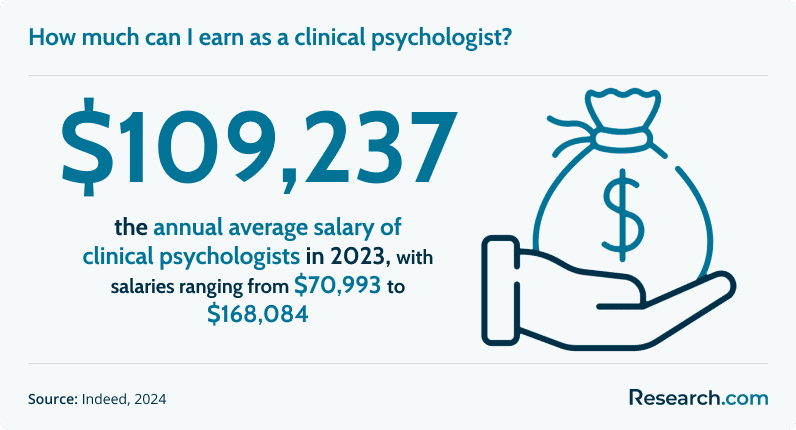
- Clinical and counseling psychologists reported a 2024 average salary of $109,237, with earnings ranging from $70,993 to $168,084; high-paying markets such as San Francisco report salaries up to $233,801.
- Top career paths with a clinical psychology master’s degree
- What this degree qualifies you to do
- Licensure requirements by counseling pathway
- Counselor licensure timeline
- Why a license changes your career options
- Counseling careers side by side
- Job outlook for clinical and counseling psychologists
- Doctoral specialization options
- Planning for private practice
- Non-clinical jobs for psychology graduates
- Online versus on-campus master’s programs
- Accelerated psychology programs
- Counseling salary expectations
- Psychologist salary expectations
- Accreditation and licensure alignment
- Clinical psychology compared with social work
- Substance abuse counseling requirements
- How to choose your next career step
- Affordable forensic psychology options
- Affordable counseling degree pathways
- Certifications that can support advancement
- Accredited online MFT programs
- PsyD cost considerations
- Key Insights
Best Careers to Pursue With a Clinical Psychology Master’s Degree for 2027
The strongest career choice depends on your end goal. If you want to start working quickly, supervised behavioral health or research roles may make sense. If you want to provide therapy with more independence, you will likely need a master’s-level license such as LPC or LMFT. If your goal is to become a licensed clinical psychologist, the master’s degree is usually a midpoint on the way to a doctorate rather than the final credential.
Entry-Level Roles That Usually Do Not Require Independent Licensure
These jobs can help you gain experience with clients, documentation, treatment teams, crisis response, and mental health systems. They are often appropriate for graduates who want to work while preparing for licensure, applying to doctoral programs, or deciding which population they want to serve. However, they generally do not authorize independent diagnosis or unsupervised psychotherapy.
| Role | Typical Responsibilities | Best For | Salary Information |
| Behavioral Health Technician | Assist licensed clinicians by monitoring clients, supporting treatment activities, responding to behavioral concerns, and helping maintain a safe care environment. | Graduates who want direct exposure to mental health or substance use treatment before choosing a license or advanced degree. | Salary Range: $25,000 - $49,500 Average Salary: $37,355 |
| Case Manager | Help clients access services, coordinate care plans, maintain records, communicate with providers, and connect people with housing, benefits, healthcare, or community supports. | Students drawn to advocacy, client navigation, and community-based mental health services. | Salary Range: $30,500 - $77,000 Average Salary: $49,266 |
| Psychology Research Assistant | Support research teams through literature reviews, participant recruitment, study materials, data collection, data analysis, and research documentation. | Graduates considering a PhD, PsyD, academic research, program evaluation, or clinical research work. | Salary Range: $31,500 - $122,000 Average Salary: $59,773 |
| Psychiatric Mental Health Technician | Work in psychiatric or behavioral health settings by observing client behavior, assisting with daily routines, supporting structured activities, and reporting concerns to licensed staff. | Graduates who want practical experience in inpatient, residential, or crisis-oriented environments. In some settings, this can be one of the better-paid psychology-related roles before doctoral training. | Salary Range: $32,500 - $171,000 Average Salary: $98,309 |
| Program Coordinator in Mental Health Services | Organize service delivery, coordinate staffing and schedules, monitor budgets, track program outcomes, and support daily operations in mental health programs. | Graduates interested in blending psychology knowledge with administration, nonprofit work, operations, or service leadership. | Salary Range: $33,500 - $151,500 Average Salary: $82,763 |
Specialized Careers That Usually Require Licensure, Certification, or Additional Preparation
These routes often provide more independence, stronger mobility, and clearer professional identity. The trade-off is that you must meet state-specific rules for coursework, field placement, supervised hours, examinations, ethics training, and renewal. Before committing to a program, ask whether it is designed for the credential you want in the state where you plan to practice.
| Role | Main Focus | Credential Issue to Check | Salary Information |
| Licensed Mental Health Counselor or LPC | Provide counseling for individuals, groups, and sometimes couples dealing with concerns such as anxiety, depression, trauma, grief, and major life changes. | Common requirements include supervised post-graduate clinical hours, a licensing exam, continuing education, and state approval. | Salary Range: $33,500 - $151,500 Average Salary: $82,763 |
| Marriage and Family Therapist or MFT | Address family conflict, couple concerns, parenting stress, relationship patterns, and individual symptoms through a systems-based approach. | LMFT eligibility depends on state rules, supervised experience, required coursework, an exam, and license renewal standards. | Salary Range: $47,500 - $160,000 Average Salary: $85,006 |
| School Psychologist | Support students through evaluation, intervention planning, consultation, counseling, and collaboration with families, teachers, and administrators. | Often requires a dedicated school psychology graduate pathway plus state school psychologist licensure or certification. | Salary Range: $11,000 - $398,500 Average Salary: $92,813 |
| Substance Abuse Counselor | Work with clients experiencing alcohol, drug, or behavioral addictions through assessment, counseling, recovery planning, relapse prevention, and referral coordination. | States set different certification or licensure levels, often including supervised hours, exams, and addiction-specific coursework. | Salary Range: $29,500 - $74,000 Average Salary: $52,978 |
The Road Ahead
Students often ask how difficult a psychology degree is. The challenge comes from combining research, ethics, clinical theory, assessment concepts, human development, and supervised practice. The degree is demanding, but it is manageable for students who are organized, emotionally resilient, and clear about their career target.
Think of the clinical psychology master’s degree as a decision point. It can help you begin working in mental health, qualify for certain licensure routes, build a stronger doctoral application, or move into research and program leadership. It is not always the last credential you will need.
For students pursuing licensed clinical psychologist roles, the longer pathway can lead to broader scope and higher professional authority. The average salary for clinical psychologists is listed as $109,237, but entry into that category generally requires education and licensure beyond the master’s level.
If your goals include independent psychologist practice, psychological assessment, advanced clinical specialization, academic work, or research leadership, compare doctoral pathways carefully, including flexible online doctorate in psychology options for working adults.
What Can I Do With a Master's Degree in Clinical Psychology?
A master’s in clinical psychology can prepare you for mental health support, research, counseling-adjacent, and human services roles, including programs completed through a well-designed online clinical psychology degree. The key limitation is legal scope. You may help with intake, treatment support, behavioral observation, documentation, psychoeducation, care coordination, or research tasks, but independent diagnosis and unsupervised psychotherapy usually require a specific license.
In 2022, around 2,701 master's degrees in clinical psychology were awarded in the United States.
Most Practical Uses of the Degree
- Enter the behavioral health workforce. Supervised and entry-level positions let you develop client communication, crisis awareness, documentation skills, and familiarity with treatment teams.
- Work toward master’s-level licensure. Depending on your state and curriculum, the degree may support LPC, LMFT, substance abuse counseling, or related credentials.
- Prepare for doctoral admission. Graduate coursework, research exposure, fieldwork, and faculty recommendations can help you decide whether a PhD or PsyD fits your goals.
- Use psychology training outside therapy. Employers in research, program management, human services, organizational development, and behavioral analysis may value skills in assessment, data interpretation, and behavior change.
Using Licensure to Expand Your Options
Many master’s-prepared graduates pursue credentials such as LPC or LMFT to move beyond support roles. These licenses typically require approved graduate coursework, supervised post-degree experience, a professional exam, continuing education, and compliance with state ethics rules. The process takes time, but it can increase autonomy and make your professional role easier for employers, insurers, and clients to understand.
The labor market is one reason licensure is attractive. Substance abuse, behavioral disorder, and mental health counselors are projected to grow by 19%, with 84,500 additional positions expected by 2033. Marriage and family therapists are projected to grow by 16%, adding 12,300 roles during the same period.
The chart below shows why many master’s-level psychology graduates consider licensure-focused counseling paths a strong alternative to immediately pursuing a doctorate.
What Are the Licensure Requirements for Different Counseling Roles?
If you are researching how to become a clinical psychologist, separate psychologist licensure from counselor licensure. A clinical psychology master’s degree may help with certain counseling licenses, but licensed psychologist status usually requires a doctorate. At the master’s level, common routes include Licensed Professional Counselor, Licensed Marriage and Family Therapist, and substance abuse counseling credentials, depending on state regulations.
Typical Licensure Process
- Earn the required graduate degree. A master’s in clinical psychology or a closely related field often takes two to three years and should include ethics, clinical theory, assessment foundations, counseling methods, and supervised field experience.
- Complete supervised clinical experience. Many states require between 2,000 and 4,000 hours of supervised practice after graduation, although the exact amount varies by credential and jurisdiction.
- Pass the required examination. Candidates generally take the licensing exam tied to their intended credential, such as LPC or LMFT.
- Renew and maintain the credential. Licensed professionals must complete continuing education and follow renewal requirements to keep the license active.
Licensure is more than a résumé line. It defines which services you can legally provide, which titles you can use, whether you may work independently, whether you can bill insurers, and whether you can supervise other clinicians.
Master’s-Level Licensure Versus Doctoral Psychologist Licensure
| Career Goal | Usual Education and Training Route | Likely Result |
| Provide counseling or therapy as a master’s-level clinician | Master’s degree, supervised hours, licensing exam, and continuing education | LPC, LMFT, substance abuse counselor, or another state-regulated counseling role |
| Practice as a licensed clinical psychologist | PhD or PsyD, supervised experience, and psychology licensing examination | Psychologist licensure, expanded assessment authority, and access to advanced clinical, academic, or research positions |
| Work in supervised behavioral health or research roles | Master’s degree may be enough for some employers | Technician, case management, program coordination, or research roles with limited independent clinical authority |
How Long Does It Take to Get Licensed as a Counselor?
After the master’s degree, the full path to becoming a licensed counselor commonly takes about 4 to 6 years in total. Your actual timeline depends on state rules, license type, workplace setting, supervision availability, and whether you can complete hours full time.
- Supervised clinical hours: 1–2 years
- Licensure exam and state-specific requirements: A few months
- Continuing education: Ongoing throughout your career
The process can seem slow, but it is not wasted time. Many graduates hold paid supervised positions while accumulating hours, which allows them to build clinical judgment, document cases, receive feedback, and become more competitive for independent roles.
If your interests later shift toward psychologist licensure, advanced assessment, or research leadership, you can compare doctorate programs in psychology while you continue gaining experience at the master’s level.
What Are the Benefits of Becoming a Licensed Counselor?
Licensure can turn a clinical psychology master’s degree from a general mental health credential into a practice-oriented career pathway. Without a license, many roles center on observation, coordination, support, or supervised service delivery. With a license, you may qualify for more independent client care, specialty practice, clinical leadership, and private practice opportunities within your legal scope.
- Greater autonomy. Licensed counselors and LMFTs can often provide therapy with less direct oversight than entry-level staff.
- Expanded clinical responsibilities. Depending on state law, licensure may allow more involvement in assessment, diagnosis, treatment planning, documentation, and complex case management.
- Access to higher-responsibility positions. Licensed roles often open doors that technician, assistant, or coordinator roles do not.
- Stronger professional credibility. A license shows that you met education, supervised experience, examination, ethics, and renewal standards.
- Durable demand. The 19% projected job growth for substance abuse and mental health counselors through 2033 reflects continued need for trained behavioral health professionals.
Students with military service obligations, relocation needs, or family responsibilities may want to compare flexible options at military friendly online colleges, particularly if they need schools with veteran support or active-duty flexibility.
How Do Different Counseling Roles Compare in Responsibilities and Growth Potential?
Counseling roles vary by population, treatment model, workplace, and state license. Do not choose only by salary. A better decision starts with the clients you want to serve, the settings you prefer, the type of therapy model that fits you, and how much independence you want after licensure.
| Role | Main Responsibilities | Growth Potential | Best Match |
| Licensed Professional Counselor | Offer counseling to individuals, groups, and sometimes couples for emotional, behavioral, adjustment, and mental health concerns. | Possible paths include private practice, community mental health leadership, clinical supervision, and specialized therapy work. | Students seeking a broad counseling scope across different client populations. |
| Licensed Marriage and Family Therapist | Treat individuals, couples, and families using relational, family systems, and interaction-focused approaches. | Advancement may include private practice, family mediation, healthcare roles, and supervision. | People interested in relationships, parenting, family conflict, and couple dynamics. |
| Substance Abuse Counselor | Support recovery through screening, counseling, treatment planning, relapse prevention, and coordination with medical or behavioral health providers. | Opportunities may exist in rehabilitation centers, correctional facilities, community agencies, and dual-diagnosis programs. | Graduates committed to addiction treatment and recovery-oriented services. |
| School Counselor | Help students with academic, social, emotional, and developmental needs while collaborating with families, teachers, and school staff. | Possible advancement includes college counseling, student support leadership, special education collaboration, or related school roles. | People who prefer educational environments over hospitals, clinics, or private practice settings. |
| Rehabilitation Counselor | Assist people with disabilities through counseling, vocational planning, adaptive strategies, resource coordination, and independence-focused support. | Career options include vocational rehabilitation, disability services, healthcare advocacy, and career counseling. | Graduates interested in disability support, employment access, and functional independence. |
Substance abuse, behavioral disorder, and mental health counselors have a projected job growth rate of 19%, and marriage and family therapists have a projected growth rate of 16%. For students who want a clinical path without immediately pursuing a doctorate, those figures make master’s-level licensure worth serious consideration.
What Is the Job Outlook for Clinical and Counseling Psychologists?
For students aiming at doctoral-level practice through options such as 3 year PsyD programs, employment projections are positive. Bureau of Labor Statistics data indicate that clinical and counseling psychologists are projected to grow by 13% from 2023 to 2033, adding about 10,200 new positions. Demand is tied to mental health treatment needs, psychological assessment, crisis care, and specialized services across healthcare, schools, and community settings.
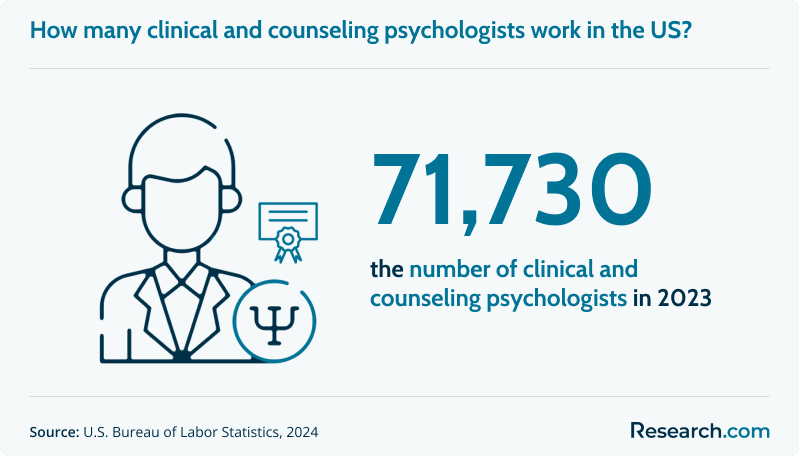
In 2023, there were around 71,730 counseling and clinical psychologists in the United States.
Factors Supporting Demand
- Higher visibility of mental health needs. More people, employers, schools, and healthcare systems are recognizing the need for qualified psychological services.
- Expansion of telehealth. Remote care has improved access for many clients who face location, transportation, or scheduling barriers.
- Specialized assessment and treatment needs. Trauma, workplace stress, crisis intervention, and complex psychological assessment continue to require advanced clinical training.
Psychologists Versus Counselors
Psychologists and counselors can both provide mental health services, but the careers differ in education level, licensure process, scope of assessment, and opportunities in research or academia. Understanding the distinction prevents a costly program choice that does not match your intended title.
| Aspect | Clinical/Counseling Psychologists | Counselors |
| Education | Doctorate (PhD or PsyD) | Master’s Degree |
| Licensure | Requires passing the Examination for Professional Practice in Psychology (EPPP) | Varies by role (e.g., LPC, LMFT) |
| Responsibilities | Diagnosing and treating complex mental health disorders, conducting assessments, and research | Providing therapeutic support and guidance |
| Growth Rate | 13% | 19% (mental health counselors) |
| Estimated Average Wage (2023) | $106,600 | ~$61,058 |
For many students, the choice is not a permanent either-or decision. A master’s degree can help you enter the field, earn supervised experience, and decide later whether doctoral study is worth the additional time and cost.
What Specializations Can You Pursue in Doctorate Clinical Psychology Programs?
Doctoral study is usually the next step if you want psychologist licensure, advanced assessment authority, university teaching, research publication, clinical supervision, or the ability to specialize in a recognized area of psychology. Master’s programs build the foundation, while doctoral programs typically go deeper into diagnosis, psychological testing, research design, evidence-based intervention, ethics, and supervised clinical practice.
- Health psychology: Studies the interaction between behavior, emotion, physical health, illness, treatment adherence, and recovery.
- Neuropsychology: Focuses on brain-behavior relationships and often serves people with cognitive changes, neurological conditions, or brain injuries.
- Forensic psychology: Applies psychological knowledge to legal issues, criminal behavior, competency questions, court-related evaluation, and consultation with legal professionals.
- Child and adolescent psychology: Addresses developmental, emotional, behavioral, social, and family concerns affecting children and teenagers.
- Clinical child psychology: Provides more specialized assessment and intervention for children and families experiencing psychological disorders, developmental difficulties, and family stress.
From 2023 to 2033, the Bureau of Labor Statistics projects 7% job growth for all psychologist occupations. The chart below provides a breakdown of psychologist occupation trends.
How Can I Manage the Business Challenges of Launching a Private Practice?
Private practice is both a clinical role and a business. Beyond competence with clients, you need a realistic business plan, startup budget, referral network, documentation process, billing system, informed-consent procedures, insurance credentialing strategy, privacy safeguards, scheduling tools, and plans for emergencies and coverage. If owning a practice is your goal, seek supervision from clinicians who already manage one and build practice-management training into your professional development. For the broader licensure roadmap, review this guide to becoming a clinical psychologist.
Are Non-Clinical Careers Viable With a Clinical Psychology Master’s Degree?
Yes. Not every graduate uses the degree for therapy. Clinical psychology training can be valuable in research, human resources, behavioral analysis, user experience research, public policy, academic administration, organizational development, market research, and program evaluation. These roles may suit you if you like psychology, behavior, data, and systems but do not want licensure or direct clinical practice. For a broader look at options, explore psychology career paths.
Are Online Programs as Effective as On-Campus Master’s Degrees in Clinical Psychology?
Online clinical psychology master’s programs can be a sound option when they are properly accredited, provide strong faculty access, include meaningful practicum or fieldwork, and align with the licensing rules in your intended state. The delivery format alone is not the deciding factor. Curriculum, supervision quality, outcomes, field placement support, accreditation, and state authorization matter more.
Online learning can work well for working professionals, caregivers, military-affiliated students, and learners who cannot relocate. Still, do not assume that every online program is licensure-ready. Compare practicum placement assistance, residency requirements, state eligibility, faculty availability, student support, and full program cost. If flexibility and cost are priorities, start with affordable online psychology master’s programs.
Can Accelerated Psychology Programs Enhance Career Progression?
Accelerated psychology programs can shorten the classroom portion of training, but speed is not automatically an advantage in clinical fields. Practicum quality, supervision, ethics preparation, licensure alignment, and faculty mentorship are critical. A faster program may be worthwhile if it still provides the academic depth and fieldwork needed for your credential goal. Compare options through guides to accelerated psychology programs before choosing the shortest route.
What Is the Average Salary for Counseling Professionals?
Counseling and behavioral health salaries vary by license, experience, state, employer, specialty, and setting. Support roles such as behavioral health technician and case manager list average salaries of $37,355 and $49,266. Licensed roles may provide more autonomy and responsibility, but pay still depends heavily on location, caseload, reimbursement, and workplace type.
Licensed Professional Counselors and Licensed Marriage and Family Therapists may earn between $50,000 and $70,000 annually, although individual outcomes can differ widely. Licensure should be viewed as a career-access tool, not a guaranteed salary outcome.
The chart below shows annual average salaries in 2023.
What Is the Average Salary for Psychologist Occupations?
Psychologist roles generally have higher earning potential than many master’s-level counseling roles because they usually require doctoral education and involve broader responsibilities, including assessment, diagnosis, research, supervision, and treatment of complex conditions. Clinical psychologists with a doctorate may commonly earn from $80,000 to $100,000 or more, depending on specialty, setting, experience, and location.
Specialties such as neuropsychology, forensic psychology, and health psychology may provide additional earning opportunities in private practice, hospitals, universities, research organizations, and consulting. Students applying to multiple programs may also consider online colleges with no application fee to reduce upfront application expenses.
In 2023, counseling and clinical psychologists earned around $106,600. The chart below compares salaries across psychologist occupations.
Is Program Accreditation Critical for Your Career Success in Clinical Psychology?
Accreditation is one of the highest-stakes factors in choosing a clinical psychology, counseling, or related graduate program. It can influence licensure eligibility, employer recognition, transfer credit, internship access, financial aid eligibility, and future doctoral admission. Before enrolling, verify both the institution’s accreditation and whether the program’s curriculum matches the credential requirements in your intended state.
This is especially important if you may pursue specialized credentials later. For example, students interested in behavior analysis can compare accredited options such as the best online master's in applied behavior analysis.
Questions to Ask Before Enrolling
- Is the institution accredited by a recognized accrediting body?
- Does the degree meet education requirements for the license I want in the state where I plan to work?
- Who is responsible for helping students find practicum, internship, or field placements?
- Are supervised hours included during the program, completed after graduation, or both?
- Which licensing exams do graduates typically prepare for?
- If I later apply to a doctorate, how will my credits and clinical training be evaluated?
- What is the total cost after fees, books, software, travel, residencies, and field placement expenses?
What Differentiates Clinical Psychology Career Paths From Social Work Careers?
Clinical psychology programs usually emphasize psychological theory, assessment, diagnosis, research methods, and therapeutic intervention. Social work programs often place greater emphasis on advocacy, case coordination, systems, community resources, and social service delivery, though licensed clinical social workers also provide therapy after meeting licensure requirements. If you are comparing the two, ask whether you prefer a psychology-centered clinical model or a broader systems and social services approach. For a deeper comparison, read about social worker vs psychologist careers.
What Are the Substance Abuse Counseling Degree Requirements?
Substance abuse counseling programs commonly cover addiction theory, counseling techniques, ethics, legal issues, co-occurring disorders, treatment planning, relapse prevention, and supervised practicum experience. Because requirements vary by state and credential level, confirm the exact rules before selecting a program. For more detail, review the substance abuse counseling degree requirements.
How Can You Advance Your Career in Clinical or Counseling Psychology?
A clinical psychology master’s degree gives you multiple possible next steps. The right one depends on your desired scope of practice, preferred clients, timeline, finances, mobility, and willingness to complete supervised training.
1. Choose Licensure if You Want Master’s-Level Clinical Independence
For many graduates, licensure is the most direct route to more independent therapy or counseling roles. Depending on coursework and state rules, common options include Licensed Professional Counselor and Licensed Marriage and Family Therapist.
- Select your intended license before choosing electives or field placements.
- Track supervised hours carefully from the start of your post-graduate work.
- Confirm exam, ethics, coursework, and supervision rules with your state board.
2. Develop a Clear Specialty
Focused training can help you serve a specific population and become more competitive. Possible areas include trauma-informed care, addiction counseling, child and adolescent therapy, family systems, forensic psychology, or neuropsychology-related support roles. If doctoral specialization interests you, review examples of types of clinical psychologists.
3. Prioritize Supervision and Mentorship
High-quality supervision strengthens clinical judgment, documentation, ethics, treatment planning, and confidence with difficult cases. It can also help you decide whether your long-term fit is master’s-level practice, doctoral study, administration, or research.
4. Look Beyond Traditional Therapy Clinics
Master’s-prepared graduates may find roles in community mental health centers, universities, schools, hospitals, correctional programs, corporate wellness, nonprofits, research teams, and human services agencies. Location also matters for earnings; San Francisco, CA ($233,801) and Phoenix, AZ ($217,794) are noted for higher salary figures for clinical psychologists.
5. Consider a Doctorate When Your Target Role Requires Psychologist Licensure
A doctorate may be appropriate if you want to practice as a psychologist, conduct advanced assessments, teach at the university level, publish research, supervise complex clinical work, or lead specialized programs. Working professionals can compare flexible graduate routes after reviewing online psychology master's programs and related pathways.
Common Mistakes to Avoid
- Enrolling without checking state licensure alignment. A program can be legitimate and still fail to meet the specific requirements for your intended license.
- Comparing only tuition. Fees, books, software, travel, residencies, practicum costs, and unpaid fieldwork can change the true price.
- Assuming online programs are easier. Online clinical programs still require rigorous coursework, supervised experience, documentation, and time management.
- Delaying your credential decision. Your target license can determine electives, practicum sites, supervision plans, and exam preparation.
- Thinking a master’s degree makes you a clinical psychologist. In most states, that title requires a doctorate and psychologist licensure.
- Using rankings as the only decision tool. Accreditation, licensure fit, supervision quality, faculty support, outcomes, cost, and location rules matter more than rank alone.
Are Affordable Online Forensic Psychology Programs a Smart Career Move?
Affordable online forensic psychology programs can be useful if you want to apply psychological knowledge in legal, correctional, investigative, victim services, or court-related environments. Potential work may involve forensic evaluation support, correctional treatment programs, legal consulting, victim advocacy, or interdisciplinary teams. Low cost is helpful, but it should not outweigh accreditation, faculty expertise, practicum relevance, and career alignment. To compare budget-focused programs, review affordable online forensic psychology master’s programs.
Are There Affordable Pathways to Quality Counseling Education?
Yes, but a low price only helps if the program prepares you for your intended credential. A cheaper program can become a poor investment if it lacks licensure alignment, field placement support, qualified faculty, or adequate student services. Compare accreditation, clinical training, exam preparation, advising, technology costs, and total program expenses. A practical starting point is the guide to the most affordable online counseling degrees.
What Additional Certifications Can Enhance Your Professional Trajectory?
Additional certifications can help licensed or license-seeking professionals build niche skills, but they rarely replace a required license. Possible areas include applied behavior analysis, trauma-informed care, neurofeedback, addiction treatment, and specialized family therapy methods. Choose credentials that support your scope of practice and client population. If behavior analysis is part of your plan, compare options for a BCBA degree online.
What Advantages Does an Accredited Online MFT Master's Program Offer?
An accredited online MFT master’s program can prepare students for marriage and family therapy licensure while offering flexibility for work, caregiving, or relocation limits. Strong programs include family systems coursework, relational therapy methods, ethics, supervised practicum, faculty interaction, and guidance on state licensing requirements. Compare options through guides to online MFT master's programs.
What Graduates Say About Careers After a Clinical Psychology Master’s Degree
- My master’s degree helped me understand the field, but the LPC opened the door to the work I actually wanted. I was able to move past entry-level roles and focus more seriously on substance abuse counseling. The licensure process took time and money, but it gave me better options and more responsibility without requiring a doctorate right away. Zoe
- I thought a master’s degree might limit me to supervised positions forever. Once I began the LPC process, I realized there were more paths than I expected. The credential helped me take on more complex clients and gave me a clearer professional identity. Carlos
- I eventually completed a doctorate, but the master’s degree was still valuable. It allowed me to do meaningful counseling work first, and that experience changed how I approached doctoral training. The doctorate was the right goal for me, but the master’s degree gave me the foundation. Natalie
What Is the Financial Investment Required for a PsyD Degree?
A PsyD can require a substantial investment of time and money. Before enrolling, compare tuition, fees, living expenses, reduced work hours, lost income, loan repayment, internship demands, and likely career outcomes. The degree may be worth it if your goals require psychologist licensure, advanced assessment authority, psychologist-level private practice, or clinical leadership. For cost-focused planning, review information on the average cost of a PsyD program.
Key Insights
- A clinical psychology master’s degree can lead to meaningful mental health work, but it usually does not make you a licensed clinical psychologist without doctoral education.
- Entry-level roles such as behavioral health technician, case manager, psychology research assistant, psychiatric mental health technician, and program coordinator can help you gain experience while you plan your next credential.
- For master’s-level graduates who want to provide therapy with more independence, licensure is the main career lever. Common options include LPC, LMFT, and substance abuse counseling credentials.
- State rules should drive your program choice. Confirm education, practicum, supervised hour, exam, and renewal requirements before enrolling or choosing a specialization.
- Demand remains strong in related fields: mental health counselor roles are projected to grow by 19%, marriage and family therapist roles by 16%, and clinical and counseling psychologist roles by 13% from 2023 to 2033.
- In 2022, 2,701 master’s degrees in clinical psychology were awarded, along with professional (1,485) and research (875) doctorates, showing that students use multiple education routes to enter the field.
- Clinical psychologists earn an average annual salary of $109,237 in 2024, with a salary range between $70,993 and $168,084, but reaching that role generally requires a doctorate and licensure.
- San Francisco, CA is listed as the highest-paying city for clinical psychologists in 2024, with salaries reaching $233,801.
- The best route depends on your goal: pursue master’s-level licensure for counseling practice, doctoral study for psychologist licensure, or non-clinical work if you prefer research, program leadership, organizational roles, or behavioral analysis outside therapy.
References:
- Bureau of Labor Statistics. (2024). Occupational employment and wages, May 2023 - 19-3033 Clinical and counseling psychologists. Retrieved from BLS.
- Bureau of Labor Statistics. (2024). Psychologists. Retrieved from BLS.
- Bureau of Labor Statistics. (2024). Substance abuse, behavioral disorder, and mental health counselors. Retrieved from BLS.
- Bureau of Labor Statistics. (2024). School and career counselors and advisors. Retrieved from BLS.
- Bureau of Labor Statistics. (2024). Occupational employment and wages, May 2023 - 21-1012 Educational, guidance, and career counselors and advisors. Retrieved from BLS.
- Bureau of Labor Statistics. (2024). Occupational employment and wages, May 2023 - 19-3034 School psychologists. Retrieved from BLS.
- Bureau of Labor Statistics. (2024). Occupational employment and wages, May 2023 - 19-3032 Industrial-organizational psychologists. Retrieved December 31, 2024, from BLS.
- Bureau of Labor Statistics. (2024). Marriage and family therapists. Retrieved December 31, 2024, from BLS.
- Bureau of Labor Statistics. (2024). Occupational employment and wages, May 2023 - 21-1013 Marriage and family therapists. Retrieved December 31, 2024, from BLS.
- Bureau of Labor Statistics. (2024). Rehabilitation counselors. Retrieved December 31, 2024, from BLS.
- Bureau of Labor Statistics. (2024). Occupational employment and wages, May 2023 - 21-1018 Substance abuse, behavioral disorder, and mental health counselors. Retrieved December 31, 2024, from BLS.
- Bureau of Labor Statistics. (2024). Occupational employment and wages, May 2023 - 21-1015 Rehabilitation counselors. Retrieved December 31, 2024, from BLS.
- Data USA. (2024). Clinical psychology. Retrieved December 31, 2024, from Data USA.
- ZipRecruiter. (2024). Behavioral health technician salary. Retrieved December 31, 2024, from ZipRecruiter.
- ZipRecruiter. (2024). Mental health case manager salary. Retrieved December 31, 2024, from ZipRecruiter.
- ZipRecruiter. (2024). Psychology research assistant salary. Retrieved December 31, 2024, from ZipRecruiter.
- ZipRecruiter. (2024). Psychiatric mental health technician salary. Retrieved December 31, 2024, from ZipRecruiter.
- ZipRecruiter. (2024). Mental health coordinator salary. Retrieved December 31, 2024, from ZipRecruiter.
- ZipRecruiter. (2024). Licensed mental health counselor salary. Retrieved December 31, 2024, from ZipRecruiter.
- ZipRecruiter. (2024). Marriage and family therapist salary. Retrieved December 31, 2024, from ZipRecruiter.
- ZipRecruiter. (2024). School psychologist salary. Retrieved December 31, 2024, from ZipRecruiter.
- ZipRecruiter. (2024). Substance abuse counselor salary. Retrieved December 31, 2024, from ZipRecruiter.
- ZipRecruiter. (2024). Clinical research coordinator salary. Retrieved December 31, 2024, from ZipRecruiter.
Other Things You Should Know About the Best Clinical Psychology Programs
Common nonlicensed roles include mental health case manager, behavioral health technician, research coordinator, and community outreach specialist. These jobs usually require a master’s degree, supervised experience, and background screening, but not state psychologist licensure or the 1,500 to 4,000 supervised hours required for independent clinical practice.
In 2027, beneficial certifications for clinical psychology graduates include Board Certification in Clinical Psychology through the American Board of Professional Psychology (ABPP). This certification enhances professional credibility and can open doors to advanced career opportunities in various specialties within clinical psychology.


