
2027 How to Become a Marriage and Family Therapist (MFT) in Reno, NV: License Requirements & Salary

Co-Founder and Chief Data Scientist
Becoming a marriage and family therapist in Reno, Nevada, is a licensing-driven career path, not just a degree choice. You need graduate-level clinical training, supervised experience, exam preparation, and a clear understanding of how Nevada regulates therapy practice. The decision matters because Reno’s mental health needs, population growth, telehealth access, and expanding behavioral health services have created more opportunities for therapists who can work with couples, families, children, and individuals in relational contexts.
This guide is written for students, career changers, counseling graduates, and pre-licensed clinicians who want a practical roadmap to becoming an MFT in Reno. It explains the education path, supervised-hour requirements, expected timeline, salary range, job outlook, private practice considerations, burnout risks, and career-growth options. It also highlights common mistakes to avoid so you can choose a program and licensure path with fewer surprises.
Quick Answer: Becoming an MFT in Reno, NV
- To become a marriage and family therapist in Reno, you generally need a master’s or doctoral degree in marriage and family therapy or a closely related mental health field, followed by supervised clinical experience and required licensing exams.
- Nevada licensure requires 3,000 supervised clinical hours, including direct client work, before independent practice.
- Marriage and family therapists in Reno, NV, earn an average annual salary of around $84,000, with cited 2025 salary ranges from $77,771 to $87,741.
- Nevada’s projected employment growth for MFTs is about 21% between 2022 and 2032, compared with a national growth rate of 16%.
- Reno offers career options in private practice, hospitals, community agencies, integrated behavioral health programs, teletherapy, and nonprofit mental health settings.
- What are the steps to become a Marriage and Family Therapist in Reno, NV?
- How does Reno, NV law define the scope of practice for MFTs?
- What degree do you need to become an MFT in Reno, NV?
- What is the average salary for a marriage and family therapist in Reno, NV?
- How long does it take to complete a master's degree in marriage and family therapy in Reno, NV?
- What is the cost of tuition for MFT programs in Reno, NV, and are there financial aid options?
- What are the requirements for MFT licensure in Reno, NV?
- What is the job market outlook for MFTs in Reno, NV?
- How can MFTs advance their careers in Reno, NV?
- What are the financial and administrative challenges for MFTs in Reno, NV, and how can they overcome them?
- How can MFTs protect their well-being and prevent burnout in Reno, NV?
- How can interdisciplinary collaboration enhance client outcomes in Reno, NV?
- What are the legal requirements for starting a private practice as an MFT in Reno, NV?
- What are the opportunities for continuing education and professional development for MFTs in Reno, NV?
- How can MFTs build an effective online presence in Reno, NV?
What are the steps to become a Marriage and Family Therapist in Reno, NV?
The Reno MFT pathway follows a sequence: complete the right graduate education, build supervised clinical experience, pass licensing exams, and then decide whether to work for an organization or start a practice. The process takes planning because your degree, practicum site, supervisor, and coursework all affect licensure eligibility.
| Step | What you need to do | Why it matters in Reno |
| 1. Choose a relevant bachelor’s foundation | Many future MFTs start with psychology, social work, human development, counseling, or a related field. | A strong behavioral science background can make graduate coursework and practicum training easier to manage. |
| 2. Earn a qualifying graduate degree | Complete a master’s or doctoral degree in marriage and family therapy or a closely related mental health field from an accredited institution. | Programs connected to local practicum sites can help students build relationships with Reno-area clinics and agencies. |
| 3. Complete supervised experience | Accumulate 3,000 hours of supervised clinical experience after meeting degree requirements. | Reno-area community agencies, hospitals, nonprofit programs, and private practices can be possible training environments. |
| 4. Prepare for licensing exams | Study for the AMFTRB national exam and Nevada-mandated jurisprudence exam. | Exam preparation should begin before your supervised hours are complete, not after. |
| 5. Apply for licensure and maintain compliance | Submit required documentation, follow Nevada rules, and complete continuing education after licensure. | Licensed therapists must stay current with ethics, clinical standards, telehealth rules, and documentation expectations. |
- Earn the right graduate degree before assuming you are license-eligible. Reno students may consider programs connected to the University of Nevada, Reno (UNR), Sierra Nevada University in Incline Village, and online options that serve Nevada residents, such as the University of San Francisco. Coursework commonly covers family systems, human development, ethics, diagnosis, couples therapy, and clinical methods. Before enrolling, verify that the curriculum aligns with Nevada licensure rules.
- Plan early for the 3,000 supervised clinical hours. Supervised practice is where you learn to translate theory into treatment plans, crisis response, case documentation, and ethical decision-making. Reno-area opportunities may include mental health clinics, hospitals, community agencies, private practices, and organizations such as Northern Nevada Adult Mental Health Services.
- Prepare strategically for the licensing exams. The national MFT licensing exam tests clinical judgment, ethics, assessment, treatment planning, and systemic therapy knowledge. Candidates often use review courses, peer study groups, and practice exams. Professional groups such as the Nevada Association for Marriage and Family Therapy (NAMFT) may also help candidates connect with mentors and continuing education options.
A smart approach is to work backward from licensure. Before choosing a program, ask whether graduates typically meet Nevada coursework standards, where students complete practicum hours, how supervision is arranged, and whether the school helps students understand the post-graduate licensure process.
The chart below shows that 40% of MFTs have earned specialized credentials, while 30% intend to pursue them later. For students, this suggests that specialization is not just an optional résumé booster; it can shape practicum choices, electives, supervision goals, and long-term career direction.
How does Reno, NV law define the scope of practice for MFTs?
Marriage and family therapists in Reno practice under Nevada law, which means their authority comes from state licensure rules rather than city-specific permission. MFTs focus on mental and emotional disorders through the lens of relationships, family systems, communication patterns, couple dynamics, parenting issues, and interpersonal functioning.
In practical terms, an MFT may provide individual therapy, couples therapy, family therapy, premarital counseling, parenting support, conflict-resolution work, and treatment planning for relational or behavioral health concerns. The defining feature is not that every session includes an entire family. It is that the therapist is trained to understand symptoms and distress in context: family history, relationships, life transitions, culture, communication, and environment.
Reno, NV marriage and family therapist licensing laws require practitioners to hold an appropriate Nevada license before providing independent clinical services. MFTs are not medical doctors and do not prescribe medication. Medication management and medical determinations are handled by psychiatrists, physicians, and other authorized medical professionals. This distinction is important for clients who may need both therapy and medication support.
Telehealth is also part of the modern scope of practice. Remote therapy can improve access for clients outside central Reno, including rural or underserved communities. However, therapists must still follow confidentiality rules, informed-consent standards, emergency protocols, and state practice requirements when delivering care online.
If you are comparing therapy careers, review related careers with an MFT degree to understand how MFT roles differ from counseling, social work, psychology, and behavioral health positions.
What degree do you need to become an MFT in Reno, NV?
To become an MFT in Reno, you typically need a graduate degree, not just a bachelor’s degree. A bachelor’s degree can prepare you for admission, but Nevada licensure requires graduate-level clinical education in marriage and family therapy or a related mental health discipline.
| Education level | Typical purpose | Licensure impact |
| Bachelor’s degree | Builds academic preparation in psychology, social work, human services, or behavioral science. | Useful for graduate admission but not enough for independent MFT licensure. |
| Master’s degree in MFT or related field | Provides clinical training in family systems, assessment, ethics, psychopathology, couples therapy, and research. | Common minimum graduate credential for the MFT licensure pathway. |
| Doctoral degree | May support advanced clinical practice, research, teaching, leadership, or specialized training. | Can meet graduate education expectations if it satisfies Nevada requirements. |
Graduate programs commonly award a Master of Arts (M.A.) or Master of Science (M.S.) in Marriage and Family Therapy. Coursework often includes Family Systems Theory, Psychopathology, Ethics and Professional Issues, Couples Therapy, Research Methods, assessment, diversity and culture, trauma-informed care, and practicum or internship experiences.
Local and regional options discussed by students include the University of Nevada, Reno (UNR), Sierra Nevada College, and Western Nevada College pathways that may support foundational study or transfer planning. Some students also choose online or hybrid counseling-related programs when local schedules or program availability are limited. If you are comparing flexible options, Research.com’s guide to the best online counseling degree programs can help you evaluate formats, coursework, and student support.
Before applying, ask each program these questions:
- Does the curriculum meet Nevada’s MFT educational requirements?
- How many practicum or internship hours are included before graduation?
- Does the school help students find Reno-area clinical placements?
- Are supervisors familiar with Nevada documentation rules?
- Can students attend part time, online, hybrid, or year-round?
- What percentage of graduates pursue MFT licensure?
What is the average salary for a marriage and family therapist in Reno, NV?
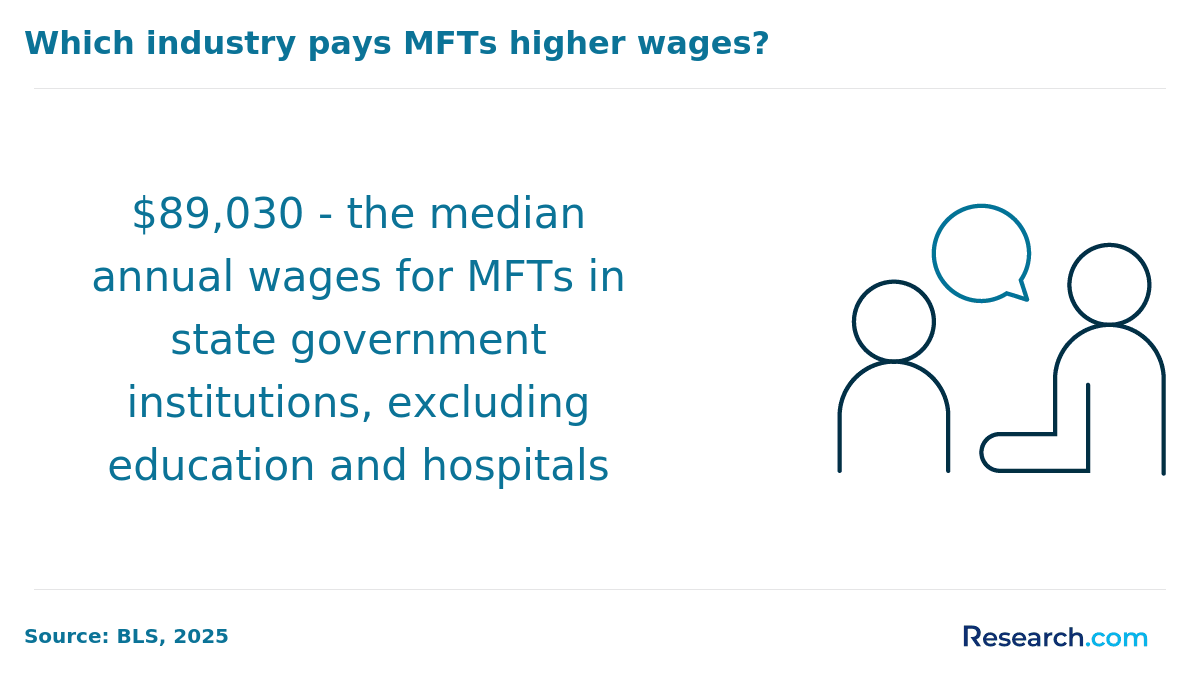
The cited average annual salary for marriage and family therapists in Reno is about $84,756. As of 2025, the reported salary range for MFTs in Reno, NV, is $77,771 to $87,741. These figures should be treated as planning estimates rather than guaranteed earnings because pay varies by employer, caseload, insurance participation, years of experience, specialty, and whether the therapist is pre-licensed, fully licensed, or self-employed.
Private practice can offer higher revenue potential, but it also brings expenses such as rent, billing software, liability insurance, unpaid administrative time, marketing, taxes, and variable client volume. Agency and hospital roles may provide steadier pay, benefits, supervision, and referral pipelines, but may offer less schedule control.
| Work setting | Potential advantages | Trade-offs to consider |
| Community mental health agency | Structured supervision, varied cases, mission-driven work, possible entry point for new clinicians. | High caseloads and administrative requirements can be demanding. |
| Hospital or integrated care setting | Team-based care, collaboration with medical providers, exposure to complex cases. | Documentation standards and productivity expectations may be strict. |
| Group practice | Shared referrals, peer consultation, less business setup than solo practice. | Income split, practice policies, and scheduling may limit autonomy. |
| Solo private practice | More control over niche, schedule, branding, and client population. | Requires business management, marketing, insurance decisions, and financial reserves. |
| Teletherapy | Flexible delivery model and broader access for clients. | Requires secure technology, privacy planning, and careful compliance with state rules. |
How long does it take to complete a master's degree in marriage and family therapy in Reno, NV?
A master’s degree in marriage and family therapy in Reno typically takes two to three years of full-time study and often includes 60 to 70 credit hours. Some accelerated or hybrid programs may allow completion in as little as 18 months, especially when students attend year-round or transfer eligible graduate credits. Part-time study, prerequisite coursework, limited practicum availability, or work obligations can extend the timeline beyond three years.
The degree is only one part of the full path. After graduate study, aspiring therapists must complete at least 3,000 hours of supervised clinical experience. That supervised period may add one to two years after coursework, depending on employment status, client volume, supervision availability, and how quickly direct service hours accumulate.
| Stage | Typical time involved | What can slow you down |
| Undergraduate preparation | Varies by prior education | Missing prerequisites or changing majors late. |
| Master’s degree | Two to three years full time; as little as 18 months in some accelerated or hybrid formats. | Part-time enrollment, practicum delays, transfer-credit limits, or required foundation courses. |
| Supervised clinical experience | Often one to two years after coursework. | Low client volume, limited supervisor access, incomplete documentation, or job changes. |
| Exam and licensure application | Varies by applicant readiness and board processing. | Delaying exam study, missing forms, or unclear supervision records. |
To shorten avoidable delays, choose a program with strong practicum coordination, begin networking with Reno counseling centers early, track hours carefully, and review the requirements for counseling certifications and licensure by state before assuming that one state’s rules match another’s.
What is the cost of tuition for MFT programs in Reno, NV, and are there financial aid options?
Tuition for MFT programs in Reno, NV, typically ranges from $15,000 to $35,000 per year, depending on whether the school is public or private, whether the student qualifies for in-state rates, and how the program structures clinical training. Because most aspiring MFTs complete a two- to three-year master’s degree, total cost should be evaluated across the full program, not one academic year.
Students should budget for more than tuition. Common additional costs include textbooks, technology fees, transportation to practicum sites, background checks, supervision-related expenses, licensing exam fees, application fees, professional association dues, and liability insurance during training.
| Cost category | Why students overlook it | How to evaluate it before enrolling |
| Tuition | Schools may advertise per-credit or annual costs, making comparisons difficult. | Ask for total estimated program tuition based on required credits. |
| Fees and materials | Books, technology, background checks, and course materials can add up. | Request a full cost-of-attendance estimate. |
| Practicum travel | Clinical sites may not be close to campus or home. | Ask where recent Reno-area students completed placements. |
| Licensing and exam costs | These often occur after graduation, when students are already managing debt. | Build exam, application, and supervision expenses into your career budget. |
| Lost income | Full-time study and practicum hours can reduce work availability. | Compare full-time, part-time, online, and hybrid schedules. |
Financial aid may include federal aid, state grants, the Pell Grant, Nevada-specific scholarships, local foundation scholarships, professional association awards, employer assistance, and loan forgiveness programs for mental health workers who serve underserved communities. Hybrid and online programs may reduce relocation or commuting expenses, but students must confirm that the program’s curriculum and clinical placement structure support Nevada licensure.
If you are comparing counseling-related credentials, reviewing MFT vs LMFT degree which is better can help clarify terminology, licensing stages, and career implications before committing to a program.
What are the requirements for MFT licensure in Reno, NV?
MFT licensure in Reno is governed at the Nevada state level. Applicants should verify current rules directly with the appropriate Nevada licensing authority before enrolling in a program or submitting an application, because requirements can change and individual transcripts may be reviewed differently.
- Graduate education. Candidates must hold a master’s or doctoral degree in marriage and family therapy or a related mental health field that satisfies Nevada’s educational standards.
- Supervised clinical experience. Applicants must complete at least 3,000 supervised clinical hours, including a minimum of 1,000 hours of direct client contact, typically over a two- to three-year period.
- National and state exams. Applicants take the Association of Marital & Family Therapy Regulatory Boards (AMFTRB) national exam and a Nevada-mandated jurisprudence exam covering state law and ethical requirements.
- Documentation. Supervision records, transcripts, application forms, and exam results must be accurate and complete. Poor recordkeeping can delay licensure even when the clinical work has been completed.
- License renewal. Licensed MFTs in Reno renew every two years and complete 30 hours of continuing education, including at least three hours in ethics.
Students with degrees in counseling, social work, psychology, or other related fields may still be eligible, but they may need additional coursework or supervised experience. If you are deciding between clinical paths, compare MFT vs MSW degree programs key differences before choosing a graduate program.
| Common licensure mistake | Why it creates problems | Better approach |
| Choosing a program based only on convenience | A convenient program may not satisfy Nevada coursework requirements. | Confirm licensure alignment before applying. |
| Assuming all clinical hours count | Hours may need proper supervision, categories, and documentation. | Track hours using board-compliant records from the start. |
| Waiting too long to study for exams | Licensure can be delayed after hours are complete. | Begin exam preparation during the supervised-experience period. |
| Ignoring continuing education rules | Renewal problems can affect professional standing. | Plan ethics and CE hours early in the renewal cycle. |
What is the job market outlook for MFTs in Reno, NV?
The MFT job outlook in Reno is favorable, but candidates should still be realistic about competition, licensing timelines, and the difference between pre-licensed and independently licensed roles. As of 2023, Reno employed about 180 MFTs, while Carson City had fewer than 50 MFTs. That larger local workforce suggests more established demand, more peer networks, and more potential employers in the Reno metro area.
Employment growth for MFTs in Nevada is projected at approximately 21% between 2022 and 2032, compared with a national average growth rate of 16%. Demand is linked to increased mental health awareness, broader acceptance of therapy, expanded insurance coverage, and the need for family-centered care in schools, healthcare settings, community agencies, and private practices.
Reno-area opportunities may be strongest for therapists who can work with high-need populations, accept insurance, provide telehealth, serve couples and families, collaborate with medical providers, or specialize in areas such as trauma, substance use, child and adolescent therapy, or culturally responsive care.
The chart below shows that California has the largest number of MFT jobs in the United States, with 30,890 positions. Minnesota follows with 4,230, New Jersey has 3,900, Pennsylvania has 2,640, and Tennessee has 2,130. These figures show where MFT employment is concentrated nationally, but local opportunity still depends on licensure rules, employer needs, population growth, and competition in each market.
How can MFTs advance their careers in Reno, NV?
Career advancement for MFTs in Reno usually comes from one or more of four moves: developing a specialty, building leadership experience, expanding referral networks, or improving business skills. A license opens the door, but long-term growth depends on how clearly a therapist positions their expertise.
- Develop a clinical niche. Specialized training in trauma therapy, substance abuse counseling, child and adolescent therapy, couples therapy, perinatal mental health, grief, or culturally responsive family work can help therapists stand out.
- Move into supervision or program leadership. Experienced MFTs may pursue roles such as clinical supervisor, program manager, training coordinator, or clinical director. Organizations such as Renown Health and Northern Nevada HOPES may need clinicians who can support integrated behavioral health and community-based services.
- Participate in professional organizations. Groups such as the Nevada Association for Marriage and Family Therapy (NAMFT) can provide networking, policy updates, referrals, mentorship, and continuing education.
- Build interdisciplinary relationships. Strong referral connections with physicians, psychiatrists, psychologists, school counselors, social workers, and behavioral specialists can improve both client care and career stability.
- Learn the business side of therapy. For therapists considering private practice, marketing, billing, insurance credentialing, documentation, tax planning, and client-retention systems are as important as clinical skill.
What are the financial and administrative challenges for MFTs in Reno, NV, and how can they overcome them?
MFTs often discover that clinical competence does not automatically translate into a sustainable practice. Billing, insurance claims, client scheduling, documentation, compliance, taxes, marketing, and unpaid cancellations can create financial pressure, especially for new private practitioners.
| Challenge | Risk for MFTs | Practical response |
| Insurance reimbursement | Delayed or denied payments can disrupt cash flow. | Use accurate coding, verify benefits, track claims, and learn payer requirements. |
| Administrative overload | Too much paperwork can reduce clinical availability. | Use practice management software or outsource billing when financially realistic. |
| Variable income | Cancellations, seasonal changes, and payer delays can make income unpredictable. | Maintain a reserve fund and monitor monthly revenue trends. |
| Compliance requirements | Weak documentation or privacy procedures can create legal and ethical exposure. | Audit records regularly and follow HIPAA, consent, and record-retention rules. |
| Limited business training | Therapists may underprice services or underestimate expenses. | Seek mentorship, business training, and consultation before launching independently. |
Some professionals strengthen their administrative thinking by studying how credentialing works across other regulated fields. For a local comparison of another certification pathway, see cheapest teacher certification programs in Reno.
How can MFTs protect their well-being and prevent burnout in Reno, NV?
Burnout is a real risk in therapy work because MFTs regularly sit with conflict, trauma, grief, family distress, and complex relational patterns. Reno clinicians who work in high-need community settings or carry large caseloads need a burnout-prevention plan before stress becomes unmanageable.
- Use supervision and consultation consistently. Even experienced therapists benefit from clinical feedback, ethical discussion, and case conceptualization support.
- Set caseload limits. A full calendar is not always a healthy calendar. Track emotional load, not just appointment numbers.
- Protect documentation time. Notes completed late at night or on weekends can erode recovery time.
- Create clear boundaries. Policies for emergency contact, cancellations, telehealth availability, and after-hours communication protect both client care and therapist well-being.
- Build peer support. Consultation groups, professional associations, and trusted colleagues can reduce isolation.
- Know when to refer. Some cases require a higher level of care, medical collaboration, or specialized treatment beyond the therapist’s scope.
Students comparing related mental health careers can also review mental health counselor requirements in Reno to understand how counseling roles, supervision, and licensure expectations may differ.
How can interdisciplinary collaboration enhance client outcomes in Reno, NV?
MFTs rarely serve clients in isolation. Couples and families may also need medication management, school support, substance use treatment, medical care, behavioral interventions, case management, or crisis services. Collaboration helps prevent fragmented care and gives clients a more coordinated treatment plan.
In Reno, useful interdisciplinary partners may include psychiatrists, psychologists, primary care providers, school counselors, social workers, substance abuse counselors, community health workers, and board-certified behavior analysts. Collaboration may involve referrals, signed releases of information, care coordination meetings, shared safety planning, and clear communication about each provider’s role.
Behavioral specialists can be especially helpful when families are managing developmental, behavioral, or learning-related concerns. Professionals interested in that part of the care network can explore how to become a BCBA in Reno for a better understanding of applied behavior analysis pathways.
What are the legal requirements for starting a private practice as an MFT in Reno, NV?
Starting a private practice in Reno requires more than finding office space and accepting clients. Therapists must satisfy professional licensing rules, business-registration requirements, privacy laws, documentation standards, and insurance or payment policies.
- Hold a valid MFT license. Independent practice requires a Nevada license. As of 2023, the pathway includes a master’s or doctoral degree in marriage and family therapy or a related mental health field and at least 3,000 supervised clinical hours.
- Register the business properly. Therapists starting a practice should register with the Nevada Secretary of State and obtain required local business licenses from the City of Reno.
- Carry professional liability insurance. Malpractice coverage protects the clinician and practice in the event of claims or complaints.
- Comply with HIPAA and confidentiality rules. Client records, telehealth platforms, emails, payment systems, and consultation procedures must protect private health information.
- Obtain an NPI if accepting insurance. A National Provider Identifier is important for therapists who plan to bill insurers.
- Create written policies. Informed consent, fees, cancellations, emergency procedures, telehealth rules, record requests, and privacy practices should be clear before the first session.
About 35% of licensed therapists in the Reno metropolitan area operated independently in private practice as of 2023. That level of independent practice suggests opportunity, but it also means new clinicians need to differentiate themselves through specialty, client experience, referral relationships, and reliable operations.
What do marriage and family therapists in Reno, NV have to say about their careers?
- "My marriage and family therapy training at the University of Nevada, Reno gave me the clinical base I needed. The combination of theory, case practice, and applied learning helped me become more confident as a therapist. Reno gives clinicians the chance to work with couples and families from many backgrounds, and that variety keeps the work meaningful. I value that my sessions can support individual healing while also strengthening relationships across the community." - Stephanie
- "I chose marriage and family therapy because I wanted to serve the city that shaped me. Sierra Nevada College helped me develop the tools to work with families while deepening my commitment to community care. Reno’s social and economic changes create real challenges for clients, but they also make the work deeply rewarding. This profession has pushed me to keep learning and has led to leadership opportunities in local mental health settings." - Marcus
- "Studying marriage and family therapy through Great Basin College was demanding, but it helped me grow both personally and professionally. Reno’s mix of city life, close community networks, and access to nature creates a unique environment for therapy. The local job market feels stable, and the continuing education options help me keep building my skills. The best part is seeing families repair trust and move forward in a place I care about." - Sophia
What are the opportunities for continuing education and professional development for MFTs in Reno, NV?
Continuing education is both a license-renewal obligation and a career-development tool. Reno MFTs can use workshops, conferences, supervision training, ethics seminars, trauma courses, telehealth training, and specialty certifications to stay current and expand their clinical reach.
Because MFTs must complete 30 hours of continuing education every two years, including at least three ethics hours, it is wise to build a renewal calendar instead of waiting until the deadline. Training choices should match the therapist’s client population. For example, a clinician seeing couples affected by substance use may benefit from additional addiction-focused education. Those interested in that overlap can review how to become a substance abuse counselor in Reno.
Good professional development also includes peer consultation, reading current clinical research, learning documentation best practices, improving cultural humility, and understanding changes in telehealth and insurance policies.
How can MFTs build an effective online presence in Reno, NV?
An online presence helps clients understand who you serve, what problems you treat, how sessions work, and whether you are accepting new clients. For Reno MFTs, local visibility is especially important because many clients search by location, insurance, specialty, and therapy type before contacting a provider.
- Create a clear professional website. Include services, specialties, fees or insurance information, telehealth availability, office location, credentials, and contact instructions.
- Use local search language naturally. Pages should mention Reno, nearby communities served, couples therapy, family therapy, and relevant specialties where accurate.
- Keep directory profiles consistent. Name, credentials, phone number, address, and availability should match across platforms.
- Explain your niche. Clients often need specific help, such as relationship conflict, blended families, parenting stress, grief, trauma, or premarital counseling.
- Respect ethics and confidentiality. Marketing should never reveal client information or promise guaranteed outcomes.
- Make contact easy. Potential clients should know whether they can call, email, request a consultation, or book online.
For a broader look at therapy career preparation in the same market, see how to become a therapist in Reno.
Common mistakes to avoid when becoming an MFT in Reno
| Mistake | Why it matters | What to do instead |
| Choosing a program without checking Nevada licensure alignment | A degree can be academically valid but still leave gaps for state licensure. | Confirm coursework, practicum, and supervision requirements before enrolling. |
| Focusing only on tuition | Fees, commuting, supervision, exam costs, and lost work hours can change affordability. | Compare total cost of attendance and post-graduation licensing expenses. |
| Assuming online programs automatically qualify | Online delivery does not guarantee that clinical placement or coursework meets Nevada rules. | Ask how the program supports Nevada students specifically. |
| Waiting to find supervision | Supervised hours are required and can be competitive. | Start networking with agencies, supervisors, and alumni during graduate school. |
| Ignoring burnout risk | High caseloads and emotionally intense work can shorten careers. | Build consultation, boundaries, and recovery time into your professional routine. |
| Launching private practice too quickly | Clinical skill alone does not cover billing, compliance, marketing, and cash flow. | Develop a business plan, referral strategy, and compliance checklist first. |
Key Insights
- Reno can be a strong market for aspiring MFTs, but licensure planning should begin before graduate enrollment.
- The central requirements are a qualifying graduate degree, 3,000 supervised clinical hours, the AMFTRB national exam, and Nevada’s jurisprudence exam.
- Reported Reno MFT earnings include an average around $84,756 and a 2025 salary range of $77,771 to $87,741, but actual income depends heavily on setting, license status, specialization, and business model.
- Nevada’s projected 21% MFT employment growth between 2022 and 2032 supports a positive outlook, though graduates still need strong supervision records, clinical skills, and local networks.
- Private practice offers autonomy but adds business, legal, insurance, and marketing responsibilities that agency roles may not require.
- The best program choice is not always the cheapest or fastest one. The right program is the one that fits Nevada licensure rules, offers accessible clinical placements, supports your schedule, and prepares you for the type of clients you want to serve.
Related Articles for Nearby Cities
- 2027 How to Become a Marriage and Family Therapist (MFT) in Sacramento, CA: License Requirements & Salary
- 2027 How to Become a Marriage and Family Therapist (MFT) in Stockton, CA: License Requirements & Salary
- 2027 How to Become a Marriage and Family Therapist (MFT) in Oakland, CA: License Requirements & Salary
- 2027 How to Become a Marriage and Family Therapist (MFT) in Fremont, CA: License Requirements & Salary
- 2027 How to Become a Marriage and Family Therapist (MFT) in San Francisco, CA: License Requirements & Salary
- 2027 How to Become a Marriage and Family Therapist (MFT) in San Jose, CA: License Requirements & Salary
- 2027 How to Become a Marriage and Family Therapist (MFT) in Fresno, CA: License Requirements & Salary
- 2027 How to Become a Marriage and Family Therapist (MFT) in Bakersfield, CA: License Requirements & Salary
- 2027 How to Become a Marriage and Family Therapist (MFT) in Boise, ID: License Requirements & Salary
- 2027 How to Become a Marriage and Family Therapist (MFT) in North Las Vegas, NV: License Requirements & Salary
References:
- American Association for Marriage and Family Therapy. (n.d.). About marriage and family therapists. Retrieved from https://www.aamft.org/AAMFT/About_AAMFT/About_Marriage_and_Family_Therapists.aspx
- National University. (2023, June 26). What is marriage and family therapy? Retrieved from https://www.nu.edu/blog/what-is-marriage-and-family-therapy/
- Pacific Oaks College. (2021, November 2). What is the difference between an LCSW and an LMFT? Retrieved from https://www.pacificoaks.edu/voices/psychology/what-is-the-difference-between-an-lcsw-and-an-lmft/
- Psychology Today. (n.d.). Marriage and family therapy. Retrieved from https://www.psychologytoday.com/us/therapy-types/marriage-and-family-therapy
- U.S. Bureau of Labor Statistics. (2023, May). Marriage and family therapists. Occupational Outlook Handbook. Retrieved from https://www.bls.gov/ooh/community-and-social-service/marriage-and-family-therapists.htm
- U.S. Department of Labor, Employment and Training Administration. (2025, May 20). Marriage and family therapists. O*NET Online. Retrieved from https://www.onetonline.org/link/summary/21-1013.00
Other Things to Know About Becoming a Licensed Marriage and Family Therapist in Reno, NV
The Nevada Board of Examiners for Marriage and Family Therapists issues MFT licenses in Reno and statewide. Applicants submit education, supervised experience, and exam documentation to this board, which also handles license renewal and disciplinary actions under Nevada law.
To become a licensed Marriage and Family Therapist in Reno, NV in 2027, you must hold a master's degree in Marriage and Family Therapy or a related field, complete supervised postgraduate experience, and pass the national MFT exam. The Licensure requirements are regulated by the Nevada Board of Examiners for Marriage and Family Therapists and Clinical Professional Counselors.
To transfer an MFT license to Reno, NV in 2027, you must apply for licensure by endorsement, provide proof of your current license in good standing, and meet Nevada’s educational and examination standards as set by the Nevada Board of Examiners for Marriage and Family Therapists.





