2027 How to Become a Mental Health Counselor in Rhode Island

Co-Founder and Chief Data Scientist
Becoming a mental health counselor in Rhode Island requires more than an interest in helping people. You need the right graduate education, supervised clinical experience, examination preparation, and a clear understanding of state licensure rules. This guide explains how the path works in Rhode Island, what the work involves, how to compare education options, and what career trade-offs to consider before investing time and money in a counseling degree.
The timing matters. Mental health needs remain substantial: in the US, 32.3% of adults reported symptoms of anxiety and/or depressive disorder between February 1 and 13, 2023, while 30.4% of adults in Rhode Island reported the same symptoms during that period (Kaiser Family Foundation, 2024). Rhode Island is meeting more of its mental health workforce need than many states, but as of April 1, 2024, only 58.1% of the state’s need for mental health professionals had been met (Bureau of Health Workforce, 2024). For students and career changers, that creates both opportunity and responsibility.
Quick Answer: How Do You Become a Mental Health Counselor in Rhode Island?
To become a licensed mental health counselor in Rhode Island, you generally need a master’s degree in counseling or a related field, at least 2 years of relevant postgraduate supervised clinical experience, a minimum of 2,000 hours of direct client contact, and a passing score on the National Clinical Mental Health Counselor Examination (NCMHCE). After meeting the education, experience, and exam requirements, you apply for licensure through the Rhode Island Board of Clinical Mental Health Counselors and Marriage and Family Therapists.
Key Things You Should Know About Becoming a Mental Health Counselor in Rhode Island
- Rhode Island has documented mental health care needs: 30.4% of adults reported symptoms of anxiety and/or depressive disorder between February 1 and 13, 2023, compared with 32.3% of adults nationally (Kaiser Family Foundation, 2024).
- National employment for substance abuse, behavioral disorder, and mental health counselors is projected to grow by 18% between 2022 and 2032 (US Bureau of Labor Statistics, 2024).
- Substance abuse, behavioral disorder, and mental health counselors in Rhode Island earned a median hourly wage of $22.13 in May 2023, equal to an estimated $42,489.6 annual wage (US Bureau of Labor Statistics, 2024).
- A single adult without children in Rhode Island can live comfortably on a gross annual income of $50,418 (Glasmeier & Massachusetts Institute of Technology, 2024), so prospective counselors should compare expected earnings with local living costs before committing to a program.
- Licensure is not automatic after graduation. Candidates must complete graduate education, supervised clinical hours, and the required national licensing examination.
- What does a mental health counselor do in Rhode Island?
- What steps are required to become a mental health counselor in Rhode Island?
- How should Rhode Island students prepare for this career?
- Why does practicum and supervised experience matter?
- Which counseling specializations are available in Rhode Island?
- Is Rhode Island a good state for mental health counselors?
- What other mental health careers can Rhode Island residents consider?
- How strong is demand for mental health counselors in Rhode Island?
- How can advanced education and certification support career growth?
- What licensing and certification requirements should counselors understand?
- What legal and ethical issues affect counseling practice in Rhode Island?
- Can mental health counselors move into school psychology roles?
- How can counselors collaborate with social workers?
- What trends are changing mental health counseling in Rhode Island?
- How do mentorship and networking help counselors advance?
- Can mental health counselors transition into school counseling?
- Why is mastering licensure important for career progress?
- What jobs can mental health counseling graduates pursue in Rhode Island?
- What challenges should Rhode Island counselors expect?
- How can substance abuse specialization help counseling professionals?
- What support is available for aspiring mental health counselors in Rhode Island?
What is the role of a mental health counselor in Rhode Island?
Mental health counselors help individuals, couples, families, and groups address emotional, behavioral, and psychological concerns. In Rhode Island, their work may include assessing client needs, creating treatment plans, providing individual or group counseling, documenting progress, coordinating referrals, and helping clients build coping strategies for anxiety, depression, trauma, addiction, relationship stress, grief, and life transitions.
The role is especially important because many Rhode Islanders continue to report mental health symptoms. Between February 1 and 13, 2023, 30.4% of adults in the state reported symptoms of anxiety and/or depressive disorder, compared with 32.3% of adults nationwide (Kaiser Family Foundation, 2024). Counselors do not solve the workforce shortage alone, but they are part of the front line of community-based mental health care.
Settings vary. A counselor may work in a community mental health center in Providence, a hospital outpatient program, a school-linked service, a substance use treatment facility, a private practice, a nonprofit agency, or an employee assistance program. The daily work can look different by setting, but the core responsibility is the same: provide ethical, evidence-informed support that helps clients function more safely and effectively.
| Core responsibility | What it looks like in practice | Why it matters |
| Assessment | Gathering client history, symptoms, risks, strengths, and goals | Helps determine the appropriate level of care and treatment focus |
| Treatment planning | Setting measurable goals with the client | Keeps counseling structured and accountable |
| Therapy and counseling | Providing individual, family, group, or crisis-focused support | Helps clients process challenges and develop healthier behaviors |
| Referral and coordination | Connecting clients to medical care, social services, or specialized treatment | Addresses needs that counseling alone may not resolve |
| Documentation | Recording sessions, treatment progress, risks, and clinical decisions | Supports continuity of care and regulatory compliance |
One Rhode Island counselor described the early stage of practice this way: “Starting my career in Providence was both exhilarating and daunting. The city is alive with energy, but it also has its share of struggles. I remember my first client—a young man grappling with anxiety. It was challenging to break through his walls, but when he finally opened up, it was like watching a flower bloom. The satisfaction of helping someone find their voice amidst the chaos is unparalleled.”
The same counselor added: “Every day presents new challenges, but the rewards are immense. I’ve witnessed transformations that reaffirm my commitment to this work. In Rhode Island, we have the opportunity to make a real difference, and that’s what keeps me going.”

What are the steps to pursue mental health counseling in Rhode Island?
The Rhode Island counseling pathway is a graduate-level licensure route. You should plan for undergraduate preparation, a qualifying master’s program, supervised clinical experience, examination, and a formal licensure application. The process is manageable if you verify requirements early and keep documentation from every stage.
| Step | What to do | Decision point |
| 1. Earn a bachelor’s degree | Complete a 4-year undergraduate degree in psychology, counseling, human services, social science, or another relevant field. | Choose courses that build writing, research, human behavior, statistics, and interpersonal communication skills. |
| 2. Choose a master’s program | Enroll in a master’s degree in mental health counseling or a closely related field. Programs may take 1 to 4 years depending on format and enrollment pace. | Confirm that the curriculum aligns with Rhode Island licensure requirements before enrolling. |
| 3. Complete supervised experience | After graduation, complete at least 2 years of relevant postgraduate clinical experience, including a minimum of 2,000 hours of direct client contact. | Make sure supervision, client hours, and setting type satisfy state expectations. |
| 4. Pass the licensing exam | Prepare for and pass the National Clinical Mental Health Counselor Examination (NCMHCE) administered by the National Board of Certified Counselors. | Build an exam timeline that does not delay your licensure application. |
| 5. Apply for licensure | Submit the required application materials to the Rhode Island Board of Clinical Mental Health Counselors and Marriage and Family Therapists. | Review every form carefully; missing documentation can slow approval. |
Rhode Island College and the University of Providence are examples of institutions named in connection with counseling education options. When comparing schools, do not rely only on reputation. Look at accreditation, field placement support, licensure alignment, faculty experience, cost, and whether the format fits your schedule.
If you are comparing requirements across states, Research.com also provides a Delaware LPC guide, which can help you understand how state licensing pathways differ.
How can students in Rhode Island prepare for a career in mental health counseling?
Students can prepare more effectively by treating licensure as the end goal from the first semester of graduate study. The best program is not simply the one with the most convenient schedule. It is the one that prepares you for Rhode Island’s academic, clinical, ethical, and examination requirements.
How to choose a counseling program
- Check accreditation and licensure fit: Look for programs that align with Rhode Island requirements. CACREP accreditation can be valuable because it signals that a counseling program follows recognized professional standards.
- Review field placement support: Ask where students complete practicum and internship experiences, how placements are approved, and whether the school has relationships with Rhode Island agencies.
- Compare total cost, not just tuition: Include fees, commuting, books, technology, supervision-related costs, exam preparation, and time away from paid work.
- Ask about exam preparation: A program should help students understand the NCMHCE and the clinical reasoning skills it tests.
- Look at specialization options: Tracks such as clinical mental health counseling, rehabilitation counseling, or addiction-focused coursework may fit different career goals.
Students should also build professional connections early. Joining organizations such as the Rhode Island Mental Health Counselors Association can provide exposure to local issues, continuing education, mentorship, and job leads. If addiction treatment interests you, it may also be useful to explore addiction counseling career options before selecting electives or placements.
| Question to ask a school | Why it matters |
| Does the program meet Rhode Island licensure education requirements? | A degree that does not align with state rules can delay or complicate licensure. |
| Is the program CACREP-accredited? | CACREP accreditation may strengthen portability and employer confidence. |
| How are practicum and internship placements arranged? | Strong placement support can reduce stress and improve training quality. |
| What percentage of students complete the program? | Completion information helps you assess student support and program fit. |
| How does the program support working adults? | Evening, hybrid, or part-time options may affect whether you can finish. |
How important is practicum experience for mental health counselors in Rhode Island?
Practicum, internship, and supervised postgraduate work are central to becoming a competent counselor. Rhode Island requires at least 2 years of relevant postgraduate clinical experience and a minimum of 2,000 hours of direct client contact for aspiring clinical mental health counselors. These hours are not a formality. They are where students and new graduates learn how to apply theory to real clients, real risk, and real ethical decisions.
- Skill development: Supervised experience helps new counselors practice assessment, treatment planning, documentation, crisis response, and therapeutic communication.
- Professional judgment: Classroom learning cannot fully simulate client complexity. Supervision helps candidates learn when to consult, refer, escalate care, or adjust treatment.
- Local career access: Placements often introduce students to Rhode Island employers, supervisors, and community-based service networks.
- Licensure documentation: Accurate records of supervision and direct client contact are essential for the final application.
A Rhode Island counselor described practicum as a turning point: “It was a whirlwind of emotions—excitement, fear, and ultimately, growth. I remember my first day at a community mental health center in Providence. I was nervous, but the support from my supervisor was incredible. I learned to listen deeply and respond with empathy, skills that are crucial in this field. After graduating from university, I landed a job in a bustling city clinic, where I now help clients navigate their mental health journeys. That practicum was the bridge to my career; it taught me not just the theory, but how to be present for others in their most vulnerable moments.”
What specializations can mental health counselors in Rhode Island pursue?
Mental health counseling is a broad profession. Specialization can help you serve a specific client population, qualify for certain roles, or build a more focused private practice. The best specialization depends on your clinical interests, tolerance for certain work environments, supervision opportunities, and long-term career plans.
| Specialization | Typical client needs | Where counselors may work | Best fit for |
| Substance abuse counseling | Alcohol use, drug use, relapse prevention, recovery support, co-occurring mental health concerns | Community health centers, rehabilitation facilities, outpatient programs | Counselors interested in addiction, recovery systems, and dual diagnosis work |
| Behavior disorder counseling | Disruptive behaviors, ADHD-related challenges, oppositional behaviors, family or school concerns | Schools, youth programs, clinics, community agencies | Counselors who want to work with children, adolescents, and families |
| Licensed Mental Health Counseling | Anxiety, depression, trauma, grief, relationship concerns, adjustment issues | Clinics, hospitals, private practices, nonprofits | Generalists who want a flexible clinical counseling career |
| Licensed Clinical Mental Health Counseling | Clinical treatment, diagnosis-related support, complex client needs, supervision potential | Clinical agencies, leadership roles, private practice settings | Counselors interested in advanced practice, supervision, or program leadership |
Specializing too early can be a mistake if you have not yet experienced different settings. Use practicum, internship, electives, and supervision to test your interests before committing to a niche.
The chart below provides a visualization of the US states with the highest number of employed mental health counselors in 2023, according to 2024 data from the US BLS.
Is Rhode Island a good place to work as a mental health counselor?
Rhode Island can be a meaningful place to practice counseling, but whether it is a good fit depends on your financial expectations, preferred work setting, licensure status, and willingness to serve clients with complex needs. The state has ongoing demand for mental health services, but salary and cost-of-living considerations should be reviewed carefully.
- Pay compared with living costs: The mental health counselor salary in Rhode Island had a median hourly wage of $22.13 in May 2023, equivalent to an estimated $42,489.6 annual wage (US Bureau of Labor Statistics, 2024). A single adult without children in Rhode Island can live comfortably with a gross annual income of $50,418 (Glasmeier & Massachusetts Institute of Technology, 2024). This gap makes budgeting, employer benefits, supervision costs, and career advancement plans important.
- Licensure by endorsement: Counselors licensed in another state may be eligible to apply for licensure by endorsement if they hold a CACREP-accredited clinical mental health counseling degree with at least 60 semester hours and meet Rhode Island’s equivalency expectations.
- Interstate practice: Rhode Island is part of the Interstate Counseling Compact, a legal agreement intended to allow licensed counselors in participating US member states to provide services across member states. The compact was created by the American Counseling Association and the National Center for Interstate Compacts in 2019, with rollout information previously pointing to the end of 2024.
| Rhode Island counseling career factor | Potential advantage | Potential concern |
| Workforce need | Only 58.1% of the state’s need for mental health professionals had been met as of April 1, 2024. | High-need settings may involve demanding caseloads. |
| Salary | Median hourly wage was $22.13 in May 2023. | The estimated annual wage of $42,489.6 is below the $50,418 comfortable living income for a single adult without children. |
| Small-state professional network | Networking and referrals may be easier to build over time. | Career options may feel concentrated in certain regions or organizations. |
| Compact participation | May improve future mobility for eligible licensed counselors. | Counselors should verify current compact rules before relying on interstate practice. |
What other mental health careers are available in Rhode Island?
Mental health counseling is not the only helping profession in the state. If you want to work with families, children, schools, healthcare systems, or community resources, compare counseling with adjacent pathways before choosing a degree. Marriage and family therapy is one option; Research.com’s guide on how to become a marriage and family therapist in Rhode Island explains the education, training, and licensure process for that profession.
What is the demand for mental health counselors in Rhode Island?
Demand for counseling services is supported by both national employment projections and Rhode Island’s unmet mental health workforce need. The US Bureau of Labor Statistics projects employment for substance abuse, behavioral disorder, and mental health counselors to grow by 18% between 2022 and 2032 (US Bureau of Labor Statistics, 2024). In Rhode Island, 58.1% of the need for mental health professionals had been met as of April 1, 2024 (Bureau of Health Workforce, 2024).
This does not mean every graduate will immediately receive a high-paying job. Hiring depends on licensure status, supervised experience, specialization, location, employer funding, and the candidate’s ability to work with high-need populations. Still, healthcare organizations, community agencies, substance use treatment providers, private practices, schools, and nonprofit programs all rely on behavioral health professionals.
How Can Advanced Education and Certification Enhance Your Counseling Career in Rhode Island?
Advanced education can help counselors move into more specialized, interdisciplinary, or leadership-oriented roles. However, additional degrees should have a clear purpose. Before enrolling, ask whether the credential will help you meet licensure requirements, qualify for a specific job, strengthen clinical competence, or increase your ability to serve a defined population.
Some professionals consider social work education when they want broader training in systems, policy, case management, and community-based support. For those comparing flexible graduate options, Research.com’s guide to online MSW programs can help you examine whether that route fits your goals. Counseling and social work overlap in client support, but the training models, licensure rules, and career identities are not identical.
What Are the Licensing and Certification Requirements for Counselors in Rhode Island?
Rhode Island counselors must pay close attention to licensure rules because legal authorization to practice depends on meeting state requirements. At a minimum, aspiring mental health counselors should expect graduate education, supervised clinical experience, direct client contact hours, and passage of the appropriate national examination. Specialized counseling or therapy careers may have different rules.
If you are also comparing family therapy, review the marriage counselor education requirements in Rhode Island to understand how that pathway differs from mental health counseling. For broader program comparisons, Research.com’s overview of counseling certification options can also help you think through credential choices, although you should always verify Rhode Island’s current board requirements before enrolling or applying.
What are the legal and ethical considerations for practicing counseling in Rhode Island?
Licensed counselors are responsible for protecting clients while following state law, board rules, and professional ethical standards. Legal and ethical practice affects every part of the job, from the first intake session to termination of services.
- Confidentiality: Clients must understand what information is private and what exceptions may apply.
- Informed consent: Counselors should clearly explain services, fees, risks, benefits, recordkeeping, and client rights.
- Mandatory reporting: Counselors must understand Rhode Island-specific reporting duties and when client safety concerns require action.
- Scope of practice: Counselors should not provide services beyond their training, competence, or license authority.
- Boundaries: Dual relationships, conflicts of interest, and inappropriate communication can harm clients and threaten licensure.
- Documentation: Clinical notes should be accurate, timely, and aligned with employer and regulatory expectations.
Can mental health counselors transition to school psychologist roles in Rhode Island?
A mental health counselor may be able to move toward school psychology, but it is not a simple title change. School psychologists typically need training focused on educational assessment, school systems, child development, consultation, and school-based intervention. A counselor considering this transition should compare the additional coursework, supervised school experience, and credentialing requirements before assuming prior counseling education will be enough.
For a more focused timeline and requirements overview, see Research.com’s guide on How long does it take to become a school psychologist in Rhode Island?.
How Can Collaboration with Social Workers Improve Client Outcomes in Rhode Island?
Counselors often work with clients whose challenges extend beyond symptoms. Housing instability, family stress, food insecurity, disability, medical needs, school concerns, and legal issues can all affect mental health. Collaboration with social workers can improve care because social workers are trained to connect clients with systems, benefits, community supports, and advocacy resources.
Students comparing the two fields can review social worker education requirements in Rhode Island. The right choice depends on whether you want your primary professional identity to center on therapy and counseling, broader social service coordination, or a blend of clinical and systems-level work.
What emerging trends are shaping mental health counseling in Rhode Island?
Several trends are influencing how counselors train and practice. Telehealth has changed access expectations, especially for clients who face transportation, scheduling, or mobility barriers. Integrated care models are also increasing the need for counselors who can coordinate with primary care, psychiatry, social work, schools, and community agencies. Digital tools may support scheduling, documentation, screening, and follow-up, but they do not replace clinical judgment.
Employer expectations are also shifting. New counselors may be expected to understand risk assessment, trauma-informed practice, culturally responsive care, substance use concerns, and interdisciplinary documentation systems. Students who want stronger psychology preparation can explore the best psychology schools in Rhode Island as part of a broader education search.
How can mentorship and networking enhance career growth?
Mentorship can shorten the learning curve in counseling. A strong mentor can help you interpret licensure rules, choose supervision opportunities, manage early-career stress, prepare for interviews, and avoid common documentation or boundary mistakes. Networking also matters because counseling roles are often connected through local agencies, supervisors, professional associations, and training events.
If your priority is entering the profession efficiently, Research.com’s guide to the quickest path to becoming a counselor in Rhode Island can help you think through timing. Speed should never come at the expense of licensure fit, accreditation, supervision quality, or clinical readiness.
What is the pathway for mental health counselors to transition into school counseling in Rhode Island?
Mental health counselors who want to work in K-12 settings should distinguish school counseling from clinical mental health counseling. School counselors focus on student academic development, career readiness, social-emotional support, family communication, crisis response, and school systems. A licensed mental health counselor may bring useful clinical skills, but school counseling usually involves separate education and certification expectations.
Before changing direction, compare state requirements, school-based field experience, and the daily responsibilities of school counselors. Research.com’s guide on how to become a school counselor in Rhode Island provides a more detailed look at the pathway.
How can mastering licensure processes boost career growth?
Licensure delays can slow hiring, supervision approval, insurance participation, and private practice plans. Counselors who understand the process early can avoid preventable setbacks, such as enrolling in a poorly matched program, failing to document supervised hours, choosing an ineligible supervisor, or waiting too long to prepare for the NCMHCE.
Use a licensure checklist during graduate school and update it as regulations change. Keep copies of syllabi, transcripts, supervision agreements, direct client contact logs, supervisor credentials, exam results, and board correspondence. For a focused overview, review Research.com’s guide to LPC license requirements in Rhode Island.
What careers are available to Mental Health Counseling Graduates in Rhode Island?
A counseling graduate’s options depend on degree type, licensure status, supervised experience, and specialization. Some roles require independent licensure, while others may be available in supervised, entry-level, or adjacent human services settings.
| Career option | Typical focus | What to consider |
| Social worker | Helping clients access services, address social barriers, and manage mental health and life challenges | Compare the career path in social work vs. counseling before choosing a graduate route. |
| Substance abuse counselor | Supporting clients with substance use concerns, recovery planning, relapse prevention, and co-occurring conditions | Specialized training and setting-specific requirements may apply. |
| Geriatric counselor | Helping older adults with grief, health changes, isolation, family transitions, and adjustment concerns | Experience with aging, healthcare systems, and family dynamics can be valuable. |
| Employee Assistance Program counselor | Supporting workers with stress, personal concerns, workplace conflict, and referrals | Short-term counseling, assessment, and referral skills are important. |
One Rhode Island counselor described entering the field this way: “Choosing to work in Providence was a leap of faith. I remember the excitement mixed with anxiety as I stepped into my first role at a community health center. The challenges were real—navigating the complexities of clients’ lives while managing my own emotions was daunting. But seeing the impact of my work, especially when clients expressed gratitude for helping them find their footing, made every struggle worthwhile. It’s a rewarding path.”
The chart below provides a visualization of the job outlook of mental health workers in the US between 2022 and 2032, according to 2024 data from the US BLS.
What challenges do mental health counselors face in Rhode Island?
Counseling can be rewarding, but it is not an easy profession. Rhode Island counselors may face administrative pressure, emotional strain, resource limitations, and financial trade-offs. Understanding the challenges before entering the field can help you choose better placements, employers, supervisors, and career goals.
- Licensure complexity: State requirements, documentation, supervision rules, and exam preparation can be confusing if you do not plan ahead.
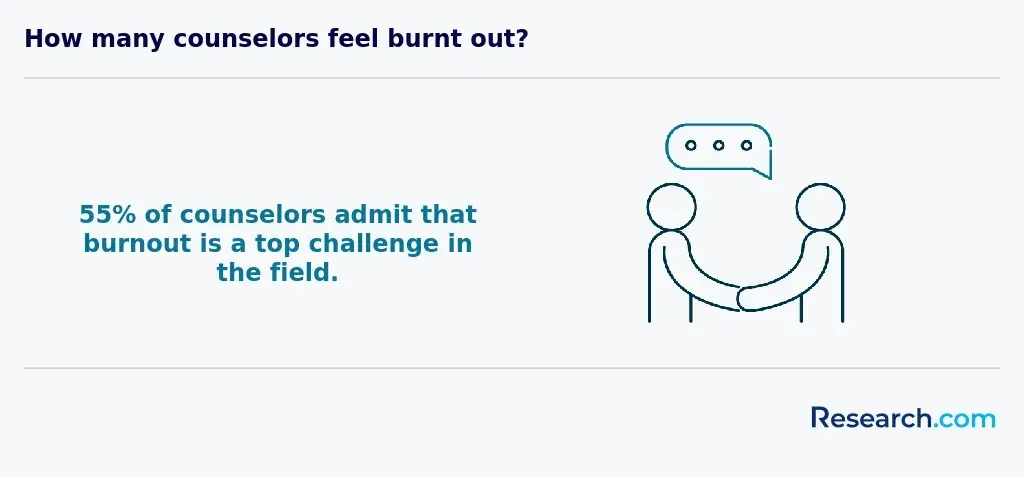
- Economic pressure: Rhode Island ranked 41st out of all 50 US states in economic performance in the second half of 2024 (American Legislative Exchange Council, 2024). Funding constraints can affect agencies, staffing, caseloads, and available services.
- Salary concerns: The May 2023 median hourly wage of $22.13 and estimated $42,489.6 annual wage should be weighed against the $50,418 gross annual income that a single adult without children can use to live comfortably in Rhode Island.
- Emotional workload: Counselors often work with trauma, crisis, relapse, grief, and chronic stress. Supervision and boundaries are essential.
- Continuing education demands: Effective counselors must keep learning while managing clinical work and personal responsibilities.
If cost is a major barrier, compare options carefully. Research.com’s guide to cheap online counseling degree programs can help you identify lower-cost possibilities, but always verify accreditation and Rhode Island licensure alignment before enrolling.
How Can Specializing in Substance Abuse Counseling Benefit Mental Health Professionals in Rhode Island?
Substance abuse counseling can be a strong specialization for mental health professionals because many clients experience both substance use concerns and mental health symptoms. Counselors who understand dual diagnosis, relapse prevention, motivational approaches, recovery systems, and family impact may be better prepared for community-based and integrated care settings.
This specialization can also improve career flexibility. Substance use treatment facilities, outpatient programs, community health centers, and related agencies often need clinicians who can address both behavioral health and addiction-related concerns. If this path interests you, review Research.com’s guide on how to become a substance abuse counselor in Rhode Island.
How does Rhode Island support aspiring mental health counselors?
Rhode Island supports aspiring counselors primarily through formal licensure pathways, graduate education options, supervised training structures, professional associations, and continuing education opportunities. Students should still verify every requirement directly with the appropriate board or official source because licensure rules and program policies can change.
The state board’s licensure process connects academic preparation with supervised clinical experience, helping candidates move from graduate education into professional practice. For a step-by-step related overview, see Research.com’s guide on how to become a therapist in Rhode Island.
Financial support may be available in some cases for professionals serving underserved communities, including loan repayment or workforce incentive programs. Do not assume eligibility. Check current program rules, service commitments, employer participation, and application deadlines before using potential aid in your financial plan.
Common mistakes to avoid
| Mistake | Why it can hurt you | Better approach |
| Choosing a program before checking licensure alignment | You may graduate without meeting Rhode Island’s educational expectations. | Compare curriculum requirements before applying. |
| Looking only at tuition | Fees, commuting, books, technology, supervision, and lost work time can change affordability. | Calculate total program cost and expected earnings. |
| Assuming online programs always qualify | Some programs may not satisfy state-specific licensure rules. | Get written confirmation from the program and verify with state requirements. |
| Ignoring practicum quality | Weak placements can limit learning and networking. | Ask where students train and how placements are supervised. |
| Waiting to document hours | Missing records can delay licensure. | Track supervised experience from the start. |
| Assuming salary outcomes are guaranteed | Pay varies by setting, license level, location, and experience. | Compare job postings, benefits, supervision support, and advancement paths. |
Here’s What Mental Health Counselors in Rhode Island Have to Say About Their Careers
- "As a mental health counselor in Rhode Island, I've found immense fulfillment in helping individuals navigate their struggles. The supportive community and collaborative environment among professionals here have enriched my practice, allowing me to grow both personally and professionally. Every breakthrough I witness in my clients reminds me why I chose this path." —Charlie
- "Working in mental health counseling in Rhode Island has given me the opportunity to make a real difference in people's lives. The state's commitment to mental health resources and advocacy has empowered me to reach underserved populations, fostering a sense of purpose that is deeply rewarding. I feel honored to be part of such a vital and compassionate field." —Mark
- "Rhode Island's diverse population presents unique challenges and opportunities in mental health counseling, and I thrive on that dynamic. The connections I've built with clients and colleagues have not only enhanced my skills but have also created a profound sense of community. Each day brings new insights and the chance to inspire hope, which is truly priceless." —Kate
Related Articles for Nearby States
- 2027 How to Become a Mental Health Counselor in Massachusetts
- 2027 How to Become a Mental Health Counselor in Connecticut
- 2027 How to Become a Mental Health Counselor in New York
- 2027 How to Become a Mental Health Counselor in New Jersey
- 2027 How to Become a Mental Health Counselor in Vermont
- 2027 How to Become a Mental Health Counselor in New Hampshire
- 2027 How to Become a Mental Health Counselor in Pennsylvania
- 2027 How to Become a Mental Health Counselor in Delaware
- 2027 How to Become a Mental Health Counselor in Maine
- 2027 How to Become a Mental Health Counselor in Maryland
References:
- American Legislative Exchange Council. (2024). Rhode Island. Rich States, Poor States. https://www.richstatespoorstates.org/states/RI
- americashealthrankings.org. (n.d.). Mental Health Providers. https://www.americashealthrankings.org/explore/measures/MHP/RI
- bouve.northeastern.edu. (2023, May 28). What do Mental Health Counselors Do? Role & Responsibilities. https://bouve.northeastern.edu/news/what-do-mental-health-counselors-do-role-responsibilities
- Bureau of Health Workforce. (2024). Health Workforce Short Areas. https://data.hrsa.gov/topics/health-workforce/shortage-areas
- The Chicago School. (2019, March 26). Careers You Can Pursue with a Master’s Degree in Clinical Mental Health Counseling. https://www.thechicagoschool.edu/insight/career-development/careers-with-masters-degree-clinical-mental-health-counseling
- counseling.education.wm.edu. (2023, October 24). The Different Types of Counseling Careers and Their Challenges. https://counseling.education.wm.edu/blog/opportunities-and-challenges-in-the-counseling-field
- Glasmeier, A. K. & Massachusetts Institute of Technology. (2024). Living Wage Calculation for Rhode Island. https://livingwage.mit.edu/states/44
- Kaiser Family Foundation. (2024). Mental Health in Rhode Island. https://www.kff.org/statedata/mental-health-and-substance-use-state-fact-sheets/rhode-island
- ncsbn.org. (n.d.). Licensure. https://www.ncsbn.org/nursing-regulation/licensure.page
- socialworklicensemap.com. (2022, May 13). What Are the Requirements to Become a Mental Health Counselor? https://socialworklicensemap.com/social-work-resources/become-mental-health-counselor
- shp.rutgers.edu. (2023, October 14). Masters in Rehabilitation Counseling – Clinical Mental Health Counseling Track. https://shp.rutgers.edu/psychiatric-rehabilitation/masters-in-rehab-counseling
- US Bureau of Labor Statistics. (2024, April 3). May 2023 State Occupational Employment and Wage Estimates: Rhode Island. Occupational Employment and Wage Statistics. https://www.bls.gov/oes/2023/may/oes_ri.htm
- US Bureau of Labor Statistics. (2024, April 17). Substance Abuse, Behavioral Disorder, and Mental Health Counselors. Occupational Outlook Handbook. https://www.bls.gov/ooh/community-and-social-service/substance-abuse-behavioral-disorder-and-mental-health-counselors.htm
Key Insights
- Rhode Island mental health counseling is a graduate-level licensed profession requiring a master’s degree, supervised postgraduate clinical experience, at least 2,000 hours of direct client contact, and the NCMHCE.
- The need for mental health professionals remains real: as of April 1, 2024, 58.1% of Rhode Island’s mental health professional need had been met.
- Financial planning is essential. Rhode Island counselors in this occupational category had a May 2023 median hourly wage of $22.13, while a single adult without children needed $50,418 in gross annual income to live comfortably in the state.
- Program choice should be based on licensure alignment, accreditation, practicum quality, cost, exam preparation, and supervision support—not convenience alone.
- Specializations such as substance abuse counseling, behavioral disorder counseling, geriatric counseling, and EAP counseling can improve career focus, but students should use field experience to confirm their interests before narrowing too quickly.
- The safest next step is to compare Rhode Island-approved licensure requirements with each program’s curriculum and ask schools direct questions about placements, graduate outcomes, and documentation support.
Other Things You Should Know about Mental Health Counseling in Rhode Island
To become a mental health counselor in Rhode Island in 2027, you must hold a master's or doctoral degree in counseling or a related field. Additionally, you need to complete 2,000 hours of supervised post-degree clinical experience and pass the National Counselor Examination for Licensure and Certification (NCE).
The average salary for a mental health counselor in Rhode Island in 2026 is expected to be around $52,000 per year. This figure can vary depending on factors such as experience level, specialization, and location within the state.