
2027 Shortest RN to MSN Online Nursing Programs

Co-Founder and Chief Data Scientist
Registered nurses who want graduate-level roles often run into the same problem: the MSN can improve career options, but finding time for another degree is difficult. RN to MSN online nursing programs are designed for licensed RNs who want to move from associate-level or diploma preparation into master’s-level nursing without taking a traditional BSN-to-MSN route first.
This guide focuses on the shortest RN to MSN online nursing programs for 2027 and explains how to compare them beyond speed alone. You will find program lengths, tuition figures, credit requirements, accreditation details, admissions considerations, specialization options, salary data, financial aid ideas, clinical placement issues, and practical questions to ask before enrolling.
The goal is not simply to find the fastest program. The better question is whether a shorter online RN to MSN pathway fits your license status, work schedule, state requirements, clinical goals, budget, and long-term career plan.
Quick Answer: What should you know about RN to MSN online nursing programs?
- RN to MSN online nursing programs help licensed RNs move into graduate nursing education, often preparing them for roles such as nurse practitioner, clinical nurse specialist, nurse educator, nurse administrator, or nurse leader.
- Completion time varies by school, course load, prior credits, and specialization. Many programs take two to three years, while some accelerated options listed in this guide report shorter timelines.
- Online coursework can be flexible, but clinical or practicum hours are still required in many programs and may need to be completed in person.
- According to 2024 Payscale data cited in this article, MSN graduates earn an average of $103,000, though actual pay depends on specialization, location, employer, experience, and certification.
- Accreditation matters. Look for programs accredited by recognized nursing accreditors such as CCNE or ACEN, especially if you plan to pursue certification, advanced practice licensure, or doctoral study.
What can you expect from RN to MSN online nursing programs?
An RN to MSN online program usually combines bridge coursework, graduate nursing theory, advanced clinical content, leadership training, research or evidence-based practice, and supervised practicum experiences. The online format can reduce commuting and make graduate study more manageable for working nurses, but it does not remove the academic or clinical intensity of the MSN.
- Common graduate content: Students often study advanced health assessment, pharmacology, pathophysiology, healthcare policy, leadership, quality improvement, research, and evidence-based practice.
- Typical timeline: Many RN to MSN online nursing programs take two to three years, although accelerated formats may be shorter depending on transfer credits, enrollment status, and specialization.
- Estimated tuition context: Graduate students pay around $20,513 in tuition annually, according to the NCES figure cited in this article.
- Clinical requirements: Online programs may allow students to complete clinical placements closer to home, but students should confirm placement support before enrolling.
- Student expectations: Online MSN learners need disciplined scheduling, strong writing skills, comfort with technology, and the ability to manage coursework alongside work and family obligations.
Where can you work after completing an RN to MSN online program?
RN to MSN graduates can work in clinical care, leadership, education, public health, informatics, and administration, depending on their specialization and state requirements. Common settings include hospitals, primary care clinics, specialty practices, long-term care facilities, universities, community health organizations, telehealth programs, and healthcare systems.
Graduates who choose advanced practice tracks may pursue roles that involve assessment, diagnosis, treatment planning, and prescribing where allowed by law. Graduates who choose leadership, education, or administration tracks may focus on staff development, quality improvement, budgeting, policy implementation, curriculum design, or care coordination.
How much can you make with an RN to MSN online degree?
Payscale’s February 2024 data reports an average salary of $103,000 for MSN degree holders. The same source shows this is $9,000 more per year than the reported average for BSN holders. Salary should not be treated as guaranteed because pay varies by role, region, experience, employer, specialty, certification, and scope of practice.
| Role | Average annual salary cited | How the role commonly uses MSN training |
| Chief nursing officer | $130,844 | Executive leadership, system-level nursing strategy, budgeting, staffing, and quality oversight |
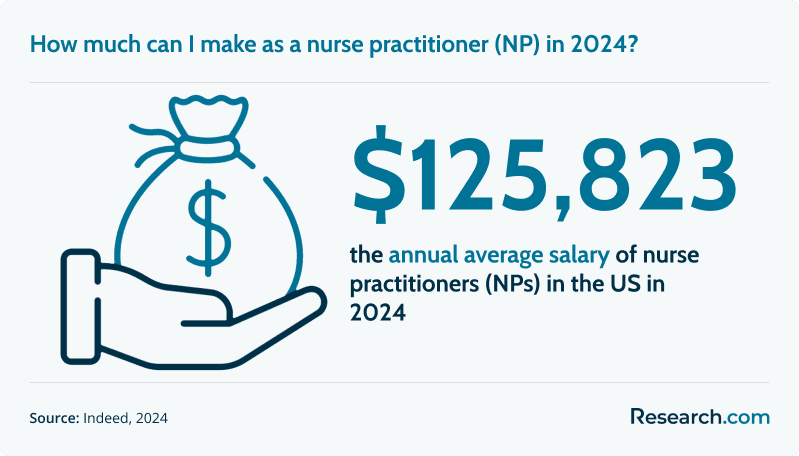
| Nurse practitioner | $120,621 | Advanced clinical assessment, diagnosis, treatment planning, and patient management |
| Clinical nurse specialist | $111,353 | Clinical expertise, practice improvement, care standards, and specialty-focused consultation |
| Nurse manager | $103,114 | Unit operations, staff supervision, scheduling, quality initiatives, and patient care coordination |
| Nurse consultant | $98,278 | Advisory work in clinical operations, compliance, case review, education, or healthcare improvement |
| Director of nursing | $97,366 | Department leadership, policy implementation, staffing plans, and care delivery oversight |
| Clinical nurse educator | $91,800 | Training nurses, developing education programs, supporting clinical competency, and curriculum work |
- Shortest RN to MSN Online Nursing Programs for 2027
- How long does it take to complete RN to MSN online nursing programs?
- How does an online RN to MSN program compare to an on-campus program?
- What is the average cost of RN to MSN online nursing programs?
- What are the financial aid options for students enrolling in RN to MSN online nursing programs?
- What are the prerequisites for enrolling in RN to MSN online nursing programs?
- What courses are typically in RN to MSN online nursing programs?
- What types of specializations are available in RN to MSN online nursing programs?
- How to choose the best RN to MSN online nursing programs?
- What career paths are available for graduates of RN to MSN online nursing programs?
- Is the Investment in an RN to MSN Online Nursing Program Worth It for Long-Term Career Growth?
- What is the difference between RN to MSN and ASN to NP programs?
- Why consider an HBCU for your RN to MSN online education?
- What Are the Emerging Trends in RN to MSN Online Nursing Education?
- What is the job market for graduates with RN to MSN online nursing programs?
- What are the admission criteria and are any programs easier to get into?
- Are RN to MSN programs more rigorous than RN to BSN programs?
- How do RN to MSN online nursing programs prepare you for advanced nursing certifications?
- Different Pathways to Doctor of Nursing Practice (DNP) for MSN Graduates
- What are the advantages of an accelerated post master's DNP program?
- How can you determine which RN to MSN program is right for you?
- What are the challenges of pursuing the shortest RN to MSN online nursing program?
Shortest RN to MSN Online Nursing Programs for 2027
How do we rank schools?
To help readers compare programs using transparent information, Research.com reviews data from reliable education sources, including the IPEDS database, Peterson's database with attention to its Distance Learning Licensed Data Set, the College Scorecard database, and the National Center for Education Statistics.
You can learn more about how Research.com evaluates schools in the research methodology section.
| School | Reported shortest timeline | Accreditation | Best fit to investigate |
| Arizona State University | 1 year | CCNE | RNs seeking a fast ADN-to-MSN bridge without a separate bachelor's program outcome |
| Chamberlain University | 14 months | CCNE | Students comparing traditional and accelerated RN to MSN formats |
| Capella University | 14 months | CCNE | Self-directed learners considering Flex Path or Guided Path pacing |
| Charleston Southern University | 16-19 months | ACEN | Students interested in short 5-week classes and leadership or education tracks |
| William Patterson University | 18 months | CCNE | Students comparing NP, administration, and nursing education options |
1. Arizona State University RN to MSN Online Nursing Program
Arizona State University offers RN to MSN online options taught by faculty that include recognized researchers, American Academy of Nursing Fellows, and Fulbright Scholars. The pathway is designed to bridge the ADN-to-MSN gap rather than award a bachelor’s degree along the way. Students also complete two practicums aligned with their professional objectives.
- Program Length: 1 year
- Tracks/Concentrations: Behavioral Health, Health Compliance, Health Care, and more
- Tuition: $586.42 per credit hour
- Required Credits to Graduate: 36
- Accreditation: Commission on Collegiate Nursing Education (CCNE)
2. Charleston Southern University RN to MSN Online Nursing Program
Charleston Southern University delivers MSN programs shaped by Christian values. Courses run in 5-week sessions, which can help students focus on one compact learning block at a time while completing applied learning and teaching projects. The university also reports a 10% tuition discount for employees of certain local healthcare systems.
- Program Length: 16-19 months
- Tracks/Concentrations: Nursing Leadership, Healthcare Administration, Nursing Education
- Tuition: $650 per credit hour
- Required Credits to Graduate: 39
- Accreditation: Accreditation Commission for Education in Nursing (ACEN)
3. Chamberlain University RN to MSN Online Nursing Program
Chamberlain University gives students a choice between a traditional route and an accelerated RN to MSN option with stricter admission requirements. Traditional students can earn both a BSN and diploma, while accelerated students complete the pathway with an MSN. The university also offers substantial discounts for alumni and military students.
- Program Length: 14 months
- Tracks/Concentrations: Nursing Education, Nursing Informatics, Nurse Practitioning, and more
- MSN Tuition: $555 or $567 (depending on program) per credit hour
- Required Credits to Graduate: No information available
- Accreditation: CCNE
4. Capella University RN to MSN Online Nursing Program
Capella University works with more than 600 healthcare employers, which may create networking options and possible tuition discounts for eligible students. Its RN to MSN online nursing programs include the fully online Flex Path option for students who prefer a self-paced structure. Students who want more scheduled progression can choose Guided Path, which places learners in one to three courses every ten weeks.
- Program Length: 14 months
- Tracks/Concentrations: No information available
- Tuition: $2,535 per 12-week billing session for the Flex Path option
- Required Credits to Graduate: 66
- Accreditation: CCNE
5. University of Mary RN to MSN Online Nursing Program
The University of Mary offers an RN to MSN pathway for working nurses who want to move into leadership and management in 20 months. The program includes 500 hours of in-person clinical experience and is structured across five semesters with bridge courses, MSN core work, and nursing leadership and management coursework.
- Program Length: 20 months
- Track/Concentration: Nursing Leadership and Management
- Tuition: $495 per credit hour
- Required Credits to Graduate: 30
- Accreditation: CCNE
6. The University of Mississippi Medical Center RN to MSN Online Nursing Program
The University of Mississippi Medical Center offers several RN to MSN tracks, with the Nursing Education track listed as the fastest option. Students complete 360 in-person practicum hours. Because UMMC may pause enrollment for some RN-to-MSN tracks, applicants should verify availability before preparing an application.
- Program Length: 5 semesters
- Tracks/Concentrations: Nursing and Health Care Administration, Nurse Education, and Nurse Pracitioning
- Tuition: $545-$1,598.67 per credit hour
- Required Credits to Graduate: No information available
- Accreditation: CCNE
7. William Patterson University RN to MSN Online Nursing Program
WPU offers online RN to MSN nursing programs with required in-person clinical hours. The program gives students several track options, and the Nursing Education track is identified as the fastest to complete.
- Program Length: 18 months
- Tracks/Concentrations: Adult Gerontology Nurse Practitioning, Family Nurse Practitioning, Nursing Administration, and Nursing Education
- Tuition: $25,742.30-$38,080
- Required Credits to Graduate: No information available
- Accreditation: CCNE
8. Walden University RN to MSN Online Nursing Program
Walden University offers RN-to-MSN programs with 9 specialty tracks, each with its own completion schedule. The fastest reported option can be completed in 20 months. Students may choose a course-based format with set deadlines and per-course billing or a self-paced tempo learning format with a flat fee for three-month access. Walden also connects students with a broad network of educational and healthcare partners.
- Program Length: 20 months
- Tracks/Concentrations: Nurse Education, Nursing Informatics, Public Health Nursing, and more
- Tuition: $480 per credit hour
- Required Credits to Graduate: No information available
- Accreditation: CCNE
9. Liberty University RN to MSN Online Nursing Program
Liberty University offers an RN to MSN pathway that awards a BSN along the route, which can be useful for students who want both credentials documented. Liberty also provides notable tuition discounts for military members and their families and may award academic credit for eligible military training after individual review.
- Program Length: 2 years
- Tracks/Concentrations: No information available
- Tuition: $330 per credit hour
- Required Credits to Graduate: 153
- Accreditation: CCNE
10. Northeastern State University RN to MSN Online Nursing Program
Northeastern University offers an RN-to-MSN pathway focused on Nursing Education. The university states that pursuing the MSN rather than a BSN can save about 24 credit hours. With six start dates throughout the year, the program may suit nurses who need multiple entry points rather than a single annual admission cycle.
- Program Length: 2 years
- Track/Concentration: Nursing Education
- Tuition: $305.50-$371.40 per credit hour
- Required Credits to Graduate: 41
- Accreditation: CCNE
Key Findings About RN to MSN Online Nursing Programs
- There are currently 179 RN to MSN programs accredited by the AACN, including RN to MSN online nursing programs.
- Many RN to MSN programs can take up to 3 years to complete, though accelerated formats may be shorter.
- Over 4 million nurses practiced in the US in 2022.
- Some programs award both the baccalaureate and master’s degree when students complete the full curriculum.
- Nurse manager and other healthcare leadership roles will grow by 28% in the coming years.
- The Journal of Nursing Regulation study cited in this article found that only 17.4% of the country’s RNs hold a master’s degree, which helps explain why MSN-prepared nurses remain a distinct segment of the nursing workforce.
How long does it take to complete RN to MSN online nursing programs?
Most RN to MSN online nursing programs take two to three years. Full-time students may finish closer to the shorter end of that range, while part-time students who continue working full-time may need three years or longer. The fastest programs can be appealing, but speed usually comes with heavier weekly workloads and less room for schedule disruption.
Timeline also depends on your previous coursework, transfer credits, bridge requirements, specialization, and whether the program includes a BSN on the way to the MSN. Program structure matters in nursing just as it does across other college majors: two programs with the same degree title may require different credits, clinical hours, and capstone expectations.
| Enrollment approach | Typical fit | Main advantage | Main trade-off |
| Accelerated full-time | RNs who can reduce work hours or manage an intense academic load | Fastest path to graduate-level credentials | Less flexibility if clinical, work, or family demands increase |
| Standard full-time | Students who want steady progress without the most compressed schedule | Balanced pace with predictable completion planning | May still be demanding for full-time working nurses |
| Part-time | Working RNs with significant job or caregiving responsibilities | More manageable weekly schedule | Longer time before graduation and possible added total fees |
How does an online RN to MSN program compare to an on-campus program?
Online RN to MSN programs can be academically comparable to campus-based programs when they are properly accredited and include the required clinical or practicum experiences. Many students choose nursing degrees online because they need flexibility while continuing to work as licensed RNs.
The biggest difference is delivery. Online programs may use asynchronous modules, live video meetings, discussion boards, virtual simulations, digital library access, and remote faculty advising. Campus programs may offer more face-to-face interaction, immediate access to campus resources, and a more structured weekly routine.
| Factor | Online RN to MSN | On-campus RN to MSN |
| Schedule flexibility | Often better for working nurses, especially when courses are asynchronous | More fixed meeting times and commuting requirements |
| Clinical experience | Usually completed in person, sometimes near the student’s location | Often coordinated through local campus-affiliated sites |
| Peer interaction | Virtual discussions and group work with geographically diverse classmates | In-person classroom and lab interaction |
| Best for | Self-directed learners who can manage deadlines independently | Students who prefer physical classrooms and direct campus support |
| Risk to check | Clinical placement responsibility and state authorization | Commute time, relocation needs, and schedule conflicts |
What is the average cost of RN to MSN online nursing programs?
Costs vary widely because schools use different tuition models, credit totals, fee structures, transfer policies, and clinical requirements. The National Center for Education Statistics reports that graduate studies, including programs such as online DNP programs, are $20,513 per year. Private institutions and out-of-state rates can increase the total cost.
Do not compare programs by tuition alone. A program with a lower per-credit rate can cost more if it requires more credits, extra bridge courses, repeated fees, travel for clinicals, or additional technology expenses. Ask for a full cost estimate that includes tuition, fees, textbooks, required software, background checks, uniforms or clinical supplies, testing fees, and travel.
| Cost factor | Why it matters | Question to ask |
| Per-credit tuition | Determines the base academic cost | Is tuition charged per credit, per course, per term, or per billing session? |
| Total credits | Affects final cost more than the advertised rate alone | How many credits will I personally need after transcript review? |
| Clinical expenses | May include travel, health requirements, supplies, or placement fees | Will I need to travel for practicums, intensives, or clinical placements? |
| Program length | Longer enrollment can increase recurring fees | What fees repeat each term or year? |
| Employer or military discounts | Can reduce out-of-pocket costs for eligible students | Do my employer, alumni status, or military benefits qualify for tuition reductions? |
What are the financial aid options for students enrolling in RN to MSN online nursing programs?
Students should explore scholarships, grants, federal aid, loans, employer tuition benefits, military education benefits, and school-based discounts. Some RN to MSN programs may become more affordable when compared carefully with cheap online MSN programs, but students should verify total cost after fees and clinical expenses.
Scholarships can reduce borrowing, though eligibility rules vary. Below are examples of scholarship opportunities cited in this article:
- AISES A.T. Anderson Scholarship: This scholarship supports undergraduate and graduate students of Native American, Alaska Native, and Native Hawaiian descent pursuing science, technology, engineering, and mathematics fields. Awards range from $1,000 for undergraduate students to $2,000 for graduate students and can help with tuition, books, and other educational costs.
- Nurses Make a Difference Scholarship: This award provides $1,000 to aspiring nurses enrolled in an accredited undergraduate nursing program. Applicants must also have a 3.0 GPA and submit an essay.
- TYLENOL Future Care Scholarship: This program awards scholarships ranging from $1,000 to $10,000 for aspiring doctors, nurses, or public health leaders. Undergraduate and graduate students enrolled in accredited institutions and pursuing healthcare-related degrees are encouraged to apply.
- Oncology Nursing Society Foundation Scholarship: The ONS Foundation scholarship program awards $3,000 to $5,000 to students committed to oncology nursing who are enrolled in accredited bachelor’s, master’s, or doctoral programs.
What are the prerequisites for enrolling in RN to MSN online nursing programs?
Admission requirements vary by school, but RN to MSN programs typically expect applicants to show they are licensed nurses with the academic and clinical foundation needed for graduate work. Requirements may differ depending on whether the applicant holds an ADN, diploma, BSN, or other approved nursing credential.
- Active RN license: Programs usually require a current registered nurse license because graduate nursing coursework assumes prior clinical preparation and professional accountability.
- Prior nursing education: Many RN to MSN online programs accept applicants with an Associate Degree in Nursing or nursing diploma from an accredited program. Some also admit BSN-prepared nurses through a more direct route.
- Clinical experience: Schools may require or strongly prefer professional nursing experience because advanced coursework builds on real patient care judgment.
- Minimum GPA: GPA standards help programs assess whether applicants are prepared for graduate-level reading, writing, analysis, and clinical reasoning.
- Recommendations: Letters from supervisors, faculty, or professional colleagues can help document clinical skill, reliability, leadership potential, and readiness for advanced study.
What courses are typically in RN to MSN online nursing programs?
MSN curricula are generally designed around graduate nursing competencies, including those identified by the AACN. Exact course titles vary, but most RN to MSN students encounter core graduate nursing content before moving deeper into their chosen specialty.
- Advanced Health Assessment: Students learn more comprehensive assessment methods, patient history techniques, physical examination skills, and diagnostic reasoning.
- Advanced Pathophysiology: This course examines disease processes and the body’s response to illness so nurses can connect symptoms, physiology, and care decisions.
- Advanced Pharmacology: Students study medication action, drug interactions, adverse effects, pharmacokinetics, pharmacodynamics, and safe medication decision-making.
- Nursing Leadership and Management: This course covers leadership theory, organizational behavior, staffing, communication, quality improvement, and healthcare operations.
What types of specializations are available in RN to MSN online nursing programs?
Specialization is one of the most important decisions in an RN to MSN program because it shapes clinical requirements, certification options, career outcomes, and state licensure considerations. Students should choose a concentration based on the kind of nursing work they want to do after graduation, not only on which track is fastest.
- Family Nurse Practitioner (FNP): FNP tracks prepare nurses to provide primary care across the lifespan, including wellness care, prevention, chronic condition management, and treatment of common health concerns.
- Adult-Gerontology Nurse Practitioner (AGNP): AGNP students focus on adult and older adult care, including acute and chronic conditions commonly seen in these populations.
- Pediatric Nurse Practitioner (PNP): PNP tracks prepare nurses to care for infants, children, and adolescents, including preventive care, developmental monitoring, and pediatric illness management.
- Psychiatric-Mental Health Nurse Practitioner (PMHNP): PMHNP programs prepare nurses to assess, diagnose, and treat psychiatric and mental health conditions across the lifespan.
- Nursing Education: This track is often appropriate for nurses who want to teach in academic or clinical settings, develop curricula, or support staff development.
- Nursing Leadership or Administration: This concentration is designed for nurses who want management, operations, policy, or executive responsibilities in healthcare organizations.
If your goal is to become a nurse practitioner, compare certification eligibility carefully. The chart below presents data on the distribution of US NPs by primary certification area.
How to choose the best RN to MSN online nursing programs?
The best RN to MSN online program is not automatically the shortest one. A strong choice should match your current credentials, state, clinical goals, budget, learning style, and desired specialty. Students comparing quick degrees should be especially careful not to sacrifice accreditation, certification eligibility, or clinical placement quality for speed.
- Verify accreditation: Confirm that the program is accredited by a recognized nursing accreditor and that the institution is legitimate. If you are comparing accredited online MSN programs, check whether the accreditor is recognized by appropriate quality assurance bodies.
- Confirm state authorization and licensure alignment: Online nursing programs may not be authorized in every state, and advanced practice tracks may have state-specific requirements.
- Ask about clinical placement support: Some schools help secure clinical sites, while others expect students to find preceptors independently.
- Review actual completion data: Ask how long students in your track typically take, not just the fastest advertised timeline.
- Compare technology and student support: A reliable learning platform, responsive faculty, tutoring, library access, and technical support can make a major difference in online graduate study.
- Check certification outcomes: If you plan to pursue NP, CNS, educator, or other certification, ask how the curriculum maps to exam eligibility.
What career paths are available for graduates of RN to MSN online nursing programs?
RN to MSN online nursing programs can lead to advanced clinical, educational, and leadership roles. Your career path depends heavily on specialization, certification, employer requirements, state scope-of-practice laws, and professional experience.
- Nurse Practitioner (NP): NPs provide advanced clinical care in settings such as primary care clinics, hospitals, specialty practices, and urgent care centers. Duties may include assessment, diagnosis, treatment planning, and prescribing where legally authorized.
- Clinical Nurse Specialist (CNS): CNSs improve patient outcomes and nursing practice in specialty areas such as critical care, oncology, pediatrics, or other clinical fields.
- Nurse Educator: Nurse educators teach in colleges, universities, healthcare organizations, and staff development programs. They may design curriculum, evaluate competencies, and support nursing education research.
- Nurse Administrator: Nurse administrators manage teams, budgets, staffing, policies, quality initiatives, and operations in hospitals, clinics, long-term care settings, and other healthcare organizations.
An MSN can be a strong next step, but it is not the only graduate pathway for nurses or healthcare professionals. If your goals are more administrative, financial, urban policy-focused, or technology-centered, you may want to compare these alternatives before committing to nursing graduate study:
- fast executive MHA options in healthcare administration
- affordable online finance master's degree programs
- affordable online urban planning and development degrees
- affordable online MBA in information systems programs
Are comprehensive student support services available in RN to MSN online nursing programs?
Many online RN to MSN programs provide advising, technical help, tutoring, library access, career services, writing support, clinical coordination, and faculty mentoring. These services are not identical across schools, so students should ask what support is available before and during clinical placement, not just during online coursework.
Applicants who are comparing programs with more accessible admission processes may also review the easiest direct entry MSN programs to get into, though direct-entry MSN programs are generally designed for a different applicant profile than RN to MSN pathways.
Is the Investment in an RN to MSN Online Nursing Program Worth It for Long-Term Career Growth?
An RN to MSN online program may be worth the investment if it leads to a role you actually want and qualifies you for credentials you need. The strongest return usually comes when the program aligns with a specific career target, such as advanced practice, nursing education, leadership, informatics, or administration.
Before enrolling, compare tuition and fees against realistic salary expectations, your ability to keep working, the time required for clinical hours, and whether your chosen track meets state and certification requirements. Students interested in advanced practice may also want to compare RN to MSN pathways with nurse practitioner programs online to understand differences in admission requirements, specialization structure, and clinical expectations.
| The investment may make sense if... | You may want another path if... |
| You need an MSN for your target role or certification pathway | Your desired job does not require graduate nursing education |
| You can manage clinical hours, coursework, and work responsibilities | You cannot realistically protect study and practicum time |
| The program is accredited and aligned with your state requirements | The program cannot confirm licensure or certification eligibility in your state |
| Your employer offers tuition support or advancement opportunities | The debt burden would be high without a clear career benefit |
What is the difference between RN to MSN and ASN to NP programs?
RN to MSN programs serve licensed registered nurses who want graduate nursing preparation. Some accept ADN or diploma-prepared nurses and include bridge coursework; others are structured for BSN-prepared nurses. The outcome may be an MSN in advanced practice, education, leadership, informatics, or another nursing specialty.
ASN to NP programs are more specifically designed for associate-prepared nurses who want to become nurse practitioners. These pathways, including ASN to NP programs, often combine bridge coursework, graduate nursing core classes, NP specialty coursework, and clinical training. The right choice depends on whether your goal is specifically NP practice or a broader MSN-level nursing role.
Why consider an HBCU for your RN to MSN online education?
Historically Black Colleges and Universities can offer nursing students a mission-driven environment, mentorship, community engagement, and a strong emphasis on culturally responsive care. For nurses who want graduate education grounded in service to diverse communities, an HBCU nursing pathway may be worth considering.
Students comparing these options can review Research.com’s guide to the best HBCU for nursing and then confirm whether each school offers the specific RN to MSN format, online delivery, clinical placement support, and accreditation needed for their goals.
What Are the Emerging Trends in RN to MSN Online Nursing Education?
RN to MSN online nursing education is increasingly shaped by digital learning tools, virtual simulation, telehealth exposure, interprofessional collaboration, and employer demand for nurses who can lead quality improvement and adapt to new care delivery models. These trends do not eliminate hands-on clinical requirements, but they can make online learning more interactive and practice-focused.
Students should also watch how programs integrate technology into specialty tracks. For example, prospective FNP students comparing cost-conscious options may want to review the cheapest online FNP program options while also confirming clinical quality and certification alignment.
What is the job market for graduates of RN to MSN online nursing programs?
The job market for RN to MSN graduates is generally favorable in advanced nursing and healthcare leadership areas, although outcomes depend on specialization, location, licensure, experience, and employer demand. The Bureau of Labor Statistics projects a 38% growth rate for nurse anesthetists, nurse practitioners, and nurse midwives—roles typically requiring an MSN degree—until 2032.
Nurse leadership is also an important market area. The Bureau of Labor Statistics reports growth for nurse managers and other healthcare leaders, as shown in the chart below.
What are the admission criteria and are any programs easier to get into?
RN to MSN admission criteria commonly include an active RN license, nursing transcripts, minimum GPA, professional experience, recommendations, a resume, and sometimes prerequisite courses or an admissions interview. Some schools offer more streamlined admissions, but easier entry should not be the only priority.
Applicants should distinguish between accessible admissions and weak academic standards. A program can be easier to apply to while still being accredited, rigorous, and clinically appropriate. Students researching broader nursing admission options may find the easiest nursing programs to get into useful for comparison, but RN to MSN applicants should still verify graduate-level requirements directly with each school.
Are RN to MSN programs more rigorous than RN to BSN programs?
Yes, RN to MSN programs are generally more rigorous than RN to BSN programs because they include graduate-level nursing theory, research, leadership, advanced clinical reasoning, and specialty preparation. RN to BSN programs usually broaden undergraduate nursing knowledge, while RN to MSN programs move students into advanced practice, education, leadership, or administrative preparation.
The difference is not only workload. RN to MSN students are expected to write at a graduate level, apply evidence to practice, complete more advanced clinical or practicum work, and prepare for roles with greater responsibility. Students unsure about the undergraduate step can review How hard are RN to BSN programs? before deciding whether a bridge route is realistic.
How do RN to MSN online nursing programs prepare you for advanced nursing certifications?
Many RN to MSN programs are built around certification pathways, especially for nurse practitioner, clinical nurse specialist, nurse educator, or leadership roles. Students should confirm eligibility before enrolling because certification rules vary by specialty and organization.
- Specialty-focused curriculum: Courses in areas such as Family Nurse Practitioner, Clinical Nurse Specialist, or Nurse Educator tracks can provide the knowledge base for certification exams.
- Required clinical or practicum experience: Programs often include supervised hours aligned with the expectations of the chosen specialty.
- Exam preparation support: Some schools offer practice questions, review resources, faculty guidance, or structured preparation for certification exams.
- Documentation support: Students should ask how the school documents clinical hours, course content, and completion requirements for certification boards.
Different Pathways to Doctor of Nursing Practice (DNP) for MSN Graduates
MSN graduates who want a terminal practice-focused nursing degree may consider a Doctor of Nursing Practice. DNP programs often build on MSN-level preparation and may emphasize advanced clinical practice, systems leadership, quality improvement, healthcare policy, and evidence-based practice implementation.
Some MSN-to-DNP options are designed for full-time students to complete in as little as 1-2 years. Students who want a shorter doctoral route can compare the shortest DNP program options while verifying accreditation, clinical or project requirements, and fit with their professional goals.
A DNP may support advancement in clinical leadership, executive practice, policy, education, or specialized care, but students should weigh cost, time, and role requirements before assuming a doctoral degree is necessary.
What are the advantages of an accelerated post master's DNP program?
Accelerated post-master’s DNP programs allow MSN-prepared nurses to move more quickly into doctoral-level study by building on prior graduate coursework and clinical experience. These programs may be especially useful for nurses who already know their leadership, clinical, or policy direction and want a more efficient doctoral pathway.
The advantage is time efficiency, but the trade-off is intensity. Students should expect advanced coursework, project-based work, leadership preparation, and a demanding schedule. To compare this route, review options such as an accelerated post master's DNP program and confirm how much prior MSN coursework can be applied.
How can you determine which RN to MSN program is right for you?
Start with your end goal. If you want direct patient care as a nurse practitioner, choose a program that matches your intended population focus and certification pathway. If you want teaching, choose nursing education. If you want management, compare leadership, administration, or healthcare administration tracks.
Then evaluate fit. Accelerated RN to MSN programs can be completed quickly, but they require strong time management and may be difficult for students working full-time. Slower formats may be better for nurses who need a sustainable workload.
Accreditation should be nonnegotiable. Confirm CCNE or ACEN accreditation, institutional accreditation, state authorization, clinical requirements, and certification eligibility. If a program cannot clearly explain whether it meets requirements in your state, keep looking.
Finally, compare support and logistics. Ask whether clinical placements are arranged for you, how online courses are delivered, whether live attendance is required, what happens if you need to pause enrollment, and whether transfer credits can reduce the timeline.
Prospective students who are not already nurses or who do not fit RN to MSN admissions requirements may need a different route, such as an online direct entry MSN program, rather than an RN to MSN pathway.
| Question to ask | Why it matters |
| Does this program accept my current nursing credential? | Some pathways are built for ADN or diploma-prepared RNs, while others assume a BSN. |
| Will I earn a BSN along the way? | This matters for employers, credential documentation, and future study. |
| Who finds my clinical site? | Clinical placement can become one of the biggest barriers in online nursing programs. |
| Does the program meet my state’s requirements? | State authorization and advanced practice rules affect whether the degree will support your goals. |
| What is the total cost after fees? | Tuition alone does not show the full financial commitment. |
What are the challenges of pursuing the shortest RN to MSN online nursing program?
The shortest RN to MSN online nursing programs can be demanding because they compress graduate coursework, clinical requirements, and major assignments into a limited timeframe. For working RNs, the hardest part is often not the online platform itself but the combined pressure of employment, family obligations, practicum scheduling, and graduate-level deadlines.
Academic rigor is another challenge. RN to MSN students may move quickly from associate-level preparation into master’s-level expectations, including research analysis, advanced pathophysiology, leadership theory, scholarly writing, and specialty practice content. Nurses who have been away from school for years may need extra time to rebuild study routines and writing confidence.
Clinical placement can also create obstacles. Even when coursework is online, students may need local preceptors, approved clinical sites, background checks, health documentation, and schedule coordination. If a program expects students to secure their own placements, this should factor heavily into the decision.
Students who want to enter nursing rather than advance from an RN license may need a different starting point. In that case, the best online nursing degree programs for non-nurses may be more relevant than an RN to MSN bridge program.
Common mistakes to avoid when choosing an RN to MSN online program
| Mistake | Why it can hurt you | Better approach |
| Choosing only the shortest program | The fastest option may not fit your schedule, state, specialty, or certification goal. | Compare timeline, accreditation, clinical support, outcomes, and total cost together. |
| Ignoring accreditation | Accreditation can affect financial aid, employer recognition, certification, and doctoral study. | Verify nursing and institutional accreditation before applying. |
| Assuming online means no clinical work | Many online MSN programs still require in-person clinical or practicum hours. | Ask where and how clinical hours are completed. |
| Comparing tuition without fees | Books, technology, clinical supplies, testing, and travel can raise the final cost. | Request a full program cost estimate. |
| Overlooking state requirements | An online program may not meet licensure or certification rules in every state. | Confirm state authorization and board requirements before enrollment. |
| Assuming salary outcomes are guaranteed | Pay depends on role, location, certification, employer, and experience. | Research local job postings and talk with employers in your target specialty. |
References
- Payscale. (n.d.). Master of Science in Nursing (MSN) Degree. Retrieved July 18, 2024, from Payscale.
- Payscale. (n.d.). Bachelor of Science in Nursing (BSN) Degree. Retrieved July 18, 2024, from Payscale.
- NCES. (n.d.). Average and percentiles of graduate tuition and required fees in degree-granting postsecondary institutions, by control of institution: Academic year 1989-90 through 2021-22. Retrieved July 18, 2024, from the NCES.
- Smiley, R.A., Allgeyer, R.L., Shobo, Y., Lyons, K.C., Letourneau, R., Zhong, E., Kaminski-Ozturk, N., & Alexander, M. (2023, April). The 2022 National Nursing Workforce Survey. Retrieved July 18, 2024, from the Journal of Nursing Regulation.
Key Insights
- The shortest RN to MSN online program is not always the best program; accreditation, state alignment, clinical placement support, and specialty fit matter more than speed alone.
- Many RN to MSN online nursing programs take two to three years, but accelerated options can shorten the timeline for students who can handle intensive coursework and practicum expectations.
- Clinical requirements remain important even in online programs. Before enrolling, confirm whether the school helps secure placements or expects you to find your own preceptors.
- MSN salary potential can be attractive, with Payscale reporting an average of $103,000 for MSN graduates, but income varies by role, location, certification, employer, and experience.
- Choose your specialization carefully. FNP, AGNP, PNP, PMHNP, education, and leadership tracks lead to different credentials, job markets, and daily responsibilities.
- Ask for a full cost breakdown, not just the tuition rate. Fees, clinical expenses, textbooks, technology, and travel can change the real price of an online RN to MSN program.
- If your long-term goal is advanced practice or doctoral study, make sure the RN to MSN program supports certification eligibility and future DNP pathways before you apply.
Other Things You Should Know About RN to MSN Online Nursing Programs
Most RN to MSN online programs require an RN license, official transcripts, a current resume, a personal statement, and one to three references. Some schools also ask for proof of an unencumbered nursing license and a minimum GPA, often 2.75 or 3.0.
To enroll in an RN to MSN online program in 2027, applicants typically need an active RN license, an associate degree in nursing, and a minimum GPA of 3.0. Some programs may require specific undergraduate coursework or clinical experience.


