2027 Fastest Online MSN in Health/Nursing Informatics Programs

Co-Founder and Chief Data Scientist
The demand for skilled professionals in nursing informatics is accelerating, with employment projected to grow 16% from 2023 to 2033. This expanding field offers promising career opportunities for nurses aiming to bridge clinical practice with data-driven healthcare. However, balancing rigorous coursework and clinical responsibilities can pose significant challenges for working professionals.
This article, prepared by career planning experts, will guide readers through the fastest online MSN programs in health/nursing informatics. It aims to help prospective students identify efficient educational pathways, align their goals with industry trends, and advance confidently in this high-growth healthcare sector.
What are the benefits of earning an online MSN in health/nursing Informatics?
- Completing an online MSN in health or nursing informatics prepares graduates for specialized roles, including leadership in data systems, analytics, and digital health strategy.
- The average annual salary for informatics nurses is approximately $98,400, with senior roles reaching $120,000–$150,000, depending on experience and specialization.
- Online MSN programs offer flexible, remote learning formats that allow working nurses to upskill while balancing personal and professional responsibilities.
What can I expect from a fast-track online MSN in health/nursing informatics program?
A fast-track online MSN in health/nursing informatics is designed for working nurses who want to advance quickly into specialized roles at the intersection of healthcare and technology. These programs typically combine a focused core curriculum in nursing theory, data analytics, and information systems with applied learning through a capstone project and supervised internship or practicum hours.
Coursework is delivered in asynchronous or hybrid formats, allowing for flexible study schedules while maintaining rigorous academic standards. Tuition generally ranges from $20,000 to $40,000, depending on the institution, credit requirements, and delivery model.
Where can I work after completing an online MSN in health/nursing informatics?
An online MSN in health or nursing informatics prepares graduates for roles that combine clinical expertise with healthcare technology and data management. Nursing informatics specialists find employment across the following sectors:
- Health Care (75%): The majority work in hospitals, clinics, or health systems as nurse informaticists, clinical analysts, or IT liaisons, supporting patient safety, data integration, and systems implementation.
- Professional Services (7%): Graduates serve as consultants or implementation specialists, helping healthcare organizations adopt new technologies and meet regulatory standards.
- Technology (5%): Some work with health tech companies, focusing on software development, system usability testing, or data security in digital health platforms.
- Education (3%): Informatics nurses may teach in academic settings or develop training programs for healthcare staff on EHR systems and data literacy.
- Government (3%): Roles include public health informatics, data analysis for federal programs, or policy support related to healthcare IT infrastructure.
- Fortune 500 Companies (3%): Graduates contribute to corporate health initiatives, insurance analytics, or occupational health programs using informatics insights.
How much can I make with an online MSN in health/nursing informatics?
Earning an online MSN in health or nursing informatics can pave the way to well-paying, specialized roles in healthcare technology and data management. Here’s a snapshot of what you might expect:
- Average Salary: Informatics nurses typically earn around $98,400 per year, translating to $47.30 per hour.
- Salary Range by Experience: Entry-level roles often start between $70,000–$80,000, while experienced professionals can expect $120,000–$150,000, especially in senior or director-level positions
- Location: Urban areas and states like California and Washington tend to offer higher compensation, sometimes over $120,000–$145,000 annually.
- Education and Certification: Holding an MSN, or even a DNP, and certifications like the ANCC’s NI-BC, CPHIMS, or CAHIMS can earn over $100,000 annually.
- List of the Fastest Online MSN in Health/Nursing Informatics Programs for 2027 List of Programs
- How long does it take to complete an online MSN in health/nursing informatics program? Program Length
- How does an online MSN in health/nursing informatics program compare to an on-campus program? How does an online MSN in health/nursing informatics program compare to an on-campus program?
- What is the average cost of an online MSN in health/nursing informatics program? Program Cost
- What are the financial aid options for students enrolling in an online MSN in health/nursing informatics program? Financial Aid
- What are the prerequisites for enrolling in an online MSN in health/nursing informatics program? What are the prerequisites for enrolling in an online MSN in health/nursing informatics program?
- What courses are typically in an online MSN in health/nursing informatics program? What courses are typically in an online MSN in health/nursing informatics program?
- What types of specializations are available in an online MSN in health/nursing informatics program? What types of specializations are available in an online MSN in health/nursing informatics program?
- How to Choose the Best Online MSN in Health/Nursing Informatics Program How to Choose the Best Online MSN in Health/Nursing Informatics Program
- What career paths are available for graduates of an online MSN in health/nursing informatics program? What career paths are available for graduates of an online MSN in health/nursing informatics program?
- What is the job market for graduates with an online MSN in health/nursing informatics program? Job Market
- How does the ROI of an online MSN in health/nursing informatics program compare to alternative online nursing degrees? How does the ROI of an online MSN in health/nursing informatics program compare to alternative online nursing degrees?
- How can I verify that an online MSN in health/nursing informatics program meets recognized accreditation standards? How can I verify that an online MSN in health/nursing informatics program meets recognized accreditation standards?
Fastest Online MSN in Health/Nursing Informatics Programs for 2027
Nurses who want to move into health technology, clinical data, electronic health record optimization, or informatics leadership often face one practical question: which online MSN in health or nursing informatics can be completed quickly without sacrificing credibility? The fastest option is not always the best option. Program length, accreditation, practicum requirements, tuition, certification preparation, and scheduling format all affect whether a degree will actually fit your career plan.
This guide is designed for licensed nurses comparing accelerated online MSN informatics programs and trying to decide whether the degree is worth the time and cost. It explains how the programs compare, what students usually study, how online and campus formats differ, what admissions requirements to expect, and which career paths may follow after graduation.
Quick Answer: What is the fastest online MSN in health/nursing informatics?
The fastest online MSN in health/nursing informatics programs can often be completed in about 14–24 months, depending on transfer credits, enrollment pace, practicum scheduling, and whether the school offers accelerated terms. Among the programs listed here, Millersville University and Capella University report 14-24 month or 14–24 month completion windows, while Liberty University lists an approximately 18-month path. Students should verify current timelines directly with each school because practicum placement, course sequencing, and part-time enrollment can extend completion time.
How Research.com evaluates these programs
Research.com ranks fast online MSN in health and nursing informatics programs using data-focused criteria intended to help students compare speed, academic quality, and career relevance. Sources used in the review process include the IPEDS database, Peterson’s database, the College Scorecard database, and The National Center for Education Statistics. Key factors include program length, accreditation, online flexibility, credit requirements, curriculum focus, and practicum expectations.
Rankings should be used as a starting point, not as the only basis for enrollment. Before choosing a program, confirm tuition, accreditation, state authorization, clinical or practicum placement rules, and certification alignment with the school. You can review Research.com's broader ranking approach on the methodology page.
| Rank | School | Program Length | Total Credits | Cost | Accreditation |
| 1 | University of South Carolina - Columbia | 2 years | 36 | $770.25 (in-state) / $870.25 (out-of-state) per credit hour | Commission on Collegiate Nursing Education (CCNE) |
| 2 | Grand Canyon University | ~2 years | 42 | $840 per credit hour | Higher Learning Commission (HLC) |
| 3 | Duke University | 2 years | 38 | $2,250 per credit hour | Commission on Collegiate Nursing Education (CCNE) |
| 4 | University of Maryland | 2 years | 36 | $926 (in-state) / $1,643 (out-of-state) per credit hour | Commission on Collegiate Nursing Education (CCNE) |
| 5 | Millersville University | 14–24 months | 37 | $605 per credit hour | National League for Nursing Commission for Nursing Education Accreditation (NLN CNEA) |
| 6 | Georgia Southwestern State University | ~22 months | 36 | $263 per credit hour | Commission on Collegiate Nursing Education (CCNE) |
| 7 | Liberty University | ~18 months | 36 | $580 per credit hour | Commission on Collegiate Nursing Education (CCNE) |
| 8 | Nova Southeastern University | ~2 years | 36 | $796 per credit hour | Commission on Collegiate Nursing Education (CCNE) |
| 9 | Commonwealth University | ~2 years | 39 | $733 per credit hour | Commission on Collegiate Nursing Education (CCNE) |
| 10 | Capella University | 14-24 months | 54 | $465 per credit hour | Commission on Collegiate Nursing Education (CCNE) |
1. University of South Carolina - Columbia
The University of South Carolina - Columbia offers an online MSN in nursing informatics for registered nurses who want to apply healthcare data, clinical information systems, and technology-supported decision-making to improve care delivery. Students complete MSN core requirements, informatics-focused coursework, and supervised practicum experiences. The program’s remote clinical placement options and flexible design make it a practical fit for working nurses preparing for nurse informaticist roles and informatics certification pathways.
- Program Length: 2 years
- Cost: $770.25 (in-state) / $870.25 (out-of-state) per credit hour
- Total Credits: 36
- Accreditation: Commission on Collegiate Nursing Education (CCNE)
2. Grand Canyon University
Grand Canyon University provides an online master of science in health informatics that combines health IT, analytics, workflow improvement, and Christian values. Coursework addresses electronic health records, data governance, clinical decision support, usability, privacy, and system security. A 16‑week applied practicum helps students connect classroom concepts to healthcare operations, while the curriculum may support preparation for industry credentials such as CPHIMS or CAHIMS.
- Program Length: ~2 years
- Cost: $840 per credit hour
- Total Credits: 42
- Accreditation: Higher Learning Commission (HLC)
3. Duke University
Duke University offers an MSN in health informatics focused on using electronic health data, digital tools, and information systems to support patient, community, and population health. The program is primarily online and includes two short campus intensives. Students complete graduate nursing coursework, informatics classes, and an applied synthesis practicum, preparing them for informatics nurse specialist positions in clinical, administrative, and healthcare IT environments.
- Program Length: 2 years
- Cost: $2,250 per credit hour
- Total Credits: 38
- Accreditation: Commission on Collegiate Nursing Education (CCNE)
4. University of Maryland
The University of Maryland offers an online MSN in health informatics for nurses aiming to lead technology and data initiatives in healthcare organizations. The curriculum covers nursing informatics theory, IT project management, health information systems, and systems design. Students complete a 500-hour practicum at an approved local site and can participate in free ANCC certification preparation workshops, which may be useful for nurses targeting clinical, vendor, government, or informatics leadership roles.
- Program Length: 2 years
- Cost: $926 (in-state) / $1,643 (out-of-state) per credit hour
- Total Credits: 36
- Accreditation: Commission on Collegiate Nursing Education (CCNE)
5. Millersville University
Millersville University delivers a fully online MSN in nursing informatics that helps registered nurses connect bedside experience with health IT, data analysis, telehealth, project management, and electronic health record systems. The program uses accelerated 7‑week courses and includes an 84‑hour practicum. Students who want a shorter completion window may find its 14–24 months timeline appealing, especially if they are preparing for credentials such as ANCC Informatics (NI‑BC) or CAHIMS.
- Program Length: 14–24 months
- Cost: $605 per credit hour
- Total Credits: 37
- Accreditation: National League for Nursing Commission for Nursing Education Accreditation (NLN CNEA)
6. Georgia Southwestern State University
Georgia Southwestern State University offers an online MSN with a concentration in nursing informatics. The program builds advanced knowledge in health information technology, analytics, clinical decision support, and informatics practice. Students take five core nursing courses and seven informatics-focused courses, including a focused project and a local practicum supervised by RN preceptors. Graduates may pursue informatics nurse roles and prepare for ANCC Informatics certification eligibility.
- Program Length: ~22 months
- Cost: $263 per credit hour
- Total Credits: 36
- Accreditation: Commission on Collegiate Nursing Education (CCNE)
7. Liberty University
Liberty University offers an online MSN in nursing informatics that combines nursing science, information systems, population health concepts, policy, ethics, and telehealth technology. Courses are delivered in flexible 8-week asynchronous formats, which may appeal to nurses balancing graduate study with shift work. Local supervised practicums help students apply informatics concepts in practice settings, and the CCNE-accredited program prepares graduates for roles such as clinical informatics specialist or nurse programmer.
- Program Length: ~18 months
- Cost: $580 per credit hour
- Total Credits: 36
- Accreditation: Commission on Collegiate Nursing Education (CCNE)
8. Nova Southeastern University
The online MSN in nursing informatics at Nova Southeastern University prepares registered nurses to use information systems, computer science, and data management to improve healthcare delivery. The asynchronous format supports working professionals, while coursework emphasizes clinical information systems, data-informed care, and health IT implementation. Students complete 200 supervised practicum hours and gain experience applying technology in clinical environments. Graduates may pursue informatics leadership roles and ANCC certification eligibility.
- Program Length: ~2 years
- Cost: $796 per credit hour
- Total Credits: 36
- Accreditation: Commission on Collegiate Nursing Education (CCNE)
9. Commonwealth University
The MSN in health informatics program at Commonwealth University is delivered fully online and combines advanced nursing science with analytics, technology, and information systems. The curriculum is structured around six-week asynchronous courses with flexible start dates. Students study electronic health record implementation, patient care systems, data analysis, and telehealth coordination. Graduates may qualify for roles such as nurse informaticist, clinical informatics specialist, or telehealth coordinator.
- Program Length: ~2 years
- Cost: $733 per credit hour
- Total Credits: 39
- Accreditation: Commission on Collegiate Nursing Education (CCNE)
10. Capella University
Capella University offers an online MSN in Nursing Informatics in GuidedPath and FlexPath formats. The program focuses on healthcare technology integration, data analytics, informatics project work, and systems implementation. Students complete 500 practicum hours with faculty and preceptor support and use virtual labs and applied projects to develop practical informatics skills. Graduates may pursue healthcare IT leadership positions such as nurse informaticist or clinical systems analyst and may prepare for ANCC and related industry certifications.
- Program Length: 14-24 months
- Cost: $465 per credit hour
- Total Credits: 54
- Accreditation: Commission on Collegiate Nursing Education (CCNE)
How long does it take to finish an online MSN in health/nursing informatics?
Most online MSN in health or nursing informatics programs take 18 to 36 months to complete. Full-time students in accelerated formats may finish in 18 to 24 months, while part-time students commonly need up to three years. The actual timeline depends on credit load, transfer credit policies, prerequisite coursework, practicum placement, and whether courses are offered in short terms or traditional semesters.
Fast-track options are usually best for nurses who already have a BSN, an active RN license, recent clinical experience, and enough schedule flexibility to handle intensive coursework. RN-to-MSN or bridge pathways can take longer because students may need additional undergraduate or leveling courses before beginning graduate informatics work.
Working nurses should pay close attention to practicum coordination. Even fully online programs usually require fieldwork, capstone projects, or supervised practice hours, and delays in securing an approved site can extend the completion date. Students comparing accelerated online formats in other fields may notice similar timing issues in resources such as Research.com's guide to fastest online general studies degree programs, where transfer credits and flexible delivery can affect time to completion.
| Student Profile | Likely Timeline | What Can Speed Up Completion | What Can Slow Completion |
| BSN-prepared RN studying full time | 18 to 24 months | Accelerated terms, no prerequisite gaps, early practicum planning | Heavy work schedule or limited course availability |
| BSN-prepared RN studying part time | Up to three years | Consistent enrollment and summer courses | Taking one course at a time or pausing enrollment |
| RN entering through a bridge pathway | Often longer than standard MSN timelines | Transfer credits and completed BSN-level prerequisites | Leveling courses, missing statistics, or delayed admission to MSN courses |
| Student in a competency-based format | Varies by pace | Prior knowledge, strong time management, rapid assessment completion | Self-paced delays or difficulty balancing independent work |
Some students also pursue short, targeted data analytics training alongside the MSN to strengthen skills in dashboards, SQL, statistics, or visualization. These options can be useful, but they do not replace the graduate nursing degree when employers specifically require MSN-level preparation.
Online vs. on-campus MSN in health/nursing informatics: Which format is better?
An online MSN in health/nursing informatics is usually the better fit for working nurses who need scheduling flexibility, want to remain employed, or cannot relocate. An on-campus program may be better for students who prefer face-to-face interaction, structured class times, campus networking, and school-arranged clinical partnerships. The academic content can be similar, but the student experience is different.
The right format depends less on prestige and more on how you learn, how much support you need, and whether you can complete practicum requirements where you live.
| Aspects | Online MSN in Health/Nursing Informatics Program | On-Campus MSN in Health/Nursing Informatics Program |
| Delivery Format | Coursework is completed online, often asynchronously or with flexible assignment windows. | Students attend in-person classes, labs, seminars, or campus-based learning sessions. |
| Clinical or Practicum Experience | Students usually complete practicum requirements near home, with placement support varying by school. | Placements may be arranged through established campus and health system partnerships. |
| Cost Structure | Students may avoid relocation, commuting, and housing expenses, though online fees can still apply. | Students may pay additional costs for transportation, housing, campus fees, and local living expenses. |
| Admission Requirements | Some programs are designed around working nurses and may offer multiple starts or flexible pacing. | Programs may use fixed admission cycles, campus schedules, and more location-dependent requirements. |
| Career Services | Support may include virtual advising, online resume reviews, job boards, webinars, and remote coaching. | Support may include in-person employer events, interview practice, faculty meetings, and campus networking. |
Choose an online program if:
- You need to keep working while earning the degree.
- You live far from a university with an informatics MSN track.
- You are comfortable communicating with faculty and classmates through online platforms.
- You can take responsibility for time management and practicum planning.
Choose an on-campus program if:
- You want regular face-to-face interaction with faculty and peers.
- You value campus-based networking and local employer relationships.
- You learn best with fixed class times and structured routines.
- You want more direct help with practicum placement through local partnerships.
What does an online MSN in health/nursing informatics cost?
The average cost of an online MSN in health/nursing informatics typically ranges from $600 to $900 per credit hour. Tuition can differ widely, with some programs listed at $263 per credit and others exceeding $2,000. Most programs require between 36 and 42 total credits, resulting in an average total tuition of approximately $25,000 to $38,000.
Students should also budget for costs beyond tuition. Common additional expenses include technology fees, books, background checks, clinical compliance documentation, certification preparation, graduation fees, and possible travel for intensives or practicum requirements.
Public universities may charge different in-state and out-of-state rates, while private universities may use one online tuition rate for all students. Accelerated formats and competency-based options can sometimes reduce total cost if a student finishes quickly, but they can become more expensive if the student slows down or needs extra terms. Similar cost and pacing trade-offs appear in other accelerated online pathways, including shortest online liberal arts degrees.
| Cost Factor | Why It Matters | Question to Ask |
| Per-credit tuition | This is the largest visible cost, but it does not always show the full price. | Is the rate different for in-state, out-of-state, online, or part-time students? |
| Total credits | A lower per-credit price may not mean lower total cost if the program requires more credits. | How many credits are required for graduation? |
| Practicum fees | Some programs charge for placement support, compliance tracking, or field supervision. | Are practicum-related costs included in tuition? |
| Technology and course fees | Online programs may add platform, simulation, or digital resource charges. | What mandatory fees are charged each term? |
| Travel requirements | Programs with campus intensives can add airfare, lodging, meals, and missed work costs. | Are any in-person visits required? |
| Time to completion | Finishing faster can lower living and opportunity costs, but accelerated study can reduce work availability. | Can I realistically maintain the required course load? |
Financial aid options for online MSN informatics students
Graduate nursing students may be able to combine federal aid, employer support, scholarships, and institutional funding to reduce out-of-pocket costs. Aid availability depends on enrollment status, school participation, program eligibility, credit load, and each student’s financial profile.
- Federal Direct Unsubsidized Loans: Graduate students may borrow up to $20,500 annually through the FAFSA, with interest beginning to accrue when funds are disbursed.
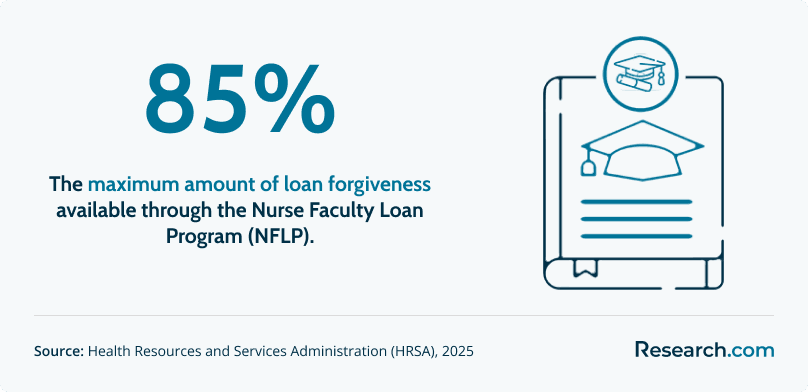
- Nurse Faculty Loan Program (NFLP): This federal program can forgive up to 85% of the loan amount for eligible graduates who become full-time nursing faculty at accredited institutions.
- Graduate PLUS Loans: These credit-based federal loans can help cover remaining education expenses after other aid is applied and include federal repayment options.
- HRSA Scholarships and Grants: Programs such as the Nurse Corps Scholarship may cover tuition and provide stipends for students who meet service commitments in underserved areas.
- Institutional Scholarships and Assistantships: Universities may offer merit aid, need-based scholarships, graduate assistantships, or program-specific awards for MSN students.
- Employer Tuition Reimbursement and Industry Grants: Hospitals, health systems, insurers, EHR vendors, and professional organizations such as HIMSS may provide tuition assistance or professional development funding.
How to reduce the cost before enrolling
- Ask your employer whether tuition reimbursement applies to online MSN informatics programs.
- Confirm whether the school charges online students in-state, out-of-state, or flat-rate tuition.
- Compare total program cost, not just the per-credit rate.
- Find out whether certification preparation, software access, and practicum support are included.
- Submit the FAFSA early and ask the financial aid office about graduate nursing scholarships.
- Calculate how many hours you can work while enrolled so you do not underestimate opportunity cost.
Admission requirements for an online MSN in health/nursing informatics
Most online MSN in health/nursing informatics programs are built for licensed registered nurses who already have a BSN. Requirements differ by school, but applicants should expect to document both academic readiness and current nursing practice eligibility.
- Bachelor’s Degree in Nursing (BSN) and Active RN License: Most programs require a BSN from an accredited institution and an active RN license. Nurses still completing their bachelor’s degree may compare lower-cost options such as affordable online RN-to-BSN programs.
- Minimum Undergraduate GPA: Many schools require at least a 3.0 GPA, while more selective programs may prefer 3.2 or higher.
- Clinical Nursing Experience: Programs often expect one to two years of recent nursing experience so students can apply informatics concepts to real clinical workflows.
- Foundational Undergraduate Coursework: Applicants may need prior coursework in statistics, health assessment, or pathophysiology. Some schools allow students to complete missing prerequisites after conditional admission.
- Bridge or Leveling Courses: Students who do not meet all prerequisites may need additional coursework in informatics, biostatistics, database concepts, or graduate writing.
- Additional Admission Materials: Common application items include official transcripts, recommendation letters, a resume, a personal statement, RN license verification, background checks, and immunization or clinical compliance records.
Questions to ask admissions before applying
- Does the program accept students from my state?
- Is a BSN required, or does the school offer an RN-to-MSN option?
- Can I complete the practicum in my local area?
- Are GRE scores required?
- How often do new cohorts start?
- Are any campus visits, synchronous sessions, or live intensives required?
Common courses in an online MSN in health/nursing informatics
An online MSN in health or nursing informatics combines graduate nursing leadership with information science, data management, digital health tools, and healthcare operations. The goal is to help nurses design, evaluate, and improve technology-supported care systems rather than simply use them.
- Foundations of Nursing Informatics: Introduces the history, scope, theories, and professional standards of nursing informatics, including its role in patient safety, care quality, and clinical decision-making.
- Healthcare Information Systems: Examines electronic health records, clinical decision support tools, interoperability, health information exchange, and the way digital systems function inside healthcare organizations.
- Data Analytics and Decision Support: Teaches students how to use evidence, dashboards, quality metrics, and analytic methods to guide clinical, administrative, and operational decisions.
- Database Management and Health Data Standards: Covers clinical databases, data retrieval, coding systems, standardized vocabularies, and terminology systems such as SNOMED CT and LOINC. Students seeking a broader IT management route may also compare a fast-track master's in management information systems online.
- Informatics Leadership and Project Management: Focuses on implementation planning, stakeholder communication, change management, workflow redesign, and informatics project evaluation.
- Legal and Ethical Issues in Health Informatics: Explores HIPAA, privacy, cybersecurity, ethical data use, access controls, and professional responsibilities in digital health environments.
- Practicum or Capstone: Requires students to apply informatics knowledge in a supervised clinical, administrative, research, vendor, or health IT setting.
Specializations available in online MSN health/nursing informatics programs
Some programs offer a general informatics track, while others allow students to focus on a narrower area such as analytics, leadership, population health, or clinical systems implementation. Choosing a specialization should be tied to the type of job you want after graduation.
| Specialization | Best For | Typical Focus |
| Clinical Informatics | Nurses who want to improve bedside workflows and clinical technology use | EHR optimization, decision support, usability, safety, and care process redesign |
| Healthcare Data Analytics | Nurses interested in dashboards, reporting, quality metrics, and performance improvement | Data visualization, statistical analysis, decision support, and measurement |
| Leadership and Administration | Nurses targeting management or director-level informatics roles | Strategy, project management, operations, budgeting, and organizational change |
| Public Health Informatics | Nurses interested in population health, surveillance, and community-level data | Epidemiology systems, reporting, public health databases, and education tools |
| Policy and Regulatory Informatics | Nurses who want to work with compliance, governance, or health IT policy | Regulations, privacy, standards, ethics, documentation, and reporting requirements |
| Consumer Health Informatics | Nurses focused on patient engagement and digital self-management tools | Patient portals, mobile health, health literacy, and user-centered design |
| Nursing Education and Informatics | Nurses who want to teach digital health skills or design technology-supported learning | Simulation, e-learning, instructional design, and competency evaluation |
Students interested in population health data systems may also compare accelerated health information management programs, especially if they want a pathway centered more on health records, coding, compliance, and information governance than advanced nursing practice.
How to choose the best online MSN in health/nursing informatics program
The best online MSN informatics program is the one that aligns with your license, state, schedule, budget, certification goals, and target job. A shorter program may not be the right choice if it lacks practicum support or does not match your career direction.
- Verify institutional and nursing accreditation. Confirm that the university is regionally accredited and that the nursing program has recognized nursing accreditation such as CCNE or ACEN when applicable.
- Check state authorization and practicum rules. Online nursing programs may not be authorized in every state. Ask whether you can complete fieldwork where you live.
- Review the curriculum carefully. Look for coursework in EHR systems, data analytics, interoperability, privacy, project management, leadership, and clinical workflow improvement.
- Compare practicum expectations. Find out the number of required hours, who finds the site, what types of preceptors are accepted, and whether your current workplace can be used.
- Match electives to your career goal. If you want analytics, prioritize data courses. If you want leadership, look for project management and strategy. If you want flexible cross-disciplinary study, you may also compare options such as a fast track online interdisciplinary studies degree.
- Calculate the full price. Include tuition, fees, books, software, travel, certification costs, and reduced work hours.
- Ask about certification preparation. Programs may align with ANCC Informatics, CAHIMS, CPHIMS, or other credentials, but students should verify eligibility requirements independently.
- Evaluate student support. Strong online programs provide advising, technical help, library access, writing support, career services, and clear practicum guidance.
Common mistakes to avoid
| Mistake | Why It Can Hurt You | Better Approach |
| Choosing only the shortest program | A fast timeline may be difficult if practicum placement or course sequencing creates delays. | Ask for a term-by-term degree plan before enrolling. |
| Ignoring accreditation | Accreditation can affect transfer credit, employer recognition, and certification preparation. | Confirm accreditation through official accreditor and school sources. |
| Looking only at tuition per credit | Fees, total credits, practicum costs, and travel can change the real price. | Request a full cost estimate from the school. |
| Assuming online means self-paced | Many online programs still have weekly deadlines, group projects, and fixed practicum timelines. | Ask whether courses are asynchronous, synchronous, self-paced, or cohort-based. |
| Waiting to plan the practicum | Finding an approved site and preceptor can take time. | Start discussing placement requirements before the first term. |
| Assuming salary outcomes are guaranteed | Pay varies by location, employer, experience, role, and technical skill level. | Compare job postings in your region and talk with informatics professionals. |
Career paths for graduates of online MSN health/nursing informatics programs
Graduates of an online MSN in health or nursing informatics can pursue roles that connect nursing practice, data, clinical systems, workflow improvement, and healthcare technology. Job titles vary by employer, and some positions may require prior informatics experience, project management skills, data analytics ability, or certification.
1. Informatics Nurse Specialist
An informatics nurse specialist helps healthcare teams select, improve, and use digital systems that support patient care. Responsibilities may include EHR optimization, workflow analysis, user training, system testing, documentation improvement, and collaboration with clinicians, IT staff, and administrators. This role is a strong fit for nurses who understand clinical realities and can translate them into technology requirements. Professionals in other data-centered fields, such as those with an accelerated geographic information systems online degree, also work at the intersection of applied data and real-world problem-solving.
Median salary: $89,465 per year.
2. Health Information Systems Director
A health information systems director oversees the planning, maintenance, implementation, and improvement of healthcare technology infrastructure. This leader may manage system upgrades, compliance processes, data access, vendor relationships, and cross-department technology strategy. The position often requires both technical understanding and the ability to align systems with patient safety, operational performance, and organizational goals.
Median salary: $130,822 per year.
3. Healthcare Data Analyst
A healthcare data analyst uses clinical, financial, operational, or quality data to identify trends and support better decision-making. Common tools may include SQL, Python, R, dashboards, spreadsheets, and visualization platforms. In healthcare settings, analysts often help measure quality outcomes, reduce inefficiencies, evaluate interventions, and provide leaders with evidence for improvement projects.
Median salary: $67,478 per year.
4. Health Informatics Researcher
A health informatics researcher studies how digital tools, data systems, telehealth models, decision-support technologies, and electronic health records affect healthcare delivery and outcomes. This path may fit nurses interested in academic research, policy, evaluation, or innovation. Students comparing career outcomes can review Research.com's guide to master's degree in health informatics salary trends for additional context.
Median salary: $72,027 per year.
5. Clinical Systems Integration Specialist
A clinical systems integration specialist works on the connections between healthcare platforms, databases, devices, and applications. Responsibilities may include interface configuration, troubleshooting, interoperability support, system testing, and collaboration between technical teams and clinical departments. The role supports timely, accurate, and usable patient information across care settings.
Median salary: $81,094 per year.
Trends shaping online MSN programs in health/nursing informatics
Online MSN informatics programs are changing as healthcare organizations rely more heavily on digital systems, analytics, interoperability, telehealth, cybersecurity, and artificial intelligence-supported decision tools. Programs are increasingly expected to prepare nurses who can evaluate technology, protect patient data, support safe implementation, and communicate across clinical and technical teams.
- Artificial intelligence and decision support: Nurses in informatics roles may help evaluate clinical decision support tools, monitor usability, and reduce risks tied to automation bias or poor workflow design.
- Cybersecurity and privacy: As healthcare data becomes more connected, informatics graduates need stronger knowledge of access controls, HIPAA obligations, risk management, and ethical data use.
- Telehealth and remote care: Programs are adding content related to virtual care workflows, remote monitoring, patient engagement tools, and data generated outside traditional clinical settings.
- Interoperability and data standards: Healthcare organizations need professionals who understand how systems exchange information and why standardized data matters for safety, reporting, and quality improvement.
- Skills-based hiring: Employers may look for evidence of applied project work, dashboard experience, EHR knowledge, analytics skills, and the ability to lead implementation teams.
Nurses who want the highest level of practice preparation may also compare doctoral pathways, including options such as a 12 month DNP program online, although DNP programs serve different goals than an MSN informatics degree.
Job market outlook for MSN health/nursing informatics graduates
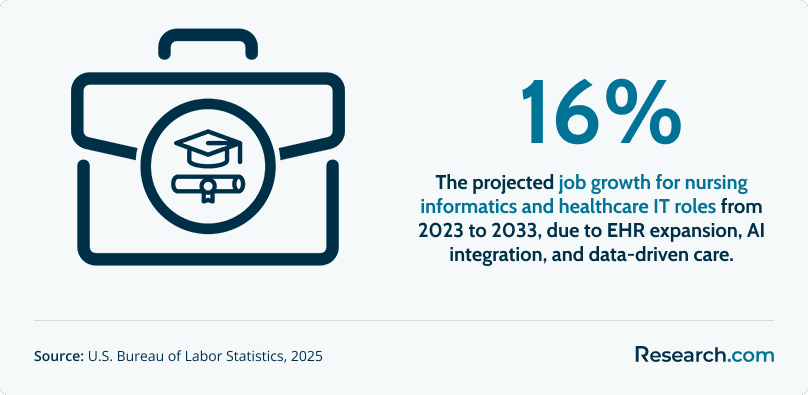
The job market for health and nursing informatics graduates is supported by ongoing healthcare digitization, electronic health record use, telehealth expansion, quality reporting, and the growing need for data-informed care. According to the cited industry report, employment for nursing informatics jobs is projected to grow 16% from 2023 to 2033, compared with the national average of 4%.
Clinical informatics and healthcare IT jobs are also expected to see a 16% increase over the same period. Demand is driven by continued electronic health record adoption, the need for better system integration, and increased use of clinical and administrative data.
In the past year alone, job postings in health informatics increased by over 40%. Still, graduates should interpret market data carefully. Hiring conditions vary by region, employer type, healthcare system size, technical skill level, and prior nursing experience. Salary and job opportunities are not guaranteed by the degree alone.
Students evaluating compensation should compare local job postings, required credentials, and experience expectations. Research.com's health informatics salary guide can help readers understand how pay may differ by role and setting.
Is an online MSN in health/nursing informatics worth it compared with other nursing degrees?
An online MSN in health/nursing informatics can be worth it for nurses who want to move away from direct bedside care into data, systems, technology implementation, clinical workflow improvement, or healthcare IT leadership. Its value depends on the student’s current role, employer needs, total program cost, and ability to gain applied informatics experience while enrolled.
Compared with a general MSN, the informatics track is more specialized and may be better for nurses who want roles involving electronic health records, analytics, clinical systems, telehealth, or digital transformation. Compared with an NP pathway, it typically does not prepare students for advanced clinical diagnosis and treatment roles. Compared with BSN completion, it is a graduate-level investment intended for advanced or specialized positions. Nurses who still need a bachelor’s degree may first compare options such as Research.com's guide to cheapest online RB-BSN programs.
| Degree Path | Best For | Main Trade-Off |
| Online MSN in Health/Nursing Informatics | Nurses pursuing informatics, health IT, analytics, EHR, telehealth, or systems roles | Strong specialization, but less direct preparation for advanced clinical provider roles |
| General MSN | Nurses seeking broader leadership, education, or administration options | More flexible, but may not provide deep informatics preparation |
| RN-to-BSN or BSN completion | RNs who need a bachelor’s degree before graduate study | Lower credential level, but often an important stepping stone |
| DNP | Nurses targeting doctoral-level practice leadership or advanced clinical systems work | Higher credential, usually more time and cost |
| Nurse practitioner program | Nurses who want advanced clinical diagnosis and treatment responsibilities | Clinical provider focus, not primarily health IT or informatics |
How to verify accreditation for an online MSN in health/nursing informatics
Accreditation matters because it can affect employer recognition, transfer credit, financial aid eligibility, and preparation for professional certification. Students should confirm both institutional accreditation and nursing program accreditation before applying.
- Check the university’s official accreditation page.
- Confirm institutional accreditation through recognized accreditor sources.
- Look for nursing program accreditation from organizations such as the Commission on Collegiate Nursing Education (CCNE) or the Accreditation Commission for Education in Nursing (ACEN), when applicable.
- Ask whether the informatics track is included under the nursing program’s accreditation.
- Verify state authorization if you live outside the school’s home state.
- Ask certification bodies directly whether the program supports your intended credential pathway.
- Request written confirmation of practicum requirements, placement rules, and any state-specific restrictions.
Students comparing advanced nursing routes may also review direct entry nurse practitioner programs, but they should remember that NP pathways and informatics pathways prepare graduates for different professional functions.
What graduates say about online MSN health/nursing informatics programs
- Lennard: "My online MSN in Health Informatics let me keep my full-time nursing job while learning how data systems, analytics, and clinical workflows fit together. The coursework was demanding, but it felt relevant because I could connect assignments to problems I was seeing in my hospital almost right away."
- Nestor: "The most valuable part of my MSN in Nursing Informatics was seeing technology taught as a patient care tool, not just an IT topic. Online discussions with nurses from different states also helped me understand how informatics challenges vary across healthcare settings."
- Darnell: "As a working nurse and parent, the online format made graduate school possible. I was surprised by how engaged the instructors were, and the applied projects helped me build confidence using informatics tools that now support better care processes at my facility."
References
- AHIMA. (n.d.). Certification careers: Certifications overview. Retrieved from AHIMA.
- AACN. (n.d.). Informatics and healthcare technologies. Retrieved from AACN.
- Alliant International University. (n.d.). Top 9 nursing trends to watch in 2025. Retrieved from Alliant.
- Glassdoor. (n.d.). Health informatics researcher salary. Retrieved from Glassdoor.
- GKC HIMSS. (n.d.). HIMSS nursing informatics workforce survey. Retrieved from GKC HIMSS.
- HIMSS. (2022). HIMSS 2022 nursing informatics workforce survey: Value and future outlook. Retrieved from HIMSS.
- HealthManagement.org. (n.d.). Bridging digital health and nursing informatics. Retrieved from HealthManagement.
- Journal of AHIMA. (n.d.). Health informatics in health information management: A growing opportunity. Retrieved from Journal of AHIMA. Additional records: PMC article and PubMed record.
- Nurse.org. (n.d.). Nursing informatics certifications. Retrieved from Nurse.org.
- NurseJournal.org. (n.d.). What can you really do with a nursing informatics degree? Retrieved from NurseJournal.
- Nursing Process. (n.d.). Fastest nursing informatics programs online. Retrieved from Nursing Process.
- Nursing World. (n.d.). Informatics nurse certification. Retrieved from Nursing World.
- Nursing World. (n.d.). Nursing informatics resources. Retrieved from Nursing World.
- Salary.com. (n.d.). Clinical integration specialist salary. Retrieved from Salary.com.
- Zippia. (n.d.). Health data analyst salary. Retrieved from Zippia.
- Zippia. (n.d.). Informatics nurse specialist salary. Retrieved from Zippia.
- Zippia. (n.d.). Information systems director salary. Retrieved from Zippia.
Key Insights
- The fastest online MSN in health/nursing informatics programs commonly take 14–24 months to about 2 years, but practicum placement and part-time enrollment can extend the timeline.
- Do not choose a program based on speed alone. Accreditation, practicum support, state authorization, curriculum quality, and certification alignment matter just as much.
- Tuition typically ranges from $600 to $900 per credit hour, but listed programs vary from $263 per credit to more than $2,000 per credit, so total cost should be calculated carefully.
- Online programs are usually best for working nurses who need flexibility, while on-campus programs may offer stronger in-person networking and placement support.
- Common informatics careers include informatics nurse specialist, healthcare data analyst, health information systems director, health informatics researcher, and clinical systems integration specialist.
- The degree is most valuable for nurses who want to work with health data, EHR systems, workflow improvement, telehealth, analytics, or healthcare IT leadership rather than advanced direct clinical practice.
- Before applying, ask each school about accreditation, state authorization, practicum hours, placement responsibility, total program cost, course format, and certification preparation.
Other Things You Should Know About Online MSN in Health/Nursing Informatics Programs
Several institutions offer fast online MSN in Health/Nursing Informatics, including the University of South Alabama, Walden University, and University of Maryland Global Campus, typically allowing completion in 12-18 months, depending on prior credits. Always verify the 2027-specific curriculum and requirements directly with each institution.
The fastest online MSN in Health/Nursing Informatics programs in 2027 typically take 12 to 18 months to complete. These programs are designed for accelerated learning, allowing students to balance their studies with professional commitments.
Students usually need basic competency in electronic health records, data analysis, and health information systems before starting. Fast-track MSN informatics programs often expect proficiency with Microsoft Office, statistics software, and clinical documentation tools. Some programs also require an introductory informatics or nursing research course.
In 2027, financial aid options for the fastest online MSN in Health/Nursing Informatics programs commonly include federal student loans, grants, scholarships, and employer tuition assistance. Prospective students should check with individual programs to explore specific aid offerings and eligibility criteria.