
2027 Fastest Online MSN in Nurse Executive Leadership Programs

Co-Founder and Chief Data Scientist
Healthcare is facing a significant leadership transition, with 40% of registered nurses planning to leave their roles in the next five years. For experienced nurses who see systemic problems but lack the authority to implement solutions, this isn't a crisis—it's a career-defining opportunity.
An online MSN in nurse executive leadership is the specific tool designed to translate your invaluable clinical wisdom into executive influence, giving you a seat at the decision-making table. This article, crafted by career planning experts, serves as a strategic guide to help you take a confident, well-informed step into the leadership role your experience has earned.
What are the benefits of getting a fast online MSN in nurse executive leadership program?
- Qualify for executive roles like Nurse Manager or Director of Nursing, giving you the authority to implement the systemic changes needed to improve patient care.
- Increase your earning potential significantly, as MSN-prepared nurses earn an average annual salary of $108,000.
- Earn your degree through a flexible online format, allowing you to advance your career without stepping away from your current job.
What can I expect from a fast online MSN in nurse executive leadership program?
An MSN in Nurse Executive Leadership offers a program fundamentally different from previous clinical training. It provides a focused curriculum designed to build an executive toolkit. The coursework centers entirely on the business of healthcare, equipping graduates with the specific skills modern health systems require from their leaders.
Core subjects include financial management, strategic planning, human resources, healthcare policy, and data informatics. The curriculum's goal is to develop fluency in the language of the C-suite, enabling graduates to make a measurable impact on their organizations. It is also important to understand the nature of accelerated programs. These "fast" tracks are intense and demand a high level of discipline. While structured for working professionals, they require a serious commitment to succeed.
Where can I work with a fast online MSN in nurse executive leadership program?
Graduates typically step into leadership roles within traditional settings like hospitals, ambulatory clinics, and large corporate health systems. These positions often include titles like Nurse Manager, Director of Nursing, or Clinical Operations Director, where they oversee departments, manage budgets, and guide patient care strategy.
However, the opportunities extend well beyond the hospital walls. An online MSN in nurse executive leadership prepares professionals for strategic roles in other vital sectors.
Graduates are sought after by insurance companies to develop clinical policy, by health technology firms to inform product development, and by government and nonprofit agencies to shape public health initiatives. This career portability is a key advantage, ensuring that the skills gained remain valuable and in-demand as the healthcare industry continues to evolve.
How much can I make with a fast online MSN in nurse executive leadership program?
Earning a six-figure salary is a standard expectation for graduates with this degree. According to 2025 data from Payscale, nurses with a Master of Science in Nursing (MSN) earn an average annual salary of $108,000.
It's important to view this as a career ladder. While new graduates can expect a significant salary increase, the highest earnings are found at the top executive levels. As you progress from a Nurse Manager to a Director of Nursing and eventually into a C-suite role like Chief Nursing Officer, your salary and compensation will grow to reflect your expanding scope of responsibility.
- List of the Fastest Online MSN in Nurse Executive Leadership Programs for 2027 List of Programs
- How long does it take to complete a fast online MSN in nurse executive leadership program? Completion Time
- How does a fast online MSN in nurse executive leadership program compare to an on-campus program? How does a fast online MSN in nurse executive leadership program compare to an on-campus program?
- What is the average cost of a fast online MSN in nurse executive leadership program? Average Cost
- What are the financial aid options for students enrolling in a fast online MSN in nurse executive leadership program? Financial Aid
- What are the prerequisites for enrolling in a fast online MSN in nurse executive leadership program? Requirements
- What courses are typically in a fast online MSN in nurse executive leadership program? Course Overview
- What types of specializations are available in a fast online MSN in nurse executive leadership program? What types of specializations are available in a fast online MSN in nurse executive leadership program?
- How to Choose the Fastest Online MSN in Nurse Executive Leadership Programs Program How to Choose the Fastest Online MSN in Nurse Executive Leadership Programs Program
- What career paths are available for graduates of a fast online MSN in nurse executive leadership program? What career paths are available for graduates of a fast online MSN in nurse executive leadership program?
- What is the job market for graduates with a fast online MSN in nurse executive leadership program? Job Outlook
- What student support services are critical for a fast online MSN in nurse executive leadership program? What student support services are critical for a fast online MSN in nurse executive leadership program?
- What is the return on investment for a fast online MSN in nurse executive leadership program? What is the return on investment for a fast online MSN in nurse executive leadership program?
- Can alternative entry pathways enhance leadership qualifications? Can alternative entry pathways enhance leadership qualifications?
Fastest Online MSN in Nurse Executive Leadership Programs for 2027
An online MSN in Nurse Executive Leadership is designed for registered nurses who want to move from bedside or unit-level practice into management, operations, quality improvement, staffing strategy, budgeting, and executive decision-making. For nurses already working full time, speed matters—but choosing the shortest program without checking accreditation, practicum expectations, cost, and career fit can lead to an expensive mistake.
This guide helps you compare fast online MSN nurse executive leadership programs, understand how long they take, what they cost, what admissions committees expect, and which career paths they can support. It is written for BSN-prepared nurses, RNs considering bridge programs, and experienced clinicians deciding whether an MSN, MBA, DNP, or another leadership credential is the better next step.
Quick answer: What is the fastest online MSN in nurse executive leadership?
The fastest online MSN in Nurse Executive Leadership programs can often be completed in about 1 year by BSN-prepared nurses enrolled full time. Most working nurses complete these programs in 18 to 24 months, while RN-to-MSN bridge pathways usually take longer because they include BSN-level coursework before the graduate leadership curriculum. The best fast program is not simply the shortest one; it should be accredited, affordable, flexible enough for your work schedule, and aligned with your leadership goals.
How Research.com evaluates these programs
Because an MSN is a major financial and professional commitment, program comparisons should be based on transparent information rather than marketing claims. Our ranking process uses trusted education data sources, including the IPEDS database, Peterson's database, the College Scorecard database, and The National Center for Education Statistics.
These sources help support comparisons of online MSN in Nurse Executive Leadership programs using factors such as completion structure, cost, institutional information, and available program details. You can review the broader Research.com ranking approach on our methodology page.
Fast online MSN in Nurse Executive Leadership programs at a glance
| School and program | Program length | Credits or units | Tuition rate | Accreditation listed |
| Nebraska Methodist College – Master of Science in Nursing (MSN), Nurse Executive Track | 21–33 months | 39 credits | $588 per credit | Commission on Collegiate Nursing Education (CCNE) |
| The University of Alabama – Master of Science in Nursing, Concentration in Nurse Executive (Online) | 1–2 years | 33–39 credits | $480 per credit | Commission on Collegiate Nursing Education (CCNE) |
| University of West Florida – Master of Science in Nursing (MSN) — Nursing Leadership | ~2 years | 39 credits | $425 per credit | Commission on Collegiate Nursing Education (CCNE) |
| Northern Kentucky University – Master of Science in Nursing – Nurse Executive Leadership Concentration Online | ~1 year | 33 credits | $600 per credit | Commission on Collegiate Nursing Education (CCNE) |
| Samuel Merritt University – Master of Science in Nursing – Executive Leadership (MSN-EL) | 1–2 years | 37 units | $1,774 per unit | Western Association of Schools and Colleges Senior College and University Commission (WSCUC) |
| Purdue University Northwest – Online Nurse Executive Program: Master of Science in Nursing (MSN) | 1–2 years | 32 credits | $512.16 per credit | Accreditation Commission for Education in Nursing (ACEN) |
| Missouri Baptist University – Master of Science in Nursing – Executive Leadership | As few as 18 months | 35 credits | $777 per credit | Commission on Collegiate Nursing Education (CCNE) |
| Wilmington University – Master of Science in Nursing Leadership – Executive Concentration | ~1 year | 36 credits | $551 per credit | Commission on Collegiate Nursing Education (CCNE) |
| Walden University – Master of Science in Nursing (MSN) – Nurse Executive Specialization | ~18 months (flexible) | 48 quarter credits | $564.50 per quarter credit | Commission on Collegiate Nursing Education (CCNE) |
| Benedictine University – Master of Science in Nursing (M.S.N.) – Nurse Executive Leader Concentration | ~2 years | 36 credits | $670 per credit | Commission on Collegiate Nursing Education (CCNE) |
1. Nebraska Methodist College – Master of Science in Nursing (MSN), Nurse Executive Track
Nebraska Methodist College offers a Nurse Executive Track built for nurses who want leadership training grounded in both nursing values and business decision-making. A key advantage is access for both BSN-prepared nurses and associate-degree nurses through an RN-to-MSN bridge pathway, which can make it useful for experienced RNs who have already taken on informal leadership responsibilities but need the graduate credential to move into formal management roles.
- Program Length: 21–33 months
- Required Credits to Graduate: 39
- Cost per Credit: $588
- Accreditation: Commission on Collegiate Nursing Education (CCNE)
2. University of Alabama – Master of Science in Nursing, Concentration in Nurse Executive (Online)
The University of Alabama’s online Nurse Executive concentration is aimed at nurses preparing for organizational leadership, policy work, quality oversight, and executive-level operations. The curriculum is a strong fit for nurses who want to connect strategic planning, care quality, and leadership accountability in roles such as chief nurse executive or senior nursing administrator.
- Program Length: 1–2 years
- Required Credits to Graduate: 33–39
- Cost per Credit: $480
- Accreditation: Commission on Collegiate Nursing Education (CCNE)
3. University of West Florida – Master of Science in Nursing (MSN) — Nursing Leadership
The University of West Florida’s Nursing Leadership MSN is designed for working nurses who need an online format with asynchronous coursework. Its focus on project management, finance, and process improvement makes it especially relevant for nurses interested in case management leadership, quality improvement, department administration, or operational roles that require measurable improvements in care delivery.
- Program Length: ~2 years
- Required Credits to Graduate: 39
- Cost per Credit: $425
- Accreditation: Commission on Collegiate Nursing Education (CCNE)
4. Northern Kentucky University – Master of Science in Nursing – Nurse Executive Leadership Concentration Online
Northern Kentucky University offers one of the shorter listed pathways, with an online Nurse Executive Leadership concentration that integrates nursing leadership with business, informatics, psychology, and applied practice. Its capstone practicum gives students a way to apply leadership concepts in a healthcare setting, which is important for nurses who want the degree to translate into practical management experience.
- Program Length: ~1 year
- Required Credits to Graduate: 33
- Cost per Credit: $600
- Accreditation: Commission on Collegiate Nursing Education (CCNE)
5. Samuel Merritt University – Master of Science in Nursing – Executive Leadership (MSN-EL)
Samuel Merritt University’s MSN-EL focuses on preparing nurses to lead change across healthcare settings. The program offers full-time and part-time formats, which can help students match the pace of study to their work and family responsibilities. Its emphasis on evidence-based practice, health policy advocacy, teaching, and management may appeal to nurses who want leadership options beyond a single hospital unit.
- Program Length: 1–2 years
- Required Units to Graduate: 37
- Cost per Unit: $1,774
- Accreditation: Western Association of Schools and Colleges Senior College and University Commission (WSCUC)
6. Purdue University Northwest – Online Nurse Executive Program: Master of Science in Nursing (MSN)
Purdue University Northwest’s online Nurse Executive MSN is practical for working nurses because students may be able to complete practicum requirements at their current workplace. The program is designed around systems leadership, policy development, financial management, and executive decision-making, with instruction from faculty who have experience in senior nursing leadership roles.
- Program Length: 1–2 years
- Required Credits to Graduate: 32
- Cost per Credit: $512.16
- Accreditation: Accreditation Commission for Education in Nursing (ACEN)
7. Missouri Baptist University – Master of Science in Nursing – Executive Leadership
Missouri Baptist University’s Executive Leadership MSN combines nursing administration with a Christian faith-based perspective. It may fit nurses who want a leadership program that explicitly connects professional management, compassionate service, and business skills. The curriculum is also structured to help graduates prepare for board certification exams such as the NE-BC.
- Program Length: As few as 18 months
- Required Credits to Graduate: 35
- Cost per Credit: $777
- Accreditation: Commission on Collegiate Nursing Education (CCNE)
8. Wilmington University – Master of Science in Nursing Leadership – Executive Concentration
Wilmington University’s MSN Leadership Executive Concentration emphasizes nursing theory, advanced practice, and research as foundations for leadership. Its dual-degree options with an MBA or M.S. in Management can be valuable for nurses who want a stronger business profile and broader preparation for policy, administration, or healthcare system leadership.
- Program Length: ~1 year
- Required Credits to Graduate: 36
- Cost per Credit: $551
- Accreditation: Commission on Collegiate Nursing Education (CCNE)
9. Walden University – Master of Science in Nursing (MSN) – Nurse Executive Specialization
Walden University’s Nurse Executive specialization is structured for students who need a high degree of pacing flexibility. Its Tempo Learning® format can allow students to personalize the pace and potentially the cost of study, while practicum placement support may be useful for nurses who need help identifying appropriate leadership practice settings.
- Program Length: ~18 months (flexible)
- Required Quarter Credits to Graduate: 48
- Cost per Quarter Credit: $564.50
- Accreditation: Commission on Collegiate Nursing Education (CCNE)
10. Benedictine University – Master of Science in Nursing (M.S.N.) – Nurse Executive Leader Concentration
Benedictine University’s Nurse Executive Leader concentration treats nursing leadership as both a clinical and business function. The curriculum is suited to nurses who want to manage teams, budgets, interprofessional collaboration, patient care services, and departmental resources in complex healthcare environments.
- Program Length: ~2 years
- Required Credits to Graduate: 36
- Cost per Credit: $670
- Accreditation: Commission on Collegiate Nursing Education (CCNE)
How Long Does a Fast Online MSN in Nurse Executive Leadership Take?
For most students, the MSN portion takes 12 to 24 months. Your actual timeline depends on your current education level, whether you study full time or part time, how practicum hours are scheduled, and whether the program uses standard semesters, accelerated terms, or a competency-based format.
Timeline for BSN-prepared nurses
If you already have a Bachelor of Science in Nursing, you can usually enter the graduate MSN curriculum directly. The shortest full-time programs may be finished in as little as 12 months, but that pace is demanding and may not be realistic if you work full time, rotate shifts, or have major family responsibilities. Many employed nurses choose 18- to 24-month plans because they reduce overload and make it easier to complete leadership projects well.
Nurse executives need strong communication skills, especially when presenting budget requests, leading change initiatives, and explaining quality data to nonclinical stakeholders. Some nurses compare adjacent graduate options, such as a top online master's in strategic communication degree, when they want deeper training in organizational messaging and stakeholder engagement.
Timeline for RNs in bridge programs
RNs with an associate degree or diploma generally need an RN-to-MSN bridge option. These programs take longer because they include BSN-level content before the graduate leadership coursework begins. A typical bridge pathway runs 24 to 36 months and can be more efficient than completing a separate BSN and then applying to an MSN later.
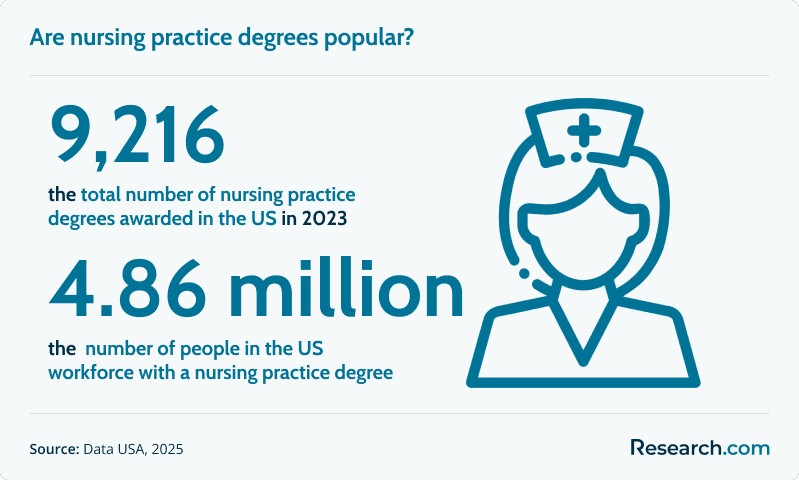
The pathway is not unusual. In 2023 alone, 9,216 advanced nursing practice degrees were awarded in the U.S., showing that advanced nursing education remains a well-established route for nurses seeking broader responsibility.
| Your starting point | Typical route | Common timeline | Best fit |
| BSN-prepared RN | Direct MSN in Nurse Executive Leadership | 12 to 24 months | Nurses ready for graduate leadership coursework now |
| RN with associate degree or diploma | RN-to-MSN bridge program | 24 to 36 months | Experienced RNs who want one integrated route to graduate preparation |
| Working nurse with unpredictable schedule | Part-time or flexible online MSN | Often 18 to 24 months or longer depending on pace | Nurses balancing employment, family, and practicum requirements |
Online vs. On-Campus MSN in Nurse Executive Leadership: Which Format Is Better?
An accredited online MSN in Nurse Executive Leadership can carry the same academic value as a campus-based program, but the best format depends on how you learn, how much structure you need, and whether you can attend classes at fixed times. Employers generally focus on the school, accreditation, relevant leadership experience, and the skills you bring—not whether every lecture happened in a physical classroom.
When an online MSN makes sense
Online programs are usually the stronger option for nurses who need to keep working while studying. They reduce relocation and commuting costs, expand your school choices beyond your local area, and let you apply leadership concepts immediately in your current workplace. This format is especially useful if your practicum can be completed near home or at your existing organization.
Healthcare leaders are also expected to understand data systems, cybersecurity concerns, electronic health records, and workflow technology. Nurses who want a stronger technology foundation sometimes compare healthcare leadership programs with an information technology degree online or related tech-focused coursework to understand how digital tools affect care delivery.
When an on-campus MSN may be better
Campus programs can be a good fit if you prefer face-to-face discussions, fixed weekly class meetings, and frequent in-person access to faculty and classmates. They may also offer stronger local networking if the school has close relationships with nearby hospitals, health systems, or public agencies. The trade-off is that you may have less schedule flexibility and fewer options if you cannot commute regularly.
| Factor | Online MSN | On-campus MSN |
| Schedule | Often better for working nurses, especially with asynchronous classes | More structured, with set class times |
| Networking | Virtual networking, local practicum relationships, national cohort access | In-person faculty and peer interaction |
| Cost considerations | May reduce commuting and relocation expenses | May include campus-related costs and travel time |
| Learning style | Works best for self-directed students | Works best for students who want live structure and immediate in-person feedback |
| Practicum | Often completed in an approved local or workplace setting | Often connected to regional healthcare partners |
How Much Does a Fast Online MSN in Nurse Executive Leadership Cost?
The total price of an online MSN in Nurse Executive Leadership varies widely, often from $20,000 to over $80,000. In the programs reviewed here, many accredited options fall within a more focused range of $16,000 to $65,000. The true cost depends on tuition, required credits, fees, textbooks, travel for any campus intensives, and whether your employer contributes tuition assistance.
When weighing the investment, compare MSN leadership programs with other healthcare administration routes and review career outcomes carefully. For example, understanding an MBA healthcare management salary can provide context when deciding whether a nursing-focused leadership degree or a business-focused degree better supports your goals.
What changes the total cost?
- Public or private institution: Public universities often have lower tuition than private institutions, though online pricing and residency rules can vary.
- Credit requirement: A lower per-credit price is not always cheaper if the program requires more credits. Multiply tuition per credit by the total number of credits or units.
- Mandatory fees: Technology, clinical or practicum coordination, graduation, library, and student service fees can increase the final bill.
- Program pace: Accelerated formats may reduce time away from advancement opportunities, but they can also limit your ability to work extra shifts.
- Employer support: Tuition reimbursement can significantly change your out-of-pocket cost, but it may come with service commitments.
Cost comparison for listed programs
| Program | Credits or units | Tuition rate | Simple tuition calculation before fees |
| Nebraska Methodist College | 39 credits | $588 per credit | 39 × $588 |
| University of Alabama | 33–39 credits | $480 per credit | 33–39 × $480 |
| University of West Florida | 39 credits | $425 per credit | 39 × $425 |
| Northern Kentucky University | 33 credits | $600 per credit | 33 × $600 |
| Samuel Merritt University | 37 units | $1,774 per unit | 37 × $1,774 |
| Purdue University Northwest | 32 credits | $512.16 per credit | 32 × $512.16 |
| Missouri Baptist University | 35 credits | $777 per credit | 35 × $777 |
| Wilmington University | 36 credits | $551 per credit | 36 × $551 |
| Walden University | 48 quarter credits | $564.50 per quarter credit | 48 × $564.50 |
| Benedictine University | 36 credits | $670 per credit | 36 × $670 |
Financial Aid Options for Online MSN Nurse Executive Leadership Students
Graduate nursing students often combine several funding sources. Start with federal aid, then check school scholarships, nursing organization scholarships, employer tuition benefits, and private loans only if needed. Do not assume that being employed automatically prevents you from receiving aid for graduate school.
- Federal loans: Many graduate students begin by completing the Free Application for Federal Student Aid, or FAFSA. Graduate federal loans are not limited only to students with low income.
- Nursing scholarships: Hospitals, professional associations, foundations, and universities may offer scholarships for nurses pursuing advanced education.
- Employer tuition reimbursement: Health systems often support nurses who are preparing for leadership roles, especially when the degree aligns with workforce planning needs.
- Private loans: These can fill gaps, but compare interest rates, repayment options, and borrower protections carefully before borrowing.
How to use employer tuition benefits wisely
Your current employer may be your most valuable funding source. Check your benefits portal and speak with human resources or nursing leadership about tuition assistance, reimbursement caps, approved schools, grade requirements, and repayment obligations if you leave the organization.
Read the service agreement closely. Some employers require you to remain employed for a set period after receiving funding. That can be a good trade-off if you plan to stay, but it may limit your mobility if a leadership opportunity opens elsewhere.
Leadership development is not limited to finance and operations. Some nurses also explore broader education in areas such as ethics, communication, culture, and critical analysis through options like a fast track online humanities degree, though an MSN remains the more direct credential for nursing executive roles.
Admissions Requirements for Fast Online MSN in Nurse Executive Leadership Programs
Most programs look for evidence that you are ready for graduate nursing leadership coursework and that you have enough clinical context to lead responsibly. Requirements vary by school, so verify details before applying.
- Active RN license: You generally need a current, unencumbered Registered Nurse license, especially in the state where you complete any practicum or clinical requirements.
- BSN for direct-entry MSN admission: Most direct MSN leadership programs expect a Bachelor of Science in Nursing from an accredited institution.
- Minimum GPA: Many schools use a cumulative undergraduate GPA of 3.0 on a 4.0 scale as a common benchmark.
- Clinical experience: Programs often expect at least one to two years of full-time registered nursing experience.
- Application materials: Schools may ask for transcripts, a resume, professional references, a statement of goals, and documentation of RN licensure.
How to show leadership potential before you apply
Admissions committees may look beyond grades. If you have served as charge nurse, preceptor, committee member, quality improvement participant, patient safety champion, or unit-based project lead, include that experience clearly in your resume and personal statement. These examples show that you already understand team dynamics, accountability, workflow problems, and patient care systems.
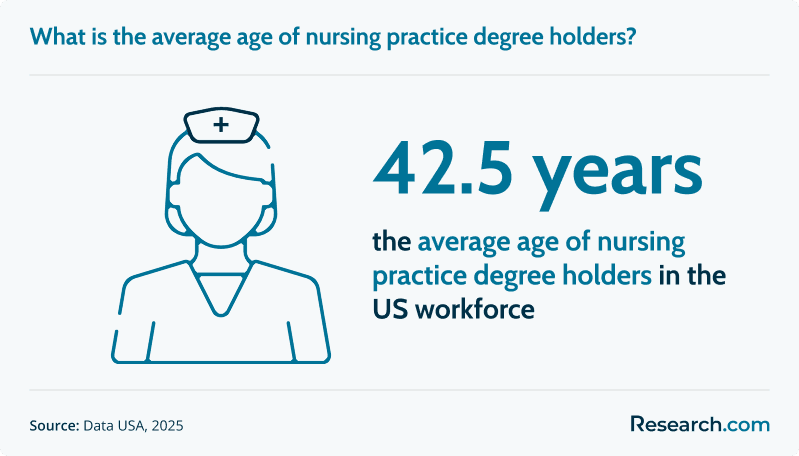
The average age for nursing practice degree holders is 42.5, which reflects how often advanced nursing education attracts professionals with substantial clinical experience rather than only early-career students.
Common Courses in an Online MSN in Nurse Executive Leadership
An MSN in Nurse Executive Leadership shifts your training from direct clinical execution to system-level leadership. You learn how to manage people, budgets, quality metrics, policy pressures, technology, and organizational change. The coursework is closely connected to the broader question of what organizational leadership is in complex healthcare environments.
Typical courses and what they help you do
| Course area | What you learn | How it applies in leadership |
| Healthcare Finance and Budgeting | Financial statements, staffing budgets, cost controls, and resource allocation | Build and defend budgets for units, departments, or service lines |
| Strategic Planning and Marketing | Market analysis, growth planning, service positioning, and organizational strategy | Support new programs, expansion plans, and long-term nursing priorities |
| Human Resources Management | Hiring, retention, performance management, staff development, and workplace culture | Lead teams, reduce turnover, and address staffing challenges |
| Healthcare Policy and Ethics | Legal requirements, ethical decision-making, regulation, and policy analysis | Make leadership decisions that protect patients, staff, and the organization |
| Data Informatics and Quality Improvement | Performance indicators, data interpretation, workflow measurement, and evidence-based improvement | Use data to improve safety, patient outcomes, efficiency, and executive reporting |
Why these courses matter in real leadership roles
The value of the curriculum is practical. Finance coursework helps you understand staffing ratios, overtime, supply costs, and budget requests. Informatics and quality improvement courses help you turn raw performance data into defensible decisions. Human resources training prepares you for difficult conversations about performance, retention, morale, and team accountability. Together, these courses help translate your clinical judgment into executive action.
Nurse Executive Leadership vs. Other MSN Specializations
Nurse Executive Leadership is a specialization within the Master of Science in Nursing. It is intended for nurses who want to lead people, departments, operations, and strategy rather than move into a direct advanced practice provider role. Before choosing this path, compare it with other nonclinical and leadership-oriented MSN tracks.
Some nurses also compare multidisciplinary pathways, including the shortest online interdisciplinary studies program, when they want a broader credential. However, for nurses who specifically want healthcare leadership roles grounded in nursing practice, the MSN in Nurse Executive Leadership is usually the more targeted option.
| Specialization | Main focus | Best for nurses who want to lead... |
| Nurse Executive Leadership | Operations, staffing, budgets, strategy, and organizational culture | People, departments, and healthcare systems |
| Nursing Informatics | Health data, technology systems, electronic records, and workflow tools | Data, technology implementation, and digital care processes |
| Nursing Education | Curriculum design, teaching, simulation, and clinical education | Students, new nurses, staff development, and continuing education |
| Care Coordination | Patient transitions, care pathways, case management, and population health coordination | Processes across settings and patient care journeys |
How to Choose the Best Fast Online MSN in Nurse Executive Leadership Program
The right program should match your career target, schedule, budget, accreditation needs, and preferred learning style. A fast timeline is valuable only if the program is credible, manageable, and respected in the settings where you want to work.
Step-by-step program selection checklist
- Verify accreditation first. Look for appropriate institutional accreditation and, for nursing programs, check whether the program lists CCNE or ACEN accreditation when that matters for your goals.
- Calculate the full price. Include tuition, fees, books, travel, background checks, practicum costs, and lost income if the pace requires fewer work hours.
- Ask how practicum placement works. Confirm whether you find your own site, whether the school helps, and whether your workplace can be approved.
- Compare course delivery formats. Asynchronous courses are often easier for shift workers; synchronous courses may offer more structure.
- Review faculty experience. Faculty who have worked as nurse executives, directors, quality leaders, or healthcare administrators can connect coursework to real decisions.
- Check certification alignment. If you plan to pursue credentials such as NE-BC, ask how the curriculum supports exam preparation.
- Look at student support. Fast programs require strong advising, technical support, writing help, library access, and responsive practicum coordination.
MSN in Nurse Executive Leadership vs. MBA
Experienced nurses often compare an MSN with an MBA. The MSN is the nurse-first leadership path: it builds on clinical credibility and teaches the business, policy, staffing, and systems skills needed to lead within healthcare. The MBA is the business-first path: it gives broad management training that can be applied to healthcare or other industries.
If you want your leadership identity to remain clearly rooted in nursing practice, the MSN is usually the more direct fit. If you want broader business mobility outside nursing or outside healthcare, an MBA may be worth comparing. You may also want to understand the difference between MHA and MBA programs, especially if you are considering healthcare administration options beyond nursing leadership.
Common mistakes to avoid
| Mistake | Why it can hurt you | Better approach |
| Choosing only the shortest program | A very fast pace can become unmanageable with full-time nursing work | Match pace to your schedule, practicum load, and support system |
| Ignoring accreditation | Accreditation can affect credibility, transfer options, and employer confidence | Confirm institutional and nursing program accreditation before applying |
| Comparing only per-credit tuition | Programs with more credits or high fees may cost more overall | Calculate total program cost before fees and ask for a full fee schedule |
| Assuming online means easier | Accelerated online graduate work requires discipline and time management | Ask for weekly time expectations and sample course schedules |
| Waiting too long to plan the practicum | Delayed site approval can slow graduation | Ask about practicum requirements before enrolling |
| Assuming salary outcomes are guaranteed | Pay varies by role, employer, region, experience, and leadership scope | Use labor market data and employer conversations to estimate realistic ROI |
Questions to ask before enrolling
- Is the program accredited by CCNE, ACEN, or another relevant accreditor listed by the school?
- Can I complete the practicum at my current workplace?
- How many hours per week should I expect to spend on coursework?
- Are courses asynchronous, synchronous, or mixed?
- What happens if my work schedule changes or I need to slow down?
- Does the curriculum support NE-BC or other leadership certification preparation?
- What career services are available for nurses seeking management roles?
- What is the full cost after tuition, fees, and required materials?
Career Paths After an Online MSN in Nurse Executive Leadership
A fast online MSN in Nurse Executive Leadership is built for nurses who want to move up the leadership ladder in hospitals, health systems, long-term care organizations, community health agencies, academic medical centers, and other healthcare settings. The progression often begins with unit or department management and may lead to director-level or executive roles over time.
Leadership skills can also apply outside acute care. For instance, the role of community health nurse can evolve into program management, public health leadership, care coordination oversight, or community-based quality initiatives.
Common roles for graduates
| Role | Typical focus | Leadership scope |
| Nurse Manager | Daily operations, staffing, performance, and unit outcomes | One unit or department |
| Clinical Nurse Coordinator | Care coordination, workflow support, clinical operations, and team communication | Unit or service-level coordination |
| Director of Nursing | Multiple units, service lines, policies, budgets, and quality goals | Departmental or multi-unit leadership |
| Quality Improvement Leader | Safety metrics, process improvement, compliance, and evidence-based initiatives | Program, department, or organization-wide projects |
| Chief Nursing Officer | Nursing strategy, executive governance, workforce planning, and patient care standards | Organization-wide nursing leadership |
What changes when you move from bedside care to leadership?
The work becomes less about delivering care to one patient at a time and more about designing systems that allow many clinicians to deliver safe, effective care. Your calendar may include budget meetings, staffing reviews, quality dashboards, policy discussions, executive briefings, conflict resolution, and performance planning. Clinical judgment still matters, but you apply it through strategy, communication, and operational decisions.
Job Market Outlook for MSN Nurse Executive Leadership Graduates
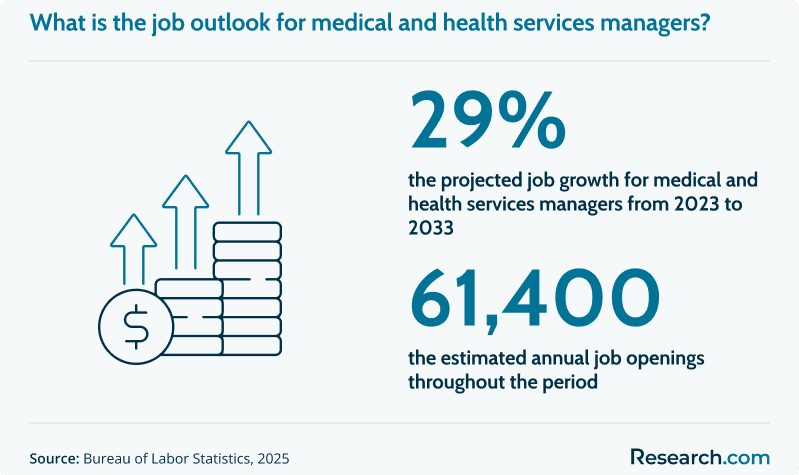
The employment outlook for healthcare leadership roles is strong. The U.S. Bureau of Labor Statistics projects that employment for medical and health services managers will grow by 29% between 2023 and 2033, with about 61,400 job openings each year. That growth supports the case for leadership-focused graduate education, especially for nurses who want to manage clinical operations rather than leave healthcare for a general business role.
This outlook also helps answer the broader question, is healthcare administration a good career? For nurses, an MSN in Nurse Executive Leadership can be a strategic way to enter administration while maintaining a nursing-centered professional identity.
Current trends affecting nurse executive leadership
- Workforce pressure: Healthcare organizations need leaders who can address staffing, retention, burnout, and succession planning.
- Data-driven management: Nurse leaders are increasingly expected to interpret dashboards, quality indicators, financial reports, and patient safety data.
- AI and automation: Emerging tools may support scheduling, documentation, analytics, and predictive planning, but leaders still need to evaluate risks, workflow impact, equity, privacy, and staff adoption.
- Value-based care and quality accountability: Leaders must connect staffing decisions, care processes, patient outcomes, and reimbursement pressures.
- Credential-based advancement: Many leadership roles favor or require graduate preparation, especially for director-level and executive positions.
A note for veterans and military nurses
Military leadership experience can be highly valuable in civilian healthcare, but it may need translation into language that hospital executives and hiring committees recognize. An MSN can help connect command experience with healthcare finance, regulatory policy, quality improvement, governance, and workforce management. This can be especially useful as more than 25% of RNs plan to retire in the coming years, creating demand for prepared nursing leaders.
Student Support Services That Matter in Fast Online MSN Programs
Fast online MSN programs leave little room for administrative confusion. Strong student support can make the difference between steady progress and delayed graduation. Prioritize programs with responsive academic advising, clear practicum guidance, technical support, virtual library access, writing help, career coaching, and faculty who are accessible outside scheduled class sessions.
For online nurse executive students, practicum support is especially important. Ask whether the school helps identify sites, what paperwork is required, how preceptors are approved, and how early you should begin planning. Students building toward advanced nursing education from a lower-cost starting point may also want to compare foundational options such as the cheapest RN programs before committing to a graduate pathway.
Return on Investment: Is a Fast Online MSN in Nurse Executive Leadership Worth It?
An MSN in Nurse Executive Leadership can be worth it if it helps you qualify for roles with broader authority, stronger advancement potential, and responsibilities that match your long-term goals. ROI should not be judged only by salary. Consider tuition, fees, time to completion, employer reimbursement, promotion prospects, geographic demand, current experience, and whether you actually want the day-to-day work of management.
Be cautious with guaranteed salary claims. Leadership compensation varies by employer, region, role scope, years of experience, and organizational size. If you are comparing advanced nursing routes, review how this degree differs from clinical doctorate options such as 12-month online DNP programs, especially if your goal is executive leadership, advanced clinical practice, education, or healthcare innovation.
When the ROI is strongest
- You already have meaningful RN experience and want formal leadership responsibility.
- Your employer offers tuition reimbursement or promotion pathways for MSN-prepared nurses.
- The program is accredited and recognized by employers in your target region.
- You choose a pace that lets you finish without burning out or reducing income unnecessarily.
- You use the practicum to solve a real organizational problem and build a leadership portfolio.
Can Alternative Entry Pathways Support Nursing Leadership Goals?
Alternative entry pathways may help some students enter nursing or advanced practice, but they are not always the most direct route to nurse executive leadership. If you are already an RN, an RN-to-MSN bridge or BSN-to-MSN leadership program is usually more aligned with management goals. If you do not have a nursing background, you need to understand the clinical preparation required before pursuing leadership in a nursing context.
Some students compare options such as direct entry nurse practitioner programs nursing when they are exploring a transition into nursing from another field. These programs may support clinical entry and advanced practice goals, but nurse executive leadership typically requires both nursing credibility and organizational experience. Before choosing an alternative pathway, confirm licensure outcomes, clinical requirements, program accreditation, and whether the degree matches the leadership roles you want.
What Graduates Say About Fast Online MSN in Nurse Executive Leadership Programs
- : "My associate degree had carried me far, but it also kept me from being considered for official management roles. I was already mentoring new nurses and leading projects, yet the credential gap was real. The RN-to-MSN bridge gave me one clear route forward, and the online format let me keep working while I moved toward the leadership jobs I wanted. — Dylan"
- : "I was comfortable handling clinical emergencies, but the idea of managing a large budget made me nervous. The leadership courses made finance feel practical instead of abstract. I learned how budgets connect to staffing, patient safety, and the decisions nurse leaders make every day. — Christine"
- : "I did not want to complete a BSN and then start over with a separate master’s program. The integrated RN-to-MSN structure made the goal feel possible because the coursework flowed in one direction. It turned a huge career step into a manageable plan. — Vanessa"
Key Insights
- The fastest online MSN in Nurse Executive Leadership programs can take about 1 year for some BSN-prepared full-time students, but 18 to 24 months is more realistic for many working nurses.
- RN-to-MSN bridge programs are longer, often 24 to 36 months, but they can be efficient for associate-degree or diploma-prepared RNs who want one integrated path to graduate leadership preparation.
- Accreditation should be checked before cost, speed, or convenience. Look closely at institutional accreditation and whether the nursing program lists CCNE or ACEN accreditation when relevant to your goals.
- Total cost is more important than per-credit tuition. Programs reviewed here show tuition structures that vary by credit load, unit pricing, and fees, with many accredited options falling within $16,000 to $65,000.
- An online MSN can be a strong choice for working nurses, but only if the program offers enough practicum support, advising, technical help, and schedule flexibility.
- The MSN is the nurse-first leadership credential. An MBA may be better for broader business mobility, while an MHA or DNP may fit different healthcare administration or advanced practice goals.
- The job outlook is favorable: medical and health services managers are projected to grow by 29% between 2023 and 2033, with about 61,400 job openings each year.
- The best ROI usually comes when the degree is paired with existing nursing experience, employer tuition support, a relevant practicum project, and a clear plan for moving into management or executive roles.
References:
- Data USA. (2025). Registered nursing. Retrieved May 24, 2024, from https://datausa.io/profile/cip/registered-nursing
- National Council of State Boards of Nursing. (2025). 2024 study highlights. Retrieved May 24, 2024, from https://www.ncsbn.org/research/recent-research/workforce/2024-workforce-pn.page
- National Council of State Boards of Nursing. (2025). Active RN licenses. Retrieved May 24, 2024, from https://www.ncsbn.org/nursing-regulation/national-nursing-database/licensure-statistics/active-rn-licenses.page
- University of St. Augustine for Health Sciences. (2024). Nursing shortage: A 2024 data study reveals key insights. Retrieved May 24, 2024, from https://www.usa.edu/blog/nursing-shortage/
- U.S. Bureau of Labor Statistics. (2025). Medical and health services managers. Retrieved May 24, 2024, from https://www.bls.gov/ooh/management/medical-and-health-services-managers.htm
- U.S. Bureau of Labor Statistics. (2025). Occupational employment and wage statistics (OEWS) profiles. Retrieved May 24, 2024, from https://data.bls.gov/oesprofile/
- U.S. Bureau of Labor Statistics. (2025). Registered nurses. Retrieved May 24, 2024, from https://www.bls.gov/ooh/healthcare/registered-nurses.htm
- U.S. Census Bureau. (2021). Who are our health care workers? Retrieved May 24, 2024, from https://www.census.gov/library/stories/2021/04/who-are-our-health-care-workers.html
- ZipRecruiter. (2025). Clinical nurse coordinator salary. Retrieved May 24, 2024, from https://www.ziprecruiter.com/Salaries/Clinical-Nurse-Coordinator-Salary#Yearly
Other Things You Should Know About the Fastest Online MSN in Nurse Executive Leadership Programs
Yes. Most accelerated online MSN nurse executive leadership programs require a Bachelor of Science in Nursing from a CCNE- or ACEN-accredited program, an active RN license, and a minimum undergraduate GPA of about 3.0. Some schools also require one year of RN experience before admission.
In 2027, some online MSN in Nurse Executive Leadership programs can be completed in as little as 12-18 months. These accelerated options are designed for full-time study and often offer flexible schedules to accommodate working professionals.
The fastest online MSN in Nurse Executive Leadership programs typically require around 30 to 36 credit hours for completion in 2027. Completing these credits efficiently can depend on course load options, including accelerated terms and year-round study schedules.


