
2027 Fastest Online Liberal Arts Degree Programs

Co-Founder and Chief Data Scientist
If you have a penchant for history, an affinity for the humanities, or a curiosity for philosophy, a liberal arts degree might be your perfect fit. But traditional timelines don’t always match modern needs. That’s where fast-track online programs come in.
These programs let you earn your degree faster without sacrificing depth or quality. They're designed for busy adults, career changers, or ambitious learners ready to dive in. With flexible formats and condensed terms, finishing in under two years is no longer a pipe dream.
In this guide, we’ll uncover the fastest and most flexible online liberal arts degrees available today. You'll find schools that value both speed and substance. Whether you're aiming for grad school, a new role, or personal enrichment, there's a fast-track option built for you.
What are the benefits of getting an accelerated online liberal arts degree?
- Liberal arts degree holders earn an average annual salary of $40,987 (ZipRecruiter, n.d.), with many graduates leveraging their versatile skill set to grow into higher-paying roles over time.
- The demand for liberal arts graduates remains steady, with an expected annual job growth rate of 2% as employers continue to seek critical thinkers and effective communicators (Crimson Education, n.d.).
- Accelerated online liberal arts programs combine speed and flexibility with a broad, interdisciplinary education, allowing students to apply essential skills across industries while entering the workforce sooner.
What can I expect from an accelerated online liberal arts degree?
Accelerated online liberal arts programs are designed for efficiency without compromising educational quality. You can expect a well-rounded curriculum, flexible scheduling, and faster degree completion. These programs are ideal for self-motivated learners who want to move quickly into the workforce or graduate studies.
Here’s what you can typically expect:
- Condensed Course Schedules: Classes often run in 5- to 8-week terms, allowing you to complete more credits in less time.
- Flexible Learning Formats: You have the liberty of studying on your own schedule while meeting weekly deadlines.
- Broad Academic Foundation: You’ll study subjects like literature, history, philosophy, and social sciences, building strong communication and critical thinking skills.
- Transfer-Friendly Policies: Accredited programs often accept prior college credits, reducing time and cost to graduation.
- A Strong Focus on Humanities: Study subjects such as history, ethics, and political science online, with discussion boards and virtual seminars fostering deep engagement.
- Skill-Based Outcomes: Graduate with sharpened writing, research, and analytical skills that are highly valued in careers like education, public service, communications, and the arts.
Where can I work with an online liberal arts degree?
A liberal arts degree opens doors to a variety of careers, especially when completed through a fast-track online program that emphasizes flexibility and focus. Here are a few dynamic paths you can pursue:
- Communications and Media: Craft compelling stories as a content strategist, editor, or public relations specialist.
- Education and Non-Profit: Work in schools, nonprofit organizations, or museums where strong speaking and writing skills are essential.
- Business and Management: Use your interdisciplinary background to lead teams, manage operations, or specialize in organizational development.
- Government and Public Policy: Contribute to policy research, civic planning, or community outreach with a foundation in ethics, history, and critical thought.
- Creative Industries: Explore roles in publishing, design, marketing, or the arts, where a broad cultural perspective adds value to creative work.
How much can I make with an online liberal arts degree?
While salaries for liberal arts graduates can vary widely depending on industry, location, and experience, the degree offers a solid foundation for long-term career growth. Here’s a breakdown of what you might earn according to ZipRecruiter (n.d.):
- Top Earners: Professionals in specialized roles or leadership positions can make up to $77,500 per year.
- 75th Percentile: Many experienced workers earn around $41,500 annually, especially in roles that value communication and analytical skills.
- Average Salary: The typical salary for liberal arts degree holders is approximately $40,987.
- 25th Percentile: Entry-level positions may start at $28,500, but gaining experience can quickly increase earning potential.
An accelerated online format allows you to enter the workforce sooner, giving you a head start on building skills and advancing your career.
- List of the Fastest Online Liberal Arts Degree Programs for 2027 List of Programs
- How long does it take to complete an accelerated online liberal arts degree program? Completion Time
- How does an accelerated online liberal arts degree program compare to a traditional program? Accelerated vs. Traditional Degrees
- How can students accelerate earning an online liberal arts degree program without fast-track options? How can students accelerate earning an online liberal arts degree program without fast-track options?
- What are the financial aid options for students enrolling in an online liberal arts degree program? Financial Aid Options
- What are the prerequisites for enrolling in an accelerated online liberal arts degree program? Enrollment Prerequisites
- What courses are typically in an online liberal arts degree program? What courses are typically in an online liberal arts degree program?
- What types of specializations are available in online liberal arts degree programs? Specializations
- How to choose the best accelerated online liberal arts degree program? Program Selection Criteria
- What career paths are available for graduates of online liberal arts degree programs? Career Paths
- What is the job outlook for graduates with an online liberal arts degree program? Job Outlook
- What is the return on investment (ROI) of an accelerated online liberal arts degree program? What is the return on investment (ROI) of an accelerated online liberal arts degree program?
- How can an accelerated online liberal arts degree prepare you for graduate studies? How can an accelerated online liberal arts degree prepare you for graduate studies?
- Is an Accelerated Online Liberal Arts Degree Valuable for Advancing in Specialized Sectors Like Healthcare Administration? Is an Accelerated Online Liberal Arts Degree Valuable for Advancing in Specialized Sectors Like Healthcare Administration?
Fastest Online Liberal Arts Degree Programs for 2027: Compare Accelerated Options, Costs, and Fit
An accelerated online liberal arts degree can help adults, transfer students, military-connected learners, and career changers finish a broad undergraduate credential without spending four more years in school. The main question is not simply which program is fastest. It is whether the program accepts your prior credits, fits your weekly schedule, has recognized accreditation, supports your career goals, and costs an amount you can justify.
This guide explains how fast online liberal arts programs work, how to compare them against traditional options, what admissions requirements to expect, which courses and concentrations are common, and how to evaluate career value. It also highlights programs with short completion timelines so you can build a practical shortlist instead of relying only on rankings or marketing claims.
Quick answer: What is the fastest way to earn an online liberal arts degree?
The fastest route is usually an accredited online program that accepts a large number of transfer credits, offers 5- to 8-week courses, allows year-round enrollment, and provides multiple start dates. Many accelerated liberal arts programs can be completed in 1 to 2 years, but your actual timeline depends on how many credits you bring in, whether you study full-time, and whether required courses are available when you need them.
| Best fit | What to look for | Why it matters |
| Adult degree completers | Generous transfer credit policies and advising | Prior college credits can shorten the path to graduation. |
| Working students | Asynchronous courses and short terms | Flexible scheduling makes it easier to keep working while studying. |
| Students planning graduate school | Strong writing, research, and analytical coursework | Liberal arts training can support later study in fields such as psychology, public policy, education, or communication. |
| Cost-conscious learners | Low cost per credit, financial aid access, and transfer acceptance | The lowest tuition is not always the best value if few credits transfer. |
How we rank schools
Ranking accelerated online degrees requires more than checking which school advertises the shortest timeline. Research.com evaluates programs with attention to affordability, flexibility, institutional quality, completion pathways, and data transparency so students can compare options with less guesswork.
Our review uses established education data sources, including the IPEDS database, Peterson’s Distance Learning Licensed Data Set, the College Scorecard database, and the National Center for Education Statistics.
For a fuller explanation of our evaluation process, see Research.com’s ranking methodology.
Fastest online liberal arts programs at a glance
| Rank | School | Program length | Cost per credit | Accreditation |
| 1 | California State University-Fresno | 1-2 years | $400 | WASC Senior College and University Commission (WSCUC) |
| 2 | Marian University | 2 years | $399 | Higher Learning Commission (HLC) |
| 3 | University of Arizona Global Campus (UAGC) | 1-2 years | $460 | WASC Senior College and University Commission (WSCUC) |
| 4 | River Valley Community College | 18 months | $215-$490 | New England Commission of Higher Education |
| 5 | California Baptist University | 16 months | $520 | Western Association of Schools and Colleges Senior College and University Commission (WSCUC) |
| 6 | Chestnut Hill College | 1 year | $575 | Middle States Commission on Higher Education (MSCHE) |
| 7 | Ivy Tech Community College | 2 years | $180 | Higher Learning Commission (HLC) |
| 8 | Harvard Extension School | 2 years | $540 | New England Commission of Higher Education |
| 9 | Antioch University | 20 months | $535 | Higher Learning Commission (HLC) |
| 10 | St. Catherine University | 1 year | $475 | Higher Learning Commission (HLC) |
1. California State University-Fresno
California State University-Fresno provides the Reconnect program for adults and former CSU students who want to finish a Bachelor of Arts in Liberal Arts on an accelerated schedule. The program is designed around interdisciplinary learning, with emphasis on analysis, communication, creative problem-solving, ethical leadership, and applied projects.
- Program Length: 1-2 years
- Cost per Credit: $400
- Accreditation: WASC Senior College and University Commission (WSCUC)
2. Marian University
Marian University offers an online Bachelor of Arts in Liberal Arts for students who want a broad, flexible degree that supports intellectual growth and career mobility. The curriculum draws from the humanities, arts, natural sciences, and social sciences while strengthening communication, creativity, and critical thinking.
- Program Length: 2 years
- Cost Per Credit: $399
- Accreditation: Higher Learning Commission (HLC)
3. University of Arizona Global Campus (UAGC)
The University of Arizona Global Campus offers an online liberal arts degree built around adaptable skills that can apply across fields. Its curriculum includes resources such as New Traditions in Public Speaking, Second Edition by Professor Dan Tinianow, which received a Textbooks for Excellence Award from the Textbook & Academic Authors Association.
- Program Length: 1-2 years
- Cost Per Credit: $460
- Accreditation: WASC Senior College and University Commission (WSCUC)
4. River Valley Community College
River Valley Community College offers an Associate of Arts in Liberal Arts through its Open Pathway Online Accelerated Program. Students complete coursework through a mix of Zoom-based and asynchronous online classes while building skills in communication, ethical reasoning, and critical inquiry.
- Program Length: 18 months
- Cost Per Credit: $215-$490
- Accreditation: New England Commission of Higher Education
5. California Baptist University
California Baptist University offers an online BA in Liberal Studies that combines multiple subject areas and may appeal to students considering education-related careers. The program includes preparation relevant to diverse classrooms and provides eligibility for exemptions from the California Subject Examinations for Teachers (CSET).
- Program Length: 16 months
- Cost Per Credit: $520
- Accreditation: Western Association of Schools and Colleges Senior College and University Commission (WSCUC)
6. Chestnut Hill College
Chestnut Hill College offers a Bachelor of Arts in Liberal Studies for adult learners who need a flexible completion route. Students may transfer credits from several institutions and choose from concentrations such as English, History, Political Science, or Religious Studies.
- Program Length: 1 year
- Cost Per Credit: $575
- Accreditation: Middle States Commission on Higher Education (MSCHE)
7. Ivy Tech Community College
Ivy Tech Community College offers an Associate of Arts in Liberal Arts that covers humanities, mathematics, natural sciences, and social sciences. The degree can serve as a transfer-oriented foundation for students who plan to continue in liberal arts or move into another bachelor’s program.
- Program Length: 2 years
- Cost Per Credit: $180
- Accreditation: Higher Learning Commission (HLC)
8. Harvard Extension School
Harvard Extension School offers a Bachelor of Liberal Arts degree for working adults who want to study part-time while continuing professional responsibilities. Students complete a liberal arts foundation while pursuing focused study in areas such as business, computer science, economics, and psychology.
- Program Length: 2 years
- Cost Per Credit: $540
- Accreditation: New England Commission of Higher Education
9. Antioch University
Antioch University offers a BA in Liberal Studies for adults seeking a flexible degree connected to personal, academic, and professional goals. Concentration options include Addiction Studies, Psychology, Creative Writing, Queer Studies, and other focused areas.
- Program Length: 20 months
- Cost Per Credit: $535
- Accreditation: Higher Learning Commission (HLC)
10. St. Catherine University
St. Catherine University offers an online Liberal Studies program with a flexible, elective-based design. Students can study subjects such as English, history, philosophy, mathematics, science, and the arts, and the program is open to learners with limited or no prior college credit.
- Program Length: 1 year
- Cost Per Credit: $475
- Accreditation: Higher Learning Commission (HLC)
What graduates say about fast-track online liberal arts programs
- : "I was managing a restaurant and working 50-hour weeks when I went back to school. The online format let me study late at night and during breaks, and I finished in 16 months. For once, college worked around my life instead of pushing me out of it. — Blair"
- : "I had been away from college for ten years and assumed I had missed my chance. Being able to transfer old credits and finish online while working full-time in retail changed that. Submitting my final paper felt like closing a loop I had carried for years. — Yuri"
- : "As a military spouse, I could not depend on staying in one place long enough for a campus program. The accelerated online format gave me structure and flexibility, even during a cross-country move. It helped me feel like my goals could move with me. — Natasha"
Key Findings
Accelerated online liberal arts programs are most useful for students who need flexibility, already have some college credit, or want a broad degree that can support multiple career directions. The fastest listed timelines range from 1 year to 2 years, but students should confirm how their transfer credits apply before assuming they can finish within the advertised timeframe.
| Finding | What it means for students |
| Speed depends heavily on transfer credits. | A 1-year completion path may require substantial prior coursework, while first-time students may need longer. |
| Accreditation is essential. | Regional or institutional accreditation affects credit transfer, graduate school eligibility, and employer recognition. |
| Cost per credit does not show total cost by itself. | Fees, books, transfer limits, repeated courses, and time to completion can change the real price. |
| Liberal arts degrees are broad by design. | Students should choose concentrations, electives, internships, or projects that connect the degree to a specific career goal. |
How long does it take to complete an accelerated online liberal arts degree?
Most accelerated online liberal arts programs in this guide fall between 1 and 2 years, although the true timeline depends on your starting point. A student with an associate degree or many transferable credits may finish much faster than a first-time college student who needs to complete the full degree from the beginning.
Many fast online bachelor’s degree programs use shortened terms, frequent start dates, and year-round scheduling. Marian University, for example, uses 5- to 8-week courses, which can help students complete credits faster than a traditional semester calendar.
Some schools also offer combined undergraduate-to-graduate options. At the University of Maine, students can earn both a bachelor’s and master’s degree with just one additional year of coursework. This can make sense for students who already know graduate study is part of their plan, but it should be evaluated carefully for cost, workload, and career fit.
Accelerated online vs. traditional liberal arts programs
An accelerated online liberal arts degree usually covers similar broad academic areas as a traditional program, including writing, humanities, social sciences, quantitative reasoning, ethics, and communication. The major difference is delivery. Accelerated programs compress coursework into shorter terms and are often structured for adults who cannot attend campus full-time.
Students comparing liberal arts with other flexible completion options may also review the shortest online general studies degree programs, especially if they want maximum credit transfer flexibility rather than a specific liberal arts curriculum.
| Feature | Accelerated online liberal arts degree | Traditional liberal arts degree |
| Course length | Often 5- to 8-week courses | Often 16-week semesters |
| Start dates | May offer several entry points each year | Often tied to fall and spring terms |
| Student profile | Working adults, transfer students, caregivers, military-connected learners | Often full-time campus students, though many formats exist |
| Learning style | Requires strong self-management and comfort with online tools | May offer more face-to-face discussion and campus resources |
| Best for | Students who need speed and flexibility | Students who want a slower pace or campus experience |
An accelerated format can be a smart choice if you can handle intensive reading, writing, and deadlines. If you want a slower pace, more in-person discussion, or time for campus activities, a traditional program may be the better academic fit. Students drawn to humanities-focused study and affordability can also compare affordable online philosophy degree programs as a related liberal arts path.
How to finish an online liberal arts degree faster without a formal fast-track program
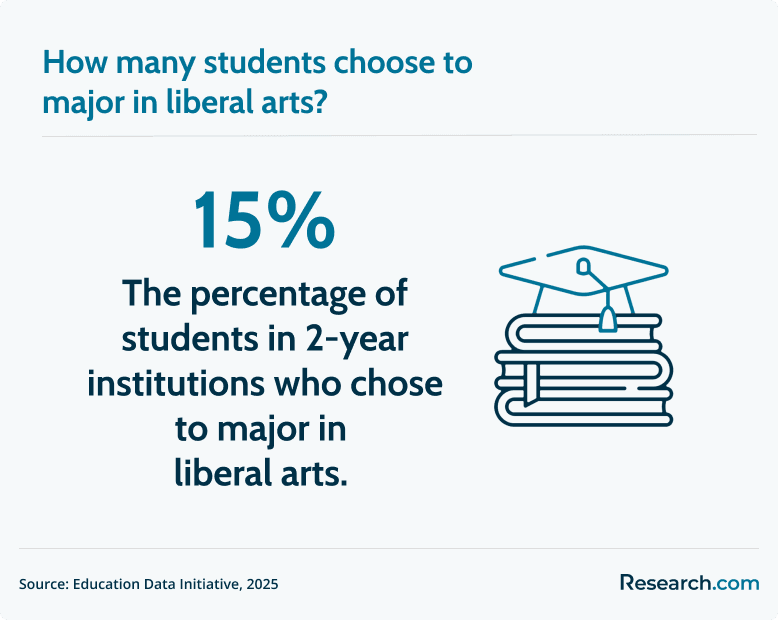
You do not always need a program labeled “accelerated” to graduate sooner. Many students shorten their timeline by combining transfer credits, summer enrollment, careful advising, and efficient course sequencing. According to the Education Data Initiative, 15% of college students chose to major in liberal arts, and many of these students need flexible ways to complete their degree efficiently.
- Request a transfer credit review before enrolling: Ask how each prior course will apply to your degree, not just how many credits the school will accept.
- Use AP, CLEP, IB, military, or prior college credits when allowed: These credits can satisfy general education or elective requirements and reduce the number of courses you still need.
- Take summer and winter courses: Year-round enrollment can prevent long gaps between terms.
- Choose courses that satisfy multiple requirements: Some interdisciplinary classes may count toward humanities, ethics, diversity, or writing requirements.
- Build a term-by-term graduation map: Work with an advisor to avoid missing prerequisite courses or required classes offered only in certain terms.
- Do not overload recklessly: Taking the maximum number of credits only helps if you can maintain your grades and complete the work.
- Use available academic resources early: Writing centers, tutoring, library support, and advisor check-ins can help you avoid withdrawals or repeated courses.
Students pursuing creative or media-related interests may also compare liberal arts coursework with more specialized options, such as online audio and music degree programs, before deciding which degree structure best supports their goals.
Financial aid options for online liberal arts students
Online liberal arts students may qualify for federal aid, institutional aid, employer tuition support, state grants, and private scholarships, depending on the school and the student’s eligibility. Before enrolling, confirm that the institution is accredited and participates in aid programs that fit your situation. Students interested in visual storytelling or related creative fields can also compare liberal arts pathways with the best online cinematography degree programs.
The following scholarship and funding options may be relevant to students interested in communication, media, writing, arts, or humanities fields:
- The Fulbright U.S. Student Program (Amount Varies): Supports graduating seniors, graduate students, and young professionals pursuing research, graduate study, or English teaching abroad in over 140 partner countries.
- ISF Media Scholarship ($3,000 to $5,000): Offered by the Islamic Scholarship Fund for students preparing for careers in media, communications, and writing, especially work connected to Muslim representation in American media.
- Against the Grain Artistic Scholarship ($1,000): Supports Asian American students in performing arts, visual arts, journalism, or mass communications.
- Media Fellows Scholarship ($750): An essay-based scholarship from the Washington Media Scholars Foundation for undergraduates interested in public policy, media, and advertising.
- L. Ron Hubbard Writers of the Future Contest ($5,000): A contest for amateur science fiction and fantasy writers judged by professionals in the field.
Students planning to connect liberal arts study with psychology may also review accelerated online psychology degree programs to compare costs, timelines, and specialization options.
Admission requirements for accelerated online liberal arts programs
Admission standards vary by institution, but accelerated online liberal arts programs commonly look for evidence that students can handle compressed coursework, independent study, and writing-heavy assignments. Transfer students should pay close attention to credit evaluation rules because those policies often determine whether the program is truly fast.
| Requirement | What students should prepare |
| High school diploma or equivalent | Most programs require a high school diploma or GED. |
| Prior college credit | Some accelerated options are built for students with an associate degree or previous coursework. |
| Minimum GPA | Programs may expect a GPA of 2.0 to 3.0, though some schools may consider conditional admission. |
| Technology access | Students need reliable internet, a computer, and the ability to use online learning platforms. |
| Communication readiness | Expect essays, discussions, presentations, and research assignments. |
| Time management | Short terms require consistent weekly study time and quick turnaround on assignments. |
The same readiness principles apply to many intensive online programs. For contrast, students exploring healthcare-related advanced study can examine accelerated online Pharm.D. programs, where workload, prerequisites, and clinical expectations are far more specialized.
Common courses in an online liberal arts degree
Liberal arts programs are intentionally broad. Instead of training students for one narrow technical task, they build written communication, interpretation, ethical reasoning, quantitative awareness, cultural understanding, and research skills. Course titles differ by school, but many programs include subjects like the following:
- Introduction to Philosophy: Covers logic, ethics, knowledge, and major questions about human experience.
- World Literature: Develops close reading, cultural interpretation, and analytical writing through texts from different periods and regions.
- American History or Government: Examines institutions, civic life, political development, and social change in the United States.
- Intercultural Communication: Studies how language, culture, identity, and context shape communication.
- Introduction to Psychology or Sociology: Explores individual behavior, social systems, and the ways people function within communities.
- Digital Literacy in the Humanities: Applies online tools to research, analyze, organize, and present information.
- Creative Expression or Fine Arts: Introduces visual art, creative writing, performance, or other forms of cultural production.
Students interested in human services or mental health careers should understand the difference between undergraduate preparation and professional licensure. A helpful starting point is this guide comparing a social worker and psychologist.
The chart below shows how liberal arts graduates are distributed across selected industries and job sectors.
Specializations available in online liberal arts degree programs
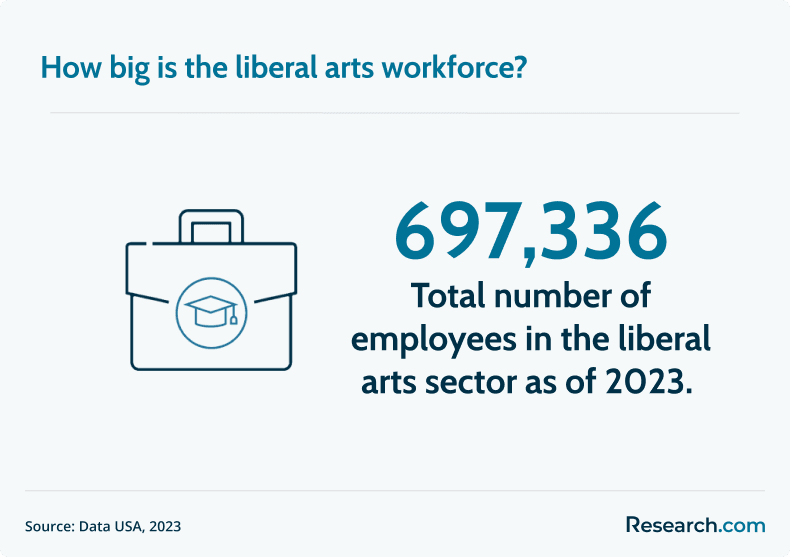
Data USA reports that 697,336 people were employed in the liberal arts sector as of 2023. Because the field is broad, students should use specializations, electives, minors, certificates, internships, or capstone projects to give the degree a clearer direction.
| Specialization | What you study | Potential direction |
| Communication Studies | Writing, public speaking, persuasion, and digital media | Marketing, public relations, journalism, corporate communication |
| Psychology | Behavior, cognition, development, and social interaction | Human services, HR, graduate study, organizational roles |
| Philosophy | Logic, ethics, argumentation, and major philosophical traditions | Law preparation, ethics, writing, policy, graduate study |
| Cultural and Ethnic Studies | Race, identity, culture, equity, and global communities | Advocacy, education, nonprofit work, community engagement |
| Political Science | Government, public policy, political systems, and international relations | Policy work, public administration, campaigns, research |
| English or Literature | Textual analysis, writing, interpretation, and literary history | Editing, technical writing, content strategy, publishing |
| History | Historical research, social change, institutions, and archival methods | Museums, archives, education, research, public history |
| Interdisciplinary Studies | Customized coursework across multiple fields | Flexible career planning, degree completion, graduate preparation |
| Creative Writing | Fiction, nonfiction, poetry, editing, and narrative craft | Publishing, media, content creation, graduate writing programs |
A specialization should not be chosen only because it sounds interesting. It should connect to your next step: employment, graduate school, a teaching pathway, communication work, nonprofit leadership, or another defined goal.
How to choose the best accelerated online liberal arts degree program
The best program is not automatically the shortest one. A fast degree can become expensive or frustrating if credits do not transfer, required classes are unavailable, advising is weak, or the curriculum does not support your goals. Use the following criteria before applying.
- Confirm accreditation: Choose a program from an accredited institution so your degree is more likely to be recognized by employers, graduate schools, and transfer institutions.
- Get a written transfer evaluation: Ask how previous college, military training, AP, CLEP, or IB credits apply to specific degree requirements.
- Compare the total cost, not only tuition: Include fees, books, technology costs, repeated courses, and the number of credits you must complete after transfer.
- Check course delivery: Asynchronous classes work well for unpredictable schedules, while synchronous classes may suit students who want live interaction.
- Review concentration options: Look for courses in psychology, communication, creative writing, philosophy, history, or another area tied to your career plan.
- Ask about term length and start dates: Short courses and frequent start dates can reduce delays, but they also require stronger time management.
- Look for graduate pathways: If you plan to continue your education, ask whether undergraduate credits can apply toward a master’s program.
- Request a graduation plan: A good advisor should be able to show the likely sequence of courses and an estimated completion timeline.
If your long-term goal involves psychology, counseling, research, or academic work, it may also help to understand how to get a doctorate in psychology before choosing undergraduate electives.
Common mistakes to avoid when choosing a fast online liberal arts degree
| Mistake | Why it can hurt you | Better approach |
| Choosing based only on the advertised completion time | The fastest timeline may apply only to students with many transfer credits. | Ask for a personalized degree audit before enrolling. |
| Ignoring accreditation | Unrecognized programs can create problems with credit transfer, graduate admission, or employer acceptance. | Verify the institution’s accreditation status before applying. |
| Comparing only cost per credit | A lower rate may not mean a lower total cost if fewer credits transfer or fees are high. | Calculate the full remaining cost to graduate. |
| Overloading every term | Compressed courses can lead to burnout, withdrawals, or lower grades. | Balance speed with realistic weekly study time. |
| Choosing no concentration or career direction | A broad degree may be harder to explain to employers without a focused skill story. | Select electives, projects, or internships tied to a target role. |
| Assuming online means self-paced | Many online courses still have weekly deadlines and group expectations. | Review the syllabus format and attendance requirements. |
Career paths for online liberal arts degree graduates
Liberal arts graduates often pursue roles that require writing, research, interpretation, communication, people skills, or policy awareness. The degree is broad, so career outcomes depend heavily on specialization, experience, internships, additional credentials, and the industry targeted.
- Technical Writer: Converts complex information into clear documentation, manuals, help content, training materials, or web resources.
- Social Worker: Supports people and communities through advocacy, case management, and service coordination, though professional social work roles may require additional education or licensure.
- Editor: Revises and shapes written content for publications, digital media, organizations, or publishing teams.
- Urban Planner: Applies research and civic knowledge to community development, housing, transportation, and sustainability work.
- Policy Analyst: Studies public issues, evaluates evidence, and develops recommendations for government, nonprofit, or research organizations.
- Creative Writer: Produces fiction, nonfiction, poetry, scripts, essays, or media content using narrative and editorial skills.
The chart below provides average annual salaries for selected career paths associated with liberal arts preparation.
Job outlook for graduates with an online liberal arts degree
The job outlook for liberal arts graduates depends on the specific role, industry, location, experience level, and any additional credentials required. A broad degree can be valuable, but students should connect it to a marketable skill set such as writing, communication strategy, human resources, research, public policy, or digital content.
According to the US Bureau of Labor Statistics (2024), selected roles connected to common liberal arts concentrations have the following projected growth from 2023 to 2033:
- Advertising, Promotions, and Marketing Manager (Communication Studies): Employment is projected to grow 8% from 2023 to 2033, with about 36,600 openings expected annually.
- Technical Writer (English): Employment is projected to grow 4% from 2023 to 2033, with about 4,100 openings expected per year.
- Historians and Archivists (History): Employment for historians is projected to grow 6% during the decade, with about 300 openings annually.
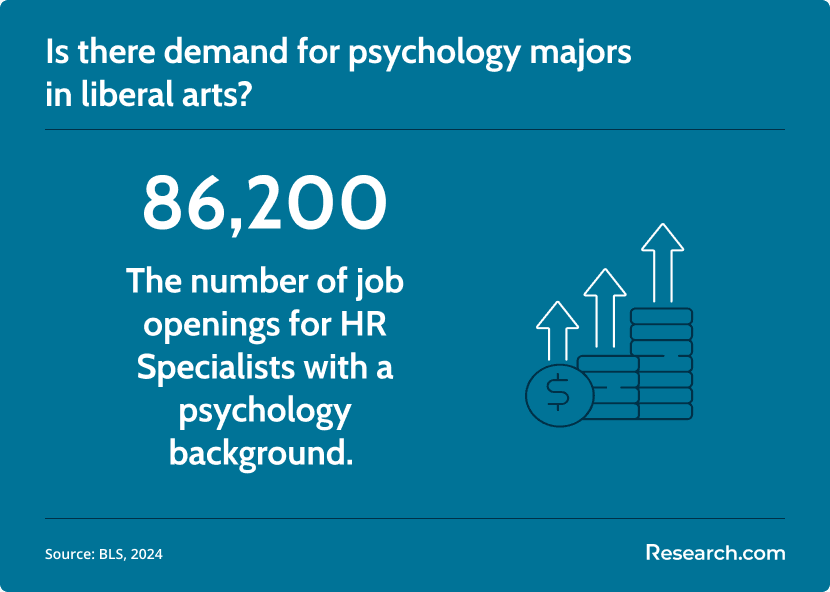
- Human Resources Specialist (Psychology): Employment is projected to grow 8% from 2023 to 2033, with an estimated 86,200 openings each year.
Students interested in psychology, business, and workplace behavior can also explore business psychologist salary and career pathways when planning future education.
What is the ROI of an accelerated online liberal arts degree?
The return on investment of an accelerated online liberal arts degree depends on total cost, transfer credits, time to completion, career goals, and whether the degree helps you qualify for advancement or graduate study. A shorter program can reduce opportunity cost if it helps you finish sooner, but speed alone does not guarantee a positive financial return.
To evaluate ROI, compare the number of credits you still need, the cost per credit, required fees, scholarship eligibility, employer reimbursement, and likely career outcomes. Working adults who need lower-cost online options can also compare the cheapest online universities for working adults.
Can an accelerated online liberal arts degree prepare you for graduate school?
Yes, an accelerated online liberal arts degree can support graduate study if the program builds strong writing, research, analysis, and argumentation skills. These skills are useful in master’s programs across communication, education, public administration, humanities, social sciences, psychology-related fields, and interdisciplinary studies.
Students should confirm that their undergraduate program is accredited and that they complete any prerequisites required by the graduate programs they plan to enter. Those who want to continue quickly after finishing a bachelor’s degree can compare 1-year online master’s programs.
Is an accelerated online liberal arts degree useful for healthcare administration and other specialized sectors?
An accelerated online liberal arts degree can be useful in specialized sectors when paired with relevant experience, targeted electives, certificates, or graduate training. In healthcare administration, for example, communication, ethics, cultural competency, writing, and organizational thinking can support leadership and coordination roles, but many advanced positions may require healthcare-specific education or experience.
Students considering this direction should compare liberal arts coursework with sector-specific credentials and review the MHA job outlook before deciding whether to pursue graduate study in healthcare administration.
Questions to ask before enrolling
- How many of my previous credits will apply directly to the liberal arts degree requirements?
- Is the institution accredited by a recognized accreditor?
- What is the total estimated cost to graduate after transfer credits are evaluated?
- Are courses asynchronous, synchronous, or a mix of both?
- How often are required courses offered?
- Can I study part-time without losing access to financial aid or the accelerated pathway?
- Does the program offer concentrations or electives connected to my career goal?
- What academic advising, writing support, library access, and career services are available to online students?
- Will this degree meet any requirements for graduate school, teacher preparation, or professional goals I have?
- What happens if I need to pause for a term because of work, family, military, or health responsibilities?
References
- Against the Grain Productions. (n.d.). ATG Artistic Scholarship. Against the Grain Productions. Retrieved 11 July 2025.
- Antioch University. (n.d.). Liberal Studies, BA – AULA. Antioch University. Retrieved 11 July 2025.
- Chestnut Hill College. (n.d.). Liberal Studies AADP. Chestnut Hill College. Retrieved 11 July 2025.
- Crimson Education. (n.d.). What Can You Do With a Liberal Arts Degree? Crimson Education. Retrieved 11 July 2025.
- Data USA. (n.d.). Liberal Arts and Humanities. Data USA. Retrieved 11 July 2025.
- Education Data Initiative. (n.d.). College Enrollment Statistics. Education Data Initiative. Retrieved 11 July 2025.
- Fresno State. (n.d.). Reconnect Program in Liberal Arts. Fresno State. Retrieved 11 July 2025.
- Harvard Extension School. (n.d.). Bachelor of Liberal Arts Degree Program. Harvard Extension School. Retrieved 11 July 2025.
- Indeed. (n.d.). What Can You Do With a Liberal Arts Degree? Indeed. Retrieved 11 July 2025.
- Islamic Scholarship Fund. (n.d.). ISF Media Scholarship. Islamic Scholarship Fund. Retrieved 11 July 2025.
- Ivy Tech Community College. (n.d.). Liberal Arts. Ivy Tech Community College. Retrieved 11 July 2025.
- Marian University. (n.d.). Liberal Arts - MAP Academics. Marian University. Retrieved 11 July 2025.
- Rollins College. (n.d.). Accelerated Master of Liberal Studies. Rollins College. Retrieved 11 July 2025.
- River Valley Community College. (n.d.). Liberal Arts Open Pathway Online Accelerated. River Valley Community College Catalog. Retrieved 11 July 2025.
- St. Catherine University. (n.d.). Liberal Studies Associate of Arts. St. Catherine University. Retrieved 11 July 2025.
- University of Arizona Global Campus. (n.d.). Online Degrees – Liberal Arts. University of Arizona Global Campus. Retrieved 11 July 2025.
- University of Maine. (n.d.). CLAS Accelerated Programs. University of Maine. Retrieved 11 July 2025.
- US Bureau of Labor Statistics. (n.d.). Human Resources Specialists. US Bureau of Labor Statistics. Retrieved 11 July 2025.
- US Bureau of Labor Statistics. (n.d.). Liberal Arts Field of Degree. US Bureau of Labor Statistics. Retrieved 11 July 2025.
- ZipRecruiter. (n.d.). Liberal Arts Salary. ZipRecruiter. Retrieved 11 July 2025.
Key Insights
- Accelerated online liberal arts degrees can often be completed in 1 to 2 years, but that timeline usually depends on transfer credits, course load, and year-round enrollment.
- The best program is the one that combines recognized accreditation, a realistic graduation plan, strong transfer credit acceptance, and courses connected to your goals.
- Cost per credit is only one part of affordability. Always calculate total remaining credits, fees, books, aid, and the cost of any courses you may need to repeat.
- Liberal arts degrees are strongest when students add direction through a concentration, capstone, internship, certificate, or graduate school plan.
- Fast programs require discipline. Shorter terms can help you graduate sooner, but they also compress reading, writing, projects, and exams into a tighter schedule.
- Before enrolling, request a written transfer evaluation and ask exactly which courses remain. That single step can prevent unexpected delays and unnecessary tuition costs.
Other Things You Need to Know About Accelerated Online Liberal Arts Degree Programs
To identify the fastest online liberal arts degree programs in 2027, research institutions offering accelerated formats, check for flexible course schedules, and confirm the possibility of earning a degree in 12-18 months. Look for accredited programs to ensure quality and recognition in the job market.
To ensure credibility, verify that the program is accredited by a recognized accrediting agency, review alumni outcomes, and check faculty qualifications. Research the institution's reputation and consult independent reviews or student testimonials to gauge program quality and effectiveness in 2027.
Admission requirements typically include a high school diploma or GED, transcripts, and sometimes standardized test scores. Some programs may also require a personal statement and letters of recommendation. Check specific program criteria for accurate details.
Yes. Many accredited programs accept up to 90 transfer credits toward a 120-credit bachelor’s degree, and some also award credit for CLEP exams or prior military training. Schools set their own transfer policies, so applicants must check course equivalency rules before enrolling.




