2027 Fastest Online Digital Photography Degree Programs

Co-Founder and Chief Data Scientist
Choosing an accelerated online digital photography program is not just a question of speed. The real decision is whether the credential, curriculum, faculty feedback, portfolio support, and total cost will help you build work that clients, employers, galleries, or creative teams will take seriously.
This guide is for students, career changers, freelancers, visual artists, content creators, and working adults who want a faster route into professional photography without moving to campus. You will learn how online photography degrees and certificates differ, what programs may cost, which schools offer accelerated or flexible options, how accreditation affects transfer credit and financial aid, and how to judge whether a program is worth the investment.
Photography is also changing quickly. AI editing tools, hybrid photo-video workflows, social media content demand, and camera-to-cloud production have raised employer and client expectations. A strong program should teach more than camera settings. It should help you develop a professional portfolio, understand business practices, use industry-standard software, and adapt to a market where many photographers are self-employed.
Quick answer: Are accelerated online digital photography programs worth it?
An accelerated online digital photography program can be worth it if you need structured training, portfolio feedback, business preparation, and a recognized credential while studying on a flexible schedule. It is less useful if you already have a strong portfolio, steady clients, and only need one or two technical skills that could be learned through a shorter workshop or certificate.
The best option depends on your goal. A certificate can help you improve skills quickly. An associate degree can prepare you for entry-level creative work or transfer. A bachelor’s or BFA program offers deeper artistic development, critique, general education, and stronger preparation for long-term creative careers.
What are the main benefits of an online digital photography qualification?
- Career preparation: Coursework can support roles such as commercial photographer, portrait photographer, photojournalist, photo editor, digital retoucher, studio assistant, and content creator.
- Portfolio development: A good program requires completed projects, critiques, revisions, and a final body of work that can be shown to clients or employers.
- Flexible study: Online and accelerated formats can help students complete coursework while working, freelancing, caring for family, or building a business.
- Technical fluency: Students typically practice camera operation, lighting, exposure, digital workflow, file management, and post-production in tools such as Adobe Lightroom and Photoshop.
- Business readiness: Programs that include entrepreneurship, copyright, pricing, client communication, marketing, and contracts are especially valuable because many photographers work independently.
What should you expect from the fastest online digital photography degree programs?
Accelerated online photography programs compress creative and technical training into shorter terms, year-round schedules, self-paced coursework, or transfer-friendly degree plans. The pace can be convenient, but it also means students must be ready to shoot regularly, submit assignments on deadline, revise based on critique, and manage equipment and software requirements from home.
| Program feature | What it means for students | Why it matters |
| Condensed schedule | Courses may run in shorter terms or allow faster completion through full-time study. | You may finish sooner, but weekly workload can be intense. |
| Portfolio-focused assignments | Students complete projects in areas such as portraits, lighting, landscapes, commercial work, or visual storytelling. | Your portfolio is often more important than the credential alone when seeking clients or creative jobs. |
| Online critique | Faculty and peers review images through galleries, discussion boards, video meetings, or annotated feedback. | Constructive critique helps students refine style, composition, editing, and concept development. |
| Digital workflow training | Programs may cover editing, file organization, color correction, output, and image delivery. | Professional clients expect consistent editing, fast turnaround, and organized delivery systems. |
| Required technology | Students usually need a capable camera, lenses, computer, storage, and editing software. | Equipment costs can affect the true price of the program. |
Where can you work with an online digital photography degree?
Digital photography graduates work across creative, commercial, editorial, and entrepreneurial settings. Many do not follow a single employer-based career path. Instead, they combine freelance assignments, contract work, content production, editing, and niche specialization.
- Freelance and small business photography: Many photographers build businesses around weddings, portraits, families, events, real estate, product photography, or local commercial clients.
- Commercial and advertising work: Brands, agencies, e-commerce companies, and corporate marketing teams need images for campaigns, product pages, social media, websites, and promotional materials.
- Media and publishing: Photojournalists, editorial photographers, and photo editors may work with newspapers, magazines, online publications, book publishers, and digital media outlets.
- In-house content roles: Universities, healthcare systems, retailers, nonprofits, and large companies may hire photographers or multimedia specialists for marketing and communications teams.
- Post-production and retouching: Skilled editors can specialize in image correction, compositing, retouching, digital asset preparation, and visual consistency for campaigns.
How much can you make with an online digital photography degree?
Photography earnings vary widely because income depends on specialization, location, client base, employment type, portfolio strength, and business skills. A degree does not guarantee a salary. It can, however, help you build the technical and creative foundation needed to compete for paid work.
- Entry-level roles: Assistant photographers and junior staff photographers may earn between $35,000 and $50,000 annually.
- Experienced photographers: Established staff photographers and freelancers with steady clients often earn between $50,000 and $75,000.
- Top-tier specialists: Commercial, advertising, fashion, luxury wedding, and other high-demand specialists can earn well over $100,000 per year through salaries, project fees, licensing, or business revenue.
- Fastest Online Digital Photography Degree Programs for 2027
- What is the average cost of an online digital photography program?
- What are the financial aid options for online digital photography programs?
- What are the prerequisites for enrolling in an online digital photography program?
- How do you choose the best online digital photography program?
- What career paths are available for graduates of online digital photography programs?
- How much can I earn with an online digital photography degree?
- How does accreditation impact the value of an online digital photography degree?
- How can online digital photography degrees support advanced academic research and professional growth?
- What is the job market for graduates with an online digital photography degree?
- What are some current and future trends in digital photography?
- How can integrating creative writing enhance my photography career?
- How does an online digital photography degree compare with other accelerated online programs?
- Can combining digital photography with interdisciplinary studies boost career prospects?
Fastest Online Digital Photography Degree Programs for 2027
The programs below include online photography degrees, photography-focused certificates, and related visual arts programs that can support digital photography careers. They are not identical credentials, so compare degree level, accreditation, transferability, cost, portfolio support, and whether the program’s focus matches your career goal.
| School or provider | Credential | Program length | Tuition listed | Accreditation listed |
| Academy of Art University | Associate of Arts in Photography | 2 years (full-time) | $1,301 per unit | Western Association of Schools and Colleges Senior College and University Commission (WSCUC) |
| Arizona State University | Online Bachelor of Fine Arts in Art – Digital Photography | 40 classes (7.5 weeks per class; typically 4 years full-time) | Arizona resident or non-resident online tuition: $7,582/year | Higher Learning Commission (HLC) |
| Liberty University | Bachelor of Fine Arts in Graphic Design with photography coursework | 3.5 years (average) | $390 per credit (full-time, undergraduate online); military undergraduate: $250/Credit | Southern Association of Colleges and Schools Commission on Colleges (SACSCOC) |
| New York Institute of Photography | Professional Photography Course certificate | Self-paced (typically 6–12 months) | $899 total | Distance Education Accrediting Commission (DEAC); Better Business Bureau (BBB) |
| University of Washington | Certificate in Photography | 9 months | $5,595 total | Northwest Commission on Colleges and Universities (NWCCU) |
| Rocky Mountain College of Art + Design | Online BFA in Photography | 4 years | $750/credit | Higher Learning Commission (HLC) |
| Sessions College for Professional Design | Associate Degree in Digital Photography | 2 years (full-time) or less | $300 per credit | Distance Education Accrediting Commission (DEAC) |
| Southern New Hampshire University | Online Associate Degree in Photography | 8 weeks | $330/credit | New England Commission of Higher Education (NECHE) |
1. Academy of Art University
The Academy of Art University Associate of Arts in Photography is available online and on campus and is built around a 60-unit structure intended to introduce students to photographic technique, visual communication, and creative practice. The curriculum includes 24 units of core courses, 15 units in the major, 18 in liberal arts, and a 3-unit sophomore portfolio. Courses such as Photography Principles and Techniques and People Photography help students strengthen both technical control and image-making judgment.
Students work with camera capture, lighting, Photoshop-based editing, print preparation, and portfolio development. The program also emphasizes concept, presentation, and communication, which matters for students who plan to pitch projects, explain creative choices, or pursue client-based work.
- Program Length: 2 years (full-time)
- Tracks/Concentrations: Not specified
- Tuition Cost: $1,301 per unit
- Required Credits to Graduate: 63 units
- Accreditation: Western Association of Schools and Colleges Senior College and University Commission (WSCUC)
2. Arizona State University (ASU Online)
Arizona State University’s online BFA in Art – Digital Photography is a bachelor’s-level program centered on expressive, conceptual, and technical photography. Students complete assignments involving portraits, landscapes, video, and print-to-order books while developing visual literacy and participating in critique.
The program is best suited to students who want a full fine arts pathway rather than a short technical course. Students are expected to build a cohesive portfolio, write about their artistic direction, and use feedback from faculty and peers to refine their work.
- Program Length: 40 classes (7.5 weeks per class; typically 4 years full-time)
- Tracks/Concentrations: Digital Photography
- Tuition Cost: Arizona resident or non-resident online tuition: $7,582/year
- Required Credits to Graduate: 120 credit hours
- Accreditation: Higher Learning Commission (HLC)
3. Liberty University
Liberty University offers a fully online Bachelor of Fine Arts in Graphic Design that includes photography-related coursework. This option may appeal to students who want photography skills but also want broader training in design, branding, digital media, and visual communication.
Students study subjects such as studio lighting, image editing, design fundamentals, and portfolio preparation. Because the credential is a graphic design BFA rather than a standalone photography degree, applicants should review the course plan carefully to confirm that the photography content is deep enough for their intended career.
- Program Length: 3.5 years (average)
- Tracks/Concentrations: Photography
- Tuition Cost: $390 per credit (full-time, undergraduate online); military undergraduate: $250/Credit
- Required Credits to Graduate: 120 credits
- Accreditation: Southern Association of Colleges and Schools Commission on Colleges (SACSCOC)
4. New York Institute of Photography
The New York Institute of Photography Professional Photography Course is a fully online, self-paced certificate program covering core digital photography skills. Topics include camera operation, lighting, composition, digital workflow, and post-processing.
This option is shorter than a degree and may fit beginners, hobbyists moving toward paid work, or working photographers who want structured feedback without committing to a two- or four-year program. Students complete projects and receive input from professional photographers, with the goal of producing portfolio-ready images and pursuing certification as a Certified Professional Photographer (CPP).
- Program Length: Self-paced (typically 6–12 months)
- Tracks/Concentrations: Professional Photography; certification as a Certified Professional Photographer (CPP)
- Tuition Cost: $899 total
- Required Credits to Graduate: Not applicable (certificate program)
- Accreditation: Distance Education Accrediting Commission (DEAC); Better Business Bureau (BBB)
5. University of Washington
The University of Washington offers a fully online Certificate in Photography for students who want focused training in technical execution and creative development. Coursework covers camera operation, lighting, composition, workflow, and image editing.
The certificate format is useful for learners who already have a degree, are testing a career change, or want guided practice before launching freelance services. Students complete hands-on assignments, receive instructor feedback, and build portfolio material while studying remotely.
- Program Length: 9 months
- Tracks/Concentrations: Photography
- Tuition Cost: $5,595 total
- Required Credits to Graduate: Not explicitly stated (certificate program)
- Accreditation: Northwest Commission on Colleges and Universities (NWCCU)
6. Rocky Mountain College of Art + Design
Rocky Mountain College of Art + Design offers an online BFA in Photography designed to prepare students for multiple photography careers. The program addresses lighting, post-production, video, visual storytelling, portfolio development, business practices, and entrepreneurship.
RMCAD’s program may be a better match for students who want a full bachelor’s-level art education and are willing to invest time in critique, concept development, and professional practice. Graduates may pursue work in advertising, portraiture, architecture, drone photography, documentary photography, photojournalism, cinematography, or retouching.
- Program Length: 4 years
- Tracks/Concentrations: Not specified
- Tuition Cost: $750/credit
- Required Credits to Graduate: 123 credits
- Accreditation: Higher Learning Commission (HLC)
7. Sessions College for Professional Design
Sessions College for Professional Design offers a fully online Associate Degree in Digital Photography for students seeking practical preparation for freelance or entry-level creative work. The program covers photographic language, equipment use, software, production methods, commercial assignments, and portfolio development.
The flexible format may suit independent learners who need schedule control. Students receive instructor feedback and complete projects connected to real-world photography and digital production. It can also serve as a stepping stone for students who later want to continue into a bachelor’s program.
- Program Length: 2 years (full-time) or less
- Tracks/Concentrations: Digital Photography
- Tuition Cost: $300 per credit
- Required Credits to Graduate: 72 credits
- Accreditation: Distance Education Accrediting Commission (DEAC)
8. Southern New Hampshire University (SNHU)
Southern New Hampshire University’s online Associate Degree in Photography combines digital photography training with humanities coursework. Students study camera operation, lighting, editing, entrepreneurship, brand development, and industry responsibilities.
This program may appeal to students looking for an online associate pathway with career-oriented support. The curriculum includes portfolio work and legal topics that can help students better understand ownership, client use, and professional obligations.
- Program Length: 8 weeks
- Tracks/Concentrations: Digital Photography
- Tuition Cost: $330/credit
- Required Credits to Graduate: 20 courses
- Accreditation: New England Commission of Higher Education (NECHE)
What is the average cost of an online digital photography program?
The cost of an online digital photography program depends on credential level, school type, course load, transfer credits, technology fees, and required equipment. Tuition is only one part of the total investment. Students should also budget for a camera body, lenses, lighting, storage, a computer capable of editing large files, backup systems, and software subscriptions.
| Credential type | Typical use case | Cost information from this guide | Best fit |
| Certificate | Focused skill building, portfolio refresh, or career testing | Certificate programs may cost between $3,000 and $15,000, while listed examples include $899 total and $5,595 total. | Students who want faster training without a full degree commitment |
| Associate degree | Entry-level preparation or transfer pathway | A two-year online associate degree from a community college can range from $10,000 to $30,000 in total tuition; listed examples include $300 per credit, $330/credit, and $1,301 per unit. | Beginners who want structured training and a credential below the bachelor’s level |
| Bachelor’s or BFA degree | Deeper artistic development, critique, and broader career preparation | A four-year online bachelor’s degree can cost anywhere from $30,000 to $70,000 at a public university and $60,000 to $120,000 or more at a private institution; listed examples include $7,582/year, $390 per credit, and $750/credit. | Students seeking a full undergraduate degree, transfer opportunities, or long-term creative career development |
Photography students comparing credentials should also look at adjacent creative programs. Some short courses resemble online certifications that pay well in the sense that they are career-focused and faster than a degree. Students deciding between photography, content production, and media business may also compare costs with a fast-track online bachelor’s degree in entertainment business.
Before enrolling, ask each school for a complete cost breakdown. Include tuition, fees, required software, camera requirements, printing or output costs, portfolio expenses, and any travel or in-person requirements. A higher tuition price does not automatically mean stronger industry preparation, so compare outcomes, student work, faculty experience, and portfolio support.
In 2023, photographers held approximately 151,100 jobs. The work can involve long periods of standing or walking while carrying heavy equipment. Employment patterns also show how entrepreneurial the field is: self-employed workers made up 65% of photographer positions. Photographic services accounted for 17% of jobs, while publishing, broadcasting, and content providers represented 4%, retail trade accounted for 3%, and arts, entertainment, and recreation made up 2%.
This distribution matters when evaluating tuition. Because many graduates will need to operate like business owners, programs that teach pricing, contracts, marketing, client relations, and workflow may provide more practical value than programs focused only on technique.
What are the financial aid options for online digital photography programs?
Students in accredited online photography degree programs may be eligible for many of the same financial aid options available to campus-based students. Eligibility depends on the school, credential type, enrollment status, and whether the institution participates in federal aid programs.
Students considering a combined visual pathway, such as photography plus design, may also compare aid policies for the fastest online graphic design degree programs, especially if they want broader preparation for branding, advertising, or digital media roles.
- FAFSA: The Free Application for Federal Student Aid is the starting point for federal grants, work-study, and federal student loans.
- Scholarships: Schools, arts organizations, private foundations, and photography groups may offer awards based on financial need, academic merit, portfolio quality, or creative promise.
- Grants: Grants usually do not need to be repaid. The federal Pell Grant is a common undergraduate option for students with exceptional financial need.
- Federal student loans: Federal loans often provide borrower protections and repayment options that private loans may not offer.
- Private student loans: Private loans can help cover gaps but should be compared carefully because rates, fees, and repayment terms vary.
- Payment plans: Some schools allow students to divide tuition payments across a semester or term instead of paying all at once.
- Employer or military benefits: Working adults, veterans, active-duty service members, and military families should ask about tuition assistance, discounts, and benefit eligibility.
Apply for aid early and ask each school whether the specific online photography credential qualifies for federal aid. Some certificates and non-degree programs may have different aid rules than associate or bachelor’s degrees.
What are the prerequisites for enrolling in an online digital photography program?
Admission requirements vary by school and credential level. Certificate programs may be open to beginners, while BFA programs may request a portfolio and stronger evidence of artistic readiness. You do not need a 2 year computer science degree to apply to photography programs, but comfort with digital tools, file management, and editing software will help.
| Requirement | Where it is common | How to prepare |
| High school diploma or GED | Most certificate, associate, and bachelor’s programs | Request official records early and confirm minimum GPA policies. |
| Academic transcripts | Degree programs and transfer applicants | Submit records from high school and any colleges previously attended. |
| Portfolio | Many BFA programs and some associate programs | Select 10-20 photographs that show range, composition, lighting awareness, and personal vision. |
| Personal statement or essay | Selective art and design programs | Explain your creative interests, influences, goals, and why the program fits your direction. |
| SAT or ACT scores | Some bachelor’s programs | Check whether the school is test-optional or still requires scores. |
| Technology readiness | Most online photography programs | Confirm required camera, lenses, computer specifications, internet access, and editing software. |
Creative programs in photography, design, and accelerated online fashion merchandising programs often value visual storytelling, market awareness, and the ability to communicate ideas. For portfolio-based admissions, quality and intention usually matter more than having expensive equipment.
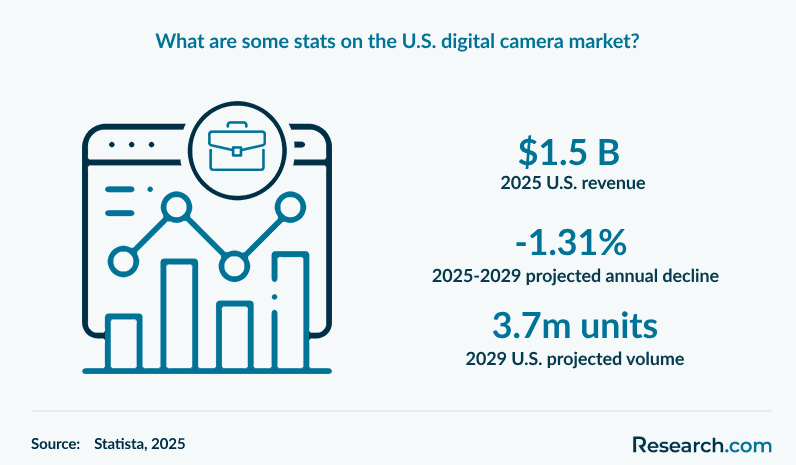
In 2025, the digital camera market in the United States is projected to generate US$1.5 billion in revenue, or approximately US$4.40 per person. China is expected to generate US$6.3 billion. The U.S. market is projected to decline annually by -1.31% between 2025 and 2029, with volume expected to decrease by 1.0% in 2026 and reach 3.7 million units by 2029.
Those figures do not mean photography skills are disappearing. They suggest that students should pay attention to the difference between consumer camera sales and professional image-making demand. High-end, enthusiast, and content creator segments still depend on specialized quality, controlled workflows, and advanced features that smartphones do not fully replace.
How do you choose the best online digital photography program?
The best online photography program is the one that fits your career goal, budget, schedule, learning style, and portfolio needs. Rankings and speed can be useful starting points, but they should not replace a careful review of accreditation, curriculum, student work, faculty experience, and career support.
| Decision factor | What to check | Warning sign |
| Accreditation | Confirm institutional accreditation and whether credits can transfer. | The school avoids clear accreditation details or uses vague claims. |
| Curriculum | Look for lighting, editing, composition, critique, workflow, business, portfolio, and current software training. | The course list is outdated or focuses only on basic camera settings. |
| Faculty | Review instructor portfolios, professional background, exhibitions, publications, or client work. | Faculty pages do not show current creative or professional experience. |
| Portfolio support | Ask how often students receive critique and what final portfolio or capstone is required. | The program promises career outcomes but does not show student work. |
| Online format | Compare asynchronous coursework, live sessions, deadlines, peer interaction, and feedback turnaround. | The format does not match your schedule or learning style. |
| Career preparation | Look for internships, career advising, business coursework, client communication, and alumni examples. | The program teaches art but ignores pricing, contracts, marketing, and client delivery. |
| Total cost | Add tuition, fees, equipment, software, storage, printing, and portfolio presentation. | The school lists tuition but does not disclose required supplies or technology expenses. |
Accreditation should be one of your first checks. Researching nationally accredited online colleges can help you understand how institutional recognition works, but also compare regional accreditation, transfer policies, and employer expectations for your intended career path.
Students who want to run a studio, freelance business, or content brand should also look for business training. Some photography students compare creative programs with the fastest bachelor’s in entrepreneurship online options to decide whether they need a broader business degree or a photography program with strong entrepreneurial coursework.
Questions to ask before enrolling
- Is this a degree, certificate, course, or concentration?
- Who accredits the institution, and does the program qualify for federal financial aid?
- How many photography-specific courses are included?
- How often will I receive detailed feedback from faculty?
- Can I see current student portfolios and graduate work?
- What camera, lens, software, and computer specifications are required?
- Does the program teach pricing, contracts, copyright, licensing, and client communication?
- Are courses asynchronous, synchronous, self-paced, or term-based?
- Will credits transfer if I continue to another degree?
- What career services are available to online students?
Common mistakes to avoid
- Choosing only by speed: The fastest program is not always the best if it lacks critique, portfolio depth, or current workflow training.
- Ignoring accreditation: Unclear accreditation can affect financial aid, credit transfer, graduate study, and employer recognition.
- Underestimating equipment costs: Tuition may look manageable until camera gear, storage, software, and computer requirements are added.
- Assuming all online programs are flexible: Some online programs require live critiques, fixed deadlines, or intensive weekly production.
- Relying only on school marketing: Review real student work, alumni outcomes, course descriptions, and faculty portfolios.
- Skipping business training: Many photographers are self-employed, so pricing, contracts, marketing, and client management are essential.
What career paths are available for graduates of online digital photography programs?
An online digital photography credential can support many creative careers, but the path is usually portfolio-driven. Photography may appear on lists of easy online degrees, but serious programs require consistent shooting, editing, critique, revision, and business preparation.
| Career path | Typical responsibilities | What helps you stand out |
| Freelance photographer | Book clients, plan shoots, edit images, deliver files, manage pricing and contracts. | A clear niche, strong portfolio, client reviews, reliable workflow, and marketing skills. |
| Staff photographer | Create images for a company, university, media outlet, hospital, retailer, or nonprofit. | Consistent technical quality, deadline reliability, and ability to follow brand guidelines. |
| Photo editor | Select, sequence, crop, correct, and prepare images for publication or digital use. | Editorial judgment, metadata skills, copyright awareness, and software fluency. |
| Digital retoucher | Perform advanced image correction, compositing, skin retouching, color work, and campaign preparation. | High-end Photoshop skills, precision, style matching, and before-and-after samples. |
| Studio manager | Coordinate scheduling, clients, billing, equipment, assistants, and production logistics. | Organization, communication, budgeting, and knowledge of photography operations. |
| Gallery assistant or curator | Support exhibitions, artist communication, artwork handling, documentation, and public programming. | Art history knowledge, writing ability, curation experience, and strong visual analysis. |
Some graduates expand into adjacent visual fields. Students interested in motion, visual effects, or multimedia production may explore the shortest online animation degrees. Those who want to combine still photography with lighting, framing, motion, and narrative production may compare fast-track cinematography programs online.
Other interdisciplinary paths are possible. A photographer who wants to teach or work abroad might combine visual arts with one of the cheapest online ESL graduate certificate programs. Product and fashion photographers may add niche craft or design knowledge through the cheapest jewelry design classes. Documentary and travel photographers may benefit from the cultural perspective developed in the cheapest anthropology online programs.
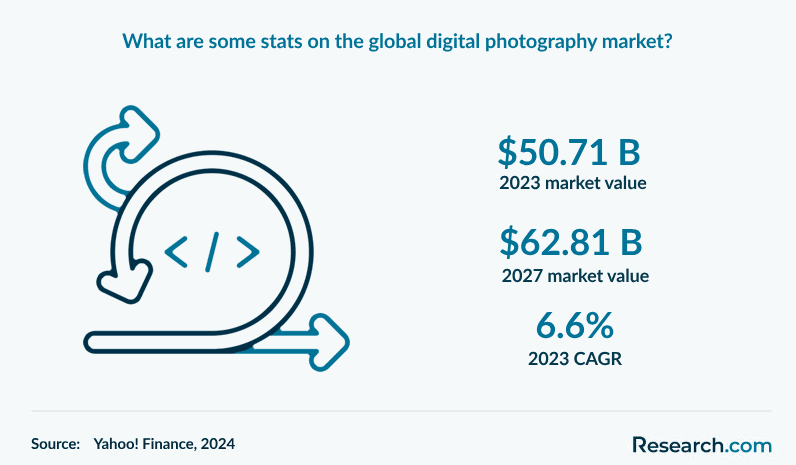
The global digital photography market has shown growth, expanding from $47.59 billion to $50.71 billion in 2023, a compound annual growth rate (CAGR) of 6.6%. Projections show the market reaching $62.81 billion by 2027, supported by a CAGR of 5.5%.
For students, the key takeaway is not that every photography job is easy to get. It is that images remain central to commerce, journalism, entertainment, education, social media, and documentation. Graduates who combine creative skill with business, editing, video, and digital distribution abilities are better positioned than those who rely only on camera technique.
How much can I earn with an online digital photography degree?
Photography pay is highly variable. Location, job title, specialization, client base, employment type, and portfolio quality can matter more than the degree itself. Students should treat salary data as a planning tool, not a promise.
- Median national wage: According to the U.S. Bureau of Labor Statistics, the median annual wage for photographers was $45,940 as of May 2023.
- Entry-level range: New photographers and assistants often earn between $30,000 and $45,000 per year.
- Experienced professional range: Photographers with several years of experience and a strong portfolio may earn between $50,000 and $75,000.
- High-earning specialists: Photographers in commercial advertising, fashion, luxury weddings, and other profitable niches can earn $100,000 or significantly more annually.
- Freelance income: Freelancers may earn less predictably but can raise revenue through higher-value clients, licensing, retouching, recurring contracts, workshops, or content products.
Salary.com reported in June 2025 that the national average salary for a photographer I was $61,598, with a typical compensation range between $46,156 and $69,202. For that title, pay rises modestly by experience level: entry-level professionals average $59,937, intermediate professionals average $60,647, senior professionals average $61,522, and experts with over eight years of experience average $61,814.
Specialization and job title can create larger differences. A photographer III averages $91,501, a freelance photographer averages $78,611, and a scientific photographer averages $54,239. Location also changes earning potential: photographer I salaries average $68,202 in the District of Columbia and $67,943 in California, compared with $54,934 in Mississippi and $55,648 in Arkansas.
Some visual professionals expand their earning options by pairing photography with storytelling, writing, or interactive media. For example, photographers who develop narrative skills may explore what can you do with an MFA, while creatives interested in games, virtual production, concept art, or 3D environments may consider an accelerated online game art and design degree.
The strongest salary gains often come from moving into higher-level roles, entering better-paying niches, building a strong client base, or working in higher-paying locations. Experience helps, but it is not the only driver of photography income.
How does accreditation impact the value of an online digital photography degree?
Accreditation matters because it can affect financial aid eligibility, credit transfer, graduate school options, and how employers or institutions view your credential. For photography, the portfolio is still central, but institutional credibility can make a difference when applying for jobs, transferring credits, or pursuing advanced study.
Students should confirm whether the school is accredited by a recognized institutional accreditor and whether the specific credential is a degree, certificate, course, or concentration. This is especially important when comparing photography with other fields where credential recognition can shape career options, such as when researching what jobs can you get with a library science degree.
How can online digital photography degrees support advanced academic research and professional growth?
Online photography programs can support more than entry-level skill building. Strong programs introduce research methods, visual analysis, critique, conceptual development, archival practice, digital production, and interdisciplinary collaboration. These skills can help students pursue graduate study, teach, publish, exhibit, or develop specialized creative projects.
Students who plan to move into higher education, arts administration, research, or advanced leadership may later compare graduate and doctoral pathways, including 2 year doctoral programs education. Photography itself may not require a doctorate, but advanced credentials can be relevant for teaching, curriculum design, research, or institutional leadership.
What is the job market for graduates with an online digital photography degree?
The photography job market is competitive, but demand for visual content remains steady across digital media, e-commerce, marketing, events, education, journalism, and social platforms. Graduates should expect to compete on portfolio quality, niche expertise, reliability, editing speed, client service, and business strategy.
- Overall outlook: The U.S. Bureau of Labor Statistics projects 4% growth for photographers between 2023 and 2033.
- Employment base: In 2023, there were 151,100 jobs in the field.
- Projected change: The 2023 to 2033 outlook is expected to add approximately 5,800 new jobs.
- Median pay: According to 2025 data from the U.S. Bureau of Labor Statistics, the median pay for photographers in 2024 was $42,520 per year, or $20.44 per hour.
- Freelance reality: Because 65% of photographers were self-employed workers in 2023, graduates need entrepreneurial skills as much as technical skill.
Students should not assume that a degree alone will secure work. A stronger strategy is to graduate with a targeted portfolio, a niche, a professional website, basic contracts, pricing knowledge, editing consistency, client communication skills, and a plan for finding paid assignments. Some visual storytellers also combine photography with writing and compare creative graduate options through resources on MFA degree salary.
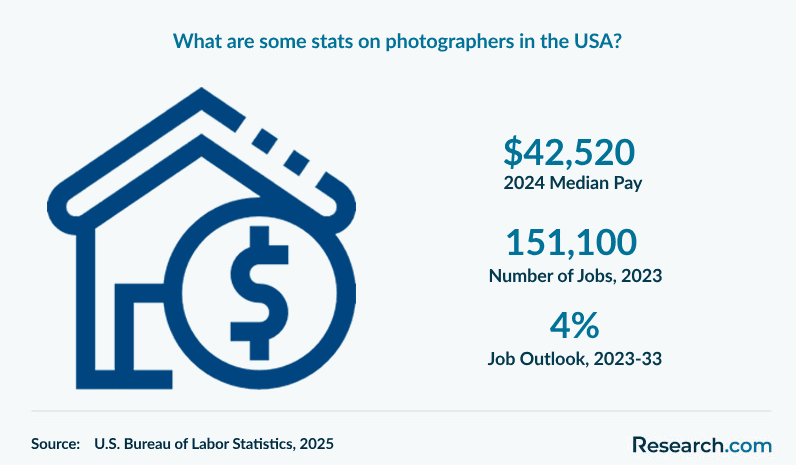
Overall, the data points to a field with average projected growth and a high level of competition. Online graduates can compete effectively when their portfolios demonstrate real skill and when they understand how to market, price, and deliver professional work.
What are some current and future trends in digital photography?
Digital photography is being reshaped by AI, hybrid media production, cloud workflows, authenticity concerns, and content demand across platforms. Students should look for programs that teach adaptable workflows rather than only traditional camera operation.
Photographers who want to pair image-making with audience strategy may compare photography training with the fastest online social media degree programs, especially if they plan to work in content marketing, personal branding, or creator-driven businesses.
- AI-powered editing and automation: AI tools now assist with subject selection, masking, noise reduction, retouching, generative editing, and workflow acceleration. Students should learn both how to use these tools and how to disclose or limit them when authenticity matters.
- Hybrid photo-video production: Many clients expect photographers to capture both stills and video. High-end mirrorless cameras increasingly support professional video features such as 6K/8K recording, internal raw video formats, and advanced audio controls. Students interested in sound and multimedia may also compare the fastest online audio and music degree programs.
- Camera-to-cloud workflows: Real-time upload, remote review, and cloud collaboration are becoming more common for event, commercial, editorial, and studio production.
- Content authenticity and provenance: As AI-generated images become more common, secure metadata and image-origin verification are increasingly important for journalism, documentary work, legal evidence, and brand trust.
- Computational photography: Techniques such as stacking multiple images for improved dynamic range or noise reduction are becoming more automated in advanced cameras and software.
The practical lesson for students is clear: learn image-making, but also learn workflow. Future-ready photographers will understand lighting, composition, editing, metadata, delivery, authenticity, short-form video, and platform-specific content requirements.
What do graduates say about accelerated online digital photography programs?
-
: "
The online photography program changed the direction of my career. I focused on fashion photography, practiced advanced Adobe Creative Cloud editing, finished through a fast-track option in 18 months, and used career services to secure a magazine internship. The pace was demanding, but it pushed me creatively. Maya
"
-
: "
I was moving out of a military career and needed training that respected my schedule. The online BFA I completed in under two years was rigorous, and peer critique helped me improve faster than I expected. I now operate my own portrait studio. Andre
"
-
: "
I studied online because I needed to stay home and care for my younger siblings. The program still felt connected, and the business courses helped me start a wedding photography business before graduation. Edgardo
"
How can integrating creative writing enhance my photography career?
Creative writing can strengthen a photography career by improving storytelling, artist statements, captions, project proposals, exhibition text, grant applications, client pitches, and documentary narratives. Strong writing helps photographers explain why an image matters, not just how it was made.
Photographers who want to build narrative-driven portfolios, publish photo essays, develop personal projects, or write stronger client proposals may benefit from exploring writing degrees online. The combination is especially useful for documentary, editorial, fine art, travel, nonprofit, and brand storytelling work.
How does an online digital photography degree compare with other accelerated online programs?
An online digital photography degree is highly applied, visual, and portfolio-based. Students spend time shooting, editing, receiving critique, and building a body of work. By contrast, a program such as an accelerated bachelor’s degree in mathematics online emphasizes quantitative reasoning, proof, data analysis, and structured problem solving.
| Program type | Main skill set | Best for |
| Online digital photography | Visual storytelling, camera control, lighting, editing, critique, portfolio development, client workflow | Creative students who want freelance, commercial, editorial, or visual media careers |
| Online mathematics | Quantitative reasoning, abstract thinking, modeling, analysis, and problem solving | Students pursuing analytical, technical, research, education, or data-related paths |
| Interdisciplinary creative study | Combines visual work with writing, media, business, technology, education, or archiving | Students who want broader creative options or niche expertise |
Can combining digital photography with interdisciplinary studies boost career prospects?
Yes, interdisciplinary study can make a photographer more versatile when it adds practical skills aligned with a real career goal. For example, pairing photography with library science can support work in digital asset management, archives, cultural institutions, metadata, preservation, and visual collections.
Students interested in curation, archiving, image databases, museum work, or institutional collections may compare photography training with the best affordable online master’s in library science. The value comes from a clear connection between the added field and the type of photography work you want to do.
Key Insights
- Speed should not be the only reason you choose a program. A fast online photography credential is valuable only if it includes strong critique, current software training, portfolio development, and practical business preparation.
- Credential type matters. Certificates are faster and more focused, associate degrees can support entry-level work or transfer, and BFA programs provide deeper artistic development and broader undergraduate training.
- Accreditation affects practical value. It can influence financial aid, transfer credits, graduate study, and institutional recognition, even though employers and clients will still judge your portfolio heavily.
- Photography is entrepreneurial. In 2023, 65% of photographers were self-employed workers, so students should prioritize programs that teach pricing, contracts, marketing, client service, and workflow.
- The U.S. digital camera market is not the same as the photography job market. The U.S. market is expected to generate US$1.5 billion in revenue in 2025 and decline annually by -1.31% through 2029, but demand for professional visual content remains tied to marketing, e-commerce, media, and creator platforms.
- Global photography demand continues to show growth. The global digital photography market expanded from $47.59 billion to $50.71 billion in 2023 and is projected to reach $62.81 billion by 2027.
- Salary depends heavily on role, specialization, and location. Salary.com reported a 2025 average of $61,598 for photographer I, while the U.S. Bureau of Labor Statistics reported 2024 median pay of $42,520 for photographers.
- AI and hybrid media skills are now important. Future-ready photographers should understand AI editing, video capture, cloud collaboration, metadata, authenticity, and platform-specific image delivery.
- The best program fit is personal. Before enrolling, compare total cost, equipment requirements, student portfolios, faculty experience, accreditation, feedback quality, transfer policies, and career support.
References:
- Salary.com. (2025, June 1). Photographer I salary (United States). Salary.com.
- Statista. (2025). Digital cameras in the United States. In Consumer electronics: TV, radio & multimedia. Statista.
- The Business Research Company. (2024, June 28). Global Digital Photography Market Poised for Growth, Expected to Reach $66.68 Billion by 2028. Yahoo Finance.
- U.S. Bureau of Labor Statistics. (2025, April 18). Photographers. In Occupational Outlook Handbook. U.S. Department of Labor. U.S. Bureau of Labor Statistics.
Other Things You Should Know About the Fastest Digital Photography Degree Programs
Yes. Many colleges accept up to 60 transfer credits for an associate degree and up to 90 for a bachelor’s degree, which can cut completion time by one year or more. Final acceptance depends on regional accreditation and the school’s transfer policy.
The fastest online digital photography degree programs in 2026 can typically be completed in 12 to 18 months. These accelerated programs are designed for students who can commit to an intensive curriculum and wish to enter the photography field quickly.