2027 Video Game Design Degree Guide: Costs, Requirements & Job Opportunities

Co-Founder and Chief Data Scientist
Choosing a video game design degree is not just about finding a school that sounds creative. It is a career decision that affects your portfolio, technical skill set, internship access, debt level, and the types of studios or technology teams that may consider you after graduation. The stakes are higher because the global video game industry reached $260 billion in 2025 and is projected to reach $320 billion by 2030, representing a 10.2% compound annual growth rate, with substantial employment opportunities emerging across development, design, and publishing sectors.
This guide is for students comparing game design degrees, parents evaluating program value, career changers looking for a creative technology path, and working professionals who want to move into interactive media. You will learn what these programs teach, how long they take, what they cost, which schools offer notable options, how salaries vary, what employers look for, and how to decide whether a game design degree is the right investment for your goals.
Quick answer: Is a video game design degree worth it?
A video game design degree can be worth it if the program helps you build a strong playable portfolio, teaches both creative and technical production skills, connects you with internships or studio-style projects, and fits your budget. It is usually most valuable for students who want structured training in game systems, programming, visual design, interactive storytelling, production workflows, and team-based development.
However, a degree alone does not guarantee a job in gaming. Employers often evaluate candidates by their portfolio, shipped projects, collaboration experience, tools knowledge, and ability to solve design problems. Before enrolling, compare curriculum depth, software access, faculty experience, career outcomes, accreditation, tuition, and opportunities to complete real games rather than only class exercises.
What are the benefits of getting a video game design degree?
- Broader career options: A strong program can prepare you for roles such as game designer, game artist, gameplay programmer, level designer, QA tester, producer, technical artist, or interactive media developer. Employers in technology, education, media, simulation, entertainment, and start-ups use game design skills. According to Glassdoor, companies associated with game designer hiring include Electronic Arts, Blizzard Entertainment, Microsoft, Amazon, and Riot Games.
- Portfolio-driven training: Degree programs typically require prototypes, team projects, capstones, and studio-style assignments. These projects can become the evidence employers use to evaluate your readiness.
- Preparation for remote and hybrid production: Many game teams now collaborate across locations using version control, project management systems, digital art pipelines, and virtual communication tools. Online or technology-heavy programs can help students practice these workflows.
- Potential access to competitive salaries: Taking into account multiple references, the mean salary for video game designers in the United States is roughly $89,809 annually. Actual earnings depend on role, studio size, location, technical specialization, portfolio quality, and experience.
What can I expect from a video game design degree?
A video game design degree usually combines design theory, technical development, visual production, storytelling, player experience, and collaborative project work. Students often study game design principles, programming, 3D modeling, animation, prototyping, production management, testing, and interactive narrative. The best programs do not treat games as isolated assignments; they require students to build, test, revise, and present playable work.
The average annual cost, including tuition and fees, for on-campus residents pursuing a video game design degree is about $9,286, with in-state tuition ranging from $8,604 to $13,992 and out-of-state tuition ranging from $14,647 to $38,970 per year. A bachelor’s degree commonly takes around four years, while associate, master’s, accelerated, and online options may follow different timelines.
| What to evaluate | Why it matters | What to look for |
| Curriculum balance | Game jobs often require both creative judgment and technical fluency. | Courses in design, programming, art, UX, production, testing, and interactive storytelling. |
| Portfolio development | Employers usually want proof that you can make playable work. | Team projects, capstones, prototypes, game jams, and public portfolio reviews. |
| Industry tools | Studios expect familiarity with common development pipelines. | Unity, Unreal Engine, 3D modeling tools, version control, scripting, and collaboration platforms. |
| Career support | Breaking into gaming is competitive. | Internship help, alumni networks, studio partnerships, resume reviews, and portfolio coaching. |
| Total cost | Tuition alone does not show the full investment. | Software, hardware, fees, living costs, supplies, and financial aid availability. |
Where can I work with a video game design degree?
Graduates can work in traditional game studios, technology companies, entertainment firms, education technology, simulation, healthcare training, marketing, media production, virtual reality, augmented reality, and start-ups. The same skills used to design engaging games can also support interactive training, serious games, user simulations, digital exhibits, and immersive brand experiences.
- Game designer: Builds rules, systems, mechanics, progression, player goals, and interaction loops.
- Game artist: Creates characters, environments, props, visual effects, animation, and other art assets.
- Game programmer: Writes code that implements gameplay features, systems, tools, interfaces, and performance improvements.
As reported by Glassdoor, recent hires in the video game design field include companies such as Electronic Arts, Blizzard Entertainment, Microsoft, Amazon, Riot Games, Activision, Disney Interactive, Epic Games, LucasArts, and Take-Two Interactive Software.
How much can I make with a video game design degree?
Across the cited sources, the average wage for video game designers in the United States is approximately $89,809 per year. Salary outcomes vary widely because “video game designer” can refer to entry-level design support, systems design, technical design, senior creative roles, or leadership positions.
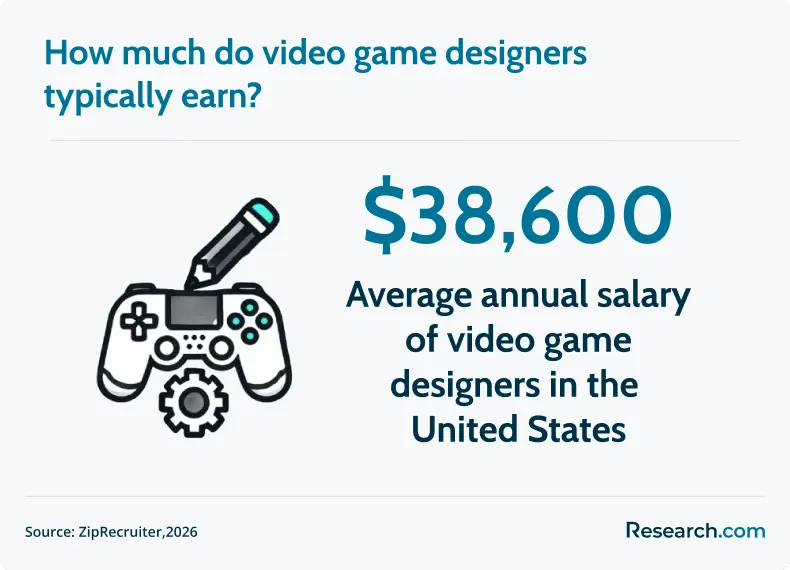
Zippia reports that the average annual salary for video game designers in the United States is approximately $95,185, with typical earnings ranging from $56,000 to $160,000. Coursera notes an average salary of $103,165 for video game designers, increasing to $121,628 with a master’s degree and $122,676 with a doctorate; individuals with an associate’s degree earn an average of $78,852. PayScale lists a 2024 average base salary of $69,076 for Video Game Designers, with a salary range between $43,000 and $110,000.
| Education level | Common early or advanced roles | Salary information cited |
| Associate degree | Game Tester, Junior Artist, production support, entry-level QA | Entry-level positions may offer $40,000 to $60,000 annually. |
| Bachelor’s degree | Game Designer, Game Programmer, Level Designer, Game Artist | Median salaries may range from $60,000 to $90,000. |
| Master’s degree | Lead Designer, Technical Director, Studio Manager, specialized technical or creative leadership | Salaries can exceed $100,000, especially in leadership roles. |
Use salary numbers as planning estimates, not promises. Location, specialization, shipped titles, portfolio strength, studio funding, and industry cycles can change compensation significantly.
- Best Video Game Design Degree Programs for 2027
- How long does it take to complete a video game design degree?
- What is the average cost of a video game design degree?
- What are the financial aid options for students enrolling in a video game design degree?
- What are the prerequisites for enrolling in video game design degree?
- What courses are typically in a video game design degree?
- What types of specializations are available in video game design degree?
- What are the core skills you’ll learn in a video game design degree?
- How to choose the best video game design degree?
- What career paths are available for graduates of video game design degree?
- What is the job market for graduates with a video game design degree?
- How does a video game design degree prepare students for emerging trends in the gaming industry?
- Should I complement my video game design degree with technical engineering courses?
- How can complementary creative disciplines enhance game design innovation?
- How can data analytics drive innovation in video game design?
- What emerging interdisciplinary fields can complement a video game design degree?
- What accreditation and industry recognition should prospective students consider?
- Can integrating computer science skills boost video game design careers?
- What is the long-term return on investment for a video game design degree?
- How does artificial intelligence reshape video game design education?
- Are online video game design programs a viable option?
- What mistakes should students avoid when choosing a game design program?
Best Video Game Design Degree Programs for 2027
How do we rank schools?
Because a game design education can require a major financial commitment, rankings should be used as one input rather than the only decision tool. Research.com’s approach draws on established education data sources, including the IPEDS database, Peterson’s database, the College Scorecard database, and The National Center for Education Statistics. These sources support comparisons of institutional data, costs, and program characteristics. For more detail on ranking criteria, review Research.com’s methodology page.
1. University of Southern California
The University of Southern California offers a Game Development and Interaction Design Bachelor of Fine Arts through the School of Cinematic Arts. This four-year program combines liberal arts study with focused preparation in interactive design and game development. Students complete pre-professional coursework through USC Dornsife College of Letters, Arts and Sciences and major coursework through the School of Cinematic Arts. The degree requires 128 units, with at least 56 units in the major.
- Cost: The median annual in-state public tuition for similar programs is $4,329, while the median out-of-state private tuition is $38,495.
- Course Requirements: The Master of Science in Game Design and Development is a two-year intensive program that requires 38 units, with 16 elective units and a 4-unit capstone requirement.
2. Carnegie Mellon University
Carnegie Mellon University’s IDeATe Game Design minor brings together art, craft, design, technology, and evaluation. Students work across disciplines while studying how games are made, tested, interpreted, and improved. The minor can be especially useful for students who want to add game design capability to another major.
- Cost: The undergraduate tuition and fees for the School of Computer Science at Carnegie Mellon University are $59,550 per year.
- Course Requirements: The undergraduate program exposes students to a wide range of topics, including game design, visual design, game programming, and game production.
3. Massachusetts Institute of Technology
MIT does not offer a single formal game development or game design degree, but the MIT Game Lab helps students shape individualized study plans around games. Students may connect game interests with game studies, psychology, computer science, media, design, or business. Graduate options include a 2-year Master of Science in Comparative Media Studies with a focus on games, broader computer science graduate programs, and opportunities to work with the MIT Game Lab through areas such as the MIT Media Lab and Sloan MBA program.
- Cost: The undergraduate tuition and fees for the Massachusetts Institute of Technology are $53,790 per year.
- Course Requirements: MIT offers a Bachelor of Science in Comparative Media Studies with a concentration in Games and Interactive Media, which includes courses in game design, interactive narrative, and digital media.
4. Stanford University
Stanford University offers a game design course that introduces students to the design language, analysis methods, and production context used in interactive entertainment. The Stanford University course emphasizes how designers evaluate games, communicate design ideas, study player behavior, understand game history, examine studio operations, and think about ethical monetization.
- Cost: The undergraduate tuition and fees for Stanford University are $56,169 per year.
- Course Requirements: Stanford offers a Bachelor of Science in Computer Science with a concentration in Human-Computer Interaction, which includes courses in game design, virtual reality, and interactive computer graphics.
5. University of Utah
The University of Utah’s Division of Games treats games as an interdisciplinary area that combines computation, art, humanities, design, and social science. The B.S. in Games prepares students for professional game industry work, while the Minor in Games serves students from other majors. The Master of Entertainment Arts and Engineering degree program focuses on interactive entertainment careers and includes studio simulation projects. Students pursuing the MBA/MEAE dual degree can also build business knowledge for game-focused ventures.
- Cost: The undergraduate tuition and fees for the University of Utah are $9,222 for residents and $29,066 for non-residents per year.
- Course Requirements: The Entertainment Arts and Engineering (EAE) Program at the University of Utah offers a Bachelor of Science in Games with courses in game design, game art, game engineering, and game production.
6. University of California, Santa Cruz
The University of California, Santa Cruz offers a Bachelor of Science in Computer Science: Computer Game Design that focuses on designing and building interactive computer games. The program combines technical, artistic, and narrative elements and includes opportunities to create games throughout the curriculum. Students complete an intensive year-long game project sequence during the final year.
- Cost: The undergraduate tuition and fees for the University of California, Santa Cruz are $14,025 for residents and $44,703 for non-residents per year.
- Course Requirements: UC Santa Cruz offers a Bachelor of Science in Computer Science: Computer Game Design, which includes courses in game design, game aesthetics, game systems, and interactive storytelling.
7. University of California, Irvine
UC Irvine’s Computer Game Science major combines computing, design, visual expression, and interactive storytelling. Housed under Informatics, the program includes coursework and capstone projects that support game programming, game design, and digital media production. Students also benefit from connections to the Video Game Development Club (VGDC) at UCI, where projects, workshops, and competitions can help strengthen practical skills.
- Cost: The undergraduate tuition and fees for the University of California, Irvine are $13,753 for residents and $43,531 for non-residents per year.
- Course Requirements: UC Irvine offers a Bachelor of Science in Computer Game Science, which includes courses in game design, game development, artificial intelligence for games, and multiuser game programming.
8. Rochester Institute of Technology
Rochester Institute of Technology’s Bachelor of Science Degree in Game Design and Development includes two cooperative education blocks that provide full-time, paid experience in the games industry or a related field. The program emphasizes game programming within a broader computing education, preparing students for work in games, simulation, modeling, training, visualization, and advanced study.
- Cost: The undergraduate tuition and fees for the Rochester Institute of Technology are $49,500 per year.
- Course Requirements: RIT offers a Bachelor of Science in Game Design and Development with courses in game design, game development, visual design, and interactive narrative.
9. Georgia Institute of Technology
Georgia Institute of Technology’s Bachelor of Science in Computational Media Media-Games blends computing, visual design, communication, and media history. Students study topics such as Computational Journalism, Computer Animation, Game Design as a Cultural Practice, and Video Game Design and Programming, preparing them for careers that require both technical implementation and digital media creativity.
- Cost: The undergraduate tuition and fees for the Georgia Institute of Technology are $12,682 for residents and $33,794 for non-residents per year.
- Course Requirements: Georgia Tech offers a Bachelor of Science in Computational Media with a concentration in Media Devices and Systems, which includes courses in game design, game studies, digital media, and interactive media.
10. Cornell University
Cornell University’s Game Design minor gives students a way to pair game design with another academic major. The minor includes foundation work such as Intro to Computer Game Architecture and advanced options including Advanced Computer Game Architecture or Analytics-driven Game Design. Additional coursework can include Graphics and Art, the Psychology of Gaming, and Human-Computer Interaction.
- Cost: The undergraduate tuition and fees for Cornell University are $60,286 per year.
- Course Requirements: Cornell offers a Bachelor of Science in Computer Science with a Game Design Track, which includes courses in game design, game development, computer graphics, and virtual environments.
Key findings before you compare programs
- BLS predicts 9.3% growth, 287,200 jobs for video game designers by 2026.
- Education can influence salary paths: associate degree holders may see $40-60k, bachelor’s degree holders may see $60-90k, and master’s degree holders may see $100k+, especially in leadership roles like Lead Designer.
- A typical undergraduate video game design program takes four years, an associate degree takes two years, and a master’s degree generally adds two more years for advanced specialization.
- On-campus residents in a video game design program pay approximately $9,286 annually for tuition and fees. In-state tuition varies from $8,604 to $13,992, while out-of-state tuition ranges between $14,647 and $38,970.
- Core coursework often includes design fundamentals, programming, 3D modeling, game development tools, interactive storytelling, UI/UX design, testing, and multiplayer design.
How long does it take to complete a video game design degree?
Completion time depends on degree level, transfer credits, enrollment status, internship requirements, and whether the program follows a traditional, accelerated, or online format.
- Associate Degree (2 years): A two-year associate program introduces the basics of game design, art, programming, and production. It may support entry-level roles or transfer into a bachelor’s program.
- Bachelor’s Degree (4 years): A four-year bachelor’s program usually provides deeper training in game systems, programming, art pipelines, design theory, prototyping, teamwork, and specialization options.
- Master’s Degree (2 years): A master’s degree typically requires two additional years after a bachelor’s degree and may focus on advanced design, research, production leadership, technical development, or specialized creative work.
Part-time students may take longer, while accelerated formats can shorten the timeline. Programs with internships, cooperative education, or large capstone projects may require careful scheduling but can improve portfolio strength.
This chart shows that the majority of game designers have a bachelor’s degree as their highest education attainment:
What is the average cost of a video game design degree?
The annual tuition and fee cost for on-campus residents in a video game design program is approximately $9,286. In-state tuition ranges from $8,604 to $13,992, while out-of-state tuition ranges from $14,647 to $38,970.
Students should also estimate the full cost of attendance, not only tuition. Game design students may need a capable computer, software subscriptions, drawing tablets, external storage, art supplies, travel for internships or showcases, and possible licensing or platform fees.
| Degree type | Typical cost range cited | Best fit |
| Associate Degree | For a two-year associate degree, the cost typically ranges from $20,000 to $60,000. | Students seeking lower-cost foundational training or a transfer pathway. |
| Bachelor’s Degree | A four-year bachelor’s degree in video game design may cost between $40,000 and $120,000. | Students who want a comprehensive credential, portfolio development, and access to internships. |
| Master’s Degree | A master’s degree can add $20,000 to $80,000, depending on the program and institution. | Students pursuing advanced specialization, leadership, research, or a career pivot. |
What are the financial aid options for students enrolling in a video game design degree?
Financial aid can come from federal programs, institutional aid, private scholarships, work-study, grants, and loans. Start by completing the Free Application for Federal Student Aid (FAFSA), then ask each school’s financial aid office about program-specific scholarships, portfolio scholarships, departmental grants, and paid campus work.
Scholarships and aid programs to review
- USC School of Cinematic Arts Endowed Scholarships: Amount: $25,000; Deadline: March 2, 2024.
- AIAS Foundation Scholarship: Amount: $2,500; Eligibility: Full-time undergraduate and graduate students in video game design or the video game industry.
- Deja Family Memorial Scholarship: Amount: $750.
- ESA Foundation Computer and Video Game Arts Scholarship: Amount: Varies; Deadline: April 15, 2024.
- Entertainment Software Association Scholarships: Awarded to approximately 400 women and minority students.
- IGDA Scholarships: Offered by the International Game Developers Association and includes Next Gen Leaders, Scholars, and Velocity scholarships.
- ESA Foundation Scholarship Program: Available for women and minority students; award amount varies.
- WomenIn Scholarship: Open to female students in video game arts and sciences; award amount varies.
- Mark Beaumont Scholarship: Amount: $2,500; intended for students pursuing a career in the video game industry.
- Randy Pausch Scholarship Fund: Supports students pursuing an undergraduate or graduate degree in a related field; Scholarship Amount: $2,500.
If you still have a funding gap after grants and scholarships, compare loan terms carefully. Private student loans may be available, but interest rates, repayment protections, and deferment options can vary. Work-study and paid internships can also reduce borrowing while helping you build relevant experience.
What are the prerequisites for enrolling in video game design degree?
Admissions requirements vary by school and degree level, but most programs want evidence that you can handle creative, technical, and collaborative coursework. Some programs are beginner-friendly; others expect a portfolio or prior programming exposure.
- High School Diploma or Equivalent: Most undergraduate programs require a high school diploma, GED, or comparable credential.
- Basic Computer Skills: Students should be comfortable using digital tools, file systems, productivity software, and online learning platforms.
- Portfolio or Project Samples: Selective programs may ask for artwork, prototypes, coding projects, design documents, animations, or other creative samples.
- Math and Science Proficiency: Programs with a stronger technical or programming focus may value preparation in algebra, physics, logic, or related analytical subjects.
- Letters of Recommendation: Some schools ask teachers, mentors, or professionals to comment on your creativity, work ethic, technical ability, or potential.
What courses are typically in a video game design degree?
Video game design curricula vary, but strong programs usually combine design thinking, software development, visual production, interaction design, narrative, testing, and project management. Students who want to pursue deeper technical leadership may also consider related training such as online software engineering degrees.
- Game Design Fundamentals: Introduces rules, mechanics, player motivation, feedback systems, difficulty curves, and the structure of engaging play.
- Programming for Games: Teaches scripting and coding concepts used to implement mechanics, systems, tools, interfaces, and interactive features.
- 3D Modeling and Animation: Develops skills for building characters, props, environments, motion, and visual assets used in game worlds.
- Game Development Tools: Provides hands-on practice with engines, prototyping tools, asset pipelines, and testing environments such as Unity or Unreal Engine.
- Interactive Storytelling: Explores narrative design, character development, branching choices, dialogue, pacing, and player agency. Students can also strengthen these abilities through storytelling skills and content creation.
- User Interface (UI) and User Experience (UX) Design: Focuses on menus, HUDs, accessibility, usability, player onboarding, and interaction flow.
- Game Testing and Quality Assurance: Covers bug reporting, playtesting, balancing, regression testing, usability feedback, and documentation.
- Multiplayer Game Design: Examines networking challenges, player interaction, matchmaking, communication, fairness, and collaborative or competitive systems.
- Game Production and Project Management: Teaches planning, team roles, scope control, milestones, documentation, scheduling, and communication.
Students who want to launch a studio, publish independently, or work on player acquisition should also understand business fundamentals and marketing video games.
What types of specializations are available in video game design degree?
Specializations help students align their coursework and portfolio with specific job targets. Choosing a concentration early can help you select better electives, build stronger projects, and apply for internships that match your strengths.
| Specialization | Focus | Best for students who enjoy |
| Game Programming | Coding, scripting, engine logic, gameplay systems, tools, and software development. | Solving technical problems and building functional systems. |
| Game Art and Animation | 2D art, 3D modeling, character design, animation, environments, and visual effects. | Creating the look, motion, and visual identity of games. Students may also start with graphic design online degree programs before specializing in games. |
| Narrative Design | Story structures, branching dialogue, characters, worldbuilding, and interactive narrative systems. | Writing, storytelling, player choice, and emotional engagement. |
| Virtual Reality (VR) and Augmented Reality (AR) | Immersive interfaces, spatial interaction, presence, comfort, and emerging platforms. | Designing experiences beyond traditional screens. |
| Level Design | Game spaces, missions, puzzles, pacing, progression, and environmental storytelling. | Shaping how players move, learn, explore, and overcome challenges. |
| Game Production and Management | Planning, budgets, scope, schedules, team coordination, and production leadership. | Organizing teams and guiding projects from concept to release. |
What are the core skills you’ll learn in a video game design degree?
A video game design degree builds a mix of creative, technical, analytical, and teamwork skills. Many of these abilities transfer to software development, digital media, simulation, education technology, UX design, and interactive marketing.
- Programming and Coding: Students learn to write scripts or code in languages such as C++ and Python, depending on the program. These skills support game logic, mechanics, systems, and tool development.
- 3D Modeling and Animation: Students practice building and animating assets used for characters, objects, environments, and scenes.
- Game Mechanics and Level Design: Learners design rules, challenges, environments, progression, feedback loops, and interactive systems that create engaging play.
- Storytelling and Narrative Development: Students learn how to shape characters, dialogue, worldbuilding, player choices, and emotional pacing.
- User Interface (UI) and User Experience (UX) Design: Students study usability, navigation, feedback, accessibility, player onboarding, and screen interaction. These skills can also support a graphic design career path.
How to choose the best video game design degree?
The right program depends on your career target, learning style, budget, portfolio needs, and current skill level. A student aiming to become a gameplay programmer should not evaluate programs the same way as a student focused on concept art, narrative design, or production management.
- Define the job you want first. Identify whether you are aiming for design, programming, art, UX, production, writing, technical art, or indie development.
- Check accreditation and institutional credibility. Confirm that the school is properly accredited and that the degree will be recognized by employers and graduate programs.
- Review the curriculum line by line. Look for required courses, electives, tools, project sequences, internships, capstones, and specialization options.
- Inspect student portfolios. A strong program should produce graduates with playable projects, polished art, technical demos, or documented design work.
- Ask about faculty experience. Faculty with industry, research, or shipped-project experience can bring practical insight into the classroom.
- Compare facilities and software access. Labs, studios, motion capture, VR equipment, game engines, rendering tools, and collaboration systems can affect hands-on learning.
- Verify internship and networking support. Programs with co-ops, studio partnerships, alumni communities, and portfolio events may offer better career access.
- Calculate total cost and likely debt. Include tuition, fees, housing, equipment, software, travel, and the time required to complete the degree.
Questions to ask before enrolling
| Question | Why it matters |
| How many finished games or major prototypes will I complete? | Your portfolio is often more important than a transcript alone. |
| Does the program teach Unity, Unreal Engine, or other current production tools? | Tool familiarity can shorten the ramp-up time for internships and junior roles. |
| Are internships, co-ops, or studio partnerships available? | Industry exposure can improve confidence, references, and job readiness. |
| What percentage of coursework is team-based? | Game development is collaborative, and employers value communication skills. |
| Can I specialize in programming, art, UX, narrative, production, or technical design? | Specialization helps you build a focused portfolio for a specific job market. |
| What are the additional equipment and software costs? | Game design can require more technology spending than some other majors. |
What career paths are available for graduates of video game design degree?
Graduates can pursue creative, technical, production, and testing roles. Entry-level titles vary by employer, but most candidates need evidence of completed work, collaboration, and problem-solving ability.
- Game Designer: Develops mechanics, systems, goals, progression, rules, documentation, and player experiences.
- Game Artist: Produces visual assets such as characters, environments, props, animations, textures, and interface elements.
- Game Programmer: Implements gameplay features, tools, AI systems, physics, interfaces, and performance improvements through code.
The field also faces representation and pay equity challenges. Currently, 13.3% of video game designers are women, while 86.7% are men. There is also a reported income gap, with male video game designers earning an average of $94,586 compared to $87,481 for their female counterparts. Students comparing programs should consider whether schools provide inclusive communities, mentorship, reporting systems, and equitable access to opportunities.
The following chart shows the big gap in gender share among video game designers.
What is the job market for graduates with a video game design degree?
The Bureau of Labor Statistics (BLS) projects a 15% growth in employment for software developers from through 2034, anticipating around 249,700 professionals in California alone in the United States. Game design graduates often compete in a broader technology and interactive media labor market, especially when their skills include programming, UX, simulation, digital media, or software development.
Industry opportunities are concentrated in states such as California, Texas, and Washington, with technology, education, and media identified as major employment sectors, mainly within private companies. Statistics on video training also point to the broader use of interactive and media-based learning.
- Expect competition. Many students want to work in games, so a generic degree without strong projects may not be enough.
- Build a specific portfolio. A systems designer, UI designer, 3D artist, gameplay programmer, and producer should not present identical portfolios.
- Develop transferable skills. Programming, UX, project management, simulation, analytics, and visual communication can open doors beyond entertainment games.
- Network before graduation. Game jams, internships, Discord communities, alumni events, conferences, and portfolio reviews can help students find leads and feedback.
How does a video game design degree prepare students for emerging trends in the gaming industry?
Game design education is changing as studios and interactive media teams adopt more advanced tools and production methods. Programs that prepare students for current trends usually include exposure to AR, VR, AI-assisted workflows, cloud-based collaboration, accessibility, analytics, UX research, and cross-platform development.
AR and VR coursework can help students design spatial interfaces and immersive experiences. AI and machine learning concepts can support adaptive gameplay, procedural content, NPC behavior, and player analytics. UX/UI training helps designers create interfaces that are usable, accessible, and engaging across devices and player groups. Students who want a deeper foundation in this area may compare options such as the cheapest UX design degree online.
Should I complement my video game design degree with technical engineering courses?
Technical engineering coursework can be useful for students interested in performance, hardware limitations, systems thinking, optimization, interactive devices, or software-hardware integration. Concepts from electrical engineering, digital signal processing, and circuit design can help designers communicate better with technical teams and understand constraints that affect game performance. If affordability is a concern, compare the electrical engineering degree online cost before adding a second credential or supplemental coursework.
How can complementary creative disciplines enhance game design innovation?
Game design depends heavily on visual communication, composition, motion, color, layout, and style. Students who strengthen their creative foundation may produce more coherent worlds, clearer interfaces, and stronger art direction. Coursework from related areas, including programs offered by cheap graphic design schools, can support skills in typography, composition, digital illustration, branding, and visual storytelling.
How can data analytics drive innovation in video game design?
Data analytics helps designers understand how players behave, where they quit, which features they use, how difficulty feels, and which systems need adjustment. Analytics can inform balancing, progression, monetization ethics, UX improvements, content planning, and live service updates. Students who want advanced quantitative skills may explore cheap data science masters programs online as a complement to game design training.
What emerging interdisciplinary fields can complement a video game design degree?
Game design connects naturally with simulation, training, education, healthcare, data systems, media studies, human factors, business analytics, and interactive research. For example, the user-centered systems and data management perspective found in an online bachelor degree in health informatics may support educational games, medical simulations, training platforms, or health-related interactive tools.
What accreditation and industry recognition should prospective students consider?
Accreditation is a baseline quality check. Prospective students should verify institutional accreditation, review whether credits are transferable, and confirm that the school’s credential will be accepted by employers or graduate programs. Industry recognition can also matter, but it should be evaluated carefully: advisory boards, internship pipelines, alumni outcomes, game showcase participation, and employer partnerships are more meaningful than vague promotional claims.
Students comparing online options can also review Research.com’s guide to game design schools online for additional program research.
Can integrating computer science skills boost video game design careers?
Yes. Computer science can make a game design graduate more competitive for technical design, gameplay programming, tools development, AI systems, engine work, simulation, and interactive software roles. A design-focused student does not always need a full computer science degree, but stronger programming, algorithms, data structures, and software engineering knowledge can expand career options. Students who want a faster technical path may compare an online bachelor's in computer science.
What is the long-term return on investment for a video game design degree?
The long-term ROI of a video game design degree depends on cost, debt, time to completion, portfolio quality, internships, specialization, and whether your skills transfer outside entertainment gaming. The strongest ROI usually comes from programs that help students build marketable projects while developing skills that apply to software, UX, simulation, digital media, analytics, and production.
Interdisciplinary thinking may also broaden opportunity. For example, students exploring simulation, training, or scientific visualization may find connections between interactive design and questions such as is biotechnology a good major, especially in sectors that use digital environments for learning or research.
How does artificial intelligence reshape video game design education?
Artificial intelligence is influencing how games are designed, tested, personalized, and produced. Game design students may encounter AI through procedural content generation, NPC behavior, adaptive difficulty, playtesting analytics, production tools, and player modeling. Programs that teach AI responsibly should also address ethics, bias, creative ownership, quality control, and the limits of automated systems.
Students who want to specialize in advanced AI systems may consider supplementing game design training with an accelerated online masters in artificial intelligence.
Are online video game design programs a viable option?
Online video game design programs can be viable if they provide rigorous coursework, portfolio-building projects, instructor feedback, collaboration tools, software access, and career support. They are especially useful for working adults, students with location constraints, and learners who need flexible scheduling.
The main risk is choosing an online program that is convenient but weak in hands-on development. A credible online program should still require prototypes, peer collaboration, game engines, critiques, testing, and a final portfolio. Students focused on cost should compare affordable online degrees while also checking accreditation, graduation requirements, technology fees, and internship access.
| Online game design may fit if... | Campus-based study may fit if... |
| You need schedule flexibility because of work or family obligations. | You want in-person labs, studio spaces, equipment, and face-to-face collaboration. |
| You are comfortable learning software independently and collaborating online. | You benefit from structured schedules and immediate in-person feedback. |
| You already have a computer setup that can handle design and development tools. | You need access to school-provided hardware, VR labs, motion capture, or specialized studios. |
| You are disciplined about building a portfolio outside class requirements. | You want a campus community with clubs, game jams, showcases, and local networking. |
What mistakes should students avoid when choosing a game design program?
- Choosing based on school name alone: A prestigious institution is not automatically the best fit if the curriculum does not match your target role.
- Ignoring accreditation: Accreditation affects credit transfer, financial aid eligibility, graduate school options, and employer confidence.
- Focusing only on tuition: Hardware, software, fees, housing, transportation, and lost work time can change the real cost.
- Assuming every program teaches programming deeply: Some programs are art- or design-heavy, while others are computer science-heavy. Read course descriptions carefully.
- Graduating without a portfolio: A transcript is rarely enough in game design. You need playable work, art samples, code samples, design documentation, or production evidence.
- Overlooking internships and networking: Career access often depends on relationships, referrals, game jams, showcases, and professional feedback.
- Assuming salary outcomes are guaranteed: Published salary figures are useful for planning, but individual results depend on role, skill, location, experience, and market conditions.
References
- Bureau of Labor Statistics, U.S. Department of Labor. (2024, January). Occupational Outlook Handbook, Web Developers and Digital Designers. Bureau of Labor Statistics. Retrieved January 17, 2024.
- Top Companies Hiring for Game Designer Jobs. (n.d.). Glassdoor. Retrieved January 17, 2024.
- Zippia (2025). Video game Designer Education Requirements. https://www.zippia.com/video-game-designer-jobs/education/
- Video game designer salary in 2024 | PayScale. (n.d.).
- ZipRecruiter (2026). Video Game Designer Salary. https://www.ziprecruiter.com/Salaries/Video-Game-Designer-Salary
- Recruiter.com. (n.d.). Career outlook and job vacancies for video game designers. Recruiter.
Key Insights
- A video game design degree is most valuable when it produces a strong portfolio, not just completed coursework.
- The best program depends on your intended role: designers, programmers, artists, UX specialists, producers, and narrative designers need different coursework and project evidence.
- Cost varies widely. Compare total cost, financial aid, equipment needs, and debt before committing.
- Employers often prioritize shipped projects, prototypes, collaboration experience, and technical fluency over the degree title alone.
- Online programs can work well, but only if they include real projects, critique, collaboration, tool access, and career support.
- Students can improve career flexibility by adding skills in computer science, UX/UI, data analytics, AI, graphic design, or simulation-related fields.
- Before enrolling, verify accreditation, inspect student work, ask about internships, and confirm that the curriculum matches the job you actually want.
Other Things You Should Know About Video Game Design Degrees
Most programs expect applicants to know at least one game engine, usually Unity or Unreal Engine, and basic 3D modeling or scripting in Python, C#, or C++. Some schools ask for a portfolio showing original game prototypes, digital art, or level-design work before admission.
Admission to a 2027 video game design degree typically requires a high school diploma or equivalent, a strong portfolio showcasing creativity and digital design skills, and sometimes standardized test scores. Some programs might also require a background in mathematics and computer science basics.
In 2027, the cost of pursuing a video game design degree varies widely depending on the institution, ranging from approximately $10,000 to $50,000 annually. Factors like location, school reputation, and available resources influence these costs, with possible additional expenses for software, equipment, and other materials.