
2027 Best Online MSN Family Nurse Practitioner Programs

Co-Founder and Chief Data Scientist
Choosing the right online Master of Science in Nursing (MSN) program is a crucial step for registered nurses aspiring to become Family Nurse Practitioners (FNPs). With so many options available, finding a program that fits your career goals, schedule, and budget can feel overwhelming.
In fact, according to the American Association of Nurse Practitioners, over 70% of NPs are certified in family care, making FNPs one of the most in-demand specializations in advanced nursing. This guide highlights the best online MSN-FNP programs, comparing key factors such as accreditation, flexibility, clinical placement support, and affordability.
What are the benefits of getting an online MSN family nurse practitioner (FNP) degree?
- Online MSN-FNP programs allow you to balance coursework with work and personal responsibilities by studying on your own schedule.
- Many programs can be completed in just 1–2 years, helping you advance your career more quickly.
- Earning your FNP degree online opens the door to higher-paying roles and greater autonomy in providing patient care.
What can I expect from an online MSN FNP program?
An online MSN Family Nurse Practitioner (FNP) program combines advanced nursing theory with clinical practice to prepare you for a more independent role in patient care. You can expect to take courses in areas like advanced pathophysiology, pharmacology, health assessment, and primary care across the lifespan.
Most programs include virtual lectures, interactive assignments, and in-person clinical rotations arranged in your local area. You'll also complete a set number of supervised clinical hours, typically between 500 to 700, to gain hands-on experience. While the coursework is rigorous, the online format offers the flexibility to learn at your own pace while continuing to work as an RN.
Where can I work with an online degree in MSN FNP?
With an online MSN FNP degree, you can work in a variety of healthcare settings that need advanced practice nurses. Common workplaces include primary care clinics, family practices, community health centers, and urgent care facilities.
Many FNPs also find opportunities in hospitals, telehealth services, schools, and even private practice. Your degree qualifies you to diagnose, treat, and manage patients across the lifespan, often with greater autonomy. Despite being earned online, your MSN FNP degree is equally respected as on-campus programs, provided it’s from an accredited institution.
How much can I earn with an online degree in MSN FNP?
With an online MSN Family Nurse Practitioner (FNP) degree, you can expect to earn a competitive salary, typically ranging from $120,000 to $130,000 annually, depending on your location, experience, and work setting. FNPs working in outpatient care centers or hospitals often earn on the higher end of the scale, while those in physician offices may earn slightly less.
In high-paying states like California or New York, salaries can exceed $140,000, with experienced or specialized FNPs earning upwards of $150,000 or more. Despite being earned online, your degree holds the same value as a traditional program, provided it’s from an accredited school, ensuring you're eligible for top-paying roles in advanced nursing practice.
Best Online MSN Family Nurse Practitioner Programs for 2027
Choosing an online MSN Family Nurse Practitioner program is a high-stakes decision for registered nurses because it affects certification eligibility, clinical placement, state licensure, tuition cost, and long-term career mobility. The right program can help you move into advanced primary care; the wrong one can create delays if it lacks proper accreditation, does not support clinical placements in your state, or does not align with your schedule.
This guide is for RNs comparing online MSN-FNP programs for 2027. It explains how the programs differ, what to check before applying, how online and campus formats compare, what costs to expect, and which career paths may be available after graduation. It also includes practical questions to ask admissions teams so you can make a decision based on fit, not just reputation or tuition.
Quick answer: What is the best online MSN FNP program?
The best online MSN FNP program is the one that is accredited, prepares graduates for national FNP certification, supports clinical placement in the student’s state, fits the student’s work schedule, and offers a realistic total cost. Programs in this guide include options from the University of Cincinnati, Sacred Heart University, University of West Florida, Arkansas State University, University of Missouri, Texas A&M University, Ohio University, Southern New Hampshire University, Walden University, and West Coast University.
Most online MSN FNP programs listed here take about two to three years to complete and require supervised in-person clinical hours. Accreditation by CCNE or ACEN is especially important because it can affect certification, licensure, employer recognition, and financial aid eligibility.
How Research.com evaluates online MSN FNP programs
Research.com rankings are built to help nurses compare programs using consistent, decision-focused criteria. We use Research.com’s ranking methodology and draw from reputable education data sources, including:
- IPEDS
- Peterson’s database, including the Distance Learning Licensed Data Set
- College Scorecard
- National Center for Education Statistics
Students should use this ranking as a starting point, then verify current tuition, state authorization, clinical placement policies, certification exam outcomes, and licensure alignment directly with each school.
Best online MSN Family Nurse Practitioner programs
The programs below are designed for nurses seeking advanced practice preparation in family-focused primary care. Because online FNP programs still require in-person clinical experience, applicants should confirm whether the school can approve clinical sites and preceptors in their state before enrolling.
| Rank | School and program | Program length | Credits and clinical hours | Tuition or cost listed | Accreditation |
| 1 | University of Cincinnati – MSN in Family Nurse Practitioner | Two years | 50 to 51 credit hours; 672 clinical hours | Tuition fees vary and need to be personally calculated by each student. | Commission on Collegiate Nursing Education (CCNE) |
| 2 | Sacred Heart University – MSN in Family Nurse Practitioner | Two to three years | 42 credit hours; 550 clinical hours | $955 per credit | Commission on Collegiate Nursing Education (CCNE) |
| 3 | University of West Florida – MSN in Family Nurse Practitioner | 27 to 30 months | 45 credit hours; 630 clinical hours | $500 per credit | Commission on Collegiate Nursing Education (CCNE) |
| 4 | Arkansas State University – MSN in Family Nurse Practitioner | 24 months | 41 credit hours; 750 clinical hours | $15,770 total tuition | Accreditation Commission for Education in Nursing (ACEN) |
| 5 | University of Missouri – MSN in Family Nurse Practitioner | Three years | 50.5 credit hours; at least 500 clinical hours | $661.50 per credit | CCNE |
| 6 | Texas A&M University – MSN in Family Nurse Practitioner | Three years | 48 credit hours; 672 clinical hours | $787.89 per credit | CCNE |
| 7 | Ohio University – MSN in Family Nurse Practitioner | Two years | 40 credit hours; 750 clinical hours | $700 per credit | CCNE |
| 8 | Southern New Hampshire University – MS in Nursing, Family Nurse Practitioner | 2.5 years | 51 credit hours; 750 clinical hours | $659 per credit | CCNE |
| 9 | Walden University – MSN in Family Nurse Practitioner | 24 months (BSN to MSN-FNP track); 30 months (RN to MSN-FNP track) | 58 credit hours (BSN to MSN-FNP track) / 84 credit hours (RN to MSN-FNP track); 640 clinical hours | $40,650 total tuition | CCNE |
| 10 | West Coast University – MSN in Family Nurse Practitioner | ~20 months (accelerated path); ~32 months (working professional pace) | 53 credit hours; ~650 clinical hours | Estimated total tuition around $40,345–$41,610. | CCNE |
1. University of Cincinnati – MSN in Family Nurse Practitioner
The online MSN-FNP from the University of Cincinnati is built for registered nurses who want to move into family-focused primary care. The program emphasizes assessment, diagnosis, treatment planning, prevention, and health promotion for patients across the lifespan. Graduates are prepared to pursue national FNP certification through ANCC or AANP.
- Program Length: Two years
- Credits/Clinical Hours Required to Graduate: 50 to 51 credit hours; 672 clinical hours
- Cost per Credit/Tuition: Tuition fees vary and need to be personally calculated by each student.
- Accreditation: Commission on Collegiate Nursing Education (CCNE)
2. Sacred Heart University – MSN in Family Nurse Practitioner
Sacred Heart University offers a CCNE-accredited MSN FNP pathway for BSN-prepared RNs and eligible ADN-prepared nurses with a non-nursing bachelor’s degree. The curriculum covers advanced assessment, pharmacology, pathophysiology, evidence-based research, and care management for patients of all ages. Students should plan for two required on-campus residencies.
- Program Length: Two to three years
- Credits/Clinical Hours Required to Graduate: 42 credit hours; 550 clinical hours
- Cost per Credit/Tuition: $955 per credit
- Accreditation: Commission on Collegiate Nursing Education (CCNE)
3. University of West Florida – MSN in Family Nurse Practitioner
The University of West Florida offers a fully online, CCNE-accredited MSN-FNP program that combines asynchronous coursework with clinical practicum requirements. The program is accredited through NC-SARA, which may support participation for students in multiple states, but applicants should still confirm state authorization and clinical placement rules. Core areas include advanced assessment, pharmacology, pathophysiology, evidence-based practice, and healthcare leadership.
- Program Length: 27 to 30 months
- Credits/Clinical Hours Required to Graduate: 45 credit hours; 630 clinical hours
- Cost per Credit/Tuition: $500 per credit
- Accreditation: Commission on Collegiate Nursing Education (CCNE)
4. Arkansas State University – MSN in Family Nurse Practitioner
The online MSN-FNP at Arkansas State University is designed for working RNs with a BSN who want advanced practice preparation without relocating. The curriculum includes graduate nursing core courses and FNP-focused study in telehealth, pharmacology, health assessment, pathophysiology, and evidence-based practice.
- Program Length: 24 months
- Credits/Clinical Hours Required to Graduate: 41 credit hours; 750 clinical hours
- Cost per Credit/Tuition: $15,770 total tuition
- Accreditation: Accreditation Commission for Education in Nursing (ACEN)
5. University of Missouri – MSN in Family Nurse Practitioner
University of Missouri offers an online MSN-FNP for BSN-prepared RNs who want to provide primary care from infancy through older adulthood. The program has an emphasis on rural and underserved populations and includes coursework in advanced health assessment, pharmacology, pathophysiology, and evidence-based disease management through the Sinclair School of Nursing.
- Program Length: Three years
- Credits/Clinical Hours Required to Graduate: 50.5 credit hours; at least 500 clinical hours
- Cost per Credit/Tuition: $661.50 per credit
- Accreditation: CCNE
6. Texas A&M University – MSN in Family Nurse Practitioner
The online MSN-FNP from Texas A&M University is delivered through the College of Nursing at Bryan–College Station and prepares BSN-educated RNs for advanced primary care roles. The program emphasizes care for underserved and rural communities and includes pathophysiology, pharmacology, diagnostic procedures, health assessment, population health, leadership, informatics, and a culminating practicum aligned with NONPF core competencies.
- Program Length: Three years
- Credits/Clinical Hours Required to Graduate: 48 credit hours; 672 clinical hours
- Cost per Credit/Tuition: $787.89 per credit
- Accreditation: CCNE
7. Ohio University – MSN in Family Nurse Practitioner
Ohio University offers an online MSN-FNP specialization for BSN-prepared RNs seeking preparation in lifespan primary care. The program uses both synchronous and asynchronous coursework and covers diagnostics, advanced assessment, pathophysiology, pharmacology, leadership, and community health.
- Program Length: Two years
- Credits/Clinical Hours Required to Graduate: 40 credit hours; 750 clinical hours
- Cost per Credit/Tuition: $700 per credit
- Accreditation: CCNE
8. Southern New Hampshire University – MS in Nursing, Family Nurse Practitioner
Southern New Hampshire University offers an MSN-FNP program for registered nurses preparing for advanced clinical practice in primary care. Coursework may include global health and diversity, advanced clinical pathophysiology, and advanced pharmacology. Students are also expected to complete a one-week on-campus immersion.
- Program Length: 2.5 years
- Credits/Clinical Hours Required to Graduate: 51 credit hours; 750 clinical hours
- Cost per Credit/Tuition: $659 per credit
- Accreditation: CCNE
9. Walden University – MSN in Family Nurse Practitioner
Walden University’s MSN FNP program uses asynchronous coursework in advanced health assessment, pharmacology, pathophysiology, diagnostic reasoning, and evidence-based care. Students may also choose an RN-MSN track requiring 84 credit hours and about 30 months of study, which may appeal to registered nurses who do not follow a traditional BSN-to-MSN route.
- Program Length: 24 months (BSN to MSN-FNP track); 30 months (RN to MSN-FNP track)
- Credits/Clinical Hours Required to Graduate: 58 credit hours (BSN to MSN-FNP track) / 84 credit hours (RN to MSN-FNP track); 640 clinical hours
- Cost: $40,650 total tuition
- Accreditation: CCNE
10. West Coast University – MSN in Family Nurse Practitioner
West Coast University’s online MSN-FNP program offers two pacing options: an accelerated path of about 20 months, or five 8-week trimesters, and a working professional pace of about 32 months. Students complete graduate nursing theory and FNP-specific coursework in advanced pharmacology, assessment, pathophysiology, and care coordination. The program also includes two required on-site, three-day intensives.
- Program Length: ~20 months (accelerated path); ~32 months (working professional pace)
- Credits/Clinical Hours Required to Graduate: 53 credit hours; ~650 clinical hours
- Cost per Credit/Tuition: Estimated total tuition around $40,345–$41,610.
- Accreditation: CCNE
What is an online MSN FNP program?
An online MSN Family Nurse Practitioner program is a graduate nursing degree that prepares registered nurses to provide advanced primary care to patients across the lifespan. The online portion usually covers didactic coursework, while clinical training must be completed in person under an approved preceptor.
FNP students typically study advanced assessment, pharmacology, pathophysiology, evidence-based practice, diagnosis, chronic disease management, health promotion, and care coordination. After graduation, students generally pursue national FNP certification and state advanced practice licensure before practicing as nurse practitioners.
How long does it take to complete an online MSN FNP program?
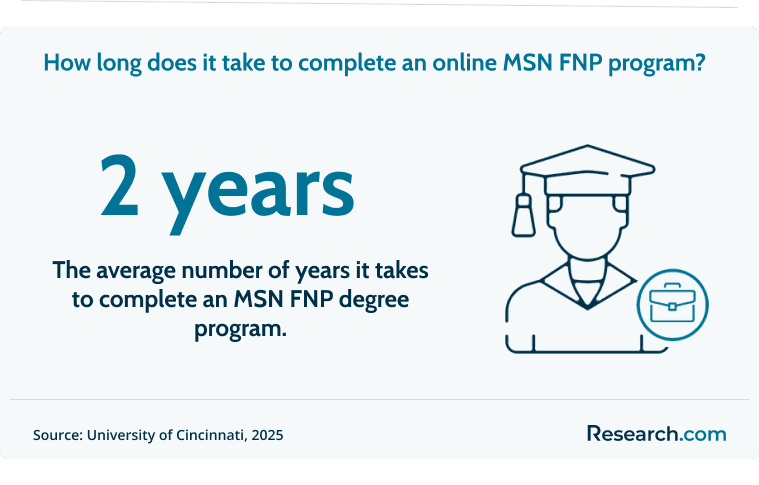
Most online MSN-FNP programs take about two years for full-time students. Part-time schedules can extend the timeline to three or more years, which may be more realistic for nurses balancing full-time work, family responsibilities, and clinical rotations. If you are not yet an RN and are exploring healthcare roles such as medical administrative assistant jobs, you will need to complete the nursing education and licensure steps required before applying to an MSN-FNP program.
Program length depends on credit load, clinical hour requirements, whether the student enters with a BSN or through a bridge pathway, and whether the curriculum includes a capstone, thesis, immersion, or campus residency. Accelerated options can reduce time in school, but they may be difficult for nurses working full time.
Online MSN FNP vs. on-campus MSN FNP: Which format is better?
Online and on-campus MSN FNP programs can both prepare students for advanced practice, but the better choice depends on how you learn, how much schedule flexibility you need, and how much help you want with clinical placement. The delivery format matters less than accreditation, clinical quality, state authorization, and certification preparation.
| Factor | Online MSN FNP program | On-campus MSN FNP program | Best fit |
| Schedule | Often offers asynchronous or hybrid coursework for working nurses. | Usually has more fixed class times and in-person attendance. | Online may work better for nurses with variable shifts. |
| Clinical training | Clinical hours are completed in person, often near the student’s location with school approval. | Clinical sites may be tied more closely to campus or university healthcare partners. | On-campus may be easier if the school has strong local placement agreements. |
| Faculty and peer interaction | Uses video meetings, discussion boards, online office hours, and virtual collaboration. | Provides more face-to-face interaction and informal networking. | Campus may suit students who prefer in-person support. |
| Learning style | Requires independence, organization, and comfort with learning platforms. | Provides more real-time structure through scheduled classes, labs, and group work. | Online is better for self-directed learners; campus is better for students who need structure. |
| Technology requirements | Requires reliable internet, a suitable device, webcam access, and comfort with digital systems. | Relies more on campus facilities, labs, libraries, and physical classrooms. | Online students should be confident using digital tools before enrolling. |
Online learning is not automatically easier. FNP students still complete rigorous graduate coursework and must meet in-person clinical expectations. Nurses comparing advanced practice routes may also want to review related roles, including radiology nurse career paths, before committing to a primary care NP track.
One common mistake is comparing MSN-FNP programs with unrelated online credentials. Shorter programs such as an online AutoCAD certificate have very different goals, costs, clinical requirements, and licensure implications, so they should not be used as benchmarks for graduate nursing education.
How much does an online MSN FNP program cost?
Online MSN-FNP tuition varies by institution, credit load, residency policy, fees, and required campus visits. Students should calculate total cost, not just price per credit. A lower per-credit rate may not always mean a lower total cost if the program requires more credits, travel, technology fees, background checks, clinical compliance expenses, or additional terms of enrollment.
The examples below show how widely costs can differ among programs in this ranking:
- Sacred Heart University ($40,110): This program is on the higher end among the listed examples and includes two on-campus residencies, which may add travel-related expenses.
- University of West Florida ($22,500): UWF is a lower-cost option among the listed programs and uses a fully online structure with local clinical experiences.
- Arkansas State University ($15,770): A-State lists one of the lowest total tuition figures in this group and is designed with working nurses in mind.
- University of Missouri ($33,405): Mizzou offers a public university option with graduate nursing coursework and the possibility of continued study through its DNP pathway.
- Ohio University ($28,000): Ohio University offers a cost-conscious option with structured clinical preparation and limited campus requirements.
When reviewing costs, do not compare MSN-FNP tuition with unrelated vocational or trade credentials such as online appliance repair certification. Graduate nursing programs include advanced clinical requirements, faculty supervision, certification preparation, and state licensure considerations that change the cost equation.
What financial aid is available for online MSN FNP students?
Accredited online MSN-FNP programs may qualify for many of the same financial aid options as campus-based programs. Students should confirm institutional eligibility and complete required applications early because aid timelines can affect enrollment decisions.
- Federal student aid: Students usually begin by submitting the FAFSA to determine eligibility for federal aid, including loans and other available support.
- Scholarships and grants: Nursing schools, professional associations, employers, and private foundations may offer funding for graduate nursing students. These awards do not require repayment.
- Employer tuition assistance: Hospitals and healthcare systems may help pay for graduate education when the degree supports workforce needs. Students should ask about service commitments, grade requirements, and reimbursement timing.
- Loan repayment and forgiveness programs: Options such as the Nurse Corps Loan Repayment Program or Public Service Loan Forgiveness may help qualifying graduates who work in eligible settings or underserved areas.
- Institutional aid and payment plans: Some schools offer internal scholarships, payment plans, or deferred billing options that can spread costs across terms.
What are the admission requirements for an online MSN FNP program?
Admission requirements vary by school, but online MSN-FNP programs generally expect applicants to have a nursing background, an active RN license, and enough clinical experience to succeed in advanced practice coursework. Students considering adjacent advanced practice options, such as an online adult-gerontology acute care NP graduate certificate, will often see similar expectations around licensure, clinical readiness, and graduate-level preparation.
| Requirement | What it usually means | Why it matters |
| Active RN license | Applicants typically need a current, unencumbered RN license in the state where they will complete clinical hours. | Clinical training requires legal authorization to practice as a registered nurse. |
| BSN or approved bridge pathway | Most programs require a Bachelor of Science in Nursing, though some offer RN-to-MSN options. | The BSN provides the undergraduate nursing foundation expected for graduate study. |
| Minimum GPA | A GPA of 3.0 or higher is commonly required, though policies vary. | Schools use academic history to evaluate readiness for advanced coursework. |
| Clinical experience | Many programs prefer or require one to two years of nursing experience. | FNP coursework assumes students can build on real patient care experience. |
| Application materials | Common materials include transcripts, a resume or CV, recommendation letters, a personal statement, and sometimes GRE scores or an interview. | These materials help faculty evaluate fit, professionalism, and career goals. |
If you are still early in your healthcare career, reviewing entry-level roles and compensation, such as a typical patient care technician salary, can help you understand the difference between support roles and the long-term educational path required for advanced practice nursing.
What courses are included in an online MSN FNP curriculum?
Online MSN-FNP coursework develops advanced clinical judgment, diagnostic reasoning, prescribing knowledge, and primary care management skills. Although course titles vary, most accredited programs include the following areas:
- Advanced pathophysiology: Students examine how diseases develop and affect body systems across different ages and patient populations.
- Advanced pharmacology: Coursework covers medication classes, prescribing principles, safety, monitoring, and legal or ethical issues connected to prescribing.
- Advanced health assessment: Students learn to collect comprehensive histories, perform physical exams, identify abnormal findings, and use diagnostic information appropriately.
- Primary care across the lifespan: These courses focus on prevention, diagnosis, treatment, and management of acute and chronic conditions in children, adults, and older adults.
- Evidence-based practice and research: Students learn how to evaluate clinical evidence and apply research findings to improve care decisions and patient outcomes.
- Health policy, leadership, and systems: FNP students study healthcare delivery, policy, advocacy, quality improvement, and operational issues. Understanding functions such as medical billing and coding responsibilities can also help advanced practice nurses understand how clinical care connects to reimbursement and documentation.
Communication is also central to FNP practice. Nurses who enjoy strategy, writing, advocacy, and team communication but do not want advanced clinical practice may want to compare nursing with broader organizational communication career options.
Are there specializations within online MSN FNP programs?
The FNP role is already a specialization within advanced practice nursing, focused on primary care for patients across the lifespan. Some programs, however, allow students to shape clinical experiences or elective coursework around populations or settings such as pediatrics, women’s health, geriatrics, rural health, community health, telehealth, public health, or leadership.
Students who want a narrower bedside or specialty focus should compare the FNP path with other nursing roles before applying. For example, nurses interested in musculoskeletal care may research orthopedic nursing career paths, while those drawn to science, research, or health technology may compare advanced nursing with master’s in biotechnology career opportunities.
How to choose the best online MSN FNP program
The best program is not simply the cheapest, fastest, or highest ranked. It is the program that meets certification and licensure requirements, fits your schedule, supports clinical placement, and provides a realistic path to graduation.
| Selection factor | What to verify | Questions to ask before applying |
| Accreditation | Confirm CCNE or ACEN accreditation. | Is the program listed by the Commission on Collegiate Nursing Education or accredited by ACEN? |
| State authorization | Make sure the school can enroll students from your state and approve clinicals there. | Can I complete clinical hours in my state, and will the program meet my state board’s requirements? |
| Clinical placement support | Determine whether the school finds placements, assists students, or requires students to secure preceptors independently. | Who is responsible for finding my preceptor, and what happens if I cannot secure one? |
| Certification preparation | Ask how the curriculum prepares students for national FNP certification exams. | What are the program’s most recent ANCC or AANP certification pass rates? |
| Format and workload | Review synchronous requirements, asynchronous coursework, immersions, and weekly time expectations. | Can I realistically complete this program while working my current schedule? |
| Total cost | Calculate tuition, fees, travel, clinical compliance costs, books, technology, and lost work time. | What is the full estimated cost from enrollment through graduation? |
Common mistakes to avoid when comparing online MSN FNP programs
- Choosing a program before checking accreditation: Accreditation affects certification eligibility, licensure, employer confidence, and financial aid access.
- Looking only at tuition per credit: Total credits, fees, travel, campus intensives, and clinical expenses can change the final cost.
- Assuming online means fully remote: FNP programs require in-person clinical hours, and some include campus visits or immersions.
- Ignoring state licensure rules: A program may be online but still not authorized or appropriate for every state.
- Underestimating clinical placement challenges: Students should ask early whether they must find their own preceptors.
- Picking the fastest option without considering workload: Accelerated programs can be demanding for nurses working full time.
- Assuming salaries are guaranteed: Pay varies by location, employer, specialty, experience, and scope-of-practice laws.
- Relying only on rankings: Rankings help narrow options, but fit, licensure alignment, and clinical support matter more for completion and career readiness.
What career paths are available after an online MSN FNP program?
Graduates of accredited MSN-FNP programs may pursue advanced practice roles after meeting certification and state licensure requirements. FNPs often work in primary care, urgent care, retail clinics, telehealth, community health, and other outpatient settings.
| Career path | Average salary listed | Typical work focus |
| Family Nurse Practitioner | $127,694 | Provides primary care, diagnoses illnesses, manages chronic conditions, orders tests, and prescribes medications in settings such as clinics, private practices, and federally qualified health centers. |
| Urgent Care Nurse Practitioner | $134,369 | Treats walk-in patients with acute but non-emergency concerns such as infections, sprains, minor injuries, and wounds. |
| Retail Health Clinic NP | $120,000 | Provides wellness visits, immunizations, and care for minor illnesses in pharmacy-based or retail clinic settings. |
| Telehealth Nurse Practitioner | $130,295 | Conducts virtual consultations, triage, follow-up care, and chronic condition management through digital platforms. |
| Community Health NP | $132,050 | Serves underserved populations through preventive care, health education, chronic disease management, public health departments, nonprofit clinics, or mobile health units. |
These salary figures should be treated as reference points, not guarantees. Location, employer type, experience, certifications, state scope-of-practice rules, and demand for primary care providers can all influence compensation.
What is the job outlook for nurse practitioners?
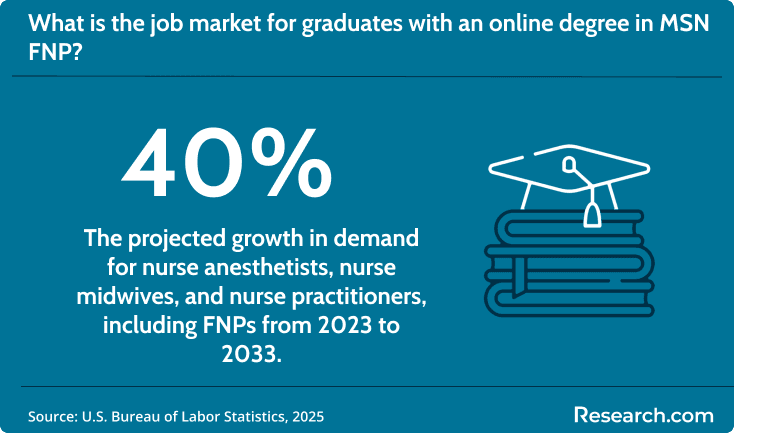
According to the U.S. Bureau of Labor Statistics, employment of nurse anesthetists, nurse midwives, and nurse practitioners, including FNPs, is projected to grow 40 percent until 2033. The BLS also reports about 31,900 openings each year on average for these roles.
This outlook reflects the continued need for advanced practice providers in primary care, preventive care, rural health, underserved communities, chronic disease management, and aging-related care. Online MSN-FNP graduates from accredited programs are generally evaluated by employers based on licensure, certification, clinical competence, experience, and program quality rather than online delivery alone.
Current trends affecting online MSN FNP students
- Telehealth is now part of primary care delivery: FNP students should expect to use digital tools for assessment, follow-up, documentation, patient education, and care coordination.
- Clinical placement has become a major decision factor: Online students should not assume local preceptors will be easy to secure, especially in competitive regions.
- Employers continue to value certification readiness: Programs that clearly prepare students for ANCC or AANP exams may offer stronger career preparation.
- Rural and underserved care remains a key focus: Several programs in this guide emphasize preparing FNPs for communities with limited access to primary care.
- Technology and informatics are increasingly relevant: FNPs need comfort with electronic health records, remote care platforms, quality data, and digital communication.
What graduates say about online MSN FNP programs
- Amanda: "Completing my MSN FNP online let me continue working full time as an RN while moving toward advanced practice. The flexible format made a major difference, and being able to complete clinical hours locally helped me manage school, work, and personal responsibilities."
- Marcus: "I was worried about returning to graduate school, but the online structure gave me room to study around my family schedule. The virtual classes were interactive, and faculty support and discussion groups helped me feel connected rather than isolated."
- Rachel: "My online MSN FNP program helped me focus on rural healthcare and build the clinical skills needed for communities with provider shortages. Case-based learning and digital tools also helped me become more comfortable with telehealth practice."
Do you need a BSN before applying to an online MSN FNP program?
Most online MSN FNP programs require applicants to hold a Bachelor of Science in Nursing. Nurses with an Associate Degree in Nursing may still have options through ADN-to-MSN or RN-to-MSN bridge pathways, but those routes often include additional undergraduate nursing coursework before graduate FNP courses begin.
If you are an RN without a BSN, compare bridge programs carefully and ask whether the school awards a BSN along the way. Students who already hold a non-nursing bachelor’s degree or need a faster route into nursing may also review online accelerated BSN programs to understand possible pathways toward graduate nursing admission.
What challenges do students face in online MSN FNP programs?
Online MSN FNP programs offer flexibility, but they are still demanding. Students must balance graduate coursework, clinical hours, employment, family obligations, and certification preparation. Common challenges include limited in-person networking, difficulty finding qualified preceptors, variation in clinical site quality, and the need to manage asynchronous coursework without constant reminders.
Students entering from an ADN background should also confirm that they meet all bridge or BSN-equivalent prerequisites before applying. Reviewing online RN to BSN nursing programs can help nurses identify a practical step if they are not yet eligible for a direct MSN-FNP pathway.
Step-by-step guide to choosing an online MSN FNP program
- Confirm your starting point: Identify whether you are applying with a BSN, ADN, non-nursing bachelor’s degree, or another background.
- Check accreditation first: Prioritize CCNE- or ACEN-accredited programs.
- Verify state eligibility: Ask whether the school can enroll students in your state and approve clinical placements there.
- Review clinical placement policies: Find out whether the program provides placements, assists with placements, or expects students to find preceptors independently.
- Calculate total cost: Include tuition, fees, travel, books, equipment, clinical compliance costs, and possible income reduction.
- Compare course delivery: Decide whether you prefer asynchronous flexibility, scheduled live classes, or a hybrid structure.
- Ask about certification outcomes: Request current ANCC or AANP pass-rate information if available.
- Talk to current students or alumni: Ask about faculty access, workload, clinical placement experience, and responsiveness.
- Match the program to your career goal: Choose an FNP program if you want broad primary care practice; consider another nursing specialty if your interests are more focused.
References:
- Arkansas State University. (2025). Master of Science in Nursing – Family Nurse Practitioner Online. ASU
- Indeed. (2025). Family nurse practitioner salary in the United States. Indeed
- Ohio University. (2025). Master of Science in Nursing (MSN) Tuition. Ohio University
- Sacred Heart University. (2025). Online MSN: Family Nurse Practitioner. SHU
- U.S. Bureau of Labor Statistics. (2025). Occupational Outlook Handbook: Nurse Anesthetists, Nurse Midwives, and Nurse Practitioners. U.S. BLS
- University of Cincinnati. (2025). How long do your Nursing programs take to complete? University of Cincinnati
- University of Missouri. (2025). FNP Tuition and fees. Mizzou Online
- University of West Florida. (2025). Family Nurse Practitioner (FNP) Online. UWF
- ZipRecruiter. (2025). Salary: Urgent Care Nurse Practitioner. ZipRecruiter
Key Insights
- The best online MSN FNP program is accredited, state-authorized, clinically practical, and aligned with your certification and licensure goals.
- Online does not mean fully remote. Every FNP program requires supervised in-person clinical hours, and some require campus immersions or residencies.
- Program costs vary widely, so compare total tuition, fees, travel, clinical expenses, and time away from work rather than tuition per credit alone.
- Clinical placement support is one of the most important questions for online students. Ask who finds preceptors and what support is available if placements fall through.
- Most MSN-FNP students need a BSN, but ADN-to-MSN, RN-to-MSN, and accelerated BSN options may help nurses who are not yet eligible for direct admission.
- Nurse practitioner employment is projected to grow 40 percent until 2033, but individual job outcomes depend on certification, licensure, experience, location, and employer demand.
- Do not choose a program based only on rankings. Use rankings to build a shortlist, then verify accreditation, state approval, clinical logistics, certification preparation, and affordability before applying.
Other Things You Should Know About Online MSN Family Nurse Practitioner Programs
The typical curriculum for an online MSN Family Nurse Practitioner program in 2027 includes courses in advanced health assessment, pathophysiology, and pharmacology, along with clinical practicums. Programs usually require 45-50 credit hours and can be completed in around two years, including clinical practice hours.
The admission requirements typically include a BSN from an accredited institution, an active RN license, clinical experience, and potentially, a graduate-level standardized test score. Specific requirements may vary by institution, so reviewing each program’s criteria is crucial for applicants.
Most online MSN Family Nurse Practitioner programs require about 500 supervised clinical hours, and some programs require more. These hours must be completed with approved preceptors in primary care or family practice settings to meet national certification expectations from organizations such as the ANCC or AANP.


