2027 How to Become a Locksmith

Co-Founder and Chief Data Scientist
Choosing locksmithing means choosing a hands-on security career rather than a traditional college-degree route. The work can include emergency lockouts, key cutting, rekeying, lock repair, safe service, automotive keys, access control, and smart lock installation. It also requires trust: clients often call a locksmith when they are locked out, worried about a break-in, or trying to protect a home, vehicle, or business.
This guide explains how to become a locksmith in 2026, including training options, licensing, apprenticeships, tools, skills, salary, work settings, job outlook, and ways to build a stronger career. It is written for people who want a practical trade career, career changers comparing short training programs with degree programs, and aspiring locksmith business owners who need to understand the full path before investing time and money.
Quick Answer: How do you become a locksmith?
You can become a locksmith by earning a high school diploma or GED, completing locksmith training through a trade school, community college, online program, or apprenticeship, gaining supervised hands-on experience, and meeting any state or local licensing requirements. A college degree is not required for most locksmith jobs. Many people learn the basics in a few months, while becoming fully trained and certified can take 1 to 2 years.
Key Things You Should Know About Becoming a Locksmith
- Most locksmiths begin with a short vocational, technical, online, or apprenticeship-based training path rather than a four-year degree.
- A high school diploma or GED is typically enough to enter locksmith training, although employers may prefer applicants with mechanical, customer service, or security experience.
- Basic locksmithing can be learned in several months, but it may take 1 to 2 years to gain stronger field experience and pursue certification.
- Some states require locksmiths to be licensed, registered, background checked, insured, or trained through approved programs before legally working.
- Locksmiths and safe repairers earn an average annual wage of $46,240 in the United States, according to the United States Bureau of Labor Statistics.
- Steps to become a locksmith
- Education and training requirements
- How long locksmith training takes
- What locksmiths do
- Online locksmith training advantages and limits
- Skills locksmiths need
- Tools and equipment used by locksmiths
- Locksmith licensing overview
- State-specific licensing requirements
- Average locksmith salary
- Where locksmiths work
- Job outlook for locksmiths
- Best education pathways for locksmiths
- Common challenges in the locksmith market
- Whether advanced degrees help locksmiths
- Career pathways and advancement options
- How apprenticeships build locksmith skill
- Cybersecurity and data skills for locksmiths
- Continuing education for locksmiths
- Networking and mentorship
- AI and locksmith security solutions
- Business education for locksmiths
- AI tools for locksmith business strategy
- Liability insurance for locksmiths
- Specialized certifications
- Complementary technical studies
- Accredited online education
- Financing locksmith training
- Data science and locksmith business planning
What are the steps to becoming a locksmith?
The most efficient route into locksmithing is practical: learn the fundamentals, work under experienced professionals, meet legal requirements, and keep updating your skills as locks and access systems become more digital.
- Finish high school or earn a GED. Locksmith training programs and employers commonly expect basic reading, math, communication, and mechanical reasoning skills. You do not need to search for the most affordable online bachelor's degrees unless your long-term goal requires a college credential.
- Choose a locksmith training format. Training may be available through a trade school, community college, online provider, employer, or apprenticeship. Look for instruction in key identification, key cutting, lock installation, rekeying, safe basics, automotive systems, access control, and professional ethics.
- Get hands-on practice. Reading about locks is not enough. You need supervised practice on real locksets, door hardware, key machines, automotive systems, safes, and electronic access equipment.
- Check licensing and background requirements. Some states and local governments require a locksmith license, registration, background check, exam, insurance, or proof of training. Confirm the rule where you plan to work before advertising services.
- Consider certification. Certification is not always legally required, but credentials from organizations such as the Associated Locksmiths of America can help demonstrate professionalism to employers and clients.
- Start in an entry-level role or apprenticeship. Many new locksmiths begin as trainees, roadside locksmiths, shop assistants, institutional locksmith helpers, or mobile service technicians.
- Build a specialty or business plan. After the basics, you can focus on residential service, commercial hardware, automotive locksmithing, safes, access control, forensic locksmithing, or self-employment.
| Step | What you do | Why it matters |
| Education | Complete high school or a GED and enroll in locksmith training. | Gives you the math, mechanical, and communication foundation needed for the trade. |
| Training | Study locks, keys, door hardware, security systems, and safe service basics. | Builds the technical knowledge needed before working on customer property. |
| Experience | Practice through an apprenticeship, employer training, or supervised fieldwork. | Turns classroom knowledge into reliable job-site performance. |
| Licensing | Meet state or local rules before offering services. | Protects you from fines, legal issues, and credibility problems. |
| Career launch | Work for a locksmith company, institution, roadside service, or your own business. | Lets you earn income while developing speed, judgment, and client trust. |
What are the educational requirements for becoming a locksmith?
Locksmithing is a skilled trade, not a degree-required profession. Most people enter with a high school diploma or GED, then complete career-focused training and supervised practice. This makes locksmithing different from many college-based career paths and similar to other technical occupations, such as those described in guides on how to become a master diesel mechanic.
- High school diploma or GED: This is the usual starting point. Courses or experience involving math, mechanical systems, electronics, shop work, business, and customer service can be helpful.
- Vocational or technical training: Programs may run from a few months to a year and often cover key duplication, rekeying, residential and commercial locks, automotive basics, safes, codes, and security hardware. Students comparing short careers that pay well may find locksmithing appealing because it can be entered without a long academic program.
- Online training: Online locksmith courses can teach theory, terminology, procedures, and business basics, but they should be paired with physical practice on tools and locks.
- Apprenticeship or employer training: This is often where new locksmiths learn job-site judgment, customer communication, troubleshooting, and safe work habits.
- Optional college study: A college major is not required. However, people comparing locksmithing with broader academic options can review the best course in college if they are also considering management, security technology, or business ownership.
The strongest candidates usually combine formal locksmith instruction with hands-on practice. A certificate alone does not prove field competence; clients and employers care whether you can solve problems safely, legally, and without unnecessary property damage.
Here's what the education levels of newly hired locksmiths look like:
How long does it take to become a locksmith?
The timeline depends on whether you choose a short course, an apprenticeship, employer training, or certification. Basic skills can be introduced quickly, but professional confidence usually takes longer because locksmiths work with security-sensitive property and stressed customers.
| Path | Typical time mentioned | Best for |
| Introductory locksmith course | 3 to 6 months | People who want a fast start in basic lock and key concepts. |
| Vocational or technical program | A few months to a year | Students who want structured lessons, practice, and career preparation. |
| Apprenticeship or on-the-job training | 6 months to 2 years | New locksmiths who need real field experience under supervision. |
| Full training plus certification and licensing | 1 to 2 years | People who want stronger credibility, more independence, or business ownership. |
Compared with longer academic programs, locksmith training can be relatively short. For context, some readers compare trade training with accelerated academic options such as a 6 month MBA or one-year graduate programs, but locksmithing is usually more tool-based and experience-driven than classroom-driven.
What exactly does a locksmith's job entail?
Locksmiths help people control physical access to homes, businesses, vehicles, safes, and restricted areas. The job can be routine, urgent, technical, and customer-facing all in the same day.
| Service area | Common tasks | Typical clients |
| Residential locksmithing | Install locks, repair hardware, rekey doors, duplicate keys, open locked doors, recommend upgrades. | Homeowners, renters, landlords, property managers. |
| Commercial locksmithing | Set up master key systems, maintain high-security locks, install door hardware, support access control. | Offices, retailers, warehouses, schools, medical facilities. |
| Automotive locksmithing | Open vehicles, cut and program keys, repair ignition issues, remove broken keys. | Drivers, dealerships, roadside assistance providers, repair shops. |
| Safe and vault work | Install, open, repair, and maintain safes and vaults. | Businesses, homeowners, financial offices, institutions. |
| Electronic security | Install or maintain smart locks, keypads, access control, alarms, and related hardware. | Businesses and homeowners upgrading security systems. |
| Forensic locksmithing | Analyze locks and security devices to determine whether and how they were bypassed. | Investigators, insurers, law enforcement, private security teams. This specialty may interest readers comparing security work with highest-paying criminal justice jobs and careers. |
What are the advantages of pursuing an online locksmith training program?
Online locksmith training can be useful, especially for career changers, rural students, or working adults. The main advantage is flexibility. The main limitation is that locksmithing cannot be mastered without physical tools and real practice.
| Online locksmith training can help when... | Be cautious when... |
| You need to study around work, family, or military responsibilities. | The program promises career results without hands-on practice. |
| You want to learn terminology, theory, lock types, business basics, and safety procedures before buying tools. | The curriculum does not explain licensing rules or ethical responsibilities. |
| You live far from a trade school or locksmith employer. | The program does not include practice guidance, tool lists, or instructor support. |
| You are comparing trade training with broader online education options such as accredited online bachelor degree programs. | You assume an online certificate automatically qualifies you for state licensure. |
If you choose an online program, ask whether it includes practical assignments, lock hardware kits, instructor feedback, licensing guidance, and preparation for entry-level employment. For readers exploring other trade fields, Research.com also covers construction trade school online options.
What skills do I need to become a locksmith?
A good locksmith is not just mechanically capable. The job also requires ethics, patience, communication, and judgment because locksmiths work with private property and security-sensitive information.
- Mechanical reasoning: You need to understand how pins, cylinders, tumblers, latches, strikes, hinges, safes, and door hardware work together.
- Manual dexterity: Locksmiths work with small parts, precision cuts, delicate mechanisms, and confined spaces.
- Problem-solving: A lockout, broken key, jammed cylinder, or faulty access system may not have an obvious solution.
- Attention to detail: Small measurement errors can cause keys to fail, doors to misalign, or locks to become insecure.
- Customer service: Clients may be anxious, angry, stranded, or worried about safety. Clear communication matters.
- Ethical judgment: Locksmiths must verify authority before opening or changing access to property.
- Basic math and computer skills: Measurements, codes, key depths, electronic systems, invoicing, scheduling, and smart security products all require comfort with numbers and software.
- Physical readiness: The work may involve driving, kneeling, drilling, lifting hardware, working outside, or responding after hours.
What tools and equipment do locksmiths use?
Locksmith tools vary by specialty. A residential locksmith may carry different equipment from an automotive, safe, or access-control technician. New locksmiths should avoid buying expensive tools before knowing their target niche and local legal rules.
- Lock picks and tension tools: Used for non-destructive entry on compatible mechanical locks when lawful and appropriate.
- Key cutting machines: Used to duplicate or originate keys based on blanks, codes, or existing keys.
- Rekeying kits: Include pins, followers, shims, plug holders, gauges, and tools used to change which key operates a lock.
- Drills and extractors: Used when repair, broken key removal, or destructive entry is necessary and authorized.
- Automotive lockout tools: May include wedges, long-reach tools, decoders, and equipment for vehicle keys depending on the locksmith’s services.
- Electronic and smart lock tools: May include programming equipment, diagnostic devices, access-control hardware tools, and manufacturer-specific resources.
- Business and safety equipment: Mobile locksmiths often need a service vehicle, inventory, invoices, identification procedures, insurance documents, and personal protective equipment.
Do I need a license to be a locksmith?
Licensing depends on where you work. In the United States, locksmith regulation is set mainly at the state and local level, so requirements can differ sharply across jurisdictions.
States that require or are commonly cited as requiring locksmith licensing or registration include:
- California
- Texas
- New York
- Illinois
- Tennessee
- New Jersey
- Florida
Licensing may involve a background check, application fee, training proof, exam, fingerprinting, insurance, or business registration. Working without the required license can create legal and financial risk.
Certification is different from licensing. A license is a government authorization to work where required. Certification is a professional credential that may strengthen your reputation but does not automatically replace a state or local license. Still, certification can be valuable for people comparing locksmithing with other certifications that pay well.
What are the state-specific licensing requirements for locksmiths?
Before paying for training or advertising services, identify the rules in the exact state, county, and city where you intend to work. Do not rely only on national summaries because local rules can change and may apply differently to employees, contractors, and business owners.
Examples of state requirements mentioned for locksmiths
- California: Requires locksmiths to hold a license issued by the Bureau of Security and Investigative Services (BSIS). Applicants must complete a background check, pass an exam, and meet experience requirements.
- Texas: Requires locksmiths to be licensed through the Texas Department of Public Safety (DPS). A background check is required, along with a written exam and completion of a state-approved locksmith training program.
- Nevada: Locksmiths must be licensed by the Nevada State Contractors Board and provide proof of training, experience, and insurance.
- Florida: Although Florida doesn’t require a state license for locksmiths, they must register with the Florida Department of Agriculture and Consumer Services (FDACS) and pass a background check.
- Alaska: Does not require locksmith licensing but encourages continuing education and certifications to ensure professionalism.
- Georgia: No state-mandated locksmith license is required, but business registration may be necessary.
- North Carolina: Locksmiths are not required to be licensed at the state level, but city or county-level permits may be necessary.
How to verify your licensing requirements
- Search your state licensing board, department of public safety, contractor board, or consumer protection agency.
- Check city and county business license rules.
- Ask whether employees and business owners follow different rules.
- Confirm whether fingerprinting, background checks, insurance, training hours, or exams are required.
- Keep written proof of compliance before accepting paid jobs.
If you want a structured credential while still entering the workforce quickly, compare locksmith programs with broader fast online degree programs, but remember that a degree program is not the same as locksmith licensure.
What is the average salary of locksmiths?
According to the United States Bureau of Labor Statistics, locksmiths and safe repairers earn an average annual wage of $46,240. This equals an average of $22.23 per hour.
Your actual income can vary based on location, licensing, specialty, employer, emergency availability, business ownership, and experience. Automotive, commercial access control, safe work, and institutional roles may require different tools and training than basic residential lock service. Salary outcomes are not guaranteed by completing a course or certification.
Where do locksmiths work?
Locksmiths can work in shops, mobile vans, institutions, commercial buildings, homes, vehicles, and emergency service settings. The best fit depends on whether you prefer predictable work, field service, business ownership, or specialized technical systems.
- Residential service: Home lockouts, rekeying, deadbolt installation, smart locks, and security upgrades.
- Commercial properties: Offices, retail stores, warehouses, hotels, apartment buildings, and facilities requiring master key or access-control systems.
- Automotive settings: Vehicle lockouts, replacement keys, transponder programming, ignition repair, and broken key extraction.
- Mobile locksmith service: On-site work using a stocked vehicle, often including emergency calls.
- Institutional employers: Schools, hospitals, government agencies, and large facilities with complex key control needs.
- Locksmith shops: Key duplication, retail hardware, walk-in lock repair, safes, and scheduled service calls.
- Emergency response: After-hours lockouts, break-in repairs, urgent rekeys, and property securing.
What is the job outlook for locksmiths?
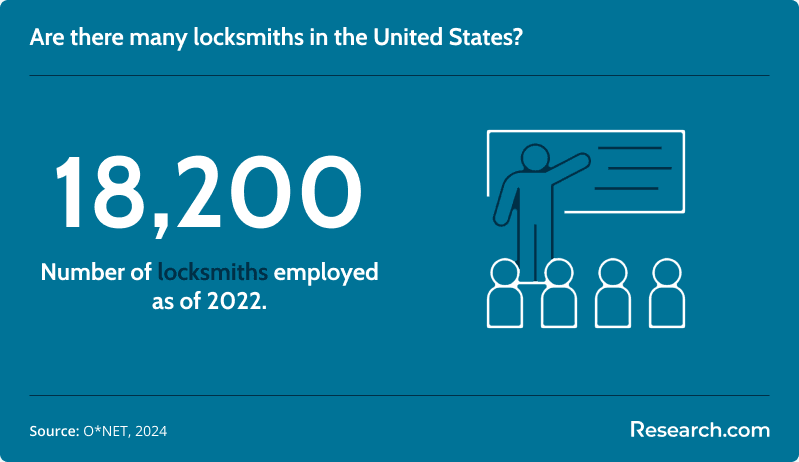
According to O*Net Online, there are 18,200 locksmiths and safe repairers employed in 2022. The occupation includes titles such as certified master locksmith (CML), certified master safecracker (CMS), forensic locksmith, lock technician, locksmith, registered safe technician, vault technician, and road service locksmith.
O*Net projects that employment for locksmiths will be -2% or lower from 2022 to 2032. Even with that decline, projected openings are still 1,700 each year during the 10-year period.
Key labor market findings cited for locksmiths
- There are 18,200 locksmiths and safe repairers employed in the U.S.
- The projected job openings for locksmiths each year is 1,700 from 2022 to 2032.
- Florida has the highest concentration of locksmiths and safe repairers in the U.S., with a 0.26 employment rate per thousand jobs and a location quotient of 2.22.
- District of Columbia is the highest-paying state for locksmiths, with an annual mean wage of $64,250 or an hourly mean wage of $30.89.
- California has the highest employment level of locksmiths, with a total of 2,250 locksmiths and safe repairers employed.
- The U.S. locksmith industry was worth $2.7 billion in 2022, a 10% decline from 2021, largely caused by the pandemic.
The practical takeaway: locksmithing is not a fast-growth occupation based on these projections, so new entrants should compete on reliability, licensing compliance, specialty skill, customer service, and business discipline.
What educational pathways can lead to a successful locksmith career?
The best education path depends on your goal. Someone who wants mobile residential work needs a different path from someone aiming for commercial access control, safe work, or a future security business.
| Goal | Recommended pathway | When it makes sense |
| Start quickly in entry-level locksmithing | Short locksmith certificate plus supervised practice. | You want a trade career without committing to a degree. |
| Build broader technical skill | Trade school, community college, or related technical coursework. | You want stronger electronics, hardware, or facility maintenance knowledge. |
| Work in management or operations later | Locksmith experience plus business, accounting, or operations education. | You plan to manage a shop, run a mobile service, or hire employees. |
| Compare locksmithing with college-based technical paths | Review best associate degrees and online associate's degree options. | You are deciding between a trade route and a broader academic credential. |
What common challenges do locksmiths encounter in today’s market?
Modern locksmiths face more than mechanical lock problems. They must handle digital security products, changing customer expectations, licensing rules, online competition, emergency service risks, and business costs.
- Technology changes: Smart locks, electronic keypads, access control, biometric systems, and connected security products require ongoing learning.
- Regulatory compliance: Locksmiths must follow licensing, registration, background check, and business rules where applicable.
- Customer trust: Because locksmiths access private property, professionalism and verification procedures are essential.
- Emergency work risk: After-hours jobs can involve safety, liability, and customer verification issues.
- Tool and inventory costs: Automotive programming, safe work, and electronic systems can require specialized equipment.
- Competition: New locksmiths may compete with established shops, roadside services, national lead-generation platforms, and security contractors.
Can advanced academic degrees transform your locksmith career?
Advanced degrees are not required to become a locksmith. For most beginners, the better investment is approved locksmith training, legal compliance, tools, supervised practice, and customer service skill. However, college-level study may help if your goal is business ownership, security management, cybersecurity, operations, or technology consulting.
For example, someone planning to build a larger security services company might eventually compare business or technology programs, including the shortest master's degree program. But a master’s degree does not replace locksmith licensing, apprenticeship experience, or trade competence.
What are the pathways to unlocking career opportunities as a locksmith?
Locksmithing offers several career routes. The right one depends on whether you want stable employment, mobile service independence, technical specialization, or business growth.
| Career pathway | What it looks like | Good fit for |
| Employee locksmith | Work for a locksmith company, hardware business, road service provider, or security contractor. | Beginners who want mentorship, structure, and steady workflow. |
| Mobile locksmith | Travel to customers for lockouts, rekeys, repairs, and installations. | People comfortable with driving, scheduling, field service, and customer interaction. |
| Institutional locksmith | Maintain locks, keys, and access systems for a large organization. | Workers who prefer facility-based work and long-term system responsibility. |
| Specialist | Focus on automotive keys, safes, access control, forensic work, or commercial hardware. | Technicians who want deeper expertise and may invest in specialized tools. |
| Business owner | Operate a shop or mobile service, manage marketing, pricing, insurance, compliance, and staff. | Experienced locksmiths with business discipline and local market knowledge. |
Short-term credentials can help with entry. If you are comparing options across fields, review 6-month certificate programs that pay well, but evaluate each program based on licensing relevance and hands-on training, not just speed.
Can apprenticeships elevate a locksmith's skillset beyond formal training?
Yes. Apprenticeships and supervised on-the-job training often provide the field judgment that classroom instruction cannot fully teach. A mentor can show you how to verify authorization, avoid unnecessary damage, select the right tool, communicate with stressed clients, and handle unusual lock or door problems.
Formal training is useful for vocabulary and fundamentals. Apprenticeship is where speed, ethics, and troubleshooting mature. If you are balancing practical training with flexible academic study, resources such as what is the easiest degree to get online can help you compare workload, but ease should not be the main factor in choosing locksmith preparation.
Common mistakes to avoid when becoming a locksmith
| Mistake | Why it hurts you | Better approach |
| Starting work before checking licensing rules. | You may face fines, legal issues, or customer trust problems. | Verify state, county, and city requirements before advertising. |
| Choosing training based only on price. | Cheap training may lack practice, instructor support, or licensing relevance. | Compare curriculum, tools, practice requirements, reviews, and outcomes carefully. |
| Assuming online training is enough by itself. | Locksmithing requires physical practice and real-world troubleshooting. | Pair online lessons with lock hardware, supervised practice, or apprenticeship. |
| Buying tools before choosing a specialty. | You may waste money on equipment you rarely use. | Start with core tools and expand based on actual services offered. |
| Ignoring business basics. | Poor pricing, scheduling, insurance, and customer policies can sink a new service. | Learn bookkeeping, marketing, customer verification, insurance, and local compliance. |
| Making salary assumptions from unrelated fields. | Locksmith income differs from degree-based industries. | Use locksmith-specific wage data instead of unrelated pages such as salary for masters in biotechnology. |
Questions to ask before choosing a locksmith training program
- Does the program explain the licensing rules for my state?
- Does it include hands-on practice, lock hardware, or tool guidance?
- Who teaches the course, and do they have field locksmith experience?
- Does the curriculum cover residential, commercial, automotive, safe, and electronic security basics?
- Will the program help me prepare for certification or entry-level work?
- Are there hidden costs for tools, kits, exams, background checks, insurance, or licensing?
- Can I speak with graduates or employers who know the program?
- Does the provider make realistic claims, or does it promise guaranteed income?
How does continuous professional development boost a locksmith's career?
Locksmiths who stop learning can fall behind as customers adopt smart locks, access control, electronic keys, and integrated security systems. Continuing education can help you expand services, reduce mistakes, meet certification requirements, and build client trust.
- Attend locksmith trade seminars and manufacturer trainings.
- Study smart locks, electronic access control, and automotive key systems.
- Learn local codes, door hardware standards, and safe work procedures.
- Improve business skills such as pricing, scheduling, reviews, and customer communication.
- Consider broader education only when it supports a clear goal; for example, compare an easiest bachelor degree option with the actual skills you need to run or grow a locksmith business.
Can professional networking and mentorship opportunities propel a locksmith's success?
Networking can help new locksmiths find apprenticeships, referrals, technical advice, and trustworthy suppliers. Mentorship is especially valuable because locksmithing includes ethical and judgment-based decisions that are hard to learn from videos alone.
- Join locksmith associations and local trade groups.
- Build relationships with hardware suppliers, property managers, real estate professionals, roadside assistance companies, and security contractors.
- Ask experienced locksmiths about pricing, customer verification, tool purchases, and service boundaries.
- If you are a working adult comparing broader education options, cheapest online colleges that accept FAFSA may help you evaluate flexible programs outside locksmithing.
Can artificial intelligence revolutionize locksmith security solutions?
AI is more relevant to locksmiths through connected security systems, diagnostics, scheduling, customer communication, fraud detection, and business operations than through traditional mechanical locks. A locksmith does not need to become an AI engineer, but understanding how digital access systems collect and use data can be helpful.
Locksmiths working with advanced access control may benefit from basic knowledge of cybersecurity, data privacy, system monitoring, and automated alerts. Professionals who want deep technical study can compare programs such as the best affordable online master's programs in artificial intelligence, but this is an optional path, not an entry requirement for locksmithing.
How can a business management degree complement locksmith expertise?
Business education can help experienced locksmiths who want to move from technician work into ownership or management. Useful topics include pricing, bookkeeping, tax planning, hiring, marketing, inventory control, customer service systems, and liability management.
A degree is not necessary to open every locksmith business, but structured business study may help some owners avoid costly mistakes. If you are comparing business-related degree options, review What is an easy bachelor's degree to get? and remember that “easy” should be less important than relevance, accreditation, cost, and time commitment.
Can emerging AI technologies optimize a locksmith’s business strategies?
AI tools may help locksmith businesses manage calls, estimate demand, organize schedules, write customer messages, track reviews, analyze service patterns, and improve inventory planning. These tools should support—not replace—professional judgment, legal compliance, and customer verification.
Locksmiths interested in digital transformation can explore programs such as the best online AI degrees, but most small locksmith businesses can begin by learning practical software for scheduling, accounting, mapping, customer relationship management, and secure recordkeeping.
Is comprehensive liability insurance essential for modern locksmith practices?
Liability insurance is an important consideration for locksmiths, especially those who work on customer property, operate mobile services, employ staff, or handle commercial security systems. Insurance can help protect against claims involving property damage, service mistakes, injuries, vehicle incidents, or business disputes.
Coverage needs depend on your services, state rules, contracts, and business structure. Ask insurers about general liability, commercial auto, tools and equipment, bonding, workers’ compensation, and coverage for electronic security work. Advanced academic programs such as short PhD programs in USA are not typical locksmith requirements; practical risk management and professional insurance advice are more directly relevant.
Can specialized certifications enhance a locksmith's earning potential?
Specialized certifications can improve credibility and may support access to more advanced work, but they do not guarantee higher pay. Their value depends on employer demand, client trust, local competition, and whether the credential matches services people are willing to pay for.
- Automotive locksmithing: Useful for transponder keys, programming, and vehicle lock systems.
- Safe and vault work: Useful for technicians who want to install, open, and repair safes.
- Electronic access control: Useful for commercial clients and modern building security.
- Forensic locksmithing: Useful for investigative support and security analysis.
- Master locksmith credentials: Useful for demonstrating broad competence after significant training and experience.
Can complementary technical studies expand a locksmith's expertise?
Yes, if the studies match your career goal. Electronics, low-voltage systems, cybersecurity, facility maintenance, construction technology, business operations, and applied engineering can all complement locksmithing. For example, an engineering degree online may be relevant for someone moving toward security system design, product development, or technical management, but it is not required for ordinary locksmith entry-level work.
Can accredited online education enhance locksmith professional growth?
Accredited online education can be useful for locksmiths who want broader skills in business, information technology, cybersecurity, management, or security operations. Accreditation matters more for degree programs than for short trade courses, but either way, you should verify the provider’s credibility before enrolling.
If you are comparing online colleges for a broader credential, options such as a college online with no application fee may reduce application barriers. For locksmith-specific training, focus first on practical curriculum, licensing alignment, instructor experience, and hands-on skill development.
Are there affordable financing options for locksmith training?
Locksmith training can be less expensive than many degree programs, but costs still matter. Budget for tuition, tools, practice locks, books or online materials, background checks, license fees, exams, insurance, transportation, and business startup costs if you plan to work independently.
- Ask schools whether payment plans are available.
- Check whether local workforce programs support trade training.
- Look for employer-paid apprenticeships or trainee positions.
- Compare community college, trade school, online, and association-based training options.
- If you are considering college-based education as well, research cheap online colleges that accept FAFSA to understand financial aid possibilities.
Are cybersecurity and data analysis skills essential for enhancing locksmith services?
They are not essential for every locksmith, but they are increasingly useful for locksmiths who work with smart locks, access control, commercial security systems, digital credentials, or customer databases. A locksmith handling digital systems should understand basic password hygiene, secure configuration, privacy, access logs, and data protection.
Data skills can also support business decisions, such as identifying peak service times, tracking inventory, measuring repeat customers, and improving marketing. Some professionals may explore advanced data-heavy fields, including a bioinformatics master's program, but that is not a standard locksmith career requirement.
Can data science insights enhance a locksmith’s business strategy?
For locksmith business owners, data can improve decisions about pricing, staffing, inventory, territories, advertising, and customer retention. Even simple records—job type, location, time, parts used, revenue, and customer source—can reveal patterns that help a business operate more efficiently.
Advanced programs such as an affordable online masters in data science degree are far beyond what most locksmiths need, but the underlying idea is useful: track reliable information, review it regularly, and use it to make better business decisions.
How to decide if locksmithing is worth it for you
Locksmithing may be worth considering if you want a practical trade, prefer hands-on problem-solving, can handle customer-facing work, and are willing to follow security and licensing rules carefully. It may not be the best fit if you dislike emergency calls, travel, mechanical detail, legal responsibility, or ongoing tool and training costs.
| Locksmithing may be a good fit if... | Consider another path if... |
| You enjoy mechanical systems and precise hands-on work. | You prefer purely desk-based work. |
| You can stay calm with stressed customers. | You dislike urgent service calls or unpredictable schedules. |
| You are comfortable following legal and ethical access procedures. | You do not want responsibility for security-sensitive work. |
| You want a career that can start without a formal degree. | You want a field with strong projected employment growth. |
| You are willing to keep learning digital security tools. | You want training that ends permanently after one course. |
References:
- United States Bureau of Labor Statistics. (2021, March 31). Occupational Employment and Wage Statistics: 49-9094 Locksmiths and Safe Repairers. BLS.
- Lowe, J. (2023, December 5). 4 of the Top Locksmith Industry Trends for 2024. Service Fusion.
Key Insights
- Locksmithing is a trade career that usually requires a high school diploma or GED, locksmith training, hands-on practice, and legal compliance—not a college degree.
- Basic training may take 3 to 6 months, but apprenticeships, certification, and stronger field competence can extend the path to 1 to 2 years.
- Licensing rules vary by state and locality. Checking requirements before training or advertising services is one of the most important early steps.
- The average annual wage for locksmiths and safe repairers is $46,240, but earnings depend on location, specialty, experience, business model, and demand.
- O*Net reports 18,200 locksmiths and safe repairers employed in 2022, with employment projected at -2% or lower from 2022 to 2032 and 1,700 projected openings each year.
- The strongest locksmiths combine mechanical skill, ethical judgment, customer service, digital security awareness, and ongoing professional development.
- Online training can be useful, but it should not replace hands-on practice, licensing research, supervised experience, and careful tool selection.
- Advanced degrees are optional and usually only relevant for locksmiths pursuing business ownership, cybersecurity, AI, data analysis, security management, or technical leadership beyond traditional locksmith work.
Other Things You Need to Know About Becoming a Locksmith
In 2027, becoming a locksmith generally requires a high school diploma or equivalent and completing locksmith training through a vocational program or apprenticeship. Additionally, some regions may require licensure or certification, which often involves passing an exam. Continuous education helps keep skills updated with new technologies.
To become a locksmith in 2027, start with a foundational education in locksmithing through courses or training programs. Next, pursue apprenticeship opportunities under an experienced locksmith. Research state-specific licensing requirements, and acquire necessary certifications and licenses. Always prioritize continuous learning to stay updated on industry advancements and technology.