2027 Nutrition Careers: Guide to Career Paths, Options & Salary

Co-Founder and Chief Data Scientist
A nutrition career can be a good fit if you want to use food, behavior change, and health science to help people prevent disease, manage chronic conditions, improve performance, or build healthier routines. The field includes clinical dietetics, community nutrition, food service management, health coaching, wellness education, research, consulting, and public health work. However, job titles, licensing rules, education requirements, and salaries vary widely, so choosing the right path matters.
This guide explains what nutrition professionals do, how nutrition differs from dietetics, what you can earn, which roles offer the strongest career options, and how to decide whether this field is worth the time and cost of training. It also covers practical steps for entering the profession, ways to increase earning potential, common mistakes to avoid, and how online or accelerated healthcare programs may support your goals.
Quick answer: Is a nutrition career a good choice?
A nutrition career can be worthwhile for people who are interested in health science, patient education, food systems, behavior change, and preventive care. According to the U.S. Bureau of Labor Statistics, the median annual wage for dietitians and nutritionists was $73,850 in May 2024, while other salary sources report averages ranging from $49,877 to $81,314 yearly. The best fit depends on your state, credential level, work setting, and whether you pursue specialized or leadership roles.
What are the main benefits of a nutrition career?
- Multiple work settings: Nutrition professionals may work in hospitals, clinics, long-term care facilities, schools, corporate wellness programs, private practices, public health agencies, sports organizations, and food service operations.
- Meaningful public health impact: The work often supports disease prevention, chronic disease management, recovery, healthy aging, and community education.
- Flexible education options: Many students can complete nutrition-related coursework online, which may make it easier to balance school with work or family responsibilities.
- Room for specialization: Professionals can focus on areas such as diabetes care, sports nutrition, pediatric nutrition, gerontology, food service management, health coaching, or nutrition research.
- Potential for advancement: Additional credentials, graduate education, business skills, and healthcare leadership training can expand job options and earning potential.
- What is a nutrition career?
- What is the difference between nutrition and dietetics?
- How much can I make with a nutrition career?
- Top nutrition career paths for 2026
- What are the top industries for a nutrition career?
- Where are the best places for a nutrition career?
- How can I increase earning potential in a nutrition career?
- What is the job outlook for a nutrition career?
- How do I pursue a nutrition career?
- What essential skills are needed to excel in a nutrition career?
- How can a master's degree expand my nutrition career opportunities?
- Can supplementary healthcare certifications boost my nutrition career?
- How can complementary healthcare training enhance my nutrition expertise?
- How can digital innovation propel my nutrition career?
- Can accelerated healthcare programs strengthen my nutrition skillset?
- How can a fast health information management program online enhance my nutrition practice?
- How can integrating nutrition with bioinformatics transform my career?
- How can mentorship bolster my nutrition career advancement?
- Which nutrition certifications can enhance my career growth?
- Is a nutrition career worth it?
- Where can I find an affordable nutritionist degree online?
What is a nutrition career?
A nutrition career focuses on helping individuals, groups, and organizations make evidence-informed food and health decisions. Depending on the role and credential, a nutrition professional may assess dietary patterns, design meal plans, support medical nutrition therapy, educate communities, manage food service programs, or help clients build sustainable habits.
Common responsibilities include:
- reviewing food intake, health history, lifestyle habits, and nutrition risks;
- creating meal plans or dietary recommendations for wellness, performance, or medical needs;
- counseling patients or clients on conditions such as diabetes, obesity, cardiovascular disease, and digestive concerns;
- collaborating with physicians, nurses, therapists, social workers, and food service teams;
- teaching workshops, developing public health campaigns, or supporting school and community nutrition programs;
- using nutrition research, data, and documentation tools to guide practice.
The field is broad. Some roles require only a high school diploma plus job training, while others require a bachelor’s degree, supervised practice, licensure, or an advanced credential. Students who want flexible preparation can compare the best online nutrition degree programs to understand coursework in food science, biochemistry, lifecycle nutrition, community health, and dietetics.
What is the difference between nutrition and dietetics?
Nutrition and dietetics both study how food affects health, but they are not the same in practice. Nutrition is the broader field. It can include wellness education, food science, population health, research, and general dietary guidance. Dietetics is the regulated healthcare application of nutrition, often involving medical nutrition therapy, individualized care plans, and credentialed clinical practice.
The distinction matters because some states regulate who can provide nutrition counseling, use certain professional titles, or deliver medical nutrition therapy. Before choosing a program or job title, check your state’s licensing rules and the credential expectations of employers in your target setting.
| Aspect | Nutrition | Dietetics |
| Main focus | Broad study of nutrients, food behavior, public health, and dietary patterns. | Clinical and applied use of nutrition to prevent, treat, or manage disease. |
| Typical scope | General wellness, education, community programs, food systems, and population-level nutrition. | Individual assessment, medical nutrition therapy, patient care plans, and clinical documentation. |
| Credential expectations | Certification is not always required, although it can improve credibility and job options. | Professional credentialing, accredited education, supervised training, and licensure are commonly required. |
| Common work settings | Schools, wellness centers, community organizations, research settings, public health programs, and corporate wellness. | Hospitals, outpatient clinics, private practices, long-term care facilities, and healthcare systems. |
| Education path | Nutrition degree or related education in food, health, biology, or public health. | Dietetics-focused degree and completion of an accredited pathway for professional practice. |
| Regulation | Rules vary by state and title; some roles are less regulated. | Often subject to licensing, continuing education, and professional practice standards. |
| Professional title | Nutritionist, nutrition educator, health coach, or nutrition specialist, depending on training and state rules. | Registered Dietitian Nutritionist (RDN) or related licensed dietetics title. |
| Academic difficulty | Requires science coursework, nutrition assessment, and communication skills. | Can be more intensive because of clinical requirements, supervised practice, and credentialing expectations; dietetics is often discussed among the hardest majors. |
How much can I make with a nutrition career?
Nutrition salaries vary by role, state, employer, credential, and experience level. The U.S. Bureau of Labor Statistics reports that the median annual wage for dietitians and nutritionists was $73,850 in May 2024. Other salary sources report different averages because they may use different job title definitions, employer samples, and data collection methods.
Reported salary figures include:
- Zippia: $49,877 yearly average.
- Indeed: $81,314 yearly average.
- Salary.com: $69,700 yearly average.
- Payscale: $52,115 yearly average.
Nutrition salaries are generally lower than some other healthcare and behavioral health careers. For comparison, health psychologist salary averages $120,811 annually. That does not mean nutrition is a poor choice, but it does mean students should evaluate debt, licensure requirements, local demand, and advancement paths before enrolling.
Top nutrition career paths for 2026
Nutrition careers range from entry-level food service and support roles to licensed clinical practice, consulting, and healthcare leadership. The right path depends on how much education you are willing to complete, whether you want direct patient care, and how important licensure or private practice is to your plan.
| Career path | What the role does | Average annual salary | Minimum required education | Growth rate |
| Nutrition Assistant | Supports dietitians and nutritionists by collecting dietary information, helping with meal plans, educating patients on basic nutrition, and tracking progress in hospitals, clinics, or residential care facilities. | $32,229 | High school diploma or equivalent; additional certification can improve job prospects. | Projected at 2% which is relatively stable |
| Food Service Supervisor | Oversees food service operations, staff, inventory, sanitation, food quality, and customer service in schools, hospitals, cafeterias, restaurants, and corporate settings. | $32,763 | High school diploma or equivalent; food safety and management certifications are often preferred. | 10%, indicating a faster than average growth |
| Nutrition Educator | Develops nutrition education programs, teaches individuals or groups, and promotes preventive health in schools, clinics, community centers, and public health organizations. | $34,652 | Bachelor's degree in Nutrition, Dietetics, or a related field; many positions also require a Master's degree. | 12%, indicating a robust demand |
| Health Coach | Helps clients set and follow goals related to nutrition, movement, lifestyle habits, and wellness; often provides motivation, accountability, and behavior-change support. | $38,671 | Typically a certification in health coaching; background in nutrition, fitness, nursing, or related fields is beneficial. | 12%, reflecting increasing demand |
| Dietary Manager | Coordinates meal service in healthcare or long-term care settings, manages menus and budgets, supervises kitchen staff, and ensures nutrition and safety standards are followed. | $42,856 | Associate degree in nutrition, dietetics, or related field; certification as a Certified Dietary Manager may be required. | 10%, reflecting growing needs |
| Nutrition Specialist | Designs individualized nutrition plans, supports clients with chronic conditions or performance goals, monitors progress, and collaborates with other healthcare providers. | $53,989 | Bachelor's degree in Nutrition, Dietetics, or a related field; often requires certification. | 7%, reflecting an increasing need |
| Dietician | Assesses nutrition needs, creates clinical care plans, supports patients with chronic conditions, and provides education in hospitals, long-term care facilities, and community health settings. | $55,763 | Bachelor’s degree in dietetics or nutrition, followed by a supervised internship; most states require licensure. | 7%, reflecting growing needs |
| Administrative Dietitian | Leads food and nutrition services, manages budgets, supervises staff, plans menus, and ensures compliance in hospitals, nursing homes, schools, and healthcare organizations. | $63,103 | Bachelor’s degree in dietetics, nutrition, or a related field; most positions also require a Registered Dietitian (RD) credential. | 7%, indicating steady demand |
| Consultant | Provides specialized advice to organizations or clients, analyzes problems, develops strategies, and may work independently or through consulting firms in healthcare, wellness, business, or related sectors. | $78,912 | Bachelor’s degree in relevant field; advanced degrees or certifications may enhance opportunities and credibility. | 11%, reflecting a rising demand |
Advanced education can help professionals move into research, policy, teaching, leadership, or specialized consulting. Some students explore flexible doctoral pathways, including a doctorate degree online with no dissertation, but any advanced program should be evaluated carefully for accreditation, relevance to nutrition practice, total cost, and employer recognition.
What are the top industries for a nutrition career?
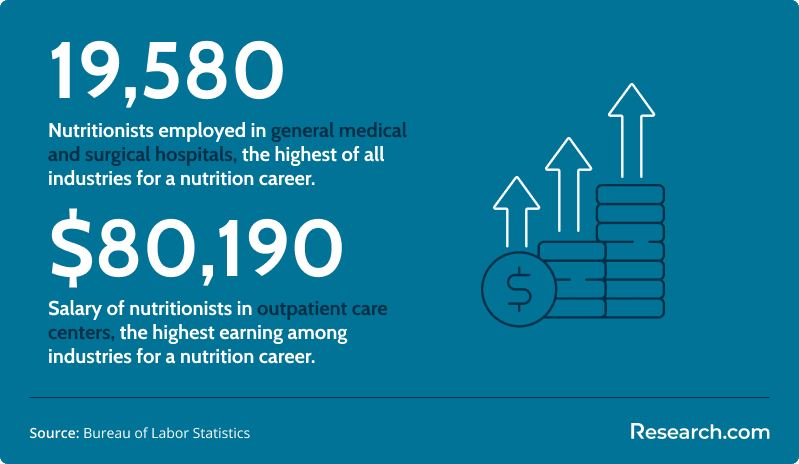
Nutrition professionals work in more than hospitals. The strongest industry fit depends on whether you prefer clinical care, education, management, research, policy, or entrepreneurship.
| Industry or setting | Best fit for | What to evaluate before choosing it |
| Hospitals and outpatient clinics | Students who want clinical work, patient care teams, and medical nutrition therapy. | Licensure rules, RDN expectations, supervised practice requirements, documentation workload, and schedule demands. |
| Long-term care and senior services | Professionals interested in aging, chronic disease, meal planning, and nutrition risk management. | Regulatory responsibilities, food service coordination, patient acuity, and interdisciplinary communication. |
| Schools and universities | People interested in child nutrition, menu planning, wellness education, and food service administration. | Budget constraints, compliance requirements, student population needs, and management responsibilities. |
| Public health and community organizations | Professionals who want population-level impact, prevention programs, and nutrition education. | Grant funding, program evaluation skills, community outreach demands, and public policy knowledge. |
| Corporate wellness and health coaching | Those who enjoy behavior change, coaching, preventive health, and workplace wellness. | Credential credibility, coaching scope of practice, client outcomes tracking, and business development expectations. |
| Private practice and consulting | Entrepreneurial professionals who want independence, niche specialization, and flexible services. | State practice laws, liability insurance, billing, marketing, client acquisition, and business operations. |
Where are the best places for a nutrition career?
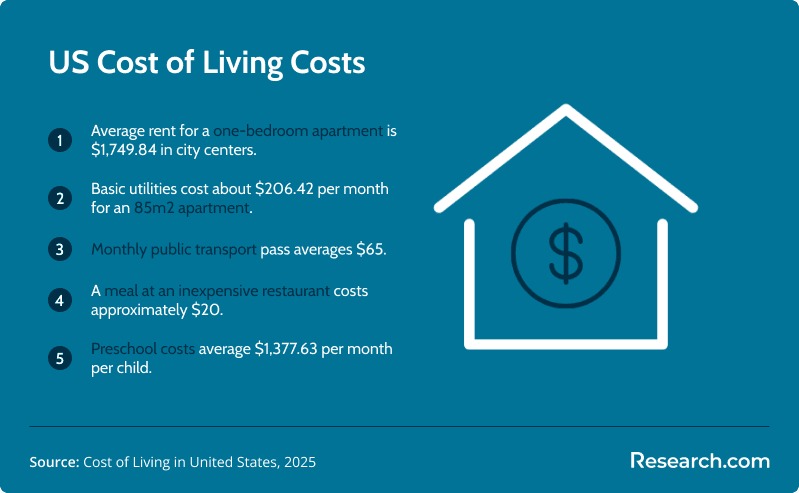
Location can affect both pay and opportunity. States with large healthcare systems, dense populations, wellness markets, or extensive public health infrastructure may offer more nutrition-related jobs. However, a higher salary does not automatically mean a better financial outcome if housing, transportation, childcare, or taxes are also higher.
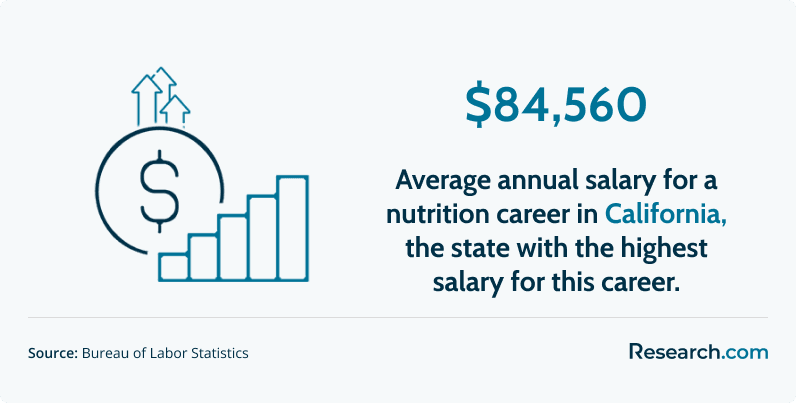
- California: California leads with 9,940 employed nutritionists and dietitians and an average annual salary of $84,560, reflecting both high employment volume and higher pay levels.
- New York: New York has 5,200 nutrition professionals earning an average of $80,510 annually, supported by major healthcare systems and wellness-focused programs.
- Texas: Texas employs 4,980 dietitians and nutritionists with an average salary of $66,440, offering opportunities across a growing healthcare sector.
- Florida: Florida has 4,430 professionals in the field and an average salary of $67,980, with demand tied in part to senior health and wellness services.
- Pennsylvania: Pennsylvania employs 3,630 professionals in this occupation at an average salary of $65,380, supported by hospital networks and community health programs.
When comparing states, look beyond the average salary. A role in a lower-cost state may provide more financial stability than a higher-paying job in a high-cost metro area.
How can I increase earning potential in a nutrition career?
The most reliable way to improve earning potential is to combine recognized credentials, specialized expertise, practical experience, and business or leadership skills. Not every option is necessary for every professional, so choose based on your target role.
- Earn advanced or specialized credentials: Specialization in sports nutrition, pediatric nutrition, diabetes care, gerontology, bariatric nutrition, or integrative and functional nutrition may help you qualify for more focused roles.
- Consider graduate education: A master’s degree or PhD can support advanced clinical, research, teaching, policy, or leadership positions. For those moving into management, healthcare MBA salary averages $110,680.
- Build a niche: A clearly defined specialty can make private practice, consulting, public speaking, and referral relationships easier to develop.
- Gain experience in high-value settings: Hospitals, specialty clinics, public health programs, sports organizations, and long-term care systems can build marketable expertise.
- Learn business fundamentals: Billing, marketing, client acquisition, compliance, budgeting, and operations matter if you want to run a private practice or consulting business.
- Use writing and speaking strategically: Workshops, articles, webinars, books, and conference presentations can build authority and create additional income streams.
- Move into leadership when appropriate: Administrative dietetics, program management, healthcare operations, and policy roles may offer broader influence and stronger compensation.
What is the job outlook for a nutrition career?
The employment outlook is positive but not explosive. According to the BLS, employment of dietitians and nutritionists is projected to grow by 6% from 2024 to 2034, which is faster than the average for all occupations. The BLS also projects about 6,100 openings for dietitians and nutritionists each year over the decade, many of them resulting from workers changing occupations or leaving the labor force.
Demand is influenced by chronic disease management, preventive care, aging populations, and growing awareness of nutrition’s role in health. At the same time, job seekers should expect variation by state, employer, credential, and specialty. Licensed clinical roles may be more credential-sensitive, while wellness and coaching roles may be more competitive because barriers to entry can be lower.
Some nutrition professionals consider management training after gaining experience. If you are asking, “What can you do with an MBA in healthcare after starting in nutrition?” the answer may include hospital administration, health services management, food and nutrition services leadership, program management, or executive roles that shape broader nutrition policies. The demand for medical and health services managers is projected to grow by 29% in the next decade, making healthcare administration a possible advancement path for professionals who want leadership rather than direct counseling.
Current trends affecting nutrition careers
- Telehealth and digital coaching: Nutrition services increasingly use virtual visits, app-based tracking, remote monitoring, and secure messaging. This can expand access but also requires strong documentation, privacy awareness, and technology skills.
- Data-informed personalization: Employers and clients are interested in more personalized nutrition support, especially when connected to chronic disease management, performance, or preventive health. Professionals should be careful to separate evidence-based practice from unsupported wellness claims.
- Interdisciplinary care: Nutrition professionals often work alongside physicians, nurses, behavioral health providers, pharmacists, and social workers. Communication and care coordination skills are increasingly important.
- Credential scrutiny: Because “nutritionist” can mean different things depending on the state and setting, employers and consumers may place more value on recognized credentials and clear scope of practice.
- Cost-conscious education choices: Students are paying closer attention to tuition, online program quality, transfer credit, supervised practice access, and whether a program supports licensure or certification goals.
How do I pursue a nutrition career?
The steps depend on whether you want a general nutrition role, health coaching position, food service management job, or regulated dietetics career. Use the following roadmap to avoid choosing a program that does not match your goals.
- Choose your target role first: Decide whether you want clinical dietetics, community nutrition, corporate wellness, food service management, sports nutrition, public health, consulting, or research.
- Check state rules: Licensing and title protection rules vary. Confirm what your state requires before enrolling, especially if you plan to provide individualized nutrition counseling or medical nutrition therapy.
- Earn the right degree: Many nutrition roles begin with a bachelor’s degree in dietetics, food and nutrition, public health, nutritional science, or a related field.
- Complete supervised training if required: Dietetics and some credentialed pathways require internships, residencies, or structured supervised practice.
- Pursue certification or licensure: Common credentials include Registered Dietitian Nutritionist (RDN) and Certified Nutrition Specialist (CNS), depending on your education, experience, and state requirements.
- Gain practical experience: Work or volunteer in hospitals, schools, wellness programs, community organizations, sports settings, food service operations, or private practices.
- Specialize strategically: Focus on a population, condition, or setting that matches employer demand and your strengths.
- Keep learning: Continuing education helps you maintain credentials, understand new research, and improve client or patient outcomes.
How to choose a nutrition program
| Question to ask | Why it matters |
| Is the program properly accredited for my goal? | Accreditation can affect transfer credits, graduate admission, supervised practice eligibility, financial aid, and employer recognition. |
| Does the curriculum align with dietetics, general nutrition, public health, or food service management? | A program may be strong academically but still not prepare you for your intended career path. |
| Will the program meet licensure or credential requirements in my state? | Online programs may not automatically satisfy state-specific requirements. |
| Are supervised practice, internships, or clinical placements included? | Hands-on experience can be essential for credentialing and employment. |
| What is the full cost, including fees, books, travel, technology, and placement expenses? | Tuition alone does not show the real price of attendance. |
| How are online students supported? | Advising, placement assistance, tutoring, and career services can affect completion and job readiness. |
| What jobs do graduates actually obtain? | Career outcomes are more useful than marketing claims or rankings alone. |
Common mistakes to avoid
- Choosing a program before choosing a career path: Nutrition education is not one-size-fits-all. A wellness-focused program may not qualify you for clinical dietetics.
- Ignoring accreditation: Accreditation affects credibility, transferability, credentialing, and sometimes financial aid.
- Assuming all online programs meet licensure requirements: Always check state rules and ask the school for written confirmation.
- Looking only at tuition: Fees, books, technology, supervised practice costs, commute expenses, and lost work hours can change the true cost.
- Relying only on rankings: Rankings can be useful, but program fit, placement support, curriculum, accreditation, and cost matter more.
- Assuming salary outcomes are guaranteed: Reported averages do not account for location, experience, employer type, credentials, or local competition.
- Overlooking business skills: Private practice and consulting require marketing, compliance, client management, and financial planning—not only nutrition knowledge.
What essential skills are needed to excel in a nutrition career?
Strong nutrition professionals combine scientific knowledge with practical communication. They need to interpret dietary data, evaluate research quality, understand nutritional biochemistry, and translate technical information into realistic recommendations. Just as important, they must listen well, build trust, document accurately, and adapt plans to a client’s culture, budget, medical needs, and daily life.
Technology skills are also becoming more important. Many roles involve electronic health records, telehealth platforms, nutrition analysis tools, mobile tracking apps, and reporting dashboards. Students comparing online nutrition schools should look for coursework and hands-on assignments that build both science knowledge and applied counseling ability.
How can a master's degree expand my nutrition career opportunities?
A master’s degree can support more advanced nutrition roles, especially in clinical specialization, public health, research, program leadership, teaching, and policy work. Graduate study may also help professionals build expertise in emerging areas such as nutrigenomics, community interventions, and evidence-based practice. If you are comparing advanced paths, review options for what you can do with a master's in nutrition before committing to a program.
Can supplementary healthcare certifications boost my nutrition career?
Supplementary healthcare training can be useful when it supports a specific career goal. For example, knowledge of reimbursement, documentation, healthcare billing, and administrative workflows may help nutrition professionals who work in clinics, hospitals, or private practices. Programs such as accredited online medical billing and coding programs may be relevant for professionals who want to understand compliance, claims processes, and practice operations. They are not a substitute for nutrition credentials, but they can strengthen administrative competence.
How can complementary healthcare training enhance my nutrition expertise?
Complementary healthcare training can help nutrition professionals better understand clinical workflows, patient intake, vital signs, care coordination, and the day-to-day demands of medical settings. This can be especially helpful for people who want to work closely with healthcare teams. A program such as the cheapest online medical assistant program may provide a broader view of medical support systems, although students should still verify accreditation, hands-on requirements, and relevance to their nutrition goals.
How can digital innovation propel my nutrition career?
Digital tools are changing how nutrition professionals assess clients, deliver education, monitor progress, and communicate with care teams. Telehealth platforms, mobile apps, nutrition tracking software, and data dashboards can improve access and efficiency when used responsibly. Professionals who want deeper preparation in healthcare data systems may consider a health information technology online degree to better understand privacy, records management, analytics, and digital health operations.
Can accelerated healthcare programs strengthen my nutrition skillset?
Accelerated healthcare programs can add practical exposure to patient care and clinical operations, but they should be chosen carefully. They make the most sense for nutrition professionals who want a stronger understanding of medical environments, not for those who need a full nutrition or dietetics credential. Programs such as 6 weeks medical assistant programs may introduce basic clinical procedures and healthcare workflows, which can improve collaboration in fast-moving care settings.
How can a fast health information management program online enhance my nutrition practice?
Health information management knowledge can help nutrition professionals document services accurately, protect patient information, communicate across departments, and use data to improve care. This is especially valuable in hospitals, outpatient clinics, long-term care, and private practice. A fast health information management program online may be useful for professionals who want cross-functional skills in digital records, compliance, and healthcare operations.
How can integrating nutrition with bioinformatics transform my career?
Nutrition and bioinformatics intersect in areas such as precision health, nutrigenomics, computational biology, and personalized intervention research. This path is most relevant for professionals interested in research, data analysis, population health, or advanced scientific roles rather than standard counseling positions. Exploring bioinformatics master's programs can help nutrition professionals understand whether data-intensive training aligns with their long-term goals.
How can mentorship bolster my nutrition career advancement?
Mentorship can shorten the learning curve in nutrition because experienced professionals can explain credentialing decisions, internship strategies, client communication challenges, niche selection, and advancement options. A mentor can also help you avoid expensive education choices that do not match your intended role. If your goal is leadership, pairing mentorship with administrative preparation, such as an accelerated healthcare administration degree online, may help connect nutrition expertise with management responsibilities.
Which nutrition certifications can enhance my career growth?
Certifications can improve credibility when they are recognized, relevant, and aligned with your scope of practice. The best certification depends on whether you want clinical nutrition, public health, sports nutrition, coaching, food safety, diabetes education, or another specialty. Before enrolling, confirm the certification’s prerequisites, renewal requirements, employer recognition, and legal limits in your state. Flexible nutrition courses online can be useful for targeted skill development, but they should not be treated as automatic replacements for degree, licensure, or supervised practice requirements.
Is a nutrition career worth it?
A nutrition career is worth it for people who value health education, science-based practice, patient or client interaction, and long-term community impact. Financially, the answer depends on role, state, credentials, debt, and cost of living. The article’s salary data includes a median annual wage around $69,680 for nutritionists and dietitians, while the BLS reports $73,850 in May 2024. Those figures may support a stable lifestyle in many areas, but they do not account for housing, transportation, healthcare, childcare, taxes, or student loan payments.
Location matters. States such as Arkansas, Mississippi, and Texas may offer a more favorable balance between income and living costs. Higher-paying states such as California and New York can offer strong salaries, but expenses may reduce the practical value of those earnings.
Role selection also matters. Among the listed career options, Consultant has the highest average salary at $78,912. Consulting can offer upside, especially in states with moderate living costs such as Texas or Florida, but it also requires business development, reputation building, and often a specialized niche.
| A nutrition career may be worth it if... | You may want another path if... |
| You enjoy translating science into practical guidance. | You want the highest-paying healthcare career with the shortest training route. |
| You are willing to meet credentialing, licensure, or supervised practice requirements for clinical roles. | You do not want to navigate state regulations or professional credentialing. |
| You are interested in chronic disease prevention, wellness, food systems, or public health. | You prefer work with little client education, counseling, or behavior-change coaching. |
| You can manage education costs and choose a program aligned with your target role. | You would need to take on high debt without a clear salary or advancement plan. |
| You are open to specialization, leadership, consulting, or additional credentials over time. | You expect a nutrition degree alone to guarantee a specific income or job title. |
Where can I find an affordable nutritionist degree online?
Affordable online nutrition programs can help reduce the cost of entering the field, but price should not be the only factor. Students should compare accreditation, curriculum, transfer credit policies, faculty support, supervised practice options, state licensure alignment, and total cost of attendance. To compare lower-cost options, review this guide to finding a nutritionist degree online.
Key insights
- Nutrition is broader than dietetics: Dietetics is the more regulated clinical pathway, while nutrition can include wellness, education, public health, food service, coaching, and research.
- Salary depends heavily on role and location: The BLS reports a median annual wage of $73,850 in May 2024 for dietitians and nutritionists, while other sources list averages from $49,877 to $81,314 yearly.
- Consulting has the highest listed average salary: Consultant roles average $78,912, but they require specialized expertise, credibility, and business skills.
- Job growth is positive: The BLS projects 6% employment growth for dietitians and nutritionists from 2024 to 2034, with about 6,100 openings each year over the decade.
- State choice affects real income: Higher salaries in states such as California and New York may be offset by higher living costs, while states such as Texas and Florida may offer a better balance for some professionals.
- Credentials matter: Before choosing a program, confirm whether it supports your target credential, supervised practice requirements, and state licensure rules.
- Advanced education can expand options: A master’s degree, healthcare MBA, specialized certification, or healthcare administration training may support leadership, consulting, research, or higher-paying roles.
- Do not choose based on tuition alone: Accreditation, licensure alignment, placement support, total cost, and career outcomes are more important than the sticker price.
References:
- Bureau of Labor Statistics. Dietitians and Nutritionists: Occupational Outlook Handbook. BLS.
- Bureau of Labor Statistics. Medical and Health Services Managers: Occupational Outlook Handbook. BLS.
- Bureau of Labor Statistics. Occupational Employment and Wages, May 2024, 29-1031 Dietitians and Nutritionists. BLS.
- Motto Mortgage. Ranking Each of the 50 States by Cost of Living. Motto Mortgage.
- Numbeo. Cost of Living in United States. Numbeo.
- ZipRecruiter. Nutrition Salary. ZipRecruiter.
- Zippia. Administrative Dietitian Jobs. Zippia.
- Zippia. Consultant Jobs. Zippia.
- Zippia. Dietary Manager Jobs. Zippia.
- Zippia. Dietician Jobs. Zippia.
- Zippia. Food Service Supervisor Jobs. Zippia.
- Zippia. Health Coach Jobs. Zippia.
- Zippia. Nutrition Assistant Jobs. Zippia.
- Zippia. Nutrition Educator Jobs. Zippia.
- Zippia. Nutrition Specialist Jobs. Zippia.
- Zippia. Nutritionist Jobs Trends. Zippia.
- Zippia. Salaries, Nutritionist. Zippia.
- Zippia. Program Coordinator Jobs. Zippia.
Other Things You You Should Know About Nutrition Careers
The most recognized credential is the RDN, earned through an ACEND-accredited graduate pathway, supervised practice, and the CDR exam. Additional certifications, such as CNS or sports nutrition credentials, can help in niche roles, but employers usually value state licensure and the RDN first.
In 2027, nutrition professionals can pursue high-paying careers as registered dietitians, wellness consultants for corporations, or nutrition-focused researchers in the biotechnology industry. Positions like these often offer competitive salaries, especially in regions with high demand for expertise in health and wellness.
To start a private practice in nutrition in 2027, a registered dietitian nutritionist (RDN) credential is necessary in most regions. Additionally, a bachelor's degree in nutrition or a related field, plus state licensure (if applicable), is critical. Business acumen, marketing skills, and legal compliance in healthcare are also essential.