
2027 Fastest Online Environmental Science Degree Programs

Co-Founder and Chief Data Scientist
Pollution continues to impact the quality of life for communities around the world. In the United States, nearly 46% of Americans are exposed to unhealthy levels of air pollution, highlighting the urgent need for environmental scientists. These professionals use data-driven research to develop effective solutions to pressing environmental challenges.
This guide is designed to help aspiring environmental scientists achieve their goals by highlighting the fastest online environmental science degree programs available. It also covers essential information about the degree, including costs, courses, and specializations, along with key details about the profession such as potential salaries, career paths, and job market demand.
What are the benefits of getting an online environmental science degree?
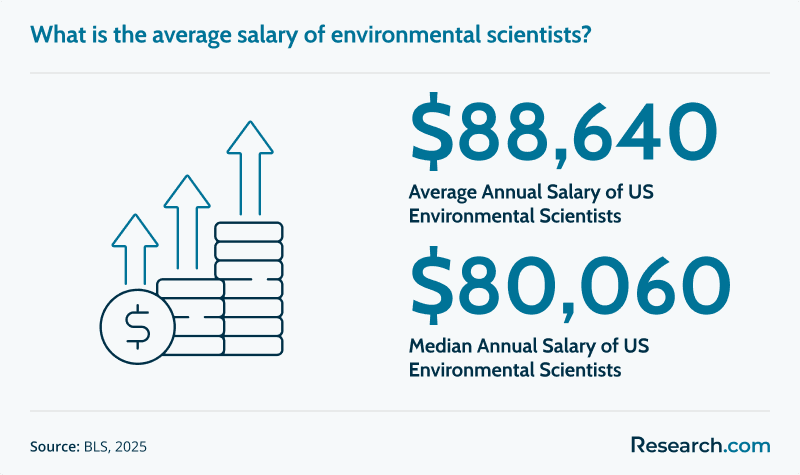
- The average yearly salary of environmental scientists is $88,640, while their median yearly salary is $80,060.
- Earning an online environmental science degree paves the way for graduates to work as environmental scientists, conservation scientists, climate analysts, or environmental teachers.
- Online environmental science degrees are more accessible, offer greater scheduling flexibility, and often cost less than traditional on-campus programs.
What can I expect from an online environmental science degree?
Prospective students pursuing an online environmental science degree can expect a rigorous, interdisciplinary curriculum that integrates natural and physical sciences, environmental policy, and technology. Core subjects often include biology, chemistry, ecology, environmental ethics, GIS, and data analysis.
Many programs incorporate hands-on components such as virtual labs, field-based assignments, and capstone projects to simulate real-world environmental work.
Specializations are commonly offered in areas like applied ecology, conservation, environmental policy, or water resource management, allowing students to tailor their studies to specific interests. The degree emphasizes critical thinking, problem-solving, and communication skills—preparing graduates to address global challenges such as climate change, pollution, and sustainable resource use.
Online programs are typically flexible, with asynchronous coursework designed to accommodate remote learners and working professionals. Students benefit from access to experienced faculty, academic advising, transfer credit opportunities, and options for accelerated graduate study or stackable credentials like certificates and microcredentials.
Where can I work with an online environmental science degree?
A graduate with an online environmental science degree can work in a variety of sectors, including government, private industry, nonprofit organizations, and research institutions. Their training in environmental systems, policy, and data analysis prepares them for diverse roles focused on sustainability and environmental protection.
The common work settings include the following:
- Government Agencies: Graduates can work for federal, state, or local environmental agencies (like the EPA or state departments of natural resources) in roles related to policy enforcement, conservation, or environmental monitoring.
- Environmental Consulting Firms: Environmental science majors may help businesses comply with environmental laws, conduct environmental impact assessments, or develop sustainability plans.
- Nonprofit and Advocacy Organizations: Graduates can support environmental education, policy advocacy, conservation efforts, and community outreach programs.
- Private Corporations: Many industries hire environmental scientists to improve sustainability practices, manage waste, or assess environmental risks.
- Research Institutions and Laboratories: Those interested in scientific research may assist with fieldwork, data collection, and lab analysis on environmental issues.
- Education and Outreach: Graduates can work as environmental educators or program coordinators in schools, museums, parks, or nature centers.
- Urban Planning and Development: Some environmental scientists work with planning agencies or architecture firms to ensure sustainable land use and minimize environmental impact in urban projects.
How much can I make with an online environmental science degree?
According to the United States Bureau of Labor Statistics (BLS), the average yearly salary of environmental scientists is $88,640, while their median yearly salary is $80,060. The latter is significantly higher than the collective median annual pay of all professions in the country ($49,500). As such, graduates of environmental science degrees can expect a fair amount of high-paying opportunities.
Environmental scientists typically earn from $50,130 to $134,830 each year in their careers. Entry-level roles usually earn wages at the lower end of the spectrum, as new hires gradually achieve higher salaries and job grades. Tenured scientists working in large firms often earn more than the average yearly salary and may have opportunities to earn more than six figures each year.
- Fastest Online Environmental Science Degree Programs for 2027 List of Programs
- How long does it take to complete an online environmental science degree? Completion Time
- How does an online environmental science degree compare to an on-campus program? How does an online environmental science degree compare to an on-campus program?
- What is the average cost of an online environmental science degree? Average Cost
- What are the financial aid options for students enrolling in an online environmental science degree? Financial Aid
- What are the prerequisites for enrolling in an online environmental science degree? Requirements
- What courses are typically in an online environmental science degree? What courses are typically in an online environmental science degree?
- What types of specializations are available in online environmental science degrees? Specializations
- How to choose the best online environmental science degree? How to choose the best online environmental science degree?
- What career paths are available for graduates of online environmental science degrees? What career paths are available for graduates of online environmental science degrees?
- How can I verify the accreditation and quality standards of an online environmental science degree? How can I verify the accreditation and quality standards of an online environmental science degree?
- What is the job market for graduates with an online environmental science degree? Job Market
- How can interdisciplinary fields expand opportunities for online environmental science graduates? How can interdisciplinary fields expand opportunities for online environmental science graduates?
- How are digital innovations enhancing practical training in online environmental science degrees? How are digital innovations enhancing practical training in online environmental science degrees?
Fastest Online Environmental Science Degree Programs for 2027: Practical 2026 Guide
Choosing a fast online environmental science degree is usually a trade-off between speed, cost, flexibility, and hands-on training. Some students want the quickest route into environmental technician or sustainability roles. Others already have a bachelor’s degree and need a graduate certificate or master’s program to move into policy, compliance, consulting, GIS, or environmental management.
This guide is built for students comparing accelerated online environmental science, environmental studies, sustainability, and closely related programs. You will find a ranked program list, completion timelines, cost considerations, online-versus-campus trade-offs, admissions requirements, common courses, career paths, job market data, and practical questions to ask before enrolling.
Quick answer: What is the fastest online environmental science degree?
The fastest option depends on your current education level. A graduate certificate can take as little as 4 to 6 months, while some master’s programs can be completed in 1 year full-time. For undergraduate students, an associate degree typically takes 1 to 2 years, and a bachelor’s degree usually takes 4 years or less, depending on transfer credits, course load, and program format.
If your goal is to enter the workforce quickly, compare certificate and associate programs first. If your goal is professional advancement, environmental consulting, sustainability leadership, or graduate-level technical work, a master’s degree or specialized graduate certificate may offer better alignment.
How we rank schools
Fast online environmental science programs can reduce time in school, but they still require a serious commitment of money, time, and scientific coursework. To make the comparison more useful, this list emphasizes programs with clear completion timelines, stated credit requirements, published costs, institutional accreditation, and curricula connected to environmental science, sustainability, environmental management, or environmental engineering.
Our research team reviewed information from trusted education data sources, including the IPEDS database, College Scorecard, Peterson's database, and the National Center for Education Statistics. Accredited institutions were prioritized because accreditation affects credit transfer, federal financial aid eligibility, employer recognition, and graduate school options. You can review the ranking process on our methodology page.
Fastest online environmental science programs at a glance
| Rank | School and Program | Credential | Program Length | Credits | Published Cost |
| 1 | Broward College A.S. in Environmental Science Technology | Associate degree | 1 to 2 years | 64 | approximately $373 per credit |
| 2 | Bellevue University Bachelor of Science in Sustainability Management | Bachelor’s degree | 4 years or less | 127 | $459 per credit; $250 military |
| 3 | American Public University Online Bachelor of Science in Environmental Science | Bachelor’s degree | 4 years or less | 120 | $350 per credit; $250 military |
| 4 | Virginia Wesleyan University Bachelor of Arts in Environmental Studies | Bachelor’s degree | 1 to 4 years | 128 | $410 per credit |
| 5 | Grand Canyon University Bachelor’s Degree in Environmental Science | Bachelor’s degree | 4 years or less | 120 | $8,250 per semester |
| 6 | Georgia Institute of Technology M.S. in Sustainability, Energy & Environmental Management | Master’s degree | 1 year full-time; 2 years part-time | 30 | $9,000–$12,000 estimate |
| 7 | Arizona State University M.S. in Environmental & Resource Management | Master’s degree | 1 to 2 years | 30 | $363 per credit |
| 8 | University of Redlands Online MBA in Sustainable Management | MBA | 21 months full-time to 3.5 years part-time | 53 total credit hours | $1,345 per credit |
| 9 | Ohio State University Graduate Certificate in Environmental Assessment | Graduate certificate | 4 to 6 months | 12 | $400 to $500 per credit |
| 10 | University of North Dakota Graduate Certificate in Environmental Engineering | Graduate certificate | approximately 1 year | 9 graduate-level credit hours | $798.08 per credit |
1. Broward College A.S. in Environmental Science Technology
The Broward College A.S. in Environmental Science Technology is built for students who want applied preparation for entry-level environmental work. The program connects classroom study with field and lab training in areas such as air, water, and soil sampling; environmental regulation; GIS software; native plants; wetland management; and project-based environmental problem solving. It can support roles such as environmental laboratory technician, sampler, or groundwater contamination analyst.
- Program length: 1 to 2 years
- Required credits to graduate: 64
- Cost per credit: approximately $373
- Accreditation: Southern Association of Colleges and Schools Commission on Colleges
2. Bellevue University Bachelor of Science in Sustainability Management
Bellevue University offers an online Bachelor of Science in Sustainability Management for students interested in the business, policy, engineering, and science sides of sustainability. Its accelerated cohort model lets students focus on one course at a time while moving through the program with peers. Coursework includes green technology, project management, sustainable development, and preparation that may support credentials such as the LEED Green Associate exam.
- Program length: 4 years or less
- Required credits to graduate: 127
- Cost per credit: $459; $250 military
- Accreditation: Higher Learning Commission
3. American Public University Online Bachelor of Science in Environmental Science
American Public University provides an online Bachelor of Science in Environmental Science focused on natural science, social science, sustainability, environmental policy, pollution science, and GIS. Students can choose a general path or focus on fish and wildlife management, making this option relevant for learners interested in conservation, environmental analysis, or resource management.
- Program length: 4 years or less
- Concentrations:
- General
- Fish and Wildlife Management
- Required credits to graduate: 120
- Cost per credit: $350; $250 military
- Accreditation: Higher Learning Commission
4. Virginia Wesleyan University Bachelor of Arts in Environmental Studies
Virginia Wesleyan University offers an online Bachelor of Arts in Environmental Studies that takes an interdisciplinary approach. Instead of focusing only on laboratory science, the program combines environmental science with economics, ethics, policy, sustainability, geology, biology, and GIS. This structure can work well for students considering corporate sustainability, conservation, policy, or environmental education roles.
- Program length: 1 to 4 years
- Required credits to graduate: 128
- Cost per credit: $410
- Accreditation: Southern Association of Colleges and Schools Commission on Colleges
5. Grand Canyon University Bachelor’s Degree in Environmental Science
Grand Canyon University offers a Bachelor of Science in Environmental Science through the College of Natural Sciences. The program emphasizes environmental stewardship, research habits, critical thinking, and lab-based learning while covering broad challenges such as climate change, pollution, and ecosystem degradation.
- Program length: 4 years or less
- Required credits to graduate: 120
- Cost per semester: $8,250
- Accreditation: Higher Learning Commission
6. Georgia Institute of Technology M.S. in Sustainability, Energy & Environmental Management
Georgia Institute of Technology offers the M.S. in Sustainability, Energy & Environmental Management through the Jimmy and Rosalynn Carter School of Public Policy in collaboration with engineering, business, planning, and economics departments. This 30-credit master’s program is designed for students who want cross-disciplinary management skills in policy economics, GIS, industrial ecology, cost–benefit analysis, air pollution control, sustainability, and environmental systems.
- Program length: 1 year full-time; 2 years part-time
- Required credits to graduate: 30
- Total cost: $9,000–$12,000 estimate
- Accreditation: Southern Association of Colleges and Schools Commission on Colleges
7. Arizona State University M.S. in Environmental & Resource Management
The M.S. in Environmental & Resource Management from Arizona State University is aimed at students who want to manage environmental risks connected to industrial pollution, regulatory compliance, engineered systems, and natural ecosystems. The curriculum includes environmental law, water and wastewater treatment, air pollution management, solid and hazardous waste management, and sustainable development.
- Program length: 1 to 2 years
- Required credits to graduate: 30
- Cost per credit: $363
- Accreditation: Southern Association of Colleges and Schools Commission on Colleges
8. University of Redlands Online MBA in Sustainable Management
The Presidio Graduate School at the University of Redlands offers an MBA in Sustainable Solutions for students who want business training grounded in sustainability, climate leadership, environmental stewardship, and social justice. The program combines core MBA topics with systems thinking, ESG strategy, energy systems, and climate planning, making it most relevant for students pursuing leadership, management, or strategy roles rather than traditional field science positions.
- Program length: 21 months full-time to 3.5 years part-time
- Required credits to graduate: 53 total credit hours
- Cost per credit: $1,345
- Accreditation: Higher Learning Commission
9. Ohio State University Graduate Certificate in Environmental Assessment
Ohio State University offers a fully online graduate certificate through the College of Food, Agricultural, and Environmental Sciences. The 4-course program is designed for professionals who need targeted training in environmental impact assessment, biodiversity, climate mitigation, policy review, project evaluation, and regulatory compliance. A bachelor's degree is required for admission.
- Program length: 4 to 6 months
- Required credits to graduate: 12
- Cost per credit: $400 to $500
- Accreditation: Higher Learning Commission
10. University of North Dakota Graduate Certificate in Environmental Engineering
The University of North Dakota offers a fully online Graduate Certificate in Environmental Engineering for students who want focused technical training across civil, chemical, and geological engineering perspectives. Coursework addresses applied environmental challenges involving air, water, land, pollution control, hazardous waste remediation, and groundwater modeling.
- Program length: approximately 1 year
- Required credits to graduate: 9 graduate-level credit hours
- Cost per credit: $798.08
- Accreditation: Higher Learning Commission
How long does it take to complete an online environmental science degree?
A full-time online bachelor’s degree in environmental science commonly takes four years, but accelerated calendars, transfer credits, prior learning credit, and heavier course loads can shorten that timeline. Students who already hold a bachelor’s degree may finish a graduate certificate in less than a year or a master’s degree in about 1.5 to 2 years, depending on the program.
| Credential | Typical Completion Time | Best For | Important Decision Point |
| Associate degree | 2 years of full-time study | Students seeking foundational science training or an entry route into technician roles | Confirm whether credits transfer smoothly into a bachelor’s program |
| Bachelor’s degree | 4 years; accelerated or transfer-friendly pathways may reduce the timeline to 2.5 to 3 years | Students who need a full undergraduate credential for environmental science, conservation, sustainability, or policy roles | Ask how many transfer credits the school will accept before estimating completion time |
| Master’s degree | 1.5 to 2 years full-time; up to 3 years part-time | Professionals seeking advanced environmental management, policy, consulting, or technical roles | Check whether the program expects prior science coursework or professional experience |
| Certificate program | 6 months to 1 year | Working professionals who need a focused credential in assessment, compliance, GIS, sustainability, or engineering | Verify whether certificate credits can later apply to a degree |
Students comparing fast online formats in other fields can also review how accelerated scheduling works in a fast-track organizational leadership bachelor's degree online. The structure is different, but the same questions apply: transfer policy, course intensity, academic calendar, and support for working adults.
How does an online environmental science degree compare to an on-campus program?
Online and campus-based environmental science programs can cover similar academic foundations: ecology, chemistry, earth systems, environmental law, GIS, sustainability, research methods, and data analysis. The real difference is how students complete labs, fieldwork, group projects, advising, and faculty interaction.
Students who want a more technical engineering route should also compare environmental science with a fastest online environmental engineering degree. Environmental engineering programs typically place more weight on engineering design, water systems, pollution control, and applied technical problem solving.
| Factor | Online Environmental Science Degree | On-Campus Environmental Science Degree | Best Choice If... |
| Schedule | Often uses asynchronous courses, recorded lectures, and flexible weekly deadlines | Usually follows fixed class times and a campus calendar | Choose online if you work, parent, serve in the military, or need geographic flexibility |
| Learning environment | Relies on learning management systems, virtual labs, discussion boards, digital collaboration, and independent study habits | Offers face-to-face classes, live discussion, in-person peer interaction, and immediate classroom feedback | Choose campus if you learn best through routine, direct contact, and structured class meetings |
| Resources | Provides remote advising, online library access, digital research tools, virtual office hours, and sometimes local fieldwork coordination | Provides direct access to labs, equipment, faculty offices, libraries, field stations, and campus events | Choose campus if you want frequent use of physical science facilities |
| Hands-on training | May use virtual labs, home-based exercises, local field assignments, or independent projects approved by faculty | Often includes scheduled labs, field trips, outdoor research, and supervised equipment use | Choose online only after confirming how the school handles lab and field requirements |
| Cost and access | Can reduce commuting, relocation, and housing expenses; tuition policies vary by school | May require relocation, parking, housing, meal plans, and campus fees | Choose online if location and total cost are major constraints |
When online study makes sense
- You need to keep working while earning the credential.
- You already live near parks, agencies, labs, employers, or field sites where local projects may be possible.
- You are comfortable managing deadlines without frequent in-person reminders.
- You value a wider school search because you are not limited to nearby campuses.
When campus study may be better
- You want frequent lab access and structured field trips.
- You are early in your college journey and need close academic support.
- You want to build local professional networks through campus events, faculty research, and student organizations.
- You are targeting roles that expect extensive field, lab, or equipment experience.
What is the average cost of an online environmental science degree?
The cost of an online environmental science degree varies by credential level, school type, residency policy, fees, and transfer credit. As a broad estimate, a full online environmental science program may range from $15,000 to $60,000. Certificates and associate degrees usually cost less than bachelor’s degrees, while master’s programs vary widely by institution and program structure.
| Credential | Common Total Cost Range | What Can Change the Final Price |
| Associate degree | $6,000 to $20,000 | Community college pricing, residency status, lab fees, and transfer pathway |
| Bachelor’s degree | $25,000 to $60,000 | Public versus private tuition, transfer credits, course load, online fees, and required materials |
| Master’s degree | $15,000 to $40,000 | Credit requirements, graduate tuition, program reputation, employer support, and specialization |
| Certificate program | $2,000 to $10,000 | Number of credits, graduate versus undergraduate level, and whether credits can stack into a degree |
Students comparing scientific graduate routes may also look at a fast track master's in biotechnology online if their interests lean toward biological systems, research, bioremediation, or applied life sciences rather than environmental management alone.
The chart below shows the most common degree levels among environmental scientists in the United States.
What are the financial aid options for students enrolling in an online environmental science degree?
Online environmental science students may qualify for many of the same financial aid options as campus-based students, as long as they attend an eligible accredited institution and meet program requirements. Before enrolling, confirm that the program is eligible for federal aid and ask whether aid applies to accelerated sessions, part-time study, certificates, or nondegree coursework.
- Federal financial aid: Start with the Free Application for Federal Student Aid (FAFSA). Eligible students may receive Pell Grants, Federal Supplemental Educational Opportunity Grants, and federal student loans.
- State grants and scholarships: Some states support residents in accredited online programs, but eligibility may depend on the school’s location, reciprocity agreements, or enrollment status.
- Institutional scholarships: Colleges may offer awards for online learners based on academic performance, financial need, field of study, public service, or transfer status.
- Employer tuition assistance: Environmental agencies, utilities, consulting firms, manufacturers, and public-sector employers may help pay for relevant coursework, especially in compliance, sustainability, GIS, safety, or management.
- Private scholarships: Nonprofits, foundations, and professional associations may fund students studying environmental science, environmental health, conservation, sustainability, or related fields.
- Work-study: Remote or flexible work-study may be available through some institutions, although options can be more limited for fully online students.
- Military and veterans benefits: Active-duty service members, veterans, and eligible dependents may be able to use GI Bill®, Tuition Assistance, or Yellow Ribbon benefits.
- Payment plans: Many schools allow tuition to be paid in installments across a semester or academic year, which can reduce the need for short-term borrowing.
How to reduce the total cost
- Complete lower-division general education courses at a lower-cost accredited institution before transferring.
- Ask for a written transfer credit evaluation before enrolling.
- Compare total program cost, not only cost per credit.
- Check whether online students pay technology, proctoring, lab, fieldwork, or graduation fees.
- Ask whether certificate credits can count toward a later master’s degree.
- Use employer reimbursement only after confirming grade requirements, repayment obligations, and eligible courses.
What are the prerequisites for enrolling in an online environmental science degree?
Admission requirements vary by institution and credential level. Undergraduate programs generally look for college readiness and basic preparation in math and science, while graduate programs may require a bachelor’s degree, prior coursework, professional experience, or recommendations. Online students must also be ready to use digital learning tools consistently.
| Requirement | Who Usually Needs It | Why It Matters |
| High school diploma or GED | Associate and bachelor’s applicants | Shows that the applicant has completed secondary education and is prepared for college-level study |
| Official transcripts | Most applicants | Allows the school to evaluate prior coursework, GPA, transfer credits, and academic history |
| Minimum GPA | Many undergraduate and graduate applicants | Programs may expect a GPA of 2.5 or higher; more competitive programs may look for a 3.0 or above |
| Standardized test scores | Some applicants | SAT, ACT, or GRE scores may be optional, conditional, or requested for specific applicant groups |
| Prior college coursework | Transfer and graduate applicants | Science-heavy programs may expect earlier coursework in biology, chemistry, ecology, geology, or related fields |
| Personal statement | Many bachelor’s and graduate applicants | Explains career goals, interest in environmental science, and fit with online learning |
| Letters of recommendation | Common for graduate programs | Helps admissions committees evaluate academic ability, work habits, and professional readiness |
| Technology access | All online students | Reliable internet, a capable computer, video conferencing access, and comfort with course platforms are essential |
Applicants considering advanced leadership or workplace-focused graduate options outside environmental science can compare admissions expectations with accelerated online master's in industrial organizational psychology programs. This can be useful for students weighing sustainability work against organizational consulting, workforce analytics, or human behavior roles.
The visual below identifies the U.S. states that offer the highest average yearly salaries for environmental scientists: the District of Columbia ($115,910), Connecticut ($109,710), and Massachusetts ($102,700).
What courses are typically in an online environmental science degree?
An online environmental science curriculum usually combines natural science, environmental systems, quantitative analysis, policy, sustainability, and applied research. Programs with a stronger science focus may include labs and field assignments, while environmental studies or sustainability programs may include more policy, ethics, planning, and management coursework.
| Course Area | What Students Learn | Career Relevance |
| Environmental science fundamentals | Ecosystems, biodiversity, human impacts, environmental systems, and sustainability concepts | Builds the baseline knowledge needed for most environmental roles |
| Ecology | Organism interactions, habitats, populations, food webs, and ecosystem dynamics | Useful for conservation, wildlife, restoration, and field science work |
| Geology or earth systems | Earth processes such as erosion, plate tectonics, soils, natural hazards, and landforms | Supports work involving land use, remediation, water resources, and environmental assessment |
| Environmental chemistry | Chemical behavior in air, water, and soil, including pollutants and contaminant movement | Important for pollution control, lab analysis, water quality, and hazardous materials work |
| Climate change and meteorology | Weather systems, climate models, greenhouse gases, warming trends, mitigation, and adaptation | Relevant to climate planning, risk assessment, policy, and sustainability roles |
| Environmental policy and law | Regulatory systems, environmental statutes, compliance, permitting, and policy analysis | Useful for consulting, government, advocacy, and corporate compliance work |
| GIS and remote sensing | Mapping, spatial data, GPS, satellite imagery, and environmental data visualization | Valuable for conservation planning, land management, disaster response, and environmental consulting |
| Statistics or data analysis | Quantitative methods for evaluating environmental data and drawing evidence-based conclusions | Supports research, reporting, modeling, compliance, and analytics-heavy roles |
| Sustainability and resource management | Water, energy, forests, waste, agriculture, and long-term resource planning | Useful for sustainability coordination, resource management, and corporate environmental roles |
| Capstone project or internship | Applied research, professional practice, or a real-world environmental problem | Helps students demonstrate job-ready experience to employers |
Students who want to strengthen the quantitative side of environmental work can compare this pathway with an accelerated master's degree in data analytics online, especially if they are interested in environmental modeling, GIS analysis, climate data, or regulatory reporting.
What types of specializations are available in online environmental science degrees?
Specializations help students connect coursework with a clearer career direction. A student interested in wildlife work should not choose the same track as someone aiming for ESG strategy, environmental health, or GIS analysis. Before choosing a concentration, review course descriptions, fieldwork expectations, faculty expertise, and the types of employers connected to the program.
| Specialization | Focus | Good Fit For |
| Conservation biology | Biodiversity, species protection, ecosystem preservation, habitat management, and restoration | Students interested in conservation agencies, parks, wildlife work, or restoration projects |
| Environmental policy and management | Environmental regulation, planning, compliance, program administration, and policy analysis | Students targeting government, nonprofit, consulting, or corporate environmental roles |
| Climate change | Climate science, mitigation, adaptation, risk planning, and climate policy | Students interested in resilience planning, sustainability strategy, climate research, or public policy |
| Environmental health | Pollution, toxins, public health, occupational risks, exposure prevention, and risk assessment | Students considering environmental health, safety, inspection, or compliance work |
| Sustainability studies | Energy, agriculture, cities, corporate sustainability, waste reduction, and long-term resource use | Students interested in sustainability coordination, ESG, facilities planning, or resource management |
| Geospatial analysis | GIS, GPS, remote sensing, mapping, data visualization, and spatial decision-making | Students who want technical data skills for planning, conservation, consulting, or emergency management |
| Marine and aquatic science | Oceans, freshwater systems, aquatic organisms, water quality, and marine resource management | Students interested in water resources, fisheries, marine biology, or aquatic conservation |
| Energy and the environment | Energy systems, renewable energy, environmental impacts, and energy policy | Students focused on renewable energy, sustainability planning, utilities, or policy work |
Students who want a more policy-centered energy pathway may compare environmental science with shortest energy policy degree programs online. Those who are more interested in sustainability than environmental science can review an accelerated sustainability bachelor's degree online.
As shown in the visual below, the industries in which environmental scientists mainly work are state government offices (28%); management, scientific, and technical consulting services (19%); and local government offices (14%).
How to choose the best online environmental science degree
The best online environmental science degree is not always the fastest or cheapest one. The right choice depends on your current credits, career target, need for field experience, budget, preferred schedule, and whether you plan to pursue graduate study, certification, or licensure-related work later.
Key factors to compare before enrolling
- Accreditation: Choose a program from a regionally accredited institution whenever possible. Accreditation can affect financial aid, credit transfer, employer recognition, and graduate school eligibility.
- Hands-on requirements: Ask how online students complete labs, fieldwork, sampling projects, GIS exercises, internships, or capstones.
- Curriculum fit: Review whether the program is science-heavy, policy-oriented, sustainability-focused, or management-based.
- Specializations: Look for concentrations that match your target roles, such as conservation biology, GIS, environmental health, climate change, sustainability, or resource management.
- Faculty background: Faculty with research, consulting, government, field science, policy, or industry experience can strengthen the practical value of the program.
- Transfer credit policy: A fast program may not be fast for you if it accepts few of your previous credits.
- Total cost: Compare tuition, fees, books, lab kits, software, proctoring, travel, and any required in-person components.
- Career support: Look for internship help, job boards, alumni networks, résumé review, interview preparation, and employer connections.
Questions to ask admissions advisors
| Question | Why It Matters |
| Is the institution regionally accredited? | Accreditation affects financial aid, credit transfer, and long-term credential value. |
| How many of my transfer credits will apply to the major? | This determines your real completion time and total cost. |
| Are labs, fieldwork, or internships required? | Environmental science is applied; you need to know how hands-on work is handled online. |
| Are there any required campus visits? | Even “online” programs may include in-person labs, orientations, or field experiences. |
| What software or equipment will I need? | GIS, lab kits, statistical software, or proctoring tools may add cost. |
| Can I study part-time or accelerate? | Flexibility affects work-life balance and completion speed. |
| What roles do graduates commonly pursue? | Career outcomes help you judge whether the curriculum aligns with your goals. |
| Does the program prepare students for certifications or professional credentials? | Some sustainability, safety, GIS, or environmental compliance roles may value additional credentials. |
Common mistakes to avoid
- Choosing only by speed: A shorter program is not helpful if it lacks the science, field, or technical training your target role expects.
- Ignoring accreditation: Unaccredited or poorly recognized programs can create problems with financial aid, graduate admission, and employer review.
- Looking only at tuition: Fees, software, lab materials, textbooks, travel, and lost transfer credits can significantly change the real cost.
- Assuming all online programs include field experience: Ask exactly how fieldwork is completed, supervised, documented, and assessed.
- Relying only on rankings: Rankings can narrow the search, but program fit, cost, transfer policy, and career alignment matter more.
- Assuming salaries are guaranteed: Earnings vary by location, employer, experience, degree level, specialization, and job responsibilities.
What career paths are available for graduates of online environmental science degrees?
Graduates may work in government, environmental consulting, nonprofits, utilities, engineering-adjacent firms, education, sustainability, and research support. Some roles involve field sampling and site visits; others focus on data, policy, compliance, reporting, outreach, or program management.
| Career Path | Typical Work | Useful Preparation |
| Environmental scientist | Collects data, investigates pollution or ecosystem impacts, and recommends science-based solutions | Environmental chemistry, ecology, statistics, field methods, and regulatory knowledge |
| Environmental consultant | Helps clients understand regulations, assess environmental risk, and reduce ecological impact | Compliance, technical writing, GIS, sampling methods, and client communication |
| Conservation scientist | Manages natural resources, habitats, forests, parks, or rangelands | Ecology, conservation biology, resource management, and field experience |
| Environmental educator | Teaches environmental topics through schools, parks, nonprofits, museums, or public outreach | Science communication, curriculum design, ecology, and community engagement |
| Climate analyst | Studies climate data and supports mitigation, adaptation, and planning decisions | Climate science, statistics, data analysis, GIS, and policy knowledge |
| GIS specialist | Maps, analyzes, and visualizes environmental and geographic data | GIS, remote sensing, spatial analysis, database skills, and environmental systems knowledge |
| Environmental health and safety specialist | Supports workplace safety, environmental compliance, inspections, reporting, and risk prevention | Environmental health, regulations, hazardous materials, safety protocols, and documentation |
| Sustainability coordinator | Develops waste reduction, energy efficiency, reporting, and resource-use programs | Sustainability, project management, ESG concepts, communication, and data tracking |
| Wildlife or marine biologist | Studies animals or aquatic life and contributes to habitat protection or ecosystem restoration | Biology, ecology, field research, statistics, and species-specific training |
| Policy analyst or environmental advocate | Researches, develops, communicates, or promotes environmental policy | Environmental law, policy analysis, economics, writing, and public communication |
Students comparing broader social science careers can review high paying sociology jobs, while those considering environmental education roles may want to understand the requirements for masters in education programs. If your goal is corporate sustainability leadership, review the sustainability manager education requirements.
How can I verify the accreditation and quality standards of an online environmental science degree?
Start with institutional accreditation. Confirm the school’s accreditor through the institution’s website and recognized accreditation databases, then check whether the program’s curriculum includes the technical, scientific, and applied components needed for your target job. Accreditation alone does not guarantee that a program is the best fit; it only confirms that the institution meets recognized quality standards.
For a cost-focused comparison, students can review affordable online environmental science programs and then verify accreditation, curriculum, student support, transfer policy, and career services before applying.
Quality checks that matter
- Confirm the institution’s accreditation status directly with the accreditor or official databases.
- Review syllabi or course descriptions for labs, field methods, GIS, statistics, research, and policy coverage.
- Ask whether online students have the same faculty access as campus students.
- Look for transparent graduation requirements, fees, and transfer policies.
- Ask for examples of capstone projects, internships, field assignments, or employer partnerships.
- Review whether graduates pursue roles aligned with your goals, such as consulting, compliance, sustainability, conservation, or GIS.
What is the job market for graduates with an online environmental science degree?
According to the BLS, employment of environmental scientists is projected to grow by 7% from 2023 to 2033, compared with the national average of 4%. The number of these professionals is expected to increase from 84,600 in 2023 to 90,700 by 2033.
During that period, the BLS projects about 8,500 openings for environmental scientists each year. Indeed currently lists over 1,000 job openings for environmental scientists. That count does not include related job titles such as environmental teacher, conservation scientist, climate analyst, sustainability coordinator, or GIS specialist.
The industries employing the highest number of environmental scientists are state government offices (21,760); management, scientific, and technical consulting services (15,980); architectural, engineering, and related services (11,430); and local government offices (11,100).
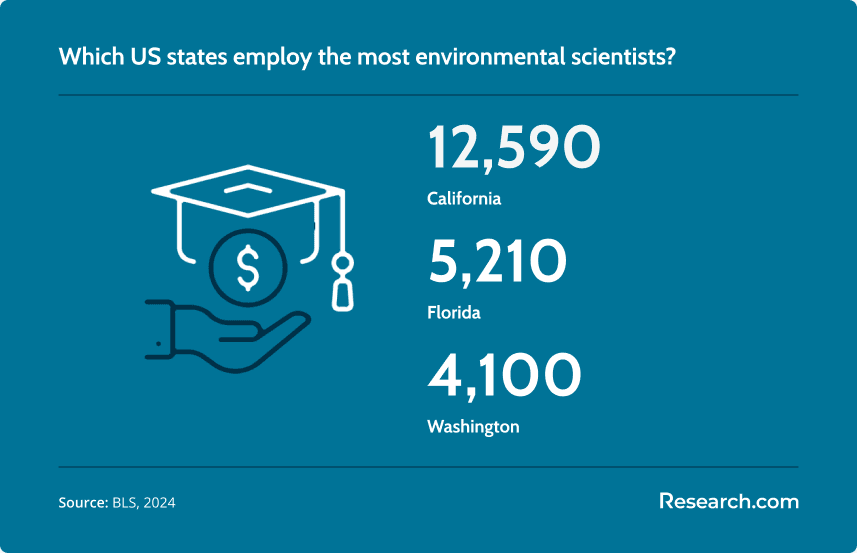
The U.S. states with the highest employment levels are California (12,590), Florida (5,210), and Washington (4,100).
How can interdisciplinary fields expand opportunities for online environmental science graduates?
Environmental problems rarely fit into one academic box. Graduates who combine environmental science with data analytics, biotechnology, energy policy, engineering, business, public health, or education may qualify for a wider range of roles. For example, environmental science plus GIS can support spatial analysis work, while environmental science plus business can support sustainability management and ESG reporting.
Biotechnology can also intersect with environmental work in areas such as ecological restoration, bioremediation, and sustainable product development. Students considering that direction can review this biotechnology careers list and salaries to compare possible roles and compensation benchmarks.
What graduates say about online environmental science degrees
- Eugene: "Studying online gave me access to faculty and course materials without relocating or commuting. The program’s interdisciplinary structure helped me connect sustainability, policy, and science, and the online discussions made it easy to learn from classmates with different professional backgrounds."
- Dennis: "I was concerned that an online degree would not include enough applied work, but the virtual labs and local field projects helped me build practical skills. GIS and environmental data interpretation became especially useful in my current work on environmental impact assessments."
- Alfred: "My online environmental science degree helped me move toward conservation and consulting opportunities. The mix of science courses, policy conversations, and faculty support made the experience feel connected to real environmental problem solving rather than just theory."
How are digital innovations enhancing practical training in online environmental science degrees?
Digital tools are changing how online environmental science students practice field and analysis skills. Virtual labs, remote sensing tools, GIS platforms, environmental simulations, collaborative research software, and online data sets can help students model ecological systems, analyze environmental conditions, and prepare reports without always being on campus.
These tools do not fully replace fieldwork, especially for students who need sampling, equipment, or site assessment experience. However, they can strengthen technical fluency and prepare students for workplaces that increasingly use environmental data, mapping software, digital monitoring, and cross-disciplinary analysis. Students interested in the technical infrastructure behind environmental monitoring can also compare related options such as the cheapest online degrees in electrical engineering.
Current trends affecting online environmental science students
- More data-driven environmental work: GIS, remote sensing, dashboards, and environmental reporting tools are increasingly important for analysis, planning, and compliance.
- Growth in sustainability and ESG-related roles: Many organizations need staff who can track emissions, energy use, waste reduction, reporting requirements, and sustainability goals.
- Continued need for regulatory knowledge: Environmental consulting, government, and corporate compliance roles require professionals who understand permits, documentation, audits, and environmental law.
- Hybrid practical training: Online programs may combine virtual labs with local field assignments, internships, or project-based capstones.
- Cross-disciplinary hiring: Employers may value candidates who combine environmental knowledge with analytics, business, engineering, policy, public health, or communication skills.
References:
- BLS (2024, April 3). 19-2041 Environmental Scientists and Specialists, Including Health. BLS
- BLS (2025, April 18). Environmental Scientists and Specialists. BLS
- BLS (2025, July 22). Industry: Cross-industry, Private, Federal, State, and Local Government Period: May 2024. BLS
- College Board. Environmental Scientists and Specialists. College Board; related occupational wage data can be reviewed through BLS industry data
- Nater, O. (2025, May 1). Report: Half of Americans breathing dangerous levels of air pollution. Population Connection
Key Insights
- The fastest online option is usually a graduate certificate, which can take 4 to 6 months, but it is best for students who already have a bachelor’s degree or professional experience.
- For undergraduate students, associate programs can lead to entry-level technical work, while bachelor’s programs provide broader preparation for environmental science, sustainability, conservation, policy, and GIS roles.
- Speed should not outweigh accreditation, field training, transfer policy, and curriculum fit. A fast degree with weak practical preparation may limit your job options.
- Online programs can work well for working adults, but students should confirm how labs, fieldwork, GIS assignments, internships, and capstones are completed.
- Total cost matters more than tuition alone. Compare fees, software, lab materials, transfer credits, financial aid eligibility, and whether credits can stack into a higher credential.
- The BLS projects 7% employment growth for environmental scientists from 2023 to 2033, with about 8,500 openings each year, but salary and job access vary by specialization, location, employer, and experience.
- The strongest career positioning often comes from pairing environmental science with a practical skill set such as GIS, data analysis, compliance, sustainability reporting, policy, engineering concepts, or communication.
Other Things You Should Know About Online Environmental Science Degrees
Prerequisites typically include a high school diploma or equivalent. Some programs may require prior coursework in biology or chemistry. Check specific program requirements, as they can vary.
Concentrations in environmental policy, sustainability, or natural resource management can speed up completion when the school offers them as 8-week courses or lets students apply up to 90 transfer credits. Programs still require the full major core, usually about 120 semester credits.
Yes, admission deadlines vary, with most 2027 fastest online environmental science degree programs closing applications by February. Always check individual program pages for precise dates, as some may have rolling admissions opening throughout the year.


