2027 Chemistry Degree Guide: Costs, Requirements & Job Opportunities

Co-Founder and Chief Data Scientist
Chemistry is one of the most flexible science degrees you can choose if you want options after graduation. It can lead to lab work, research, manufacturing, health-related roles, environmental work, teaching, and advanced study. It also gives you skills employers value across industries: data analysis, problem-solving, technical writing, and careful laboratory practice.
If you are considering a chemistry degree, this guide will help you decide whether it fits your goals, what different degree levels prepare you for, how much it can cost, what careers it can lead to, and what to check before choosing a program. It also explains emerging areas in chemistry, the role of accreditation, and how to evaluate whether the investment makes sense for your situation.
One important note: salary and job outcomes vary by location, employer, degree level, and experience. A chemistry degree can be a strong path, but the best choice depends on the role you want and how far you plan to study.
Chemistry Degree Table of Contents
- What is a Chemistry degree?
- Cost of Chemistry Degree
- Chemistry Degree Jobs
- Types of Degrees in Chemistry for 2027
- Chemistry Degree Requirements
- What to Look for in a Chemistry Program
- Majors Related to Chemistry
- What are some emerging fields in chemistry that offer exciting career opportunities?
- How can online education supplement a traditional chemistry degree?
- Is online advanced education a valuable investment for chemistry professionals?
- How do you decide if a chemistry degree is the right choice for you?
- Can an associate accelerated program expedite my entry into the chemistry field?
- What are the best ways to gain practical experience in chemistry?
- Can an accelerated chemistry degree fast-track my career?
- How can I choose an affordable chemistry degree program?
- How do professional networks and mentorship opportunities enhance chemistry careers?
- How do faculty expertise and institutional reputation influence a chemistry degree?
What is a Chemistry degree?
A chemistry degree is a science program focused on matter, its structure, how it behaves, and how it changes during reactions. Because chemistry connects biology, physics, environmental science, medicine, and engineering, it is often called the central science.
Most programs combine classroom theory with lab work, data analysis, and research projects. Students learn how to observe carefully, run experiments safely, interpret results, and communicate findings clearly. These are useful skills whether you want to work in industry, research, government, or education.
For many students, the real question is not just “What is chemistry?” but “What can I do with it?” The answer is broad. A chemistry degree can support careers in pharmaceuticals, materials, food science, environmental testing, manufacturing, and more. It can also be a strong foundation for graduate study or professional school.
Common skills developed in chemistry programs include:
- Analytical reasoning and problem-solving
- Data collection, organization, and interpretation
- Laboratory safety and experimental technique
- Reading and evaluating scientific literature
- Teamwork and collaboration
- Technical communication and report writing
- Numeracy and use of scientific tools
- Academic writing and research methods
Typical core subjects include:
- Biochemistry
- Organic chemistry
- Inorganic chemistry
- Physical chemistry
- Analytical chemistry
Depending on the school, students may also be able to take specialized courses such as:
- Petrology and mineralogy
- Earth systems and geology
- Chemistry of materials
- Molecular pharmacology
- Solid-state chemistry
What can you do with a Chemistry degree?
If you are asking what a chemistry degree can actually lead to, the short answer is: more than most people expect. Graduates work in laboratories, production facilities, government agencies, research institutes, schools, and technical support roles. Some move into chemistry directly. Others use the degree as a springboard into health care, law, engineering, or graduate research.
Many openings are found in pharmaceuticals, food science, environmental testing, and chemical engineering-related work. Chemistry graduates are also employed in education, manufacturing, quality assurance, and technology-driven industries.
The broader chemical sector remains economically important. The 2025 Global Chemical Industry Report states that the global chemistry enterprise supports over 120 million jobs and has $6 trillion in economic impact worldwide (International Council of Chemical Associations, 2025). That does not mean every graduate will find the same outcome, but it does show the scale of the field.
-
: "The report emphasizes that the chemistry enterprise depends heavily on the people working in industrial and government laboratories, and it also points to the field’s diversity as a strength.
“Over the past forty years, the number of women in the chemistry enterprise has steadily increased; currently, almost one-third of the chemistry workforce are women," the study noted.
It also highlights international collaboration as a major part of modern chemical research. “More than 35% of scientific articles today are the results of international collaborations among researchers from different countries," the research highlights.
The report adds that many organizations are now building collaborative programs to support innovation and strategic growth. “A number of other organizations and businesses have been working to develop collaborative programs and activities in order to facilitate innovation and to further the organization's strategic goals."
"
Cost of Chemistry Degree
The cost of a chemistry degree depends on the institution type, degree level, residency status, and whether the program includes lab-based fees. Tuition is only one part of the total expense. Books, supplies, housing, transportation, and laboratory costs can significantly increase what you pay.
According to the National Center for Education Statistics, the average tuition at most four-year institutions is around $28,000. That figure does not capture all program costs, and chemistry programs may be more expensive than other majors if they require specialized labs or equipment.
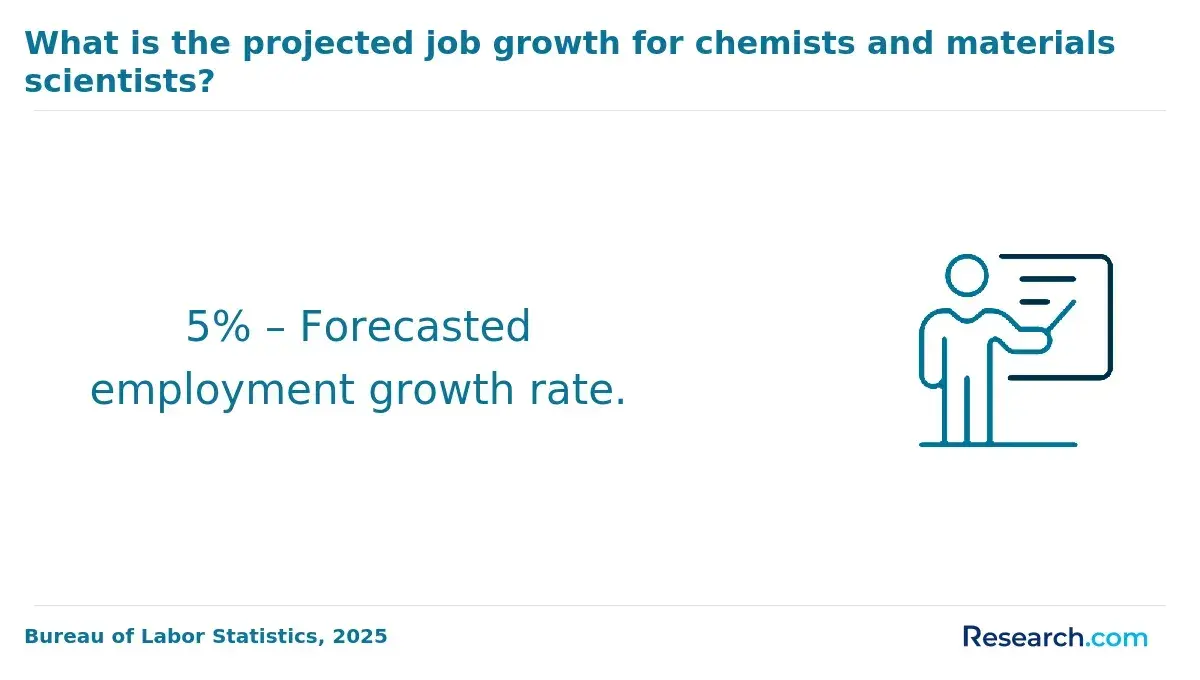
The U.S. Bureau of Labor Statistics notes that several science-related occupations are expected to grow through 2029, including fields connected to chemistry such as forensic science and environmental science will enjoy a rise in employment through 2029. That makes cost evaluation especially important: you want to balance program price, likely debt, and realistic career outcomes.
| Degree level | Public In-State | Public Out-of-State | Private |
| Associate Degree | From $3,570 | From $5000 | From $15,000 |
| Bachelor's Degree | $4,000 - $27,500 | $12,000 - $27,500 | $30,000 - $50,000 |
| Master's Degree | From $10,645 | From $20,263 | From $40,000 |
| Doctoral Degree | $28,000 to $40,000 | $28,000 to $40,000 | $45,000 - $56,000 |
| *Values are estimates. |
Is a degree in Chemistry worth it?
A chemistry degree can be worth it if you want a science-based career and are willing to build technical skills over time. The value is strongest for students who enjoy laboratory work, research, problem-solving, and structured scientific thinking.
The degree can open different levels of work depending on how far you study. Associate programs may prepare students for research technician or laboratory assistant roles. Bachelor’s programs can support work as chemists, technologists, and related technical professionals. Master’s and doctoral study can open the door to specialized research, teaching, consulting, and leadership roles.
It is also worth considering that chemistry can be a gateway degree. Some graduates continue into pharmaceuticals, chemical engineering, environmental work, or medicine. Others move into law, education, or data-focused roles. The best return is usually seen by students who choose a specialization with clear demand and pair the degree with relevant experience.
Chemistry Degree Jobs
A chemistry degree can lead to technical, scientific, and interdisciplinary careers. Employers usually look for candidates who can handle data, follow protocols, troubleshoot experiments, and communicate findings accurately. Laboratory experience is especially important because many chemistry roles are practical and detail-heavy.
Graduates with advanced degrees or several years of experience can move into specialized positions such as senior researchers, consultants, project leads, and academic roles. Some industries also hire chemists for policy, quality control, regulatory support, and product development.
Is chemistry in high demand?
Demand is strongest in industries that rely on research, product testing, materials development, environmental monitoring, and drug discovery. Chemistry graduates may find opportunities in pharmaceuticals, manufacturing, food science, public agencies, and research laboratories. However, the best opportunities often depend on location, degree level, and specialization.
A chemistry background can also support nontraditional pathways. Some graduates move into patent law, technical sales, compliance, science communication, or teaching. Others continue into master’s or doctoral study to qualify for more advanced roles.
According to College Factual, there were 20,985 chemistry degrees awarded in the U.S., and the reported average early-career salary for chemistry graduates is $47,693 (College Factual, 2025). Those numbers show that chemistry remains a relevant major, but outcomes still vary widely by role and location.
What jobs can you get with a Chemistry degree?
- Chemical engineer. A chemistry degree can provide a strong scientific base for some engineering-adjacent roles, especially when combined with additional engineering study or experience. These jobs often involve understanding materials, processes, safety, and equipment behavior.
- Food science. Chemistry graduates may work in product testing, food safety, quality assurance, and manufacturing support in the food and beverage industry.
- Medical and allied health sciences. Chemistry training can support careers in biochemistry, clinical science, and research-based health roles. Graduates of online biology degree programs may also pursue some of these paths.
- Pharmaceuticals. This is one of the most common areas for chemistry graduates. Roles may involve drug development, formulation, testing, quality control, and research support. Some positions require additional biology, analytical chemistry, or synthetic chemistry preparation.
- Forensics. Forensic chemists analyze evidence from crime scenes and laboratory samples. The work often combines chemistry with biology, materials science, and genetics. Employers may include police departments, hospitals, forensic laboratories, and federal agencies.
What kind of salary can I earn with a Chemistry degree?
Salary depends on the role, employer, state or country, and your level of experience. Entry-level chemists often start in research support, quality control, or lab technician roles. As experience grows, so does responsibility and pay.
Indeed reports that chemists with less than one year of experience earn about $67,379 annually. For professionals with more than 10 years of experience, the average salary rises to $107,578 annually. These figures are helpful for context, but actual pay can differ by industry and region.
Types of Degrees in Chemistry for 2027
Chemistry degrees are offered at several levels, and each one prepares you for different responsibilities. The right choice depends on how soon you want to enter the workforce, how far you want to specialize, and whether you plan to pursue graduate study later.
What kinds of Chemistry degrees are there?
1. Associate Degree in Chemistry
Average time to complete: Two years
This option gives students a foundation in chemistry, biology, physics, math, and general education. It is usually best for students who want to move into entry-level lab support roles quickly or who plan to transfer into a bachelor’s program later.
Typical entry-level jobs: Research assistant, laboratory assistant, teacher’s assistant
2. Bachelor Degree in Chemistry
Average time to complete: Four years
A bachelor’s program is the most common route for students who want full chemistry training. Coursework usually covers analytical, physical, organic, inorganic, and biochemistry, along with supporting math and natural science courses. Many programs also include lab sequences and research opportunities.
This is the degree level most commonly linked to chemist roles, lab specialist positions, and science teaching pathways. It is also the standard starting point for many graduate programs.
Typical entry-level jobs: Chemist, researcher, laboratory specialist, chemistry teacher
3. Master’s Degree in Chemistry
Average time to complete: One to three years
Most master’s programs take about two years, although timelines vary by school and thesis requirements. Students usually choose a concentration such as environmental chemistry, materials science, forensic chemistry, or another applied area.
This degree can strengthen research ability, improve technical specialization, and support advancement into senior lab work, industrial roles, or college-level teaching at some institutions.
Typical entry-level jobs: College instructor, head researcher, industry specialist, industrial chemist
4. Doctoral Degree in Chemistry
Average time to complete: At least four years
A Ph.D. in chemistry usually takes several years beyond the bachelor’s degree, and the total timeline can extend from three to 10 years depending on the research project and program structure. Doctoral study is research-intensive and prepares students for advanced scientific leadership, independent research, and university-level teaching.
Students typically complete coursework, seminars, lab training, qualifying exams, and dissertation research.
Typical entry-level jobs: College professor, laboratory manager, environmental specialist, materials scientist
Chemistry Degree Requirements
Admissions expectations vary by school, but chemistry programs usually look for students with a strong background in science and math. Some programs are open to beginners, while others expect prior chemistry or lab exposure.
Admission Requirements
Proof of graduation and personal statement
Applicants usually need a high school diploma or GED. Many schools also ask for a personal statement that explains academic interest, career goals, and reasons for choosing chemistry.
Coursework
Students who want to prepare early should focus on STEM subjects in high school or earlier college work. Helpful courses often include:
- Physics
- Biology
- Mathematics
- Information Technology
SAT or ACT score
Some schools do not require standardized test scores, but strong results can improve admission chances or scholarship eligibility. The article’s original figures note an average ACT composite score of 19.4 and an estimated SAT equivalent of 1,100 to 1,200 for general admissions. Competitive universities, such as Caltech, may require stronger academic profiles.
Skill Requirements
Analytical and critical thinking
Chemistry students need comfort with formulas, measurements, patterns, and interpretation. You are expected to analyze results carefully and explain what they mean.
Laboratory experience
Hands-on lab work is central to chemistry. Prior lab exposure is helpful because it builds familiarity with safety rules, equipment, and scientific procedure.
Academic writing
Chemistry programs often require lab reports, research papers, and formal summaries. Clear writing matters because scientific work must be documented precisely.
What to Look for in a Chemistry Program
The best chemistry program is not always the cheapest or the most famous. It is the one that gives you the best mix of training, support, accreditation, and career access for your goals.
Before applying, review the curriculum, lab facilities, research opportunities, internship access, and faculty expertise. Chemistry is hands-on, so weak lab infrastructure can limit what you learn.
Key factors to compare
- Specializations: Some schools emphasize organic chemistry, while others are stronger in environmental chemistry, biochemistry, forensic chemistry, or materials science.
- Lab facilities: Make sure the program has the equipment and space needed for serious laboratory instruction.
- Accreditation: Regional accreditation is important for degree recognition and transferability. Some chemistry programs may also have ACS recognition or approval.
- Internships and research: Look for opportunities to gain real-world experience before graduation.
- Faculty background: Faculty with active research experience can strengthen both learning and networking.
- Cost and aid: Compare tuition, fees, and scholarships together rather than looking at sticker price alone.
Accreditation
Accreditation matters because it helps confirm that a school meets recognized academic standards. Students should first check whether the institution is regionally accredited. That is especially important if you plan to transfer credits, apply for graduate school, or qualify for certain jobs.
The American Chemical Society (ACS) may also recognize or support chemistry programs that meet specific educational standards. ACS-affiliated programs can signal strong lab training, curriculum quality, and alignment with professional expectations, though not every good chemistry program will have ACS recognition.
Scholarship Options
Scholarships can reduce the total cost of a chemistry degree, especially for students who need help paying for tuition, lab fees, or living costs. It is smart to ask each school about institutional aid first, then compare outside awards.
- American Chemical Society. The ACS Scholarship Program supports students from underrepresented groups who are studying chemistry or pursuing chemistry-related careers. Selected students may receive up to $5,000 each academic year.
- Alpha Chi Sigma Scholar Award. Eligible fraternity members may receive $2,500, an inscribed certificate, and a gold scholarship key.
- American Institute of Chemical Engineers. This organization offers several scholarships and awards, with amounts ranging from $1,000 to $5,000.
Majors Related to Chemistry
If you like chemistry but want a program with a more direct path into a specific industry, you may want to compare it with closely related majors. These options can lead to similar careers with different technical emphasis.
What are some emerging fields in chemistry that offer exciting career opportunities?
Chemistry is changing quickly as industries look for safer materials, cleaner processes, and more precise research methods. If you want a future-focused path, these areas are worth watching because they connect chemistry with current market needs.
1. Green Chemistry
Green chemistry focuses on reducing waste, lowering toxicity, and designing products and processes with less environmental harm. It is especially relevant in manufacturing, energy, agriculture, and pharmaceuticals.
2. Nanotechnology
Nanotechnology works at the atomic and molecular scale to create materials with new or improved properties. Chemistry graduates in this area may contribute to electronics, medical devices, drug delivery, and energy storage.
3. Materials Science
Materials science combines chemistry, physics, and engineering to design polymers, ceramics, composites, and advanced functional materials. This field supports aerospace, electronics, transportation, and biomedical innovation.
4. Biotechnology and Pharmaceutical Chemistry
This area blends chemistry with biology to support drug discovery, diagnostics, and therapy development. It is a strong option for students interested in health care, research, and life sciences.
How can online education supplement a traditional chemistry degree?
Online learning can be useful in chemistry, but it works best as a supplement rather than a full replacement for lab-based education. Students can use online courses to strengthen theory, review math and science fundamentals, and learn safety or research concepts before or alongside in-person lab work.
Hybrid study can also help working students keep moving without pausing their education. Virtual simulations, recorded lectures, and digital assignments can support learning between lab sessions. For broader technical training, reputable online trade schools may also provide targeted coursework in applied science or lab-related skills.
Is online advanced education a valuable investment for chemistry professionals?
Online graduate-level study can be a practical choice for chemistry professionals who want to specialize without leaving work. It may be especially useful for people pursuing management, education, regulatory, or research-adjacent roles where flexibility matters.
That said, online advanced education is not automatically better than campus study. The best option depends on the type of chemistry work you want to do, whether the curriculum includes research or lab components, and whether the credential is accepted by employers in your target field. If you are exploring doctoral options, a professional doctorate online may be worth reviewing, but only if it matches your career goals and learning needs.
How do you decide if a chemistry degree is the right choice for you?
A chemistry degree is a strong fit if you enjoy scientific problem-solving, careful experimentation, and learning how materials behave. It is especially suitable for students who are comfortable with math, organized work, and long-term skill building.
It may be the right path if you want to work in laboratories, pharmaceuticals, environmental testing, product development, or research. It may be less ideal if you want a highly creative major with fewer science and math requirements or if you are not interested in lab work.
Before you commit, ask yourself these questions:
- Do I enjoy science, data, and structured problem-solving?
- Am I willing to spend time in labs and on technical assignments?
- Do I want to enter the workforce quickly, or do I plan to continue to graduate study?
- Which careers do I actually want after graduation?
- Will I need licensure, certification, or a graduate degree for my target role?
To compare chemistry with other majors, you can also explore "What degree should I get?" as part of your decision-making process.
Can an associate accelerated program expedite my entry into the chemistry field?
Yes, an accelerated associate program can help you enter the field sooner if your goal is to start in a support role. These programs focus on the fundamentals and may shorten the time needed to qualify for laboratory assistant or research support positions.
They can be a smart option for students who want lower upfront cost, a quicker finish, or a stepping-stone toward a bachelor’s degree. However, they are not the best choice for everyone. If you want to become a professional chemist or move into research leadership, you will likely need to continue studying beyond the associate level.
For a faster pathway, you may want to review an associate accelerated program, especially if transferability and lab access are clearly explained.
Versatile Career Path in STEM Through Chemistry
One reason chemistry remains popular is that it sits at the intersection of several STEM fields. The degree can support direct chemistry jobs, but it can also lead toward medicine, engineering, environmental work, education, or research administration.
Students often specialize in the final years of study, which helps them align coursework with a future industry. That flexibility is valuable, but it also means students should choose their electives carefully. A general chemistry degree alone is helpful; a chemistry degree paired with the right concentration, internship, or graduate credential can be much stronger.
Some graduates use chemistry as a launch point into technical fields such as petroleum work, while others pursue advanced professional study, including doctors. The degree is versatile, but your outcome will depend on the path you build around it.
What are the best ways to gain practical experience in chemistry?
Practical experience is one of the most important parts of a chemistry education. Employers want to see that you can apply theory, follow procedures, document results, and work safely in real settings.
Good ways to build experience include:
- Applying for internships in industry, government, or academic labs
- Joining faculty-led research projects
- Taking part in independent studies or capstone work
- Volunteering in laboratory or environmental testing settings
- Using summer programs, co-ops, or assistantships to build your résumé
Interdisciplinary learning can also sharpen your problem-solving skills, especially when you work on projects that involve related science or health fields. That is one reason students often benefit from comparing chemistry with other applied programs, including athletic training programs, when thinking about cross-disciplinary careers.
Can an accelerated chemistry degree fast-track my career?
An accelerated chemistry degree can shorten the time to graduation, but it does not automatically guarantee a faster career. What it can do is help you enter the job market sooner, reduce time spent in school, and lower some education costs if the program is structured well.
Accelerated programs are most useful for highly motivated students who can manage a fast academic pace and who already know what type of chemistry role they want. They may be less suitable if you need more time for labs, internships, or part-time work.
If you are comparing compressed formats, resources like the best accelerated degree programs can help you review your options more efficiently.
How can I choose an affordable chemistry degree program?
Affordability should be judged by total cost, not just tuition. A program that looks cheaper at first may become expensive once you add lab fees, books, commuting, housing, and time to graduation.
To compare programs wisely, look at:
- Tuition after aid, not just published price
- Lab and course fees
- Transfer credit policies
- Time to completion
- Access to scholarships and grants
- Whether the program is accredited
Online and part-time formats can sometimes reduce costs, but only if they still provide the lab experience or field training you need. For a starting point, cheap online bachelor degrees can help you compare lower-cost options while keeping quality in view.
How do professional networks and mentorship opportunities enhance chemistry careers?
Networking and mentorship can matter as much as coursework once you begin looking for jobs or graduate programs. A good mentor can help you choose electives, prepare for interviews, identify research opportunities, and understand which specialties are growing.
Professional organizations, conferences, and lab-based experiences can also connect you with employers and peers. These relationships often lead to internships, research placements, letters of recommendation, and job leads that are not posted publicly.
If you want a more direct route into career planning, look for programs with strong advising and alumni support. Some students also compare flexible pathways through accelerated online bachelor's degree programs when they need to balance school with work.
How do faculty expertise and institutional reputation influence a chemistry degree?
Faculty quality and school reputation can shape the value of your chemistry degree more than many students realize. Professors with active research backgrounds can expose you to current techniques, while strong departments often offer better lab facilities, undergraduate research, and connections to employers or graduate schools.
A respected institution may also help if you plan to apply for internships, graduate programs, or research positions. That said, reputation alone should not drive your decision. A smaller program with strong mentoring, good labs, and solid accreditation may be a better fit than a famous school that offers limited support.
Always confirm that the program holds an accredited bachelor degree status if you want reliable transferability and broader recognition.
Common mistakes to avoid when choosing a Chemistry degree
- Choosing a program without checking regional accreditation or ACS recognition
- Ignoring lab quality and focusing only on classroom courses
- Assuming every online chemistry option works for licensure or graduate school
- Comparing tuition without including fees, books, and living costs
- Picking a program based on rankings alone instead of career fit
- Assuming salary numbers apply equally to all regions and employers
- Skipping internships and then graduating with limited hands-on experience
Questions to ask before enrolling
- Is the school regionally accredited?
- Does the chemistry program have ACS recognition or another quality indicator?
- What lab facilities and equipment will I use?
- Are internships, co-ops, or research placements available?
- What are the total costs after aid and fees?
- How many students continue to graduate school or work in chemistry-related jobs?
- Can I transfer credits if I change schools later?
- Does this program support my target career path?
Key Insights
- A chemistry degree is best for students who like science, problem-solving, laboratory work, and analytical thinking.
- The degree can lead to jobs in pharmaceuticals, food science, environmental work, forensics, manufacturing, research, and teaching.
- Associate, bachelor’s, master’s, and doctoral degrees each prepare you for different levels of responsibility and different timelines.
- Cost matters, but total value depends on accreditation, lab quality, internships, and whether the program fits your career plan.
- Accreditation is not optional to check. Regional accreditation is important, and ACS recognition can strengthen confidence in the program.
- Online learning can support chemistry study, but lab-heavy careers usually still require hands-on experience.
- The strongest chemistry graduates often combine coursework with research, internships, networking, and a clear specialization.
References:
- American Chemical Society. (n.d.). Government chemistry careers. https://www.acs.org/careers/chemical-sciences/job-sectors/government.html
- Apex Learning. (2026). Top 15 Highest Paying Chemistry Jobs in 2025-2026. https://apexlearning.org.uk/highest-paying-chemistry-jobs-2025/
- BLS. (2025). Chemists and Materials Scientists: Occupational Outlook Handbook. https://www.bls.gov/ooh/life-physical-and-social-science/chemists-and-materials-scientists.htm
- College Factual. (2025). 2025 chemistry degree guide & rankings. Retrieved from https://www.collegefactual.com/majors/physical-sciences/chemistry/rankings/top-ranked/
- International Council of Chemical Associations. (2025). The economic footprint of the global chemical industry. https://www.icca-chem.org/news/economic-analysis-2025-report/
- National Institute of Standards and Technology. (n.d.). Physical science and chemistry postings. https://www.nist.gov/careers
- Talent.com. (2026). Chemist: Average salary in Canada, 2026. Retrieved from https://ca.talent.com/salary?job=chemist
- U.S. Department of Energy. (n.d.). Science careers and job opportunities. https://www.energy.gov/science
- U.S. Bureau of Labor Statistics. (2026). Healthcare, science, and engineering careers that don’t require a 4-year degree. https://www.bls.gov/careeroutlook/2026/article/healthcare-science-and-engineering-careers.htm
Other Things You Should Know About Chemistry Degrees
In 2027, the job market for chemistry graduates remains robust, with opportunities in pharmaceuticals, environmental science, and materials research. The demand for skilled chemists is fueled by advancements in technology and a growing focus on sustainable practices, ensuring a variety of roles for new graduates.
The cost of a chemistry degree varies by institution and degree level. For instance, a bachelor's degree may cost between $4,000 and $50,000 annually, while a master's degree ranges from $10,645 to $40,000 per year. These figures exclude additional expenses like laboratory fees, books, and accommodation.
Chemistry graduates in 2027 can pursue diverse career paths, including roles in pharmaceuticals, environmental science, biotechnology, and academic research. Many positions require a bachelor's degree, while advanced roles, such as in chemical engineering or specialized research, often demand a master's or Ph.D., bringing opportunities across various industries.
Chemistry degrees range from associate degrees to doctoral degrees. An associate degree typically takes two years, a bachelor's degree takes four years, a master's degree takes one to three years, and a doctoral degree can take at least four years to complete.
Prerequisites typically include a high school diploma or GED, a strong background in STEM subjects (especially chemistry), and competitive SAT or ACT scores. Some programs may also require a personal statement, letters of recommendation, and proof of laboratory experience.
When selecting a chemistry program in 2027, consider factors such as program accreditation, faculty expertise, available research opportunities, laboratory facilities, and industry connections. Accredited programs ensure a standardized level of education, which can impact employment opportunities and further education prospects.