
2027 Fastest Online Master’s Degree in Sustainability Programs

Co-Founder and Chief Data Scientist
The global shift to a green economy has created a critical leadership vacuum. With demand for green talent growing at 11.6% annually while supply increases by only 5.6%, companies face a projected talent shortage of nearly 19% by 2030. Since 70% of current sustainability professionals hold an advanced degree, an accelerated online master's in sustainability is now the essential credential for rapid advancement.
This comprehensive guide, meticulously crafted by seasoned career planning experts, is your personalized roadmap for leveraging this degree to achieve your strategic career aspirations and make a profound, tangible impact in the rapidly evolving green economy.
What are the benefits of the fastest online master's in sustainability programs?
- This degree prepares you for high-impact leadership roles like Chief Sustainability Officer or ESG Director, allowing you to drive strategic change and contribute to significant social good within top corporations.
- You can unlock substantial earning potential, as executives like Vice Presidents with a master’s degree can earn an estimated $50,000 more annually than those with only a bachelor's.
- The flexible online format is specifically designed for working professionals, enabling you to gain these critical credentials and accelerate your career without pausing your current employment.
What can I expect from the fastest online master's in sustainability programs?
You can expect a rigorous, interdisciplinary curriculum designed to be completed efficiently while you continue to advance in your career. These programs deliver advanced strategic knowledge and applied skills in a flexible online format, preparing you for immediate impact. The curriculum is often designed with direct input from employers and taught by active practitioners, ensuring what you learn is directly relevant to the challenges you’ll face professionally.
You will join a diverse and dynamic cohort of peers. The field is notably inclusive, with women holding 64% of sustainability positions, and it draws professionals from a wide array of backgrounds. This powerful network, combined with a highly relevant online master's in sustainability, provides a clear pathway to leadership. Expect to develop not just technical knowledge but the strategic competencies needed to manage complex Environmental, Social, and Governance (ESG) issues and guide organizational change.
Where can I work with a master's in sustainability?
Graduates can work across virtually all sectors—from large corporations and consulting firms to government agencies and non-profits. Sustainability is no longer a niche department; it is a core business function. Professionals with these skills are being integrated directly into strategic departments like supply chain (39%), procurement (38%), and even finance (21%).
Demand for green talent is surging in high-impact industries, including a 60% increase in the tech sector and significant growth in utilities (23.1%) and manufacturing (13.2%). This degree opens doors to strategic roles focused on ESG integration, allowing you to drive change from within established and emerging industries, future-proofing your career in the process.
How much can I earn with a master's in sustainability?
You can expect significantly higher earning potential, especially in strategic leadership positions that this degree prepares you for. Average base salaries reflect this value, with sustainability managers earning around $141,040, directors making $193,542, and vice presidents commanding salaries near $288,620.
The financial return on the degree is clear, as executives like VPs with a master's degree earn an estimated $50,000 more annually than those with only a bachelor's. While specific salaries vary by industry and experience level, obtaining this advanced credential is a key step toward securing top-tier compensation in this rapidly growing field.
- 8 Fastest Online Master's Degree in Sustainability Programs for 2027 Best Programs
- How long does it take to complete the fastest online master's in sustainability programs? Completion Time
- What is the average cost of the fastest online master's in sustainability programs? Program Cost
- What are the financial aid options for students enrolling in the fastest online master's in sustainability programs? Financial Aid
- What are the prerequisites for enrolling in the fastest online master's in sustainability programs? What are the prerequisites for enrolling in the fastest online master's in sustainability programs?
- What courses are typically in an online master's in sustainability program? What courses are typically in an online master's in sustainability program?
- What types of specializations are available in online master's in sustainability programs? What types of specializations are available in online master's in sustainability programs?
- How to choose the best fastest online master's in sustainability program? How to choose the best fastest online master's in sustainability program?
- What is the return on investment of an online master's in sustainability program? What is the return on investment of an online master's in sustainability program?
- What career paths are available for graduates of the fastest online master's in sustainability programs? What career paths are available for graduates of the fastest online master's in sustainability programs?
- What is the job market for graduates of online master's degree in sustainability programs? Job Market
- How does an online master's in sustainability equip graduates for emerging interdisciplinary sectors? How does an online master's in sustainability equip graduates for emerging interdisciplinary sectors?
- How do online master's in sustainability programs incorporate digital innovation? How do online master's in sustainability programs incorporate digital innovation?
8 Fastest Online Master's Degree in Sustainability Programs for 2027
Choosing a fast online master’s in sustainability is a practical decision for professionals who want to move into environmental management, ESG, climate policy, sustainable business, or resource planning without pausing their careers. The challenge is knowing which programs are truly efficient, credible, affordable, and aligned with your target role.
This guide compares accelerated and flexible online master’s programs in sustainability-related fields, explains how long they take, what they cost, what admissions teams usually require, and how to evaluate return on investment. You will also learn how online programs compare with campus-based options, which specializations are available, and what career paths may open after graduation.
Quick answer: What is the fastest online master’s in sustainability?
The fastest online master’s in sustainability programs can be completed in approximately 1 year, though many take approximately 2 years for working professionals. The best option depends on whether you want a business-focused credential, a technical environmental management degree, a policy-oriented program, or a safety and compliance pathway. Wilmington University and Columbia Southern University list approximately 1-year completion timelines, while several other programs offer approximately 2-year formats with part-time flexibility.
How Research.com selected these programs
Because graduate education requires a major financial and time commitment, this ranking emphasizes transparency, program structure, cost information, accreditation, online accessibility, and relevance to sustainability careers. Our ranking process uses Research.com’s published methodology to help readers compare programs with clear and consistent criteria.
To support the ranking, we reviewed institutional and program data from sources such as the IPEDS database maintained by the National Center for Education Statistics, Peterson’s database and its Distance Learning Licensed Data Set, and the College Scorecard for cost and outcome context.
| Rank | School | Program | Stated Time to Complete | Best Fit |
| 1 | Harvard University | Master of Liberal Arts (MLA) in Sustainability | Up to 5 years (typically 2 years) | Professionals who want a customizable Ivy League sustainability curriculum |
| 2 | Georgia Institute of Technology | Master of Sustainability Energy and Environmental Management (MSEEM) | Approximately 2 years | Students interested in data, policy, engineering, and environmental systems |
| 3 | Arizona State University | MS in Environmental and Resource Management | 1-2 years | Learners seeking applied environmental resource management training |
| 4 | University of Massachusetts – Boston | MS in Environmental Sciences | Approximately 2 years | Students focused on environmental science, coastal systems, and research |
| 5 | University of Maryland Global Campus | PSM in Environmental Management | Approximately 2 years | Working professionals seeking practical environmental management skills |
| 6 | University of Houston Clear Lake | MS in Environmental Management | Approximately 2 years | Professionals interested in compliance, risk, industry, and government roles |
| 7 | Wilmington University | MBA in Sustainability | Approximately 1 year | Business professionals who want sustainability leadership training |
| 8 | Columbia Southern University | MS in Occupational Safety and Health – Environmental Management | Approximately 1 year | Students pursuing safety, health, environmental management, and CSP-related pathways |
1. Harvard University - Master of Liberal Arts (MLA) in Sustainability
Harvard University offers a flexible sustainability master’s program for students who want to shape their studies around a specific professional direction. The curriculum can support interests in corporate sustainability, environmental policy, city planning, food systems, natural resource management, and related areas. Its mostly online, asynchronous structure is useful for working adults, although students should plan for one required on-campus course.
- Program Length: Up to 5 years (typically 2 years)
- Customizable Tracks: Corporate Sustainability; Natural Resource Management; Environmental Policy; City Planning; and Food Systems
- Required Credits to Graduate: 48 credits
- Cost per Credit: $860
- Accreditation: New England Commission of Higher Education (NECHE)
2. Georgia Institute of Technology - Master of Sustainability Energy and Environmental Management (MSEEM)
Georgia Institute of Technology’s MSEEM is designed for students who want to connect sustainability with public policy, technology, engineering, planning, and economics. The program is a strong match for professionals who want analytical training for climate adaptation, infrastructure decisions, environmental management, or energy-related policy work.
- Program Length: Approximately 2 years
- Individualized Courses of Study: Public Policy; Business; Industrial and Systems Engineering; City and Regional Planning; Civil and Environmental Engineering; and Economics
- Required Credits to Graduate: 30
- Cost per Credit: $601
- Accreditation: Southern Association of Colleges and Schools Commission on Colleges (SACSCOC)
3. Arizona State University - MS in Environmental and Resource Management
Arizona State University’s MS in Environmental and Resource Management focuses on managing environmental resources across organizations and sectors. A key advantage is the ability to choose among four culminating experiences, including a traditional thesis or an applied project, so students can align the final requirement with research, practice, or career advancement goals.
- Program Length: 1-2 years
- Focus Areas: Environmental Management; International Environmental Management and Sustainable Development; and Water Management
- Required Credits to Graduate: 30
- Annual Tuition: $10,890
- Accreditation: Higher Learning Commission (HLC)
4. University of Massachusetts – Boston - MS in Environmental Sciences
The University of Massachusetts – Boston MS in Environmental Sciences is suited to students who want research-driven preparation in environmental science, natural resource conservation, climate-related issues, and coastal systems. The thesis and non-thesis options make it useful for both research-oriented students and professionals preparing for applied environmental policy or management roles.
- Program Length: Approximately 2 years
- Tracks: Thesis; and Non-Thesis
- Required Credits to Graduate: 30
- Semester Tuition: $7,443.90 (in-state); $14,530.05 (out-of-state)
- Accreditation: New England Commission of Higher Education (NECHE)
5. University of Maryland Global Campus - PSM in Environmental Management
The University of Maryland Global Campus PSM in Environmental Management is built for working professionals who want a career-oriented graduate degree with applied environmental management training. Students study ecosystem-based management, policy, environmental risk, and stakeholder engagement, and the capstone gives them an opportunity to work on practical organizational problems.
- Program Length: Approximately 2 years
- Required Credits to Graduate: 36
- Cost per Credit: $544 (in-state); $659 (out-of-state); $336 (military)
- Accreditation: Middle States Commission on Higher Education (MSCHE)
6. University of Houston Clear Lake - MS in Environmental Management
The University of Houston Clear Lake MS in Environmental Management combines environmental knowledge with business, legal, compliance, and risk-management training. The program allows students to take between 20% to 80% of coursework online and welcomes applicants from any undergraduate major, making it a flexible option for professionals moving into government, consulting, industry, or sustainability roles.
- Program Length: Approximately 2 years
- Elective Options: Water Management; Environmental Risk Management; Sustainability; Coastal Resilience; Geographical Information Systems; Industrial Hygiene; and Environmental Geology
- Required Credits to Graduate: 36
- Annual Tuition: $9,920 (in-state); $19,352 (out-of-state)
- Accreditation: Southern Association of Colleges and Schools Commission on Colleges (SACSCOC)
7. Wilmington University - MBA in Sustainability
The Wilmington University MBA in Sustainability is a business-centered option for students who want to apply sustainability principles to strategy, operations, analytics, and organizational leadership. The no-GMAT structure, online delivery, and approximately 1-year format make it especially relevant for professionals who want a faster management credential. The program can be completed in just one year for under $20,000.
- Program Length: Approximately 1 year
- Concentration: Environmental Sustainability
- Required Credits to Graduate: 36
- Tuition per Course: $1,611
- Accreditation: Middle States Commission on Higher Education (MSCHE)
8. Columbia Southern University - MS in Occupational Safety and Health – Environmental Management
Columbia Southern University offers an MS in Occupational Safety and Health with an Environmental Management concentration for students interested in safety systems, environmental technology, and regulatory or compliance-focused roles. Its Qualified Academic Program (QAP) status can support students seeking the Graduate Safety Practitioner (GSP) designation and a pathway toward becoming a Certified Safety Professional (CSP).
- Program Length: Approximately 1 year
- Concentration: Environmental Management
- Required Credits to Graduate: 36
- Cost per Credit: $359
- Accreditation: Southern Association of Colleges and Schools Commission on Colleges (SACSCOC); Accreditation Council for Business Schools and Programs (ACBSP)
How long does it take to complete the fastest online master's in sustainability programs?
The fastest online sustainability master’s programs generally take approximately 1 year to approximately 2 years, depending on the school, course load, transfer policies, and whether the student enrolls full time or part time. Some programs are intentionally compressed for students who can manage intensive coursework, while others allow working professionals to spread the degree over a longer timeline.
“Fast” should not mean academically thin. A strong accelerated program uses shorter terms, year-round scheduling, focused course sequencing, online delivery, and applied projects to reduce time to completion without removing essential graduate-level content.
| Program Pace | Typical Completion Time | Who It Fits Best | Trade-Off to Consider |
| Accelerated full-time | Approximately 1 year | Students who can prioritize school and handle a heavier workload | Less scheduling flexibility and more weekly study time |
| Standard full-time | Approximately 2 years | Working professionals who want speed without an extreme course load | Longer time before graduation than a 1-year format |
| Part-time flexible | Often about 2 years or longer | Students balancing full-time employment, caregiving, or travel | Delays career transition or promotion timing |
| Extended completion window | Up to 5 years or more in some programs | Professionals who need maximum flexibility | Higher risk of losing momentum before finishing |
Students comparing formats may find it helpful to examine how acceleration works in other fields as well, such as an accelerated online bachelor's in Mathematics. The subject matter differs, but the same questions apply: How many credits are required, how often are courses offered, and how much time can you realistically study each week?
Why speed can matter in sustainability careers
Speed matters most when the degree helps you qualify for a near-term promotion, pivot into a sustainability role, or add ESG, compliance, resource management, or environmental policy knowledge to existing professional experience. Current labor-market data cited in the source material shows demand for green talent growing at 11.6% annually while supply is increasing by 5.6%, which suggests that qualified professionals may benefit from entering the field sooner rather than later.
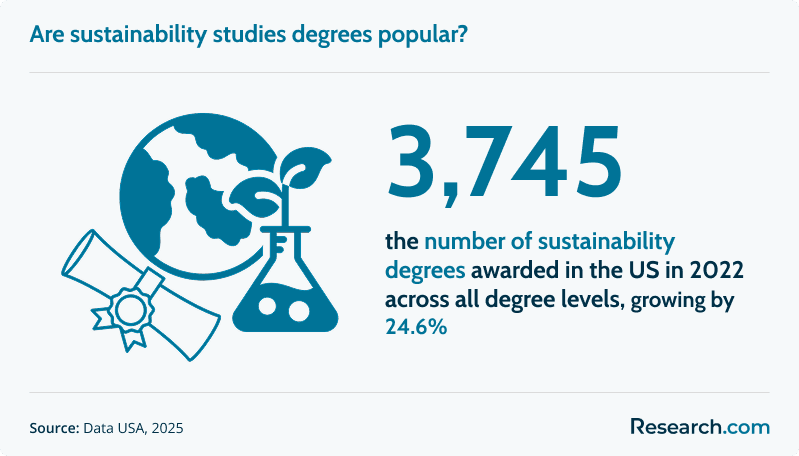
The sustainability education pipeline is also expanding. U.S. universities awarded 3,745 sustainability degrees in 2022, a 24.6% increase in one year. That growth creates more trained graduates, so completing efficiently can help students act while their credential and experience align with employer demand.
How does an online master's in sustainability program compare to an on-campus program?
A reputable online master’s in sustainability can offer the same degree title, graduate-level expectations, and faculty involvement as an on-campus version, but the learning experience is different. Online programs are usually designed for working adults who need flexibility, while campus programs may offer more face-to-face interaction, local networking, and access to physical labs or campus events.
Students should not assume online means easier. Strong online sustainability programs often require extensive reading, applied projects, group work, data analysis, writing, and presentations. The main difference is where and how the work happens.
| Factor | Online Master’s in Sustainability | On-Campus Master’s in Sustainability |
| Schedule | Often asynchronous or hybrid, with more flexibility for working students | Usually follows fixed class times and campus-based requirements |
| Relocation | Usually not required, though some programs may include limited residencies | May require moving or commuting |
| Networking | Can connect students across industries, regions, and time zones | Often stronger for local networking and in-person faculty access |
| Learning style | Requires self-direction, written communication, and disciplined time management | Provides more structured in-person accountability |
| Best for | Professionals who need career continuity and geographic flexibility | Students who want campus immersion or in-person research access |
Accelerated online models are common across graduate education, including fields such as accelerated online science education master's programs. The key is to confirm that the online format provides the support, advising, course access, and applied experiences needed for your goals.
How online study reflects modern sustainability work
Online sustainability programs can build habits that are useful in modern workplaces: remote collaboration, digital research, virtual presentation, asynchronous communication, and independent project management. These skills matter because sustainability work often involves cross-functional teams, external stakeholders, vendors, regulators, investors, and geographically distributed operations.
Source material projects that by 2025, Sustainability Specialist roles will be nearly 62% hybrid and another 20% fully remote. While projections are not guarantees for any individual job, they show why online learning can be practical preparation for sustainability careers that rely on digital collaboration.
Students who are comparing online tuition across unrelated disciplines can also review cost-focused guides such as the cheapest online bachelor's degree in mathematics to understand how Research.com evaluates affordability, though career outcomes and curricula will differ by field.
What is the average cost of the fastest online master's in sustainability programs?
The average total tuition for an online master’s in sustainability is about $21,457 for in-state students and $30,504 for out-of-state students. Average cost per credit is about $601 for in-state students and $887 for out-of-state students. Actual tuition can vary widely, with total program costs ranging from about $10,900 to over $58,000 depending on the institution, residency status, credit requirements, and fee structure.
Students should compare total degree cost rather than only the advertised price per credit. A lower per-credit rate may not save money if the program requires more credits, and a higher tuition rate may be partly offset by scholarships, employer support, military pricing, or faster completion.
| Cost Item | Why It Matters | Question to Ask |
| Tuition per credit or course | Determines the main academic cost | Is tuition charged per credit, per course, per semester, or by residency status? |
| Total required credits | Controls the full tuition calculation | How many credits are required to graduate? |
| Student and technology fees | Can increase the final bill | Are online, graduation, course material, or proctoring fees charged separately? |
| Residency requirements | May add travel and lodging costs | Are any campus visits, intensives, or field experiences required? |
| Time to completion | Affects opportunity cost and payment timing | Can I finish faster without overloading my schedule? |
For students whose top priority is cost control, Research.com’s guide to a low cost master's in sustainability online can help identify programs where tuition may be more manageable.
How to think about ROI without overestimating outcomes
Salary potential is one part of the investment decision, but it should not be treated as a promise. The source material cites average earnings of $141,040 for sustainability managers and about $193,542 for directors. Those figures can make the degree look financially attractive, but individual outcomes depend on experience, industry, location, prior education, employer, and the specific role pursued.
A better ROI calculation compares total program cost, expected debt, current salary, realistic target roles, completion timeline, and whether the degree fills a specific skill gap. If the program helps you move from a general role into ESG reporting, environmental compliance, sustainable finance, or sustainability strategy, the value may extend beyond immediate salary gains.
What are the financial aid options for students enrolling in the fastest online master's in sustainability programs?
Online graduate students may have access to several funding sources, but availability varies by school, enrollment status, citizenship status, program eligibility, and employer policies. The most effective strategy is usually to combine multiple forms of support rather than relying on one source.
- Federal student loans: Eligible students can begin by completing the Free Application for Federal Student Aid (FAFSA). Federal loans are commonly used by graduate students, but borrowing should be weighed carefully against expected career benefits.
- Institutional scholarships and grants: Some universities offer graduate scholarships, departmental awards, or need-based support for online students. Ask whether online students are considered equally with campus students.
- Employer tuition assistance: Sustainability skills can be valuable to employers managing reporting, compliance, resource efficiency, supply chains, or ESG goals. Employees should ask HR whether tuition reimbursement, professional development funds, or partnership discounts apply.
- Payment plans: Monthly payment options can reduce the pressure of paying a semester balance at once, though they do not reduce the total price.
- Military or public-sector benefits: Some programs list separate military tuition rates or may participate in benefit programs. Verify eligibility directly with the school and benefit administrator.
Funding questions to ask before enrolling
| Question | Why It Matters |
| Is the program eligible for federal financial aid? | Not every credential or enrollment pattern qualifies. |
| What is the exact total cost to graduate? | Tuition estimates may exclude fees, travel, books, or required software. |
| Are scholarships renewable? | A one-term award may not reduce long-term cost enough. |
| Can employer reimbursement be used before or after payment? | Some employers reimburse only after successful course completion. |
| Will part-time enrollment affect aid? | Loan and scholarship eligibility may depend on credit load. |
Cost planning is important across graduate fields. Students comparing financial aid strategies may also find broader affordability examples useful, such as Research.com’s guide to the cheapest online master's programs in homeland security, while keeping in mind that program requirements and career outcomes differ.
What are the prerequisites for enrolling in the fastest online master's in sustainability programs?
Most online master’s in sustainability programs require a bachelor’s degree from an accredited institution, but they do not always require an undergraduate major in environmental science. Sustainability is interdisciplinary, so applicants may come from business, engineering, public policy, natural sciences, social sciences, liberal arts, communications, or operations backgrounds.
- Bachelor’s degree: A four-year degree from an accredited college or university is typically required.
- GPA expectation: Many programs look for a cumulative undergraduate GPA of 3.0 or higher on a 4.0 scale, though policies vary.
- Resume: Professional experience can strengthen an application, especially for applied or executive-oriented programs.
- Personal statement: Admissions committees often want to know why sustainability matters to your career plan and how the program fits your goals.
- Letters of recommendation: Programs commonly request two or three references from supervisors, faculty, or professionals who can evaluate your readiness for graduate work.
- Test scores: GRE or GMAT requirements vary, and many programs have waived standardized testing.
Applicants from non-science backgrounds should not automatically rule themselves out. A finance professional may be a strong candidate for sustainable investment or ESG reporting. An operations manager may be well positioned for supply chain sustainability. A public-sector employee may bring policy or regulatory experience. Students from other accelerated online pathways, such as an accelerated bachelor's degree in history online, can also bring valuable research, writing, and analytical skills.
The source material notes that nearly a million professionals in the U.S. workforce hold a sustainability degree, showing that the field includes people with varied academic and professional histories.
What courses are typically in an online master's in sustainability program?
Online sustainability master’s programs usually combine environmental science, policy, business strategy, analytics, communication, and management. The goal is to prepare graduates to translate environmental and social goals into decisions that organizations can measure, fund, implement, and defend.
| Course Area | What Students Learn | Career Relevance |
| Corporate sustainability strategy | How organizations set sustainability goals, align them with operations, and manage change | Useful for sustainability manager, consultant, and director roles |
| ESG metrics and reporting | How to collect, evaluate, and communicate environmental, social, and governance information | Relevant to ESG analyst, ESG manager, investor relations, and compliance roles |
| Sustainable finance and economics | How capital, incentives, markets, and policy affect environmental decisions | Useful for sustainable finance, strategy, and corporate planning roles |
| Lifecycle and risk assessment | How to evaluate environmental impact, operational risk, and resource use across systems | Relevant to product, supply chain, consulting, and environmental management work |
| Climate and energy policy | How regulations, energy transitions, and climate goals shape organizational decisions | Useful for policy, government, utility, nonprofit, and corporate strategy roles |
| Capstone, thesis, or applied project | How to apply coursework to a practical or research-based sustainability problem | Can become a portfolio piece for employers |
Why the master’s level is common in sustainability education
Sustainability roles often require more than general environmental awareness. Employers may expect knowledge of reporting frameworks, data analysis, operations, policy, finance, stakeholder engagement, and risk management. The source material states that in 2023, master’s degrees were the single most awarded credential in sustainability studies in the U.S., accounting for nearly 44% of all degrees conferred. That reflects the field’s demand for advanced, cross-functional training.
What types of specializations are available in online master's in sustainability programs?
Specializations help students turn a broad sustainability degree into a clearer career signal. Some programs offer formal concentrations, while others allow students to build a focus through electives, capstones, or thesis topics.
| Specialization | Best For | Typical Career Direction |
| Sustainable finance and ESG management | Students with finance, accounting, investment, consulting, or corporate strategy interests | ESG manager, sustainable finance manager, analyst, consultant |
| Circular economy and sustainable supply chains | Professionals in procurement, logistics, manufacturing, operations, or product management | Supply chain sustainability lead, circular economy consultant, procurement strategist |
| Climate and energy policy | Students interested in regulation, government, utilities, nonprofits, and energy transition work | Policy analyst, climate program manager, energy sustainability specialist |
| Sustainability communications and reporting | Professionals who work with stakeholders, investors, employees, communities, or public messaging | CSR reporting lead, sustainability communications manager, ESG reporting specialist |
| Environmental management and compliance | Students interested in industry, risk reduction, audits, and regulatory obligations | Environmental manager, compliance manager, consultant |
Students interested in the energy transition should look for coursework that explains policy, grid issues, renewable energy adoption, and implementation barriers. The United Nations Development Programme’s overview of the renewable energy transitions can provide useful background on why energy systems are central to climate strategy.
How to choose a specialization strategically
Choose a specialization based on the roles you want, not just the topics you enjoy. The source material notes that Sustainable Procurement is the fastest-growing green skill on LinkedIn, with a 15% increase in professionals adding it to their profiles this year alone. That kind of skill-specific demand can make a targeted concentration more valuable than a general curriculum.
Specialization matters in many business fields. For example, students comparing sustainability finance with broader finance careers may want to explore what can a masters in finance do for you to understand how financial training can support different career paths.
How to choose the best fastest online master's in sustainability program?
The best fast online master’s in sustainability is the one that matches your target role, budget, learning style, and timeline. A prestigious name can help, but it should not outweigh accreditation, curriculum relevance, total cost, faculty expertise, career support, and applied learning opportunities.
| If Your Goal Is... | Prioritize This Type of Program | Look Closely At |
| Corporate sustainability leadership | MBA or strategy-focused sustainability program | Business courses, ESG reporting, analytics, change management |
| Environmental compliance or risk management | MS or PSM in environmental management | Regulations, auditing, risk assessment, applied capstone |
| Climate policy or public-sector work | Policy-oriented sustainability or environmental science program | Policy analysis, climate adaptation, economics, planning |
| Research or science-based roles | MS with thesis or research track | Methods, data analysis, faculty research, thesis support |
| Safety and environmental management | Occupational safety and health program with environmental concentration | QAP status, CSP pathway relevance, safety management curriculum |
Questions to ask each school
- Is the university institutionally accredited? Confirm accreditation with the school and accreditor before enrolling.
- Does the curriculum match my target job postings? Compare required courses with the skills listed in roles you want.
- Can I finish at the advertised speed while working? Ask how many hours students typically study each week.
- Are courses asynchronous, synchronous, or hybrid? A fast program is only useful if the schedule fits your life.
- What applied work will I complete? Capstones, client projects, theses, and portfolios can help demonstrate skills to employers.
- What career support is available to online students? Ask about coaching, alumni access, job boards, employer events, and resume support.
- What is the full cost to graduate? Request a written estimate that includes tuition, fees, technology costs, and any required travel.
MS vs. MBA in sustainability: which is better?
An MS is usually better for students who want deeper technical, scientific, policy, or environmental management training. An MBA with a sustainability concentration is usually better for professionals who want to lead teams, influence corporate strategy, manage budgets, or integrate sustainability into business decisions.
The source material notes that 10% of some VPs in the field hold an MBA in sustainability, while 34% hold a traditional MBA. That suggests employers may value broad business leadership alongside sustainability expertise. If you already have technical environmental experience, an MBA may round out your leadership profile. If you already have business experience, an MS may add the specialized sustainability knowledge you lack.
What is the return on investment of an online master's in sustainability program?
The ROI of an online master’s in sustainability depends on total cost, debt, completion speed, current income, prior experience, and the type of role you pursue after graduation. A strong program can improve ROI by helping students qualify for higher-responsibility roles, switch into sustainability from another field, or add specialized skills such as ESG reporting, environmental compliance, sustainable finance, or supply chain sustainability.
Do not evaluate ROI only by average salary. Instead, compare the program against your specific career path. For example, a student who already works in operations may see value from a supply chain sustainability specialization, while a student entering the field without relevant experience may need internships, projects, networking, or entry-level environmental roles before seeing a major salary change.
| ROI Factor | Positive Signal | Warning Sign |
| Total cost | The program has transparent tuition and fees | Fees, residencies, or required materials are unclear |
| Career alignment | Courses match your target job descriptions | The curriculum is broad but not tied to your goals |
| Speed | You can finish quickly without risking burnout | The pace is unrealistic with your work schedule |
| Applied experience | Capstone, thesis, or client project creates portfolio evidence | The program is mostly theoretical with limited practical work |
| Employer support | Your employer may reimburse tuition or promote sustainability skills | You must borrow heavily without a clear advancement plan |
Students still considering undergraduate options can compare the graduate pathway with foundational programs such as the cheapest bachelor's degree in environmental science online. A bachelor’s degree may be more appropriate for career entry, while a master’s degree is often better suited to specialization or advancement.
What career paths are available for graduates of the fastest online master's in sustainability programs?
Graduates of online master’s in sustainability programs may pursue roles in corporate sustainability, ESG, environmental management, consulting, policy, sustainable finance, resource management, energy, government, nonprofits, and compliance. The best-fit role depends on the student’s prior experience and specialization, not the degree title alone.
Students exploring the broader field can review Research.com’s guide to sustainability careers for more role-specific pathways.
| Career Path | What the Role Usually Involves | Useful Program Focus |
| Chief Sustainability Officer (CSO) | Sets enterprise-wide sustainability strategy and works with executives, boards, investors, and operations teams | Corporate strategy, ESG, leadership, finance |
| ESG Manager or Director | Manages environmental, social, and governance data, reporting, performance improvement, and stakeholder communication | ESG metrics, reporting, analytics, compliance |
| Senior Sustainability Consultant | Advises clients on sustainability strategy, implementation, risk, reporting, and operational improvement | Consulting, policy, systems thinking, project management |
| Sustainable Finance Manager | Works with investments, financial analysis, green finance, and sustainability-linked decision-making | Sustainable finance, ESG, economics, risk analysis |
| Environmental Manager | Oversees environmental compliance, permitting, audits, reporting, and risk reduction | Environmental management, regulations, risk assessment |
| Climate or Energy Program Manager | Coordinates projects related to emissions reduction, renewable energy, climate adaptation, or policy implementation | Climate policy, energy systems, project management |
Remote and hybrid work in sustainability
Sustainability roles often involve digital reporting, cross-functional meetings, supplier coordination, stakeholder communication, and data analysis, which can support hybrid or remote work. The source material projects that by 2025, 29% of sustainability director roles and 34% of manager roles will be fully remote. Actual remote availability will depend on employer, industry, seniority, and whether the role involves site visits or field operations.
What is the job market for graduates of online master's degree in sustainability programs?
The job market for sustainability-trained professionals is supported by several forces: corporate ESG expectations, climate-related risk planning, regulatory compliance, resource efficiency, investor pressure, supply chain concerns, and public-sector environmental goals. The source material states that demand for green talent is growing at 11.6% while supply is increasing by 5.6%, indicating a talent gap in sustainability-related work.
LinkedIn data cited in the source material also states that job seekers with demonstrated green skills have a 54.6% higher hiring rate globally compared with the overall workforce. That does not guarantee employment for every graduate, but it supports the importance of building visible, job-relevant skills through coursework, projects, certifications, and professional experience.
Environmental science and related occupational outlook
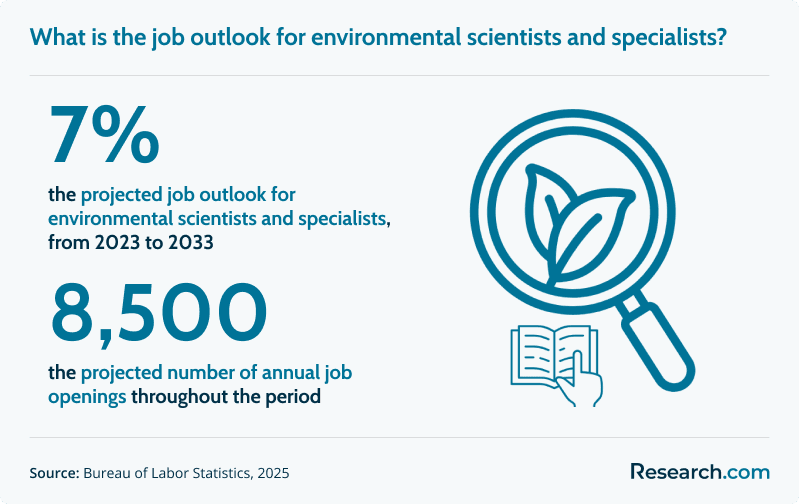
According to the U.S. Bureau of Labor Statistics source cited in the original article, environmental scientists and specialists are projected to grow by 7% through 2033, with about 8,500 job openings projected each year, on average, over the decade. Students should treat this as one indicator of demand in a related field rather than a direct projection for every sustainability job title.
How does an online master's in sustainability equip graduates for emerging interdisciplinary sectors?
Sustainability work increasingly overlaps with data, business, energy, biotechnology, finance, public policy, and industrial operations. An online master’s program can help students build interdisciplinary fluency: the ability to understand environmental impacts, communicate with technical teams, evaluate trade-offs, and translate sustainability goals into operational decisions.
This matters because emerging sectors often need professionals who can work across boundaries. For example, students interested in sustainability and life sciences may explore biotech jobs, where environmental practices, product development, regulatory expectations, and technology can intersect.
How do online master's in sustainability programs incorporate digital innovation?
Online master’s in sustainability programs commonly use digital learning platforms, collaboration tools, data sets, simulations, case studies, and applied projects to help students connect concepts with professional practice. Students may work with environmental data, reporting tools, policy analysis, lifecycle assessment concepts, or virtual team projects.
Digital fluency is increasingly important because sustainability teams often rely on dashboards, remote collaboration, emissions data, supplier information, geospatial tools, and reporting systems. Students interested in the broader relationship between sustainability, infrastructure, and technology can compare related technical education pathways such as affordable online electrical engineering degree programs.
Common mistakes to avoid when choosing a fast online master’s in sustainability
| Mistake | Why It Can Hurt You | Better Approach |
| Choosing only by speed | The fastest program may not match your target role or learning capacity | Balance completion time with curriculum fit and workload realism |
| Ignoring accreditation | Accreditation affects credibility, aid eligibility, and employer acceptance | Verify institutional accreditation before applying |
| Comparing only tuition per credit | Total cost depends on credits, fees, residency, and completion timeline | Calculate the full cost to graduate |
| Assuming all sustainability degrees lead to the same jobs | An MBA, MS, PSM, and safety-focused degree can point to different outcomes | Match the degree type to the job titles you want |
| Skipping applied experience | Employers often want proof that you can solve real sustainability problems | Prioritize capstones, projects, thesis work, or employer-based assignments |
| Relying only on rankings | A ranked program may still be a poor personal fit | Use rankings as a starting point, then evaluate goals, cost, support, and schedule |
How to apply to a fast online master’s in sustainability
- Define your target role. Decide whether you want to work in ESG, corporate strategy, environmental management, policy, consulting, sustainable finance, supply chains, or safety.
- Shortlist accredited programs. Confirm institutional accreditation and review whether the degree format is fully online, hybrid, or requires campus visits.
- Compare curriculum to job postings. Look for repeated skills in target roles and check whether the program teaches them.
- Calculate total cost. Include tuition, fees, materials, travel, time away from work, and loan interest if borrowing.
- Ask about workload. Fast programs can be demanding. Ask admissions staff how many hours students typically spend each week.
- Prepare application materials early. Update your resume, request recommendations, draft a focused statement of purpose, and gather transcripts.
- Plan funding before enrollment. Complete FAFSA if eligible, ask about scholarships, and check employer tuition benefits.
- Choose based on fit, not hype. The right program should help you build credible, job-relevant sustainability expertise at a cost and pace you can manage.
Key Insights
- The fastest online sustainability master’s programs can take approximately 1 year, but approximately 2 years is common for working professionals. Speed is valuable only if the workload is realistic and the curriculum fits your goals.
- Degree type matters. An MS often supports technical, scientific, policy, or environmental management roles, while an MBA with sustainability is stronger for business leadership and strategy.
- Costs vary widely. Average total tuition is about $21,457 for in-state students and $30,504 for out-of-state students, but specific programs can range from about $10,900 to over $58,000.
- Accreditation and applied learning are non-negotiable. Before enrolling, verify accreditation and look for capstones, thesis options, client projects, or portfolio-building assignments.
- Sustainability hiring is skill-driven. Green talent demand is growing at 11.6% while supply is increasing by 5.6%, so students should build visible skills in ESG reporting, compliance, policy, finance, supply chains, or resource management.
- ROI depends on your starting point. A master’s degree is most valuable when it connects directly to your experience, target role, and employer demand rather than serving as a general credential.
References:
- Bureau of Labor Statistics. (2025). Environmental scientists and specialists. Retrieved May 24, 2024, from BLS occupational outlook data.
- Data USA. (2025). Environmental studies. Retrieved May 24, 2024, from Data USA environmental studies profile.
- Data USA. (2025). Sustainability studies. Retrieved May 24, 2024, from Data USA sustainability studies profile.
- LinkedIn. (2024). Global green skills report 2024. Retrieved May 24, 2024, from LinkedIn Global Green Skills Report.
- National Registry of Environment Professionals. (2025). 10 compelling reasons why an environmental career is for you. Retrieved May 24, 2024, from NREP environmental careers article.
- Trellis. (2024). The state of the sustainability profession 2024. Retrieved May 24, 2024, from Trellis sustainability profession report.
- Zippia. (2025). Environmental manager demographics and statistics in the US. Retrieved May 24, 2024, from Zippia environmental manager statistics.
Other Things You Should Know About Online Master's Degree in Sustainability Programs
Many accelerated online sustainability master’s programs require a capstone, and some require a thesis or practicum instead. A common format is 30 to 36 credit hours, with the final project completed in the last term under faculty supervision and program-approved guidelines.
Students enrolling in online sustainability programs typically need a reliable computer with high-speed internet, a webcam, and specific software like Blackboard or Zoom for online classes. Check with individual programs for any additional technical requirements for 2027.


