2027 Fastest Online Master’s in Mathematics Degree Programs

Co-Founder and Chief Data Scientist
Seventy-one percent (71%) of prospective graduate students say they prefer fully online master’s programs even before considering costs or location. For aspiring mathematicians, that means access to high-quality programs they can complete in just 1.5 to 2 years. Online formats give them the chance to tackle advanced topics, without having to relocate or pause their current projects.
Fortunately, not all online math degrees take years to complete. Some are designed for faster results without cutting corners. To help students find the fastest, most accessible online master’s in mathematics programs in the U.S., I reviewed publicly available data from accredited institutions across the country. I’ve narrowed down top ten programs that stand out for their speed, flexibility, and academic quality.
What are the benefits of taking an online master’s degree program in mathematics?
- Online programs let you earn your degree while continuing to work, with asynchronous classes, part-time options, and access to coursework anytime. This is ideal for teachers, engineers, or analysts who need a graduate degree to move into leadership or specialized roles.
- A master's degree in mathematics can qualify you for advanced roles in academia, research, actuarial science, cryptography, quantitative finance, and data analysis.
- With online study, you can enroll in highly ranked math programs without relocating, giving you access to expert faculty, academic resources, and peer networks that might not be available locally.
- An online master’s can be a stepping stone to a Ph.D. in mathematics or a teaching career at the community college or high school level, especially in states where a master’s is required for advanced teaching certification or salary increases.
What can I expect from an online master’s degree program in mathematics?
Students can expect to study subjects like real analysis, linear algebra, mathematical modeling, and statistics, with some programs offering electives in data science or machine learning. Most programs require 30 to 36 credit hours, and many are designed to be flexible for working professionals. Tuition varies widely, but on average, it ranges from $450 to $900 per credit, depending on the institution and residency status.
Where can I work with an online master’s degree in mathematics?
Mathematics professionals are not limited to just data analysis or teaching. Graduates may work in corporate offices, research labs, remote teams, or academic institutions. A few programs even prepare graduates to work in interdisciplinary teams with engineers, scientists, or policy analysts.
In finance, they may develop models for risk management or pricing strategies. In tech, they often support roles in algorithm development, cryptography, or AI. Healthcare organizations hire math professionals to work on epidemiological modeling, clinical trials, and health informatics. Even energy companies and logistics firms seek math graduates for optimization and forecasting.
How much can I make with a master’s degree in mathematics?
Earning a master’s in mathematics can lead to strong salaries across several fields. Mathematicians, many of whom hold a master's degree, earn a median salary of $121,680 per year.
Salaries are often higher for roles in tech and finance. Data scientists, for example, can earn up to $194,410. Quantitative analysts and machine learning engineers can earn even more depending on experience and industry. Teaching roles at the college level typically pay less but offer job security and flexibility. Postsecondary math instructors earn a median salary of $81,020.
- Fastest Online Master's in Mathematics Degree Program for 2027 Best Programs
- How long does it take to complete an online master’s degree program in mathematics? Completion Time
- How does an online master’s program in mathematics compare to an on-campus program? How does an online master’s program in mathematics compare to an on-campus program?
- What is the average cost of an online master’s degree program in mathematics? Average Cost
- What are the financial aid options for students enrolling in an online bachelor’s in computer science program? Financial Aid
- What are the prerequisites for enrolling in an online master’s degree program in mathematics? Requirements
- What courses are typically in an online master’s degree program in mathematics? Courses
- What types of specializations are available in an online master’s degree program in mathematics? What types of specializations are available in an online master’s degree program in mathematics?
- How do you choose an online master’s degree program in mathematics? How do you choose an online master’s degree program in mathematics?
- What career paths are available for graduates of an online master’s degree program in mathematics? What career paths are available for graduates of an online master’s degree program in mathematics?
- What is the job market like for graduates of an online master’s degree program in mathematics? What is the job market like for graduates of an online master’s degree program in mathematics?
- What challenges might you face during an online master’s in mathematics program? What challenges might you face during an online master’s in mathematics program?
- Should I Pursue a Doctoral Degree After My Online Master’s in Mathematics? Should I Pursue a Doctoral Degree After My Online Master’s in Mathematics?
- What is the return on investment of an online master’s in mathematics program? online
- How can I validate the quality and credibility of an online master’s in mathematics program? How can I validate the quality and credibility of an online master’s in mathematics program?
Fastest Online Master’s in Mathematics Degree Programs for 2027
Choosing a fast online master’s in mathematics is usually a balancing act: you want to finish quickly, but you also need enough rigor, faculty access, and career relevance to make the degree worthwhile. The right program can help working professionals move into data science, statistics, operations research, quantitative finance, teaching, or doctoral study without stepping away from work for two years or more.
This guide is designed for students comparing accelerated online mathematics, applied mathematics, statistics, and computational mathematics programs. You will find ranked program options, completion timelines, cost factors, admissions expectations, common courses, career outcomes, and practical questions to ask before enrolling.
Quick answer: What is the fastest online master’s in mathematics?
The fastest online master’s in mathematics programs can be completed in as little as 12 months by full-time students, although many students finish in 18 to 24 months depending on course load, thesis requirements, work schedule, and term availability. Programs with 30 to 36 credits, year-round enrollment, non-thesis options, and asynchronous coursework are usually the most practical choices for students who want to graduate quickly.
How we rank schools
This ranking is based on independent research and structured data review. Research.com evaluated program length, online delivery, credit requirements, tuition information, accreditation, curriculum relevance, and flexibility for working adults. Data sources include the IPEDS database, Peterson’s education datasets, including distance learning data, College Scorecard, and the National Center for Education Statistics.
For a broader explanation of how Research.com evaluates colleges and programs, see our ranking methodology.
| Rank | School and Program | Credits | Cost Listed | Best Fit |
| 1 | University of Washington MS in Applied Mathematics | 36 | $1,020 per credit | Students seeking a fast, interdisciplinary applied mathematics program |
| 2 | Johns Hopkins University MS in Applied & Computational Mathematics | 30 (10 courses) | ~$54,550 total | Professionals who want strong brand recognition and multiple focus areas |
| 3 | University of Delaware MS in Applied Statistics | 30 | $6,670 per course | Students targeting analytics, modeling, and applied statistics roles |
| 4 | North Carolina State University MS in Statistics | 30 | Varies by residency | Students who want a flexible statistics curriculum with modern data electives |
| 5 | Colorado State University MS in Applied Statistics | Typically 31 | In-state $811 per credit | Students who want flexible pacing and the same diploma as campus learners |
| 6 | Florida Institute of Technology MS in Applied Mathematics | 30 | $620 per credit | STEM professionals who value live and on-demand learning plus capstone work |
| 7 | Indiana State University MS in Mathematics | 33 | $554 per credit | Working adults who prefer synchronous evening or afternoon classes |
| 8 | University of West Florida MS in Mathematical Sciences | 30 | $377.60 per credit | Students comparing thesis and non-thesis options at a lower listed per-credit cost |
| 9 | University of Idaho MS in Statistical Science | 30 | $1,617 per credit (out-of-state); $548 per credit (in-state) | Students who want internship, thesis, or consulting practicum experience |
| 10 | Oregon State University Ecampus MS in Applied Mathematics | 45 quarter credits | $560 per credit | Students who want a university with established online learning infrastructure |
1. University of Washington MS in Applied Mathematics
The University of Washington offers a 36-credit MS in Applied Mathematics that can be completed in just 12 months by full-time students. Part-time students can spread the degree across up to three years, making it a strong option for professionals who want speed without losing scheduling flexibility.
The curriculum combines optimization, computational methods, and applications in fields such as biology and climate science. Its cohort structure, quarterly start dates, and faculty engagement can help students maintain momentum in a demanding graduate program.
- Cost: $1,020 per credit
- Required Credits: 36
- Accreditation: NWCCU
- Why it stands out: A fast, fully online applied mathematics option with interdisciplinary coursework and a structured cohort model
2. Johns Hopkins University MS in Applied & Computational Mathematics
Johns Hopkins University delivers an online or hybrid MS in Applied & Computational Mathematics with five study areas, including probability, simulation, and data analysis. The program is a good match for working professionals who want flexibility but still prefer a rigorous engineering-based academic environment.
Students complete 30 credits through 10 courses. The program’s post-master’s certificate option may also appeal to graduates who want to keep building specialized technical credentials after the degree.
- Cost: ~$54,550 total
- Required Credits: 30 (10 courses)
- Accreditation: Middle States Commission on Higher Education
- Why it stands out: Strong applied mathematics reputation, multiple focus areas, and flexible online or hybrid delivery
3. University of Delaware MS in Applied Statistics
The University of Delaware offers a 30-credit MS in Applied Statistics that combines theory with practical modeling work. Students complete coursework that may include regression projects, real-world data experiments, and applied statistical methods relevant to data science and analytics careers.
This program is especially useful for students who want a statistics-focused master’s rather than a broad mathematics degree. Its pacing flexibility can support students who are working while trying to finish quickly.
- Cost: $6,670 per course
- Required Credits: 30
- Accreditation: Middle States Commission on Higher Education
- Why it stands out: A strong mix of statistical theory, modeling practice, and applied data preparation
4. North Carolina State University MS in Statistics
North Carolina State University offers a fully online 30-credit MS in Statistics with full-time and part-time enrollment options. Students may complete the program in as little as one year, depending on course availability and workload.
The curriculum includes advanced inference, regression models, and electives in areas such as big data or data science. This structure makes the program a strong option for students who want graduate statistics training that connects directly to modern analytics work.
- Cost: Varies by residency
- Required Credits: 30
- Accreditation: SACSCOC
- Why it stands out: A high-caliber online statistics curriculum with flexible pacing and current data-focused electives
5. Colorado State University MS in Applied Statistics
Colorado State University’s MS in Applied Statistics gives students flexible pacing, with completion timelines ranging from 1-4 years. The online format includes both synchronous and asynchronous learning, which can help students balance interaction with schedule control.
Graduates earn the same diploma as on-campus students, an important consideration for learners who want the convenience of online study without a separate online-degree designation. Students can review broader institutional information through CSU.
- Cost: In-state $811 per credit
- Required Credits: Typically 31
- Accreditation: Higher Learning Commission (HLC)
- Why it stands out: Flexible completion speed, applied statistics focus, and standard diploma recognition
6. Florida Institute of Technology MS in Applied Mathematics
Florida Institute of Technology offers a fully online, accelerated 30-credit MS in Applied Mathematics that can be completed in two years. The program is designed around problem-solving, STEM preparation, and applied mathematical thinking.
Students use a combination of live and on-demand instruction and complete either a field experience or thesis. That final project component can be valuable for students who want evidence of applied work for employers or future doctoral applications.
- Cost: $620 per credit
- Required Credits: 30
- Accreditation: SACSCOC
- Why it stands out: STEM-focused applied mathematics training with a thesis or field experience option
7. Indiana State University MS in Mathematics
Indiana State University offers a 33-credit MS in Mathematics with full-time and part-time pacing. The program includes synchronous classes scheduled in the afternoon and evening, which can work well for students who want live instruction but cannot attend during traditional daytime hours.
Students can choose a thesis or non-thesis route depending on whether they are preparing for research, doctoral study, teaching advancement, or applied professional work.
- Cost: $554 per credit
- Required Credits: 33
- Accreditation: Higher Learning Commission
- Why it stands out: Flexible scheduling, applied math coursework, and thesis or non-thesis choice
8. University of West Florida MS in Mathematical Sciences
The University of West Florida offers a 30-credit MS in Mathematical Sciences with thesis and non-thesis tracks. Its synchronous evening classes are designed for professionals who want live engagement without relocating or leaving full-time work.
The program’s broader mathematical sciences structure can suit students who want exposure to multiple areas of mathematics rather than a narrowly statistics-only curriculum. Small class sizes may also support closer faculty interaction.
- Cost: $377.60 per credit
- Required Credits: 30
- Accreditation: SACSCOC
- Why it stands out: Evening live sessions, thesis flexibility, and broad mathematical sciences coverage
9. University of Idaho MS in Statistical Science
The University of Idaho offers a 30-credit MS in Statistical Science with internship or thesis options. Courses are available through live or on-demand 16-week terms, giving students some control over how they participate.
The program is part of the Western Regional Graduate Program (WRGP), so eligible residents of WICHE states pay in-state tuition rates regardless of where they live. Its consulting practicum gives students client-facing experience, which can be useful for translating statistical methods into business, policy, or research recommendations.
- Cost: $1,617 per credit (out-of-state); $548 per credit (in-state)
- Required Credits: 30
- Accreditation: NWCCU
- Why it stands out: Internship, thesis, and consulting practicum opportunities are built into the academic experience
10. Oregon State University Ecampus MS in Applied Mathematics
Oregon State University Ecampus offers an online MS in Applied Mathematics with 45 quarter credits. The program follows the rigor of campus-based coursework while giving online students access to Oregon State’s distance learning support systems.
Oregon State has a long history in online education and is ranked among U.S. News’ top 10 for online bachelor’s programs. That record may matter to students who want an institution with mature online systems, technical support, and experience serving remote learners.
- Cost: $560 per credit
- Required Credits: 45 quarter credits
- Accreditation: NWCCU
- Why it stands out: Established Ecampus infrastructure and recognized distance education experience
How Long Does an Online Master’s in Mathematics Take?
Most online master’s in mathematics programs take about 18 to 24 months. Accelerated students may finish in 12 to 18 months, especially in programs with 30 to 36 credits, year-round scheduling, and no thesis requirement. If speed is your main priority, compare these programs with other fast online master’s degree options.
Your actual timeline depends on several factors: whether you enroll full time or part time, how many courses you can manage per term, whether the program requires a thesis, and whether summer or intersession courses are available.
| Timeline Factor | How It Can Shorten the Degree | What to Watch For |
| Full-time enrollment | Allows students to complete more credits each term | May be difficult for students working full time |
| Summer or intersession courses | Can reduce the total program length by a semester | Not every required course is offered every term |
| Non-thesis track | Usually avoids a longer research timeline | May be less ideal for students planning doctoral study |
| Asynchronous coursework | Lets students study around work and family schedules | Requires strong self-management and weekly discipline |
| Quarterly starts | May reduce waiting time before beginning the program | Course sequencing still matters |
For example, taking one or two additional courses during an 8-week summer term or a 3-week January term may help a student finish a full semester earlier. Before enrolling, ask whether the courses you need are actually available during those shorter terms.
Online vs. Campus Master’s in Mathematics: Which Format Is Better?
An online master’s in mathematics can be academically comparable to an on-campus degree when it comes from a regionally accredited university and uses the same faculty, curriculum standards, and assessment expectations. In fully online graduate programs, about 86% of students report that online value is equal to or better than campus-based study.
The better format depends on how you learn. Online programs are often best for working adults who need recorded lectures, flexible study time, and the ability to remain in their current location. Campus programs may be better for students who want daily in-person collaboration, informal faculty interaction, and easier access to research groups or assistantships.
| Format | Advantages | Limitations | Best For |
| Online | Flexible scheduling, no relocation, recorded lectures, access from anywhere | Less spontaneous interaction and more need for self-discipline | Working professionals, military students, parents, and students outside major university areas |
| Campus | Face-to-face collaboration, easier informal networking, direct access to campus resources | Less scheduling flexibility and possible relocation costs | Students who prefer in-person learning, research immersion, or teaching assistantship opportunities |
| Hybrid | Combines online flexibility with some in-person engagement | May still require travel or local residency | Students near campus who want both structure and flexibility |
How Much Does an Online Master’s in Mathematics Cost?
An online master’s in mathematics commonly costs between $18,000 and $33,000, depending on tuition rate, total credits, fees, residency status, and whether the school charges per course or per credit. Many programs charge $450 to $900 per credit hour, and most require 30 to 36 credits.
Do not compare tuition alone. A lower per-credit rate can become less attractive if the program requires more credits, charges high technology fees, or requires expensive software. Students comparing accelerated programs in other disciplines, such as shorter online health sciences programs, should use the same full-cost approach rather than focusing only on advertised tuition.
Common additional expenses include textbooks, proctoring services, statistical or computational software, graduation fees, and extended access to online learning tools. Some students lower the total cost by choosing part-time enrollment while working, using employer tuition assistance, applying for scholarships, or selecting fast-track college programs that reduce time in school.
| Cost Item | Why It Matters | Question to Ask |
| Tuition rate | The largest direct cost in most programs | Is tuition charged per credit, per course, or as a flat rate? |
| Total credits | A lower rate may still cost more if the program requires more credits | How many credits are required to graduate? |
| Residency rules | In-state and out-of-state rates can differ significantly | Do online students qualify for in-state or special distance tuition? |
| Technology and proctoring fees | These costs can add up over multiple terms | Which fees are mandatory for online students? |
| Software and materials | Advanced math and statistics courses may require specialized tools | Are required platforms included in tuition? |
Financial Aid Options for Online Master’s in Mathematics Students
Graduate students in online mathematics programs may qualify for many of the same institutional, employer-based, private, and federal loan options available to on-campus graduate students, provided the school and program meet eligibility requirements. The most important first step is completing the FAFSA and confirming that the online program is offered by an accredited institution eligible for federal student aid.
The Pell Grant is primarily an undergraduate grant, so most master’s students should not plan around Pell funding. For context, the federal Pell Grant maximum for the 2025–26 academic year is up to $7,395 for eligible full-time students. Nearly 6 million undergraduates received a Pell Grant in 2022–23, and the average award was about $4,500.
Graduate students should instead look closely at federal loans, institutional scholarships, assistantships where available, employer tuition benefits, and private scholarships for STEM, statistics, data science, education, and quantitative fields. FSEOG funding can provide up to $4,000 annually to students with exceptional need, but students should confirm eligibility because aid rules vary by student level and institution.
Employer tuition assistance can be especially valuable for working professionals. Some companies offer up to $5,250 per year in education benefits, which may cover part of an online mathematics master’s if the degree aligns with the employee’s role or advancement path.
Admission Requirements and Prerequisites for an Online Master’s in Mathematics
Most online master’s in mathematics programs expect applicants to have strong undergraduate preparation in mathematics or a closely related quantitative field. A bachelor’s degree in math is helpful, but some programs also consider applicants from engineering, statistics, computer science, physics, economics, or data-related backgrounds if they have completed the necessary math coursework.
- Core math background: Common prerequisites include Calculus I through III, Linear Algebra, and often Differential Equations, Probability, or Statistics. North Carolina State, for example, identifies multivariate calculus and applied linear algebra as minimum entry preparation for its online master’s in statistics.
- Undergraduate GPA: Many programs expect a minimum cumulative GPA of 3.0 or higher from a regionally accredited institution. Students who completed an affordable online bachelor’s in mathematics from an accredited school may already meet this foundation.
- Application materials: Applicants commonly submit official transcripts, a statement of purpose, a resume or CV, and two to three recommendation letters. GRE scores are rarely required for online math programs.
- Bridge or conditional admission: Some universities allow students to complete prerequisite or bridge coursework before full admission, especially when applicants are missing proof-based mathematics, intermediate statistics, or advanced calculus preparation.
| Applicant Profile | Likely Strengths | Possible Gap to Address |
| Mathematics major | Strong theory, proof, and calculus background | May need more programming or applied data experience |
| Engineering or physics major | Applied modeling and computational experience | May need more statistics or proof-based coursework |
| Computer science major | Programming and algorithmic thinking | May need advanced calculus, linear algebra, or probability |
| Business or economics major | Quantitative and financial analysis exposure | May need several formal math prerequisites before admission |
Courses in an Online Master’s in Mathematics Program
Coursework varies by degree type. A pure mathematics program may emphasize proofs, algebra, analysis, and theory. An applied mathematics program usually focuses on modeling, computation, optimization, and problem-solving. A statistics program may center on inference, regression, experimental design, and data analysis.
Students considering accelerated degrees in unrelated fields, such as fast online nutrition degrees, should understand that accelerated mathematics graduate programs can be highly technical. The speed is attractive, but the workload is often intensive because the material builds quickly from one concept to the next.
Typical graduate mathematics and applied mathematics courses may include:
- Dynamical Systems and Chaos: Covers nonlinear differential equations, bifurcation, and applications in areas such as engineering and biology.
- Scientific Computing: Teaches computational methods, often using tools such as MATLAB, for problems in science, engineering, finance, and analytics.
- Fundamentals of Optimization: Examines convex analysis, duality, and optimization methods used in machine learning, regression, logistics, and operations research.
- Computational Data Analysis: Introduces statistical and computational techniques such as spectral analysis, time series methods, and data filtering.
Many of the best online degrees now include applied projects, practicum courses, or consulting experiences. A consulting practicum trains students to communicate mathematical or statistical findings to non-specialists, which is a valuable workplace skill. Texas A&M, for example, includes STAT 692 (Statistical Consulting) as a two-credit core requirement.
In that type of course, students may work with external researchers, complete analyses, and prepare professional reports before graduation. This practical emphasis reflects broader demand for advanced quantitative training: U.S. institutions awarded 88% more mathematics and statistics master’s degrees in 2021-22 than a decade earlier.
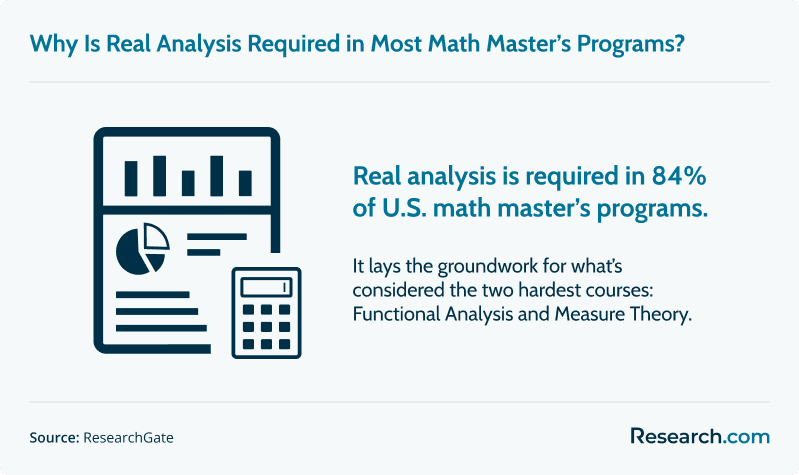
Common Specializations in Online Master’s in Mathematics Programs
Specializations help students connect an advanced math degree to a specific career path. Choosing a concentration early can guide course selection, internship decisions, and capstone topics. Students comparing accelerated graduate options in other fields, such as the fastest online master’s in nutrition, should apply the same logic: speed matters, but specialization determines career fit.
| Specialization | What It Covers | Potential Career Direction |
| Data Science and Analytics | Statistics, machine learning, programming, and data modeling | Data scientist, analyst, machine learning-focused roles |
| Applied Mathematics and Modeling | Numerical methods, simulations, and models for real systems | Engineering, biology, finance, or scientific computing roles |
| Financial Mathematics and Quantitative Finance | Pricing models, risk analysis, stochastic calculus, and financial engineering | Quantitative analyst or financial modeling roles |
| Pure Mathematics and Theory | Proof, topology, algebra, number theory, and advanced theory | PhD preparation, research, or advanced teaching |
| Operations Research and Optimization | Linear programming, decision analysis, logistics, and network flow | Operations research, supply chain, logistics, and systems optimization |
| Cryptography and Cybersecurity Mathematics | Number theory, algorithms, encryption, privacy, and secure communication | Cybersecurity, cryptography, and secure systems roles |
Demand for data science skills is expected to grow by 35% within ten years. That does not mean every mathematics graduate should choose data science, but it does show why many programs now include analytics, computation, and modeling electives.
Some programs also offer interdisciplinary options in mathematical biology, environmental modeling, or education. Students who plan to teach should compare coursework against math teacher requirements in their state, because a master’s degree alone may not satisfy licensure rules.
Specializations commonly require 6-12 elective credits beyond the core curriculum. Before enrolling, confirm whether the specialization is a formal transcripted concentration, an informal course cluster, or simply a recommended elective path.
How to Choose the Right Online Master’s in Mathematics
The best online mathematics master’s is not always the fastest or the cheapest. It is the program that fits your academic background, career target, budget, schedule, and learning style. Students comparing programs across disciplines, such as accelerated online MHA programs, should avoid choosing by completion speed alone.
Accreditation should be non-negotiable. Ninety-two percent (92%) of employers regard online degrees from traditional universities as comparable to in-person degrees, but that confidence depends heavily on institutional credibility, academic quality, and whether the degree comes from a recognized school.
Questions to ask before applying
- Is the university regionally accredited?
- Is the online degree identical to the campus degree on the transcript and diploma?
- Can the program be completed in 12, 18, or 24 months with the courses actually offered online?
- Are courses asynchronous, synchronous, or a mix of both?
- Does the curriculum match your goal: data science, teaching, statistics, PhD preparation, finance, or operations research?
- Are faculty full-time professors, adjunct instructors, or a combination?
- Does the program include a thesis, capstone, internship, practicum, or portfolio project?
- What academic support is available to online students?
- Are career services, tutoring, library access, and technical support available remotely?
- What is the total cost after tuition, fees, software, materials, and travel, if any?
Who should choose a fast online mathematics master’s?
- Working professionals who already have strong quantitative preparation and want career mobility.
- Teachers seeking advanced math knowledge, provided the program aligns with state licensure or salary-lane requirements.
- Analysts, engineers, programmers, and scientists who want deeper modeling, statistics, or optimization skills.
- Students who can handle compressed graduate coursework without frequent in-person support.
Who should consider a different path?
- Applicants missing several prerequisites may need bridge coursework before starting a fast program.
- Students who want a funded research assistantship may find more options in campus-based programs.
- Learners who need frequent face-to-face interaction may struggle in a mostly asynchronous format.
- Students focused on software engineering alone may be better served by computer science or data science programs.
Career Paths for Graduates of Online Master’s in Mathematics Programs
A master’s in mathematics can lead to careers far beyond teaching. Employers in finance, technology, healthcare, logistics, insurance, government, defense, and research need professionals who can build models, interpret data, optimize systems, and explain quantitative findings.
Your specialization matters. A student who chooses optimization and operations research may pursue different roles than a student who focuses on statistics, cryptography, or pure mathematics. Use the career table below to connect program choices with job targets.
| Career Path | What the Role Does | Relevant Program Focus | Salary or Outlook Stated |
| Data Scientist | Builds models and extracts insights from large datasets | Data science, statistics, machine learning, programming | U.S. BLS projects 35% job growth in data science from 2022 to 2032, with median salaries around $112,590 |
| Quantitative Analyst | Creates financial models for trading, risk, and investment decisions | Financial mathematics, stochastic modeling, computational methods | Quants often earn $101,350, and the field typically requires a master’s degree or higher |
| Statistician | Designs and applies statistical methods for business, science, policy, or research | Statistics, probability, regression, experimental design | Employment growth of 33.8% from 2016 to 2026, with median pay of $104,110 |
| Operations Research Analyst | Uses optimization and modeling to improve decisions and systems | Optimization, operations research, logistics, decision analysis | Employment is expected to grow 27.4% over the next decade |
| Actuary | Assesses financial risk for insurance, pensions, and related systems | Probability, statistics, financial mathematics, risk modeling | Median salary of about $125,770, with top earners exceeding $206,430 |
| Financial Analyst or Cryptographer | Analyzes markets or designs mathematical systems for encryption and security | Finance, number theory, algorithms, cryptography | These roles typically earn around $100,968 per year |
Job Market Outlook for Online Master’s in Mathematics Graduates
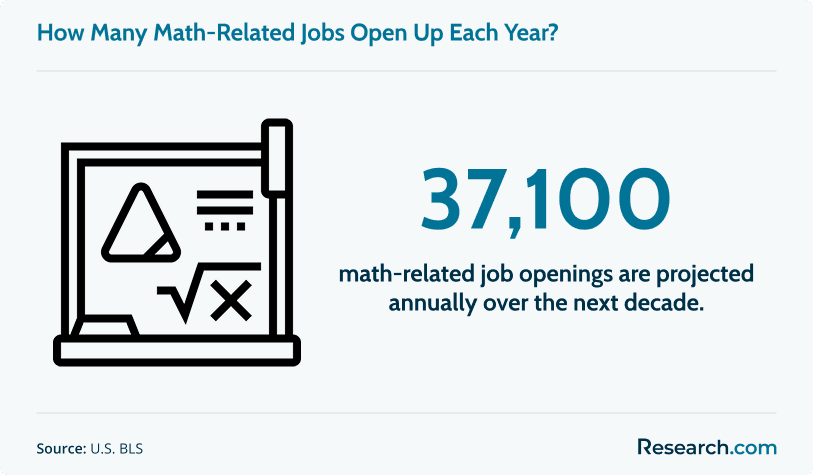
The labor market remains favorable for professionals with advanced quantitative training. According to the U.S. Bureau of Labor Statistics, employment for mathematicians and statisticians is projected to grow 11% from 2023 to 2033, with about 37,100 openings each year.
Graduates of one-year master’s programs and other accelerated online degrees can be competitive when they can demonstrate strong technical skills, project work, and communication ability. Employers in finance, technology, defense, healthcare analytics, logistics, and research often care more about verified quantitative competence than whether coursework was completed online or on campus.
AI and automation are also changing expectations. Routine calculations are easier to automate, but employers still need people who can choose the right model, validate assumptions, interpret results, identify bias, and explain uncertainty to decision-makers. For mathematics graduates, that means communication, programming, and applied problem-solving are increasingly important alongside theory.
Challenges of an Online Master’s in Mathematics
Online mathematics graduate programs are flexible, but they are not easy. The main challenge is managing difficult material without the built-in structure of a campus schedule. Students must keep up with proofs, coding assignments, problem sets, statistical software, and group projects while often working full time.
| Challenge | Why It Happens | How to Handle It |
| Falling behind in technical courses | Math concepts build quickly, and one missed topic can affect later work | Schedule weekly review blocks and use tutoring or office hours early |
| Limited peer interaction | Online students may not meet classmates informally | Join discussion boards, study groups, and virtual networking events |
| Balancing work and school | Graduate math workloads can be heavier than expected | Start part time if unsure, then increase course load after the first term |
| Technology and software demands | Courses may require statistical tools, coding environments, or proctoring platforms | Confirm hardware and software requirements before classes begin |
| Unclear career direction | Mathematics degrees can lead to many paths, but electives differ by goal | Choose a specialization and capstone topic tied to your target role |
Students considering later doctoral work can also learn from the structure of other accelerated online doctoral options, including the fastest online doctorate in education, but doctoral expectations in mathematics are typically more research-intensive and discipline-specific.
Should You Pursue a Doctoral Degree After an Online Master’s in Mathematics?
A doctorate may make sense if your long-term goal involves university teaching, original research, advanced theory, or highly specialized technical leadership. It is less necessary if your goal is to move into analytics, applied statistics, operations research, or industry modeling roles where a master’s plus strong project experience may be sufficient.
Before applying to doctoral programs, ask whether your master’s includes enough proof-based coursework, research preparation, faculty mentorship, and thesis experience. A non-thesis accelerated master’s can be excellent for industry advancement but may not be the strongest preparation for a research PhD unless you build research experience separately.
Students exploring leadership-focused doctoral options in education may also compare costs and flexibility through guides to affordable online doctoral programs in educational leadership, but those programs serve different professional goals than a doctorate in mathematics.
How to Validate the Quality of an Online Master’s in Mathematics
Start with accreditation. A credible online master’s should be offered by a regionally accredited university. Then look at program-level evidence: faculty credentials, course rigor, online student support, graduation requirements, technology platforms, and whether the diploma or transcript differs from the campus version.
Rankings can be helpful, but they should not be your only decision tool. Independent rankings, third-party reviews, alumni outcomes, and student support information should be used together. Comparisons with unrelated accelerated programs, such as the fastest online philosophy degree options, can help illustrate differences in pacing and delivery, but mathematics programs should be judged primarily on quantitative rigor and career alignment.
Quality checklist
- Regional accreditation is clearly listed and verifiable.
- Admissions requirements match the level of the curriculum.
- Faculty have relevant academic or industry expertise.
- Courses include current tools in statistics, computation, modeling, or proof-based mathematics.
- Online students receive advising, tutoring, library access, and career support.
- The program publishes clear cost, credit, and completion requirements.
- Capstone, thesis, practicum, or project options align with your career goal.
Return on Investment of an Online Master’s in Mathematics
ROI depends on the total cost of the program, your current salary, the career path you target, and how well the curriculum supports that path. A fast program can improve ROI by reducing time in school, but only if it does not sacrifice the skills, projects, or credentials employers expect.
Compare tuition, fees, software costs, financial aid, employer assistance, and opportunity cost against likely career outcomes. Also consider non-salary benefits such as eligibility for advanced technical roles, teaching advancement, doctoral preparation, and stronger quantitative credibility. Looking at affordability in other online graduate fields, such as low-cost online MLIS degrees, can help you think more carefully about price, but the salary and career logic will differ by field.
Common mistakes to avoid
- Choosing only the fastest program: A 12-month timeline is useful only if the curriculum supports your goals.
- Ignoring accreditation: Unaccredited or poorly recognized programs can weaken employer and doctoral-program acceptance.
- Comparing tuition without total cost: Fees, credits, software, and residency rules can change the real price.
- Assuming online means easier: Online graduate mathematics can be as demanding as campus study.
- Skipping prerequisites: Missing calculus, linear algebra, or statistics preparation can make an accelerated program much harder.
- Choosing a specialization too late: Electives, projects, and internships should support a specific career direction.
- Assuming salary outcomes are guaranteed: Reported salaries depend on role, location, experience, industry, and technical skills.
What Graduates Say About Online Master’s in Mathematics Programs
- : "I thought the program would be mostly abstract theory, but many courses used real datasets and modeling assignments. Working with classmates online across different time zones made the projects feel closer to a real workplace. — Kiara"
- : "I began receiving interview requests before I finished the degree. Hiring managers noticed the applied coursework on my resume, and the flexible schedule helped me complete the program quickly while continuing to work. — Lila"
- : "Completing the degree in 18 months while working full time changed my career path. Mathematical Modeling was the course that helped me most because it gave me new ways to simulate forecasting and inventory problems in my supply chain role. — Marissa"
References
- Bureau of Labor Statistics. Mathematicians and statisticians: Occupational Outlook Handbook. BLS mathematicians and statisticians data
- Bureau of Labor Statistics. Mathematical occupations. BLS mathematical occupations overview
- Bureau of Labor Statistics. Postsecondary teachers: Occupational Outlook Handbook. BLS postsecondary teachers data
- FSEOG.com. FSEOG amounts. FSEOG award information
- Graduate Programs at Northeastern University. What is the earning potential of a master's degree? Northeastern graduate earning potential article
- Johns Hopkins University. Tuition and fees. Engineering for Professionals. Johns Hopkins Engineering for Professionals tuition and fees
- Johns Hopkins University. Tuition and fees. Engineering for Professionals. Johns Hopkins tuition and fees reference
- National Center for Education Statistics. Graduate degree fields (Indicator CTB). NCES graduate degree fields data
- Northeastern University. Are online degrees respected by employers? Northeastern employer perception article
- ResearchGate. The modern mathematics master’s degree: A survey of U.S. programs. ResearchGate mathematics master’s survey
- UPCEA & Collegis Education. 71% of prospective graduate students prefer fully online programs. UPCEA and Collegis online graduate student preference report
Key Insights
- The fastest online master’s in mathematics programs can be completed in as little as 12 months, but 18 to 24 months is more realistic for many working students.
- Program fit matters more than speed alone. Choose a curriculum aligned with your goal, whether that is data science, statistics, applied modeling, teaching, finance, operations research, or doctoral study.
- Accreditation is essential. A regionally accredited university, clear faculty credentials, and strong online student support are stronger quality signals than marketing language about flexibility.
- Total cost should include tuition, credits, fees, residency rules, software, books, and opportunity cost. A lower tuition rate is not always the lowest overall price.
- Online mathematics programs can be academically rigorous and employer-relevant, but students need strong self-discipline, prerequisite preparation, and comfort with technical coursework.
- Career outcomes depend on specialization and skills. Applied projects, consulting practicums, internships, and portfolio-ready work can make the degree more valuable in quantitative fields.
Other Things You Should Know About Getting the Fastest Online Master’s Degree Program in Mathematics
Typically, applicants need a bachelor’s degree in mathematics or a related field with a strong academic record. Some programs might require GRE scores or previous coursework in advanced mathematics. Recommendations and a statement of purpose are often required as well.
Yes, some programs admit applicants with a bachelor’s degree in a related field such as physics, engineering, or statistics. They often require prior coursework in calculus, linear algebra, and proof-based mathematics, plus a minimum GPA, commonly around 3.0, before full admission.