
2027 Best Online Bachelor's in History Degree Programs

Co-Founder and Chief Data Scientist
Exploring an online history degree is a smart step for students looking to build strong research, writing, and analytical skills through a flexible format. According to the most recent education data, U.S. colleges conferred approximately 151,100 bachelor’s degrees in history and social sciences, making it a significant and enduring field of study despite broader declines in humanities enrollment
Whether you're aiming for careers in education, public history, museum work, or non‑profit research, a reputable online history degree can offer both flexibility and outcomes that align with professional aspirations. This guide features some of the best online bachelor’s in history programs, offering a side‑by‑side look at tuition, curriculum options, and specializations.
What are the benefits of getting an online bachelor’s degree in history?
- Online history programs allow students to balance their studies with work or family responsibilities through asynchronous coursework and multiple start dates.
- Graduates gain critical thinking, research, and communication skills that apply to a wide range of careers in education, public service, and cultural institutions.
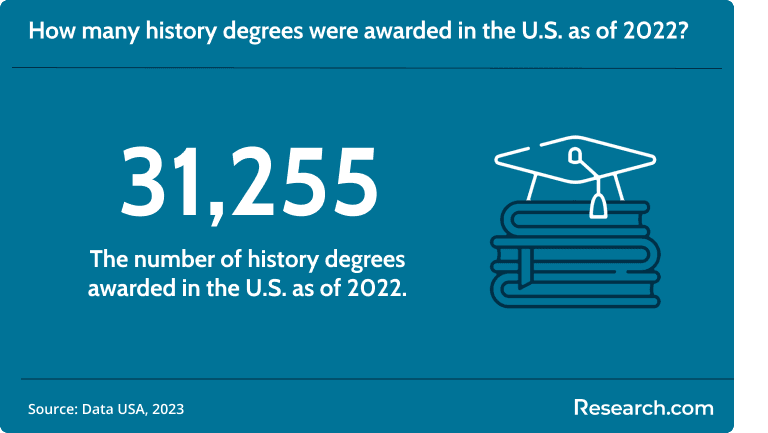
- With 31,255 history degrees awarded in 2022, the field remains a popular and respected choice among undergraduate students nationwide.
What can I expect from an online bachelor’s in history degree?
An online bachelor’s in history degree offers a comprehensive study of past events, cultures, and societies while helping you develop essential skills in research, analysis, and written communication. You’ll explore a range of historical periods and regions, such as U.S., European, and global history, through coursework that often includes primary source analysis, historiography, and thematic electives.
Programs typically require around 120 credit hours and may feature capstone projects, internships, or optional specializations like public history or military history. Delivered through flexible, asynchronous formats, these degrees are designed to support both traditional and nontraditional students pursuing careers or further study in education, law, public service, or cultural institutions.
Where can I work with an online bachelor’s degree in history?
With an online bachelor’s degree in history, you can work in a variety of fields that value critical thinking, research, and communication skills. Common career paths include roles in education, museums, archives, public history, government, journalism, and nonprofit organizations.
Graduates often find positions as history teachers, museum curators, archivists, policy researchers, or editors, and some go on to pursue graduate study in history, law, or related disciplines. The versatility of the degree allows for both public and private sector opportunities, especially in roles that require understanding context, analyzing information, and crafting clear narratives.
How much can I earn with an online history degree?
Earning potential with an online history degree varies based on your chosen career path, experience level, and location. Entry-level roles such as history teachers, archivists, and museum technicians typically offer salaries ranging from $45,000 to $65,000 per year, while specialized positions like policy researchers, museum curators, and editors can earn between $70,000 and $100,000 or more.
According to recent labor data, careers that combine historical expertise with research, writing, or public engagement tend to offer the highest earning potential. Pursuing graduate education can also lead to higher-paying roles in academia, law, or government.
- List of the Best Online Bachelor’s Degree Programs in History for 2027 List of Programs
- How long does it take to complete an online bachelor’s degree in history program? Completion Time
- How does an online history degree compare to an on-campus program? How does an online history degree compare to an on-campus program?
- What is the average cost of an online history degree program? Average Cost
- What are the financial aid options for students enrolling in an online history degree program? Financial Aid
- What are the prerequisites for enrolling in an online bachelor’s degree in history program? Requirements
- What courses are typically in an online bachelor’s degree in history program? What courses are typically in an online bachelor’s degree in history program?
- What types of specializations are available in an online history degree program? What types of specializations are available in an online history degree program?
- How do I choose the best online history degree program? How do I choose the best online history degree program?
- What career paths are available for graduates of an online history degree program? What career paths are available for graduates of an online history degree program?
- What is the job market for graduates with an online bachelor’s degree in history? Job Market
- How does an online history degree pave the way for advanced graduate opportunities? How does an online history degree pave the way for advanced graduate opportunities?
- What accreditation and quality standards should I look for in an online history degree program? What accreditation and quality standards should I look for in an online history degree program?
- How can interdisciplinary credentials enhance career prospects with an online history degree? online
- What emerging trends are shaping online history education? What emerging trends are shaping online history education?
Best Online Bachelor’s Degree Programs in History for 2026
Choosing an online bachelor’s degree in history is not just a question of which school has the most interesting courses. You also need to compare accreditation, tuition, transfer credit rules, online flexibility, teaching pathways, and whether the degree supports your long-term goals in education, public history, archives, museums, law, policy, journalism, or graduate study.
This guide is designed for students who want a flexible history degree without relocating, working adults returning to college, military-affiliated learners, transfer students, and future graduate students who want a humanities degree with strong research and writing value. You will find ranked program options, cost and timeline expectations, common courses, specializations, career paths, and practical questions to ask before applying.
Quick answer: What is the best online bachelor’s degree in history?
The best online bachelor’s degree in history depends on your goals. Oregon State University is a strong option for students who want a fully online B.A. or B.S. with broad global history coverage. American Public University may fit military-affiliated students because of its reduced tuition options. Southern New Hampshire University offers multiple history concentrations, while Oklahoma State University and UNCG may appeal to students interested in public history, museums, archives, or digital history.
For most students, the right choice is an accredited online history program that accepts transfer credits, offers courses aligned with career goals, provides strong advising, and has a total cost that makes sense after grants, scholarships, military benefits, or employer assistance are applied.
How we evaluate online history degree programs
Research.com uses a structured methodology to help readers compare schools using transparent academic, cost, and student-outcome factors. For online bachelor’s programs in history, we prioritize institutional credibility, online learning quality, tuition clarity, curriculum breadth, transfer accessibility, student support, and relevance to common history-related career paths.
Our analysis draws from recognized education data sources, including:
- IPEDS database
- Peterson's database, including the Distance Learning Licensed Data Set
- College Scorecard database
- National Center for Education Statistics
Best online bachelor’s in history programs at a glance
| School | Degree | Program Length | Notable Focus Areas | Listed Tuition or Cost Detail | Accreditation |
| Oregon State University | B.A./B.S. in History | Three to four years; 180 quarter credits | African, European, U.S., and world history | $384 per credit | NWCCU |
| American Public University | B.A. in History | Three to four years; 120 semester hours | General, American, European, Global History | $350 per credit; $250 Preferred Military Rate; $315 Veteran Grant or Opportunity Grant | HLC |
| Southern New Hampshire University | B.A. in History | Three to four years; 120 credit hours | American, European, Middle Eastern Studies, Military History | $342 standard full-time; $250 for active-duty military and spouses | NECHE |
| Arizona State University | B.A. in History | Three to four years; 120 credit hours | Political, economic, cultural, and global history | Approximately $580 per credit | HLC |
| University of Maryland Global Campus | B.A. in History | Three to four years; 120 credit hours | U.S. History or World History focus through upper-level electives | Approximately $324–$499 per credit | MSCHE |
| University of Central Florida | B.A. in History | Three to four years; 120 credit hours | Asia, Africa, Europe, Latin America, Middle East | $179.19 Florida residents; $715.80 out-of-state per credit | SACSCOC |
| Oklahoma State University | B.A. in History | Three to four years; 120 credit hours | U.S. West, Military History, Museum & Preservation, Digital History | See OSU Bursar’s online calculator; active-duty military may qualify for resident rate | HLC |
| Norfolk State University | B.A. in History | Three to four years; 120 credit hours | History-Social Science, military science, African/African Diaspora emphasis | Approximately $462 Virginia residents; about $985 out-of-state per credit | SACSCOC |
| University of Massachusetts Dartmouth | B.A. in History | Three to four years; 120 credit hours | U.S., European, global history, seminars, electives | Public state university tuition; specific online undergraduate rate not listed | NECHE |
| University of North Carolina at Greensboro | B.A. in History | Three to four years; 120 credit hours | Public History | ~$186 in-state; ~$698 out-of-state; ~200% of in-state for outside-NC online students | SACSCOC |
1. Oregon State University – B.A./B.S. in History
Oregon State University offers an online Bachelor of Arts or Bachelor of Science in History for students who want a broad, research-oriented humanities degree with exposure to multiple regions and historical periods. The curriculum emphasizes source interpretation, analytical writing, and historical argumentation rather than simple memorization of dates and events. Students can study African, European, U.S., and world history and complete advanced work that may include original research and capstone projects.
- Program Length: Three to four years; 180 quarter credits
- Tracks/concentrations: N/A
- Cost per Credit/Tuition: $384 per credit
- Accreditation: Northwest Commission on Colleges and Universities (NWCCU)
- Best fit: Students who want a regionally accredited public university with a fully online history degree and strong coverage of global historical perspectives.
2. American Public University (APU) – B.A. in History
American Public University provides a fully online Bachelor of Arts in History for learners who want a structured 120-credit curriculum with a required concentration. Students may focus on General, American, European, or Global History while developing skills in primary source analysis, research design, historical interpretation, and academic writing. The program culminates in a major historical research paper, which can be useful for students considering graduate school, public history, teaching, or research-related work.
- Program Length: Three to four years; 120 semester hours
- Tracks/concentrations: General, American, European, Global History; 39 hr requirement
- Cost per Credit/Tuition: $350 per credit standard; $250 with Preferred Military Rate; $315 with Veteran Grant or Opportunity Grant
- Accreditation: Higher Learning Commission (HLC)
- Best fit: Military-affiliated students, adult learners, and students who want a concentration-based online history curriculum.
3. Southern New Hampshire University (SNHU) – B.A. in History
The online Bachelor of Arts in History at Southern New Hampshire University is designed around research, written communication, and historical analysis. Students examine U.S., European, Middle Eastern, and military history while learning how to evaluate primary and secondary sources. The 120-credit structure includes a 36-credit free elective block and a capstone research course, giving students room to tailor the degree toward career interests or future graduate study.
- Program Length: Three to four years; 120 credit hours
- Tracks/concentrations: American History, European History, Middle Eastern Studies, Military History
- Cost per Credit/Tuition: $342 standard full-time; $250 for active-duty military and spouses
- Accreditation: New England Commission of Higher Education (NECHE)
- Best fit: Students who want a flexible online degree with multiple concentration options and a large elective block.
4. Arizona State University (ASU) – B.A. in History
Arizona State University offers an online Bachelor of Arts in History that asks students to study how societies, institutions, cultures, and global systems change over time. The program is built for learners who want to interpret historical evidence, understand political and economic developments, and strengthen research and communication skills that can transfer to law, public policy, education, public service, or graduate study.
- Program Length: Three to four years; 120 credit hours
- Tracks/concentrations: N/A
- Cost per Credit/Tuition: Approximately $580 per credit
- Accreditation: Higher Learning Commission (HLC)
- Best fit: Students seeking a large public research university with a broad online history curriculum.
5. University of Maryland Global Campus (UMGC) – B.A. in History
The University of Maryland Global Campus history degree is built for students who want an online program with applied relevance to education, archives, public history, journalism, policy, and cultural resource management. With roots dating back to 1947 and long experience in distance education, UMGC emphasizes critical reading, historical research, and clear writing. Students can use upper-level electives to focus on U.S. History or World History.
- Program Length: Three to four years; 120 credit hours
- Tracks/concentrations: U.S. History or World History focus within upper-level electives
- Cost per Credit/Tuition: Approximately $324–$499 per credit; varies by region and aid
- Accreditation: Middle States Commission on Higher Education (MSCHE)
- Best fit: Working adults, transfer students, and learners looking for a career-oriented online history degree.
6. University of Central Florida (UCF) – B.A. in History
University of Central Florida’s online Bachelor of Arts in History helps students connect past societies, conflicts, movements, and ideas to modern issues. The curriculum includes Western and World Civilization, historiography, and upper-level electives across regions such as Asia, Europe, Latin America, and the Middle East. This program may be a good fit for students who want broad regional choice within a public university format.
- Program Length: Three to four years; 120 credit hours
- Tracks/concentrations: Flexible regional electives, including Asia, Africa, Europe, Latin America, and Middle East
- Cost per Credit/Tuition: $179.19 for Florida residents; $715.80 out-of-state per credit
- Accreditation: Southern Association of Colleges and Schools Commission on Colleges (SACSCOC)
- Best fit: Florida residents seeking a lower listed per-credit tuition rate and students who want regional history electives.
7. Oklahoma State University (OSU Online) – B.A. in History
Oklahoma State University offers an online B.A. in History with opportunities to explore U.S. history, the U.S. West, military history, museum studies, preservation, and digital history. Students complete survey courses, a methods introduction, 30 upper-division history credits, related humanities or social science electives, and a senior research seminar or project. The program’s practicum connections with archives, museums, and oral history projects can be especially valuable for students interested in applied history work.
- Program Length: Three to four years; 120 credit hours
- Tracks/concentrations: U.S. West, Military History, Museum & Preservation, Digital History focus areas
- Cost per Credit/Tuition: See OSU Bursar’s online calculator; active-duty military may qualify for resident rate
- Accreditation: HLC
- Best fit: Students interested in archives, museums, oral history, preservation, or digital public history.
8. Norfolk State University (NSU) – B.A. in History Online
Norfolk State University offers an online Bachelor of Arts in History with flexibility for adult learners, transfer students, and military-affiliated students. The curriculum combines history with geography, political science, and related disciplines. Students may also pursue options connected to History-Social Science for Virginia licensure, military science, or electives with an African/African Diaspora emphasis.
- Program Length: Three to four years; 120 credit hours
- Tracks/concentrations: History-Social Science for Virginia licensure, military science in Army or Navy, or customizable electives with African/African Diaspora emphasis
- Cost per Credit/Tuition: Approximately $462 per credit for Virginia residents; about $985 per credit for out-of-state students
- Accreditation: Southern Association of Colleges and Schools Commission on Colleges (SACSCOC)
- Best fit: Virginia students, transfer students, and learners interested in teaching-aligned or African/African Diaspora-focused coursework.
9. University of Massachusetts Dartmouth (UMass Dartmouth) – B.A. in History Online
University of Massachusetts Dartmouth’s online Bachelor of Arts in History gives students a fully online route to a 120-credit humanities degree. The curriculum builds historical perspective, analytical thinking, and writing ability through introductory history, a critical skills course, 27 upper-level history credits, U.S. history, European history, global history, seminars, and electives. Graduates may apply these skills in government, education, business, law, or further study.
- Program Length: Three to four years; 120 credit hours
- Tracks/concentrations: N/A
- Cost per Credit/Tuition: Public state university tuition; specific online undergraduate rate not listed, with affordable options noted
- Accreditation: New England Commission of Higher Education (NECHE)
- Best fit: Students who want a public university history degree with broad upper-level coursework.
10. University of North Carolina at Greensboro (UNCG) – B.A. in History Online
University of North Carolina at Greensboro’s online Bachelor of Arts in History is built for students who want flexibility along with opportunities in public history. Coursework covers U.S., European, and world history, and students may engage with internships, digital archives, and applied historical interpretation. The public history option can be useful for learners interested in museums, heritage organizations, historical societies, and community history projects.
- Program Length: Three to four years; 120 credit hours
- Tracks/concentrations: Public History
- Cost per Credit/Tuition: ~$186 in-state; ~$698 out-of-state; ~200% of in-state for outside-NC online students
- Accreditation: Southern Association of Colleges and Schools Commission on Colleges (SACSCOC)
- Best fit: Students who want a public history pathway within an online B.A. program.
How Long Does an Online Bachelor’s Degree in History Take?
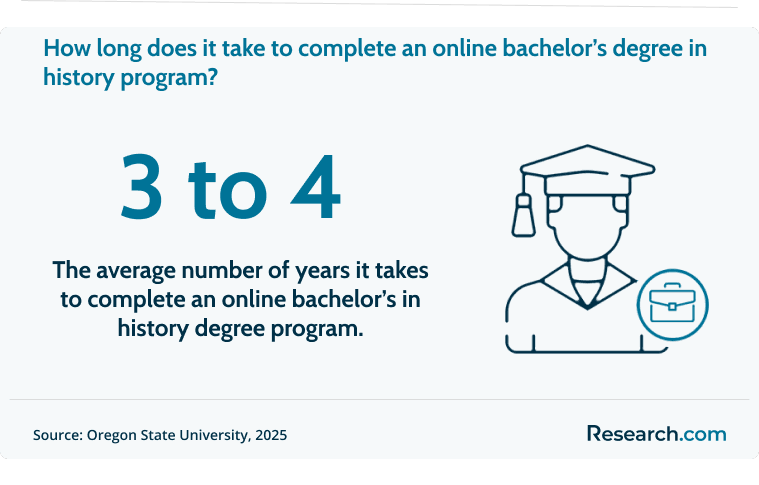
Most online bachelor’s degrees in history take three to four years for full-time students. A typical program requires about 120 semester credit hours, or the quarter-credit equivalent, across general education, major coursework, electives, and a capstone or senior research requirement.
Students taking 12 to 15 credits per semester usually stay on a traditional four-year timeline. Some online programs use shorter academic terms, such as 8-week or 7.5-week sessions, which may help motivated students complete courses more quickly if they study year-round.
Part-time students often need longer than four years, especially if they are working, serving in the military, raising children, or managing other responsibilities. However, asynchronous classes, multiple start dates, and generous transfer credit policies can make the degree more manageable.
If you already have prior college credits, an associate degree, military training, or eligible exam credits, ask each school for a transfer evaluation before enrolling. In some cases, students may complete an accelerated bachelor's degree in history online in as little as two years, depending on how many credits are accepted and how many courses are offered each term.
| Student Situation | Likely Timeline | What Can Shorten or Lengthen Completion |
| First-time full-time student | Three to four years | Course load, term structure, summer enrollment, and availability of required courses |
| Part-time working adult | Often longer than four years | Number of courses taken each term and whether the program offers asynchronous classes |
| Transfer student | Potentially shorter | Accepted transfer credits, residency requirements, and upper-division major requirements |
| Military-affiliated student | Varies | Transfer credit for military training, deployment schedule, tuition assistance rules, and term flexibility |
Online vs. On-Campus History Degree: Which Format Is Better?
An online history degree can offer the same academic credential as a campus-based program when it comes from an accredited institution. The main differences are not usually the degree title, but the learning format, scheduling structure, access to in-person experiences, and the type of student support you use most often.
| Factor | Online History Degree | On-Campus History Degree | Best Choice If... |
| Schedule | Often asynchronous or partially asynchronous | Usually fixed class meeting times | Choose online if you need flexibility around work, caregiving, or military service. |
| Coursework | Typically similar to the campus curriculum at the same school | Delivered in classrooms with scheduled discussions | Either format can work if the school is accredited and the curriculum fits your goals. |
| Interaction | Discussion boards, video lectures, virtual office hours, online group work | In-person discussion, campus events, faculty office visits | Choose campus if face-to-face networking and classroom discussion are essential to you. |
| Resources | Digital libraries, databases, remote advising, online tutoring | Physical libraries, campus clubs, in-person advising, local internships | Choose online if remote access matters; choose campus if you want frequent in-person engagement. |
| Teaching preparation | May require separate student-teaching or licensure steps depending on state rules | May have more embedded local field placements | Future teachers should verify state licensure alignment before choosing either format. |
Students planning to teach should be especially careful. A history major alone may not satisfy teacher licensure requirements. If your goal is elementary or secondary education, review how your program connects to certification and learn the difference between elementary and secondary education before choosing electives or a teaching pathway.
How Much Does an Online Bachelor’s Degree in History Cost?
The cost of an online bachelor’s degree in history varies widely by school, residency status, transfer credits, military eligibility, institutional aid, and fees. Tuition is only one part of the total price. Students should also review technology fees, books, graduation fees, transcript fees, and whether online learners pay in-state, out-of-state, or separate distance-learning tuition.
Using American Public University’s listed tuition examples, a 120-credit history degree may fall into the following sample ranges:
| Tuition Category | Per-Credit Example | Approximate 120-Credit Total | Who May Qualify |
| Standard rate | ~$350 per credit hour | ~$42,000 | Civilian students without listed tuition discounts or aid |
| Preferred Military Rate | $250 per credit hour | ~$30,000 | Eligible military-affiliated students |
| Veteran Grant or Opportunity Grant rate | Approximately $315 per credit hour | ~$37,000 | Students who qualify for the listed grant discount |
These figures are examples, not a universal price for every online history degree. A student at a public university may pay much less or much more depending on residency. For instance, UCF lists $179.19 per credit for Florida residents and $715.80 for out-of-state students, while Norfolk State lists approximately $462 per credit for Virginia residents and about $985 per credit for out-of-state students.
Students comparing flexible online degrees in other disciplines may also review options such as the shortest environmental engineering programs online, but the right comparison should always include accreditation, total credits required, career goals, and out-of-pocket cost after aid.
Before enrolling, request a written cost estimate from each school that includes accepted transfer credits, remaining credits, tuition category, fees, and projected aid. Do not rely only on the advertised per-credit rate.
Financial Aid Options for Online History Degree Students
Online students in accredited bachelor’s programs can often use the same broad aid categories available to campus students. Eligibility depends on the school, program status, enrollment level, citizenship or residency rules, prior borrowing, and academic progress.
- Federal financial aid: Students in eligible accredited programs can apply for grants, loans, and work-study consideration by completing the Free Application for Federal Student Aid (FAFSA).
- Institutional scholarships and grants: Many universities offer need-based or merit-based aid. Some awards are available to online learners, transfer students, adult learners, first-generation students, or students in humanities programs.
- Military and veteran benefits: Active-duty service members, veterans, spouses, and dependents may qualify for tuition discounts, the GI Bill®, the Yellow Ribbon Program, or school-specific military rates. APU and UMGC are examples of institutions with military-oriented tuition structures.
- Employer tuition assistance: Working adults should ask their employer whether tuition reimbursement, education benefits, or partner-school discounts are available.
- Transfer credit savings: The least expensive credit is often the one you do not have to retake. Ask whether prior college work, military training, CLEP exams, or community college credits can reduce your remaining degree requirements.
| Question to Ask | Why It Matters |
| Is the institution accredited and eligible for federal aid? | Federal aid generally depends on institutional eligibility and program status. |
| How many credits will transfer before I enroll? | Transfer acceptance can significantly affect total cost and completion time. |
| Do online students pay extra fees? | Technology, distance-learning, and course fees can change the real price. |
| Will dropping below full-time change my aid? | Enrollment intensity can affect grants, loans, satisfactory academic progress, and benefits. |
| Are military, veteran, spouse, or employer discounts stackable? | Some discounts cannot be combined, so students need a final net-price estimate. |
Admission Requirements for an Online Bachelor’s Degree in History
Admission requirements vary by institution, but most online bachelor’s programs in history use a straightforward undergraduate application process. Transfer applicants may have additional steps because schools must evaluate prior college coursework.
- High school diploma or equivalent: First-year applicants usually need a high school diploma or recognized equivalent, such as a GED. Some schools may list a minimum GPA, often around 2.0 to 2.5.
- Official transcripts: Applicants typically submit transcripts from high school and every college previously attended. These records determine admission eligibility and transfer credit.
- Standardized test scores: Many online programs are test-optional, but some schools may review SAT or ACT scores, especially when an applicant does not meet GPA expectations.
- English proficiency: International applicants may need TOEFL, IELTS, or an equivalent exam to show readiness for college-level coursework in English.
- Additional materials: Some programs may request a personal statement, letters of recommendation, or documentation for military, veteran, transfer, or prior-learning credits.
If you plan to move from a history bachelor’s degree into education, compare undergraduate requirements with the prerequisites for a master's in education. Taking the right history, social science, writing, and education-related electives early can reduce gaps later.
Typical Courses in an Online History Bachelor’s Program
An online history degree teaches students how to investigate evidence, evaluate competing interpretations, build arguments, and communicate clearly. Most programs combine broad survey courses with methods training, upper-level electives, and a final research project.
| Course Area | What Students Learn | Why It Matters |
| World and U.S. history surveys | Major political, social, cultural, and economic developments across broad periods | Builds the foundation for advanced regional or thematic study |
| Historical methods and historiography | How historians use sources, construct arguments, and evaluate interpretations | Essential for research papers, archives work, graduate study, and teaching |
| Regional history | Latin American, Middle Eastern, Asian, African, European, or U.S. history | Supports geographic specialization and global literacy |
| Thematic history | Military, environmental, economic, religious, science and technology, or cultural history | Lets students connect history to career interests or interdisciplinary fields |
| Public history and digital history | Museums, archives, exhibits, oral history, digital collections, and public interpretation | Useful for applied roles outside traditional classroom or academic settings |
| Social and cultural history | Race, ethnicity, gender, identity, migration, popular culture, and social movements | Develops context for education, policy, journalism, nonprofit, and community work |
| Government, civics, or political systems | Institutions, law, political development, and civic structures | Helpful for students considering teaching, public policy, law, or government roles |
Students exploring policy-oriented or writing-intensive online pathways may also compare history with the fastest online energy policy degree programs or the shortest online journalism programs. These comparisons can help clarify whether your primary goal is historical research, public communication, policy analysis, or professional writing.
Common Specializations in Online History Degree Programs
Specializations help students turn a broad history degree into a more focused academic plan. Some schools offer formal concentrations, while others allow students to create focus areas through electives.
- American history: Focuses on U.S. political, social, cultural, military, constitutional, and regional history.
- European history: Covers topics such as ancient, medieval, modern, political, intellectual, and social history in Europe.
- Global or world history: Studies cross-cultural exchange, migration, empire, trade, war, religion, and globalization across regions.
- Middle Eastern, Asian, African, or Latin American history: Provides regional depth for students interested in international affairs, education, research, or graduate study.
- Military history: Examines warfare, strategy, institutions, technology, memory, and the social impact of conflict.
- Public history: Prepares students to communicate history through museums, historic sites, community projects, archives, documentaries, and exhibits.
- Digital history: Applies digital archives, mapping, databases, multimedia tools, and public-facing platforms to historical research and interpretation.
- Environmental history: Looks at the relationship between people, ecosystems, policy, land use, energy, and climate across time.
In 2022, there were 31,255 history degrees awarded in the United States, showing that students continue to pursue the field for its research, writing, teaching, and interdisciplinary value. Learners comparing specialization-heavy online programs in other fields may also review options such as a fast track pediatric nurse practitioner graduate certificate online or a fast-track online creative writing degree, but history students should choose electives based on their own career target rather than speed alone.
How to Choose the Best Online History Degree Program
The best online history program is the one that fits your academic goals, schedule, budget, transfer situation, and career plans. Rankings can help create a shortlist, but they should not replace a program-by-program review.
- Verify accreditation first. Confirm that the institution is accredited by a recognized agency, such as the Higher Learning Commission (HLC) or another appropriate accreditor. Accreditation affects credit transfer, financial aid eligibility, employer recognition, and graduate school options.
- Match the curriculum to your goal. A future teacher, archivist, museum worker, law school applicant, and policy researcher may need different electives. Look for courses that support your intended path.
- Review faculty expertise. If you want military history, African Diaspora history, public history, or digital history, check whether faculty and course offerings actually support that area.
- Confirm online format details. Ask whether classes are asynchronous, synchronous, self-paced, cohort-based, or term-based. Flexibility differs by school.
- Request a transfer evaluation. Do this before committing. Transfer credit can change both cost and graduation timeline.
- Compare net price, not sticker price. Include tuition, fees, books, aid, military benefits, employer reimbursement, and the cost of credits you still need to complete.
- Check career and graduate school support. Ask about internship access, digital archives, writing support, research mentorship, teacher licensure advising, and alumni outcomes.
| If Your Goal Is... | Look For... | Be Careful About... |
| Teaching history or social studies | State licensure advising, education electives, field placement guidance | Assuming a history major automatically qualifies you for a teaching license |
| Museum or archives work | Public history, digital history, museum studies, internships, capstone projects | Choosing a purely theoretical program with no applied coursework |
| Law or graduate school | Research methods, writing-intensive seminars, faculty mentorship | Avoiding challenging upper-level writing courses |
| Military history or national security interests | Military history concentration, policy electives, research opportunities | Choosing a program with only one or two related electives |
| Fast completion | Generous transfer policy, multiple start dates, year-round courses | Ignoring course availability or upper-division residency requirements |
Career Paths With an Online Bachelor’s Degree in History
A history degree does not train students for only one occupation. It develops research, interpretation, writing, evidence evaluation, and communication skills that can apply across education, public service, museums, archives, publishing, journalism, policy, nonprofit work, and graduate study. Some roles require additional credentials, licensure, internships, or a master’s degree.
| Career Path | Listed Average Salary | How a History Degree Helps | Additional Requirements to Check |
| Archivist | $59,910 | Source preservation, document analysis, cataloging, historical context | Some roles prefer graduate study in history, archives, or library science |
| Museum Curator | $61,750 | Exhibit research, object interpretation, public education, collection context | Experience, internships, museum studies, or graduate education may be needed |
| History Teacher | $58,099 | Subject knowledge, source analysis, civic context, written communication | Teaching credential or state licensure is commonly required |
| Public Historian | $78,452 | Community history, exhibits, oral history, historic preservation, interpretation | Applied projects, internships, or graduate study may improve competitiveness |
| Policy Researcher | $85,855 | Historical context, trend analysis, research synthesis, persuasive writing | Policy, economics, statistics, or graduate training may be useful |
| Editor or Writer | $79,867 | Research accuracy, narrative structure, source evaluation, clear prose | Portfolio, journalism experience, editing skills, or subject specialization |
History graduates who enjoy advising, training, or student support may also explore roles related to academic and professional development, including the path of a career education specialist.
Job Market Outlook for Online History Degree Graduates
The job market for history graduates is strongest when students connect the degree to a clear skill set and career direction. Employers may value research, writing, evidence analysis, communication, cultural literacy, and the ability to explain complex issues, but many history-related roles are competitive and may require internships, portfolios, licensure, or graduate education.
According to labor projections, employment of archivists, curators, and museum workers is expected to grow 11% from 2023 to 2033, which is much faster than the average for all occupations. There are projected to be about 4,700 job openings per year in these roles over the next decade.
Entry-level opportunities may be found in museums, historical societies, schools, government agencies, nonprofits, media organizations, libraries, public history projects, and research support roles. Students interested in interdisciplinary graduate study may also compare humanities preparation with fields such as an accelerated online biotechnology master's degree, especially if they are considering a later pivot into science communication, policy, or interdisciplinary research.
How an Online History Degree Can Support Graduate Study
An online bachelor’s degree in history can be strong preparation for graduate programs that require advanced reading, research, argumentation, and writing. Common next steps include master’s programs in history, education, public history, library science, archival studies, public policy, law, museum studies, and educational leadership.
Students considering advanced education should use the bachelor’s degree strategically. Choose writing-intensive seminars, complete a strong capstone project, build relationships with faculty who can write recommendations, and save polished research papers for graduate applications. Professionals interested in doctoral-level education pathways may compare flexible options such as the shortest online EdD programs, especially if they want to connect historical inquiry with leadership, education, or institutional research.
Accreditation and Quality Standards to Check Before Enrolling
Accreditation is one of the most important quality checks for an online history degree. It affects federal financial aid eligibility, credit transfer, graduate school recognition, and how employers perceive the credential. Students should confirm institutional accreditation directly through the school and accreditor before enrolling.
- Institutional accreditation: Look for recognized accreditation from agencies such as HLC, NECHE, NWCCU, MSCHE, or SACSCOC, depending on the school’s region.
- Program transparency: The school should clearly list degree requirements, major courses, transfer policies, tuition, fees, and graduation expectations.
- Faculty qualifications: Review whether instructors have relevant academic training and research areas.
- Online student support: Strong programs provide advising, tutoring, library access, career services, technical help, and writing support for distance learners.
- Licensure clarity: If you plan to teach, verify whether the program meets your state’s teacher preparation requirements or whether separate certification is required.
Students who want to pair historical expertise with school, district, or organizational leadership may later consider an online doctoral degree in educational leadership, but the undergraduate program should still stand on its own as an accredited, academically credible degree.
Trends Shaping Online History Education
Online history education is becoming more digital, applied, and interdisciplinary. Students are increasingly expected to work with digitized primary sources, online archives, mapping tools, multimedia exhibits, public-facing writing, and collaborative research platforms. These tools do not replace traditional historical thinking; they expand how students find, organize, interpret, and present evidence.
- Digital archives are now central to research: Online students can access historical newspapers, government records, oral histories, image collections, and scholarly databases from anywhere.
- Public history is gaining visibility: More programs include museum studies, local history, historic preservation, digital exhibits, and community-based research.
- AI requires stronger source evaluation: As generative tools become more common, history students need to verify sources, identify unsupported claims, and distinguish evidence from generated text.
- Employers expect transferable skills: Writing, analysis, project management, digital literacy, and audience-aware communication are often as important as subject knowledge.
- Interdisciplinary study is more common: History students may combine coursework with education, political science, data visualization, journalism, philosophy, law, library science, or policy.
Students who enjoy the humanities but are still comparing disciplines may review fastest philosophy online degrees to understand how another writing- and analysis-focused field differs from history.
Interdisciplinary Credentials That Can Strengthen a History Degree
A history bachelor’s degree can become more career-focused when paired with practical experience or a complementary credential. The right add-on depends on the work you want to do.
| Career Direction | Helpful Add-On | Why It Helps |
| Archives or libraries | Library science, archival studies, digital preservation | Builds technical skills for managing records, collections, databases, and public access |
| Museums and public history | Museum studies, public history internship, digital exhibit experience | Shows employers you can present research to public audiences |
| Teaching | Teacher preparation, education coursework, state licensure pathway | Connects subject knowledge to classroom requirements |
| Policy or government | Political science, economics, public administration, statistics | Adds policy tools to historical context and research ability |
| Writing, editing, or journalism | Portfolio, communications coursework, editing experience | Demonstrates applied writing skills beyond academic papers |
For students interested in archives, digital collections, or information management, an inexpensive online master's in library science may provide a practical graduate-level complement to an undergraduate history background.
Common Mistakes to Avoid When Choosing an Online History Degree
- Choosing a program before checking accreditation: Always verify institutional accreditation before applying or using financial aid.
- Looking only at tuition per credit: Total cost also depends on fees, transfer credits, aid, books, and how many credits you still need.
- Assuming online means self-paced: Many online programs have weekly deadlines, scheduled terms, group projects, or live sessions.
- Ignoring transfer credit policies: A school with a lower tuition rate may cost more if it accepts fewer of your previous credits.
- Assuming a history degree automatically leads to teaching licensure: Teacher certification rules vary by state and often require additional coursework, exams, or supervised teaching.
- Choosing a specialization with no career plan: Follow your interests, but also ask how the concentration supports internships, graduate school, or employment.
- Relying only on rankings: Rankings can help you start, but your best program is the one that fits your budget, schedule, credit history, and goals.
- Skipping career preparation until senior year: Build a writing portfolio, seek internships, use digital archives, and ask faculty for research opportunities early.
Questions to Ask Before You Apply
- Is the institution regionally or nationally accredited by a recognized accreditor?
- Will the diploma or transcript identify the degree as online?
- How many of my prior credits will transfer into the major, general education, and electives?
- Are courses asynchronous, synchronous, or a mix of both?
- How often are required upper-level history courses offered?
- Does the program offer public history, digital history, teaching-aligned, or regional electives that match my goals?
- What is my estimated total cost after aid, fees, and transfer credits?
- Are internships, archives projects, museum partnerships, or capstone research opportunities available to online students?
- If I want to teach, does this degree align with my state’s licensure requirements?
- What career services, writing support, library access, and faculty advising are available remotely?
What Graduates Say About Studying History Online
- Amanda: "Earning my history degree online made it possible to keep working and take care of my family while finishing college. I liked being able to study when my schedule allowed, and the online discussions still helped me feel connected to classmates and instructors."
- David: "The strongest part of my program was the research and writing practice. Those skills helped me move into a local museum role after graduation, and the online format was more interactive than I expected because we used digital archives, group assignments, and regular instructor feedback."
- Samantha: "I started with a love of historical stories, but the degree taught me how to evaluate evidence, build arguments, and communicate clearly. Being able to complete the coursework from anywhere helped me keep moving toward a career without pausing the rest of my life."
Key Insights
- An online history degree is worth considering if you need flexibility and value research, writing, and analysis. It can support careers in education, public history, museums, archives, policy, publishing, journalism, nonprofit work, or graduate study.
- Accreditation should be your first filter. It affects financial aid, transfer credit, graduate school options, and employer confidence.
- Program fit matters more than rank alone. Choose based on concentration options, transfer credit acceptance, total cost, course format, faculty expertise, and career support.
- Teaching careers require extra planning. A history major may be useful for social studies education, but state licensure often requires additional coursework, exams, and supervised teaching.
- Public history, digital history, and archives-related coursework can improve career alignment. Students interested in museums, preservation, oral history, or digital collections should prioritize applied opportunities.
- Do not compare tuition without calculating net cost. Residency, military benefits, grants, transfer credits, and fees can change the real price of the degree.
- The strongest students build evidence of skill while enrolled. A capstone paper, digital exhibit, internship, writing portfolio, or archives project can make the degree more useful after graduation.
References:
- American Public University. (2025). Online Bachelor of Arts in History (BA). APU
- Data USA. (2023). History, including STEM Majors. Data USA
- Indeed Team. (2025). Historian salary in the United States. Indeed
- Oregon State University. (2025). Online Ecampus: History B.A. or B.S. OSU
- U.S. Bureau of Labor Statistics. (2025). Occupational Employment and Wages: Archivists. U.S. BLS
- ZipRecruiter. (2025). Salary: History Teacher, United States. ZipRecruiter
Other Things You Should Know About Online History Degrees
Typical admission requirements for 2027 online history programs include a high school diploma or equivalent, SAT/ACT scores, and application forms. Some institutions may also require a personal statement, recommendation letters, or entrance exams. Check specific program prerequisites for detailed eligibility criteria.
By 2027, most top online bachelor's in history programs require around 120 credit hours for graduation. This typically includes a mix of general education, core history courses, and elective classes, tailored to provide a comprehensive understanding of historical contexts and methodologies.
Yes. Regional accreditation from agencies recognized by the U.S. Department of Education helps ensure quality and can affect graduate school and employer recognition. Most programs also accept up to 90 transfer credits, but schools set limits on which history and general education courses will count.


