
2027 Kinesiology Degree Guide: Costs, Requirements & Job Opportunities

Co-Founder and Chief Data Scientist
Choosing a kinesiology degree usually starts with one practical question: will studying human movement lead to a career you can actually use? The answer depends on the role you want, the credential it requires, and whether you plan to stop at a bachelor’s degree or continue into graduate or licensed healthcare training.
Kinesiology can prepare students for work in exercise science, athletic performance, rehabilitation support, wellness, coaching, research, and health-related graduate programs. It can also serve as a pre-professional foundation for careers such as physical therapy, occupational therapy, nursing, medicine, and other types of doctors. This guide explains what kinesiology is, what degree levels are available, what jobs may be realistic, how much programs can cost, and how to decide whether this path fits your career goals.
Interest in the field remains steady. DataUSA reports that the number of kinesiology degrees awarded is increasing by 1.48%, with 33,730 students having received the degree. The number of people joining the kinesiology workforce is also rising, with an increase of 9% projected from 2024 to 2034.
Kinesiology Degree Table of Contents
- What is a Kinesiology Degree?
- Cost of Kinesiology Degree
- Kinesiology Degree Jobs
- Types of Degrees in Kinesiology
- Kinesiology Degree Requirements
- What to Look for in a Kinesiology Program
- Majors Related to Kinesiology
- Is an Online Kinesiology Degree a Cost-Effective Option?
- What are the benefits of combining kinesiology with other disciplines?
- Should kinesiology graduates consider complementary certifications?
- How Does Technology and Online Education Expand Kinesiology Career Opportunities?
- Exploring Interdisciplinary Opportunities Between Biology and Kinesiology
- Can Accelerated Healthcare Programs Advance Your Kinesiology Career?
- Should a Doctorate Complement Your Kinesiology Degree?
- Professional Certifications and Licenses for Kinesiology Graduates
- Future Trends in Kinesiology and Emerging Opportunities
- Can dual master's degrees boost your kinesiology career?
- How Can Practical Experience Enhance Your Kinesiology Career?
Quick Answer: What Can You Do With a Kinesiology Degree?
With a kinesiology degree, you can pursue careers related to exercise, movement, rehabilitation, sports performance, wellness, coaching, and health education. Common options include exercise physiologist, athletic trainer, fitness trainer, strength and conditioning coach, wellness coordinator, sports manager, and rehabilitation support roles. Some higher-paying or licensed careers, including physical therapist, occupational therapist, chiropractor, registered nurse, and medical doctor, typically require additional graduate education, clinical training, exams, or state licensure.
| Career goal | How kinesiology helps | What to check before choosing this path |
| Fitness, wellness, or coaching | Builds knowledge of exercise programming, anatomy, movement, and performance | Whether employers prefer certifications, internship experience, or a specific specialization |
| Rehabilitation or clinical support | Provides a foundation in biomechanics, exercise physiology, assessment, and patient communication | Whether the target role requires licensure, supervised clinical hours, or a graduate degree |
| Physical therapy or occupational therapy | Can satisfy many science and movement-related prerequisites | Whether the program meets prerequisite requirements for PT or OT graduate admission |
| Research or teaching | Introduces research methods, human performance, motor control, and health science topics | Whether a master’s or doctoral degree is needed for advancement |
What is a kinesiology degree?
A kinesiology degree is an academic program focused on human movement. The field draws from anatomy, physiology, biomechanics, motor control, psychology, exercise science, health behavior, and rehabilitation principles. The word comes from the Greek roots “kinesis,” meaning movement, and “logos,” meaning study.
In practical terms, kinesiology asks how the body moves, why movement breaks down, how exercise affects health, and how people can improve performance, prevent injury, recover mobility, or maintain physical function across the lifespan. Students often study muscles, joints, nervous system control, cardiovascular response to exercise, injury prevention, fitness assessment, and evidence-based exercise programming.
What do kinesiology students learn?
- Human anatomy and physiology: how body systems support movement, health, and physical performance.
- Biomechanics: how force, posture, alignment, and movement patterns affect efficiency and injury risk.
- Exercise physiology: how the body responds and adapts to physical activity.
- Motor learning and control: how people develop, refine, and regain movement skills.
- Assessment and documentation: how to evaluate fitness, movement quality, functional progress, and client or patient outcomes.
- Behavior and communication: how to motivate clients, explain health information clearly, and support adherence to exercise or rehabilitation plans.
What can you do with a kinesiology degree?
Kinesiology graduates can work in athletic training, strength and conditioning, wellness coaching, personal training, exercise physiology, sports management, rehabilitation support, health education, and research. Some graduates use the degree as a stepping stone into graduate healthcare programs. Others move into communication, administration, or business roles connected to sport, fitness, and health services.
Students interested in laboratory or academic research may also compare kinesiology with adjacent life-science fields, including molecular biology research careers. If you are comparing similar majors, this guide on what you can do with an exercise science degree can help clarify where the fields overlap.

Cost of Kinesiology Degree
The cost of a kinesiology degree depends heavily on degree level, residency status, school type, transfer credits, online or campus format, fees, housing, and how long you take to finish. Based on four-year degree-granting postsecondary institutions, the average kinesiology degree tuition is $7,344 for in-state public schools and $30,988 for out-of-state private colleges and universities. An online kinesiology degree may cost less in some cases, especially when it reduces commuting, housing, or relocation expenses.
How much does it cost to get a kinesiology degree?
The table below summarizes estimated tuition by degree level and institution type.
| Public In-State | Public Out-of-State | Private | |
| Associate Degree | $3,570 | $9,970 | $10,270 |
| Bachelor's Degree | $7,344 | $27,020 | $37,650 |
| Master's Degree | $8,950 | $10,408 | $29,960 |
| Doctoral Degree | $10,830 | $17,270 | $42,920 |
| *Values are estimates. |
Is a degree in kinesiology worth it?
A kinesiology degree is most likely to be worth it when your target career clearly connects to movement science, fitness, rehabilitation, sport, wellness, or a graduate healthcare pathway. It may be less worthwhile if you expect a bachelor’s degree alone to guarantee a licensed clinical role or a high salary immediately after graduation.
Recent BLS data show that exercise physiologists have a median pay of $58,160 per year. The average wage of kinesiology majors is $69,000, while physical therapists, occupational therapists, and chiropractors have annual median wages above that recorded average at $99,710, $96,370, and $76,530, respectively. Those higher-paying roles may require additional education, exams, clinical preparation, or licensure.
| A kinesiology degree may be worth it if... | You should be cautious if... |
| You enjoy anatomy, exercise, movement, sport, rehabilitation, and health behavior. | You want a guaranteed clinical license from a bachelor’s degree alone. |
| You are willing to complete internships, certifications, or graduate training when needed. | You are choosing the major only because it sounds broadly healthcare-related. |
| You have a specific plan, such as PT school, athletic training, wellness, coaching, or exercise physiology. | You have not checked salary ranges, state requirements, or graduate school prerequisites. |
| You are comfortable working directly with clients, athletes, patients, or research participants. | You prefer desk-based work with little physical demonstration, observation, or coaching. |
Kinesiology Degree Jobs
Kinesiology degree jobs vary widely because the major sits at the intersection of health, fitness, sport, and rehabilitation. Some roles are available with a bachelor’s degree and relevant experience, while others require graduate school, certification, or licensure. Before choosing this major, identify your target role and work backward from its requirements.
Is kinesiology in high demand?
Demand is supported by several long-term needs: injury prevention, chronic disease management, aging-related mobility support, sports performance, workplace wellness, and growing public interest in fitness and preventive health. Kinesiology graduates may find opportunities in hospitals, rehabilitation clinics, fitness centers, schools, universities, community health organizations, senior wellness programs, sports organizations, and corporate wellness settings.
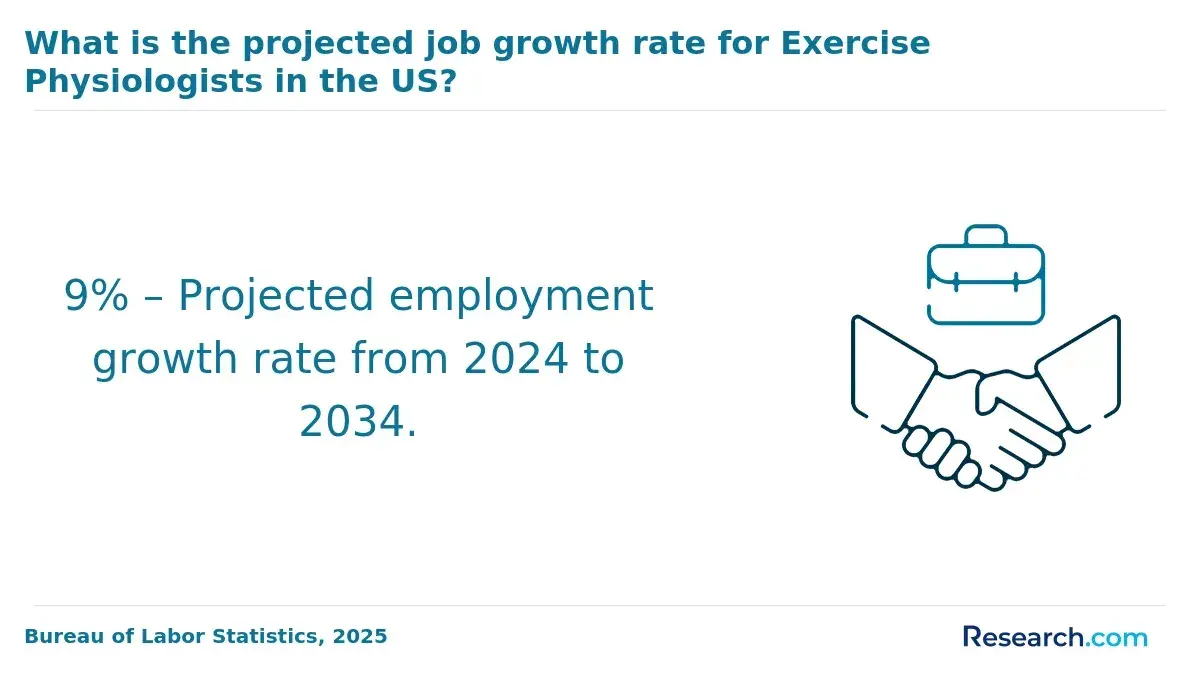
According to the outlook figures cited for related occupations, physical therapists have a job outlook of 11% from 2024 to 2034. Exercise physiologists are expected to rise by 9%. Occupational therapists and athletic trainers are both listed at 14%. Fitness trainers and instructors continue to be popular in this period by 12%. These figures do not mean every kinesiology graduate will have the same outcome; location, credentials, experience, and role requirements matter.
What jobs can you get with a kinesiology degree?
- Exercise physiologist: Reviews health histories, evaluates fitness and risk factors, conducts stress or fitness testing with medical equipment, and designs exercise programs for clients or patients.
- Athletic trainer: Helps prevent and respond to sports-related injuries, applies protective supports such as tape, bandages, and braces, assists with first aid or emergency care, and develops injury-prevention programs.
- Physical therapist: Evaluates movement limitations, helps patients reduce pain, and creates treatment plans to improve mobility. This career typically requires additional graduate-level professional preparation and licensure.
- Occupational therapist: Helps people improve or regain daily living and work-related functions after injury, illness, disability, or developmental challenges. This path also requires additional professional education and licensure.
- Fitness trainer or instructor: Leads individuals or groups through exercise programs, teaches safe technique, tracks progress, and adapts workouts to client goals and abilities.
- Strength and conditioning coach: Designs sport-specific training programs focused on power, speed, endurance, injury reduction, and performance improvement.
- Wellness coordinator: Creates health promotion programs for employers, community organizations, schools, or fitness facilities.
- Research assistant or academic pathway: Supports studies related to movement, exercise, health outcomes, performance, rehabilitation, or biomechanics.
What kind of salary can I earn with a kinesiology degree?
The average wage of kinesiology majors is $69,000. Salary potential depends on the job title, setting, degree level, certification, licensure, geography, and years of experience. Physical therapists, occupational therapists, and chiropractors have annual median wages above the recorded average at $99,710, $96,370, and $76,530, respectively. Exercise physiologists have a median pay of $58,160 per year.
| Role | Salary figure stated | Important note |
| Exercise physiologist | $58,160 per year | Often tied to clinical, wellness, or rehabilitation settings. |
| Average wage of kinesiology majors | $69,000 | A broad average that should not be treated as a guaranteed starting salary. |
| Physical therapist | $99,710 | Requires additional professional preparation and licensure. |
| Occupational therapist | $96,370 | Requires additional professional preparation and licensure. |
| Chiropractor | $76,530 | Requires additional professional education and licensure. |
Types of Degrees in Kinesiology
Kinesiology is offered at the certificate, associate, bachelor’s, master’s, and doctoral levels. The right credential depends on whether you want quick entry into fitness work, a transfer pathway, a full undergraduate foundation, advanced clinical or research preparation, or an academic career.
| Credential | Average time to complete | Best fit | Possible outcomes |
| Certificate in Kinesiology | 1 semester | Students seeking focused preparation in coaching, fitness specialization, personal training, or athletic training support | Athletic trainer aide, sports coach, personal trainer |
| Associate Degree in Kinesiology | 2 years | Students planning to transfer or enter support roles in fitness, recreation, or wellness | Preparation toward physician’s assistant, occupational therapist, or sports manager pathways |
| Bachelor’s Degree in Kinesiology | 4 years | Students seeking entry-level work or preparation for graduate healthcare programs | Corporate wellness trainer, cardiac rehabilitation therapist, athletic trainer pathway |
| Master’s Degree in Kinesiology | 2 years | Students seeking specialization, research preparation, or advanced practice in movement science | Clinical exercise physiologist, wellness coach, strength and conditioning specialist |
| Doctoral Degree in Kinesiology | 3 years | Students aiming for research, college teaching, or advanced scholarly work | Researcher, postsecondary instructor, research analyst |
Certificate in Kinesiology
Average time to complete: 1 semester
A kinesiology certificate is a short, focused credential for students who want targeted training in areas such as coaching, personal training, fitness specialization, or athletic training support. These programs may take weeks, a few months, or as long as a semester. They can be useful for career exploration, skill-building, or adding a focused credential to an existing degree.
Entry-level jobs: athletic trainer aide, sports coach, personal trainer
Associate Degree in Kinesiology
Average time to complete: 2 years
An associate degree introduces students to foundational topics in kinesiology, including human anatomy, physiology, health, fitness, basic movement science, first aid, CPR, and introductory science coursework such as biology, chemistry, or physics. Many students use the associate degree as a transfer route into a bachelor’s program.
Entry-level jobs: physician’s assistant, occupational therapist, sports manager. In practice, some of these careers require additional education beyond the associate level, so students should verify requirements early.
Bachelor’s Degree in Kinesiology
Average time to complete: 4 years
A bachelor’s degree is the most common kinesiology credential for students entering the field. Coursework often includes applied exercise physiology, applied biomechanics, functional kinesiology, anatomy, assessment, evaluation, coaching, fitness programming, and research literacy. Students may use this degree for entry-level roles or as preparation for graduate study.
Entry-level jobs: corporate wellness trainer, cardiac rehabilitation therapist, athletic trainer
Master’s Degree in Kinesiology
Average time to complete: 2 years
A master’s degree allows students to specialize. Oregon State University, for example, offers options in biophysical kinesiology and psychosocial kinesiology. Biophysical kinesiology emphasizes biomechanics, exercise physiology, and motor control, while psychosocial kinesiology focuses on motor development, sport and exercise psychology, and the sociology of sport.
Graduate students are usually expected to engage in research, advanced analysis, and specialized practice. Students more interested in the management side of athletics may also compare kinesiology with an online master’s degree in sports management.
High-level positions: clinical exercise physiologist, wellness coach, strength and conditioning specialist
Doctoral Degree in Kinesiology
Average time to complete: 3 years
A doctoral program is designed for advanced research, college teaching, and specialized scholarship. Students may study athletic training and sports medicine, biomechanics, exercise physiology, motor control, physical activity psychology, and the history and philosophy of sport. A Ph.D. can be appropriate for students who want to lead research, teach at the postsecondary level, or contribute to evidence-based practice in movement science.
High-level positions: researcher, postsecondary instructor, research analyst
Kinesiology Degree Requirements
Admission requirements vary by school and degree level, but kinesiology programs usually expect students to show readiness for science-based coursework. Applicants should check each college’s requirements instead of assuming that all programs use the same standards.
Admission Requirements
- Proof of graduation: Colleges typically require a high school diploma or equivalent for undergraduate admission. Transfer or second-degree applicants may also need records from previous colleges.
- Transcripts: Applicants usually submit high school and college transcripts. The general acceptance GPA for higher education degrees is 2.0, though individual programs may set different expectations or use probationary admission.
- Coursework preparation: Biology, chemistry, physics, English, and other advanced high school courses can strengthen readiness for kinesiology, especially because the major includes substantial science content.
- SAT or ACT policies: The College Board has stopped offering SAT subject tests and SAT with essays. ACT is still offered, but each institution may set its own testing policy, so applicants should confirm whether scores are required, optional, or not considered.
- International student requirements: Students whose first language is not English may need to demonstrate English proficiency through IELTS, TOEFL, Cambridge English Langauge Assessment, Pearson Test of English-Academic, or another accepted exam.
Skill Requirements
- Writing and communication: Kinesiology professionals must explain exercise plans, safety precautions, treatment goals, and progress clearly. They may also document assessments, observations, and client or patient outcomes.
- Health and fitness knowledge: Students need a strong grasp of exercise principles, injury prevention, anatomy, wellness, and evidence-based practice. They should also be willing to keep learning after graduation as research and best practices change.
- Research literacy: Practitioners should be able to interpret new findings carefully. For example, Andrýskova and Lee examined the use of kinesiology tape in sports and noted that insufficient knowledge about proper taping can reduce effectiveness or cause undesired effects. Their paper, “The Guidelines for Application of Kinesiology Tape for Prevention and Treatment of Sports Injuries,” published in Healthcare, emphasized that kinesiology tape should be applied for a maximum of 24 hours because excessive wear may contribute to skin problems.
- Physical stamina: Many kinesiology-related jobs involve standing, demonstrating movements, assisting clients, setting up equipment, and working hands-on with athletes or patients.
- Professional judgment: Graduates must know when to refer someone to a licensed clinician, physician, or specialist instead of working outside their scope.
What to Look for in a Kinesiology Program
Not all kinesiology programs lead to the same outcomes. Some emphasize fitness and coaching, while others focus on rehabilitation science, sport management, research, or pre-health preparation. The best program is the one that matches your intended career path and prepares you for the next credential, exam, internship, or graduate program you may need.
Available Specializations
Specializations can shape your career options. San José State University lists four specializations for kinesiology: exercise and fitness specialization, rehabilitation science, inclusive physical activity in communities, and sport management and culture. The University of Texas at Austin lists six: coaching, disability studies in movement science, medical fitness and rehabilitation, strength conditioning coaching, community health and wellness, and health fitness instruction.
Accreditation
Accreditation helps verify that a school or program meets recognized academic or professional standards. This is especially important if your goal involves licensure, certification, graduate admission, or clinical training. Relevant organizations may include the National Strength and Conditioning Association, the Commission on Accreditation of Allied Health Education Programs, the Commission on Accreditation of Athletic Training Education, the Committee on Accreditation for Exercise Sciences, and The Energy Kinesiology Association. Students should confirm accreditation directly through accreditor websites and the school’s official program page.
Student-Teacher Ratio
Class size matters in a hands-on field. A lower student-to-faculty ratio can make it easier to receive feedback on movement assessment, research projects, lab work, and career planning. These days, the acceptable student:teacher ratio in postsecondary institutions is 17:1 or lower. A ratio higher than 20:1 may be a warning sign if the program relies heavily on advising, labs, internships, or close faculty supervision.
Financial Aid Options
Students should compare scholarships, grants, federal student loans, work-study options, departmental awards, alumni-funded scholarships, and employer tuition support. Do not evaluate a school by tuition alone. Fees, housing, transportation, course materials, clinical placement costs, and the time needed to graduate can change the real price. For broader policy context, students sometimes explore debates around why college should be free, but individual applicants still need a concrete financing plan.
Questions to ask before enrolling
| Question | Why it matters |
| Is the program accredited by the appropriate body? | Accreditation can affect transfer, graduate admission, licensure, and employer confidence. |
| Which specialization best matches my career goal? | A sport management track may not prepare you the same way as a rehabilitation science track. |
| Does the curriculum include labs, internships, or clinical experience? | Hands-on learning is often important for employment and graduate applications. |
| Will the degree meet prerequisites for PT, OT, nursing, medicine, or other graduate programs? | Missing prerequisites can delay admission or add cost later. |
| What certifications do graduates commonly pursue? | Some careers depend on credentials beyond the degree. |
| What is the total cost after aid, fees, and living expenses? | The listed tuition does not always reflect the full cost of attendance. |
Majors Related to Kinesiology
If kinesiology sounds close to your interests but not quite right, compare it with nearby majors. Related programs may lead to different graduate school options, teaching routes, research paths, or health careers.
- Psychology: useful for students interested in behavior change, sport psychology, motivation, counseling-adjacent pathways, or mental performance.
- Education: relevant for students interested in teaching, coaching, physical education, youth development, or health education.
- Biology: a strong option for students aiming toward medicine, research, physiology, anatomy, laboratory science, or advanced healthcare study.
Is an Online Kinesiology Degree a Cost-Effective Option?
An online kinesiology degree can be cost-effective when it is accredited, aligned with your career goals, and designed with enough practical learning to support employment or graduate admission. Online study may reduce commuting and relocation costs, but students should still check tuition, fees, lab requirements, internship placement support, technology costs, and whether in-person experiences are required.
For budget-conscious students, comparing the cheapest online kinesiology degree options can be a reasonable starting point. However, the lowest-priced program is not automatically the best choice. Prioritize accreditation, course quality, faculty expertise, transfer policies, career services, and whether the curriculum supports your intended role.
| Online kinesiology may work well if... | Campus-based study may be better if... |
| You need schedule flexibility because of work, caregiving, or location. | You want frequent in-person labs, coaching practice, or athletic training environments. |
| The program helps arrange internships or field experiences near you. | Your target career requires extensive supervised clinical or hands-on training. |
| You are disciplined enough to complete science coursework independently. | You learn best through direct demonstration, immediate feedback, and campus facilities. |
| The school is transparent about costs, accreditation, and outcomes. | You need access to labs, performance equipment, teams, or rehabilitation settings on campus. |
What are the benefits of combining kinesiology with other disciplines?
Kinesiology becomes more flexible when paired with another field. The best combination depends on your career goal: psychology for behavior and motivation, nutrition for wellness, biology for healthcare and research, business for management, and education for teaching or coaching.
Career flexibility
Combining kinesiology with psychology, nutrition, education, or business can open more than one employment direction. For example, kinesiology plus psychology may support work in sport psychology-adjacent settings, mental performance coaching, or behavior-change programs, depending on the role’s credential requirements.
More complete health and wellness services
Nutrition, public health, or health education can complement exercise programming. This is useful for fitness professionals, wellness consultants, and rehabilitation-focused graduates who want to understand the broader lifestyle factors that affect movement, recovery, and long-term health.
Business and entrepreneurship preparation
Students who want to run a gym, training business, wellness company, or rehabilitation-related service should consider business coursework. Marketing, accounting, operations, and management skills can be just as important as exercise knowledge for self-employed professionals.
Specialized healthcare and research paths
Biology, biomechanics, sports medicine, or biomedical science can deepen preparation for allied health, orthopedics, rehabilitation research, and advanced study. Students pursuing these routes should confirm prerequisite requirements early.
Stronger marketability
Employers may value graduates who can connect movement science with communication, analytics, health behavior, management, or technology. Interdisciplinary preparation is most powerful when it is intentional rather than a random collection of courses.
Should kinesiology graduates consider complementary certifications?
Complementary certifications can help kinesiology graduates show specific competencies, especially in fitness, strength and conditioning, health coaching, exercise physiology, or administrative healthcare support. A certification should match the job you want; collecting unrelated credentials can waste time and money.
Some graduates also expand into healthcare operations. For example, online medical billing and coding certification programs may be useful for those who want to combine movement-science knowledge with administrative roles in clinics, rehabilitation offices, or healthcare organizations.
How Does Technology and Online Education Expand Kinesiology Career Opportunities?
Technology is changing how movement, performance, rehabilitation, and wellness are measured and delivered. Kinesiology students increasingly encounter telehealth tools, wearable devices, remote coaching platforms, digital fitness tracking, simulation-based learning, and data-informed training plans. These tools do not replace scientific judgment, but they can improve monitoring, feedback, and client engagement when used responsibly.
Online education is also widening access to related healthcare training. Students exploring broader healthcare credentials may compare remote learning options in adjacent fields, including guides that ask Can you become a pharmacist online?. The main lesson for kinesiology students is to evaluate every online program carefully: format alone does not determine quality, accreditation or career fit.
Exploring Interdisciplinary Opportunities Between Biology and Kinesiology
Biology and kinesiology fit naturally together because both examine the human body, function, adaptation, and health. Kinesiology focuses on movement and performance, while biology can deepen understanding of cells, tissues, physiology, genetics, and disease processes.
This combination may be especially useful for students interested in rehabilitative science, sports medicine, cellular biomechanics, exercise physiology research, or healthcare graduate programs. Biology strengthens scientific depth; kinesiology keeps that science connected to movement, function, and applied human performance.
Students considering this route should compare career requirements carefully. Some biology-related paths lead to laboratory or research careers, while others require advanced professional education. Reviewing biology major salary information can help students understand how biology-based careers differ from kinesiology-based roles.
Can Accelerated Healthcare Programs Advance Your Kinesiology Career?
Accelerated healthcare programs can help kinesiology graduates move into more specialized clinical or allied health roles, but only when the program fits a clear career plan. Faster does not always mean better. Students should verify accreditation, clinical placement quality, licensure eligibility, prerequisite requirements, and total cost before enrolling.
Some students use kinesiology as a launchpad into other health professions. For example, those exploring pharmaceutical care and interdisciplinary healthcare teams may compare fast track online PharmD programs. The key is to choose accelerated training because it advances a specific goal, not because it simply sounds efficient.
Should a Doctorate Complement Your Kinesiology Degree?
A doctorate can make sense if you want to conduct research, teach at the college level, lead specialized programs, or move into advanced clinical or healthcare leadership pathways. It may not be necessary for many fitness, coaching, wellness, or entry-level movement science roles.
Students weighing doctoral education should compare the opportunity cost, time commitment, research expectations, licensure outcomes, and career payoff. Some may pursue a Ph.D. in kinesiology, while others may explore professional doctorates in related healthcare fields. For students considering pharmacy as a complementary path, reviewing top PharmD programs can help clarify how professional doctorate options differ from research-focused study.
Professional Certifications and Licenses for Kinesiology Graduates
A kinesiology degree alone may not be enough for every role. Certifications can validate specialized skills, while licenses are legally required for certain healthcare professions. Always check state requirements and employer expectations before assuming a credential qualifies you for practice.
| Credential or license | Best for | What it signals |
| Certified Strength and Conditioning Specialist (CSCS) | Graduates who want to train athletes or improve sport performance | Knowledge of strength training, conditioning, exercise physiology, and injury prevention |
| Certified Exercise Physiologist (EP-C) | Graduates interested in exercise programming for clients, including those with medically controlled conditions | Competence in assessment, exercise prescription, and health-related fitness programming |
| Physical Therapist (PT) license | Students pursuing physical therapy practice | Completion of required professional preparation and passing the National Physical Therapy Examination (NPTE) |
| Occupational Therapist (OT) license | Students pursuing occupational therapy practice | Completion of required professional preparation and passing the National Board for Certification in Occupational Therapy (NBCOT) exam |
Certified Strength and Conditioning Specialist (CSCS)
The Certified Strength and Conditioning Specialist credential is offered by the National Strength and Conditioning Association. It is a common option for graduates who want to work with athletes and develop performance-focused training programs.
Certified Exercise Physiologist (EP-C)
The American College of Sports Medicine offers the Certified Exercise Physiologist credential. This certification is aimed at professionals who design exercise programs, including programs for clients with medically controlled conditions.
Physical Therapist and Occupational Therapist Licenses
To become a licensed physical therapist or occupational therapist, kinesiology graduates must complete additional graduate-level education and pass the National Physical Therapy Examination or the National Board for Certification in Occupational Therapy exam. Licensure allows qualified professionals to work with patients recovering from injury, managing pain, improving mobility, or rebuilding daily function.
Future Trends in Kinesiology and Emerging Opportunities
Kinesiology is being shaped by healthcare demand, technology, aging-related mobility needs, preventive health, and the professionalization of sports performance. Graduates who combine scientific knowledge with practical experience, data literacy, and strong communication skills are better positioned to adapt.
- Telehealth and virtual fitness: Remote consultations, digital coaching, and virtual rehabilitation support are expanding how professionals interact with clients and patients. Kinesiology graduates should understand both the convenience and the limits of remote care.
- Wearable technology in rehabilitation and fitness: Fitness trackers and smart wearables can provide data on activity, recovery, intensity, and progress. Professionals need to interpret this data carefully rather than relying on devices as a substitute for assessment.
- Aging population and preventive healthcare: Mobility, balance, strength, pain management, and injury prevention are increasingly important in older adult care and community wellness.
- Sports science and performance optimization: Athletes at many levels are seeking evidence-based training, biomechanics analysis, recovery strategies, and injury prevention support.
- Corporate wellness: Employers continue to invest in employee well-being through fitness programs, ergonomic support, health initiatives, and wellness education.
Graduates who want advanced preparation in these areas may compare an affordable master's degrees online option with campus-based programs, especially if they need flexibility while working.
Can dual master's degrees boost your kinesiology career?
Dual master’s degrees can strengthen a kinesiology career when the second discipline directly supports your goals. Useful pairings may include business management for wellness entrepreneurship, nutrition for health coaching, biomedical engineering for movement technology, public health for population wellness, or psychology for performance and behavior change.
Before enrolling in dual master's degrees, compare the cost, time commitment, career payoff, and whether employers in your target field value both credentials. A dual degree is most effective when it builds a coherent professional identity, not when it simply adds another line to a resume.
How Can Practical Experience Enhance Your Kinesiology Career?
Hands-on experience is one of the biggest differentiators for kinesiology students. Internships, clinical placements, lab work, coaching experience, research assistantships, and volunteer roles help translate classroom knowledge into practical judgment.
- Internships: Build experience in fitness centers, clinics, athletic departments, rehabilitation settings, or corporate wellness programs.
- Clinical observation: Helps students understand licensed healthcare roles before applying to graduate programs.
- Research experience: Supports students considering graduate study, biomechanics, exercise physiology, or academic careers.
- Coaching and training practice: Develops communication, cueing, assessment, and program design skills.
- Community health work: Gives students experience with diverse populations, health education, and preventive wellness.
Students comparing related allied health training may also review accelerated options, including resources that answer how long a medical assistant program is. Practical experience should support your larger career plan, whether that means employment after graduation or admission to another health program.
Common Mistakes to Avoid When Choosing a Kinesiology Degree
| Mistake | Better approach |
| Assuming all kinesiology careers are available with only a bachelor’s degree | Identify the exact job title and check whether it requires certification, licensure, graduate school, or clinical hours. |
| Choosing a program based only on tuition | Compare total cost, accreditation, internship support, transfer policies, graduate school placement, and time to completion. |
| Ignoring accreditation | Verify institutional and programmatic accreditation before enrolling, especially for clinical or licensure-related goals. |
| Picking a specialization without a career plan | Match the track to your target outcome: rehabilitation, coaching, sport management, wellness, or research. |
| Assuming online programs are automatically easier or weaker | Evaluate curriculum quality, lab requirements, faculty support, field placement, and student outcomes. |
| Waiting too long to gain experience | Start building internships, volunteer hours, coaching practice, or research involvement early. |
| Relying on salary averages as guarantees | Use salary data as a planning tool, then research local employers, entry-level roles, and credential requirements. |
Laying Down the Foundations for a Kinesiology Career
A kinesiology degree can lead to many directions, but the best outcomes usually come from planning early. If your goal is fitness, wellness, or coaching, focus on practical experience and relevant certifications. If your goal is physical therapy, occupational therapy, nursing, medicine, or another clinical profession, use kinesiology strategically to complete prerequisites and build a strong graduate school application.
Careers with a kinesiology degree can be rewarding, but they can also be physically and emotionally demanding. You may work with athletes under pressure, patients recovering from injury, older adults trying to maintain mobility, or clients struggling to stay consistent. Strong communication, patience, and evidence-based judgment matter as much as scientific knowledge.
Kinesiology can also support research, teaching, healthcare administration, or further clinical education. Some graduates later pursue a nursing degree, while others track trends in higher education to decide whether another credential is worth the investment.
Key Insights
- Kinesiology is the study of human movement: It combines anatomy, physiology, biomechanics, exercise science, psychology, and health behavior.
- The degree is flexible, but not automatic: Graduates can enter fitness, wellness, coaching, sports, rehabilitation support, or research, but many clinical roles require additional education or licensure.
- Costs vary widely: Estimated tuition ranges from $3,570 for a public in-state associate degree to $42,920 for a private doctoral degree.
- Salary depends on the role: Exercise physiologists have a median pay of $58,160 per year, while physical therapists, occupational therapists, and chiropractors are listed at $99,710, $96,370, and $76,530, respectively.
- Demand is strongest when credentials match the job: Related outlook figures include 11% for physical therapists, 9% for exercise physiologists, 14% for occupational therapists and athletic trainers, and 12% for fitness trainers and instructors from 2024 to 2034.
- Specialization matters: Rehabilitation science, sport management, coaching, medical fitness, and community wellness tracks can lead to different outcomes.
- Accreditation is essential: Always confirm accreditation before enrolling, especially if graduate school, certification, or licensure is part of your plan.
- Experience improves employability: Internships, labs, clinical observation, research, and coaching practice help turn coursework into career-ready skills.
- Online programs can be cost-effective: They are strongest when accredited, well-supported, and connected to practical learning opportunities.
- The best decision starts with the end goal: Choose the degree level, specialization, certifications, and practical experiences based on the career you want, not just the major name.
References:
- BLS. (2025, August 28). Athletic trainers. Retrieved from U.S. Bureau of Labor Statistics.
- BLS. (2025, August 28). Exercise physiologists. Retrieved from U.S. Bureau of Labor Statistics.
- BLS. (2025, August 28). Fitness trainers and instructors. Retrieved from U.S. Bureau of Labor Statistics.
- BLS. (2025, August 28). Occupational therapists. Retrieved from U.S. Bureau of Labor Statistics.
- BLS. (2025, August 28). Physical therapists. Retrieved from U.S. Bureau of Labor Statistics.
- BLS. (2025, August 28). Recreational therapists. Retrieved from U.S. Bureau of Labor Statistics.
- College of Health and Human Development. (n.d.). Ph.D. in kinesiology. Retrieved from Penn State.
- College of Public Health and Human Sciences. (n.d.). Kinesiology master’s degree program. Retrieved from Oregon State University.
- EducationData. (2026, February 14). Average Cost of College & Tuition. Retrieved from EducationData.
- Mt. San Antonio College. (n.d.). Certificate programs. Retrieved from Mt. San Antonio College.
- San Bernardino Valley College. (2025). Kinesiology associate of arts transfer degree. Retrieved from San Bernardino Valley College.
- UCF. (n.d.). Kinesiology (BS) Exercise and sport physiology degree. Retrieved from University of Central Florida.
- University of Texas at Austin. (n.d.). Kinesiology and health specializations. Retrieved from University of Texas at Austin.
Other Things You Should Know About A Kinesiology Degree
Yes. Many kinesiology programs require at least one year of high school or college biology, and some also ask for chemistry or anatomy and physiology before enrollment. Competitive universities may set minimum grades, often a C or better, and require 2.5–3.0 GPA for admission.
The cost varies by degree level and institution type. An associate degree ranges from $3,570 to $10,270, a bachelor’s degree from $7,344 to $37,650, a master’s degree from $8,950 to $29,960, and a doctoral degree from $10,830 to $42,920 annually.
Kinesiology students in 2027 can explore various financial aid options such as federal student loans, grants like the Pell Grant, scholarships specifically for kinesiology studies, and work-study programs. Many universities also offer merit-based and need-based aid, enabling students to manage educational costs effectively.
Job prospects are positive, with high demand in various roles such as physical therapists, exercise physiologists, occupational therapists, and fitness trainers. The job outlook for these positions is expected to grow significantly in the coming years.
Requirements typically include proof of graduation, transcripts, a minimum GPA, and sometimes standardized test scores (ACT). International students may need to demonstrate English proficiency through tests like IELTS or TOEFL.
Financial aid options include scholarships, grants, federal student loans, and work-study programs. Many institutions offer specific scholarships for kinesiology students, and it's advisable to explore these opportunities early to maximize your chances.





