
2027 Medical Billing and Coding Certificate vs. Bachelor's Degree: Explaining the Difference

Co-Founder and Chief Data Scientist
If you want to enter medical billing and coding, the biggest education decision is usually whether to choose a short certificate program or commit to a bachelor’s degree. The right answer depends on your timeline, budget, career goals, and whether you want an entry-level coding role or a broader path into health information management, compliance, auditing, analytics, or revenue cycle leadership.
This guide compares the two routes in practical terms: completion time, cost, admissions, curriculum, certifications, job duties, salary potential, advancement options, and technology trends. It is designed for prospective students, career changers, and working healthcare employees who want to choose a path without overpaying for credentials they may not need.
Quick Answer: Certificate vs. Bachelor’s Degree in Medical Billing and Coding
A medical billing and coding certificate is usually the better choice if you want the fastest and least expensive route into entry-level billing, coding, claims, or medical records roles. A bachelor’s degree is a stronger fit if your goal is long-term advancement into health information management, coding auditing, compliance, informatics, data analysis, or supervisory positions.
| Decision Factor | Medical Billing and Coding Certificate | Bachelor’s Degree |
| Typical completion time | 6 months to 1 year | About 4 years |
| Typical cost range | $1,200 to $29,390 | $15,000 to $120,000 |
| Best for | Fast entry into billing and coding jobs | Broader healthcare administration and leadership paths |
| Common outcomes | Medical biller, coding specialist, medical records technician | Health information manager, coding auditor, revenue cycle analyst, compliance officer |
| Main trade-off | Lower cost and faster completion, but narrower advancement scope | Higher cost and longer timeline, but stronger preparation for advanced roles |
What You Should Know Before Choosing
- A certificate usually takes 6 months to 1 year, while a bachelor’s degree generally takes about 4 years.
- Certificate programs range from $1,200 to $29,390, while bachelor’s degree programs range from $15,000 to $120,000.
- Certificate holders usually begin in entry-level billing, coding, and claims roles; bachelor’s graduates may qualify for roles involving auditing, data analysis, compliance, supervision, and health information systems.
- The field has been associated with projected job growth of 11% from 2018 to 2028, but students should also review current employer requirements in their local market before enrolling.
- Certificate vs. bachelor’s degree: how long does each path take?
- How much does each medical billing and coding education path cost?
- What are the admission requirements for certificates and bachelor’s degrees?
- How does the curriculum differ between a certificate and a degree?
- Which specializations are available at each education level?
- What skills do students build in each program type?
- How do job responsibilities differ by credential?
- Is medical billing and coding education worth the cost?
- Which extra qualifications can improve career prospects?
- What jobs can you get with a certificate or bachelor’s degree?
- How much can certificate holders and bachelor’s graduates earn?
- Can advanced education move your career forward?
- What is the job outlook for medical billing and coding professionals?
- How is technology changing medical billing and coding?
- How do networking and mentorship opportunities compare?
Certificate vs. bachelor’s degree: how long does each path take?
A medical billing and coding certificate is built for speed. Most programs can be completed in 6 months to 1 year, depending on the school, format, course load, and whether the student studies full time or part time. These programs usually focus on job-ready coding, billing, insurance, and health records skills rather than general education requirements.
Students who need a faster route may consider short online options, including accelerated medical billing and coding courses. However, a shorter program is not automatically better. Before enrolling, check whether the curriculum prepares you for the certification exam you plan to take and whether employers in your area recognize the provider.
A bachelor’s degree usually takes about 4 years because it includes general education, healthcare administration, health information technology, compliance, data management, and leadership coursework. Some programs also include internships, capstone projects, or applied projects that help students connect coding knowledge with broader healthcare operations.
Yes, students can complete medical billing and coding training online. If you are comparing remote options, review this guide on how to become a certified medical coder and biller from home to understand what online study can and cannot provide.
| Student Situation | Better-Fit Option | Why It May Make Sense |
| You need to enter the workforce quickly | Certificate | It provides concentrated training without a 4-year commitment. |
| You already work in healthcare and want a coding credential | Certificate | It can add technical coding knowledge without requiring a full degree. |
| You want management, auditing, compliance, or informatics roles | Bachelor’s degree | It includes broader healthcare systems and administrative training. |
| You are unsure about long-term healthcare leadership | Certificate first, degree later | You can test the field before investing in a longer program. |
How much does each medical billing and coding education path cost?
Cost is one of the clearest differences between a certificate and a bachelor’s degree. Certificate programs usually require a smaller upfront investment, while bachelor’s degrees can cost substantially more because they take longer and include a wider set of courses.
Certificate Program Costs
Medical billing and coding certificate programs generally cost between $1,200 and $29,390. The final price depends on the school type, program length, online or campus format, included materials, and whether certification exam preparation is bundled into tuition.
- Online programs: The cost of online medical billing and coding courses often ranges from $1,200 to $3,500.
- Trade schools and community colleges: These programs can range from $1,000 to $5,500, depending on the institution and course structure.
- More comprehensive certificate programs: Some longer or more intensive certificate programs may cost up to $29,390.
- Certification exam costs: Students should also plan for exam fees, which can range from $199 to $499 per exam, depending on the certifying organization.
Bachelor’s Degree Costs
Bachelor’s degree programs connected to medical billing, coding, health information management, or healthcare administration typically range from $15,000 to $120,000 in total cost. The wide range reflects differences in public versus private schools, in-state versus out-of-state tuition, online versus campus delivery, and full-time versus part-time attendance.
- Total tuition: Some bachelor’s programs cost between $15,000 and $30,000 for the full program.
- Higher annual costs: Some programs may charge approximately $30,000 per year, especially at private institutions or for out-of-state students; over four years, this can reach up to $120,000.
- Extra expenses: Budget for books, software, technology fees, student fees, and certification exam costs. Students who need help paying for school can compare online medical billing and coding programs with financial aid.
| Cost Item | Certificate | Bachelor’s Degree |
| Program price range | $1,200 to $29,390 | $15,000 to $120,000 |
| Time out of workforce | Usually lower because the program is shorter | Potentially higher if studying full time for about 4 years |
| Exam-related costs | $199 to $499 per exam may apply | $199 to $499 per exam may also apply if certification is pursued |
| Best way to reduce cost | Choose an accredited, exam-aligned program with transparent fees | Use transfer credits, financial aid, employer tuition benefits, or lower-cost public options |
What are the admission requirements for certificates and bachelor’s degrees?
Certificate programs are usually easier to enter because they are designed for workforce preparation. Bachelor’s degree programs often require a more complete college application and may evaluate academic history more closely.
Medical Billing and Coding Certificate Admission Requirements
Most certificate programs are open to students who have completed secondary education and can handle basic college-level reading, writing, and math. Common requirements include:
- High school diploma or GED: Most schools require proof of high school completion or an equivalent credential.
- Placement testing: Some colleges use English or math placement tests to determine whether students need support courses.
- Minimum age: Many programs require students to be at least 18 years old.
- School-specific prerequisites: A program may ask for a minimum GPA, prior coursework, or basic computer proficiency.
Bachelor’s Degree Admission Requirements
Bachelor’s programs usually require a more formal application because students are entering a 4-year degree pathway. Requirements may include:
- High school diploma or GED: Applicants generally need secondary school completion or an equivalent credential.
- Standardized test scores: Some schools may ask for SAT or ACT scores, though policies vary.
- High school transcript: Colleges may review grades, course rigor, and academic consistency.
- Prerequisite coursework: Some programs may prefer or require high school math and science preparation.
- Minimum GPA: A minimum GPA, often around 2.5 to 3.0, may be required.
- Additional materials: Essays, recommendation letters, interviews, or transfer credit evaluations may be part of the process.
How does the curriculum differ between a certificate and a degree?
The certificate curriculum is narrower and more technical. It is meant to help students learn the coding systems, billing processes, insurance procedures, and documentation rules used in entry-level healthcare revenue cycle work.
Common Certificate Courses
- Medical terminology
- Anatomy and physiology
- Pathophysiology and pharmacology
- Health insurance and reimbursement
- ICD-10-CM and PCS coding
- CPT and HCPCS coding
- Healthcare law and ethics
- Medical billing and insurance
- Health information management
A bachelor’s degree goes beyond coding mechanics. It usually includes advanced health information coursework, healthcare administration, technology, leadership, compliance, data analysis, quality improvement, and organizational management.
Common Bachelor’s Degree Courses
- Advanced medical terminology
- Advanced anatomy and physiology
- Clinical pathophysiology
- Healthcare reimbursement systems
- Advanced ICD, CPT, and HCPCS coding
- Health information technology and management
- Healthcare law and ethics
- Healthcare data analysis and quality improvement
- Healthcare delivery systems
- Medical office management
- Human resources and organizational management
- Project management in healthcare
If you are comparing medical billing and coding with other allied health careers, you may also want to review unrelated but useful healthcare education comparisons such as online speech pathology master’s programs with no GRE requirement.
Which specializations are available at each education level?
Certificate students usually specialize through professional certification exams. Bachelor’s students may specialize through coursework, concentrations, internships, and applied projects in health information management, reimbursement, compliance, analytics, or administration.
Specialization Options for Certificate Holders
Certificate programs commonly prepare students for focused industry credentials. These credentials can signal coding knowledge to employers and may strengthen entry-level applications.
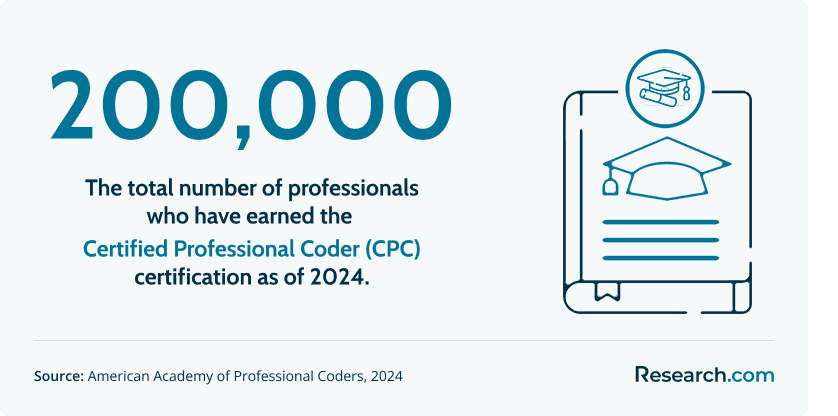
- Certified Professional Coder (CPC): This credential emphasizes physician and outpatient coding. More than 200,000 professionals hold the CPC, making it a widely recognized credential in the field.
- Certified Billing and Coding Specialist (CBCS): This option covers coding and billing processes, including claims preparation, reimbursement workflows, and payment documentation.
- Certified Coding Associate (CCA): This credential introduces coding across settings and is often used by early-career professionals building foundational coding credibility.
- Certified Coding Specialist – Physician-Based (CCS-P): This credential focuses on physician-based coding and outpatient clinical documentation.
- Certified Outpatient Coder (COC): This option is designed for outpatient hospital and ambulatory care coding.
Specialization Options for Bachelor’s Degree Holders
- Health information management: Combines coding knowledge with data governance, record integrity, privacy, and information systems.
- Healthcare reimbursement: Focuses on insurance systems, claims rules, payment models, and revenue cycle processes.
- Medical office administration: Prepares students to coordinate staff, workflows, patient records, and billing operations.
- Health services and information systems: Emphasizes electronic health records, health data tools, and system improvement.
- Legal aspects of health information: Covers privacy, compliance, ethical record management, and regulatory expectations.
| Goal | Credential Strategy | Why It Helps |
| Get a first coding job | Certificate plus CPC, CBCS, or CCA preparation | Shows job-ready knowledge in coding and billing fundamentals. |
| Move into auditing | Bachelor’s degree plus coding experience | Auditing requires technical accuracy and broader compliance judgment. |
| Work in compliance | Bachelor’s degree with health law and information governance coursework | Compliance roles require regulatory knowledge beyond basic coding. |
| Lead a revenue cycle team | Bachelor’s degree plus experience in billing operations | Leadership roles require workflow, data, communication, and management skills. |
What skills do students build in each program type?
Both paths teach medical billing and coding concepts, but the depth and purpose differ. Certificates emphasize immediate technical execution. Bachelor’s degrees add analysis, management, systems thinking, and compliance-focused decision-making.
Skills Developed in a Certificate Program
- Medical coding systems: Students learn to use ICD-10 and CPT codes to translate diagnoses, procedures, and services into standardized records.
- Insurance and reimbursement processes: Coursework introduces claims submission, payer rules, denials, and reimbursement workflows.
- Billing and coding software: Students practice tools used to prepare claims, track payments, and manage billing records.
- Electronic health records: Programs teach students how to locate, interpret, and protect patient information in EHR systems.
- Medical terminology: Students build the vocabulary needed to understand clinical documentation and assign accurate codes.
Skills Developed in a Bachelor’s Degree Program
- Healthcare data analysis: Students learn how to use data to identify trends, improve billing processes, and support operational decisions.
- Healthcare project management: Degree programs may prepare students to help implement new workflows, billing systems, or compliance initiatives.
- Information governance: Students study policies for managing patient information responsibly and consistently.
- Health information law and regulation: Coursework may include HIPAA and related privacy, confidentiality, and data security concepts.
- Health informatics: Students examine how technology supports patient records, reporting, analytics, and healthcare operations.
How do job responsibilities differ by credential?
For a deeper role overview, see this guide to medical billing and coding job duties. In general, certificate holders are more likely to perform hands-on billing and coding tasks, while bachelor’s graduates are more likely to move into analysis, auditing, compliance, supervision, or systems-focused work after gaining experience.
| Responsibility Area | Certificate Holder | Bachelor’s Degree Holder |
| Coding | Assigns ICD-10, CPT, and HCPCS codes from clinical documentation | May review complex coding patterns, support audits, or train coding staff |
| Claims | Prepares, submits, and follows up on insurance claims | May analyze denial trends and improve reimbursement workflows |
| Patient billing | Creates patient bills and answers billing questions | May help design policies for billing communication and dispute resolution |
| Records | Maintains accurate patient and billing records | May oversee record governance, privacy, and data quality processes |
| Compliance | Applies coding rules and documentation standards | May conduct internal audits, develop procedures, and monitor regulatory risk |
| Leadership | Usually limited in entry-level roles | May supervise teams, manage projects, or coordinate cross-department work |
- Common certificate-level tasks: assigning codes, preparing claims, submitting claims, handling patient billing, and maintaining records.
- Common bachelor’s-level tasks: auditing and compliance work, data analysis, staff supervision, policy development, and advanced communication with providers, payers, and internal teams.
Is medical billing and coding education worth the cost?
Medical billing and coding education can be worth the cost when the program matches your career target and does not require unnecessary debt. A certificate can offer a faster return if your immediate goal is entry-level employment. A bachelor’s degree may be worth the larger investment if you want a wider healthcare administration path and are prepared to use the degree for advancement, not just initial entry.
The key is to evaluate return on investment before enrolling. Compare total tuition, fees, exam costs, completion time, employer recognition, job placement support, certification pass preparation, and transfer options. Also confirm whether the school is properly accredited; Research.com’s list of accredited medical billing and coding schools online can help you start that review.
When a Certificate Is Usually Worth It
- You want to enter the field quickly.
- You need a lower-cost training option.
- You plan to sit for a coding or billing certification exam.
- You are comfortable starting in an entry-level role and advancing through experience.
When a Bachelor’s Degree Is Usually Worth It
- You want a long-term path into health information management, compliance, auditing, analytics, or leadership.
- You are willing to spend about 4 years completing a broader degree.
- You want a credential that can support future graduate study.
- You are comparing roles beyond basic coding and billing.
Which extra qualifications can improve career prospects?
Additional credentials can help medical billing and coding professionals stand out, especially when they align with a specific job target. The most useful qualifications are usually coding certifications, payer-specific experience, EHR experience, auditing knowledge, reimbursement training, compliance coursework, and continuing education tied to coding updates.
Not every additional credential is equally relevant. A coding professional should prioritize healthcare revenue cycle, health information, compliance, analytics, and management credentials before unrelated programs. However, students comparing administrative leadership across industries may find broader program examples useful, such as affordable online master’s programs in sports management, when thinking about how management training differs by field.
Practical Ways to Strengthen Your Profile
- Choose a program that prepares you for a recognized certification exam.
- Build accuracy with ICD-10-CM, CPT, HCPCS, documentation rules, and claims workflows.
- Gain experience with electronic health records and billing software.
- Track annual coding updates and continuing education requirements.
- If pursuing leadership, add coursework in compliance, analytics, reimbursement, or health information management.
What jobs can you get with a certificate or bachelor’s degree?
Certificate programs usually lead to entry-level medical billing, coding, claims, collections, and records jobs. Bachelor’s degrees can support more advanced positions, especially when combined with work experience and certification. Students comparing exams can review this guide to CBCS vs. CPC certification and other medical coding and billing certification options.
Common Jobs with a Medical Billing and Coding Certificate
| Job Title | What the Role Does | Median Salary |
| Medical Biller | Prepares and submits insurance claims, follows up on unpaid claims, resolves billing issues, and maintains patient billing records. | $42,673 per year |
| Medical Records Technician | Maintains patient health information, organizes medical data, supports EHR accuracy, and helps protect record security. | $44,324 per year |
| Coding Specialist | Assigns ICD-10-CM, CPT, and HCPCS codes to diagnoses and procedures for billing, claims, documentation, and reporting. | $57,000 per year |
| Medical Collector | Works on overdue accounts, contacts patients or insurers, negotiates payment plans, and addresses billing disputes. | $36,235 per year |
| Billing Analyst | Reviews billing data, checks invoice accuracy, resolves discrepancies, and supports revenue cycle improvement. | $60,263 per year |
Common Jobs with a Bachelor’s Degree
| Job Title | What the Role Does | Median Salary |
| Health Information Manager | Oversees patient data management, supports compliance, and helps healthcare organizations use information effectively. | $80,888 per year |
| Coding Auditor | Reviews coding accuracy, identifies compliance issues, gives feedback, and recommends improvements to coding processes. | $68,410 per year |
| Revenue Cycle Analyst | Analyzes billing and reimbursement data, identifies process issues, and works with departments to improve financial operations. | $65,719 per year |
| Compliance Officer | Develops compliance programs, conducts audits, provides training, and monitors legal and ethical risks. | $98,949 per year |
| Health Informatics Specialist | Manages and analyzes health data, supports information systems, protects data security, and improves operational decisions. | $82,781 per year |
Some professionals eventually pursue graduate education to move into analytics, management, or specialized health information roles. If you are exploring accelerated graduate study, compare online master’s degree programs that take 6 months. If healthcare administration is your long-term goal, this overview of MBA in healthcare management salary outcomes may also help you evaluate advanced business training.
How much can certificate holders and bachelor’s graduates earn?
Salary depends on credential level, certification, employer type, experience, location, specialty, and job responsibility. In general, bachelor’s degree holders tend to qualify for roles with broader responsibility and higher earning potential, while certificate holders can still earn competitive wages when they add certification and experience.
According to the American Academy of Professional Coders (AAPC), professionals with a bachelor’s degree in health information management earn an average annual salary of approximately $66,500. Those with a master’s degree or higher earn about $81,500 per year.
AAPC also reports that certified professionals earn an average annual salary of about $62,670, while non-certified professionals earn around $53,750 per year. These figures suggest that certification can matter, even for students who do not complete a bachelor’s degree.
| Credential or Education Level | Reported Average Annual Salary | What to Consider |
| Certified professionals | About $62,670 | Certification may improve credibility and access to coding-focused roles. |
| Non-certified professionals | Around $53,750 | Some employers may prefer or require certification for coding roles. |
| Bachelor’s degree in health information management | Approximately $66,500 | The degree may support broader health information and supervisory paths. |
| Master’s degree or higher | About $81,500 | Advanced education may be more relevant for leadership, analytics, or management roles. |
Can advanced education move your career forward?
Advanced education can help if your target role requires leadership, analytics, compliance, informatics, or healthcare management skills. It is less necessary if your goal is a straightforward coding or billing position. Before enrolling in a graduate program, compare the cost with the specific job titles you want and the qualifications employers list for those jobs.
Professionals who want to broaden their healthcare expertise sometimes compare programs outside billing and coding. For example, reviewing the fastest online master’s degree options in nutrition can show how specialized graduate programs structure applied healthcare training, even though nutrition is a different field.
Advanced Education May Help If You Want To:
- Lead a revenue cycle or health information team.
- Move from coding production into auditing or compliance.
- Work with healthcare data, reporting, or informatics systems.
- Qualify for broader healthcare administration roles.
- Prepare for graduate-level management or policy work.
What is the job outlook for medical billing and coding professionals?
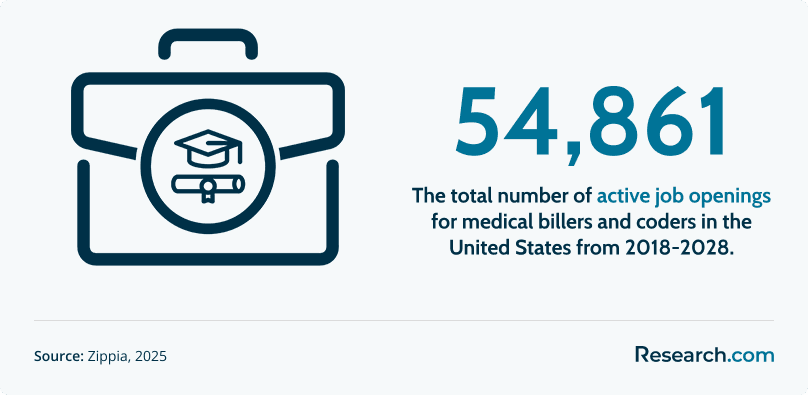
The cited U.S. Bureau of Labor Statistics data projects a 9% growth rate for medical records specialists from 2019 to 2029, a category that includes many medical billing and coding roles. The article’s data also notes over 134,966 medical biller coders employed in the United States and 54,861 active job openings.
Demand is tied to healthcare utilization, insurance documentation, reimbursement complexity, and the need for accurate patient records. The average salary for a medical biller and coder is approximately $45,672 per year. However, job prospects vary by region, employer, certification, specialty, and experience level.
Remote work and specialization can also shape career paths. Some employers offer remote billing or coding roles, but many prefer candidates who have proven accuracy, certification, and experience with payer rules or specialty coding.
How is technology changing medical billing and coding?
Medical billing and coding work is becoming more technology-driven. Artificial intelligence, machine learning, automated coding tools, electronic health records, and analytics platforms can speed up some workflows, but they also increase the need for professionals who can verify accuracy, resolve exceptions, interpret documentation, and understand compliance risk.
Technology is unlikely to make human coding judgment irrelevant. Instead, it changes what employers value. Coders who understand documentation quality, payer rules, audit risk, data integrity, and system workflows may be better positioned than workers who only know basic code lookup. Students interested in the broader healthcare labor market can also compare high-paying medical careers to see how technical skill, regulation, and education affect different healthcare roles.
Technology Skills That Can Help
- Comfort with electronic health record systems
- Experience using billing and claims software
- Ability to review automated coding suggestions critically
- Understanding of data privacy and information security
- Basic reporting and spreadsheet skills for denial or reimbursement analysis
How do networking and mentorship opportunities compare?
Certificate programs usually emphasize fast technical training, so networking and mentorship may be limited to instructors, classmates, career services, and short employer connections. Bachelor’s programs often provide broader access to alumni networks, internships, faculty advising, career centers, student organizations, and employer partnerships.
That difference matters if you want advancement. Mentors can help students understand which certifications employers value, which specialties are growing, how to prepare for audits, and when to pursue a degree after starting with a certificate. For a broader look at how academic networks and career pathways differ across health and science fields, you can compare higher-paying careers for biology majors.
Certificate First, Degree First, or Both: Which Path Should You Choose?
There is no single best credential for every student. The smartest path is the one that matches your career target and financial situation.
| Choose This Path | If This Describes You | Main Caution |
| Certificate first | You want a quick, lower-cost route into entry-level work. | Make sure the program prepares you for recognized certification and employer expectations. |
| Bachelor’s degree first | You want broader healthcare administration, compliance, informatics, or management options. | Do not assume the degree alone replaces coding certification or practical experience. |
| Certificate, then bachelor’s later | You want to start working, gain experience, and decide later whether a degree is worth it. | Check whether certificate credits can transfer before you enroll. |
| Certification without a long program | You already have healthcare experience and mainly need exam preparation. | Confirm you have enough coding knowledge and practice before paying for an exam. |
Common Mistakes to Avoid
- Choosing a program only because it is fast: A short program is useful only if it teaches the coding systems, billing processes, and certification content employers expect.
- Ignoring accreditation: Accreditation helps protect students from low-quality programs and may affect credit transfer, financial aid, and employer confidence.
- Looking only at tuition: Include books, software, exam fees, technology fees, retake costs, and time away from work.
- Assuming an online program is automatically flexible: Some online programs still require scheduled sessions, proctored exams, or strict weekly deadlines.
- Assuming a bachelor’s degree guarantees a higher salary: Salary depends on role, certification, experience, employer, specialty, and location.
- Not checking certification alignment: If your goal is CPC, CBCS, CCA, CCS-P, or COC, confirm that the program prepares you for that specific exam.
- Forgetting transfer credit policies: If you may continue from a certificate to a degree, ask whether credits transfer before you start.
Questions to Ask Before Enrolling
- Is the school accredited, and by which accrediting body?
- Does the program prepare students for the certification exam I plan to take?
- Are exam fees included in tuition, or do I pay separately?
- What coding systems, billing software, and EHR tools are covered?
- Does the program include hands-on coding practice and claim examples?
- Are career services, internships, externships, or employer connections available?
- Can credits transfer into an associate or bachelor’s degree later?
- What is the total cost after books, fees, software, and exams?
- Do local employers prefer certification, a degree, experience, or some combination?
- What support is available for online students?
References
- AAPC. Salary by credential. Retrieved April 20, 2025, from AAPC salary by credential.
- AAPC. Salary by education. Retrieved April 20, 2025, from AAPC salary by education.
- AAPC. Taking the CPC exam. Retrieved April 20, 2025, from AAPC CPC exam information.
- AAPC. Certified in outpatient coding. Retrieved April 20, 2025, from AAPC COC certification.
- American Health Information Management Association. Certified Coding Associate. Retrieved April 20, 2025, from AHIMA CCA certification.
- Accrediting Bureau of Health Education Schools. Accreditation information. Retrieved April 20, 2025, from ABHES.
- American Health Information Management Association. Certified Coding Specialist - Physician. Retrieved April 20, 2025, from AHIMA CCS-P certification.
- American Medical Billing and Coding Institute. Medical billing salary information. Retrieved April 20, 2025, from AMBCI medical billing salary.
- Allied Health Network. Medical billing and coding curriculum information. Retrieved April 20, 2025, from Allied Health Network curriculum overview.
- Centers for Medicare & Medicaid Services. ICD-10 codes. Retrieved April 20, 2025, from CMS ICD-10 codes.
- Centers for Medicare & Medicaid Services. Overview of coding and classification systems. Retrieved April 20, 2025, from CMS coding classification systems.
- Distance Education Accrediting Commission. Accreditation information. Retrieved April 20, 2025, from DEAC.
- National Healthcareer Association. Certified Billing and Coding Specialist. Retrieved April 20, 2025, from NHA CBCS certification.
- Salary.com. Salaries for medical billing and coding entry-level with a bachelor’s degree. Retrieved April 20, 2025, from Salary.com bachelor’s degree salary data.
- ZipRecruiter. Medical biller salary. Retrieved April 20, 2025, from ZipRecruiter medical biller salary.
- ZipRecruiter. Billing analyst salary. Retrieved April 20, 2025, from ZipRecruiter billing analyst salary.
- ZipRecruiter. Medical collector salary. Retrieved April 20, 2025, from ZipRecruiter medical collector salary.
- ZipRecruiter. Coding specialist salary. Retrieved April 20, 2025, from ZipRecruiter coding specialist salary.
- ZipRecruiter. Medical records technician salary. Retrieved April 20, 2025, from ZipRecruiter medical records technician salary.
- ZipRecruiter. Health information manager salary. Retrieved April 20, 2025, from ZipRecruiter health information manager salary.
- ZipRecruiter. Health informatics specialist salary. Retrieved April 20, 2025, from ZipRecruiter health informatics specialist salary.
- ZipRecruiter. Compliance officer salary. Retrieved April 20, 2025, from ZipRecruiter compliance officer salary.
- ZipRecruiter. Revenue cycle analyst salary. Retrieved April 20, 2025, from ZipRecruiter revenue cycle analyst salary.
- ZipRecruiter. Medical coding auditor salary. Retrieved April 20, 2025, from ZipRecruiter medical coding auditor salary.
- ZipRecruiter. Health information manager salary. Retrieved April 20, 2025, from ZipRecruiter health information manager salary data.
- American Medical Billing and Coding Institute salary resource: AMBCI salary page.
Key Insights
- A certificate is the most practical starting point for many students because it can be completed in 6 months to 1 year and costs far less than most bachelor’s programs.
- A bachelor’s degree is usually a better fit for students aiming beyond entry-level coding into health information management, compliance, coding auditing, revenue cycle analysis, informatics, or supervision.
- Cost differences are significant: certificate programs range from $1,200 to $29,390, while bachelor’s degree programs range from $15,000 to $120,000.
- Certification can affect earning potential. AAPC reports certified professionals earn about $62,670 annually, compared with around $53,750 for non-certified professionals.
- Bachelor’s degree holders in health information management earn approximately $66,500 on average, while those with a master’s degree or higher earn about $81,500 per year.
- The cited employment outlook includes 9% growth from 2019 to 2029, more than 134,966 employed medical biller coders in the U.S., and 54,861 active job openings.
- The most common degrees in the field include certificates held by 18.6% of professionals and bachelor’s degrees held by 16.5%.
- Common medical biller and coder skills include patient care at 16.9%, medical billing at 5.2%, and ICD-10 at 5.0%.
- More than 200,000 professionals hold the CPC, making it a major credential for coding knowledge, documentation compliance, evaluation and management, and surgical coding.
- The best path for many students is certificate first, experience second, and a bachelor’s degree later if advancement goals justify the time and cost.
Other Things You Should Know about Getting a Medical Billing and Coding Certificate vs. a Bachelor's Degree
In 2027, a Medical Billing and Coding Certificate typically takes about one year to complete, offering a concise, focused training experience. In contrast, a Bachelor's Degree generally requires four years of study, encompassing a broader educational spectrum beyond just billing and coding.
In 2027, enrolling in a Medical Billing and Coding Certificate program typically requires a high school diploma or GED. Conversely, a Bachelor's Degree program requires a high school diploma and standardized test scores, along with possible prerequisites, depending on the specific degree program.


