
2027 Most Affordable Online TESOL Master's Degree Programs

Co-Founder and Chief Data Scientist
Choosing an affordable online TESOL master’s degree is a practical way to strengthen your ESL teaching credentials without leaving your job or paying premium graduate tuition. TESOL—Teaching English to Speakers of Other Languages—prepares educators to teach English learners in K-12 schools, adult education, community colleges, private language programs, and international classrooms. The challenge is that programs vary widely in price, licensure alignment, practicum expectations, and career fit.
This guide is designed for teachers, aspiring ESL instructors, international educators, and education professionals comparing low-cost online TESOL master’s programs for 2027. You will find affordable program options, expected coursework, salary and job-market context, financial aid considerations, program-selection questions, and common mistakes to avoid before enrolling.
Quick answer: Is an affordable online TESOL master’s degree worth considering?
Yes—an online TESOL master’s degree can be a strong option if you want advanced ESL training, need a credential for English learner instruction, or plan to move into curriculum, coordination, adult education, or international teaching. Many online programs require 30–36 credits, can be completed in 12–18 months by full-time students, and may cost far less than the average graduate tuition at public universities, which is about $12,596 per year. The best choice is not simply the cheapest program; it is the lowest-cost accredited program that matches your licensure needs, teaching context, schedule, and career goals.
What are the benefits of getting an online TESOL master's degree?
- Broader teaching options: A TESOL master’s can support roles in K-12 ESL, adult education, community college instruction, private language schools, international education, curriculum development, and teacher training.
- Stronger qualification for specialized ESL roles: Master’s-level ESL educators are commonly associated with salaries around $60 k per year, while coordinator, curriculum, and experienced institutional roles may pay more depending on employer and location.
- Flexible graduate study: Online TESOL programs often allow working educators to study without relocating, use asynchronous coursework, and finish in as little as 12 months in accelerated formats.
What can I expect from an online TESOL master's degree program?
An online TESOL master’s program usually combines language theory, teaching methods, classroom assessment, curriculum design, and supervised practice. Most programs require about 30–36 credits and include graduate-level work in linguistics, second-language acquisition, instructional strategies for multilingual learners, and culturally responsive teaching. Many conclude with a practicum, capstone, action research project, portfolio, or comprehensive assessment.
Online delivery does not mean lighter academic expectations. Accredited programs typically require discussion participation, lesson design, case analyses, research-based assignments, peer collaboration, and field-based teaching or observation. The main difference is format: students often complete readings, lectures, assignments, and discussions through a learning platform rather than attending campus classes.
| Program feature | What it usually means for students |
| Credit load | Most programs fall in the 30–36 credit range. |
| Format | Many online programs use asynchronous courses, although some may include live sessions or scheduled meetings. |
| Field experience | A practicum, observation, or applied classroom project may be required, often completed near the student’s location. |
| Best fit | Working teachers, career changers, adult ESL instructors, and international educators who need flexibility. |
| Important caution | If you need K-12 licensure or an ESL endorsement, confirm state approval before enrolling. |
Where can I work with an online TESOL master's degree program?
Graduates of online TESOL master’s programs work in many education settings where English learners need language instruction and academic support. Common employers include public and private K-12 schools, adult education centers, community colleges, literacy programs, private language institutes, nonprofit organizations, universities with intensive English programs, and international schools.
In K-12 settings, TESOL-trained educators support English language learners in elementary, middle, and high school classrooms. In adult education, they may teach English to immigrants, refugees, working adults, or learners preparing for employment, citizenship, college entry, or daily communication. In higher education, graduates may teach in community college ESL departments or university-based English language programs.
A TESOL master’s can also support non-classroom roles. With experience, graduates may move into ESL curriculum development, instructional coaching, assessment design, district-level coordination, teacher training, consulting, or language program administration. States with large multilingual populations—such as California, Texas, New York, Florida, and Illinois—are often highlighted for shortages of TESOL-qualified teachers.
How much can I make with an online TESOL master's degree program?
TESOL-related salaries depend on role, sector, region, credentials, school funding, union contracts, and years of experience. According to the U.S. Bureau of Labor Statistics, adult basic and secondary education teachers, a group that includes adult ESL instructors, earn a median annual wage of about $59,950. K-12 ESL teacher salaries generally align with broader teacher salary schedules, which average around $60,000 depending on district and state.
Several salary sources report comparable national figures. Zippia lists an average ESL teacher salary of $52,701 per year in the U.S. ZipRecruiter reports about $56,700 per year, or approximately $27/hour, for ESL teachers. Indeed.com reports an average of $58,700 per year for “English Teacher” roles in the U.S., a category that may overlap with ESL positions. Glassdoor estimates total pay around $57,000 annually for ESL teachers, with base salary near $50,000.
Higher-responsibility roles can pay more, especially for experienced professionals. ESL program coordinators, directors, university instructors, curriculum specialists, and international school educators may reach the $60k–$80k range, depending on employer, location, qualifications, and contract structure. A TESOL master’s does not guarantee a specific salary, but it can help applicants qualify for roles that require or prefer graduate preparation.
- Most Affordable Online TESOL Master's Degree Programs for 2027
- How long does it take to complete an online TESOL master's degree program?
- How does an online TESOL master's degree compare to an on-campus program?
- What is the average cost of an online TESOL master's degree program?
- What are the financial aid options for students enrolling in an online TESOL master's degree program?
- What are the prerequisites for enrolling in an online TESOL master's degree program?
- What courses are typically in an online TESOL master's degree program?
- What types of specializations are available in online TESOL master's degree programs?
- What advanced degree opportunities can I pursue after completing an online TESOL master’s degree?
- Is an online TESOL master's degree a sound investment for long-term career growth?
- What are the emerging trends in online TESOL master's degree programs?
- Is online TESOL a more cost-effective option compared to other online graduate degrees?
- How do you choose the best online TESOL master's degree program?
- What career paths are available for graduates of online TESOL master's degree programs?
- What is the job market for graduates with an online TESOL master's degree?
Most Affordable Online TESOL Master's Degree Programs for 2027
The programs below were selected for students who want a lower-cost online TESOL, ESL, English language learning, or closely related graduate degree from an accredited institution. Tuition figures reflect available 2023–2027 information provided in the source material, and costs may change by term, residency status, fees, course load, or institutional policy. Always verify the current total price with the school before applying.
How do we rank schools?
Our school research uses Research.com’s published methodology and considers affordability, academic credibility, program relevance, and student flexibility. Tuition information is checked against sources such as the IPEDS database from the U.S. Department of Education, school-published program pages, and the College Scorecard database. We also review online learning and institutional information from sources such as Peterson’s database.
Each listed institution is a regionally accredited nonprofit school. Several programs also hold education-specific recognition or align with state endorsement expectations. Because licensure rules vary, students seeking an ESL endorsement should confirm eligibility with their state education agency before enrolling.
| Rank | School | Program | Published cost | Typical completion time |
| 1 | Buena Vista University | M.Ed. Teacher Leadership, Curriculum & Instruction, TESL track | $250 per credit hour | 1 year or ~2 years part-time |
| 2 | Western Governors University | M.A. in English Language Learning, PreK–12 | $3,953 per 6-month term | 12–18 months on average |
| 3 | American College of Education | M.Ed. in Teaching English Learners | $9,109 total tuition for 31 credits | 12 months to 18 months |
| 4 | Morningside University | MAT, English as a Second Language | $348 per credit | ~18 months |
| 5 | Fort Hays State University | M.S. in Education, ESOL Concentration | $338.62 per credit | 18–24 months |
| 6 | University of Texas Permian Basin | M.A. in Bilingual/ESL Education, ESL concentration | $390 per credit, approximately | 12 months to 18 months |
| 7 | Valley City State University | M.Ed. in Teaching English Learners | $366.92 per credit | ~2 years |
| 8 | Liberty University | M.A. in Teaching English as a Second Language | $565 per credit | 12–18 months |
| 9 | Arizona State University Online | Master of TESOL | Approx. $449 per credit | 18 months on average |
| 10 | Southeastern Oklahoma State University | M.Ed. in Curriculum & Instruction, ESL | $318 per credit | as few as 12 months |
1. Buena Vista University – M.Ed. Teacher Leadership, Curriculum & Instruction (TESL track)
Buena Vista University is a private institution in Storm Lake, Iowa, with roots dating to 1891. Its online Master of Education in Teacher Leadership, Curriculum & Instruction includes a Teaching English as a Second Language track designed for educators who want practical preparation for multilingual classrooms. The program is especially relevant for licensed teachers who want graduate-level training connected to classroom leadership, curriculum, and English learner instruction.
- Program cost: $250 per credit hour
- Program duration: 1 year in the accelerated “+1” format for full-time students or ~2 years part-time
- Total credits needed to graduate: 30 credits estimated
- Program/School Accreditation: Higher Learning Commission (HLC); Iowa Department of Education alignment for state ESL endorsement requirements
2. Western Governors University – M.A. in English Language Learning (PreK–12)
Western Governors University is a nonprofit online university known for competency-based learning. Its M.A. in English Language Learning is built for licensed teachers who want to strengthen PreK–12 ELL instruction and may be seeking an ESL/ELL endorsement. Students progress by demonstrating competency, which can make the program appealing to motivated educators who want to move faster than a traditional semester schedule allows.
- Program cost: $3,953 per 6-month term
- Program duration: 12–18 months on average, with acceleration possible through demonstrated competency
- Total credits needed to graduate: Equivalent to ~33 credits, measured through competency units
- Program/School Accreditation: Northwest Commission on Colleges and Universities (NWCCU); CAEP-accredited Teachers College
3. American College of Education – M.Ed. in Teaching English Learners
American College of Education focuses heavily on online graduate education for working teachers. Its M.Ed. in Teaching English Learners prepares educators to support English learners in K-12 and adult learning environments. The program is structured for affordability and speed, with applied coursework and faculty who commonly bring school-based experience to instruction.
- Program cost: $9,109 total tuition for 31 credits, at $235/credit
- Program duration: 12 months accelerated full-time or up to 18 months part-time
- Total credits needed to graduate: 31 semester credits
- Program/School Accreditation: Higher Learning Commission (HLC); CAEP-accredited programs
4. Morningside University – Master of Arts in Teaching (MAT) – English as a Second Language
Morningside University, a private university in Sioux City, Iowa, offers an online MAT in English as a Second Language for licensed teachers seeking advanced ESL strategies and endorsement preparation. Coursework emphasizes classroom practice, cultural responsiveness, linguistics, and action research, making it a practical choice for educators who want to apply graduate learning directly in their current teaching role.
- Program cost: $348 per credit, with total cost around $11,136 for 32 credits
- Program duration: ~18 months, with possible completion in as little as 5 terms by taking two courses each term
- Total credits needed to graduate: 32 credits
- Program/School Accreditation: Higher Learning Commission (HLC); Iowa Board of Educational Examiners approval for ESL endorsement in Iowa
5. Fort Hays State University – M.S. in Education (ESOL Concentration)
Fort Hays State University is a public Kansas university known for relatively low online tuition. Its M.S. in Education with an ESOL Concentration serves educators who want deeper English learner expertise or an ESOL endorsement pathway. Students can pursue a shorter endorsement-focused sequence or the full graduate degree, and the curriculum includes research-based practice and field experience.
- Program cost: $338.62 per credit for the online graduate rate
- Program duration: 18–24 months, with completion possible in about 5 semesters
- Total credits needed to graduate: 33 credits for the M.S.Ed. in ESOL track
- Program/School Accreditation: Higher Learning Commission (HLC); Kansas State Department of Education and CAEP accreditation for ESOL endorsement preparation
6. University of Texas Permian Basin – M.A. in Bilingual/ESL Education (ESL concentration)
UT Permian Basin is part of the University of Texas System and offers a fully online M.A. in Bilingual/ESL Education with an ESL concentration. The program is a strong fit for educators who want an accelerated 30-credit pathway focused on English as a Second Language rather than bilingual education. Seven-week courses make the schedule intensive but efficient for students who can manage a fast academic pace.
- Program cost: $390 per credit, approximately
- Program duration: 12 months full-time fast track to 18 months part-time
- Total credits needed to graduate: 30 credits
- Program/School Accreditation: SACSCOC; Council for the Accreditation of Educator Preparation (CAEP); program meets Texas ESL certification requirements
7. Valley City State University – M.Ed. in Teaching English Learners (TEL)
Valley City State University is a public North Dakota institution with a long-standing teacher education mission. Its M.Ed. concentration in Teaching English Learners blends core education coursework with TESOL-specific study in second-language acquisition, methods, assessment, and applied classroom practice. The program may be particularly useful for educators in the Upper Midwest, although the online format can serve students beyond the region.
- Program cost: $366.92 per credit for online graduate tuition
- Program duration: ~2 years part-time, or about 4 semesters full-time through suggested pathways
- Total credits needed to graduate: 34 credits
- Program/School Accreditation: Higher Learning Commission (HLC); NCATE/CAEP accredited education unit; program meets North Dakota ESPB standards for EL endorsement
8. Liberty University – M.A. in Teaching English as a Second Language (TESL)
Liberty University is a private Christian university in Lynchburg, Virginia, with a large online learning division. Its online M.A. in TESL combines TESOL pedagogy, linguistics, and faith-informed educational perspectives. The program may interest students who want to teach English domestically, internationally, or in mission-related settings. Eight-week courses and a transfer-credit option can help some students shorten time to completion.
- Program cost: $565 per credit for the full-time online rate
- Program duration: 12–18 months, with fast completion possible by taking 2 courses every 8-week term
- Total credits needed to graduate: 30 credits
- Program/School Accreditation: SACSCOC; NCATE, now CAEP, accredited School of Education
9. Arizona State University Online – Master of TESOL (MTESOL)
Arizona State University offers its online Master of TESOL through ASU Online and the Department of English. The program has a strong academic orientation, with study in linguistics, curriculum, language teaching methods, and an applied project. It may be especially useful for students interested in adult ESL, international English teaching, higher education pathways, or future doctoral study.
- Program cost: Approx. $449 per credit for ASU Online graduate tuition in this program
- Program duration: 18 months on average, with possible completion in as little as 15 months through full-time enrollment
- Total credits needed to graduate: 30 credits
- Program/School Accreditation: Higher Learning Commission (HLC)
10. Southeastern Oklahoma State University – M.Ed. in Curriculum & Instruction (English as a Second Language)
Southeastern Oklahoma State University is a public institution founded in 1909 in Durant, Oklahoma. Its online M.Ed. in Curriculum & Instruction with an ESL emphasis is designed for educators who want graduate preparation in instructional design, second-language acquisition, assessment, and culturally responsive teaching. Seven-week online courses and in-state tuition for every online learner make the program a notable low-cost option for working teachers.
- Program cost: $318 per credit, or $9,540 total for 30 credits
- Program duration: as few as 12 months across five consecutive seven-week sessions
- Total credits to graduate: 30
- Program/School accreditation: Higher Learning Commission (HLC); Council for the Accreditation of Educator Preparation (CAEP)
How long does it take to complete an online TESOL master's degree program?
Most online TESOL master’s programs, including many ESL masters programs, take about 1 to 2 years. Full-time students in accelerated schedules may finish in 12 to 18 months, while part-time students who take one course at a time may need closer to 2 to 3 years.
The biggest timeline factors are credit load, term length, practicum requirements, capstone expectations, transfer credits, and whether the program uses a competency-based model. For example, Western Governors University reports a 12–18 month average for its competency-based model, while American College of Education structures its online program for 12-month completion.
| Enrollment pace | Typical timeline | Best for |
| Accelerated full-time | About 12 months | Students with strong time availability and predictable schedules |
| Standard full-time | 12–18 months | Working educators who can handle two courses per term |
| Part-time | 2 to 3 years | Teachers balancing school-year workloads, family responsibilities, or coaching duties |
| Competency-based | Varies by pace | Self-directed learners who can demonstrate mastery quickly |
How does an online TESOL master's degree compare to an on-campus program?
An accredited online TESOL master’s should cover the same core content as a comparable campus program: linguistics, language acquisition, ESL methods, assessment, curriculum design, multicultural education, and supervised practice. Students are typically held to similar standards for reading, writing, research, projects, and fieldwork. The delivery model is the main distinction, not the academic field itself. Some online programs match on-campus expectations while giving students more control over when and where they study.
Online formats are often better for working teachers because lectures, discussions, and assignments may be completed asynchronously. Campus programs may provide more face-to-face interaction, easier access to local faculty networks, and on-site practicum coordination. Neither format is automatically better; the stronger option is the one that is accredited, affordable, well-supported, and aligned with your teaching goals.
Employer acceptance of online degrees has improved significantly, especially when the program is offered by a reputable accredited university. Drexel University notes that employers generally consider accredited online degrees equivalent to on-campus degrees when the institution has a credible academic brand. Many transcripts and diplomas do not specify whether coursework was completed online, which is common across fields such as TESOL and online masters in education.
| Factor | Online TESOL master’s | On-campus TESOL master’s |
| Schedule | Often asynchronous or designed for working adults | Usually tied to campus meeting times |
| Relocation | Usually not required | May require living near campus |
| Practicum | Often completed locally with school approval | Often arranged through campus partnerships |
| Networking | May include virtual peers from many regions | Often stronger local face-to-face relationships |
| Best for | Working teachers, rural students, international educators | Students who prefer in-person learning and campus services |
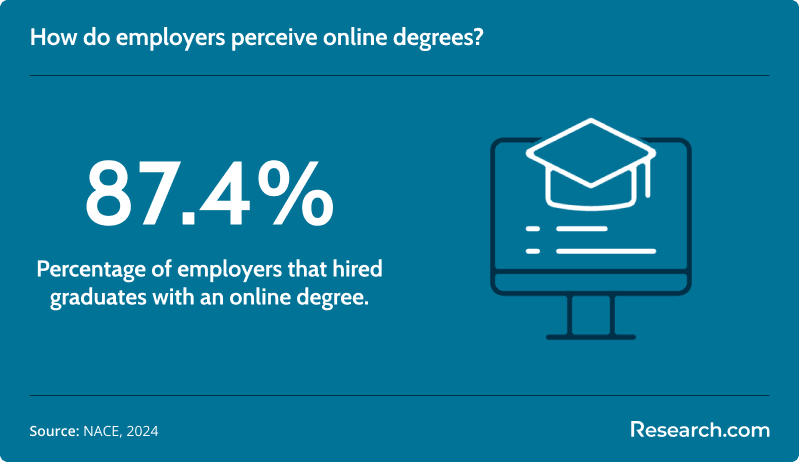
A National Association of Colleges and Employers survey from NACE 2024 found that 87.4 % of employers reported hiring candidates who earned their degree online. The graphic below places that figure in context and helps explain why reputable online credentials, including online TESOL master’s degrees, are now widely accepted in many education hiring settings.
What is the average cost of an online TESOL master's degree program?
Graduate TESOL tuition varies widely by institution and residency status. National tuition information for TESOL programs shows a range from $11,614 to $20,545. A two-year graduate pathway can therefore reach roughly $23k or more in tuition alone at many schools.
The most affordable online TESOL programs often come in lower. Many charge between $300 to $500 per credit, which places a 30-credit degree around $9,000 to $15,000 before fees. Some programs in this guide are even lower, including one at $250 per credit, or about $7,500 total, and several below $400 per credit.
Online students may also avoid housing, commuting, parking, and campus meal costs. Some schools reduce or waive certain fees for distance learners, and some online programs offer the same tuition regardless of state residency. Those details can make a major difference when comparing online and out-of-state campus options. Cost structures across programs can resemble other low-cost graduate or online options, such as the cheapest online philosophy degree programs, where per-credit pricing and fee transparency strongly affect total value.
When comparing cost, do not focus only on tuition per credit. Confirm total credits, technology fees, practicum fees, graduation fees, transfer-credit rules, course retake policies, and whether financial aid applies to your enrollment pace. Some affordable graduate pathways allow students to reduce expenses through flexible pacing or transfer policies, but rules vary by school.
| Cost item | Why it matters |
| Per-credit tuition | Determines the base cost, but it is not the whole price. |
| Total required credits | A lower per-credit rate may cost more if the program requires more credits. |
| Fees | Technology, online learning, practicum, graduation, and student service fees can raise the final bill. |
| Transfer credits | Accepted graduate credits may shorten the degree and reduce cost. |
| Residency pricing | Some online programs charge all students one rate, while others use in-state and out-of-state tuition. |
| Licensure alignment | A cheap program may be costly later if it does not meet your endorsement requirements. |
The table and visual context below compare national 2023–2024 averages: graduate TESOL/ESL programs run about $11,614 in-state and $20,545 out-of-state, while undergraduate tracks cost $10,007 and $23,933 respectively. This comparison shows why programs priced under $400 per credit can be financially attractive for budget-conscious educators.
What are the financial aid options for students enrolling in an online TESOL master's degree program?
Students in accredited online TESOL master’s programs generally have access to the same major aid categories available to graduate students in other online teaching degrees. The starting point is the FAFSA, which determines eligibility for federal graduate student loans such as Graduate Direct Unsubsidized Loans and Grad PLUS loans.
Graduate students usually cannot use Pell Grants, which are limited to undergraduates, but they may qualify for university scholarships, education grants, professional association awards, state teacher-development support, or employer tuition assistance. Current teachers should ask their district whether ESL, bilingual education, or high-need teaching credentials qualify for reimbursement or salary-lane movement.
Military-affiliated students should review GI Bill benefits, Yellow Ribbon participation, and school-based military tuition discounts. The source material notes that Liberty University charges around $275/credit for military students compared with $565 for standard graduate tuition. Online programs may also offer payment plans or per-course billing, which can help students avoid paying an entire term upfront.
| Aid option | What to check before relying on it |
| Federal graduate loans | Confirm the school is eligible for federal aid and that your enrollment load qualifies. |
| University scholarships | Ask whether online graduate education students are eligible and whether awards renew. |
| Employer reimbursement | Verify reimbursement limits, grade requirements, service commitments, and approved programs. |
| State or district aid | Look for programs tied to ESL, bilingual education, or teacher shortage areas. |
| Military benefits | Confirm benefit eligibility, institutional participation, and any military tuition rate. |
| Payment plans | Review fees, payment deadlines, and whether plans cover all charges. |
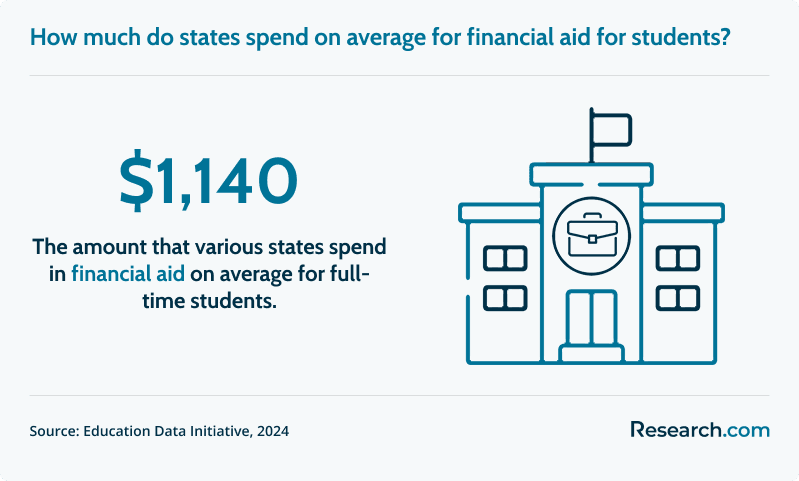
States also contribute meaningful support to students. The infographic below shows that, on average, states spend $1,140 per full-time student in financial aid according to Education Data Initiative, 2024. That baseline aid may reduce net cost when combined with federal loans, scholarships, employer support, or military benefits.
What are the prerequisites for enrolling in an online TESOL master's degree program?
Most online TESOL master’s programs require a bachelor’s degree from an accredited institution. The undergraduate major does not always need to be education, English, or linguistics, although some programs prefer applicants with teaching experience or related academic preparation. Common minimum GPA requirements are around 3.0 or 2.75, depending on the school.
Application materials often include official transcripts, a resume, 2-3 recommendation letters, and a statement of purpose explaining the applicant’s TESOL goals. Many online graduate education programs no longer require the GRE or GMAT, particularly for applicants who meet GPA expectations or have professional teaching experience.
Requirements differ sharply for licensure-focused programs. If the degree is designed for licensed K-12 teachers seeking an ESL endorsement, applicants may need a valid teaching license and sometimes classroom experience. Programs focused on adult ESL, higher education, applied linguistics, or international teaching may admit students without a teaching license.
International applicants or non-native English speakers may need TOEFL or IELTS scores. Compared with more research-intensive pathways, such as how to get a doctorate degree in psychology, TESOL master’s admissions are often more accessible because they commonly emphasize teaching goals, prior education, recommendations, and English proficiency rather than extensive research experience.
- Bachelor’s degree from an accredited institution
- Minimum GPA around 3.0 or 2.75, depending on the school
- Official transcripts
- Resume or CV
- 2-3 letters of recommendation
- Statement of purpose or admissions essay
- Teaching license or classroom experience for some endorsement-focused programs
- TOEFL or IELTS for many international or non-native English-speaking applicants
What courses are typically in an online TESOL master's degree program?
Online TESOL master’s curricula are designed to connect language theory with classroom practice. Like other online master's programs for teaching, they often blend educational research, instructional design, assessment, and field-based application.
| Course area | What students learn | Example course titles |
| Linguistics and grammar | How English structure, sound systems, syntax, and usage affect language learning | Applied Linguistics for ESL Teachers; English Grammar for TESOL |
| Second-language acquisition | How learners acquire additional languages and what affects progress | Second Language Acquisition |
| TESOL methodology | How to teach listening, speaking, reading, and writing to English learners | Methods of Teaching ESL; TESOL Classroom Practices |
| Assessment | How to evaluate language proficiency, academic growth, and classroom outcomes | Assessment and Evaluation for English Language Learners |
| Culture and diversity | How culture, identity, migration, and language background shape instruction | Cultural Perspectives in TESOL; ESL in Multicultural Settings |
| Research and capstone work | How to investigate classroom problems and apply evidence-based solutions | Educational Research; Action Research Project |
| Practicum or internship | How to apply TESOL methods through supervised teaching or observation | ESL Practicum; TESOL Field Experience |
By graduation, students should be able to plan language lessons, assess English learner progress, adapt instruction for different proficiency levels, design or evaluate ESL curriculum, and reflect on teaching through research-informed practice.
What types of specializations are available in online TESOL master's degree programs?
TESOL is already a specialized graduate field, but many programs allow students to focus on a teaching context or professional goal. The most common distinctions are K-12 ESL, adult education, bilingual education, applied linguistics, curriculum and instruction, and international English teaching.
| Specialization or track | Best for | Important note |
| K-12 ESL or ELL | Licensed teachers who want to work with English learners in public or private schools | Check state endorsement and licensure requirements before enrolling. |
| Adult or college ESL | Students interested in community colleges, adult education centers, or intensive English programs | May not lead to K-12 certification. |
| Bilingual education | Educators working in bilingual classrooms or dual-language settings | May require language proficiency beyond English. |
| Applied linguistics | Students interested in language research, higher education, or international teaching | Often more theory- and research-oriented. |
| Curriculum and instruction with ESL | Teachers who want broader instructional leadership plus ESL expertise | Useful for coaching, curriculum design, and school improvement roles. |
| International or global TESOL | Educators planning to teach abroad or in international schools | Employer requirements vary widely by country and institution. |
For example, the University of Texas Permian Basin offers a bilingual education track and an ESL education track. Other schools embed TESOL within curriculum and instruction, teacher leadership, or applied linguistics. The right specialization depends on where you plan to teach and whether you need a state-recognized credential.
What advanced degree opportunities can I pursue after completing an online TESOL master’s degree?
A TESOL master’s can lead to doctoral study for educators interested in research, higher education, leadership, or large-scale curriculum work. Common next steps include a PhD in TESOL, PhD in Applied Linguistics, EdD in Curriculum and Instruction, or EdD in Educational Leadership. Students comparing doctorate options may also review accelerated education leadership pathways, including fully funded EdD programs online, when cost and timeline are major concerns.
Doctoral study makes the most sense if you want to publish research, teach at the university level, lead district or institutional language programs, evaluate language policy, or move into senior administrative roles. It is usually less necessary if your goal is classroom ESL teaching, where licensure, experience, and a master’s credential may be sufficient depending on the employer.
Is an online TESOL master's degree a sound investment for long-term career growth?
An online TESOL master’s can be a worthwhile investment when it clearly supports your next career step. The degree is most valuable for educators who need ESL endorsement coursework, want to qualify for specialized English learner roles, plan to teach adults or internationally, or want to move into curriculum, coaching, or program coordination.
Return on investment depends on total cost, current salary, local salary schedules, endorsement value, employer reimbursement, and the roles available in your region. Some educators strengthen their long-term options by pairing TESOL expertise with adjacent credentials, such as an affordable online master's degree in early childhood education, especially if they work with young multilingual learners. However, adding credentials only improves ROI when they match real job requirements or salary structures.
What are the emerging trends in online TESOL master's degree programs?
Online TESOL programs are changing as English learner instruction becomes more technology-rich and data-informed. Many programs now emphasize online teaching strategies, digital assessment tools, multimodal literacy, culturally responsive instruction, and support for multilingual students in virtual or blended classrooms. Some institutions are also experimenting with adaptive learning systems, AI-supported feedback, virtual simulations, global collaboration projects, and stackable credentials.
Students should evaluate these trends carefully. Technology can improve practice and feedback, but it should not replace supervised teaching, strong faculty guidance, or rigorous language pedagogy. Micro-credentials and certificates may be useful when they build toward a degree or meet employer needs, similar to stackable options found in the most affordable accredited online EdD programs. Before paying extra for a trend-driven feature, ask whether it improves licensure eligibility, practicum quality, employability, or instructional skill.
Is online TESOL a more cost-effective option compared to other online graduate degrees?
Online TESOL can be cost-effective compared with many graduate degrees because several reputable programs fall in the low five-figure range, can be completed relatively quickly, and may allow students to keep working while enrolled. Cost-effectiveness improves further when a district reimburses tuition, the program leads to an ESL endorsement, or the graduate qualifies for higher-paying roles.
Still, affordability should be judged against career fit, not just tuition. A low-cost degree in any field, including the cheapest political science online degree, is only a good investment if it supports a realistic goal. TESOL students should compare total program cost, licensure alignment, practicum quality, faculty expertise, and job outcomes before deciding that one program offers better value than another.
How do you choose the best online TESOL master's degree program?
The best online TESOL master’s is the one that meets your credential requirements, teaches the population you want to serve, fits your schedule, and keeps total debt manageable. General selection principles overlap with other online programs, including an affordable web development degree online, but TESOL students must pay special attention to practicum placement and licensure rules.
- Confirm accreditation first. Look for regional accreditation and, when relevant, CAEP recognition or state education approval.
- Check licensure and endorsement alignment. If you plan to teach K-12 ESL, ask your state education agency whether the program satisfies endorsement or certification rules.
- Match the curriculum to your target learners. K-12, adult education, college ESL, bilingual education, and international TESOL may require different preparation.
- Review practicum expectations. Ask where fieldwork can be completed, who supervises it, and whether you must arrange your own placement.
- Calculate the full cost. Compare tuition, fees, books, transfer-credit policies, course load, and financial aid availability.
- Evaluate flexibility honestly. Accelerated seven- or eight-week courses can be convenient but demanding for full-time teachers.
- Look at faculty expertise. Strong programs usually include instructors with ESL, applied linguistics, bilingual education, or classroom leadership experience.
- Ask about student support. Advising, tutoring, library access, career support, and licensure guidance matter more in online programs than many applicants expect.
- Talk with graduates when possible. Alumni can explain workload, practicum quality, responsiveness, and whether the program helped them professionally.
Questions to ask before enrolling
- Does this program meet ESL endorsement or certification requirements in my state?
- Is the degree intended for licensed K-12 teachers, adult ESL instructors, international teachers, or all of these groups?
- How many credits are required, and what is the total cost including fees?
- Can I complete fieldwork near my home or current school?
- Are courses asynchronous, synchronous, or a mix of both?
- How many hours per week should I expect for each course?
- Can I transfer graduate credits into the program?
- What career services or licensure advising are available to online students?
What career paths are available for graduates of online TESOL master's degree programs?
TESOL graduates can work in teaching, curriculum, administration, consulting, and language program development. Many roles overlap with broader master of education job opportunities, but TESOL adds specialized preparation for multilingual learners and English language instruction.
| Career path | Typical setting | What the role involves |
| K-12 ESL teacher | Public or private elementary, middle, and high schools | Provides English language development and academic language support to English learners. |
| Adult ESL instructor | Adult education centers, community programs, literacy organizations | Teaches English for employment, daily life, citizenship, or academic transition. |
| Community college or university ESL instructor | Community colleges, intensive English programs, university language centers | Prepares learners for academic English, college study, or professional communication. |
| ESL curriculum specialist | Districts, publishers, education companies, nonprofits | Designs lessons, materials, assessments, and language-learning resources. |
| ESL program coordinator | School districts, community colleges, nonprofits, language programs | Oversees programs, supports teachers, manages curriculum, and monitors learner outcomes. |
| Teacher trainer or consultant | Schools, agencies, professional development providers | Trains educators in English learner strategies, assessment, and inclusive instruction. |
| International English teacher | International schools, language institutes, universities abroad | Teaches English in global settings where advanced TESOL credentials may strengthen applications. |
| Language coach or corporate ESL trainer | Businesses, private clients, online platforms | Provides workplace English, accent support, presentation coaching, or professional language training. |
Educators who want to advance into senior district leadership, school administration, or higher education administration may later consider a doctorate in education online. For many classroom and curriculum roles, however, a TESOL master’s plus teaching experience may be the more direct path.
The Bureau of Labor Statistics provides context on where TESOL-trained educators work. The chart below shows that among roughly 41,700 ESL and adult-education positions in 2023, 34 % were in local K-12 schools, 13 % were in private education services, and local and state community colleges each accounted for 11 %. These figures show why TESOL preparation can lead to opportunities beyond one classroom type.
What is the job market for graduates with an online TESOL master's degree?
The TESOL job market depends heavily on whether you want to work in K-12 schools, adult education, higher education, or international teaching. K-12 ESL remains a strong area in many districts because schools need licensed teachers who can support English learners. Adult education roles may be more competitive, particularly where funding is limited.
In U.S. public schools, about 10% of students are English language learners, with higher shares in some states and districts. California, Texas, Florida, New York, and Illinois are frequently identified as states with significant demand for ESL-qualified educators. The source material also notes that roughly one-third of schools with ESL/bilingual programs struggle to find licensed ESL teachers.
Adult education is more mixed. The U.S. Bureau of Labor Statistics projects a decline of about 13% in jobs for adult literacy and ESL instructors from 2023 to 2033. That does not mean adult ESL work disappears, but it does mean applicants may need flexibility, part-time availability, community-program experience, or additional credentials.
Internationally, English instruction remains a major employment area for TESOL graduates. Those exploring global education career options may find opportunities in language institutes, universities, international schools, and government-sponsored programs. Requirements vary by country, and some employers may prefer in-person experience, teaching licenses, or nationality-specific work authorization.
- K-12 ESL teaching is often the strongest domestic market for licensed TESOL graduates.
- Adult ESL and community college roles exist but may be more competitive due to projected employment decline in adult literacy and ESL instruction.
- International teaching can be a strong option, especially for graduates with advanced TESOL preparation and classroom experience.
- Licensure, location, and practicum quality can affect job prospects as much as the degree title.
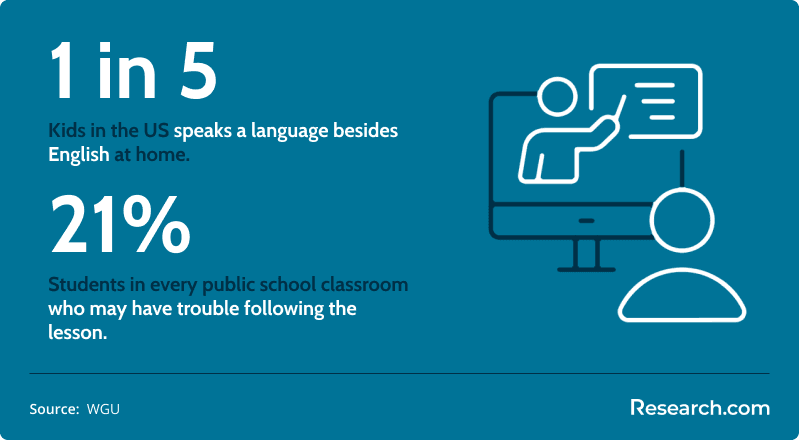
The infographic below illustrates another important demand driver: 1 in 5 children in the U.S., or about 21 % of every public-school classroom, speak a language other than English at home according to WGU, 2024. This helps explain why many schools continue to need educators trained in English learner instruction.
Common mistakes to avoid when choosing an online TESOL master’s program
| Mistake | Why it can hurt you | Better approach |
| Choosing the cheapest program without checking accreditation | Employers, financial aid programs, and licensure agencies may not recognize the degree. | Verify regional accreditation and state approval before applying. |
| Assuming every TESOL master’s leads to K-12 endorsement | Some programs are designed for adult, international, or applied linguistics careers instead. | Ask your state licensing agency to confirm endorsement eligibility in writing. |
| Ignoring practicum requirements | Fieldwork may require local placement, school permission, or extra time during the workday. | Ask how placements are arranged and whether your current school can qualify. |
| Comparing only per-credit tuition | Fees, total credits, books, and transfer rules can change the final cost. | Request a full cost estimate for your expected completion plan. |
| Overestimating accelerated-program flexibility | Seven- or eight-week courses can be intense for full-time teachers. | Review weekly workload and start with a manageable course load if possible. |
| Relying only on rankings | A highly ranked or low-cost program may not fit your state, schedule, or career goal. | Use rankings as a starting point, then evaluate licensure fit, support, and outcomes. |
Here's What Graduates Have to Say About Their Other Online TESOL Master's Degree Programs
- The program connected theory to my classroom practice. I created a complete ESL curriculum during practicum, and my students’ test scores rose 18 percent. Completing the degree in 14 months while teaching full-time showed me the credential had practical value. Leon
- My online TESOL master’s helped me move from general English teaching into district-level ESL coordination with a $12K salary increase. The bilingual literacy research project I completed still shapes our K-5 reading interventions. Danielle
- Because the program was fully online, I could study after my evening classes in Seoul and work with classmates across three continents. That international network helped me secure a university position in Chile two weeks after graduation. Zaira
Key Insights
- The most affordable listed option starts at $250 per credit, with an estimated total cost as low as about $7,500 before fees.
- Most online TESOL master’s programs require 30–36 credits and can be completed in 12–18 months by full-time or accelerated students.
- An accredited online TESOL degree can carry similar employer credibility to an on-campus degree, but licensure alignment must be verified separately.
- K-12 ESL teaching is often the strongest domestic pathway for licensed graduates, while adult ESL roles may be more competitive because BLS projects a decline of about 13% from 2023 to 2033.
- Do not choose based on tuition alone. The best-value program is accredited, affordable, practical, and approved for the teaching role or endorsement you actually need.
- Before enrolling, confirm total cost, practicum placement, transfer-credit rules, state endorsement eligibility, online support, and expected weekly workload.
References:
- ACE.edu. Master of Education in Teaching English Learners.
- ASU Online. Master of TESOL.
- Bureau of Labor Statistics. Adult Literacy and High School Equivalency Diploma Teachers.
- CollegeGrad. Adult Basic and Secondary Education and ESL Teachers.
- FHSU.edu. ESOL Program.
- Glassdoor. ESL Teacher Salaries.
- GreatCollegeDeals.net. 20 Most Affordable Online Master’s in TESOL Programs.
- Indeed. English Teacher Salaries.
- Liberty University. Master of Arts in Teaching English as a Second Language.
- Liberty University Online. Master of Arts in Global Studies – TESL.
- Morningside University. English as a Second Language Graduate Program.
- Online.UTPB.edu. Master of Arts in Bilingual/ESL.
- Payscale. English as a Second Language (ESL) Teacher Salary.
- Salary.com. ESL (English) Teacher Salary.
- TESOLCourse.com. Where Are ESL Teachers in Demand in the USA?
- Western Governors University. Teachers Are in High Demand — Especially These Types.
- Zippia. ESL Teacher Job and Industry Trends.
- Zippia. ESL Teacher Salaries.
- ZipRecruiter. ESL Teacher Salary.
Other Things You Should Know About Online TESOL Master's Degree Programs
Affordable online TESOL master’s programs in 2027 often total about $10,000 to $20,000 for the full degree. Public universities usually charge lower in-state rates, while private schools cost more. Fees for technology, books, and graduation are usually separate from tuition.
Typically, affordable online TESOL master's programs in 2027 require a bachelor's degree from an accredited institution, a minimum GPA (often around 3.0), and proficiency in English demonstrated through tests like the TOEFL or IELTS for non-native speakers. Some programs may also require teaching experience or a statement of purpose.


