2027 AI Bachelor's Degrees in Florida: Best Options

Co-Founder and Chief Data Scientist
Professionals with unrelated undergraduate degrees often face barriers when trying to enter the rapidly evolving field of artificial intelligence in Florida. Identifying flexible, accredited bachelor's programs that accommodate career changers can be challenging amid diverse options and varying curriculum quality.
This article explores the best artificial intelligence bachelor's degrees available in Florida. It offers detailed insights into program flexibility, accreditation, and industry relevance to help prospective students select an optimal path for a successful shift into the AI industry.
Key Things You Should Know
- Florida offers several accredited AI bachelor's degrees with strong industry ties, including programs at the University of Florida and Florida State University, reflecting growing regional tech demand.
- Graduates benefit from rising job markets; AI-related roles in Florida are projected to grow over 25% through 2030, with median salaries exceeding $90,000 annually.
- Programs emphasize practical skills in machine learning, data science, and robotics, ensuring students gain experience aligned with 2025 industry standards and technologies.
Which universities in Florida offer accredited bachelor's degrees in artificial intelligence?
Several universities in Florida offer accredited bachelor's degrees in artificial intelligence, reflecting the rising demand for skilled professionals in this field.
The University of Central Florida provides a Bachelor of Science in Computer Science with a specialization in artificial intelligence, focusing on machine learning, robotics, and data analytics. This program carries ABET accreditation, ensuring alignment with industry standards.
Florida International University features a Bachelor of Science in Computer Science with a dedicated artificial intelligence track. Its curriculum covers neural networks, natural language processing, and AI ethics, preparing students for advanced roles or graduate studies.
This program is accredited by the Computing Accreditation Commission of ABET, highlighting its academic quality and relevance. These bachelor's degree programs in artificial intelligence offered by Florida universities attract many prospective students seeking specialized education.
The University of Florida incorporates artificial intelligence through electives and research opportunities in its Bachelor of Science in Computer Science degree. Students can participate in AI-driven projects in partnership with state-funded technology initiatives. The university has regional accreditation from the Southern Association of Colleges and Schools Commission on Colleges (SACSCOC).
According to the National Center for Education Statistics, bachelor's programs in artificial intelligence have grown 74% since 2020 nationwide. This growth signals increasing institutional investment in curricula that meet evolving workforce needs.
Prospective students should thoroughly verify program accreditation and course content to ensure a comprehensive AI education aligned with career goals. For those exploring career outcomes, reviewing artificial intelligence degree jobs can provide valuable insight into opportunities available after graduation.
What are the admission requirements and prerequisite coursework for AI bachelor's degree programs in Florida?
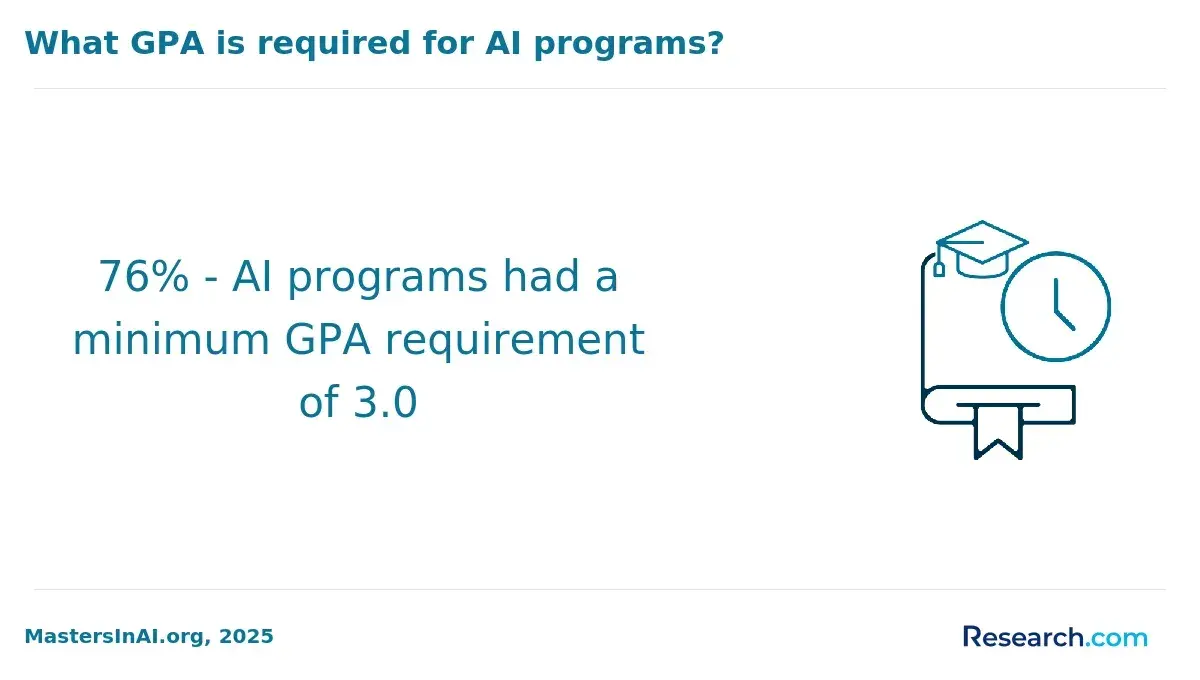
Admission requirements for AI bachelor's programs in Florida usually include a high school diploma or equivalent with a strong academic record. Most universities expect a minimum GPA of 3.0, particularly emphasizing math and science courses.
While some schools still request standardized test scores, such as the SAT or ACT, typically around 1200 SAT or 25 ACT, many have adopted test-optional policies.
Applicants should show proficiency in core subjects like algebra, geometry, and introductory calculus. Advanced math coursework, such as AP Calculus or college-level math classes, is highly recommended and often necessary for competitive admission.
Prerequisite coursework for AI degrees in Florida universities generally includes initial programming experience in languages like Python or Java, alongside foundational computer science knowledge.
Courses in discrete mathematics and statistics are commonly required before starting AI-specific classes. These prerequisites help ensure students develop the analytical and logical skills needed for complex algorithm design and machine learning concepts.
Research highlights that students with strong mathematics preparation perform significantly better in AI curricula. According to a study by the Association for Computing Machinery (ACM), students with advanced math backgrounds earn up to 23% higher grades in AI courses.
Some Florida institutions also accept coding boot camp portfolios or online course certificates, especially for transfer students or working professionals with prior STEM degrees, which may waive certain requirements.
Prospective students interested in further education might explore options like the cheapest master in data science to build advanced expertise beyond the bachelor's level.
How do online and campus-based AI bachelor's programs in Florida compare in terms of curriculum and flexibility?
Online and campus-based AI bachelor's programs in Florida share similar core curricula with essential topics like machine learning, neural networks, data structures, and programming languages such as Python and R. Both formats include foundational STEM courses along with specialized AI subjects.
When comparing online vs campus-based AI bachelor's programs in Florida, campus programs usually offer more hands-on labs, research opportunities, and networking events with faculty, which support students seeking direct interaction and experiential learning.
A flexibility comparison of AI bachelor's degrees in Florida highlights that online programs enable asynchronous coursework, benefiting working professionals and students with family obligations. These programs often provide recorded lectures, virtual labs, and discussion boards for self-paced study.
Campus programs require more fixed schedules and commuting but offer on-site resources. The 2024 National Postsecondary Student Aid Study (NPSAS) shows online STEM degree completion rates have reached parity with campus rates at 68%, indicating the maturation of online AI program quality and student support.
Students focused on internships or employer ties may lean toward campus programs with closer connections to local tech companies. Conversely, online learners access broader networks and may benefit from schools linked with global businesses.
Prospective students should consider their learning style, career objectives, and life needs when assessing programs. Florida's diverse public institutions provide options in both formats. For those interested in related fields, exploring game design schools online can offer additional pathways in digital technology education.
What core courses and technical skills are covered in Florida AI bachelor's degree programs?
Florida AI bachelor's degree core courses and technical skills focus on building a strong foundation in mathematics, programming, and machine learning principles. Essential subjects include linear algebra, calculus, probability, and statistics, which are vital for understanding algorithms and data modeling.
Students also study data structures and algorithms to develop problem-solving skills specifically for AI applications. Programming instruction centers primarily on Python, reflecting its dominance in the field; 89% of entry-level AI job postings demand Python proficiency, according to the Stack Overflow Developer Survey.
Key technical skills taught in Florida AI undergraduate programs include machine learning, deep learning, natural language processing, and computer vision. Students gain hands-on experience with supervised and unsupervised learning models using frameworks such as TensorFlow and PyTorch.
Coursework also covers neural networks, reinforcement learning, AI system design, and managing large datasets through databases and big data technologies.
Software engineering fundamentals support graduates in creating scalable AI solutions. Many programs include robotics, automated reasoning, and ethics courses to address bias and transparency issues in AI. Electives often explore cloud computing or applications in industries like healthcare and finance, broadening practical knowledge.
For those interested in closely related fields, an online cybersecurity degree may complement AI studies well.
How long does it take to complete an AI bachelor's degree in Florida, and what is the typical cost?
Completing a bachelor's degree in artificial intelligence in Florida generally takes four years of full-time study, consistent with most undergraduate programs. Some universities offer accelerated options that allow students to finish in three years by increasing course loads or attending summer sessions.
Part-time students often extend their studies to five or six years due to work or personal commitments. For instance, the University of Florida and Florida State University maintain traditional four-year curricula, while the University of South Florida provides more flexible schedules designed for working professionals.
The average annual tuition for STEM bachelor's degrees at Florida public universities is about $6,500, roughly 40% less than the national average of $10,800 according to the College Board's 2024 Trends in College Pricing report.
This means tuition alone can total around $26,000 over four years at public institutions. Private schools offering AI-related degrees often charge over $30,000 annually, so careful budgeting and scholarship research are important.
Additional costs such as fees, textbooks, and technology typically add thousands of dollars per year. Some programs require specialized AI labs or software fees. In-state residency significantly reduces tuition compared to out-of-state rates, which can be double or more.
What career paths and job titles are available to graduates of Florida AI bachelor's programs?
Graduates from Florida AI bachelor's programs have access to diverse career opportunities in technology, data science, and software development. Prominent roles include machine learning engineer, data scientist, AI researcher, AI software developer, and computer vision engineer.
Machine learning engineers comprise 31% of AI jobs, highlighting the demand for these positions. LinkedIn's 2024 Jobs on the Rise report indicates an 84% year-over-year increase in AI-related job postings as of Q3.
Machine learning engineers develop algorithms enabling computers to learn autonomously. Data scientists analyze large datasets to build predictive models that guide business decisions. AI researchers focus on advancing AI techniques in areas such as natural language processing and robotics.
AI software developers build applications like chatbots and recommendation systems, while computer vision engineers create systems for analyzing visual data, applicable in healthcare imaging, autonomous vehicles, and security.
Opportunities span industries including healthcare, finance, automotive, and dynamic tech startups. Entry-level roles such as data analyst or software engineer offer pathways to build foundational skills. Pursuing advanced certifications or graduate degrees can enhance qualifications for research or specialized AI engineering roles.
Practical experience with Python, neural networks, and cloud AI platforms is essential for competitiveness. Networking and internships within Florida's growing technology sector provide valuable real-world experience and connections.
What is the average salary for AI bachelor's degree graduates working in Florida?
Graduates with a bachelor's degree in artificial intelligence in Florida can expect an average salary of $127,400 per year, as reported by the U.S. Bureau of Labor Statistics' Occupational Employment and Wage Statistics (OEWS). This salary exceeds the state's median for professional roles by about 15%, highlighting strong demand and competitive pay for AI expertise in the region.
Starting salaries typically range between $90,000 and $110,000, depending on the position and experience. Senior roles such as machine learning engineers, AI specialists, or developers in sectors like healthcare, finance, and technology often earn over $130,000. Larger metropolitan areas such as Miami and Tampa generally offer higher compensation than rural locations.
Specializations within artificial intelligence, like natural language processing, computer vision, or robotics, can influence salary trajectories. Various employers, including startups, major corporations, and government agencies, provide different compensation packages.
Enhancing skills through internships, certifications in AI programming languages, cloud computing, and data analytics can significantly boost earning potential.
With a notable salary premium over general professional careers, pursuing a bachelor's degree in AI in Florida positions graduates for growth in a rapidly evolving job market. Developing relevant skills and industry connections supports maximizing career and salary prospects in this dynamic field.
What is the job outlook and demand for AI professionals in Florida's job market?
The job outlook for AI professionals in Florida is exceptionally strong, fueled by rapid technology adoption across industries. The U.S. Bureau of Labor Statistics projects a 35% growth in AI and machine learning specialist positions through 2032, a rate more than 10 times faster than the average for all occupations.
Florida's diverse economy presents numerous opportunities for AI graduates, especially in healthcare, finance, aerospace, and IT sectors that heavily invest in AI-driven solutions, including predictive analytics and automation. Emerging tech hubs in Miami and Tampa Bay specifically seek AI roles in data science and algorithm development.
Typical roles for graduates include machine learning engineers, AI software developers, data analysts, and robotics specialists. Employers often request proficiency in programming languages such as Python and experience with frameworks like TensorFlow or PyTorch. Expertise in neural networks and natural language processing is also highly valued.
Florida's position in the U.S. labor market supports remote and hybrid work options, expanding job possibilities beyond geographic limits. This growth, combined with sector diversity and competitive salaries, makes Florida a promising state for AI career advancement.
What professional certifications or credentials complement an AI bachelor's degree from a Florida institution?
Professional certifications greatly enhance the value of an AI bachelor's degree from a Florida institution by demonstrating specialized expertise and boosting employability. Data from the Coursera Global Skills Index shows professionals with both a bachelor's degree and certifications earn 31% more, with AI certifications offering the highest salary premiums among all STEM credentials.
Key credentials include the Certified Artificial Intelligence Practitioner (CAIP), which confirms knowledge of AI concepts and applications. The Google Professional Machine Learning Engineer certification focuses on designing scalable ML models, while the Certified Data Scientist from DASCA bridges AI and data science skills.
Certifications in cloud platforms are increasingly important as AI projects rely on cloud computing. The Microsoft Certified: Azure AI Engineer Associate and AWS Certified Machine Learning - Specialty validate expertise in deploying AI solutions at scale.
Ethical AI credentials like the IEEE Certified AI Ethics Professional reflect the growing importance of responsible AI practices by educating professionals on ethical risks and governance.
Selecting certifications aligned with career ambitions helps graduates target roles such as AI engineer, ML specialist, or data analyst, meeting employer demand for practical skills alongside theoretical knowledge.
How should prospective students evaluate the quality and reputation of AI bachelor's programs in Florida?
Prospective students evaluating AI bachelor's programs in Florida should focus on three main factors: program reputation, curriculum rigor, and graduate outcomes.
Universities with nationally ranked STEM programs tend to offer substantial financial advantages, as graduates from top 50 schools earn about 28% more over their careers, roughly $340,000 extra in lifetime earnings, according to analysis by the Georgetown University Center on Education and the Workforce.
Review faculty qualifications and their involvement in advanced AI research or industry collaborations, as this often enhances learning and networking opportunities. The curriculum should cover current AI topics like machine learning, natural language processing, and robotics, and include practical experiences such as labs, capstone projects, or internships to boost job readiness.
Accreditation is crucial; seek programs with regional accreditation and endorsements from bodies such as ABET, which validates technology and engineering education. Investigate graduate employment rates and median starting salaries for insights into program effectiveness.
Additionally, understanding alumni career trajectories can reveal how well the program supports diverse AI roles from research to development and application.
Prospective students are encouraged to contact admissions counselors or program directors about placement services and industry partnerships. This strategic approach enables learners to select AI programs aligned with their career ambitions and maximize their education's value.
Other Things You Should Know About Artificial Intelligence
Strong foundations in mathematics, particularly linear algebra, calculus, and statistics, are essential for success in artificial intelligence programs. Programming skills in languages such as Python or Java, along with proficiency in data structures and algorithms, are equally important. Critical thinking and problem-solving abilities also play a key role in understanding complex AI concepts and applying them effectively.
Many AI bachelor's programs in Florida encourage or require internships to provide hands-on experience with real-world AI applications. Practical experiences help students develop valuable industry skills and build professional networks. While not always mandatory, completing internships significantly enhances job readiness and career prospects in the AI field.
Yes, graduates with AI degrees commonly find opportunities beyond the traditional tech industry. Sectors such as healthcare, finance, automotive, and manufacturing increasingly use AI for data analysis, automation, and decision-making support. Thus, AI skills can be applied across diverse industries requiring technological innovation.
Both programming skills and theoretical understanding are crucial for a well-rounded AI education. Programming is necessary to implement AI models and algorithms, while theoretical concepts provide the foundational knowledge of how AI systems learn and function. Balancing practical coding abilities with theoretical insights yields the best outcomes for students and AI practitioners.
In 2027, top AI bachelor's degree programs in Florida include those at the University of Florida, Florida State University, and the University of Central Florida. These institutions offer comprehensive curricula focusing on machine learning, data analytics, and applied AI technologies, preparing students for diverse careers in artificial intelligence.
References
- What Are the Career Paths After a Bachelor of Science in AI https://tetr.com/blog/what-are-the-career-paths-after-a-bachelor-of-science-in-ai
- AI Degree in Florida: Master’s in AI, Certificate Programs, & More https://aidegreeguide.com/degrees/florida-ai-programs/
- Florida's best Artificial Intelligence (AI) colleges [Rankings] https://edurank.org/cs/ai/florida/
- Careers in AI: Opportunities and Pathways - ACS https://www.acs-college.com/careers-in-ai-opportunities-and-pathways
- Artificial Intelligence Concentration https://www.fullsail.edu/degrees/artificial-intelligence-bachelor-degree-program
- Data Scientist Salary in Florida – FL https://www.datasciencegraduateprograms.com/florida/florida-salary/
- How to Evaluate a Student Information System in an AI-First Era https://moderncampus.com/blog/how-to-evaluate-a-student-information-system-in-an-ai-first-era.html
- Machine Learning Engineer Salary in Jacksonville, Florida, United States (2026) https://www.erieri.com/salary/job/machine-learning-engineer/united-states/florida/jacksonville
- Universities prepare students to use AI in the workplace - South Florida Business Journal https://www.bizjournals.com/southflorida/news/2026/03/26/universities-prepare-students-to-use-ai-at-work.html
- 447,170 Florida Jobs at Risk From AI Exposure https://www.myperfectresume.com/career-center/careers/basics/ai-exposure-florida