2027 Best AI Master's Degrees for Prompt Engineering Careers

Co-Founder and Chief Data Scientist
Many professionals with degrees outside STEM fields struggle to find graduate programs that effectively bridge their background with careers in prompt engineering. Limited access to flexible, accredited master's degrees focusing on practical AI skills hinders their transition into this rapidly evolving industry. Choosing the right program requires balancing curriculum quality, industry relevance, and scheduling flexibility.
This article explores the best AI master's degrees designed to support learners from diverse academic origins in securing competitive prompt engineering roles. It aims to guide readers toward informed decisions by evaluating programs that combine accessibility, comprehensive education, and career-oriented training.
Key Things You Should Know
- The demand for AI master's degrees specializing in prompt engineering has surged by 40% since 2024, reflecting growing industry reliance on advanced language models.
- Top U.S. programs emphasize hands-on experience with transformer architectures, natural language processing, and ethical AI use, providing critical skills for prompt engineering careers.
- Graduates with focused AI master's degrees see median starting salaries around $110,000, with strong growth prospects in tech, healthcare, and finance sectors.
What is prompt engineering, and how do AI master's degrees prepare you?
Prompt engineering techniques in AI master's programs focus on designing and refining inputs to guide AI models toward accurate, relevant outputs. This specialization unlocks the full capabilities of large language models and generative AI systems.
AI master's degrees prepare students by teaching foundational concepts such as AI architectures, natural language processing, and human-computer interaction.
How AI master's degrees train for prompt engineering careers often includes coursework covering:
- Foundations of machine learning and deep learning algorithms to understand how AI interprets prompts.
- Practical skills in prompt design, iterative testing, and error analysis for refining AI responses.
- Ethical concerns and bias mitigation to ensure responsible prompt crafting.
- Hands-on projects simulating real-world scenarios, improving problem-solving specific to prompt engineering.
The World Economic Forum's Future of Jobs Report 2025 states that 86% of employers anticipate AI and information-processing technologies will transform business by 2030, underscoring strong demand for prompt engineers who combine technical expertise with domain knowledge.
Graduates with a master's in AI are better equipped to interpret client needs and translate them into impactful prompts, a skill increasingly sought after as companies pursue efficiency and innovation through AI.
Prospective students should consider programs offering advanced NLP techniques and interdisciplinary collaboration. Exploring an accelerated computer science degree online can also provide a solid foundation for entering this evolving field.
Which AI master's programs best fit prompt engineering career goals?
Master's programs aligned with prompt engineering career goals emphasize applied artificial intelligence training, focusing on natural language processing, machine learning, and human-computer interaction.
Leading programs at Stanford University, Carnegie Mellon University, and the University of Washington integrate prompt design, model fine-tuning, and hands-on AI deployment.
Stanford's AI program highlights experience with advanced models used commercially, preparing graduates for growing job market demands.
The AI Index Report 2025 from Stanford shows U.S. private AI investment surged to $109.1 billion in 2024, underscoring the demand for industry-relevant skills that applied master's degrees provide.
Key features to consider in the best AI master's programs for prompt engineering careers include:
- Courses covering prompt engineering, NLP, and large language models to build technical expertise.
- Project-based curricula enabling practical exploration of prompt creation and optimization.
- Opportunities for internships or collaboration with AI industry partners to gain real-world experience.
- Access to computational resources and AI research labs supporting innovation in prompt techniques.
For working professionals, part-time and online master's options, such as those from Georgia Tech, offer flexible schedules combined with rigorous applied AI content.
When researching top AI graduate degrees and data science programs aligned with prompt engineering goals, prospective students should verify faculty expertise in language models and AI applications, as well as successful graduate placement in prompt engineering roles. Prior experience in coding and data science improves readiness.
What jobs can you get with an AI master's in prompt engineering?
An AI master's degree in prompt engineering equips graduates for specialized roles focused on designing, refining, and optimizing prompts for large language models and AI systems.
Job titles include Prompt Engineer, AI Application Developer, and Conversational AI Designer, where expertise in crafting precise prompts enhances model responses in customer service, content generation, and decision support tools. These roles highlight the value of prompt engineering career paths in advancing AI applications.
Graduates also find opportunities as Machine Learning Engineers or AI Research Scientists, integrating prompt-based methods into broader AI workflows. They collaborate with data scientists to improve natural language processing accuracy or develop adaptive AI tools for healthcare diagnostics.
Jobs for prompt engineering graduates in AI span industries such as finance, marketing, and education, where prompt quality influences user experience and business results.
The U.S. Bureau of Labor Statistics projects a 26% employment growth for computer and information research scientists from 2023 to 2033, reflecting strong demand for AI expertise. Employers prioritize professionals skilled at analyzing model behavior, troubleshooting ambiguous outputs, and tailoring prompts to specific uses.
Successful candidates develop strong coding skills, knowledge of AI frameworks, and an understanding of human-computer interaction principles to maximize their job prospects.
Those seeking affordable pathways to engineering education may consider exploring the cheapest online civil engineering degree, which can provide foundational technical skills relevant in AI fields.
How can you verify accreditation for AI master's programs in the U.S.?
To verify accreditation for accredited AI master's programs in the U.S., use the U.S. Department of Education's Database of Accredited Postsecondary Institutions and Programs (DAPIP).
This official source lists schools and programs recognized by federally approved accreditors, such as regional bodies like the Middle States Commission on Higher Education (MSCHE) and the Western Association of Schools and Colleges (WASC).
Attending a program accredited by a USDE-recognized agency is essential, as federal student aid eligibility depends on this accreditation status.
Students can confirm accreditation by:
- Checking the institution's official website for explicit mention of recognized accreditors on their accreditation page.
- Cross-referencing the program and institution name on the Department of Education's DAPIP website to ensure up-to-date status.
- Verifying that the accreditation specifically covers the AI graduate degree program, not just the institution in general.
Lack of proper accreditation may impact eligibility for financial aid, credit transfer, and employment opportunities. Employers and graduate schools usually prioritize candidates with degrees from accredited institutions. While private databases exist, only the U.S. Department of Education provides a reliable, authoritative accreditation check.
Prospective students looking for affordable options might also explore the best online cybersecurity degree programs of 2025 as related pathways in emerging tech fields. Knowing how to check accreditation for AI graduate degrees in the United States helps ensure credentials meet professional and federal standards.
What curriculum and courses matter most for prompt engineering specialization?
Prompt engineering specialization requires a curriculum that integrates core courses in natural language processing, machine learning, and human-computer interaction to establish a strong foundation. Proficiency in programming languages like Python and frameworks such as TensorFlow or PyTorch is essential for designing and fine-tuning prompt models effectively.
Additionally, courses covering generative models and transformer architectures provide crucial insights into how large language models interpret and respond to input prompts.
Recent trends emphasize the importance of AI ethics, governance, and safety in prompt engineering education. The Stanford University AI Index Report 2025 highlights a rise in safety and reliability standards driven by bodies like NIST and ISO/IEC.
This evolution stresses the need for curricula to include evaluation methodologies and regulatory frameworks, teaching students to identify bias, errors, and security vulnerabilities in model outputs.
Practical, applied projects involving conversational agents, content generation, and decision support bridge theoretical knowledge and real-world skills. Electives in cognitive science and linguistics offer valuable perspectives on language patterns that improve prompt effectiveness. Training in data management and version control further supports reproducibility and collaboration within prompt engineering workflows.
This comprehensive approach, combining core AI skills, ethics, applied design, and interdisciplinary study, prepares graduates to meet the growing industry demand and evolving regulatory landscape in prompt engineering specialization.
What are the admissions requirements for AI master's programs focused on prompt engineering?
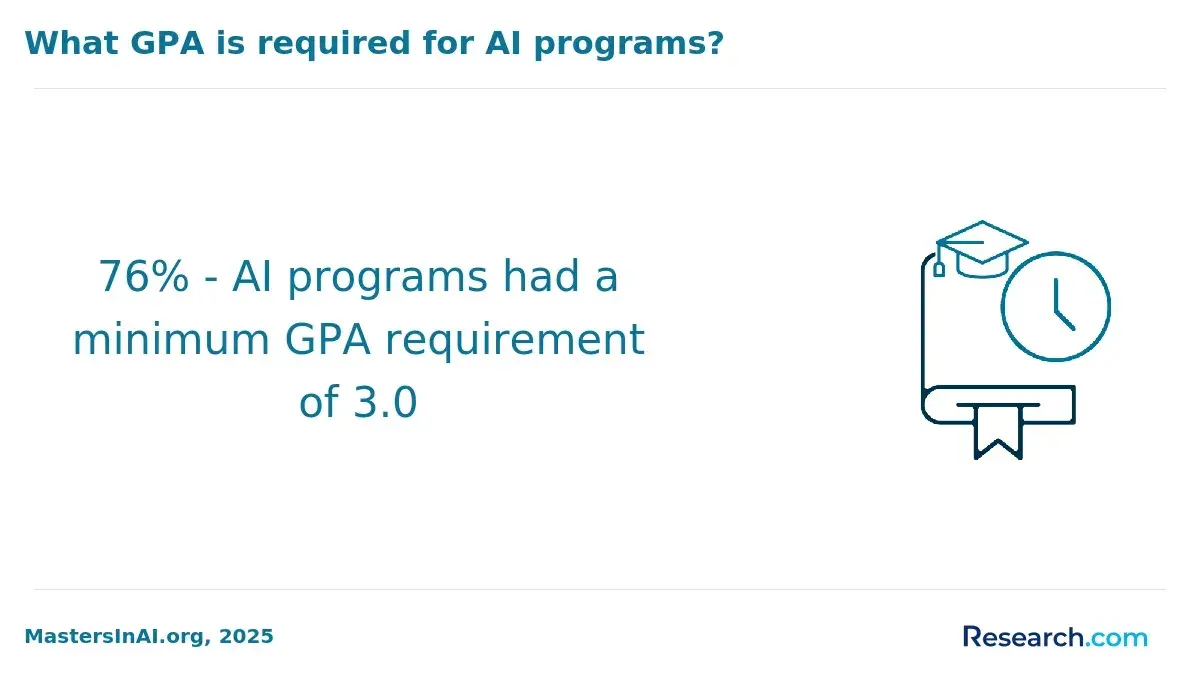
Applicants to AI master's programs focused on prompt engineering generally need a bachelor's degree in computer science, mathematics, or related STEM fields, often with a GPA of 3.0 or higher. Core prerequisite courses usually include programming, linear algebra, statistics, and machine learning fundamentals to prepare candidates for advanced technical content.
While many programs waive standardized tests like the GRE, some institutions still require them. International students must prove English proficiency through exams such as the TOEFL iBT. According to ETS's 2024 TOEFL iBT Test and Score Data Summary, millions take this exam annually, making it a key component in graduate admissions.
Strong applications typically feature recommendation letters highlighting analytical skills and relevant experience. A carefully crafted statement of purpose should clearly express career goals related to prompt engineering or applied artificial intelligence. Some programs also request portfolios showcasing work with language models, prompt design, or AI systems.
Professional experience in software development or data science, including internships or published research in natural language processing or AI, enhances an applicant's profile. Candidates should verify each program's specific requirements, deadlines, and interview processes, as the balance between academic credentials and professional expertise varies widely across institutions.
How do online AI master's programs compare with on-campus options for prompt engineers?
Online ai master's programs deliver training comparable to traditional on-campus degrees, catering especially well to working professionals and remote learners.
According to the National Center for Education Statistics (IPEDS, 2024), a significant portion of U.S. graduate students enroll exclusively in distance education, confirming that online degrees are widely accepted rather than niche. This format enables prompt engineers to engage in advanced ai curricula while balancing career commitments.
On-campus programs offer resources like labs, face-to-face networking, and live collaboration, which benefit students who prefer direct mentorship and peer interaction. Still, many online programs include synchronous classes, project-based learning, and virtual labs that effectively replicate practical experience vital for prompt engineering roles.
Remote study is practical for mastering language models and ai frameworks, supported by cloud computing and software tools. Numerous online programs also offer specializations in natural language processing and AI ethics, essential for prompt design expertise.
Hybrid models with occasional campus visits provide additional hands-on opportunities without requiring full residency.
Key factors to consider when choosing between online and on-campus formats include:
- Individual learning style and self-discipline for online study
- Access to networking and industry connections, often stronger on campus
- Curriculum alignment with current prompt engineering needs
- Costs linked to relocation and housing versus online tuition fees
Online ai master's programs now match traditional degrees in rigor, offering a flexible and effective pathway for prompt engineers to advance their careers.
How long do AI master's programs take, and what do they cost?
Master's programs in artificial intelligence generally span 1 to 2 years full-time, with part-time and online options extending this to 3 or more years to accommodate working professionals.
Some programs accelerate coursework into 12 to 18 months, while others include traditional two-year tracks featuring a research thesis or capstone project. Program length often depends on prerequisite coursework, especially if students lack a strong technical background.
Tuition varies widely between public and private nonprofit schools. Public universities typically charge in-state graduate tuition ranging from $12,000 to $30,000 annually, with out-of-state fees between $25,000 and $50,000.
Private nonprofit institutions often exceed $35,000 to $60,000 per year. Additional costs like technology fees, textbooks, and living expenses can add $5,000 to $15,000 yearly, though financial aid, assistantships, and employer tuition reimbursement may offset costs.
When evaluating programs, consider these factors:
- Delivery mode-online programs might charge higher per-credit fees but offer flexible pacing.
- Duration-accelerated versus traditional timelines affect total cost and time investment.
- Networking opportunities-on-campus programs provide more direct interaction, but with relocation and living costs.
Careful comparison of total expenses and potential salary benefits, especially for roles in prompt engineering, ensures sound investment in your AI education.
What salaries can prompt engineers earn with a master's degree?
Prompt engineers holding a master's degree typically earn competitive salaries that reflect their expertise in artificial intelligence and natural language processing.
According to data from the U.S. Bureau of Labor Statistics (Occupational Employment and Wage Statistics, May 2024), the median annual wage for "Computer and Information Research Scientists"-which includes many prompt engineering roles-is about $145,000. This serves as a solid benchmark for professionals in AI prompt engineering.
Salary ranges vary based on industry, location, and experience. Those working in tech hubs like Silicon Valley or New York often earn over $170,000 annually.
Entry-level positions for recent graduates usually start between $100,000 and $120,000 but grow quickly with demonstrated skills in prompt design, model fine-tuning, and system integration.
Professionals combining prompt engineering with machine learning, data science, or software development often qualify for senior roles exceeding $180,000. Research-focused specialists and applied AI consultants may also earn bonuses tied to project results.
To improve career prospects, gaining hands-on experience through internships or collaborations with AI companies is valuable. Sectors with strong employer demand include healthcare, finance, and autonomous systems, offering opportunities for higher salaries and career growth.
What certifications complement an AI master's for prompt engineering careers?
Certifications in cloud computing and cybersecurity significantly enhance an AI master's degree for careers in prompt engineering. Employers are investing heavily in cloud, cybersecurity, and AI skills, making certifications a strategic advantage for job seekers.
Prompt engineers with cloud expertise can optimize deployments using platforms like AWS, Azure, or Google Cloud.
- AWS Certified Solutions Architect
- Microsoft Certified: Azure AI Engineer Associate
- Google Professional Cloud Architect
Cybersecurity credentials such as CompTIA Security+, Certified Information Systems Security Professional (CISSP), and Certified Ethical Hacker (CEH) certify an ability to protect sensitive data and secure AI workflows during prompt generation and model deployment.
Additional certifications in data management and machine learning, like the TensorFlow Developer Certificate and Certified Data Professional (CDP), deepen knowledge in data pipelines and AI model integration, boosting prompt engineering skills.
Combining AI domain knowledge with cloud scalability and cybersecurity expertise meets workforce demands and improves competitiveness. Prompt engineers with recognized certifications can command salary premiums of 10-20% over those with only academic degrees, highlighting the value of these qualifications.
Other Things You Should Know About Artificial Intelligence
Yes, many universities offer part-time or flexible AI master's programs designed for working professionals. These formats often include evening, weekend, or online classes that allow students to balance studies with employment. Such programs may take longer to complete but provide the necessary rigor and credentials for career advancement.
Ethics is an integral component of AI education, addressing concerns about bias, fairness, privacy, and the societal impact of AI technologies. Most programs incorporate dedicated courses or modules on AI ethics to prepare students to develop responsible and transparent AI systems. Understanding ethical considerations is crucial for prompt engineers working with language models and decision-making algorithms.
Practical experience through internships or hands-on projects is highly valued in AI master's degrees, as it bridges theory and real-world application. Many programs include capstone projects or collaborations with industry partners to strengthen students' skills and professional networks. This experience is essential for prompt engineering roles that require problem-solving in dynamic environments.
In 2027, sectors like technology, healthcare, finance, and marketing are projected to actively recruit AI master's graduates focusing on prompt engineering. For career prospects in finance, consider exploring a master’s in AI finance.
References
- 11 Best AI Certifications in 2025 to Deepen Your Technical Knowledge | DigitalOcean https://www.digitalocean.com/resources/articles/ai-certifications
- Why mastering prompt engineering is your next career move https://www.learndirect.com/blog/why-mastering-prompt-engineering-is-your-next-career-move
- Best Prompt Engineering Courses 2026 — 9 Reviewed (Free & Paid) https://iternal.ai/best-prompt-engineering-courses
- What Is Prompt Engineering? Skills, Use Cases, and Careers https://www.udacity.com/topic/what-is-prompt-engineering
- Comparing the Best Online Masters in Data Science Programs and Masters Programs in Artificial Intelligence https://aifolks.org/blogs/comparing-the-best-online-masters-in-data-science-programs-and-masters-programs-in-artificial-intelligence
- Master of Artificial Intelligence https://wscs.eu/master-of-artificial-intelligence/
- Best AI Certifications to Boost Your Career in 2026 – Dataquest https://www.dataquest.io/blog/best-ai-certifications/
- Best Prompt Engineering Certifications & Courses (2026 Guide) https://flashgenius.net/blog-article/best-prompt-engineering-certifications-courses-2025-guide
- Prompt engineering jobs: The lucrative AI job nobody told you about https://codesignal.com/blog/prompt-engineering-jobs/
- Accreditations | Maestro https://maestro.org/accreditations