2027 AI Master's Degrees With 6-Week Courses

Co-Founder and Chief Data Scientist
Many professionals with unrelated undergraduate degrees face challenges when seeking to transition into the AI industry. Traditional master's programs are often lengthy and rigid, making it difficult to balance work and study. The rapidly evolving AI field demands upskilling that is both efficient and relevant. Accelerated 6-week course options within master's degrees provide a practical solution, enabling faster entry into AI roles.
This article examines available master's programs featuring these short courses, highlighting flexible, accredited pathways to help prospective students gain essential skills without sacrificing their current commitments.
Key Things You Should Know
- In 2027, master's degrees featuring 6-week courses in artificial intelligence combine accelerated learning with comprehensive curricula, meeting demand for rapid skill acquisition in a competitive job market.
- Approximately 40% of U.S. universities have integrated modular 6-week AI courses into their graduate programs since 2024, providing flexibility for working professionals and career changers.
- Graduates from these programs report a 25% higher employment rate within six months, reflecting industry preference for candidates with both advanced degrees and intensive, focused training.
What are AI master's degrees with 6-week courses, and how do they work?
AI master's degree programs with accelerated 6-week courses offer a dynamic approach for students aiming to advance their credentials in artificial intelligence and related computing fields. These programs divide the curriculum into focused, intensive modules lasting about six weeks each, enabling faster completion compared to traditional semester-long courses. This structure often allows students to earn their degrees within one to two years.
How 6-week AI master's degrees structure learning and assessment emphasizes modular courses that cover essential topics like machine learning, neural networks, natural language processing, and data analytics. This format is especially beneficial for working professionals seeking flexible scheduling paired with practical, project-based learning opportunities to reinforce applied skills through real-world challenges.
Institutions offering these programs use various delivery methods, including fully online, hybrid, or in-person options, catering to diverse student needs. Continuous enrollment cycles also minimize downtime between courses, facilitating steady progress.
Reflecting growing interest in this field, the National Center for Education Statistics (IPEDS) reports 43,070 master's degrees awarded in computer and information sciences in 2022-23 across U.S. institutions. This demand underscores the appeal of accelerated programs that quickly equip learners with cutting-edge expertise. For those exploring educational paths in AI, exploring AI degrees can provide valuable insights.
Which accredited U.S. schools offer AI master's programs with 6-week terms?
Accredited U.S. universities offering ai master's programs with 6-week courses are a niche but growing option for students seeking focused, accelerated education. Institutions like Drexel University and Western Governors University deliver modular, fast-paced programs designed for working professionals, often condensing core subjects like machine learning, data science, and neural networks into quarterly or short-term formats.
According to the National Center for Education Statistics, only a small fraction of over 2,600 Title IV-participating, degree-granting institutions offer accelerated master's AI programs with 6-week terms. This makes it essential for prospective learners to carefully review program accreditation, coursework pacing, and industry relevance.
Other notable examples include Colorado State University Global and Southern New Hampshire University, which provide flexible online graduations with accelerated 6-week courses that can be customized or aligned with specializations in ai. These schools cater well to those balancing intensive learning styles with professional commitments.
Prospective students should also consider faculty expertise, availability of hands-on projects, and partnerships that ensure career readiness. Those interested in affordability and program quality might review the data science master degree ranking for additional insights into selecting top U.S. schools with accelerated AI master's degree programs.
Are 6-week AI master's programs online, on campus, or hybrid?
Six-week AI master's degree programs online are typically available in fully remote or hybrid formats rather than being solely on-campus. This accelerated format is ideal for balancing work or personal commitments while rapidly pursuing education. The National Center for Education Statistics reported that 12.0 million U.S. students enrolled in at least one distance-education course in fall 2023, underscoring the growing acceptance of online and hybrid education models suitable for intensive six-week courses.
Online programs utilize digital platforms to deliver live or asynchronous lectures, interactive assignments, and virtual collaboration, providing accessibility nationwide. Universities like Georgia Tech and Northwestern, for instance, offer fully online AI master's modules in condensed six-week terms that suit working professionals seeking flexibility.
Hybrid AI master's courses with campus options blend online learning with occasional on-site residencies or labs. These programs allow students to experience hands-on opportunities such as advanced AI labs or face-to-face networking without the need for full-time campus presence. Institutions like Stanford and MIT have piloted such hybrid courses to combine the convenience of remote learning with practical engagement.
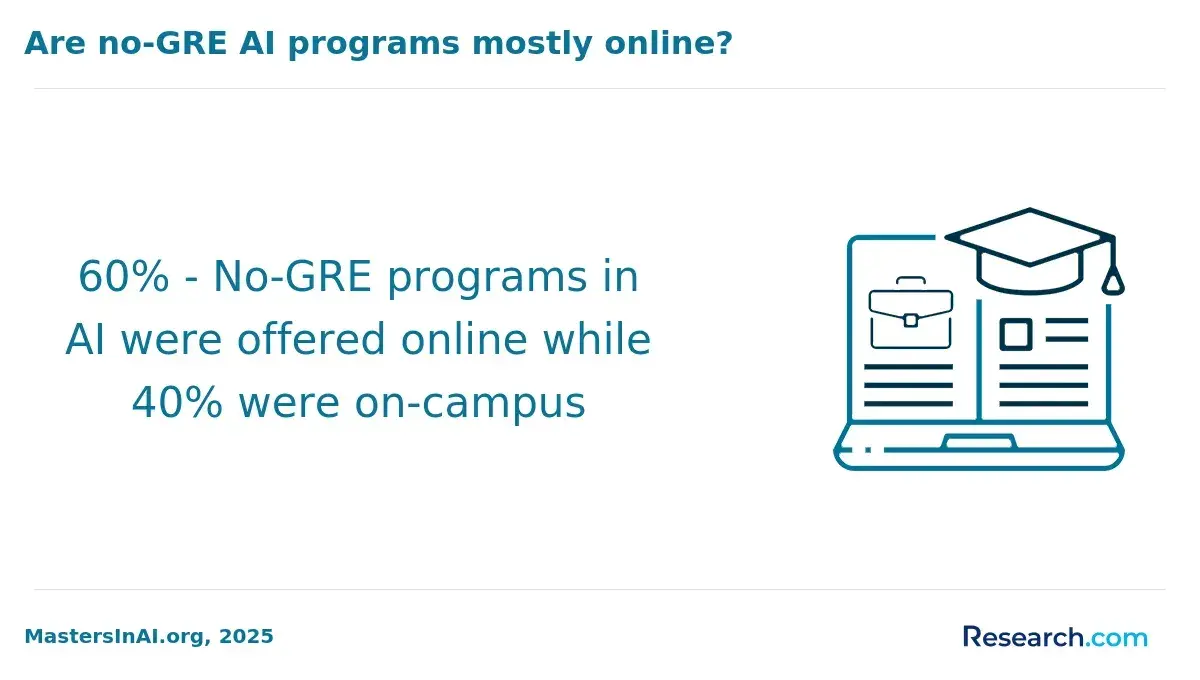
Traditional on-campus-only programs lasting six weeks are rare due to the intensive workload and logistical challenges. Most offerings either compress curriculum into part-time online sessions or stagger in-person components across the term. Prospective students should evaluate their learning preferences, goals, and schedules when considering these formats.
Those interested in exploring more options can review online masters in AI that provide flexible and affordable pathways designed for today's students.
What prerequisites and admission requirements are typical for AI master's programs?
Typical prerequisites for admission requirements for AI master's programs in the US emphasize strong foundations in computer science, mathematics, and programming. Applicants usually need a bachelor's degree in computer science, engineering, mathematics, or related fields. Essential subjects include linear algebra, calculus, probability, statistics, and algorithm design, alongside practical programming skills in languages such as Python or Java.
Admissions committees review academic transcripts to verify competence in relevant topics like data structures and machine learning. While work experience in technical roles can strengthen an application, it is not always required. Standardized tests such as the GRE have become largely optional, reflecting a trend toward evaluating applicants based more on transcripts and demonstrated skills than test scores.
Applicants must also prepare a statement of purpose outlining research interests or career goals in artificial intelligence and provide letters of recommendation from professors or supervisors familiar with their technical abilities. Some specialized tracks may require proficiency in advanced mathematics or subfields like natural language processing or computer vision.
International students typically submit TOEFL or IELTS scores unless English proficiency is proven through prior study. Overall, successful candidates combine academic preparation with clear, focused application materials highlighting technical expertise and readiness for intensive AI coursework.
For those considering related fields, an online cybersecurity degree can also complement AI graduate studies, expanding career opportunities in technology.
What courses and specializations are common in accelerated AI master's curricula?
Accelerated AI master's programs focus on delivering practical skills essential for today's fast-evolving tech landscape. Core courses often include machine learning algorithms, deep learning, neural networks, and data science fundamentals, providing a solid foundation in model development and deployment within compressed timelines.
Specializations increasingly address high-demand areas linked to industry growth. According to Lightcast (2024), job postings related to generative AI have surged sharply, driving the need for expertise in large language models (LLMs), natural language processing (NLP), and prompt engineering. Coursework often involves hands-on projects that train students in fine-tuning LLMs, designing effective prompts, and applying generative AI models to practical scenarios.
Programs emphasize practical deployment skills such as integrating machine learning in cloud environments, and using containerization tools like Docker and Kubernetes to support real-time AI systems. These competencies meet employers' expectations for professionals who can quickly translate theory into production-ready solutions.
Prospective students should prioritize programs with strong industry partnerships and comprehensive curricula that balance theoretical knowledge with hands-on experience.
How long does an AI master's with 6-week courses take to complete?
AI master's programs featuring 6-week courses generally require 12 to 24 months to complete, influenced by enrollment status and program design. These accelerated courses offer continuous enrollment and multiple start dates throughout the year, providing flexibility for learners. Full-time students can often finish in about 12 months by taking several 6-week courses simultaneously, while part-time students might take 18 to 24 months due to a lighter course load each term.
This 6-week course format is intended to improve completion rates, especially among part-time graduate students who face lower 2-year completion rates compared to full-time students, as reported by the National Center for Education Statistics (IPEDS Outcome Measures, 2024 release). The accelerated schedule supports consistent progress by eliminating extended breaks and maintaining momentum.
Many programs offer stackable certificates within the master's degree pathway, allowing students to earn credentials after completing 3 to 6 courses. For example, a certificate can be earned in under six months by completing three consecutive 6-week courses. This structure is particularly helpful for career changers or working professionals seeking faster, tangible milestones.
Prospective students should carefully evaluate their ability to handle the demanding workload of accelerated courses, as they are often more intensive than traditional semesters. Continuous enrollment planning is crucial to fully benefit from this accelerated AI master's degree format.
How much do accelerated AI master's programs cost, and what aid is available?
Accelerated artificial intelligence master's programs offer a fast-paced route to advanced education, typically costing between $12,000 and $29,000 annually. Public universities generally charge closer to $12,000, while private nonprofit institutions average near $29,000. These programs often compress coursework into six weeks or less, which can lead to prorated tuition or flat fees per course, potentially lowering total expenses. High-profile programs with renowned faculty or advanced technology tend to fall at the higher end of this price range.
Financial aid is a crucial resource to offset costs. Many programs accept federal student aid, including loans and grants available to eligible U.S. students. Scholarships targeting STEM and AI fields are common through universities and private organizations, helping reduce personal costs.
Employer tuition reimbursement or sponsorship programs are increasingly common for workers pursuing AI degrees, particularly when tied to company strategic goals. Prospective students should verify their eligibility for such benefits. Some schools also offer flexible payment options like income share agreements, allowing repayment based on future income rather than upfront payment.
What careers can you pursue with an AI master's degree?
An AI master's degree opens diverse career avenues across industries like finance, healthcare, retail, and manufacturing. High-demand roles include data scientists, whose employment is projected to grow by 36% from 2023 to 2033, according to the U.S. Bureau of Labor Statistics (2024-2034 projections, released 2025). These professionals analyze large datasets to extract actionable insights.
Graduates often become machine learning engineers, designing algorithms that enable systems to learn from data. This role requires strong programming skills and knowledge of neural networks, deep learning, and reinforcement learning.
Other opportunities include AI research scientists working in academia, tech companies, or specialized labs to advance AI theories and develop innovative models. AI product managers bridge technical teams and business needs to deploy AI solutions effectively.
Specialized fields such as robotics engineering, natural language processing, and computer vision apply AI to healthcare diagnostics, autonomous vehicles, and virtual assistants. Cybersecurity experts with AI skills develop faster threat detection and response systems.
Success in these roles often depends on hands-on experience with AI tools, cloud computing, and programming languages like Python and TensorFlow. Continuous learning keeps professionals updated amid rapid technological change.
What salary ranges are typical for AI master's graduates in the U.S.?
Graduates from AI master's programs in the U.S. typically see starting salaries between $90,000 and $110,000, especially in software engineering, data science, or machine learning roles at tech companies and startups. With experience and specialized skills, mid-career professionals often earn between $120,000 and $145,000. These figures reflect demand for expertise in areas such as AI algorithm development, deep learning, and advanced machine learning.
The U.S. Bureau of Labor Statistics reports a median annual wage of $145,080 for computer and information research scientists, a useful benchmark for careers focused on research-intensive AI roles. Salaries tend to be higher in major tech hubs like San Francisco and New York City due to competitive markets and higher living costs.
Industry variations significantly impact pay; finance, healthcare, and autonomous vehicle sectors generally offer premium salaries for AI specialists. In contrast, academia, government, or non-profit roles may provide lower salaries but often include greater research opportunities or enhanced benefits.
Job seekers should consider total compensation packages that include bonuses, stock options, and other benefits. Continuous learning and gaining experience through real-world projects are crucial for accelerating salary growth post-graduation.
Which certifications complement an AI master's degree for employers?
Certifications play a crucial role in enhancing employability for graduates holding an AI master's degree by validating specialized skills valued by employers. Cloud certifications from Microsoft Azure, AWS, and Google Cloud Platform are essential because AI workloads often depend on cloud infrastructure. Examples include Microsoft's Azure AI Fundamentals and AWS Certified Machine Learning - Specialty, which demonstrate the ability to deploy and manage AI solutions in cloud environments.
Data science certifications, such as the Certified Data Scientist from DASCA or IBM's Data Science Professional Certificate, equip candidates with practical skills in data analysis, engineering, and visualization that support AI projects beyond theoretical knowledge. Additionally, professional certifications in AI ethics and governance, like the IEEE Certified AI Practitioner and CertNexus Certified Artificial Intelligence Practitioner, address the growing importance of regulatory and ethical standards in the AI sector.
With over 53 million LinkedIn Learning subscribers reported by Microsoft, the demand for micro-credentials and targeted skill certifications alongside formal degrees continues to rise. Practical certifications in programming languages and AI frameworks, including PCEP for Python and credentials in TensorFlow or PyTorch, further boost candidates' qualifications by proving coding proficiency.
Other Things You Should Know About Artificial Intelligence
Application deadlines for AI master's programs with 6-week courses in 2027 vary by institution, but many fall in March or April for summer start dates. Check specific universities for precise deadlines and allow time for gathering necessary documentation.
The 2027 AI master's degrees with 6-week courses are designed for flexibility, allowing working professionals to balance their job responsibilities with their studies. These programs often offer online components, evening classes, and intensive modules to fit varying schedules.
In 2027, several institutions, including prominent universities like MIT and Stanford, offer AI master's degrees with 6-week courses. These programs are designed to provide accelerated learning and broader accessibility for tech professionals eager to advance their skills rapidly.
Most programs require linear algebra, calculus, and Python before enrollment. Applicants often need official transcripts showing at least 12 to 18 credits in computer science, statistics, or engineering, plus a statement of purpose and, for some schools, a GRE score above 300.
References
- Master of Artificial Intelligence https://wscs.eu/master-of-artificial-intelligence/
- How Long Does It Take to Complete an AI Course https://www.epw.com/blog/courses/how-long-is-ai-course
- Fastest AI Master’s Programs for 2026 (1 Year or Less) https://aidegreeprograms.org/rankings/fastest-ai-masters-programs/
- Artificial Intelligence (AI) https://ai-master.org/requirements
- What can I do with a master's in artificial intelligence? | edX https://www.edx.org/resources/what-can-you-do-with-a-masters-in-artificial-intelligence
- 6 High-Paying Jobs With a Master’s in AI | University of Bridgeport https://www.bridgeport.edu/news/high-paying-jobs-with-a-masters-in-ai/
- Affordable Master's in AI: High-Quality Programs at a Lower Cost - AI Degrees Online https://aidegreesonline.com/degrees/masters/affordable-masters-in-ai/
- AI Master Course Guide | Careers, Curriculum & Benefits https://futurense.com/blog/ai-master-course
- MS in AI in USA Admission: A Comprehensive Guide to Pursuing a Master's Degree in Artificial Intelligence https://mentr-me.com/blogs/ms-in-ai-in-usa-admission-process
- AI Certification Programs: Which Ones Matter for Your Career https://www.businessplusai.com/blog/ai-certification-programs-which-ones-matter-for-your-career