2027 AI Associate Degrees With Fall and Spring Start Options

Co-Founder and Chief Data Scientist
Many aspiring professionals face challenges when seeking accredited programs that allow a career shift into artificial intelligence without disrupting current commitments. Traditional degree paths often lack convenient start times and flexibility, deterring individuals aiming to reskill efficiently. This gap leaves qualified candidates struggling to find a manageable entry point into AI fields.
Exploring associate degrees with fall and spring start options presents a practical solution. This article examines flexible program choices and key factors prospective students should consider to successfully transition into artificial intelligence careers through accessible, accredited education.
Key Things You Should Know
- Associate degrees in artificial intelligence commonly offer fall and spring start options to accommodate varied student schedules and encourage enrollment flexibility across U.S. community colleges.
- By 2027, employment in AI-related tech jobs is projected to grow 19% annually, emphasizing the value of these degrees for immediate career entry with practical skills.
- Programs emphasize programming, machine learning, data analytics, and ethics, with many including internships to enhance real-world experience and industry readiness for graduates.
What is an AI associate degree, and what careers can it prepare you for?
An AI associate degree programs in the United States provide essential knowledge and practical skills in artificial intelligence technologies and programming. This two-year curriculum typically includes machine learning, data analysis, robotics, neural networks, and coding languages such as Python or R. Hands-on projects enable students to build and deploy AI models, prepare datasets, and explore ethical concerns related to AI applications.
Graduates can access some of the best jobs with an associate degree in artificial intelligence, including:
- AI technician roles supporting software development teams
- Data analyst positions focused on interpreting large datasets with AI tools
- Machine learning assistant jobs helping develop predictive models
- Robotics technician roles within automation industries
- Junior positions in natural language processing or computer vision
These jobs often act as gateways to advanced careers, especially when paired with certifications or further study. For instance, graduates may pursue becoming computer and information research scientists-a profession expected to expand 26% from 2023 to 2033, according to U.S. labor statistics. This growth mirrors rising AI demand across healthcare, finance, manufacturing, and technology sectors.
Many programs offer fall and spring start dates to accommodate working adults balancing employment and education. When selecting programs, students should consider the availability of labs, internships, and alignment with current industry software standards to maximize career opportunities.
Learn more about an artificial intelligence degree and related career pathways.
Which accredited colleges offer AI associate degrees with fall and spring starts?
Several accredited colleges offer artificial intelligence associate degrees with fall and spring enrollment, providing flexible options for students to start their education according to their schedules. This flexibility benefits working adults and recent high school graduates by improving access to quality programs. Community colleges and technical schools across various states, such as Northern Virginia Community College (NOVA) and Portland Community College in Oregon, provide AI-related associate degrees with multiple start terms each year.
These institutions ensure their AI degree programs have regional accreditation recognized by the U.S. Department of Education, guaranteeing program quality and transferability of credits. Prospective students should research admissions calendars carefully, as some programs may limit spring starts to select AI courses. Online and hybrid AI associate degrees often offer rolling admissions or multiple enrollment periods to enhance accessibility.
According to the National Center for Education Statistics, there were 4,360 degree-granting postsecondary institutions operating in the U.S. during the 2024-25 academic year. Many community colleges shape their academic calendars to accommodate these multiple start terms, especially in high-demand fields like AI.
For those seeking the best accredited community colleges for artificial intelligence associate degrees with spring and fall start options, prioritizing clear semester availability and verified accreditation is essential. Additionally, exploring resources like the data science master rank can offer valuable insights into affordable and reputable related programs.
How do online AI associate degrees compare with on-campus programs?
Online AI associate degrees versus on-campus programs often come down to flexibility and learning preferences. Online degrees allow students to balance work, family, or location challenges while accessing quality education. According to the NCES Integrated Postsecondary Education Data System, 53% of postsecondary students enrolled in at least one distance education course, reflecting growing acceptance of online learning.
The differences between online and on-campus AI associate degrees are generally minor, as many online programs mirror their on-campus versions to meet accreditation standards. On-campus programs deliver face-to-face instructor interaction, hands-on lab work with AI tools, and real-time collaboration, which benefits those seeking structured environments and immediate feedback. In contrast, online courses use virtual labs, video tutorials, and interactive forums, often enabling students to learn at their own pace.
Students should assess their learning style and obligations, as online formats tend to emphasize self-directed learning requiring strong motivation and time management. Those worried about practical experience can look for hybrid options or local internships to supplement their studies. It is also important to verify program accreditation and instructor qualifications to ensure market value.
To explore programs blending technology and creativity, consider checking reputable sources for degrees such as a game art degree online.
What courses and skills are covered in an AI associate degree curriculum?
An associate degree curriculum in AI programming and development courses offers foundational and practical skills essential for today's tech job market. Core courses frequently cover programming languages such as Python, which, according to the 2025 Labor Market Analytics by Lightcast, is the most-requested skill, appearing in approximately 12.5% of U.S. job postings. Students gain proficiency in Python alongside data structures and algorithms to prepare for AI development and problem-solving roles.
Fundamental AI concepts and practical skills training typically include:
- Introduction to machine learning concepts, including supervised and unsupervised learning techniques.
- Data analysis and management, focusing on preprocessing, cleaning, and interpreting large datasets.
- Statistics and probability for data-driven decision-making and model evaluation.
- Database management systems and SQL for structured data handling.
- Basic neural networks and deep learning principles to understand AI architectures.
- Ethics in AI, covering legal and societal impacts of intelligent systems.
Hands-on laboratory and project-based courses often use AI frameworks like TensorFlow and PyTorch, allowing students to develop models in image recognition and natural language processing. Electives might include robotics, computer vision, or automation. Programs also integrate critical thinking and problem-solving skills to navigate real-world AI challenges.
Students interested in AI should review programs carefully to ensure they meet industry demands, especially in programming and data skills. Exploring related fields, such as data science degrees, can also enhance career opportunities.
What admissions requirements and prerequisites do AI associate programs typically have?
Admissions for AI associate degree programs in the U.S. typically emphasize accessibility, with many community colleges applying open-admissions policies. Most require only a high school diploma or equivalent as the primary prerequisite. According to NCES (IPEDS, 2024-25), 73% of undergraduates attend institutions with open admissions, reflecting a focus on broad entry for AI programs.
Applicants must usually submit a high school transcript or GED certification. Some colleges require placement tests in math and English to determine if developmental courses are needed before starting core AI classes. Basic math skills, such as algebra or statistics, are often recommended or required to prepare for data analytics and machine learning topics.
While not always mandatory, technical skills like programming in Python or Java can benefit students and are often taught in introductory courses during the first semester. Experience from coding bootcamps or data science certifications may allow advanced placement, though policies vary by institution.
Prospective students should check each college's specific requirements, as some programs have application deadlines, residency verification, and immunization records needed for fall and spring enrollment.
How long does an AI associate degree take, and can you study part-time?
An AI associate degree generally requires two full academic years of full-time study, typically around 15 credit hours per semester during fall and spring. Many U.S. colleges also offer part-time options, extending the program to three or more years to accommodate students balancing work, family, or other responsibilities.
Part-time study is common among associate-level students. Data from NCES (2024 Digest) shows that 37% of U.S. undergraduates enrolled part-time in 2022. Such students often take 6 to 9 credits per semester or attend evening and weekend classes designed for working adults.
Accelerated paths are available through summer sessions or hybrid models that mix online and on-campus learning. These options allow faster completion or flexibility for professionals who want to upskill without leaving their jobs. For instance, a full-time worker might finish an AI associate degree in three years by combining lighter course loads with summer classes.
Students should check if part-time status affects eligibility for financial aid, advising, and support services. Most programs keep consistent curriculum and credential standards regardless of pacing, ensuring graduates acquire key skills in AI principles, programming, and data analysis.
Admissions usually open in fall and spring, helping students synchronize their studies with personal and career plans effectively.
How much does an AI associate degree cost, and what financial aid applies?
An associate degree in artificial intelligence at a public two-year college typically costs about $4,050 for in-district tuition and fees, according to College Board's Trends in College Pricing 2024 data. Actual costs may vary by state, institution, and residency, with out-of-district and out-of-state tuition sometimes exceeding $10,000 annually.
Financial aid significantly reduces these expenses. Federal programs like Pell Grants offer up to $7,395 per year (2025-26 cycle), directly lowering the student's cost. The Federal Supplemental Educational Opportunity Grant (FSEOG) can provide up to $4,000 annually, though it is limited and awarded on a first-come, first-served basis.
Additional support comes from state and institutional scholarships, particularly for STEM and artificial intelligence-related fields. Work-study programs also help students earn income to cover costs like textbooks and fees.
Private loans and payment plans remain options but should be approached cautiously due to interest rates and repayment terms. It's crucial to complete the FAFSA early for maximum federal aid and explore college-specific scholarships. Some artificial intelligence programs collaborate with employers to offer tuition assistance or apprenticeships that offset costs.
What jobs can you get with an AI associate degree, and what are typical duties?
An AI associate degree prepares graduates for entry-level roles supporting data science, machine learning, and automation projects. Common positions include data analyst, machine learning technician, AI support specialist, and junior AI developer. These roles often serve as stepping stones toward advanced careers in analytics or AI engineering.
Typical responsibilities involve data preprocessing, cleaning, and organizing datasets for effective algorithm training. Graduates assist in coding and testing AI models under supervision, maintain AI systems, and generate reports on algorithm performance. Some positions require configuring AI tools and troubleshooting issues impacting model accuracy-for example, a machine learning technician may optimize training data quality, while a data analyst evaluates output trends.
The U.S. Bureau of Labor Statistics projects 36% job growth for data scientists from 2023 to 2033, reflecting strong demand for analytics and machine learning roles suited to associate degree holders. Key skills improving employability include Python, SQL, and familiarity with AI frameworks such as TensorFlow.
Career advancement typically involves gaining additional experience or certifications. Entry-level roles often require collaboration with data engineers and senior scientists to implement AI solutions in industries like healthcare, finance, and manufacturing.
Building practical experience through internships or hands-on projects demonstrating data manipulation and basic machine learning implementations is crucial for job seekers after graduation.
What salaries can AI associate degree graduates expect in entry-level roles?
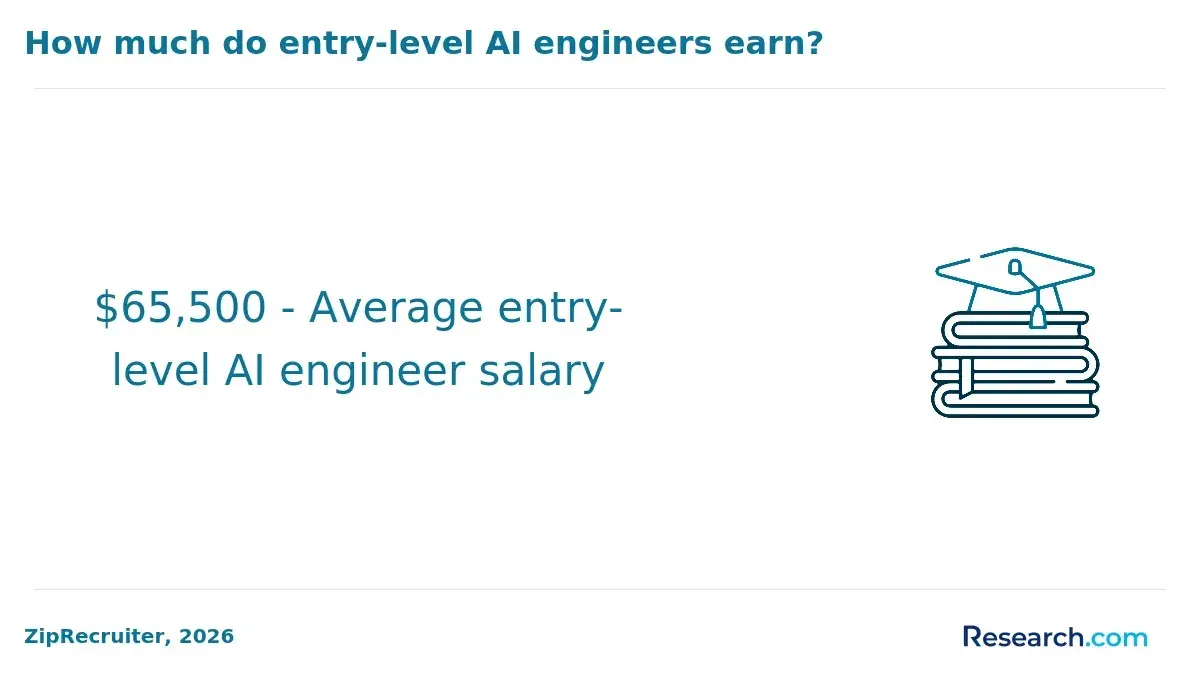
Graduates holding an associate degree in artificial intelligence often find entry-level salaries near the national median for related tech occupations. The U.S. Bureau of Labor Statistics (BLS) reports that computer user support specialists-a typical starting job for associate-level tech graduates-earn a median annual wage of $60,810. This figure serves as a practical benchmark for individuals entering the AI field with a two-year degree.
Starting salaries depend on job role and industry, including:
- AI technician or AI operations assistant roles at large tech companies typically range from $55,000 to $65,000.
- Healthcare and manufacturing sectors adopting AI technologies usually offer $50,000 to $60,000 at entry-level.
- Technical support positions specializing in AI software or hardware often align closely with the $60,000 median wage.
Geographic location influences salary levels significantly. Graduates in major tech hubs such as San Francisco, Seattle, or Boston may command up to 15% higher starting pay due to strong demand for AI skills. Conversely, smaller markets generally offer somewhat lower but locally competitive salaries.
An associate degree primarily prepares students for support, technician, or operational roles rather than development or research careers that require a bachelor's or higher degree. Career advancement and increased earnings are achievable with experience, professional certifications, or further education. Prospective students considering fall or spring start dates can use these salary insights to make informed decisions about their educational and financial planning.
Which industry certifications align with an AI associate degree for career advancement?
Industry certifications paired with an AI associate degree enhance career prospects by validating both practical skills and theoretical knowledge. According to CompTIA's IT Industry Outlook 2025, 92% of employers value IT certifications for hiring and skills validation, emphasizing the benefit of stacking certifications alongside formal education.
Key certifications that complement an AI associate degree include:
- Microsoft Certified: Azure AI Fundamentals - Focuses on foundational AI workloads and services within Microsoft Azure, crucial for cloud-based AI roles.
- Google Associate Cloud Engineer - Covers deployment and management of AI models on Google Cloud, a prominent platform for AI applications.
- IBM AI Engineering Professional Certificate - Offers practical experience in machine learning, deep learning, and data analysis tools alongside programming skills.
- Certified Analytics Professional (CAP) - Validates expertise in translating data into actionable insights through AI-driven analytics.
- CompTIA Data+ and Security+ - Provide knowledge in data analytics and cybersecurity, essential for maintaining AI system integrity and data handling.
Students and professionals should choose certifications aligned with their career targets. AI developers benefit from programming and cloud certifications, while those aiming at AI data analysis should focus on analytics credentials. This dual focus responds to employer demand for both technical and applied AI skills.
Certifications also signal ongoing commitment to learning, helping candidates stand out in competitive job markets. Aligning certification paths with industry trends and employer expectations can accelerate advancement and salary growth in AI careers.
Other Things You Should Know About Artificial Intelligence
Work experience is not typically required for enrolling in a 2027 AI associate degree program. These programs are designed to accommodate individuals at various levels of expertise, making them accessible to both beginners and those looking to advance their current skills with flexibility in starting either in the fall or spring.
Many AI associate degrees offer transfer pathways to four-year bachelor's programs in fields like computer science, data science, or AI itself. Students should check if their credits are transferable and if their schools have articulation agreements with universities. This allows for a smoother transition and continued education in AI-related disciplines.
Yes, practical experience is often a component of AI associate degrees through labs, projects, or internships. Hands-on learning helps students apply theoretical knowledge to real-world problems, enhancing technical skills and employability. Availability of internships may vary depending on the institution and program format.
Students typically learn programming languages such as Python, Java, and sometimes R, which are foundational for AI development. Courses often include training in AI frameworks and tools like TensorFlow, Keras, or machine learning libraries. Familiarity with databases and data analysis software is also commonly part of the curriculum.
Graduates of 2027 AI associate degree programs can pursue roles such as AI technician, data analyst, or machine learning assistant. These positions offer foundational experience, potentially leading to advanced studies, including specialized programs like healthcare AI master’s programs online, enhancing career growth.
References
- 16 Artificial Intelligence Career Paths https://www.calmu.edu/news/artificial-intelligence-career-paths
- What kind of jobs can I expect after completing an AI course with placement support? https://www.h2kinfosys.com/blog/what-kind-of-jobs-can-i-expect-after-completing-an-ai-course-with-placement-support/
- Degree Programs in Artificial Intelligence | ComputerScience.org https://www.computerscience.org/degrees/artificial-intelligence/
- The Prerequisites for Artificial Intelligence- IABAC - IABAC https://iabac.org/blog/what-are-the-prerequisites-for-artificial-intelligence-a-modern-approach
- AI Prerequisites https://www.nobledesktop.com/learn/ai/prerequisites
- Certification https://trailhead.salesforce.com/credentials/aiassociate
- Salesforce AI Associate Certification Guide & Tips | Salesforce Ben https://www.salesforceben.com/salesforce-ai-associate-certification-guide-tips/
- How Long Does It Take to Complete an AI Course https://www.epw.com/blog/courses/how-long-is-ai-course
- Cost to Study Artificial Intelligence in 2026 https://checkmateittech.com/cost-to-study-artificial-intelligence-usa/
- Artificial Intelligence Course Eligibility: Requirements & Prerequisites https://www.mygreatlearning.com/artificial-intelligence/courses/eligibility