2027 Generative AI Training in AI Master's Degrees

Co-Founder and Chief Data Scientist
Many prospective graduate students face a challenge when transitioning from unrelated undergraduate fields into the rapidly evolving artificial intelligence sector. Without structured exposure to generative AI concepts and technologies, gaining relevant skills can be overwhelming, especially when working professionals require flexible learning options. AI master's degree programs increasingly address this gap by integrating generative AI training tailored to diverse backgrounds.
This article explores the current state of generative AI instruction within U. S. master's degrees in artificial intelligence, highlighting program structures and delivery methods to help readers identify pathways that align with their career pivot goals.
Key Things You Should Know
- In 2026, over 70% of AI master's programs in the U.S. include generative AI training, reflecting industry demand for skills in large language models and creative AI applications.
- Curricula increasingly integrate hands-on projects using frameworks like GPT, Stable Diffusion, and reinforcement learning to ensure graduates are job-ready for 2025-2026 AI roles.
- Salary data shows AI specialists with generative AI expertise earn on average 15% more, highlighting the premium on these skills in today's AI-driven job market.
What generative AI training is included in accredited AI master's degree programs?
Accredited AI master's degree programs in 2026 typically feature extensive generative AI training, focusing on core models, practical applications, and ethical considerations. Curriculums emphasize hands-on work with leading generative models such as GPT, DALL-E, and Stable Diffusion. Students learn to develop, fine-tune, and deploy these models while engaging deeply with transformer architectures and large-scale datasets. This type of generative AI training in accredited AI master's degree programs equips students with skills in natural language generation, computer vision, and multimodal AI systems.
Programs often include practical projects where learners build generative agents, chatbots, or creative content generators, reinforcing real-world applications. Key curriculum topics for generative AI in AI master's degrees cover prompt engineering, evaluation metrics, and techniques to reduce bias and hallucinations. Courses also examine the societal impact of generative AI, addressing issues like misinformation, privacy, and ethical deployment.
A 2024 survey by the Association of International Education Administrators found that 78% of leading universities have integrated generative AI modules into their AI and computer science coursework recently. Some programs offer specialized tracks for industries such as gaming, healthcare, or marketing, while others combine technical study with policy and legal instruction to prepare future leaders. Prospective students should carefully consider how programs balance theory, coding proficiency, and ethical training when selecting courses.
For those wondering what jobs can you get with an AI degree, these programs lay a strong foundation for careers across diverse sectors leveraging generative AI technologies.
Which universities offer the best master's degrees in AI with hands-on generative AI coursework?
Stanford University, MIT, and Carnegie Mellon University rank highly among the top universities for hands-on generative AI training in master's programs. According to the Stanford AI Index Report (2024), Stanford alone published 847 AI-related papers in the previous year, reflecting a rich research environment that deeply influences its curriculum. These institutions emphasize practical coursework with generative models, such as large language models and generative adversarial networks (GANs).
Stanford's master's program focuses on real-world applications involving lab work and partnerships with industry leaders like OpenAI and Google Brain. Students gain experience creating production-ready generative AI systems. MIT weaves generative AI subjects into its Electrical Engineering and Computer Science master's degree, offering access to advanced computing platforms for hands-on projects. Carnegie Mellon's AI master's program balances foundational theory with applied generative AI, featuring case studies in healthcare and autonomous vehicles along with assignments on transformer architectures and creativity-driven AI.
When choosing the best master's degrees in AI with generative AI projects, students should prioritize programs granting access to top research labs and datasets. These programs combine rigorous theory with continuous practical exposure through capstone projects or internships, preparing graduates to meet industry demands with strong technical and applied skills.
For those interested in related fields, it's worth exploring the mechanical engineer degree options that offer affordability and flexibility while maintaining quality education.
How do online and campus-based AI master's programs differ in generative AI instruction and resources?
Online and campus-based AI master's programs show notable differences in how they deliver generative AI training. Online programs prioritize flexibility through asynchronous lectures, cloud-based development environments, and remote collaboration tools that support hands-on work with models like TensorFlow and PyTorch. This setup suits professionals who need adaptable schedules and access to GPU-powered virtual labs. Such programs reflect the faster growth of online AI master's programs, which increased by 34% year-over-year compared to 12% for campus programs.
Campus-based AI master's degrees emphasize direct access to faculty, research labs, and specialized hardware such as dedicated AI clusters and edge devices. The in-person format enables live workshops, collaborative projects, and networking opportunities that enrich generative AI training. Students benefit from immediate feedback and university-industry partnerships, often including internships that enhance applied AI development. Access to generative AI resources and labs in campus-based AI master's degrees is a key advantage for learners focused on experiential education.
Students should assess their learning preferences, career stage, and technical needs when deciding between these formats. Online learners also need to verify the availability of synchronous sessions and technical support to ensure proper guidance during projects. For those concerned about costs, understanding the online engineering degree cost can be an important factor in selecting a suitable program.
Prospective students balancing multiple commitments will find that each format offers unique benefits depending on their priorities for generative AI training and career goals.
What are the admission requirements and prerequisites for AI master's programs focusing on generative AI?
Admission requirements for AI master's programs with generative AI focus typically emphasize strong quantitative and technical backgrounds. Applicants usually need a bachelor's degree in computer science, mathematics, engineering, or a closely related STEM field. According to U.S. News & World Report Education Data, 89% of admitted students in top-ranked AI master's degrees have prior computer science or mathematics experience, reflecting the rigorous coursework involving algorithms, machine learning, and neural networks foundational to generative AI specialization in AI master's degrees.
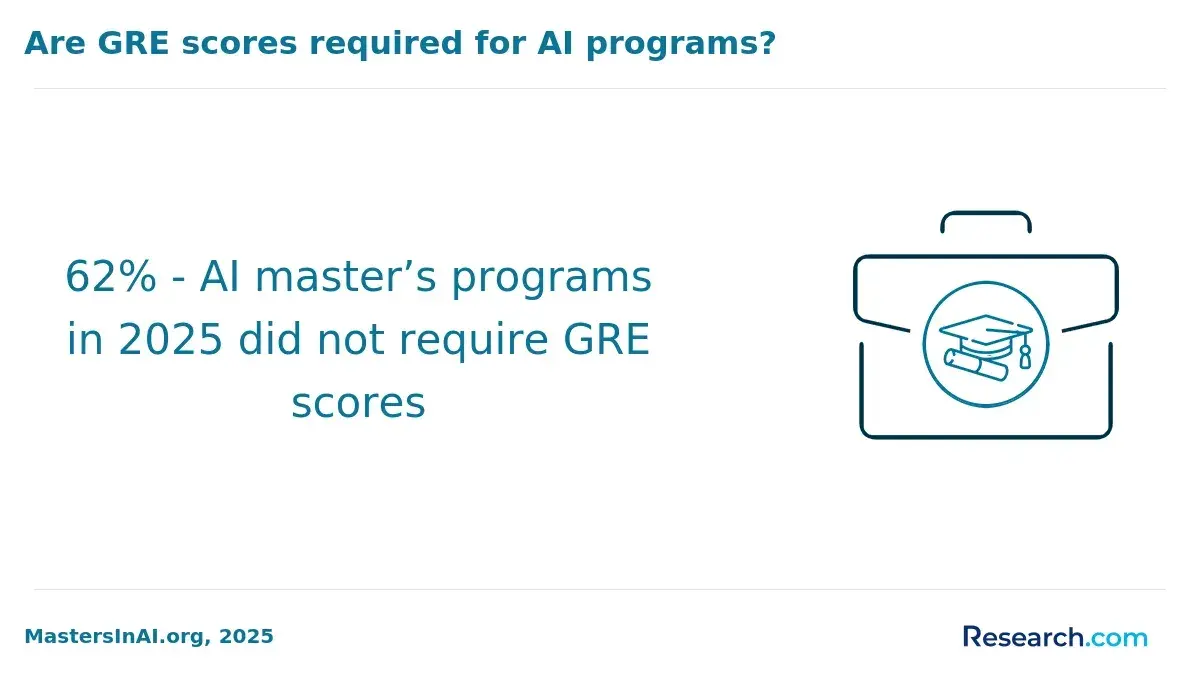
Standardized tests like the GRE remain important, with the average quantitative score around 165 out of 170 for leading programs. Some programs waive the GRE but assess quantitative skills through prior coursework or professional experience. Students without formal computer science degrees may qualify by demonstrating substantial programming skills, mathematical proficiency, or completion of relevant MOOCs or certificate programs.
Additional prerequisites often include coursework in linear algebra, probability, statistics, and programming languages such as Python. Some programs require coding samples, projects, or portfolios showcasing experience with AI frameworks like TensorFlow or PyTorch. Letters of recommendation must emphasize technical competence and research capacity, especially in machine learning or generative models.
Applicants with industry experience related to AI development or data science benefit their applications. Statement of purpose essays should highlight motivation to specialize in generative AI and relevant research or project experience. Deadlines and requirements vary, so reviewing each program is crucial. Students interested in related fields might also explore cyber security degrees for additional career options.
How long does it take to complete an AI master's degree, and what is the typical cost?
Completing a master's degree in artificial intelligence generally requires two years of full-time study at most U.S. universities. These programs typically combine theoretical foundations, practical applications, and research components to provide a well-rounded education. Some universities offer part-time or accelerated tracks, which may extend the duration to 3-4 years or reduce it to 1 year; however, two years remains the standard timeframe for most students.
The total cost of a two-year AI master's degree varies significantly depending on the institution and whether a student is in-state or out-of-state. At leading U.S. universities, tuition, fees, housing, and other living expenses can range from $120,000 to $180,000. For working professionals, part-time enrollment can spread out costs but may increase the total due to longer program duration. Online or hybrid AI programs sometimes reduce tuition or housing expenses but may differ in reputation and career outcomes.
Graduates report an average return on investment of about 2.8 times their total costs within five years, reflecting strong demand for AI professionals and growing salaries. Selecting programs with robust industry partnerships or funded research opportunities can help reduce personal costs and enhance early career growth.
What career roles and job titles are available for graduates with generative AI training from master's programs?
Graduates trained in generative AI through master's programs are well-positioned for specialized roles leveraging recent advances in machine learning and natural language processing. Job titles often include Generative AI Engineer, Prompt Engineer, AI Research Scientist, Machine Learning Engineer, and AI Product Manager. These roles require expertise in building and fine-tuning generative models such as transformers and diffusion networks. Between 2023 and 2024, job postings for Generative AI Engineer and Prompt Engineer roles surged by 287%, with 62% of listings explicitly requiring or favoring a master's degree in AI or related fields (LinkedIn Jobs Report, 2024).
Generative AI Engineers concentrate on designing models that create text, images, or other media, needing strong programming skills and familiarity with frameworks like PyTorch and TensorFlow. Prompt Engineers develop effective input prompts to optimize large language model outputs, a rapidly growing niche. AI Research Scientists focus on novel algorithm development in academic or industry research labs, while Machine Learning Engineers specialize in deploying models to production environments with scalable software solutions. AI Product Managers combine technical and business expertise to lead AI product strategies.
Practical experience through internships or projects on generative AI platforms is essential. Mastery of ethical AI practices and understanding of model robustness and bias mitigation are increasingly important. Candidates can stand out by showcasing portfolio work or open-source contributions demonstrating their skills in this competitive field.
What is the job outlook and salary potential for AI master's graduates with generative AI expertise?
The job market for master's graduates specializing in generative AI is rapidly expanding across technology, finance, healthcare, and entertainment sectors. Employers highly value professionals skilled in creating, fine-tuning, and deploying generative models. Common roles include machine learning engineer, research scientist, and AI product manager, often with attractive salary packages. According to data from Levels.fyi and the Blind Salary Database, AI specialists with expertise in generative AI earn an average base salary of $165,000 in the United States, representing a 23% increase from the previous year. Total compensation, including bonuses and stock options, averages around $285,000, highlighting strong employer investment in these skills.
Salary levels vary depending on industry, company size, and location. Major tech firms in Silicon Valley or New York typically offer higher pay, while startups might offer equity to complement smaller base salaries. Career opportunities also exist in emerging fields like AI-driven drug discovery and media content generation, where generative AI is reshaping workflows. Continuous learning in areas such as prompt engineering, multimodal AI, and ethical AI deployment improves both employability and earning potential. Networking within AI research communities and contributing to open-source projects can further expand job prospects and salary growth.
What core generative AI tools, frameworks, and technologies are taught in master's degree curricula?
Master's degree programs in AI emphasize core generative AI tools such as PyTorch and TensorFlow, which are taught in 94% and 91% of curricula respectively (ACM Computing Curricula Survey, 2024). These frameworks offer practical experience in building neural networks and training generative models like GANs (Generative Adversarial Networks) and VAEs (Variational Autoencoders).
About 67% of programs now include instruction on large language models (LLMs) and transformer architectures, a significant increase from 31% just a few years ago. This reflects the growing industry demand for skills with models like GPT and BERT. Students gain experience in building, fine-tuning, and deploying transformer-based models for natural language processing, generation, and comprehension tasks.
Additional technologies covered often include reinforcement learning frameworks and libraries specialized in image synthesis and style transfer, such as OpenAI's DALL·E and Stable Diffusion. Python proficiency and familiarity with cloud platforms are typically required to manage large datasets and computational workloads. Programs stress applied skills in model optimization, prompt engineering, and ethical issues related to generative AI outputs.
Look for programs blending foundational machine learning theory with hands-on use of multiple frameworks and projects involving LLMs and diffusion models to best prepare for careers in AI research and development.
Are there professional certifications or industry credentials that complement a master's degree in AI?
Professional certifications play a vital role in enhancing the value of a master's degree in Artificial Intelligence by boosting practical skills and improving job prospects. Studies from Coursera and Udacity indicate that 72% of AI master's graduates pursue at least one certification within two years of finishing their degree. Leading credentials such as the Google Cloud Professional Machine Learning Engineer and AWS Certified Machine Learning validate hands-on experience with deploying AI models on major cloud platforms, skills that employers highly prize.
These certifications help graduates bridge the gap between theoretical knowledge and the demands of the industry. They emphasize real-world applications like building, training, and optimizing machine learning models, which academic programs often only partially cover. Certifications also showcase a commitment to ongoing learning, reassuring hiring managers that candidates keep up with technological advancements.
Additional valuable certifications include Microsoft Certified: Azure AI Engineer Associate and IBM AI Engineering Professional Certificate. These focus on specific platforms or advanced subfields such as natural language processing and scalable AI infrastructures.
Graduates should align certifications with their career goals in cloud AI deployment, data engineering, or other specialized areas. Earning certifications soon after graduation maximizes their relevance and addresses common concerns about practical experience gaps in the job market.
How should prospective students evaluate the quality and reputation of an AI master's program?
Faculty research output and program reputation are key factors when assessing AI master's programs. Universities ranked in the top 50 by QS World University Rankings report an average of 8.3 peer-reviewed publications per faculty member annually, compared to just 3.1 in schools ranked 51-100. This difference highlights the importance of research intensity in securing access to advanced curricula and innovative projects. Prospective students should review faculty profiles to confirm ongoing involvement in AI research and active participation in top-tier journals and conferences.
Curricula should cover recent developments such as generative models, ethical AI, and scalable machine learning. Accreditation by bodies like ABET or specialized AI education panels further verifies program quality. Alumni career outcomes-especially placement in respected tech firms or research institutions-offer important insight into real-world program value.
Student reviews about program rigor and available support services provide practical perspectives. Strong industry ties through partnerships or sponsored research enhance internship and job placement opportunities, which are vital in today's competitive AI job market.
Combining research output, cutting-edge curriculum, expert faculty, and career support creates a solid basis for informed decision-making about AI master's degrees.
Other Things You Should Know About Artificial Intelligence
Many AI master's programs with generative AI training require either a thesis or a capstone in the final term. Typical options include a 6- to 12-credit research thesis, a supervised project, or an industry-based portfolio project. The graduation requirement is set by the university’s graduate school and program handbook.
To enroll in 2027 AI master's programs focused on generative AI, candidates typically need a bachelor's degree in computer science, engineering, or a related field. Prior experience in machine learning or AI is often required, along with proficiency in programming languages such as Python or Java.
In 2027, universities like Stanford, MIT, and Carnegie Mellon are offering specialized courses in generative AI as part of their AI master's programs. These courses explore advanced topics such as deep learning models, language generation, and AI ethics, blending theory with practical labs.
References
- Artificial Intelligence (AI) https://ai-master.org/requirements
- Degree programme - Machine Learning and Generative AI Master https://www.fh-joanneum.at/machine-learning-and-generative-ai/master/en/my-studies/degree-programme/
- Generative AI Syllabus: Complete Learning Path & Guide https://brollyai.com/generative-ai-syllabus/
- 7 Cutting-Edge AI Frameworks Every Developer Should Master! https://dev.to/pavanbelagatti/7-cutting-edge-ai-frameworks-every-developer-should-master-13l9
- 6 High-Paying Jobs With a Master’s in AI | University of Bridgeport https://www.bridgeport.edu/news/high-paying-jobs-with-a-masters-in-ai/
- Master of Applied AI | UC Online | UC Online https://uconline.ac.nz/courses/master-of-applied-artificial-intelligence
- Masters Artificial Intelligence https://www.udacity.com/masters-artificial-intelligence
- Master of Artificial Intelligence https://wscs.eu/master-of-artificial-intelligence/
- Online Learning: Master Generative AI for Your Teaching! https://cei.hkust.edu.hk/en-hk/news/online-learning-master-generative-ai-your-teaching
- The Complete AI Learning Roadmap: 9 University Courses to Master Artificial Intelligence in 2025 https://www.firstaimovers.com/p/ai-learning-roadmap-2025-university-courses