2027 Cost Per Credit for AI Master's Programs

Co-Founder and Chief Data Scientist
Choosing to pursue a master's degree in artificial intelligence raises immediate concerns about cost, particularly the per-credit expenses that impact overall affordability. Many prospective students balance career changes and financial responsibilities, making precise knowledge of tuition rates crucial to planning. These costs vary widely across programs, influencing decisions about which schools to apply to based on budget and expected return on investment
This article examines the average cost per credit for artificial intelligence master's programs in 2027, highlighting trends and helping readers identify affordable, flexible options that align with their career pivot goals.
Key Things You Should Know
- Average cost per credit for AI master's programs in 2026 ranges from $800 to $1,500 at public and private U.S. universities, reflecting a 5% increase from 2024 data.
- Public institutions typically offer more affordable rates, averaging $900 per credit, while private programs can exceed $1,400, influencing total program expenses significantly.
- Growing demand for AI expertise correlates with rising tuition, as competitive programs invest in cutting-edge resources and faculty, impacting cost per credit trends.
How much does a master's degree in artificial intelligence cost per credit hour in 2027?
The cost per credit hour for ai master's programs typically ranges from $400 to $2,500, influenced mainly by the institution type and program delivery. Public universities often provide tuition rates between $400 and $900 per credit, making them a more affordable option for many students. Conversely, private institutions or highly specialized programs-especially those incorporating advanced AI lab work online-can cost as much as $2,500 per credit.
Master's degree tuition rates for artificial intelligence programs vary widely. For instance, a public state university might charge around $500 per credit, resulting in approximately $15,000 for a 30-credit degree. Private research universities focusing on cutting-edge AI technologies may charge from $2,000 up to $2,500 per credit, leading to total tuition costs between $60,000 and $75,000. Some online programs also command a premium for flexibility and exclusive resources but show significant variation in pricing.
Residency status is another crucial factor since out-of-state students usually face higher tuition at public universities. Programs connected with major AI research hubs or industry collaborations often have higher fees due to specialized faculty and opportunities. When budgeting for tuition, it is important to also consider mandatory fees, materials, and potential travel for on-campus intensives.
Financial aid options, including scholarships and employer tuition reimbursement, can substantially offset expenses. Prospective students interested in applied artificial intelligence should carefully compare costs to ensure the chosen master's degree aligns with their educational and financial goals.
What is the average total tuition for a master's program in artificial intelligence across accredited U.S. universities?
The average total tuition for a master's program in artificial intelligence at accredited U.S. universities varies widely, generally ranging from $60,000 to $120,000. Private institutions typically charge more than $100,000 for the entire degree, reflecting their advanced research facilities, faculty expertise, and specialized resources. Meanwhile, public universities usually offer more affordable pricing, with many in-state programs in the University of California system or the University of Michigan hovering between $40,000 and $60,000 for residents. Out-of-state students, however, may encounter tuition closer to private school rates.
When evaluating the cost of a master's degree in artificial intelligence at accredited US universities, students should consider their long-term career objectives and financial situation. Resources like the National Association of Graduate Admissions Professionals offer important data and comparisons to help prospective students budget effectively. Additionally, many programs provide scholarships, assistantships, or employer tuition assistance to offset expenses.
Exploring alternatives such as the cheapest online master's mechanical engineering programs may also offer insights into affordability and program quality across STEM fields. Thoughtful consideration of tuition costs alongside program prestige enables students to make informed decisions that balance investment and educational value.
How do online artificial intelligence master's programs compare in cost to campus-based options?
Online artificial intelligence master's programs typically cost between $35,000 and $70,000 in total tuition, significantly less than campus-based programs, which average $70,000 to $120,000. This cost comparison of online artificial intelligence master's programs versus campus-based options reveals a 20-40% savings for online study, making it an attractive choice for many students with work or family commitments.
Lower tuition rates often reflect reduced overhead expenses such as campus facilities and in-person resources. Despite the savings, many online AI degrees maintain comparable curricula, faculty expertise, and accreditation. Prospective students should also consider the average cost per credit for on-campus and online artificial intelligence master's degrees to budget effectively while verifying program quality and career value.
Online AI programs frequently offer asynchronous schedules, which help working professionals manage education alongside full-time employment. On the other hand, campus-based options might provide enhanced networking, hands-on labs, and access to unique resources that justify their higher price for some learners. Students seeking cost efficiency and flexibility may find online degrees more practical, while those prioritizing face-to-face interaction could lean toward traditional programs.
For those interested in broader options, exploring related fields such as video game programs can provide useful insights into the variations in pricing and delivery methods across disciplines.
What are the admission requirements for master's programs in artificial intelligence?
Admission requirements for master's programs in artificial intelligence in the US often emphasize a strong quantitative background and consistent academic achievement. Most top programs, approximately 78%, require a Graduate Record Examination (GRE) score of at least 310 combined, coupled with a minimum undergraduate GPA of 3.0, reflecting competitive graduate admission criteria for AI master's degrees. Applicants should be prepared to meet these benchmarks for the best chances.
Many programs also expect prior coursework in foundational subjects such as linear algebra, calculus, or computer science, with about 65% mandating these prerequisites. Those lacking this preparation may need to complete additional courses or show equivalent experience. Letters of recommendation and a statement of purpose outlining research interests or career objectives related to AI are commonly requested. Some schools value internships or relevant work experience in fields like data science or software development.
International applicants usually must submit English proficiency test scores such as TOEFL or IELTS. Interviews may also be required to assess problem-solving skills and motivation. Since requirements vary, reviewing each program's specific criteria is essential. Some schools waive GRE scores due to recent testing challenges, while others enforce strict cutoffs. Early preparation of transcripts and supporting documents can enhance admission success.
These standards are based on data from the U.S. News & World Report graduate program database and align with consistent academic expectations across AI programs. Prospective students might also explore related educational opportunities like affordable cybersecurity programs to broaden their knowledge and skills.
How long does it typically take to complete a master's degree in artificial intelligence?
Completing a master's degree in artificial intelligence typically requires 18 to 24 months for full-time students, while part-time students generally take 24 to 36 months. Part-time learners often balance work and study by taking 3 to 6 credits per semester, extending their program duration. In contrast, full-time students usually enroll in 9 to 12 credits per semester to finish more quickly. Some universities offer accelerated tracks, allowing completion in as little as 12 to 15 months, especially for students with relevant prior credits or experience.
The increase in completion rates-up 15% since 2022 according to the Council of Graduate Schools-is attributed to streamlined curricula that reduce redundancy and speed learning without compromising depth. Program formats-online, hybrid, or in-person-also impact pacing and flexibility. Online programs often allow asynchronous study, letting motivated students progress faster, but careful planning is necessary to meet all prerequisites and exam deadlines.
Students should assess their professional commitments and academic goals to choose a timeline that suits them. Generally, 18 to 36 months is a realistic framework for finishing a master's in artificial intelligence, supported by current research and expert recommendations.
What core coursework and specializations are included in artificial intelligence master's curricula?
Core coursework in artificial intelligence master's programs covers foundational knowledge and advanced techniques crucial for becoming an expert. Nearly all programs-94%, according to the Association for Computing Machinery's 2024 curriculum analysis-include machine learning and deep learning. These courses address algorithms, neural networks, supervised and unsupervised learning, and optimization methods. Students typically learn programming languages like Python and use frameworks such as TensorFlow or PyTorch to implement AI models practically.
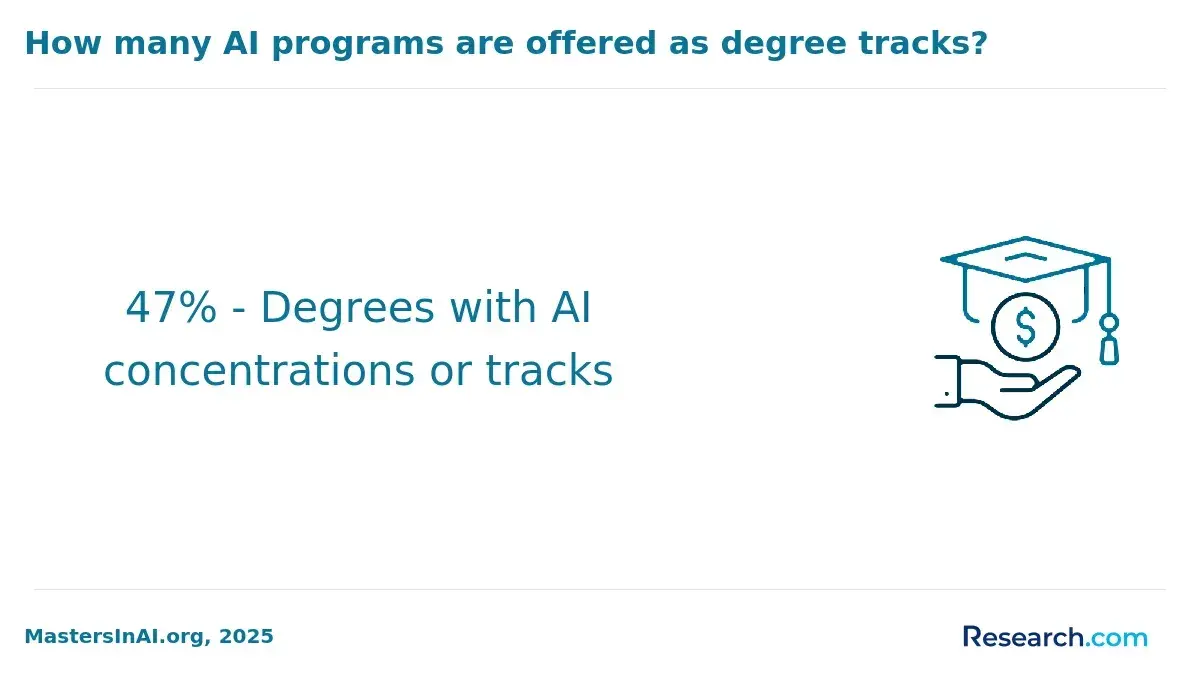
Beyond the core, 71% of programs offer specialized tracks tailored to industry needs. Popular options include natural language processing (NLP), computer vision, and reinforcement learning. NLP enables machines to understand and generate human language for applications like chatbots and translation. Computer vision focuses on interpreting visual data, vital in autonomous vehicles and medical imaging. Reinforcement learning trains models to make decisions based on rewards, important in robotics and gaming.
Electives often cover data ethics, AI safety, and human-centered design to tackle practical challenges. Programs may also include statistics, probability, and advanced mathematics to strengthen theoretical foundations. Prospective students should seek programs combining theory with hands-on projects, internships, or research to improve job readiness by applying AI techniques to real-world problems.
This detailed curriculum knowledge helps individuals align their education with career goals in research, development, or applied AI roles across healthcare, finance, robotics, and more.
Which accreditation bodies oversee artificial intelligence master's programs and how do I verify program accreditation?
Accreditation of artificial intelligence master's programs in the U.S. is mainly governed by regional bodies like the Southern Association of Colleges and Schools Commission on Colleges (SACSCOC), which approve most institutions. In addition, ABET, a specialized accreditor dedicated to STEM fields, accredits around 15% of AI-focused master's programs nationwide. According to the 2024 ABET annual report, applications for AI program accreditation have surged by 40% since 2022, reflecting growing industry standards and academic interest.
When verifying a program's accreditation, start by identifying its accrediting authority. Regional accreditors such as SACSCOC are recognized by the U.S. Department of Education and guarantee institutional quality across disciplines. ABET accreditation specifically confirms that technical standards relevant to AI, computer science, or engineering are met, appealing to students seeking rigorous technical education.
Prospective students should consult official websites of these bodies for current listings-SACSCOC offers a directory of accredited institutions, while ABET's site allows direct searches for accredited AI and computing programs. Ensuring proper accreditation safeguards credit transferability and enhances degree recognition by employers.
In deciding on rigorous education or better employment prospects, students may prioritize programs with ABET accreditation. Regional accreditation remains crucial for federal financial aid eligibility and overall institutional quality. Checking for both specialized and regional accreditation protects your professional and educational investment in an AI master's degree.
What career roles and job titles do graduates of artificial intelligence master's programs pursue?
Graduates of artificial intelligence master's programs typically pursue careers as machine learning engineers (32%), AI research scientists (28%), data scientists (22%), and AI product managers (18%), based on employment data tracked by the IEEE Computer Society. Machine learning engineers design and deploy algorithms to enable systems to learn from data, often working in technology, healthcare, or finance. AI research scientists focus on creating new models and advancing theoretical frameworks, frequently employed by research labs, universities, and tech companies.
Data scientists apply AI techniques to extract insights for business decision-making across industries such as retail, manufacturing, and marketing. AI product managers oversee the development and rollout of AI-powered products, working closely with engineers and stakeholders to align technical capabilities with market demands. This role requires both technical knowledge and strategic planning abilities. Specialized roles within AI include NLP engineers, computer vision specialists, and robotics engineers.
Prospective students should consider their strengths and interests: strong programmers might favor machine learning engineering, while those inclined toward theory might pursue research scientist roles. The 18% representation of AI product managers highlights the increasing value of bridging AI with business strategy. For updated employer demand and salary expectations, consulting industry reports and organizations like the IEEE Computer Society is recommended.
What is the average salary for professionals with a master's degree in artificial intelligence?
Professionals with a master's degree in artificial intelligence typically start with salaries between $120,000 and $140,000 annually. As they gain experience, this range can increase to an average of $180,000 to $250,000 per year. This reflects about a 35% premium compared to master's degree holders in computer science, based on compensation data from Levels.fyi and Blind.
Entry-level positions for AI graduates include roles like machine learning engineer, data scientist, and AI research analyst. Starting pay often begins near $120,000 but can rise quickly with demonstrated skills and project impact. Specializations in areas such as natural language processing or computer vision may result in even higher starting salaries due to strong market demand.
Experienced AI professionals frequently move into senior engineer, AI architect, or leadership roles. Those with five or more years of experience, technical contributions, or management responsibilities often earn between $180,000 and $250,000. Geographic factors also matter, with tech centers like San Francisco and New York offering salaries at the upper end of this spectrum.
The salary premium over computer science graduates highlights the strong value employers place on AI expertise. Individuals considering a master's in artificial intelligence should balance these salary benefits against program expenses and career ambitions, as AI degrees often deliver a solid return on investment in tech-driven fields.
What is the job outlook and industry demand for artificial intelligence master's degree holders through 2030?
Job prospects for master's degree holders in artificial intelligence remain exceptionally promising through 2030. Roles in this field are projected to grow at an annual rate of 37.9%, significantly outpacing the 5.3% average for all other occupations, based on labor market projections from the U.S. Bureau of Labor Statistics and the McKinsey Global Institute. This rapid growth is driven by widespread adoption of AI technologies in many industries.
Demand is especially strong in technology, finance, and healthcare. Technology firms seek AI specialists to develop advanced machine learning algorithms, natural language processing tools, and autonomous systems. In finance, experts create predictive models to improve risk management and automate trading. Healthcare increasingly integrates AI for diagnostics, personalized treatments, and operational improvements, resulting in expanding job opportunities.
Graduates can pursue diverse roles such as AI research scientist, machine learning engineer, data scientist, and AI product manager. These positions require a blend of technical expertise and domain knowledge. Those with a master's degree in artificial intelligence are well-positioned for mid- to senior-level careers offering competitive salaries and growth potential.
Continuous learning in areas like reinforcement learning, explainable AI, and ethical AI frameworks is essential to stay relevant. Geographic flexibility also helps, with hubs like Silicon Valley, New York, and Boston showing intense demand. Focused education and strategic career planning align well with sustained employment growth in artificial intelligence.
Other Things You Should Know About Artificial Intelligence
In 2027, the cost per credit for AI master's programs varies significantly between public and private universities. Public universities typically charge between $500 and $1,200 per credit, while private universities may charge upwards of $1,500 to $2,500 per credit. These costs can fluctuate based on location, institutional prestige, and available resources.
Many artificial intelligence master's programs allow transfer credits, but policies vary significantly by institution. Typically, only graduate-level courses relevant to artificial intelligence or related fields like data science or machine learning are eligible. It's important to check with the specific program's registrar or admissions office about transfer limits and approved courses.
Yes, some universities provide scholarships, assistantships, or fellowships targeted at students in artificial intelligence or related disciplines. Funding opportunities may come through academic departments, research grants, or industry partnerships. Prospective students should research available options well in advance and apply for financial aid early.
Python is the most widely taught programming language in artificial intelligence master's programs due to its extensive libraries for machine learning and data analysis. Other languages such as R, Java, and MATLAB may also be included depending on the curriculum. Mastery of these languages supports practical implementation of AI algorithms and research projects.
References
- AI’s Impact on Job Growth | J.P. Morgan Global Research https://www.jpmorgan.com/insights/global-research/artificial-intelligence/ai-impact-job-growth
- Most Affordable Online Master's in AI for 2026 https://aidegreeprograms.org/rankings/affordable-online-ai-masters/
- Top 10 Careers You Can Pursue With an Online Master’s in AI https://www.ucumberlands.edu/blog/careers-you-can-pursue-with-an-online-masters-in-ai
- Artificial intelligence and society https://psl.eu/en/education/master-s-degree-artificial-intelligence-and-society
- AI & ML PG Program Costs: What To Expect? https://cms.nucleusnetwork.com/urban-beat/ai-and-ml-pg-program-costs-what-to-expect-1764797941
- THE GLOBAL STANDARD IN DATA SCIENCE & AI EDUCATION https://www.dasca.org/data-science-accreditation-program
- Study programme - Master Artificial Intelligence https://www.uva.nl/shared-content/programmas/en/masters/artificial-intelligence/study-programme/study-programme.html
- AI will perform most work tasks by 2030 - Amsterdam Centre for Business Innovation https://acbi.uva.nl/content/news/2025/01/ai-will-perform-most-work-tasks-by-2030.html
- What Jobs Can I Get With a Master's in Artificial Intelligence? | CSU Global https://csuglobal.edu/blog/what-jobs-can-you-get-masters-artificial-intelligence
- Most Affordable Online Master's in AI for 2025 https://www.mastersinai.org/degrees/affordable-online-masters-in-ai/