2027 AI Master's Degrees for Marketing Professionals

Co-Founder and Chief Data Scientist
Choosing an AI master’s degree as a marketing professional is usually a question of fit: Will the program build enough technical skill to use AI responsibly, without forcing you into a computer science curriculum that assumes years of coding experience? The strongest programs help marketers connect customer data, automation, predictive analytics, generative AI, and campaign strategy in ways that employers can measure.
This guide explains what an AI-focused master’s pathway for marketers includes, which careers it can support, how to evaluate accreditation and curriculum quality, what admissions committees typically expect, how long programs take, what they may cost, and how online and campus formats compare. It is designed for working marketers, brand managers, digital strategists, analysts, and career changers who want practical AI capability rather than theory alone.
Key Things You Should Know
- AI master's degrees for marketing professionals in 2027 combine data science, machine learning, and consumer behavior, enhancing targeted campaign strategies and ROI measurement.
- Programs emphasize practical skills with 60% of courses involving real-world projects, reflecting the 35% annual growth in AI-driven marketing job postings.
- Graduates can expect an average salary increase of 25% post-degree, responding to industry demand for AI expertise to optimize digital marketing and customer engagement.
What is an AI master's degree for marketing professionals?
An AI master’s degree for marketing professionals is a graduate program that teaches marketers how to use artificial intelligence, machine learning, analytics, and automation to improve customer insight, campaign performance, personalization, and business decision-making. Unlike a traditional marketing master’s, it places heavier emphasis on data, algorithms, experimentation, and responsible AI use. Unlike a pure computer science program, it usually frames technical tools around customer behavior, brand strategy, advertising, sales funnels, and marketing operations.
These programs are especially relevant because marketing teams increasingly rely on AI for audience segmentation, content testing, lead scoring, media optimization, chatbot design, sentiment analysis, and predictive forecasting. With 72% of marketing organizations already using generative AI and another 20% planning adoption within a year, professionals who understand both marketing strategy and AI implementation are better positioned to lead projects rather than simply use tools selected by others.
What students typically learn
Most AI marketing master’s programs combine business, analytics, and applied technology. Common areas include data science fundamentals, marketing analytics, machine learning for customer segmentation, natural language processing, AI-assisted content personalization, digital advertising optimization, and ethical AI governance. Students also examine privacy, consent, bias, explainability, and compliance issues, including regulations like GDPR.
The best programs do not treat AI as a shortcut for marketing work. They teach students how to evaluate model output, question assumptions in datasets, protect customer trust, and connect AI recommendations to measurable marketing goals such as retention, conversion, lifetime value, and return on ad spend.
Who this degree is best for
- Marketing professionals who want to move into analytics, automation, growth, or AI strategy roles.
- Digital marketers who already use platforms such as CRM, email automation, paid media, or analytics tools and want deeper technical fluency.
- Brand or product marketers who need to understand AI-powered personalization, customer journeys, and market intelligence.
- Career changers with business or communications backgrounds who want a structured path into AI-related marketing work.
Students comparing AI career paths can also review Research.com’s overview of applied artificial intelligence careers to understand how marketing-focused roles fit into the broader AI job market.
What careers can you get with an AI master's in marketing?
An AI master’s in marketing can prepare graduates for roles that sit between marketing strategy, data analysis, automation, and product innovation. The degree is most valuable when it helps you prove that you can translate AI outputs into business decisions, not just run tools or generate reports.
One common path is market research analysis. Market research analysts use data to understand customers, competitors, pricing, and demand. Employment in these positions is expected to grow 8% in the U.S. from 2024 to 2034, outpacing average job growth projections. AI skills can strengthen this work by improving forecasting, clustering, sentiment analysis, and survey or behavioral data interpretation.
Common AI marketing career paths
| Role | How AI is used | Best fit for |
| AI marketing strategist | Designs campaigns using personalization, automation, testing, and predictive insights. | Marketers who want to lead AI-enabled growth initiatives. |
| Marketing data scientist | Builds or applies models for segmentation, churn prediction, attribution, and customer lifetime value. | Professionals with stronger quantitative or programming interests. |
| Digital marketing analyst | Uses machine learning and analytics to improve paid search, social media, SEO, email, and conversion funnels. | Digital marketers who want deeper measurement and optimization skills. |
| AI product manager | Guides the development or adoption of AI tools used in marketing, sales, customer engagement, or analytics. | Marketers who enjoy cross-functional work with technical teams. |
| AI marketing consultant | Advises organizations on tool selection, workflow redesign, automation, governance, and performance measurement. | Experienced marketers who can combine strategy, change management, and analytics. |
Employers typically look for a blend of marketing judgment, data literacy, experimentation skills, and tool fluency. Strong candidates can explain what a model is recommending, why the recommendation matters, where the data may be weak, and how the marketing team should act on the insight.
For broader comparisons of affordable advanced degree pathways in technical fields, Research.com also maintains resources such as affordable online master’s degree options.
How do you choose an accredited AI master's program for marketing?
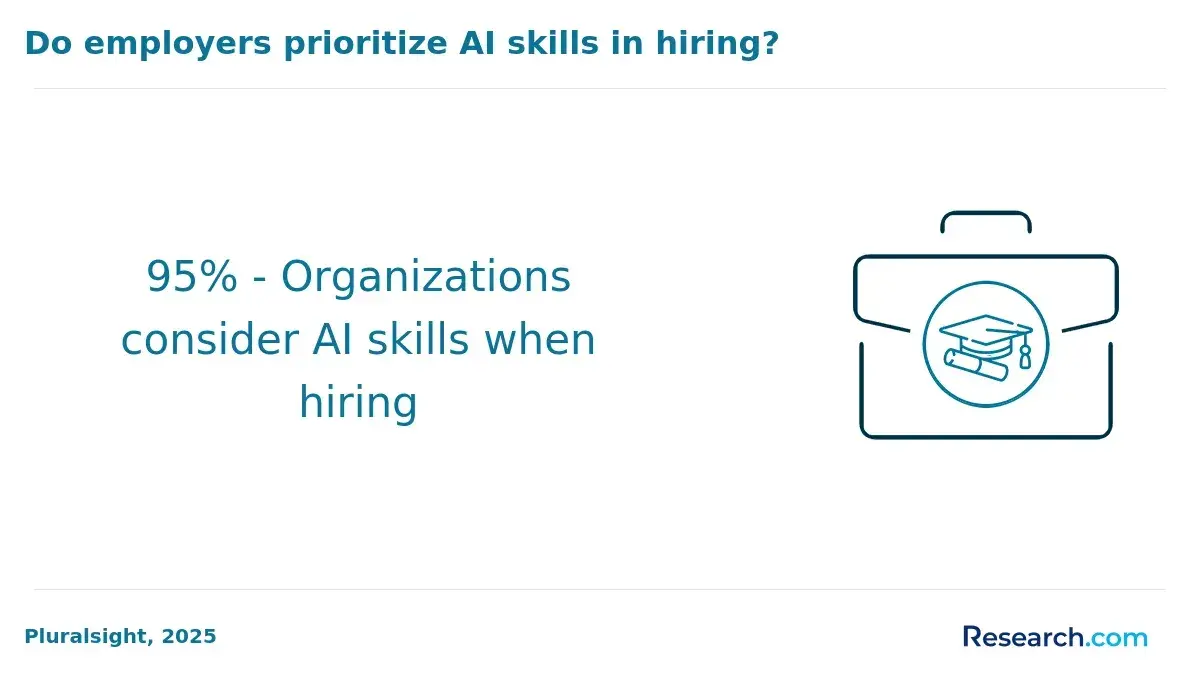
Start with accreditation, then evaluate fit. An accredited AI master’s program should be offered by an institution recognized by the U.S. Department of Education or the Council for Higher Education Accreditation (CHEA). Accreditation matters because it signals that the school meets academic quality standards and can affect credit transfer, federal financial aid eligibility, employer recognition, and future doctoral study. It also matters in hiring: 20% of U.S. employers use accreditation as a screening criterion when evaluating candidates, according to an AACRAO 2024 survey.
After confirming accreditation, focus on whether the program is genuinely useful for marketing careers. A strong program should connect AI methods to real marketing problems, not simply add one AI elective to a general business degree.
Program quality checklist
- Accreditation: Verify institutional accreditation through official accreditor or government databases, not only through marketing language on a school website.
- Marketing relevance: Look for courses in marketing analytics, consumer behavior modeling, campaign optimization, personalization, digital advertising, and AI ethics.
- Technical depth: The curriculum should teach enough statistics, data management, machine learning, and analytics to make you credible with data and technical teams.
- Hands-on work: Prioritize programs with capstones, portfolio projects, real datasets, labs, internships, or industry-sponsored projects.
- Faculty and industry ties: Review whether faculty publish or consult in AI, analytics, digital marketing, consumer insight, or related fields.
- Career outcomes: Ask for job titles, employer examples, internship access, career services, and alumni outcomes tied to AI or analytics roles.
- Flexibility: Working professionals should compare online, hybrid, evening, part-time, and accelerated formats.
- Total cost: Compare tuition, fees, technology costs, travel, lost income, and available aid against realistic salary and promotion goals.
Avoid choosing a program based only on the phrase “AI” in the title. Read course descriptions, faculty profiles, admissions prerequisites, and sample projects. If you are comparing online options, Research.com’s guide to the best online master’s in artificial intelligence can help you evaluate affordability and quality together.
What curriculum and courses are common in AI marketing master's programs?
AI marketing master’s programs usually combine marketing strategy, analytics, machine learning, and responsible technology use. The goal is not to turn every marketer into a full software engineer. The goal is to help graduates understand data well enough to ask better questions, evaluate AI tools, collaborate with technical teams, and make stronger marketing decisions.
A well-designed curriculum should include both foundations and applications. Foundations help students understand statistics, data quality, modeling, experimentation, and measurement. Applications show how those skills apply to customer segmentation, media buying, personalization, retention, content strategy, and campaign performance.
Common courses
- Machine Learning for Marketing: Covers algorithms used for customer segmentation, recommendation systems, personalization, churn prediction, and propensity modeling.
- Marketing Analytics: Teaches students how to interpret large datasets, connect metrics to business goals, and turn analysis into action.
- Natural Language Processing for Consumer Interaction: Applies NLP to sentiment analysis, social listening, customer reviews, chatbots, and conversational marketing.
- Digital Advertising and Programmatic Marketing: Examines automated ad buying, targeting, bidding, attribution, testing, and optimization.
- Data Science Fundamentals: Builds skills in statistics, data mining, predictive modeling, data visualization, and data preparation.
- Ethics and Privacy in AI Marketing: Covers bias, transparency, data protection, consent, responsible personalization, and regulatory issues.
Electives and applied projects
Electives may include computer vision for visual content analysis, deep learning for customer behavior prediction, AI in e-commerce, CRM analytics, marketing automation, social media analytics, or AI product management. Many programs include hands-on work with tools such as TensorFlow or Azure ML, along with dashboards, cloud platforms, or marketing automation systems.
When comparing programs, ask what you will actually build. A useful portfolio might include a customer segmentation model, campaign performance dashboard, sentiment analysis project, recommendation prototype, or AI governance plan for a marketing team. These deliverables can be more persuasive to employers than course titles alone.
Students who want a deeper technical analytics pathway may also compare AI marketing programs with an online MS in data science.
What are the admission requirements for AI master's programs in marketing?
Admission requirements vary by school, but most AI master’s programs in marketing require a bachelor’s degree from an accredited institution. Accepted undergraduate backgrounds often include marketing, business, communications, economics, computer science, information systems, statistics, or related fields. Applicants do not always need a STEM degree, but they should be ready to show quantitative ability and a clear reason for studying AI in a marketing context.
Typical application materials
- Official transcripts from prior colleges or universities.
- Statement of purpose explaining career goals, marketing experience, and interest in AI applications.
- Letters of recommendation that speak to analytical ability, communication skills, leadership, or professional performance.
- Resume or CV showing work experience, projects, internships, certifications, or relevant technical exposure.
- GRE or GMAT scores if required, though many programs are test-optional.
- Portfolio, coding sample, or project evidence when requested or encouraged.
- TOEFL or IELTS scores for international students unless prior education in English qualifies them for an exemption.
Many schools have moved away from mandatory standardized testing. According to Common App for Grad School data, about 50% of U.S. graduate applications now follow test-optional policies. Some programs offer test score waivers for applicants with professional experience or a strong undergraduate GPA, typically above 3.0 on a 4.0 scale.
How non-technical applicants can strengthen their profile
If your background is mostly creative, brand, communications, or general business, admissions committees may look for evidence that you can handle quantitative coursework. Helpful preparation can include prior classes in statistics, calculus, programming, analytics, database concepts, or research methods. Professional experience with CRM systems, paid media dashboards, web analytics, A/B testing, marketing automation, or reporting can also help.
Some programs require prerequisite courses before enrollment or during the first term. Applicants should ask whether prerequisites are credit-bearing, whether they add cost, and whether they affect the expected graduation timeline.
How long does an AI marketing master's degree take to complete?
An AI marketing master’s degree generally takes 1 to 3 years to complete. Full-time students often finish in 12 to 18 months, while part-time students commonly take 2 to 3 years. The right timeline depends on your work schedule, financial situation, prior coursework, program format, and whether the degree includes a thesis, internship, practicum, or capstone project.
Part-time study is common at the graduate level. NCES reported in the Digest of Education Statistics 2024 that 39% of U.S. graduate students pursue part-time education. For working marketing professionals, a slower pace can make the degree more manageable and allow immediate application of new AI skills at work.
Timeline by enrollment format
| Format | Typical completion time | Best for |
| Accelerated or intensive full-time | 12 to 18 months | Students who can reduce work hours or study full time. |
| Standard full-time | 1 to 2 years | Students seeking a structured, faster route to graduation. |
| Part-time | 2 to 3 years | Working professionals balancing career, family, and school. |
| Online or hybrid flexible pace | Varies by course load | Students who need location flexibility or asynchronous coursework. |
Before enrolling, ask whether courses are offered every term or only once per year. A required course that is missed or full can delay graduation. Also confirm transfer credit policies, maximum time-to-completion rules, and whether prior graduate coursework or certificates can shorten the degree.
How much does an AI master's in marketing cost, and what aid exists?
The cost of an AI master’s degree focused on marketing ranges from about $12,910 per year at public institutions to $30,130 at private nonprofit schools, based on 2024 data from the College Board’s Trends in Graduate Student Aid report. These figures cover tuition and fees only. They do not include living expenses, books, technology, travel, relocation, childcare, health insurance, or lost income from reducing work hours.
Because many programs last one to two years, applicants should calculate the total program cost, not just the annual tuition. Online programs may reduce relocation or commuting costs, but they can still include technology fees, course materials, proctoring fees, or residency requirements.
Common funding options
- Federal Direct Unsubsidized Loans: Available to eligible graduate students, but borrowing should be planned carefully because interest accrues.
- Grad PLUS Loans: Can help cover remaining costs after other aid, subject to eligibility and credit requirements.
- Scholarships: Some schools offer merit-based awards for students in technology, analytics, business, or marketing-focused programs.
- Employer tuition reimbursement: Particularly useful when the degree aligns with digital transformation, analytics, marketing automation, or AI adoption goals at work.
- Assistantships or fellowships: May provide stipends or tuition support in exchange for research, teaching, or administrative work.
- Payment plans: Some institutions allow students to spread tuition payments across a term instead of paying all at once.
Questions to ask before committing
- Is tuition charged per credit, per term, or by program?
- Are online students charged different tuition or fees?
- Do part-time students qualify for the same scholarships and aid?
- Are prerequisite courses included in the advertised cost?
- What happens financially if you pause enrollment or extend the program?
- Does employer reimbursement require you to stay with the company for a set period?
Apply for aid early because scholarship, assistantship, and fellowship deadlines may fall before general admission deadlines. Also compare the cost with realistic career outcomes, not only with advertised salary potential.
What's the difference between online and campus AI marketing master's programs?
Online and campus AI marketing master’s programs can lead to similar academic credentials when they are offered by accredited institutions, but the learning experience can be very different. The best choice depends on your schedule, location, learning style, networking needs, and access to hands-on support.
Online learning is now common in graduate education. NCES data shows that 54% of U.S. graduate students enrolled in at least one distance education course. For marketing professionals who are already working, online or hybrid formats can make graduate study possible without relocating or pausing a career.
Online vs. campus comparison
| Factor | Online programs | Campus programs |
| Flexibility | Often better for working professionals, especially with asynchronous courses. | Usually more structured, with fixed class times and in-person attendance. |
| Networking | Depends on virtual events, group projects, alumni networks, and faculty access. | Often easier through in-person events, informal conversations, and campus recruiting. |
| Hands-on learning | May use cloud tools, virtual labs, simulations, and remote collaboration platforms. | May offer easier access to labs, live workshops, and direct faculty feedback. |
| Cost considerations | May reduce relocation, commuting, and housing expenses. | May involve relocation or commuting but can provide stronger on-campus resources. |
| Best fit | Self-directed students who need schedule and location flexibility. | Students who prefer face-to-face learning and immersive academic environments. |
Employers increasingly recognize accredited online degrees, but reputation and rigor still matter. Review whether the online version has the same faculty, curriculum standards, career services, and diploma wording as the campus program. Also ask how online students access advising, tutoring, technical support, library resources, networking, and capstone supervision.
Campus programs may be stronger for students who want intensive networking, immediate instructor access, or structured collaboration. Online programs may be better for experienced marketers who want to keep working while building AI skills. Neither format is automatically superior; the right choice is the one you can complete successfully while building a portfolio employers can evaluate.
What salary can you expect with an AI master's in marketing roles?
Salary potential for AI marketing roles depends on job title, experience, industry, location, technical depth, and the business value you can demonstrate. A master’s degree can help, but employers usually pay for measurable capability: improving acquisition, retention, personalization, forecasting, campaign efficiency, or customer insight through AI and analytics.
The U.S. Bureau of Labor Statistics reports the median annual wage for marketing managers was $157,620. Graduates with advanced AI expertise may earn more in roles where data-driven decision-making, automation, and predictive analytics are central to revenue growth. However, salary outcomes vary widely, and a degree alone does not guarantee a specific income.
Typical salary ranges mentioned for AI marketing roles
| Career stage or role type | Reported salary range | What affects pay |
| Entry-level AI marketing analyst | Around $90,000 to $110,000 annually | Analytics experience, tool fluency, portfolio quality, and industry. |
| AI-focused marketing, analytics, or digital marketing roles | Generally ranging from $120,000 to more than $180,000 | Company size, location, management responsibility, and technical specialization. |
| Senior experts applying machine learning to optimize campaigns | Upwards of $170,000 | Leadership scope, model impact, revenue responsibility, and strategic influence. |
Skills that can strengthen earning potential include predictive analytics, natural language processing, marketing attribution, experimentation design, data visualization, customer segmentation, personalization strategy, and marketing automation. Professionals who can communicate clearly with executives, data scientists, designers, and sales teams often have an advantage because AI marketing work is highly cross-functional.
To improve ROI, choose a program that produces concrete evidence of skill: capstone projects, dashboards, campaign models, AI governance plans, or documented performance improvements from real or realistic datasets.
Do AI marketing roles require certifications or professional credentials?
AI marketing roles usually do not require licensure, and there is no single mandatory professional credential for the field. Certifications can still be valuable because they provide quick evidence of specific skills, especially in fast-changing areas such as generative AI, analytics platforms, machine learning tools, and marketing automation systems.
Employers increasingly use skills-based evidence when evaluating candidates. According to the LinkedIn Workplace Learning Report 2024, 45% of learning-and-development leaders report a rise in skills assessments and credentials being used for hiring decisions. This makes certificates, portfolios, and project demonstrations useful supplements to a master’s degree.
Credentials that may help
- AI and machine learning certificates: Useful for showing familiarity with model concepts, supervised learning, predictive analytics, or applied AI workflows.
- Digital marketing credentials: Helpful for roles involving paid media, SEO, analytics, content strategy, email, social, and conversion optimization.
- Platform-specific certifications: Valuable when employers use particular marketing automation, CRM, analytics, cloud, or advertising tools.
- Data analytics certificates: Useful for demonstrating dashboarding, SQL, visualization, experimentation, and reporting skills.
- Responsible AI or privacy training: Helpful for roles involving customer data, personalization, consent, and governance.
Programs like Google’s AI certification and those from the Digital Marketing Institute can help candidates document skills in recognizable formats. Micro-credentials and short-term certificates are especially useful for professionals moving from traditional marketing into AI-enabled roles because they can fill targeted gaps without requiring another full degree.
The strongest credential strategy is selective. Do not collect certificates randomly. Choose credentials that align with the roles you want, the tools employers mention in job descriptions, and the projects you can show. A portfolio with AI-driven marketing results can often be as persuasive as a certificate, especially when it explains the business problem, data used, method applied, ethical considerations, and measurable outcome.
Other Things You Should Know About Artificial Intelligence
Most 2027 AI master’s degrees for marketing require 30 to 36 semester credits, completed in 12 to 24 months. Programs usually include core work in machine learning, analytics, and marketing strategy, with a final capstone or thesis counted in the credit total.
In 2027, students should understand the importance of transparency, data privacy, and bias mitigation in AI. Ethical AI use requires clear communication with consumers, protection of personal information, and ensuring that AI models are free from discriminatory biases to uphold integrity and trust in marketing practices.
Applicants typically need a bachelor's degree in marketing, business, or a related field and may require coursework in statistics or programming. Some programs might also ask for professional experience in marketing or a quantitative field before admission.
Despite its benefits, AI has limitations including dependence on data quality, potential biases in algorithms, and challenges with interpreting nuanced human behavior. Marketing professionals need to combine AI insights with human judgment to make well-rounded decisions.
References
- Best AI for Marketing Courses in 2025 (Ranked) https://cxl.com/blog/best-ai-marketing-courses/
- Search Site https://www.beds.ac.uk/courses/ai-in-marketing/
- Online vs. On-Campus Digital Marketing Masters Programs https://digitalmaxima.com/comparison-of-online-vs-on-campus-digital-marketing-masters-programs/
- (25) Top AI Marketing Jobs | Murray Resources https://murrayresources.com/25-top-ai-marketing-jobs/
- Master in Digital Marketing & Applied AI https://esden.es/en/masters/master-in-digital-marketing-applied-ai/
- Top 15 AI-Powered Digital Marketing Jobs |100% Placement Support . https://aimarketingmasters.in/ai-powered-digital-marketing-jobs/
- EBS https://www.ebs-paris.fr/en/ai-marketing-business/
- AI Paygrades https://aipaygrad.es/
- Top Career Opportunities in AI Digital Marketing https://www.aipowereddigital.marketing/blog/top-career-opportunities-in-ai-digital-marketing
- Most Affordable Online Master's in AI for 2026 https://aidegreeprograms.org/rankings/affordable-online-ai-masters/