2027 AI Degree Programs With the Strongest Employment Results

Co-Founder and Chief Data Scientist
Many aspiring professionals face uncertainty when choosing graduate programs that lead to strong employment outcomes in the AI field. Without clear data on which degrees yield the best job prospects, making a strategic investment in education can be overwhelming and risky. The challenge grows for those transitioning from unrelated undergraduate backgrounds who seek flexible, accredited programs aligned with industry demands. Understanding how different AI degree programs perform in the job market helps mitigate this risk. This article examines AI degree programs with the strongest employment results, offering insights to guide informed decisions for career pivoters aiming to enter this rapidly evolving sector.
Key Things You Should Know
- Top AI degree programs in 2026 report employment rates exceeding 85% within six months post-graduation, driven by strong industry demand and specialized curriculum alignment.
- Programs emphasizing hands-on projects and internships see a 30% higher job placement rate compared to theory-focused degrees, reflecting employer preference for practical experience.
- Graduates from programs integrating emerging AI fields like natural language processing and computer vision command starting salaries 20% above the national average for tech roles.
Which AI degree programs deliver the strongest employment outcomes and job placement rates?
AI degree programs with highest job placement rates in the US combine rigorous technical training and direct industry engagement to address the growing demand for skilled professionals. Specialized bachelor's and master's degrees in AI, machine learning, and data science report placement rates exceeding 80% within six months. Those programs with embedded internships, cooperative education, or capstone projects with AI-driven companies show the strongest employment outcomes.
Top US AI degree programs for employment outcomes emphasize hands-on experience with real-world datasets, proficiency in AI frameworks like TensorFlow or PyTorch, and a solid foundation in programming and analytics. Partnerships with tech hubs or startups help students prepare for the 35,445 open AI roles in the U.S. from Q1 2025, a 25.2% increase over the previous year (Syracuse University iSchool).
Graduates from interdisciplinary programs combining AI with business strategy, ethics, or robotics have broader career opportunities as AI engineers, data scientists, or AI product managers, with salary growth linked to reputation and alumni networks.
Practical advice for prospective students targeting strong employment outcomes includes:
- Choose programs with corporate partnerships offering internships or mentorship.
- Seek curricula incorporating current AI tools such as TensorFlow or PyTorch.
- Evaluate career services that specialize in AI industry placements.
To explore affordability alongside quality, consider the data science ranking, as these factors also influence successful career entry.
What AI-related careers can you qualify for with a degree in artificial intelligence?
A degree in artificial intelligence opens diverse career opportunities across many sectors. Graduates often pursue roles such as machine learning engineer, data scientist, AI research scientist, and robotics engineer, focusing on developing and optimizing algorithms for intelligent systems. Growing fields also include AI ethics and policy, where professionals guide responsible AI use and compliance with regulations.
AI degree career opportunities in the United States now extend far beyond traditional tech companies. Recent data shows that 51% of AI-related jobs are found in non-tech industries such as finance, healthcare, manufacturing, and retail, up from 39% five years ago. These roles leverage AI skills in predictive analytics, natural language processing, and automation to drive innovation and efficiency.
Examples of AI roles in non-tech sectors include healthcare data analysts who create diagnostic tools, financial quantitative analysts using AI for trading strategies, and logistics managers applying AI to optimize supply chains. Other paths include AI product management and UX design focused on human-AI interaction. To boost job readiness, students should seek programs that provide practical experience with AI tools, Python programming, and industry-relevant datasets.
For those interested in highest paying jobs with an artificial intelligence degree, gaining proficiency in cloud computing and AI deployment frameworks is crucial. Employers value candidates with strong technical skills combined with domain knowledge. Prospective students can explore online AI degree programs to find affordable options offering these essential skills.
How do salaries and earning potential compare for graduates of AI degree programs?
Salaries for graduates of AI degree programs vary widely by region, role, and employer, but the earning potential for AI program graduates remains notably high. In the United States, top AI professionals can earn total annual compensation exceeding $400,000 when bonuses and equity awards are included. This places AI specialists among the highest-paid technical workers, especially in major tech hubs like Silicon Valley, Seattle, and New York City. According to Syracuse University iSchool's report on the 10 highest-paying AI jobs in 2026, this salary trend reflects the strong demand for talent and the scarcity of qualified professionals.
Starting salaries for new graduates typically range from $85,000 to $130,000, with roles such as machine learning engineers, data scientists, and research scientists leading the pack. Mid-level professionals with 3 to 5 years of experience can expect base salaries between $150,000 and $220,000, while bonuses and equity can increase total compensation by 20-50%, especially at start-ups or high-growth firms.
Employment sectors impact earnings: finance, autonomous vehicles, and healthcare AI often offer higher pay, while academic and government roles provide more stability but generally lower salaries. Geographic differences are significant, with AI roles in smaller cities offering salaries 20-40% below those in Silicon Valley. Prospective students should consider targeting programs with strong industry connections and internships to improve placement rates and access to high-paying roles.
Specialized AI subfields such as natural language processing, computer vision, or reinforcement learning can boost earning potential immediately after graduation. For those pursuing advanced studies, a PhD in artificial intelligence USA can further enhance career prospects and salary outcomes. Considering the AI degree graduate salary comparison is essential for making informed educational choices.
What types of artificial intelligence degrees exist, and which level is best for career growth?
Artificial intelligence degree programs are available at the associate, bachelor's, master's, and doctoral levels, each tailored to different career trajectories. Among these, the bachelor's degree in AI or related fields such as computer science with an AI specialization offers the strongest career growth potential. Job postings requiring at least a bachelor's degree show a significantly higher demand for AI skills compared to those seeking only an associate degree, making it the best level of artificial intelligence degree for employment outcomes.
Associate degrees in AI have grown in popularity, with AI skill requirements in these roles more than tripling from 0.4% in 2010 to 1.4% recently, according to the Federal Reserve Bank of Atlanta. These programs prepare students for entry-level roles like AI technician or data analyst but often come with slower career progression and lower salaries.
Bachelor's programs develop core expertise in machine learning, neural networks, and data science, qualifying graduates for positions such as AI engineer, software developer with AI focus, or data scientist. These roles typically offer higher pay and faster career advancement.
Master's and doctoral degrees emphasize advanced research, AI methodologies, and leadership, suitable for candidates targeting senior technical or research-based careers. These programs usually require a bachelor's degree as a prerequisite and involve more time and cost. Individuals interested in research careers may explore options like a PhD data science online.
For those focused on immediate job competitiveness and sustained career growth, understanding the types of artificial intelligence degree programs for career growth helps in choosing the most balanced path in AI fields.
How do online AI degree programs compare to campus-based options in quality and outcomes?
Online AI degree programs offered by accredited institutions now rival or surpass campus-based programs in both academic rigor and career outcomes. These digital programs provide flexibility while maintaining a strong curriculum, particularly at universities with dedicated AI research centers and faculty. Many include hands-on projects, virtual labs, and internships that mirror on-campus learning experiences, preparing students for competitive roles across tech industries.
Employment data highlights that AI degrees target a highly specialized, well-compensated segment of the workforce. Entry-level AI engineer positions make up only about 2.5% of tech job postings, but median total pay reaches $157,000 (Scholaro summary). This indicates robust career prospects for graduates with advanced skills in machine learning, data modeling, and ethical AI development.
When evaluating programs, prospective students should prioritize reputation, faculty expertise, and industry connections over delivery method alone. For instance, an online master's at Illinois Tech shows job placement comparable to its on-campus equivalent, while campus programs may offer enhanced networking but often involve higher costs and less accessibility.
Compared to bootcamps or certificates, full AI degrees offer comprehensive theoretical foundations and access to research opportunities, broadening eligibility for advanced roles in AI research, algorithm design, and leadership.
What should you look for in accreditation and program quality when choosing an AI degree?
Accreditation is a vital factor when selecting an ai degree, ensuring the program meets rigorous academic standards and is recognized by employers. Regional accreditation from agencies like WASC, SACSCOC, or HLC guarantees respectability and eligibility for federal financial aid. Additional programmatic accreditation from bodies such as ABET confirms the curriculum aligns with industry benchmarks in AI, data science, and machine learning.
High-quality programs balance theory with hands-on experience, integrating internships, capstone projects, or collaborations with tech companies. This experiential learning equips graduates to meet workforce demands effectively. Prospective students should examine graduation rates and alumni employment, especially programs boasting over 85% placement in ai-related roles within six months. Such data reflect strong employer connections and robust career support.
Affordability greatly impacts return on investment. Emerging accredited online master's programs in ai offer total tuition around $4,000, significantly lower than traditional costs and ideal for mid-career professionals switching fields. Financial aid availability and career counseling tailored to AI roles are important considerations. Faculty expertise and research activity are also key; programs staffed by active ai researchers and industry professionals provide richer learning and networking opportunities.
What core courses and technical skills are typically taught in leading AI degree programs?
Leading ai degree programs emphasize foundational technical skills and core coursework critical for workforce readiness. Essential classes typically include machine learning, data structures, algorithms, statistics, probability, and programming-mainly Python, with some R or Java. These subjects build the quantitative and coding skills required for effective model creation and data handling.
Specializations often focus on deep learning, natural language processing, computer vision, and robotics. Students gain expertise in training neural networks, processing unstructured data, and developing autonomous systems. Many programs now include courses in data engineering and cloud computing to prepare graduates for managing large-scale ai workloads and deploying models in practical settings.
Mathematics such as linear algebra, calculus, and optimization theory remains essential for understanding ai algorithms. Ethics courses address bias, fairness, and responsible deployment. Software engineering and database training round out the curriculum, enabling students to build scalable ai applications.
Technical proficiency in popular frameworks like TensorFlow or PyTorch, familiarity with SQL and NoSQL databases, and experience with version control systems like Git are highly valued. Practical learning through internships, co-ops, or project-based work is crucial. Between 2024 and 2025, ai mentions in marketing job postings rose from 8.4% to 14.9%, expanding opportunities even beyond core tech sectors.
Applicants should seek programs offering experiential learning that aligns with industry needs and promotes portfolio development.
What are the common admission requirements and prerequisites for AI bachelor's and master's degrees?
Admission to AI bachelor's and master's degree programs demands strong skills in mathematics, programming, and analytical thinking. Undergraduate applicants generally need a high school diploma with proficiency in algebra, calculus, and sometimes statistics. Many schools require SAT or ACT scores, though test-optional policies are increasingly common. Coursework in computer science or related STEM areas further supports applications.
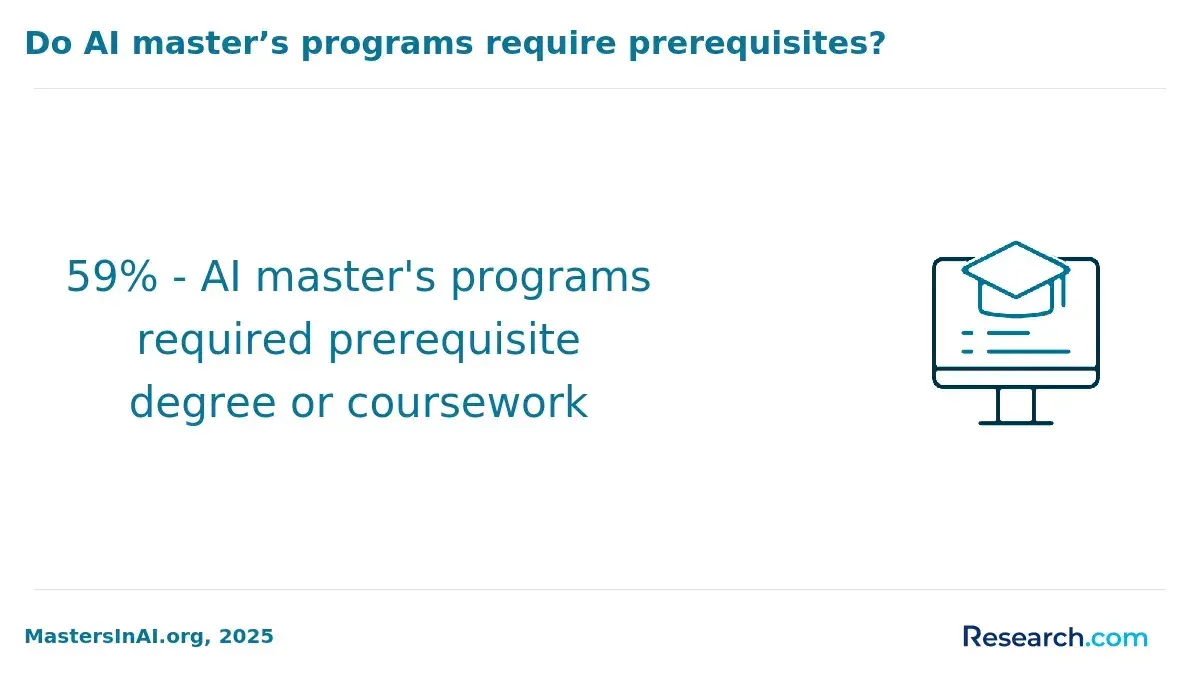
Master's programs typically expect a bachelor's degree in computer science, engineering, mathematics, or a related discipline. Candidates should demonstrate programming experience in languages like Python, Java, or C++. Prerequisites often include knowledge of data structures, algorithms, linear algebra, probability, and statistics. Application materials commonly involve GRE scores, statements of purpose, and letters of recommendation focusing on technical and research skills.
Practical experience gained through internships or projects in machine learning, robotics, or data analytics significantly strengthens applications. Some programs ask for prior coursework in fundamental AI or machine learning principles. Students lacking certain prerequisites can often pursue foundation or bridge courses before admission. Admissions committees prioritize candidates with proven problem-solving abilities and dedication to research or innovation in AI.
Employment in AI-related fields is expected to grow by 26% between 2023 and 2033, highlighting the importance of meeting these requirements. Graduates well-prepared in these areas enjoy stronger career stability and opportunities, as noted by Scholaro summarizing U.S. Bureau of Labor Statistics data.
How long do AI degree programs usually take, and what costs and financial aid should you expect?
AI degree programs vary widely in length, from short certificate courses lasting 6 months to 1 year, to bachelor's degrees that typically take 3 to 4 years. Master's degrees generally range from 1 to 2 years, offering specialized training and research opportunities. PhD programs can extend from 3 to 6 years, focusing on advanced methodologies and original research.
Costs also differ depending on the institution and program type. Public universities often charge between $10,000 and $30,000 annually for in-state students, while private and specialized AI schools frequently exceed $40,000 per year. More affordable online programs sometimes cost under $20,000 total, and professional certificates fall between $2,000 and $10,000.
Financial aid options include merit-based scholarships, need-based grants, employer tuition assistance, and federal student loans. Many graduate programs also offer assistantships or research grants. Prospective students should explore scholarships specific to AI or STEM areas.
Recent findings from Business Journalism's "AI skills are in demand, but is it enough for new grads?" report indicate a decline in employment rates for early-career AI graduates in AI-focused roles during the first few years after graduation. This highlights the importance of gaining internships, practical experience, and networking alongside formal education to navigate a competitive job market.
How strong is the long-term job outlook and employer demand for AI professionals in the U.S.?
By 2026, 35% of entry-level jobs in the U.S. will require skills related to artificial intelligence, reflecting strong and growing employer demand. Approximately 4.2% of full-time job listings now explicitly mention AI, nearly double last year's share, signaling rapid integration of AI across industries (CNBC Select).
This surge highlights the value of investing early in AI expertise for long-term career resilience and advancement. Employers in technology, healthcare, finance, and manufacturing increasingly seek candidates skilled in machine learning, natural language processing, and data analytics. Careers include AI engineers, data scientists, and product managers with AI capabilities.
Prospective students and professionals should develop practical AI skills targeted to industry needs. Combining AI knowledge with cybersecurity or bioinformatics, for example, enhances employability. Continuous learning through certifications or advanced degrees remains crucial for those pursuing higher-level roles and salary growth.
Geographic location and industry sector influence AI job opportunities. Urban tech hubs and specialized companies offer more openings, but AI adoption is expanding in traditional industries nationwide. AI proficiency is no longer niche-it's becoming a baseline hiring qualification.
- Focus on applied AI skills aligned with industry trends.
- Prioritize continual education to stay competitive.
- Consider local job market variations in AI demand.
US students and workers aiming for sustainable careers should emphasize AI skills now to access growing roles and long-term salary benefits. For further insights, see CNBC Select.
Other Things You Should Know About Artificial Intelligence
AI degree programs in 2027 that offer robust industry-relevant specializations include Stanford University, MIT, and Carnegie Mellon University, each known for their focus on machine learning, natural language processing, and robotics, making them highly attractive to employers seeking specialized AI expertise.
Yes, internships are crucial for AI students as they offer practical experience with real-world applications of artificial intelligence technologies. They help students build professional networks, improve technical skills, and increase employability after graduation. Many top AI programs encourage or require internships to complement academic learning.
Ethics is a growing focus within artificial intelligence education, addressing concerns like bias, privacy, and responsible use of AI systems. Programs often include dedicated courses or modules on AI ethics to prepare students to create fair and transparent technologies. Understanding ethical implications is essential for developing trustworthy AI applications.
Research projects are integral to artificial intelligence degree programs, allowing students to apply theoretical knowledge to innovative problems. These projects enhance critical thinking, problem-solving, and technical skills by tackling cutting-edge AI challenges. Participation in research can also strengthen resumes and open opportunities for advanced study or industry roles.
References
- The most future-proof IT degree programs that won’t be replaced by AI. https://itcompare.pl/en-us/articles/68/the-most-futureproof-it-degree-programs-that-won-t-be-replaced-by-ai
- How Much Does it Cost to Learn AI? https://blog.nobledesktop.com/learn/ai/ai-cost-to-learn
- How Online AI Master's Degrees Affect Salary in 2026 https://www.nexford.edu/insights/how-online-ai-masters-degrees-affect-salary
- Artificial Intelligence Degree Requirements: What Do You Need to Apply? https://aifwd.com/education/artificial-intelligence-degree-requirements/
- Bachelor in Management and Artificial Intelligence https://www.kozminski.edu.pl/en/programs/undergraduate-programs-bachelor/bachelor-management-and-artificial-intelligence
- What Do You Learn In an Artificial Intelligence Course? | CompSci https://www.computerscience.org/resources/artificial-intelligence/
- 16 Artificial Intelligence Career Paths https://www.calmu.edu/news/artificial-intelligence-career-paths
- Here’s How an AI Degree Stacks Up Against Other Options https://www.aidegree.org/blog/comparison-table
- Top 5 AI Certifications That Actually Help You Get Hired https://aixqp.com/top-5-ai-certifications-that-actually-help-you-get-hired/
- Application for the Master's program https://www.informatik.uni-bonn.de/en/studies/master-programs/master-program-application