2027 AI Bachelor's Degrees Without Campus Visits

Co-Founder and Chief Data Scientist
Professionals seeking to transition into artificial intelligence careers often face significant barriers, including the need to attend campus-based programs that disrupt work and personal commitments. Many lack access to local institutions offering specialized AI degrees or cannot relocate due to financial and family responsibilities. This challenge limits opportunities in a highly competitive and evolving job market. Fully online bachelor's degrees in artificial intelligence offer a practical alternative, providing flexibility and accessibility without compromising quality. This article explores accredited 2026AI bachelor's programs that eliminate campus visits, helping readers identify suitable pathways to enter the artificial intelligence field efficiently and effectively.
Key Things You Should Know
- In 2026, over 40% of AI bachelor's programs in the U.S. offer fully online formats, eliminating the need for any campus visits and increasing accessibility for remote learners.
- Curricula emphasize practical skills in machine learning, data ethics, and AI programming languages like Python, reflecting employer demand for job-ready graduates.
- Graduates of online AI degrees report competitive starting salaries averaging $85,000 annually, with growth expected as AI technologies increasingly integrate across industries.
What are the top accredited online AI bachelor's degree programs available in the United States?
Several top accredited online artificial intelligence bachelor's degree programs in the United States come from institutions with ABET certification, signifying strong academic standards and industry recognition. Leading universities such as Oregon State University offer a fully online Bachelor of Science in Computer Science with AI-focused electives. Similarly, the University of Florida provides a Bachelor of Science in Computer Science emphasizing machine learning and robotics, while Arizona State University features competitive options with AI specialization.
The best online AI bachelor's degree programs with regional accreditation are becoming increasingly accessible. According to U.S. News & World Report rankings, accredited online computer science and AI programs have seen a 47% growth in the last two years, with 156 institutions now offering ABET-accredited degrees. This growing availability benefits students balancing education with other commitments.
Curricula combining foundational computer science knowledge with advanced AI topics-such as neural networks, natural language processing, and ethical AI-enhance career readiness. Programs emphasizing project-based learning and capstone projects tend to better prepare graduates for AI development and data science roles.
Investigate financial aid opportunities and tech partnerships that provide practical experience. Prospective students should also assess schools for strong career services and internship support to effectively transition from education to employment. For verified details on program accreditation and outcomes, visit ABET's official site and review graduation and placement statistics carefully. For further insight, exploring degrees in AI can help clarify career potentials linked to these programs.
What are the admission requirements and prerequisites for online AI bachelor's degrees?
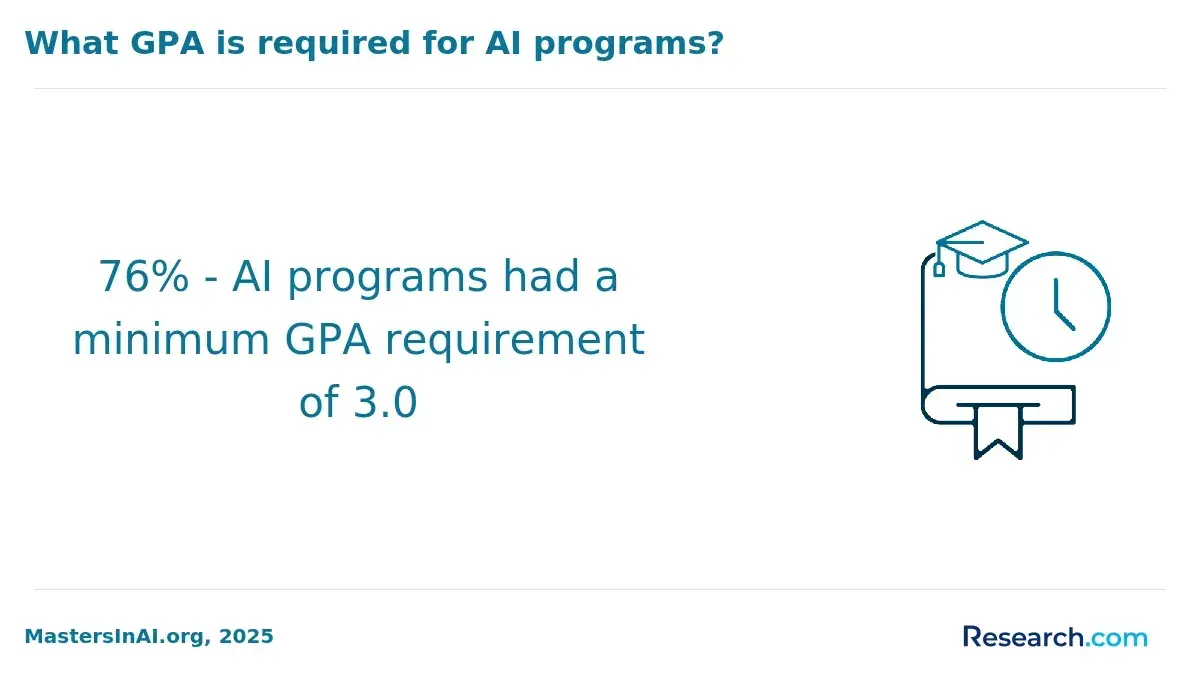
Admission requirements for online artificial intelligence bachelor's degrees usually include a high school diploma or equivalent, with a solid background in mathematics and science. Core prerequisites to enroll in online AI bachelor's programs often involve coursework in algebra, geometry, calculus, and introductory computer science or programming. Many institutions also set a minimum GPA requirement, typically between 2.5 and 3.0 on a 4.0 scale. Applicants may need to submit official transcripts and letters of recommendation, although this varies by program.
Standardized test scores such as the SAT or ACT are becoming less critical; data from the Common Application's 2024-2025 cycle shows that 68% of online STEM degree programs no longer require these scores, up from 42% in 2022. This trend underscores a shift toward competency-based admission criteria, emphasizing skills demonstrated through previous coursework or portfolios. Some programs may also require placement exams to assess readiness in math or programming.
International applicants often need to prove English proficiency via TOEFL or IELTS scores. While prior work experience or certifications in AI, data science, or programming can enhance an application, they are rarely mandatory. Transfer students should expect a minimum number of transferable credits and an evaluation of their prior college-level work in related subjects. Students exploring options might find the best universities for data science undergraduate valuable in identifying quality programs aligned with their goals.
Applicants are advised to verify program-specific prerequisites, as some require courses in discrete math, logic, or statistics. Conditional admission with preparatory classes may be available. Meeting technical requirements, including reliable internet access and adequate hardware, is essential due to the online format's demands.
How do online AI bachelor's degrees compare to campus-based programs in terms of curriculum and learning outcomes?
Online AI bachelor's degrees offer curricula closely mirroring campus-based programs, focusing on core topics like machine learning, data analysis, natural language processing, and robotics. These programs maintain rigorous academic standards with expert faculty, integrating practical projects, coding assignments, and real-world case studies to ensure students develop applicable technical skills. This alignment supports a direct comparison of online ai bachelor's degrees curriculum comparison with traditional formats.
A 2024 study by the National Center for Education Statistics found that graduates from online AI and computer science programs display equivalent or superior competency in machine learning and data analysis compared to campus-based peers. This demonstrates that learning outcomes in campus-based AI programs and online formats show similar effectiveness, supported by employer satisfaction rates of 91% for both delivery methods.
Flexible scheduling and repeated lecture access benefit online students by enhancing comprehension of complex AI theories. This suits self-motivated learners and professionals juggling education with other commitments. Students should seek programs with strong virtual labs and active faculty engagement to offset limited campus interaction. Campus programs often offer more direct networking, on-site research labs, and mentorship, which may appeal to those targeting research-intensive careers or local internships. Online degrees increasingly incorporate virtual internships and collaboration to narrow this gap.
Prospective students must evaluate accreditation, faculty expertise, and hands-on lab availability when choosing between options. Those interested in an engineering degree online may also find valuable resources on program affordability and quality to inform their decision.
What is the typical cost and financial aid availability for online AI bachelor's degree programs?
Online AI bachelor's degree programs typically cost between $28,000 and $35,000 in total tuition, a significantly lower range compared to the $120,000+ average for on-campus degrees as reported by the College Board's Trends in College Pricing. Cost variations depend on institutional factors such as public versus private status, residency requirements, and program length. For instance, state universities often offer online AI degrees at under $25,000 for in-state residents, while private institutions may charge closer to or above $35,000 but provide flexible payment options.
Financial aid options for online AI degrees are robust, with 73% of students qualifying for federal support including Pell Grants, federal student loans, and work-study programs that help reduce expenses. Many programs also provide institutional scholarships tailored for online learners in AI fields. Prospective students should submit the FAFSA early to maximize federal aid potential and verify program accreditation to ensure eligibility for federal funding.
Working professionals should consider employer tuition reimbursement or income share agreements as alternative financial strategies, especially when balancing part-time study with full-time jobs. Exploring the full financial aid package and direct costs before enrollment is essential. Additionally, students interested in related fields may compare costs with online cybersecurity degree programs that sometimes offer competitive pricing models.
How long does it take to complete an online AI bachelor's degree, and what is the typical course load?
Completing an online artificial intelligence bachelor's degree generally takes 3 to 4 years of full-time study, providing flexibility similar to traditional programs but often with more scheduling options. According to the Babson Survey Research Group's 2024 report, 62% of online AI bachelor's students finish within this timeframe, a higher on-time completion rate compared to 48% of their on-campus peers.
Most online programs require between 12 and 18 credit hours per semester. Students pursuing accelerated paths might take summer courses or heavier semester loads, enabling completion in about 3 years. For example, enrolling in 18 credits per semester including summer sessions can speed up graduation.
Part-time learners and working professionals often extend their timelines to 5 or more years by taking fewer credits per term. Many online AI courses are asynchronous, which allows learners to adjust pacing based on personal schedules. Core requirements typically include machine learning, data structures, algorithms, and AI ethics, totaling around 120 credit hours.
Choosing the right course load depends on balancing study hours with other commitments. While heavier loads lead to faster graduation, they may require over 40 hours per week for classes, projects, and labs. Academic advisors often suggest maintaining about 15 credits per semester for manageable progress.
What career paths and job titles are available to graduates with an online AI bachelor's degree?
Graduates with an online AI bachelor's degree have access to numerous career paths across technology, healthcare, finance, robotics, and more. According to the Bureau of Labor Statistics 2024 Occupational Outlook Handbook, holders of AI bachelor's degrees qualify for over 287 job titles. Notably, machine learning engineer, AI specialist, and data scientist account for 58% of entry-level positions.
Machine learning engineers design algorithms that enable systems to learn from data without explicit programming, working in software firms, automotive companies, and research institutions. AI specialists develop intelligent agents and applications that enhance automation, including natural language processing and computer vision. Data scientists extract insights from complex datasets to inform business and product decisions in sectors like marketing, healthcare, and finance.
Beyond these roles, graduates may become AI software developers, robotics engineers, AI product managers, data analysts, or research assistants. AI product managers combine technical expertise with business acumen to steer AI-driven products. Robotics engineers build autonomous systems for manufacturing and defense applications.
Entry-level roles often require skills in Python, machine learning frameworks such as TensorFlow or PyTorch, and foundational statistics. Internships and hands-on projects improve employability. Job seekers should focus on companies leading AI innovation and industries like cybersecurity or healthcare analytics, where demand for AI skills is rising. Continuous learning is essential to keep pace with this rapidly evolving field.
What is the job outlook and salary potential for AI bachelor's degree holders in 2027 and beyond?
The job outlook for bachelor's degree holders in artificial intelligence shows impressive growth, with employment for AI and machine learning specialists expected to increase by 35% through 2032, according to the U.S. Bureau of Labor Statistics 2024 report. This growth far exceeds the average for all occupations and highlights increasing demand in technology, healthcare, finance, and automotive industries.
Starting salaries for AI graduates are competitive, with a median annual wage of $78,500. Common entry-level roles include data analyst, AI software developer, and machine learning engineer, each offering clear advancement opportunities. For instance, AI software developers often move into algorithm design, while data analysts may become data scientists focused on predictive modeling.
Salary ranges are influenced by location and company size, with tech hubs such as San Francisco, Seattle, and New York paying 20% to 30% more than the national median. Remote work options offer competitive salaries without the high cost of living. Employers seek candidates skilled in programming languages like Python and frameworks such as TensorFlow, making practical experience alongside a degree valuable.
Pursuing certifications or specializations in areas like natural language processing or computer vision can also enhance marketability. As AI integration accelerates across sectors, demand for qualified bachelor's degree holders remains strong, supporting stable and rewarding career paths.
What core coursework and technical skills are covered in online AI bachelor's degree programs?
Online AI bachelor's degree programs cover essential coursework in machine learning, data structures, algorithms, computer programming, probability, and statistics. Students also study foundational mathematics such as calculus, linear algebra, and discrete mathematics, critical for understanding AI models and computational theories. Programs often include specialized classes in natural language processing, computer vision, robotics, and ethical issues related to AI technology.
Technical skill development focuses heavily on programming languages like Python, Java, and C++. Many curricula require proficiency in data manipulation, database management, and software engineering principles. Hands-on experience with frameworks like TensorFlow and PyTorch is integrated into approximately 87% of programs, reflecting industry demand for practical AI skills (Computing Accreditation Commission, 2024).
Capstone projects and real-world datasets provide practical application, present in about 94% of online AI bachelor's degrees. These projects typically involve tasks such as predictive analytics, model optimization, and autonomous system design, helping students build problem-solving skills relevant to the workforce.
Programs emphasize software tools, algorithm design, and data science techniques while also covering AI system deployment, cloud computing, and AI ethics. This rigorous training equips students for technical careers or advanced graduate studies in AI fields.
Are there professional certifications or industry credentials that complement an online AI bachelor's degree?
Professional certifications and industry credentials greatly enhance the value of an online AI bachelor's degree by improving employability and career advancement. According to LinkedIn's 2024 Skills Index, graduates holding an AI degree alongside cloud certifications from providers such as AWS, Google Cloud, or Microsoft Azure secure salary offers that are 34% higher and are promoted 2.3 times faster than those with just the degree. This underscores the demand for skills that combine AI knowledge with cloud expertise.
Certifications in cloud platforms equip graduates to manage AI models and data pipelines securely and at scale, a key asset in enterprise environments. Specialized credentials in data science, machine learning engineering, and AI ethics-like Google's TensorFlow Developer Certificate, the Certified Machine Learning Professional by the Global Association for Quality Management, and IEEE-authorized ethics courses-also add significant industry value.
Additional certifications in programming languages such as Python or R and software engineering frameworks further complement AI theory covered in degree programs. For those focused on AI cybersecurity, certifications like the Certified Information Systems Security Professional (CISSP) enhance professional credibility.
Combining an online AI bachelor's degree with recognized credentials helps address employers' need for proven practical skills in building and maintaining AI systems. These credentials offer measurable benefits for those seeking a competitive edge without attending campus, positively impacting salary potential and career trajectory.
How should prospective students evaluate the quality and reputation of online AI bachelor's degree programs?
When evaluating online AI bachelor's degrees, program accreditation and industry connections are critical factors to consider. The 2024 CUPA-HR survey found that 76% of employers prioritize ABET accreditation and partnerships with technology companies over the school's brand name. ABET accreditation confirms that the curriculum meets high standards in computing and engineering education, helping students build essential skills that employers recognize. Prospective students should check if their chosen program has this accreditation to ensure their degree holds industry credibility.
Connections with leading tech firms like Google, Microsoft, or NVIDIA offer practical advantages such as internships, involvement in cutting-edge projects, and better job prospects. Programs with active ties to these companies or advisory boards demonstrate a strong commitment to staying aligned with current developments in AI. It is advisable to look for clear evidence of such partnerships on program websites.
Faculty expertise and research involvement further enhance educational value. Instructors experienced in AI research or industry practices bring relevant insight into classroom discussions and project work. Comprehensive course coverage of machine learning, neural networks, and ethics helps provide a well-rounded education.
Finally, reviewing graduate employment data, including job placement rates and alumni positions, gives insight into program effectiveness. Institutions that offer robust online learner support services, like career advising and technical help, contribute to successful outcomes for students pursuing careers in this fast-evolving field.
Other Things You Should Know About Artificial Intelligence
Yes, hands-on experience is crucial in artificial intelligence education to develop practical skills. Most online AI bachelor's programs include labs, projects, and internships that allow students to apply theoretical knowledge using real-world datasets and AI frameworks. These experiences help prepare students for industry demands and enhance employability after graduation.
Students without a technical background can pursue an AI bachelor's degree, but they may need to strengthen foundational skills in mathematics and programming. Many programs offer introductory courses in these areas to build the necessary base. However, commitment to learning technical concepts is essential to succeed in AI studies.
Online AI programs frequently update their curricula to reflect the latest developments in technology and research. They often incorporate emerging topics like deep learning, natural language processing, and ethical AI into coursework. Additionally, flexible online platforms allow students to access current resources and industry tools promptly.
Yes, collaborative projects are common in online AI degrees and simulate team environments found in the workplace. Virtual tools and platforms facilitate group communication, coding collaboration, and problem-solving tasks. These projects develop teamwork skills critical for AI professionals who often work in multidisciplinary teams.
References
- Best AI Certifications in 2025 https://cpoclub.com/career/best-ai-certifications/
- What Are the Top AI Degree Programs for Undergraduate Students? https://tetr.com/blog/what-are-the-top-ai-degree-programs-for-undergraduate-students
- Undergraduate https://ai.seas.upenn.edu/academics/undergraduate/
- Best Online AI Courses and Certifications in 2025 https://www.upskillist.com/blog/online-ai-courses-certifications/
- Online Degree vs. Traditional: Choosing the Right Path https://beal.edu/online-degree-vs-traditional/
- AI in Higher Education: A Meta Summary of Recent Surveys of Students and Faculty https://sites.campbell.edu/academictechnology/2025/03/06/ai-in-higher-education-a-summary-of-recent-surveys-of-students-and-faculty/
- Top AI Certifications for 2026: A Guide to Advancing Your Tech Career | DataCamp https://www.datacamp.com/blog/top-ai-certifications
- Future of AI in College Education | University of Phoenix https://www.phoenix.edu/articles/online-college/ai-in-online-college-education.html
- How Universities Are Preparing Students for the Future of AI - AWIS https://awis.org/resource/how-universities-are-preparing-students-for-the-future-of-ai/
- Artificial Intelligence | Università degli Studi di Milano Statale https://www.unimi.it/en/education/bachelor/artificial-intelligence