2027 Best AI Master's Degrees for AI Policy Careers

Co-Founder and Chief Data Scientist
Choosing a master’s program for an AI policy career is not the same as choosing a purely technical AI degree. The best fit depends on the type of policy work you want to do, how much technical depth you need, whether you can study online or on campus, and whether the cost is justified by the career path you are targeting.
AI policy roles sit between technology, law, ethics, risk, public administration, and organizational governance. They are a strong fit for professionals with backgrounds in public policy, law, computer science, data science, engineering, compliance, security, social science, or business who want to help organizations use AI responsibly and meet evolving regulatory expectations.
This guide explains what AI policy-focused master’s programs teach, how to compare accredited options, which coursework matters most, what admissions committees commonly expect, how online and campus formats differ, how long programs take, what they cost, and which jobs and salary ranges graduates may pursue.
Key Things You Should Know
- AI master's programs focusing on policy blend technical skills with ethics, law, and governance to prepare graduates for regulatory roles amid a 35% job growth expected in this sector by 2030.
- Top U.S. universities now incorporate interdisciplinary curricula addressing bias, data privacy, and human rights, reflecting 2025's increased demand for socially conscious AI leaders.
- Graduate students benefit from partnerships with government agencies and think tanks, providing real-world experience crucial for shaping AI policy frameworks and ensuring responsible innovation.
What is an AI master's degree focused on AI policy careers?
An AI master’s degree focused on policy careers is a graduate program that prepares students to evaluate, govern, and shape the use of artificial intelligence in organizations and society. Unlike a traditional computer science master’s, it does not focus only on building AI systems. It also examines how AI affects privacy, civil rights, security, labor markets, public services, competition, accountability, and legal compliance.
These programs are usually interdisciplinary. Students study enough AI, data science, and machine learning to understand how systems work, then pair that technical foundation with coursework in ethics, law, risk management, regulation, public policy, and institutional governance. The goal is to produce graduates who can translate between technical teams, executives, lawyers, regulators, and the public.
Common areas of study include:
- AI governance frameworks and responsible AI principles
- Machine learning foundations and algorithmic transparency
- Privacy, cybersecurity, and data protection
- Bias, fairness, explainability, and accountability
- Technology law, public policy, and regulatory analysis
- Risk assessment, audit methods, and compliance operations
- International AI governance and cross-border regulatory issues
The need for this training is growing as AI regulation expands. Federal agencies issued 59 AI-related regulations recently, more than double the previous period. That shift is creating demand for professionals who understand both the capabilities of AI systems and the policy frameworks used to manage their risks.
Graduates may work as policy analysts, AI governance specialists, compliance officers, AI ethics consultants, legal technology advisors, public sector analysts, or risk managers. Strong candidates can read technical documentation, evaluate policy trade-offs, write clearly for nontechnical audiences, and explain how AI decisions affect people and institutions.
Prospective students should look for programs with applied policy projects, faculty involved in AI governance research, connections to government or research centers, and coursework that directly covers legislation, privacy law, ethical standards, and algorithmic accountability. For a broader view of related career options, explore what you can do with AI degrees.
Which master's programs best prepare graduates for AI policy roles?
The strongest master’s programs for AI policy roles combine technical AI literacy with policy analysis, ethics, law, governance, and applied decision-making. A program does not need to be branded only as an “AI policy” degree to be useful. Some of the best pathways are housed in public policy schools, computer science departments, law and technology centers, data science programs, or interdisciplinary technology governance institutes.
Demand for this training is being shaped by government and employer requirements. The White House Office of Management and Budget’s 2024 guidance (M-24-10) mandates U.S. federal agencies to appoint Chief AI Officers and establish AI Governance Boards. Programs that help students understand governance boards, risk reviews, procurement standards, impact assessments, and compliance documentation are especially relevant for public-sector and regulated-industry roles.
Look for programs that include the following elements:
- Technical AI foundations: machine learning, data analytics, model evaluation, algorithmic transparency, and limitations of AI systems.
- Policy and governance training: AI ethics, public administration, regulatory design, digital governance, legislative analysis, and institutional accountability.
- Legal and compliance exposure: privacy, cybersecurity, intellectual property, civil rights, procurement, audit requirements, and risk controls.
- Applied experience: internships, practicums, policy labs, capstone projects, consulting projects, or partnerships with agencies, think tanks, nonprofits, or technology companies.
- Interdisciplinary faculty: instructors with backgrounds in computer science, law, public policy, sociology, ethics, economics, security, and data governance.
Examples include Carnegie Mellon University’s Master of Science in Public Policy and Management with AI specialization and Stanford University’s Master in Computer Science with AI Policy tracks. The right choice depends on whether you want deeper technical preparation, stronger policy training, or a balanced interdisciplinary credential.
Use the comparison below to clarify which type of program may fit your target role:
| Program emphasis | Best fit for students targeting | What to verify before enrolling |
| Public policy with AI specialization | Government, think tanks, advocacy, public-sector consulting | Whether the curriculum includes enough AI and data analysis to work with technical teams |
| Computer science or AI with policy track | Technical governance, AI assurance, model risk, product policy | Whether the program offers serious coursework in law, ethics, and regulatory analysis |
| Law, technology, or governance-focused master’s | Compliance, regulatory affairs, privacy, legal operations | Whether students receive practical exposure to AI systems and data-driven decision-making |
| Data science with policy or ethics coursework | Responsible AI analytics, risk assessment, AI auditing | Whether policy training goes beyond a single ethics course |
Working professionals should also compare delivery format, advising quality, employer partnerships, and access to policy workshops. A program with strong career services and applied governance projects may be more valuable than one with a prestigious name but little direct preparation for AI regulation work.
Students who want to strengthen adjacent technical expertise may also compare options such as a mechanical engineering program online, particularly if they are interested in AI policy for robotics, manufacturing, transportation, or safety-critical systems.
How do you choose an accredited AI policy master's program?
Start by confirming institutional accreditation. In North America, students should verify that the college or university holds regional accreditation recognized by the U.S. Department of Education or the Council for Higher Education Accreditation. Accreditation affects academic quality assurance, transferability, employer recognition, and eligibility for federal aid.
After accreditation, evaluate the program’s actual fit for AI policy work. A strong program should not treat AI ethics as an add-on. It should integrate technical understanding, policy analysis, regulatory frameworks, data governance, and applied decision-making throughout the curriculum.
Use these criteria when comparing programs:
- Accreditation: Is the institution regionally accredited and recognized by employers, agencies, or policy organizations?
- Curriculum balance: Does the program teach both AI technical foundations and policy analysis?
- Faculty expertise: Are faculty members active in AI policy research, standards work, advisory roles, regulation, public administration, law, or responsible AI practice?
- Applied learning: Are there policy labs, capstones, internships, simulations, consulting projects, or collaborations with government bodies, think tanks, or industry partners?
- Career outcomes: Does the program publish employment data, employer examples, alumni roles, or salary outcomes?
- Format and pacing: Can you complete the program full time, part time, online, hybrid, or on campus without undermining your career or finances?
- Career services: Does the school help students access policy internships, fellowship opportunities, government hiring pathways, or responsible AI roles in industry?
Graduate outcomes can help you judge return on investment, but they should be interpreted carefully. Median annual earnings around $131,000 two years post-graduation from computer and information sciences master’s programs show strong demand in adjacent technical fields. However, individual outcomes depend on prior experience, location, employer type, security clearance needs, technical skill level, and whether the role is in government, consulting, technology, or nonprofit policy work.
Before applying, read course descriptions rather than relying only on program titles. Some programs use AI-related marketing language but offer limited coursework in governance, privacy, or regulation. Others may have excellent policy content but not enough technical depth for roles that require collaboration with engineers or model risk teams.
If cost is a major factor and you want to build technical strength before or alongside AI policy study, you may also compare an affordable online engineering degree as part of a broader education plan.
What coursework and skills matter most for AI policy careers?
AI policy professionals need more than general interest in ethics or technology. They must understand how AI systems are developed, where they fail, how data is collected and used, and how laws, standards, and organizational controls can reduce harm without blocking useful innovation.
Coursework in AI and big data analytics is especially important. The World Economic Forum’s Future of Jobs Report 2025 highlights “AI and big data” as the fastest-growing skill category for 2025-2030. For policy professionals, this does not always mean becoming a machine learning engineer, but it does mean developing enough technical fluency to ask informed questions and challenge weak claims.
High-value coursework often includes:
- Machine learning concepts, model evaluation, and AI system limitations
- Data governance, privacy, cybersecurity, and information risk
- Algorithmic bias, fairness, explainability, and accountability
- Technology law, administrative law, digital rights, and public policy
- Regulatory impact analysis and compliance program design
- Statistics, causal reasoning, and empirical policy evaluation
- Public administration, procurement, standards, and institutional governance
- Policy writing, stakeholder engagement, and risk communication
Important technical skills include familiarity with Python, R, data analysis tools, machine learning workflows, and model documentation. You do not need to be the strongest programmer in the room for many policy roles, but you should be able to understand technical evidence, recognize inflated claims, and communicate with engineers without losing the policy question.
Equally important are judgment and communication skills. AI policy work often involves trade-offs: accuracy versus fairness, innovation versus safety, privacy versus personalization, transparency versus security, and automation versus human oversight. Employers value professionals who can write concise policy briefs, design review processes, evaluate risk, and explain recommendations to executives, regulators, technical teams, or the public.
Practical experience matters. Internships or projects with government agencies, think tanks, international organizations, civil society groups, or regulated companies can help students turn classroom knowledge into usable evidence. Strong capstone projects often involve AI impact assessments, governance playbooks, model audit frameworks, privacy reviews, procurement guidance, or regulatory memos.
Students who want a stronger technical foundation may consider a master data science online as one route to build AI, analytics, and data governance skills. Programs that combine data science with policy ethics can be especially useful for responsible AI, risk, and compliance roles. Online master’s in data science programs can also be relevant for applicants who need more quantitative preparation before moving into AI governance work.
What admission requirements are common for AI policy-focused AI master's programs?
Admission requirements vary by school, but most AI policy-focused master’s programs look for evidence that applicants can handle graduate-level analytical work and contribute to interdisciplinary discussions about technology and society. Applicants may come from computer science, public policy, law, data science, engineering, economics, political science, business, security, or related fields.
Many U.S. schools have moved away from requiring the GRE, following the widespread GRExit trend that places more weight on transcripts, writing ability, professional experience, and demonstrated quantitative preparation. If a program lists the GRE as optional, submit scores only if they strengthen your application.
Common application requirements include:
- A bachelor’s degree in a relevant or transferable field, such as computer science, public policy, data science, engineering, law, economics, political science, or business.
- Official transcripts, often showing a GPA typically around 3.0 or higher.
- Evidence of quantitative readiness through coursework in statistics, mathematics, economics, computer science, research methods, or data analysis.
- Proof of coding or technical exposure, often through Python, R, data analytics coursework, professional projects, certifications, or work experience.
- A statement of purpose explaining your interest in AI policy, ethics, regulation, governance, risk, public administration, or societal impact.
- Recommendation letters from faculty, supervisors, or policy professionals who can speak to your analytical ability, writing, judgment, and readiness for graduate study.
- A resume showing relevant work, internships, research, public service, compliance, technology, legal, nonprofit, or think tank experience.
- Writing samples or short essays on AI, technology policy, public policy, ethics, law, or governance when requested.
International students often need TOEFL or IELTS scores to verify English proficiency. Some programs may also request credential evaluations, financial documentation, or additional application materials.
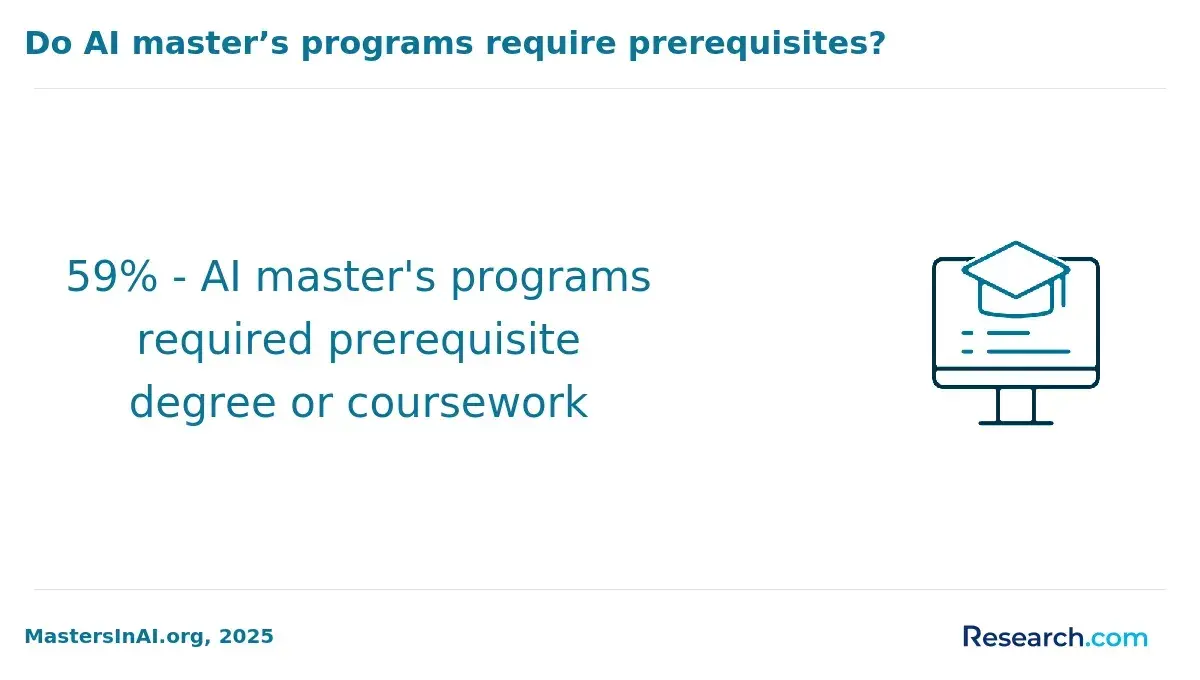
If your undergraduate degree is unrelated, focus on closing readiness gaps before applying. Useful steps include completing courses in statistics, Python, data analysis, public policy, AI ethics, or privacy; building a small policy portfolio; publishing a short writing sample; or volunteering on technology governance projects. Admissions committees are often willing to consider career changers when the application clearly explains why the applicant is prepared for the program and how the degree supports a realistic career goal.
Should you choose an online or campus AI master's for policy work?
Choose an online AI master’s for policy work if you need flexibility, want to keep working, cannot relocate, or already have access to professional networks. Choose a campus program if you need in-person networking, structured internships, close faculty access, or proximity to government agencies, policy organizations, and technology employers.
Online graduate education is now widely used. Data from the National Center for Education Statistics indicates that a majority of U.S. graduate students take at least one distance-education course, reflecting the growing acceptance of remote learning. For working professionals, online study can make an AI policy master’s possible without leaving a job or moving to a high-cost policy hub.
Campus programs can still offer advantages that are hard to replicate online. In-person policy simulations, research assistantships, networking events, guest lectures, and local internships may be especially valuable for students entering the field without an existing policy network. Many Washington, D.C.-based programs integrate internships and collaborations with government agencies, which can be useful for students aiming at federal policy, public affairs, regulatory, or think tank roles.
| Format | Advantages | Possible drawbacks |
| Online | Flexible scheduling, no relocation, easier to combine with full-time work, broader geographic access | Requires self-discipline, may offer fewer informal networking opportunities, internships may require more independent effort |
| Campus | Stronger in-person networking, easier access to faculty, policy events, labs, and local internships | May require relocation, less schedule flexibility, possible higher living costs |
| Hybrid | Combines remote coursework with selected in-person experiences | Travel requirements can add cost and scheduling complexity |
Ask the following before deciding:
- Will the online program provide live interaction, faculty access, and career support, or is it mostly self-paced content?
- Does the campus program offer internships or policy placements that justify relocation?
- Can you attend networking events, conferences, or policy workshops while enrolled online?
- Does the program help distance learners find capstone projects or applied governance experience?
- Will the degree format be clearly accepted by your target employers?
Regardless of format, prioritize accreditation, curriculum depth, applied experience, and placement support. A well-designed online program can be a strong choice for experienced professionals, while a campus program may be better for students who need to build a new network from the ground up.
How long do AI policy-oriented AI master's programs take to complete?
AI policy-oriented master’s programs generally take about two years to complete. That aligns with the National Center for Education Statistics (NCES) median time-to-degree of 24 months for U.S. master’s degrees. The exact timeline depends on credit requirements, enrollment status, course availability, capstone or thesis expectations, and whether the program is online, hybrid, or campus-based.
Most programs require a combination of AI coursework, policy analysis, ethics, law or governance courses, electives, and an applied project. Students should check whether key courses are offered every term or only once per year, because limited course availability can affect graduation timing.
- Full-time students: Usually complete 30 to 36 credit hours within two years.
- Part-time students: May take three or more years, which can work well for professionals balancing study with employment.
- Accelerated students: Can sometimes finish in 12 to 18 months, but these tracks require heavier course loads and less flexibility.
- Online or hybrid students: May move faster or slower depending on how many courses they take each term.
Research, thesis, or policy lab requirements can lengthen the timeline, especially when students choose complex topics such as generative AI regulation, algorithmic audits, procurement standards, model risk management, or international AI governance. Capstone projects may also depend on external partners, data access, or faculty supervision.
Before enrolling, ask the program for a sample plan of study for full-time and part-time students. Also confirm whether summer courses are available, whether prerequisites are required, and whether transfer credits or prior graduate coursework can shorten completion time.
What do AI policy master's programs cost, and what aid is available?
AI policy master’s program costs vary widely by institution type, residency status, format, and whether the program is housed in a public policy, computer science, law, data science, or interdisciplinary school. On average, in-state students at public universities pay about $12,600 annually, whereas private nonprofit schools charge approximately $29,900 per year. These estimates cover tuition and fees but do not include additional expenses such as books, supplies, technology, travel, health insurance, relocation, or living costs.
When comparing programs, look beyond the advertised tuition. Calculate total cost to completion, not just annual tuition. A lower yearly price may not be cheaper if the program takes longer, offers fewer summer courses, or requires expensive residencies. A higher-cost program may be worth considering if it offers strong assistantships, employer connections, or career outcomes aligned with your goals.
Common funding options include:
- Research or teaching assistantships: These may provide tuition waivers and stipends, especially in research-active departments or interdisciplinary AI centers.
- Federal loans: Direct Unsubsidized Loans and Grad PLUS loans are generally accessible to eligible students, though Grad PLUS requires credit approval.
- Merit scholarships: Some universities offer awards for academic achievement, leadership, public service, technology policy, or AI-related study.
- Need-based grants: Some states and universities provide need-based support, though availability varies by school and student status.
- Employer tuition reimbursement: Government agencies, technology companies, consulting firms, and regulated employers may help fund part-time study when the degree supports the employee’s role.
- Fellowships: Entities such as the National Science Foundation and AI-focused policy think tanks may provide funding for candidates interested in AI ethics, governance, and regulation.
International students should confirm aid eligibility early because institutional support often favors U.S. residents. Online students should also verify whether they qualify for the same scholarships, assistantships, and student services as campus students.
Before accepting an offer, ask the school for a written estimate of tuition, fees, expected annual increases, required residencies, assistantship availability, and average debt among graduates if available. Cost matters most when viewed against your target role, expected salary range, and ability to keep working while enrolled.
What jobs can you get with an AI master's for policy careers?
With an AI master’s focused on policy, graduates can pursue roles that help organizations evaluate AI risks, comply with emerging rules, design governance systems, and communicate technology decisions to stakeholders. These jobs exist in government agencies, technology companies, consulting firms, think tanks, nonprofits, international organizations, universities, financial institutions, healthcare organizations, and other regulated industries.
Common job titles include:
- AI policy analyst: Studies AI trends, evaluates proposed regulations, writes policy briefs, and advises public or private organizations.
- AI governance specialist: Develops internal policies, review processes, documentation standards, and oversight structures for AI use.
- Responsible AI program manager: Coordinates ethics, fairness, transparency, risk, and compliance work across product, legal, security, and data teams.
- Risk and compliance manager: Helps organizations identify AI-related legal, operational, privacy, and reputational risks.
- Data governance manager: Oversees policies for data quality, privacy, access, retention, and responsible data use.
- Regulatory affairs specialist: Tracks AI-related laws, standards, and agency guidance and translates them into organizational action.
- AI ethics consultant: Advises organizations on fairness, accountability, explainability, human oversight, and public impact.
- Public sector technology advisor: Supports agencies developing AI procurement rules, governance boards, impact assessments, or implementation policies.
Labor-market data from Lightcast highlights a significant rise in demand for “responsible AI” skills across policy-related roles including risk, compliance, and governance. This suggests that employers increasingly value professionals who can connect AI knowledge with oversight, accountability, and practical implementation.
The best role for you will depend on your prior background. Applicants with technical experience may be competitive for AI assurance, model risk, or governance roles. Applicants with law, public policy, or compliance experience may fit regulatory affairs, ethics, privacy, or public-sector positions. Career changers should build a portfolio that shows applied work, such as policy memos, impact assessments, audit frameworks, or responsible AI governance plans.
To strengthen employability, develop expertise in AI ethics frameworks, compliance legislation, risk analysis, data privacy laws, algorithmic accountability, stakeholder communication, and technical documentation. Employers want candidates who can move from abstract principles to workable processes.
What salary and job outlook can AI policy professionals expect?
AI policy professionals can expect a strong outlook as governments, companies, and nonprofits respond to new expectations around AI governance, compliance, privacy, security, and ethical use. The field is not limited to one occupation, so salary and growth vary by role, employer, location, technical depth, and level of responsibility.
The U.S. Bureau of Labor Statistics projects a 32% growth in related roles such as Information Security Analysts between 2022 and 2032, outpacing many other occupations. While AI policy is broader than information security, that projection reflects the wider demand for professionals who can manage technology risk, protect data, and help organizations meet complex governance requirements.
Salary prospects vary by experience and specialization:
- Entry-level positions typically offer $75,000 to $90,000 annually, depending on location and employer.
- Mid-career professionals with skills in AI risk management or regulatory affairs can earn between $110,000 and $140,000.
- Senior roles like chief compliance officers or AI ethics directors often surpass $180,000, especially in tech companies, government, or consulting firms.
Higher salaries are more likely in roles that combine policy judgment with technical fluency, legal or compliance expertise, cybersecurity knowledge, product governance, or management responsibility. Government and nonprofit roles may pay less than large technology or consulting employers but can offer mission alignment, policy influence, and long-term stability.
Career mobility is strongest for professionals who can work across disciplines. Useful complements to an AI policy master’s include experience in law, data science, public administration, cybersecurity, privacy, risk management, procurement, and organizational change. Certifications in cybersecurity and risk management may also strengthen applications for employers navigating AI oversight and compliance challenges.
Other Things You Should Know About Artificial Intelligence
Many programs require a capstone or thesis to finish the degree, often worth 3 to 6 credits. For AI policy careers, the project usually examines governance, algorithmic accountability, or regulation. Some universities let students choose an internship-based practicum instead of a research thesis.
The best AI master's programs for aspiring AI policy experts in 2027 include Stanford University's MS in Computer Science with a focus on AI, Carnegie Mellon University's Master of Science in Public Policy and Management with AI specialization, and the University of Oxford's MSc in Social Data Science, which integrates AI policy coursework.
AI master's programs in 2027 prepare students for policy-making roles by offering specialized courses in AI ethics, data governance, and regulatory frameworks. They often include hands-on projects or internships with policy agencies or think tanks, providing practical experience in shaping AI-related legislation.
To enroll in a master's program in 2027 focused on AI policy, applicants typically need a bachelor's degree in a related field, demonstrate proficiency in programming languages, and pass the GRE or equivalent exam. Some programs may also require prior work experience in technology or policy sectors.
A successful career in AI policy requires strong analytical skills, legal knowledge, and technological literacy. Familiarity with data analysis and ethics helps frame AI issues. For those interested in combining technology with finance, an AI and financial technology master’s might also offer a complementary perspective.
References
- What are the best graduate degrees for policy work? - Emerging Technology Policy Careers https://emergingtechpolicy.org/pathways/graduate-school/2-comparing-options/
- Top 10 Careers You Can Pursue With an Online Master’s in AI https://www.ucumberlands.edu/blog/careers-you-can-pursue-with-an-online-masters-in-ai
- The Top Skills You Need for AI Jobs in 2025 — Multiverse https://www.multiverse.io/en-GB/blog/top-ai-skills
- How to Choose the Best Online Master’s in Artificial Intelligence for Your Career Goals https://aifolks.org/blogs/how-to-choose-the-best-online-masters-in-artificial-intelligence-for-your-career-goals
- Choosing a master’s degree: data science or artificial intelligence | edX https://www.edx.org/resources/choosing-a-masters-degree-data-science-or-artificial-intelligence
- Artificial Intelligence Jobs: Salary Overview by Seniority | Leland https://www.joinleland.com/library/a/ai-jobs-and-salaries
- Top AI Graduate Programs To Kickstart Your Career in Artificial Intelligence Today https://www.investopedia.com/top-ai-graduate-programs-to-kickstart-your-career-in-artificial-intelligence-today-11916749
- Market Analysis of 146 AI Governance Job Postings https://axialsearch.com/insights/ai-governance-jobs/
- Top No GRE AI Master's Programs for 2026 https://aidegreeprograms.org/rankings/top-ai-masters-programs-with-no-gre/
- How Long to Complete An AI Course if You’re Working Full Time? https://emeritus.org/in/learn/how-long-to-complete-an-ai-course/