2027 AI Master's Degrees for Journalists and Media Professionals

Co-Founder and Chief Data Scientist
Journalists and media professionals often face the challenge of adapting to rapidly evolving technology, especially when seeking to integrate artificial intelligence into their workflows. Traditional journalism programs may lack the technical focus needed for this pivot, leaving many without clear pathways to advanced skills in AI.
Finding accredited, flexible graduate programs that cater specifically to professionals from unrelated fields becomes essential to remain competitive. This article explores master's degrees in artificial intelligence tailored for journalists and media experts, offering practical guidance on selecting programs that balance technical depth with industry relevance.
Key Things You Should Know
- AI master's programs for journalists blend data science with media ethics, equipping students to handle automated reporting and AI-driven content analysis effectively by 2026.
- Enrollment in U.S. AI journalism degrees rose 18% between 2024 and 2025, reflecting growing demand for AI literacy in media careers.
- Graduates gain skills in natural language processing, fact-checking algorithms, and ethical AI use, addressing challenges like misinformation in modern journalism.
What is an AI master's degree for journalists and media professionals?
An AI master's degree for journalists and media professionals integrates artificial intelligence tools with core journalistic principles to enhance news production, content analysis, and digital storytelling. These programs teach students technical skills including machine learning, natural language processing, and data analytics. They often cover automated content generation, sentiment analysis, fact-checking algorithms, and the ethical challenges posed by AI in media.
The application of AI in journalism and media studies is becoming essential, with about 75% of news organizations using generative AI for transcription, translation, and summarization tasks. Graduates can expect to manage AI-driven workflows, design AI-enhanced reporting tools, or supervise editorial decisions based on data insights.
Variations of AI master's degrees for journalists and media professionals include:Programs with a technical focus on coding and AI model development.Degrees combining media studies with AI policy, ethics, and communication strategies.Hybrid curricula blending data journalism and AI to improve investigative reporting.
Prospective students should prioritize programs that offer hands-on experience with AI platforms common in newsrooms, such as automated video editing and content recommendation systems. It's also critical the program addresses challenges like bias in AI outputs and the impact of automation on media jobs. Exploring what is applied AI engineering within these programs can further enhance one's ability to innovate content delivery while maintaining accuracy and ethical standards in a rapidly evolving media landscape. For more details on career paths and skills, consider this resource on what is applied AI engineering.
Which accredited schools offer AI master's programs aligned with media careers?
Several accredited U.S. schools offering artificial intelligence master's degrees for media have emerged, blending technical AI training with applications in journalism, content generation, and ethical considerations. The University of Southern California delivers a Master of Science in Journalism featuring robust AI coursework tailored for media innovation. Northeastern University offers an MS in Artificial Intelligence with options in media analytics and computational storytelling.
Carnegie Mellon University's Master of Computational Data Science stands out for integrating AI methods useful in media research and digital communication. New York University provides a specialized MS in Artificial Intelligence focusing on AI ethics and media technologies, addressing key challenges like misinformation.
The QS World University Rankings 2025 highlight over 1,500 institutions excelling in AI-related fields worldwide. Prospective students can consult the data science master us ranking to evaluate research impact, employability, and the extent of international exposure, ensuring program credibility and relevance.
Top universities with AI programs tailored to journalism careers emphasize practical skills such as natural language processing, automated content creation, and audience analytics. Programs that include internships or partnerships with media organizations enhance career prospects. Faculty expertise in both AI and journalism is also crucial for a comprehensive learning experience.
The growth of U.S. accredited programs with focused media-aligned AI tracks provides essential skillsets for evolving journalistic roles, prioritizing institutions with strong research and curriculum integration.
Should you choose an online or campus AI master's program for media work?
Choosing between online vs campus AI master's programs for media professionals involves weighing factors like flexibility, networking, and learning preferences. Online programs suit those seeking flexible scheduling while working full-time, offering access to asynchronous lectures, virtual labs, and global forums. These programs often use advanced tools such as automated content analysis and natural language processing, which are highly relevant to media roles. However, they may lack the immediate mentorship and local industry connections critical to some careers in journalism and media.
Campus programs provide immersive, hands-on experiences, with direct interaction with faculty and peers. They often feature specialized labs and guest speakers, ideal for students who thrive on in-person collaboration and structured learning. The downside can include travel and relocation costs, which may not be feasible for everyone.
- Need flexibility while balancing a job? Online is ideal.
- Require strong industry networking? Campus could be better.
- Is connecting with local media important? Choose campus programs in key cities.
- Comfortable with virtual collaboration? Online options span nationwide and global markets.
Both formats cover core AI skills such as data-driven storytelling and algorithmic ethics. To find the best format for AI master's degree in journalism and media, students must align program style with career goals and lifestyle. The rising acceptance of online education reflects its effectiveness in preparing media professionals for AI integration.
For those considering engineering fields alongside media, exploring options like the engineering online degree may also be beneficial.
What prerequisites and admissions requirements do AI master's programs typically have?
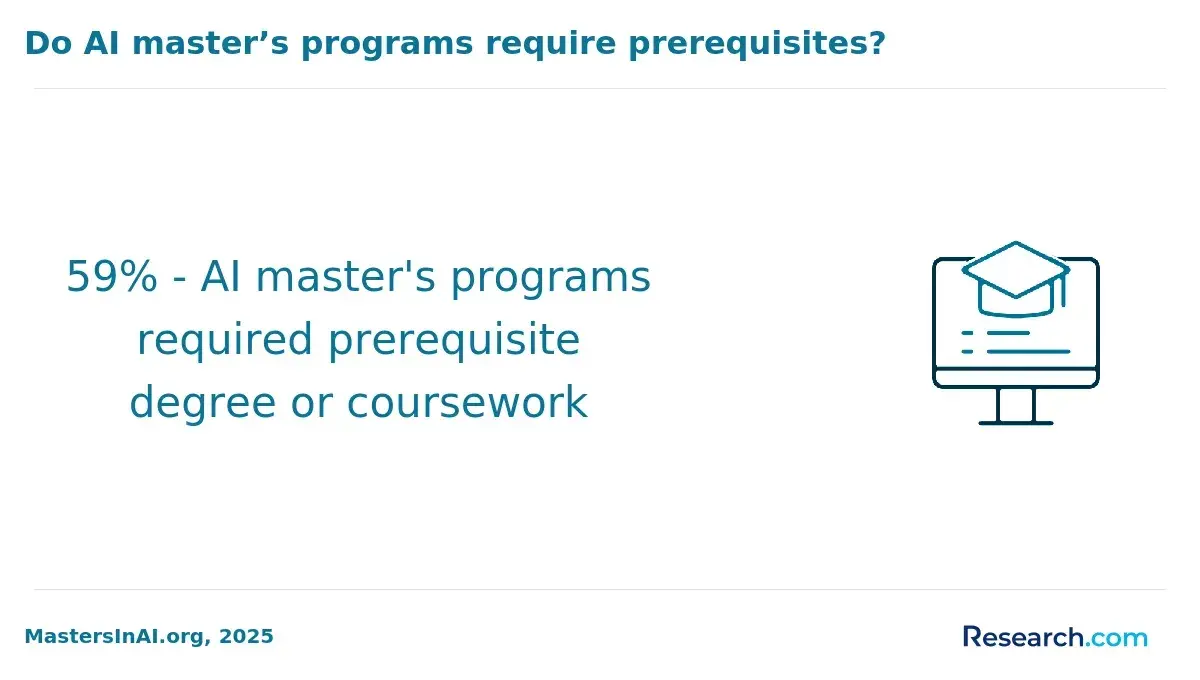
Master's programs in artificial intelligence designed for journalists and media professionals usually demand a strong quantitative and technical foundation. Applicants are generally expected to hold a bachelor's degree in computer science, engineering, mathematics, statistics, or related STEM fields. Key AI concepts like machine learning and data analysis rely heavily on programming and mathematical skills.
Typical prerequisites for enrolling in AI master's degrees for media professionals include:
- Proficiency in programming languages such as Python, R, or Java.
- Knowledge of linear algebra, calculus, and probability theory.
- Experience with data structures and algorithms.
- Strong analytical skills showcased through coursework or projects.
Candidates without STEM backgrounds may qualify by demonstrating competency via post-baccalaureate coursework, relevant work experience, or competitive GRE quantitative scores. Around 50% of GRE General Test takers in 2023-24 had engineering or physical sciences majors, reflecting the quantitative-heavy nature of AI program applicants.
Additional admissions requirements for AI master's programs in North America often include letters of recommendation highlighting technical and research abilities, a statement of purpose detailing AI interests and media goals, GRE scores emphasizing quantitative reasoning, and TOEFL or IELTS scores for non-native English speakers.
Strong quantitative skills and relevant technical experience are critical for admission. Students interested in data science may also explore the best online data science masters to complement their AI studies.
What courses and skills are taught in AI master's programs for journalists?
AI master's programs for journalists blend technical and practical skills to seamlessly integrate artificial intelligence into media workflows. Core coursework often includes machine learning fundamentals, natural language processing (NLP), and data analytics, which help students understand how AI tools analyze large datasets, automate routine reporting, and uncover insights critical for investigative journalism.
Students gain applied skills such as data visualization, detecting algorithmic bias, and automated content creation. Techniques covered include deploying AI-driven transcription, fact-checking algorithms, and sentiment analysis to boost story accuracy and audience engagement. Ethical considerations and transparency in AI use are emphasized to develop critical thinking about AI's societal impacts.
Technical training focuses on programming languages like Python and R to manipulate data and build tailored AI models. Practical projects-such as social media data scraping and AI-powered news recommendation systems-provide hands-on experience with AI applications directly relevant to journalism.
Soft skills also receive attention, particularly cross-disciplinary communication and digital literacy, preparing students to collaborate effectively with AI developers and data scientists in newsroom settings. Understanding audience analytics and AI-driven personalization is commonly addressed.
The World Economic Forum's Future of Jobs Report 2025 identifies "AI and big data" as the fastest-growing skill set through 2030, underlining the importance of combining data-driven storytelling with AI literacy in media programs (World Economic Forum, 2025).
How long do AI master's programs take, and what do they cost?
Master's programs in artificial intelligence tailored for journalists and media professionals typically span one to two years, varying by full-time or part-time enrollment. Full-time students usually complete these programs within 12 to 18 months, whereas part-time tracks can extend beyond two years, accommodating those who balance work and study.
Tuition costs fluctuate significantly depending on institution type and residency. Public universities average around $12,600 per year for in-state students, while private nonprofit institutions can charge about $29,900 yearly. Over two years, a full-time public university student might spend roughly $25,200, compared to nearly $60,000 at a private nonprofit school.
Additional expenses include fees, books, specialized software, and hardware essential for advanced AI coursework. Many programs offer hybrid or fully online options, influencing both cost and duration. Financial aid, scholarships, and assistantships are commonly available to help offset costs.
- Program length: 12 to 24+ months
- Tuition benchmarks: $12,600 (public) to $29,900 (private) annually
- Additional expenses: technology and materials
- Formats: full-time, part-time, online, hybrid
- Financial support: scholarships and assistantships
These factors are key when planning your education and career path in the dynamic field of artificial intelligence media applications.
What specializations fit journalists: NLP, data science, or machine learning?
Specializing in natural language processing (NLP) offers journalists and media professionals the most practical benefits in AI-driven workflows. NLP focuses on understanding and generating human language, enabling capabilities such as automated summarization, content recommendation, translation, and enhanced search functions. According to Stanford's AI Index Report 2025, foundation models powering modern NLP dominated AI training and newsroom technology upgrades, underscoring NLP's growing importance in media.
Data science skills emphasize data analysis and visualization, allowing journalists to interpret complex datasets, conduct investigative reporting, and create compelling data-driven stories. However, data science lacks a primary focus on language-specific challenges crucial for automated content generation and editorial tasks.
Machine learning (ML) extends beyond text to include image and audio recognition, recommendation systems, and fraud detection. While valuable for news verification and analyzing audience behavior, ML without NLP expertise may miss key language nuances essential in journalism.
Recommendations for professionals include:
- Choose NLP to master language-based tools vital for real-time news processing and automation.
- Consider data science if your strength lies in quantitative analysis and visual storytelling.
- Select machine learning for roles incorporating multimedia analysis or complex audience modeling.
NLP specialization aligns best with newsroom innovation and current research, making it the preferred AI focus for journalists.
What careers can you pursue with an AI master's in journalism and media?
An AI master's degree in journalism and media opens diverse career opportunities that integrate data science, media strategy, and content creation. Graduates can become media data analysts, using AI tools to assess audience behavior and enhance content reach. This role requires skills in data visualization and predictive modeling to deliver actionable newsroom insights.
News automation specialists develop AI-driven tools to automate reporting tasks such as earnings summaries, sports recaps, and weather updates, improving efficiency without compromising quality. Expertise in natural language processing and machine learning is essential here.
Data journalism continues to grow rapidly. Professionals with AI expertise often work as investigative reporters, analyzing large datasets to uncover trends traditional reporting might miss. Collaboration with data scientists helps produce interactive stories and vivid visuals.
Media strategy increasingly relies on AI for audience segmentation and personalized content. Careers such as audience intelligence analysts or digital marketing strategists leverage AI to customize campaigns and boost engagement.
The U.S. Bureau of Labor Statistics projects a 36% growth in data scientist employment from 2023 to 2033, emphasizing strong demand for AI and data skills in media analytics and newsroom data roles (BLS Occupational Outlook Handbook, updated 2024/2025).
Additional career paths include content recommendation engineers and ethics advisers, focusing on algorithm bias and transparency. Graduates gain versatility to bridge technology and journalism amid evolving AI-driven media landscapes.
What salary ranges can AI-trained journalists and media professionals expect?
Journalists and media professionals skilled in artificial intelligence often draw salaries comparable to those in data science and technology fields, highlighting the increasing value of technical expertise in media. The U.S. Bureau of Labor Statistics reports a median annual wage of $108,020 for data scientists, serving as a useful benchmark for AI-focused media roles. Entry-level jobs in AI-driven media analysis or data journalism generally pay between $60,000 and $75,000, depending on employer and location.
Experienced specialists managing AI projects, developing algorithms, or applying machine learning in newsroom settings can earn from $100,000 to $130,000 or more. Salary differences are influenced by factors such as geographic region, employer type, and combinations of journalism and technical skills.
Government and nonprofit media outlets usually offer salaries on the lower end, while tech-centric news organizations and major media corporations provide higher pay. Freelancers and consultants using AI tools for investigative reporting or content personalization may achieve variable income, with some reaching six-figure earnings.
What certifications and professional standards matter for AI in newsrooms?
ISO/IEC 42001, released in 2023, is rapidly becoming a vital standard for newsrooms adopting artificial intelligence technologies. It is the first certifiable AI management system that helps organizations implement formal audit and compliance processes. Between 2024 and 2025, its adoption increased significantly as news organizations prioritized accountable AI use to mitigate risks related to biased algorithms and data privacy violations. Using this standard, newsrooms can critically assess AI vendor practices when choosing tools for content curation, fact-checking, or automated editing, protecting their credibility.
Beyond ISO/IEC 42001, certifications stressing ethical AI use-covering transparency, bias mitigation, and explainability-are increasingly important. Credentials such as the Certified AI Ethics Professional (CAIEP) and specialized courses offered by journalism schools provide essential knowledge on regulatory compliance and editorial accountability for AI-driven content.
Many newsrooms combine ISO frameworks with internal audits and comprehensive staff training to sustain ongoing AI governance. This multilayered approach prepares organizations for legal challenges and public scrutiny. For journalists and newsroom leaders, mastering these standards aligns with employer demand for proficiency in responsible AI deployment.
Other Things You Should Know About Artificial Intelligence
Core courses typically include AI Ethics, Data Analysis, Machine Learning, and AI Applications in Media. These classes offer a strong foundation in understanding AI's impact and integrating technology into journalistic practices. Expect practical projects and collaboration with tech experts.
Key AI technologies include natural language processing (NLP) for text analysis, machine learning for pattern recognition, and computer vision for multimedia data processing. Familiarity with these areas empowers media professionals to innovate storytelling, conduct investigative research, and optimize audience engagement strategies.
It should come from a university recognized by an official national accreditor, such as a regional accreditor in the United States or a ministry-approved agency in Europe. Employers usually check institutional accreditation first, because it affects degree validity, transfer credit, and eligibility for further study.
Typically, applicants need a bachelor's degree, preferably in journalism, media, or communication. Strong analytical and technical skills are advantageous. Knowledge of data analysis or computer science can help, though not always required. Those interested in finance applications might explore options like a master’s in AI finance for further exploration.
References
- Salary https://www.nctj.com/life-as-a-journalist/salary/
- Top 10 Careers You Can Pursue With an Online Master’s in AI https://www.ucumberlands.edu/blog/careers-you-can-pursue-with-an-online-masters-in-ai
- AI and society in a new master's program! / Media University https://www.media-university.de/en/study/masters-degree-program/artificial-intelligence-and-societies/
- Artificial Intelligence for Journalists in Oviedo, Spain | IA University https://ia.university/academic-programs/ai-course-journalists-oviedo/
- Programmes | HKBU AR https://ar.hkbu.edu.hk/tpg-admissions/programmes/master-of-science-msc-in-ai-and-digital-media-approved-programme-under-ugc-s-targeted-tpg-programmes-fellowships-scheme
- Get Paid to Train AI: The New Side Hustle for Professionals | Built In https://builtin.com/articles/train-ai-side-hustle
- Journalist Career Path Guide https://aiapply.co/careers/journalist
- Masters Artificial Intelligence https://www.udacity.com/masters-artificial-intelligence
- Salary and Jobs Report 2025-26: Privacy, AI Governance and Digital Responsibility | IAPP https://iapp.org/resources/article/salary-survey-summary
- M.SC. IN Artificial Intelligence https://put.poznan.pl/msc-artificial-intelligence