2027 AI Master's Degrees With Applied Capstone Tracks

Co-Founder and Chief Data Scientist
Many professionals with undergraduate degrees in unrelated fields face challenges transitioning into the AI industry due to a lack of practical, hands-on experience. Traditional master's programs often focus heavily on theory, leaving students underprepared for real-world applications. This gap can hinder career advancement and limit access to competitive roles in the rapidly evolving AI job market.
Applied capstone tracks provide targeted, project-based learning, enabling students to demonstrate job-ready skills through tangible outcomes. This article explores master's degree programs offering applied capstone experiences designed to equip learners with relevant expertise and improve their chances of successful career pivots into Artificial Intelligence.
Key Things You Should Know
- Master's degrees in AI with applied capstone tracks surged 18% in U.S. universities from 2024 to 2025, emphasizing practical skills for immediate workforce impact.
- These programs blend core AI theory with hands-on projects, helping 72% of graduates secure jobs in AI-related fields within six months.
- Popular capstone themes include machine learning, natural language processing, and robotics, reflecting industry demands for specialized expertise in 2026.
What is an AI master's degree with an applied capstone track?
An AI master's degree with practical capstone projects integrates advanced study with real-world application through a hands-on final project. This applied capstone track emphasizes creating deliverables like software prototypes, data models, or AI-driven business solutions rather than just theoretical knowledge. Students tackle challenges across sectors such as healthcare, finance, autonomous systems, and natural language processing, gai.
Graduates with experience from applied capstone tracks meet the increasing demand for professionals able to implement AI solutions effectively. According to data from GMAC, 81% of global employers have hired or plan to hire graduates from business master's programs with analytics or AI-adjacent tracks, recognizing their ability to solve real business problems.
Prospective students should ensure their program's capstone offers mentorship and opportunities to develop portfolio-worthy work, bridging the gap between academic theory and workplace readiness. Many programs also provide interdisciplinary projects or partnerships with companies for live case studies.
For those exploring career options, learning more about AI degrees can provide insight into the diverse roles graduates can pursue. Applied capstone tracks in AI graduate degrees remain a valuable pathway for gaining tangible skills that employers seek today.
Which accredited universities offer AI master's programs with applied capstones?
Several accredited universities in the U.S. offer master's programs in artificial intelligence that include applied capstone tracks, combining advanced coursework with real-world project experience. These capstones allow students to tackle tangible AI challenges in industry or research, bridging theoretical knowledge with practical skills.
Institutions like Carnegie Mellon University and the University of Southern California provide Master of Science degrees emphasizing hands-on capstone projects aligned with AI specializations. The Georgia Institute of Technology offers a Master of Science in Computer Science with pathways focused on machine learning and AI, featuring capstone options developed in partnership with tech companies.
Northeastern University's MS in Artificial Intelligence integrates practical problem-solving through capstone projects in areas such as natural language processing and computer vision applied to healthcare and finance. These examples highlight some of the top US universities for AI master's degrees with real-world capstone projects.
Data from NCES IPEDS shows over 61,000 master's degrees in computer and information sciences were awarded in the U.S. recently, supporting a strong pipeline of graduates skilled in applied AI. Prospective students should consider factors like industry partnerships, project scope, and faculty expertise when selecting a capstone track.
Flexible completion options-onsite, remote, or interdisciplinary-cater to diverse career goals. For those exploring affordable and reputable options, reviewing data science programs can offer useful insights into programs that combine quality education with cost-efficiency.
How do applied capstone tracks differ from AI thesis or research tracks?
Applied capstone projects versus AI thesis tracks differ significantly in focus and outcomes. Capstone tracks center on practical, industry-relevant solutions, requiring students to tackle real-world problems often in collaboration with business or technology partners. These projects emphasize teamwork, software engineering, product design, and cross-functional collaboration.
By contrast, thesis tracks are research-intensive and theoretical, involving hypothesis formulation, rigorous experiments, and extensive literature review. Students aim to contribute original, publishable research and often prepare for doctoral studies or research careers. This track suits those interested in academic or long-term R&D roles rather than immediate industry positions.
Differences between the AI capstone and research tracks also reflect funding patterns. Industry-funded academic research, with billions allocated annually, mainly supports application-driven projects fueling capstone programs. This environment accelerates translating innovations into commercial products.
Prospective students choosing between tracks should align their selection with career goals. Applied capstones fit those targeting roles in AI development, deployment, or consulting. Thesis tracks are better suited for careers in academia or advanced research. For a broader overview of affordable options, consider exploring an AI master's degree.
What coursework and specializations are common in applied AI master's programs?
Applied artificial intelligence graduate coursework commonly includes foundational subjects like machine learning, deep learning, supervised and unsupervised learning algorithms, neural networks, reinforcement learning, and natural language processing. These core areas are often paired with practical projects to build hands-on skills and industry readiness.
Specializations in applied AI master's degrees frequently cover computer vision, robotics, data engineering, AI ethics, and human-centered AI. For instance, computer vision courses may focus on image recognition and video analysis, while robotics emphasizes autonomous systems and sensor integration. The data engineering track highlights big data pipelines and real-time analytics vital for scalable AI solutions.
Programs generally emphasize capstone projects simulating real-world challenges such as predictive maintenance, fraud detection, or conversational agents, requiring students to integrate multiple AI techniques. Practical experience with cloud platforms and AI development tools like TensorFlow, PyTorch, and Kubernetes is routinely incorporated.
Many curricula also include software engineering practices tailored for AI applications, covering version control, containerization, and model deployment. This preparation helps graduates transition smoothly into production environments. Students interested in applied AI can explore options, including data science master's online programs that often offer a balanced mix of theory, specialization, and applied experience.
What are typical admission requirements for applied AI master's programs?
Admission to applied AI master's programs typically requires a bachelor's degree in computer science, engineering, mathematics, or a related STEM field. Applicants from other disciplines often need to prove their quantitative skills through relevant coursework or work experience. Foundational knowledge in programming, data structures, algorithms, and statistics is usually expected.
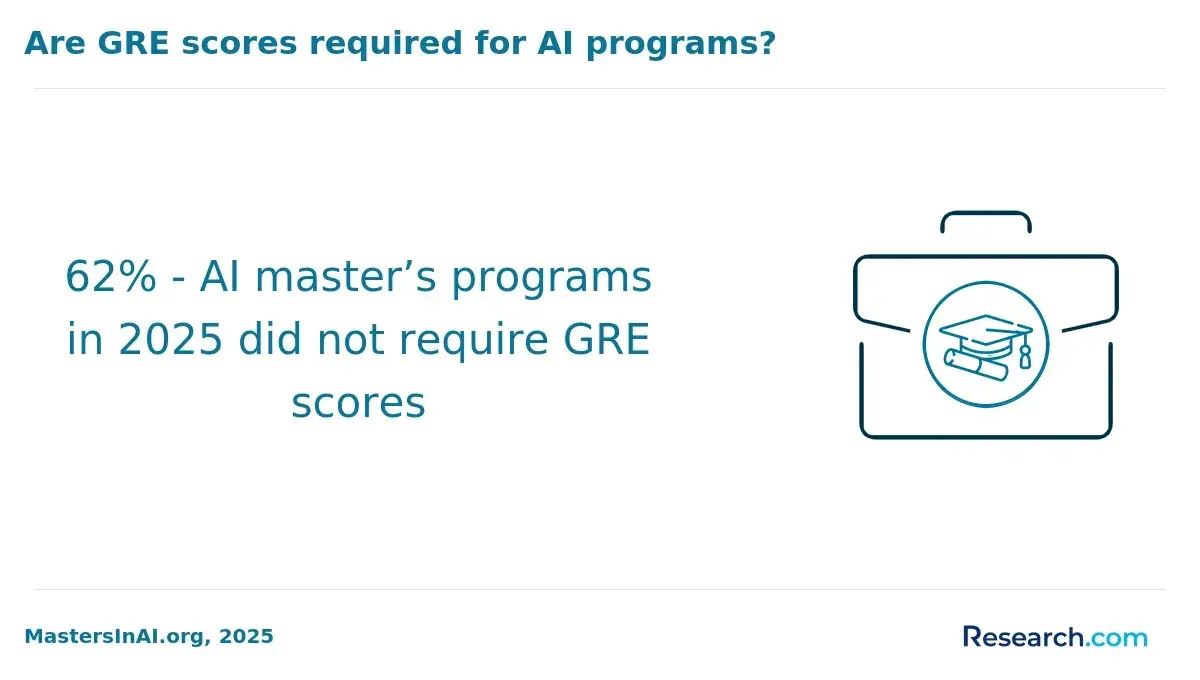
GRE scores remain part of many application processes, but are increasingly optional or flexible. While some universities still request these scores, others consider them supplementary rather than mandatory. This shift aligns with recent trends reported by ETS, where GRE testing volumes rebounded, but requirements loosened.
Typical application materials include:
- Letters of recommendation focused on technical and academic skills
- Personal statements outlining career goals and motivation for applied AI
- Resumes highlighting experience in AI, machine learning, or relevant internships
- Official transcripts showcasing academic rigor
Some programs may require prerequisites or offer conditional admission to address gaps in AI fundamentals. Hands-on experience with AI frameworks, coding languages like Python, or projects can compensate for less traditional academic backgrounds.
Admissions committees value diverse backgrounds, especially candidates who can apply AI across disciplines such as ethics, business, or healthcare. GPA cutoffs often fall between 3.0 and 3.5 on a 4.0 scale, though holistic review practices continue to gain emphasis.
How do online and on-campus applied AI master's programs compare?
Online and on-campus applied AI master's programs differ mainly in flexibility and hands-on experiences. A growing majority of graduate candidates prefer flexible formats like online or hybrid programs, which better accommodate working professionals by allowing study without relocating or altering work schedules. Many online programs include virtual labs and simulations to provide practical AI training comparable to on-campus learning.
On-campus programs offer direct faculty interaction, campus research resources, and in-person collaboration through labs and capstone projects. This format supports hardware-focused AI fields, such as robotics, more naturally. Hybrid models often require short on-site residencies or internships to complement online coursework, bridging the gap between remote study and experiential learning.
Admissions timing, program length, and cost vary as well. Online degrees usually feature rolling admissions and asynchronous content, making them more accessible and sometimes more affordable. In contrast, on-campus programs usually require full-time enrollment with fixed semesters, providing a more structured setting but higher opportunity costs.
Prospective students should consider:
- On-campus or hybrid formats for deeper networking and lab access.
- Online programs to balance employment while building applied AI skills through capstone projects.
- Ensuring online capstones offer mentor guidance or industry partnerships for meaningful experience.
Both formats deliver quality applied AI education; the choice depends on individual goals and lifestyle. GMAC's research shows a clear shift toward online and hybrid AI master's programs shaping education pathways.
How long do applied AI master's programs take, and what do they cost?
Applied AI master's programs usually require 1.5 to 2 years of full-time study, with some part-time or flexible options extending up to 3 years to accommodate working professionals. The length depends on credit requirements, internship or capstone project durations, and the program's curriculum structure. These programs often include 3-6 months dedicated to hands-on applied projects.
On average, tuition and fees for graduate studies at public universities in the U.S. hover around $12,596 annually. Completing a two-year applied AI master's at a public institution may cost roughly $25,000 in tuition alone, excluding living expenses and materials. Private and specialized tech schools typically charge considerably more, sometimes exceeding $50,000 per year.
Additional expenses students should consider include software licenses, cloud services, and travel related to internships. Financial aid, scholarships, and employer tuition reimbursement can significantly reduce these costs.
Common applied AI master's program structures include a 36-credit curriculum finished in 18 months with a 6-credit integrated capstone or a 48-credit plan over 2 years featuring a 3-credit industry project. Programs emphasizing real-world AI challenges tend to demand more time than purely coursework-based degrees but provide substantial career advantages.
How do applied capstone projects work, and who sponsors them?
Applied capstone projects in AI master's programs provide vital hands-on experience through real-world problem solving. Sponsored by external organizations such as private companies, government agencies, and nonprofits, these projects present authentic challenges with specific problem statements, data sets, and performance criteria. Students apply theoretical knowledge to deliver practical solutions aligned with current industry demands.
These projects typically last a semester or an academic year and involve collaboration in teams or individual work under mentorship from both academic and industry professionals. For example, a healthcare organization might sponsor a capstone targeting predictive analytics to lower patient readmission, while a technology firm may focus on natural language processing to enhance customer support chatbots.
Industry adoption of AI is rising, with nearly half of organizations using AI in at least one business function. This growth expands opportunities for capstone sponsorships and relevant problem statements, helping master's programs develop strong industry connections. These connections improve student employability by offering access to real data, advanced tools, and professional workflows.
What careers can an applied AI master's lead to, and what skills matter?
Applied AI master's degrees equip graduates with skills essential for the practical implementation of AI technologies. Key career paths include AI engineer, machine learning engineer, data scientist, AI product manager, and AI research scientist focused on real-world solutions.
According to LinkedIn's 2024 Economic Graph insights, AI engineer roles rank among the fastest-growing jobs, fueled by demand for expertise in deployment, MLOps, and productization. Successful candidates develop expertise beyond theory, including:
- Building, testing, and deploying machine learning models in production
- Creating scalable AI systems integrated with software and cloud infrastructure
- Applying MLOps practices like continuous integration, delivery, and monitoring
- Collaborating with AI product teams to translate research into user-centric applications
- Using programming languages such as Python and frameworks like TensorFlow or PyTorch
These programs often include capstone projects tackling real-world problems, helping students showcase their skills in portfolios. Graduates find opportunities in industries like healthcare, finance, autonomous vehicles, and technology, where applied AI drives competitive advantage. Employers value professionals who bridge AI research and operational deployment.
For those reskilling, an applied AI master's degree offers not only advanced technical knowledge but also hands-on experience managing AI lifecycle challenges like data pipeline automation, bias mitigation, and model interpretability, all increasingly critical in AI-driven companies.
What salary ranges and job outlook can graduates expect in AI roles?
Graduates holding a master's degree in AI with applied capstone experience can anticipate starting salaries between $95,000 and $130,000 annually. Roles such as machine learning engineer, data scientist, and AI research analyst generally fall within this range. Professionals in mid-career with specialized project experience frequently earn above $160,000.
The job market for AI professionals is notably strong. According to Lightcast, U.S. job postings requiring generative AI skills have surged, reflecting widespread industry adoption. These roles typically offer a wage premium of 10%-20% compared to similar positions without generative AI expertise.
Key hiring sectors include technology, finance, healthcare, and manufacturing, where applied AI drives innovation and solves complex challenges. Candidates who showcase real-world capstone projects gain a competitive edge with employers seeking practical expertise.
Building a multi-disciplinary skill set, such as programming, model deployment, and domain-specific knowledge, is essential for maximizing salary potential and job security. Regional variations exist, with tech hubs like San Francisco, Seattle, and New York offering higher salaries alongside higher living costs.
- Entry-level AI roles: $95,000-$130,000
- Mid-career AI professionals: $130,000-$160,000+
- Wage premium for generative AI skills: 10%-20% above comparable roles without such skills
Graduates who combine theoretical knowledge with applied capstone projects enhance their marketability and readiness for a dynamic job market with increasing demand and competitive compensation.
Other Things You Should Know About Artificial Intelligence
While many AI master's programs prefer applicants with a background in computer science, engineering, or related fields, some programs accept students from diverse academic backgrounds. These programs often require foundational courses in programming, mathematics, and statistics either before admission or during the first semester. Prospective students without prior experience should be prepared to build technical skills early in the curriculum.
Many AI master's programs encourage or require internships to complement the applied capstone experience, but policies vary by institution. Internships offer hands-on exposure to AI technologies in professional settings, enhancing both technical and collaborative skills. Some programs integrate internships as an official credit-bearing component, while others recommend them as optional but beneficial.
Applied capstone projects focus on solving concrete problems using AI techniques, often involving client collaboration and product development. This practical approach develops skills in project management, teamwork, and communication alongside technical expertise. It better prepares graduates for industry roles by simulating workplace challenges, unlike traditional research, which tends to emphasize theoretical investigation.
An applied capstone track in a 2027 AI master's degree program focuses on real-world problem-solving, enhancing skills in machine learning, data analysis, and project management. It often includes interdisciplinary applications, such as a medical artificial intelligence master’s degree, augmenting technical proficiency alongside domain-specific expertise.
References
- Capstone Project https://capstone.groups.et.byu.net/wikis/doku.php
- 25 Best Master's in AI Programs - MastersInAI.org https://www.mastersinai.org/degrees/best-masters-in-artificial-intelligence/
- AI Careers - Top AI Jobs with Education Requirements and Pay https://aidegreeprograms.org/ai-careers/
- What to Look for in a Master’s in AI Program | University of Bridgeport https://www.bridgeport.edu/news/masters-in-artificial-intelligence-program-what-to-look-for/
- Capstone Project vs Thesis in University: Key Differences Explained https://www.quetext.com/blog/capstone-project-vs-thesis
- Application and admission - Master Artificial Intelligence https://www.uva.nl/shared-content/programmas/en/masters/artificial-intelligence/application-and-admission/international-prior-education/international-prior-education-foldout-menu.html
- Artificial Intelligence (AI) https://ai-master.org/requirements
- Masters Artificial Intelligence https://www.udacity.com/masters-artificial-intelligence
- Top 10 AI graduate degree programs https://www.cio.com/article/350315/top-10-ai-graduate-degree-programs.html
- Master Programme in Applied AI | Luleå University of Technology https://www.ltu.se/en/education/programme/tmdia-master-programme-in-applied-ai