2027 Accessibility of Online AI Degree Programs

Co-Founder and Chief Data Scientist
Working professionals with degrees in unrelated fields often face challenges when seeking to transition into the AI industry. Traditional programs may demand extensive prerequisites or lack flexible scheduling, making advancement difficult. Additionally, the rapidly evolving nature of the AI field calls for accessible options that balance quality and convenience.
Many prospective students struggle to identify accredited online AI degree programs that fit their unique needs. This article examines the accessibility of current online AI degree programs, focusing on accreditation, flexibility, and program rigor, to help readers navigate and select viable pathways for entering the AI workforce.
Key Things You Should Know
- Online AI degree programs in 2026 prioritize accessibility, with over 60% offering adaptive learning technologies tailored for diverse learning needs and disabilities.
- Federal and state funding have increased by 25% since 2024 to support accessibility enhancements in online STEM and AI education platforms.
- Enrollment of underrepresented groups in online AI degrees rose by 18% between 2024 and 2025, reflecting improved outreach and inclusive curriculum design.
What is an online AI degree program?
Online artificial intelligence degree programs in the US provide flexible, comprehensive education designed to build expertise across core AI topics such as machine learning, neural networks, natural language processing, data science, and AI ethics. These programs often include programming skills in languages like Python and focus on practical algorithm development and applied techniques to prepare students for diverse careers in industry or research.
Such accredited AI degree programs available online come in various formats and specializations. Some emphasize the theoretical foundations and research aspects of AI, while others concentrate on engineering applications and real-world problem-solving. Options include AI-centric computer science degrees, data analytics with AI components, and interdisciplinary studies involving robotics and cognitive science. Business applications of AI are also covered in programs targeting management professionals.
Designed for working professionals and remote learners, these online degrees blend video lectures, interactive assignments, and virtual labs, often including collaborative projects and internships through partnerships. The rapid increase in demand is reflected by hundreds of institutions offering AI-related degrees, with over 300 master's and nearly 200 bachelor's programs available nationally.
Prospective students seeking best online computer science degree options may find AI-focused curricula that align with their schedules and career ambitions, ensuring a broad spectrum of quality learning paths.
Are online AI programs accredited?
Online AI programs offered by accredited institutions provide reliable and recognized credentials essential for career advancement. Most reputable online artificial intelligence degree programs come from regionally accredited universities that meet strict quality standards vetted by organizations recognized by the U.S. Department of Education or the Council for Higher Education Accreditation.
This regional accreditation ensures academic rigor, qualified faculty, and comprehensive student support critical for valid degrees. Students should confirm that any online artificial intelligence degrees recognized by US accreditation bodies they consider hold proper regional or national accreditation.
Many public universities provide fully online AI bachelor's and master's degrees accredited by bodies such as the Higher Learning Commission or WASC Senior College and University Commission. Without accreditation, programs may not be eligible for federal financial aid or recognized by employers and graduate schools.
Cost is a key factor when comparing AI degree programs. According to recent data, the median annual tuition at in-state public universities is $10,037, while private universities charge a median of $55,651. This notable price difference highlights the affordability of public online programs without compromising quality. Prospective students can explore details on affordability in an online engineering degree cost analysis.
Specialized accreditations or certifications in computer science or engineering fields add further value by confirming that AI coursework meets industry-relevant standards. When selecting an online AI degree, students should weigh accreditation type, curriculum, and cost together to find credible and economically accessible options.
How do online and campus AI programs compare?
Online vs campus AI degree programs accessibility significantly affects cost, flexibility, and learning outcomes. Online programs usually have much lower tuition fees. For instance, an online AI master's program at Udacity costs about $4,000, while the average two-year campus AI master's program in the U.S. is around $74,000. This sharp contrast highlights a notable ROI difference favoring online education for many students.
Campus programs offer direct interaction, better networking, and access to on-site resources such as labs and career centers. These benefits attract students who prefer immersive, collaborative settings and face-to-face mentorship. However, greater expenses and geographical restrictions pose challenges.
Online artificial intelligence programs stand out for their flexibility, ideal for working professionals or those with family responsibilities, allowing access to course materials anytime and supporting self-paced learning. This is particularly important for students living far from top research universities or needing adaptable schedules.
When comparing online and campus artificial intelligence programs, consider:
- Costs and financial aid options.
- Need for physical labs or teamwork environments.
- Learning style and ability to study independently.
- Career objectives and significance of networking.
Exploring options among cyber security degrees can also provide insights into affordability and program delivery modes relevant to AI education.
What courses are in an AI degree curriculum?
AI degree curriculum components in online programs typically combine foundational knowledge with specialized topics to develop comprehensive expertise. Core courses often include machine learning, data structures, and algorithms, forming a strong computational and mathematical base. Specialized subjects cover neural networks, natural language processing, computer vision, and robotics, highlighting diverse AI applications. Students also study probability, statistics, and linear algebra to understand AI models effectively.
Practical proficiency is emphasized through programming languages like Python and R, alongside coursework using AI frameworks such as TensorFlow or PyTorch. Many U.S. programs address ethics and social impact, focusing on issues like AI bias, privacy, and societal effects. Advanced study might include reinforcement learning, deep learning architectures, and AI system design.
Core courses for artificial intelligence degrees in the US often incorporate electives tailored to sectors like healthcare, finance, or autonomous systems, enabling students to focus on specific career paths. Project-based learning and capstone experiences help develop skills with real-world datasets.
Student adoption of AI tools is high, with 86% using AI in their studies and 54% engaging weekly. This trend supports curricula that balance theory, programming, ethics, and domain-specific knowledge, preparing students for today's AI roles. Prospective students seeking advanced degrees should consider options like the online data science PhD for deeper specialization.
What are the admission requirements for AI degrees?
Admission criteria for artificial intelligence degree programs vary by level and institution but commonly require a strong STEM background. For bachelor's degrees, candidates generally need a high school diploma with coursework in mathematics and science, along with competitive SAT or ACT scores. Some schools may also expect prior programming experience or prerequisites in calculus or computer science.
Graduate programs, including master's and doctoral degrees, typically require an undergraduate degree in computer science, engineering, mathematics, or related fields. Many demand a minimum GPA around 3.0 and GRE scores, though some have removed this requirement. Demonstrating programming skills through coursework or work experience is highly recommended.
Other application components often include letters of recommendation, personal statements, and sometimes interviews or portfolios showcasing technical projects. Professional experience in AI or related areas can strengthen applications, especially for working professionals pursuing part-time or online options.
Since only a small percentage of schools offer formal or informal guidance on artificial intelligence programs, applicants should carefully review admission requirements for each institution. Prospective students with non-technical backgrounds may also consider preparatory or bridging courses before enrollment.
How long does an online AI degree take?
Online artificial intelligence degree programs vary in length from 1 to 4 years depending on the level and study pace. A bachelor's degree typically requires about four years of full-time study, though accelerated and part-time options can shorten or extend this timeline. Master's programs usually take 1 to 2 years beyond a bachelor's degree and emphasize advanced topics such as machine learning, natural language processing, and robotics.
Many master's offerings provide flexible schedules-including evening, weekend, or asynchronous courses-catering to working professionals. Certificate programs and micro-credentials can be completed within 6 to 12 months and focus on targeted AI skills like data analysis or deep learning frameworks, making them ideal for rapid upskilling instead of a full degree.
Students should also consider faculty development challenges; while 60% of educators have adopted AI tools, 81% report insufficient time to develop comprehensive training, which may impact course depth and availability in some online programs. When choosing a program, assess credit requirements and pacing to fit your career goals and lifestyle. Part-time or modular formats often benefit those balancing employment, while full-time students may prefer traditional timelines.
How much does an online AI degree cost?
The cost of an online AI degree program varies significantly depending on the institution type and level of study, typically ranging from $10,000 to over $60,000 for a full degree. Public universities offering online bachelor's degrees usually charge between $10,000 and $30,000 for in-state students, while out-of-state tuition can be double that. Private institutions often exceed $50,000 for bachelor's or master's degrees. These estimates generally exclude extra fees such as textbooks or technology costs.
Certificate programs and shorter professional courses cost between $1,000 and $5,000, offering specialized skills without the commitment of a full degree. Many schools provide flexible payment plans or employer tuition assistance, which can be valuable for working professionals. Financial aid, scholarships, and federal grants remain critical for managing expenses, so it's important to check eligibility early in the application process.
82% of students highlight the importance of proper AI knowledge for career prospects. When evaluating costs, consider curriculum relevance, faculty expertise, and connections to employers rather than price alone. Cheaper programs may lack depth or recognized credentials, affecting employability.
What jobs can you get with an AI degree?
An AI degree offers diverse career paths across industries such as technology, healthcare, finance, education, and manufacturing. Graduates can work as machine learning engineers, data scientists, AI research scientists, robotics engineers, or AI software developers, focusing on creating AI models and systems to solve complex problems or automate tasks.
In healthcare, AI professionals develop diagnostic tools and predictive models that improve patient outcomes. Finance sectors rely on AI expertise for fraud detection, risk assessment, and automated trading. Manufacturing companies seek AI engineers to optimize supply chains and perform predictive maintenance on equipment.
Education increasingly benefits from AI integration, with teachers and administrators using AI tools to boost efficiency and save around six weeks per school year, based on findings from Teaching Efficiency. This trend drives demand for AI-savvy education professionals who integrate such technologies within curricula and administrative workflows.
Additional roles include AI product managers who guide development and AI consultants who advise on technology deployment. Entry-level jobs usually require strong programming skills in Python, algorithm proficiency, and familiarity with frameworks like TensorFlow or PyTorch.
Ethical AI specialists also play a crucial role in ensuring responsible AI use and regulatory compliance. Given this wide array of opportunities, students should consider focusing on industry interests and technical skills to enhance employability.
What salary can AI degree graduates expect?
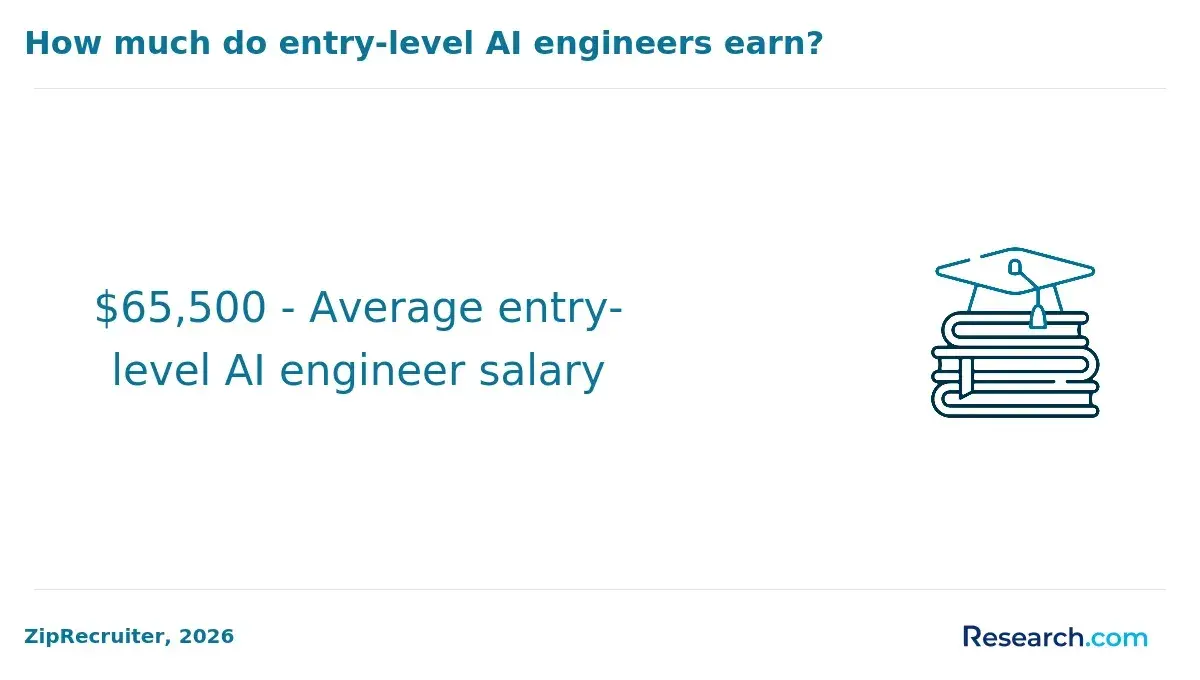
Graduates with an AI degree can anticipate starting salaries ranging from $85,000 to $110,000 annually, depending on specialization and location. Entry-level roles such as AI software engineer, data scientist, or machine learning engineer typically fall within this range. With gained experience, mid-career AI professionals often earn between $120,000 and $160,000. Senior or specialized roles like AI research scientist or AI consultant may exceed $180,000 per year.
Demand for AI talent is rapidly growing. According to the National Employment Statistics Bureau, AI-related job postings have increased by 53%, reflecting strong market pressure and heightened value for AI credentials. Graduates holding an online AI degree are positioned to negotiate better salaries as opportunities expand.
Salary differences also arise across industries:
- Technology and software firms generally offer the highest wages, with averages exceeding $130,000.
- Finance and healthcare sectors provide competitive ranges between $100,000 and $140,000.
- Startups may start lower but compensate with stock options or faster growth.
Location impacts compensation as well. Urban centers like San Francisco, New York, and Seattle offer higher salaries alongside greater living costs. Increasing remote work options enable access to competitive pay without relocation.
Certifications, internships, and skills in tools like Python, R, or TensorFlow further enhance salary prospects. Candidates combining an online AI degree with hands-on experience and specialized credentials secure stronger offers overall.
Do AI careers require certifications or licensure?
The AI industry generally values practical skills and hands-on project experience over formal certifications or licensure. Unlike regulated professions such as law or engineering, most AI careers in the U.S. do not require mandatory credentials. Employers seek demonstrable expertise in areas like machine learning, data analysis, programming languages such as Python, and familiarity with key AI frameworks. However, roles connected to regulated sectors like healthcare, finance, or autonomous vehicles may require specific compliance or certifications related to those fields.
Though there's no universal licensing for AI professionals, voluntary certifications can significantly improve employability and career growth. Credentials from recognized bodies like the Artificial Intelligence Board of America (ARTIBA) or technical certificates from platforms such as Google Cloud and Microsoft Azure provide structured validation of skills. These certifications typically cover foundational AI concepts, machine learning methods, and ethical considerations.
Continuous learning is critical due to rapid technological advances. The AI education market is expected to surpass $136.79 billion by 2035, driven by expanding online and hybrid degree programs that often offer certificates upon completion.
Prospective students should focus on:
- Building a strong portfolio with AI projects and practical applications.
- Acquiring relevant certifications aligned to their area of specialization.
- Choosing courses or degrees emphasizing hands-on skills and updated technologies.
- Understanding compliance requirements for AI use in regulated industries.
Other Things You Should Know About Artificial Intelligence
While prior programming experience is not always mandatory, it is highly recommended for students pursuing an AI degree. Many online AI programs expect familiarity with programming languages such as Python, as coding forms the basis for algorithm development and data manipulation in AI. Students without prior experience may need to complete introductory courses to build foundational skills.
Most accredited online AI degree programs strive to meet accessibility standards and accommodate students with disabilities. This includes offering screen reader compatibility, captioned video lectures, and flexible assignment deadlines. Prospective students should verify specific accommodations with each program to ensure their needs can be fully supported.
Online AI degree programs often offer specialization tracks such as machine learning, natural language processing, robotics, and computer vision. These tracks allow students to focus their studies on particular areas of interest within AI, enhancing their expertise and employability in niche sectors. Availability of these tracks varies by institution.
Many online AI programs include hands-on components like coding projects, virtual labs, and capstone experiences to simulate real-world applications. These practical exercises help students apply theoretical knowledge and develop problem-solving skills essential for AI careers. Some programs partner with companies or offer internships to broaden experiential learning.
References
- Top 25 Online Master’s In AI Programs for 2026 - Programs.com https://programs.com/programs/online-masters-in-ai/
- Master’s in Artificial Intelligence Salary | University of Bridgeport https://www.bridgeport.edu/news/masters-in-artificial-intelligence-salary-expectations/
- Master of Artificial Intelligence https://wscs.eu/master-of-artificial-intelligence/
- How to Get into a BSc in AI Program | Admission Guide 2025 https://futurense.com/blog/bsc-ai-program
- Are AI Certifications Worth It for Jobs https://zenvanriel.com/ai-engineer-blog/is-ai-certification-worth-it/
- University Degree vs AI Bootcamp: Which is Best Career Path? https://agilefever.com/university-degree-vs-ai-bootcamp-which-is-best/
- 16 Artificial Intelligence Career Paths https://www.calmu.edu/news/artificial-intelligence-career-paths
- Artificial Intelligence - Vistula University https://vistula.edu.pl/en/major/artificial-intelligence
- Most Affordable Online Master's in AI for 2025 https://www.mastersinai.org/degrees/affordable-online-masters-in-ai/
- How Online AI Master's Degrees Affect Salary in 2026 https://www.nexford.edu/insights/how-online-ai-masters-degrees-affect-salary