2027 Veterans in AI Degree Programs

Co-Founder and Chief Data Scientist
Many veterans seeking to transition into civilian careers face challenges adapting their military experience to fast-evolving fields like artificial intelligence. The lack of a formal background in computer science often limits access to advanced degree programs tailored for working professionals. Additionally, balancing education with family and employment demands complicates the decision-making process. This article examines current trends and available options in veterans-centered artificial intelligence degree programs that offer flexible, accredited pathways. It aims to guide prospective students through program selection, accreditation standards, and career alignment to help veterans successfully pivot into the artificial intelligence industry.
Key Things You Should Know
- Veterans comprised approximately 12% of students enrolled in AI degree programs nationwide in 2025, reflecting increased interest fueled by military technology experience and GI Bill benefits.
- Many veterans pursue AI studies to transition into high-demand tech roles; AI-related job postings favor candidates with military backgrounds for problem-solving and leadership skills.
- Universities are expanding veteran support services in AI programs, including tailored mentorship and flexible scheduling, to accommodate military commitments and enhance completion rates.
What are the best AI degree pathways for veterans transitioning from military service?
Veterans transitioning to civilian careers should seek the best AI degree programs that offer flexibility and accreditation. Bachelor's or master's degrees in computer science with specializations in artificial intelligence, data science, or machine learning provide essential foundational knowledge, including programming, algorithms, and AI ethics. These degrees support veterans new to technology while recognizing their unique military backgrounds.
Professional certificates and bootcamps affiliated with universities or government-approved institutions offer practical, accelerated training for veterans aiming to pivot quickly into AI careers. Online degree programs with asynchronous coursework help accommodate veterans balancing work, family, and relocation challenges. Many veterans leverage education benefits through the U.S. Department of Veterans Affairs, which in FY 2024 supported over 901,000 veterans with $12 billion in funding, making advanced AI master's degrees and training more affordable.
Key considerations for enrolling in AI programs include:
- Accreditation by recognized bodies to ensure degree value
- Curriculum depth covering AI fundamentals and applied techniques
- Flexible delivery formats, including online and hybrid models
- Financial support options leveraging VA education benefits
- Opportunities for research, internships, and industry connections
Veterans should also look for programs with strong career services, industry partnerships, and veteran support networks to improve job placement. Those with technical military training may benefit from specialized AI programs focused on defense and security, while others might consider foundational computer science degrees as a stepping stone. For an accelerated path, veterans may explore an accelerated computer science degree tailored to their needs. Such top military-friendly artificial intelligence educational pathways offer tailored support to veterans seeking meaningful careers in the growing field of AI.
How do AI bachelor's and master's programs support veterans' career goals in tech?
Veteran support in AI degree programs often includes flexible curricular designs, such as part-time or online options, enabling veterans to balance education with family and work responsibilities. Programs usually offer veteran-focused advising that translates military skills into civilian tech roles, facilitating smoother career advancement for veterans in artificial intelligence fields. Practical training in programming, machine learning, and data analysis equips veterans, especially those with military systems or intelligence backgrounds, for careers in cybersecurity, defense contracting, and AI startups.
Financial assistance plays a vital role, with many institutions accepting GI Bill benefits and providing additional scholarships tailored for veterans pursuing tech degrees. Veterans seeking a cheap online engineering degree can find more affordable pathways that reduce financial strain and support degree completion.
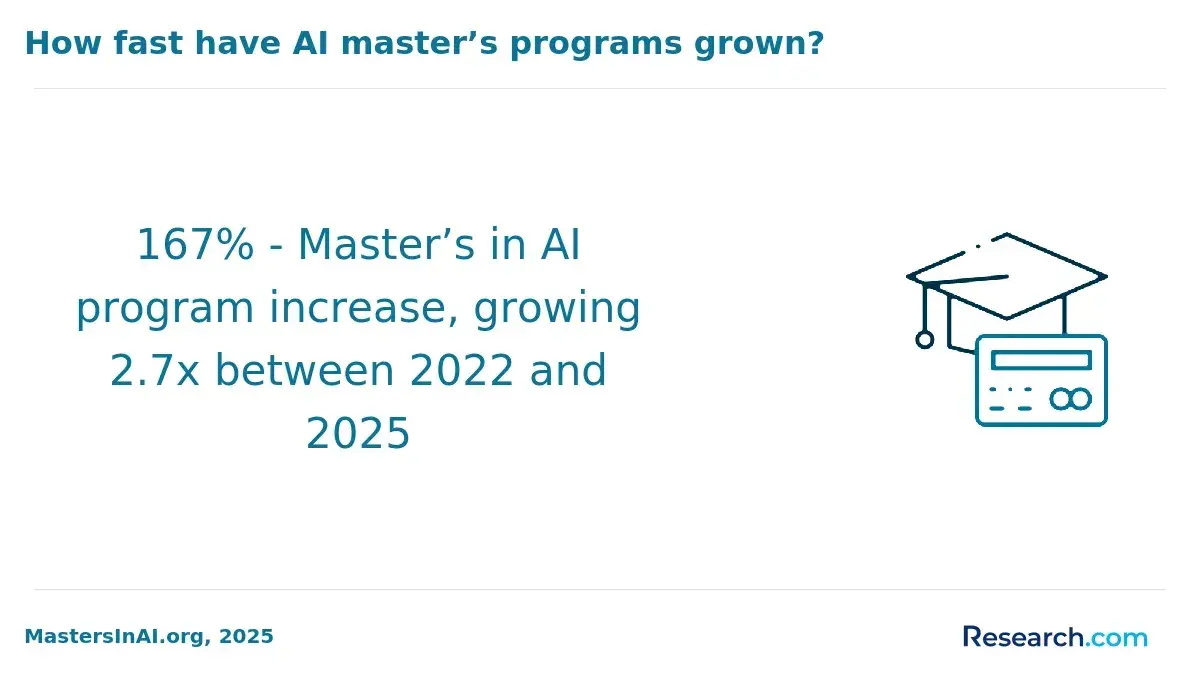
Between 2022 and 2025, master's programs in AI expanded dramatically, increasing by 167% from 116 to 310 programs nationwide. This surge enhances access and variety, empowering veterans to choose options that align with their career goals and preferred learning styles. Schools offering mentorship by AI professionals with military experience, veteran-tailored internships, and strong industry networks further boost career placement opportunities.
Overall, these offerings enable veterans to leverage their military expertise effectively, supporting career advancement for veterans in artificial intelligence through skill translation, flexible education, and targeted resources.
What GI Bill and military education benefits can veterans use for AI degrees?
Veterans can effectively utilize several education benefits to pursue AI degrees, with the Post-9/11 GI Bill being the most comprehensive. It covers tuition and fees up to the highest in-state public university rate, provides a monthly housing allowance, and includes a stipend for books and supplies. This benefit is transferable for veterans who served after September 10, 2001, meeting specific service requirements.
The chapter 33 Post-9/11 GI Bill supports online and flexible AI programs, which is crucial as by 2025, 62% of student veterans took at least one online course, and 36% enrolled fully online, reflecting a need for adaptable education options. Institutions participating in the VA's Yellow Ribbon Program can cover tuition beyond public school limits, aiding veterans attending private or out-of-state AI programs.
Other benefits, like the Montgomery GI Bill and Vocational Rehabilitation and Employment (VR&E) provide educational assistance for veterans with service-connected disabilities, which can be applied to AI degree programs. Military Tuition Assistance may supplement GI Bill benefits for active-duty service members pursuing certifications or associate degrees. Veterans should verify their chosen schools are VA-approved.
Veterans education benefits for artificial intelligence degrees are best maximized by selecting programs designed for military learners, often featuring flexible online formats. Consulting VA education counselors or veterans' school representatives helps clarify eligibility and benefit usage. For those interested, there are many options including an online PhD in artificial intelligence USA, offering further flexibility and specialization.
Using GI Bill benefits for AI degree programs requires understanding these options and ensuring program accreditation, enabling veterans to balance education with work and family commitments effectively.
How should veterans compare online versus campus-based AI degree programs?
Veterans evaluating online versus campus-based AI degree programs should weigh flexibility, support services, and career outcomes according to their unique needs. Online programs offer scheduling flexibility and asynchronous learning, ideal for veterans balancing family, work, or relocation. Campus-based programs provide immersive environments with direct faculty interaction, hands-on AI labs, and stronger access to university career centers, which may benefit those seeking mentorship and networking.
Key points to consider include:
- Accreditation and curriculum aligned with industry standards to ensure job-relevant skills.
- Veteran-specific support services like tutoring, counseling, and GI Bill assistance.
- Access to internships or cooperative education, often more available on campuses.
- Opportunities to engage in cutting-edge AI research typically found on physical campuses.
Veterans comparing flexibility and outcomes of AI degrees for veterans should note the strong labor force participation in IT fields, with an unemployment rate of 2.8% in AI-related jobs, better than the national average. Programs emphasizing practical AI skills and certifications aligned with employer demand, including those offering cybersecurity courses online, provide valuable credentials. Those prioritizing immediate workforce entry might lean toward campus programs with robust career placement networks, while veterans needing adaptable schedules may prefer online degrees.
Which accreditation and institutional approvals matter most for AI programs serving veterans?
Veterans seeking AI education should prioritize programs with strong accreditation and institutional approvals to ensure eligibility for veteran benefits and valuable credentials. The most important accreditation is regional accreditation, recognized by the U.S. Department of Education, which guarantees academic quality and allows veterans to use the Post-9/11 GI Bill and other financial aid. National accreditations or specialized ones like ABET in computing can complement but not replace regional accreditation for GI Bill eligibility.
Approval by the U.S. Department of Veterans Affairs (VA) is also essential since only VA-certified programs qualify for GI Bill funding. Veterans must verify the program's listing in the VA's eligible institution directory before enrolling to secure tuition coverage, including for costly AI degrees.
Key considerations for accreditation and approvals include:
- Whether the AI program offers transferable credits recognized by employers and other schools
- If the institution complies with state authorization rules for online learners, as some states limit VA benefits to approved providers
- The presence of updated curricula that align with current AI industry standards
Financial aid and GI Bill benefits have made accredited AI degrees accessible; since 2009, Post-9/11 GI Bill disbursements have passed $143 billion, with $12 billion awarded recently, ensuring strong tuition support even for high-cost programs.
What core courses and specializations do AI degree programs typically offer veterans?
AI degree programs for veterans usually cover key topics such as machine learning, data structures, algorithms, and computer programming. Foundational knowledge in linear algebra, probability, and statistics is critical for developing AI models. Many curricula address ethical considerations, including data privacy and bias, preparing students for real-world challenges. Veterans can often specialize in areas like natural language processing, computer vision, robotics, or AI for cybersecurity, tailoring studies to their career aspirations and experience.
Interdisciplinary coursework often blends AI skills with healthcare analytics or autonomous systems, aligning with veterans' technical backgrounds and interests. Hands-on projects and capstone experiences help veterans build industry-relevant portfolios. Flexible program formats, including online and hybrid options, accommodate their schedules.
Research from Veterans' Persistence and Completion in STEM/AI Pathways shows that veterans using Post-9/11 GI Bill benefits achieve a 47% six-year degree completion rate versus 23% for financially independent civilians. This highlights the effectiveness of AI programs designed for veterans through structured coursework and support services.
Veterans should seek programs offering AI research labs, mentorship, and career services tailored to military experience. Understanding credit transfer policies and technical prerequisites can facilitate smoother entry. Graduates often pursue careers in AI development, data science, or machine learning engineering within defense, healthcare, and technology sectors.
What admissions requirements and prior-military experience considerations apply to AI degrees?
Admissions for AI degree programs usually require a bachelor's degree in fields like computer science, engineering, mathematics, or data science. Candidates should have completed coursework in programming, statistics, and algorithms. For graduate-level admissions, a minimum GPA of 3.0 on a 4.0 scale is common. GRE scores are often required unless waived due to military experience or professional expertise.
Veterans benefit from their military background, with many schools recognizing technical training in areas such as cybersecurity, robotics, or signal processing as satisfying prerequisites. Credit for military certifications or specialized training is sometimes granted. Official military transcripts, including the Joint Services Transcript (JST) or Community College of the Air Force (CCAF), are typically requested to verify military education and training.
Veterans are encouraged to emphasize leadership and problem-solving skills gained through service, which are prized in AI research and development. Financial aid and counseling services tailored to veterans are commonly available. Many utilize GI Bill benefits to help cover tuition and expenses. With a significant portion of student veterans pursuing graduate studies, the pathway into AI degrees remains strong.
Programs may require coding proficiency or research experience, and some offer bridging courses to support veterans updating their foundational skills before full admission.
How much do AI degree programs cost for veterans, and what funding options exist?
Costs for AI degree programs for veterans range from about $10,000 to $40,000 for certificates or associate degrees, and $20,000 up to $100,000 or more for bachelor's and graduate degrees. Veterans can reduce these expenses significantly through various funding options designed for their status.
The Post-9/11 GI Bill is the main benefit covering tuition, paying up to the full in-state public university rate or a national maximum. When tuition exceeds these limits, especially at private schools, the Yellow Ribbon Program helps bridge the gap. Tuition Assistance (TA) offers additional support for active service members, usable for many online and on-campus AI programs.
Other federal benefits include the Vocational Rehabilitation and Employment (VR&E) program, targeting veterans with service-connected disabilities. Many institutions also offer veterans-specific scholarships and grants via their veterans' affairs offices. Partnerships between employers and the government sometimes provide stipends or loan forgiveness for veterans working in AI fields linked to national research or healthcare.
The VA's AI research portfolio has grown to over 120 active AI-related projects, reflecting expanding opportunities for veterans in healthcare innovation. Engaging early with university veterans' coordinators can help maximize financial aid and find hybrid or online AI programs tailored to military lifestyles and transitions.
What AI-related careers, roles, and industries are most accessible to veterans after graduation?
Veterans graduating from AI degree programs have diverse career opportunities in multiple industries. Common roles include AI software engineers, data scientists, machine learning specialists, and AI systems architects. These positions emphasize designing, developing, and optimizing algorithms and models for intelligent systems. Veterans with technical backgrounds often transition into cybersecurity and autonomous systems, leveraging military experience with defense technologies.
Industries actively recruiting AI-skilled veterans include defense, healthcare, finance, and manufacturing. For example, the defense sector integrates AI into decision-support systems and autonomous vehicles, utilizing veterans' operational knowledge. Healthcare uses AI for diagnostic tools and managing large datasets to enhance personalized medicine. Finance firms recruit AI analysts to advance fraud detection and automate trading processes.
The widespread availability of AI education across the U.S. supports veterans' career transitions. As of 2025, 304 institutions offered AI or AI-related degrees, including 193 bachelor's and 310 master's programs. Many provide veteran-specific support services and connect students with internships and job-placement initiatives targeting veterans in AI. Veterans should assess roles requiring both technical AI skills and domain expertise gained during service.
Specializing in areas like natural language processing for intelligence or robotics for logistics can open targeted career pathways. Hands-on experience with Python and cloud computing increases job prospects. Continuous learning, certifications, and professional networking remain essential for career growth in this rapidly evolving field.
What salaries and long-term job outlook can veterans expect in AI fields?
Veterans with degrees in artificial intelligence have promising earning potential and strong job prospects. Entry-level positions for AI specialists typically offer salaries between $85,000 and $110,000 annually. With experience, salaries increase to $130,000-$160,000, especially in sectors like technology, finance, and defense. Advanced roles, such as AI research scientists or machine learning engineers, often exceed $180,000, particularly in major tech hubs.
The long-term outlook for AI careers remains robust due to the technology's expanding role in healthcare, cybersecurity, autonomous systems, and government. Veterans benefit from this demand, supported by data showing that those with bachelor's degrees have a 77% labor force participation rate and median weekly earnings 18% higher than those of veterans without degrees.
Potential career paths include AI ethics, data engineering, and AI project management, fields that reward military skills like discipline, teamwork, and security clearance eligibility. Staying updated on AI technologies and earning relevant certifications enhances salary growth and job security.
Job stability and benefits in AI often surpass those in other tech fields, driven by government and defense investments. Veterans targeting AI careers should combine their degrees with practical abilities in programming languages such as Python and platforms like TensorFlow to maximize opportunities.
Other Things You Should Know About Artificial Intelligence
While a background in coding is beneficial, it is not mandatory for veterans in 2027 entering AI degree programs. Many programs offer introductory courses in programming languages to help students develop necessary coding skills. Veterans can leverage these resources to build competence in coding during their studies.
The Accrediting Board for Engineering and Technology (ABET) and the Distance Education Accrediting Commission (DEAC) oversee AI degree programs for veterans in 2027. These bodies ensure the programs meet industry standards and educational quality required for professional competency.
Yes, there are scholarships tailored for veterans pursuing AI degrees in 2027, such as the Post-9/11 GI Bill benefits and specific veteran-focused scholarships offered by institutions, covering tuition and fees to support their education in artificial intelligence.
Veterans can submit Joint Services Transcripts or CCAF transcripts for prior learning review, and many schools award elective credit for approved technical, leadership, or cyber training. Colleges set their own limits, but upper-division AI core courses usually still require regular coursework and cannot be fully waived.
References
- Scholarships for AI and Machine Learning | 2026 UPDATED List https://abroadin.com/blog/scholarships-for-ai/
- Six AI-Proof 'Sweet Spot' Careers Where Veterans Dominate in 2026 – New Report Reveals the Winners https://www.military.com/feature/2026/03/04/6-ai-proof-sweet-spot-careers-where-veterans-dominate-2026-new-report-reveals-winners.html
- AI and Veteran Employment: Streamlining Job Matches - Amerit Consulting https://ameritconsulting.com/ai-and-veteran-employment-streamlining-job-matches/
- Online Bachelor’s Degree: Artificial Intelligence https://www.umgc.edu/online-degrees/bachelors/artificial-intelligence-ai
- AI Training for Veterans https://www.graduateschool.edu/topics/ai-training-for-veterans
- GI BILL Program | Intellectual Point https://military.intellectualpoint.com/programs/gibill
- Master’s in AI Online: Today’s Best Programs https://www.onlinemastersdegrees.org/best-programs/computer-science/artificial-intelligence-ai/
- The Impact of Artificial Intelligence on Organizations Serving U.S. Military Veterans and Their Families - dixoncenter https://dixoncenter.org/the-impact-of-artificial-intelligence-on-organizations-serving-u-s-military-veterans-and-their-families/
- How Military Veterans Can Get into AI https://lightning.ai/blog/how-military-veterans-can-get-into-ai
- AI Programs and Courses | DeVry University https://www.devry.edu/online-programs/area-of-study/artificial-intelligence.html